


- Executive Summary
- Global Cosmetics and Perfumery Glass Bottles Market Snapshot, 2026 and 2033
- Market Opportunity Assessment, 2026 – 2033, US$ Bn
- Key Market Trends
- Future Market Projections
- Premium Market Insights
- Industry Developments and Key Market Events
- PMR Analysis and Recommendations
- Market Overview
- Market Scope and Definition
- Market Dynamics
- Drivers
- Restraints
- Opportunity
- Key Trends
- Macro-economic Factors
- Global Sectoral Outlook
- Global GDP Growth Outlook
- COVID-19 Impact Analysis
- Forecast Factors – Relevance and Impact
- Value Added Insights
- Tool Adoption Analysis
- Regulatory Landscape
- Value Chain Analysis
- PESTLE Analysis
- Porter’s Five Force Analysis
- Price Analysis, 2025A
- Key Highlights
- Key Factors Impacting Deployment Costs
- Pricing Analysis, By Product Type
- Global Cosmetics and Perfumery Glass Bottles Market Outlook
- Key Highlights
- Market Volume (Units) Projections
- Market Size (US$ Bn) and Y-o-Y Growth
- Absolute $ Opportunity
- Market Size (US$ Bn) and Volume (Units) Analysis and Forecast
- Historical Market Size (US$ Bn) Analysis, 2020-2025
- Current Market Size (US$ Bn) Analysis and Forecast, 2026 – 2033
- Global Cosmetics and Perfumery Glass Bottles Market Outlook: Product Type
- Introduction / Key Findings
- Historical Market Size (US$ Bn) and Volume (Units) Analysis, By Product Type, 2020 – 2025
- Current Market Size (US$ Bn) and Volume (Units) Analysis and Forecast, By Product Type, 2026 – 2033
- Perfume Bottles
- Cosmetic Bottles
- Nail Polish Bottles
- Specialty Bottles
- Market Attractiveness Analysis: Product Type
- Global Cosmetics and Perfumery Glass Bottles Market Outlook: Capacity
- Introduction / Key Findings
- Historical Market Size (US$ Bn) Analysis, By Capacity, 2020 – 2025
- Current Market Size (US$ Bn) Analysis and Forecast, By Capacity, 2026 – 2033
- Up to 50 ml
- 50–100 ml
- Above 100 ml
- Market Attractiveness Analysis: Capacity
- Global Cosmetics and Perfumery Glass Bottles Market Outlook: Application
- Introduction / Key Findings
- Historical Market Size (US$ Bn) Analysis, By Application, 2020 – 2025
- Current Market Size (US$ Bn) Analysis and Forecast, By Application, 2026 – 2033
- Perfumes & Fragrances
- Skincare Products
- Haircare Products
- Makeup & Cosmetics Liquids
- Others
- Market Attractiveness Analysis: Application
- Key Highlights
- Global Cosmetics and Perfumery Glass Bottles Market Outlook: Region
- Key Highlights
- Historical Market Size (US$ Bn) and Volume (Units) Analysis, By Region, 2020 – 2025
- Current Market Size (US$ Bn) and Volume (Units) Analysis and Forecast, By Region, 2026 – 2033
- North America
- Europe
- East Asia
- South Asia and Oceania
- Latin America
- Middle East & Africa
- Market Attractiveness Analysis: Region
- North America Cosmetics and Perfumery Glass Bottles Market Outlook
- Key Highlights
- Historical Market Size (US$ Bn) Analysis, By Market, 2020 – 2025
- By Country
- By Product Type
- By Capacity
- By Application
- Current Market Size (US$ Bn) Analysis and Forecast, By Country, 2026 – 2033
- U.S.
- Canada
- Current Market Size (US$ Bn) and Volume (Units) Analysis and Forecast, By Product Type, 2026 – 2033
- Perfume Bottles
- Cosmetic Bottles
- Nail Polish Bottles
- Specialty Bottles
- Current Market Size (US$ Bn) Analysis and Forecast, By Capacity, 2026 – 2033
- Up to 50 ml
- 50–100 ml
- Above 100 ml
- Current Market Size (US$ Bn) Analysis and Forecast, By Application, 2026-2033
- Perfumes & Fragrances
- Skincare Products
- Haircare Products
- Makeup & Cosmetics Liquids
- Others
- Market Attractiveness Analysis
- Europe Cosmetics and Perfumery Glass Bottles Market Outlook
- Key Highlights
- Historical Market Size (US$ Bn) Analysis, By Market, 2020 – 2025
- By Country
- By Product Type
- By Capacity
- By Application
- Current Market Size (US$ Bn) Analysis and Forecast, By Country, 2026 – 2033
- Germany
- France
- U.K.
- Italy
- Spain
- Russia
- Türkiye
- Rest of Europe
- Current Market Size (US$ Bn) and Volume (Units) Analysis and Forecast, By Product Type, 2026 – 2033
- Perfume Bottles
- Cosmetic Bottles
- Nail Polish Bottles
- Specialty Bottles
- Current Market Size (US$ Bn) Analysis and Forecast, By Capacity, 2026 – 2033
- Up to 50 ml
- 50–100 ml
- Above 100 ml
- Current Market Size (US$ Bn) Analysis and Forecast, By Application, 2026-2033
- Perfumes & Fragrances
- Skincare Products
- Haircare Products
- Makeup & Cosmetics Liquids
- Others
- Market Attractiveness Analysis
- East Asia Cosmetics and Perfumery Glass Bottles Market Outlook
- Key Highlights
- Historical Market Size (US$ Bn) Analysis, By Market, 2020 – 2025
- By Country
- By Product Type
- By Capacity
- By Application
- Current Market Size (US$ Bn) Analysis and Forecast, By Country, 2026 – 2033
- China
- Japan
- South Korea
- Current Market Size (US$ Bn) and Volume (Units) Analysis and Forecast, By Product Type, 2026 – 2033
- Perfume Bottles
- Cosmetic Bottles
- Nail Polish Bottles
- Specialty Bottles
- Current Market Size (US$ Bn) Analysis and Forecast, By Capacity, 2026 – 2033
- Up to 50 ml
- 50–100 ml
- Above 100 ml
- Current Market Size (US$ Bn) Analysis and Forecast, By Application, 2026-2033
- Perfumes & Fragrances
- Skincare Products
- Haircare Products
- Makeup & Cosmetics Liquids
- Others
- Market Attractiveness Analysis
- South Asia & Oceania Cosmetics and Perfumery Glass Bottles Market Outlook
- Key Highlights
- Historical Market Size (US$ Bn) Analysis, By Market, 2020 – 2025
- By Country
- By Product Type
- By Capacity
- By Application
- Current Market Size (US$ Bn) Analysis and Forecast, By Country, 2026 – 2033
- India
- Southeast Asia
- ANZ
- Rest of South Asia & Oceania
- Current Market Size (US$ Bn) and Volume (Units) Analysis and Forecast, By Product Type, 2026 – 2033
- Perfume Bottles
- Cosmetic Bottles
- Nail Polish Bottles
- Specialty Bottles
- Current Market Size (US$ Bn) Analysis and Forecast, By Capacity, 2026 – 2033
- Up to 50 ml
- 50–100 ml
- Above 100 ml
- Current Market Size (US$ Bn) Analysis and Forecast, By Application, 2026-2033
- Perfumes & Fragrances
- Skincare Products
- Haircare Products
- Makeup & Cosmetics Liquids
- Others
- Market Attractiveness Analysis
- Latin America Cosmetics and Perfumery Glass Bottles Market Outlook
- Key Highlights
- Historical Market Size (US$ Bn) Analysis, By Market, 2020 – 2025
- By Country
- By Product Type
- By Capacity
- By Application
- Current Market Size (US$ Bn) Analysis and Forecast, By Country, 2026 – 2033
- Brazil
- Mexico
- Rest of Latin America
- Current Market Size (US$ Bn) and Volume (Units) Analysis and Forecast, By Product Type, 2026 – 2033
- Perfume Bottles
- Cosmetic Bottles
- Nail Polish Bottles
- Specialty Bottles
- Current Market Size (US$ Bn) Analysis and Forecast, By Capacity, 2026 – 2033
- Up to 50 ml
- 50–100 ml
- Above 100 ml
- Current Market Size (US$ Bn) Analysis and Forecast, By Application, 2026-2033
- Perfumes & Fragrances
- Skincare Products
- Haircare Products
- Makeup & Cosmetics Liquids
- Others
- Market Attractiveness Analysis
- Middle East & Africa Cosmetics and Perfumery Glass Bottles Market Outlook
- Key Highlights
- Historical Market Size (US$ Bn) Analysis, By Market, 2020 – 2025
- By Country
- By Product Type
- By Capacity
- By Application
- Current Market Size (US$ Bn) Analysis and Forecast, By Country, 2026 – 2033
- GCC Countries
- Egypt
- South Africa
- Northern Africa
- Rest of Middle East & Africa
- Current Market Size (US$ Bn) and Volume (Units) Analysis and Forecast, By Product Type, 2026 – 2033
- Perfume Bottles
- Cosmetic Bottles
- Nail Polish Bottles
- Specialty Bottles
- Current Market Size (US$ Bn) Analysis and Forecast, By Capacity, 2026 – 2033
- Up to 50 ml
- 50–100 ml
- Above 100 ml
- Current Market Size (US$ Bn) Analysis and Forecast, By Application, 2026-2033
- Perfumes & Fragrances
- Skincare Products
- Haircare Products
- Makeup & Cosmetics Liquids
- Others
- Market Attractiveness Analysis
- Competition Landscape
- Market Share Analysis, 2025
- Market Structure
- Competition Intensity Mapping By Market
- Competition Dashboard
- Company Profiles (Details – Overview, Financials, Strategy, Recent Developments)
- Apackaging Group LLC
- Overview
- Segments and Deployments
- Key Financials
- Market Developments
- Market Strategy
- Berlin Packaging LLC
- Bormioli Luigi SpA
- CAG-Holding GmbH
- Vidraria Anchieta
- Nekem Packaging
- Piramal Glass Private Limited
- Pragati Glass Pvt Ltd
- Roetell Group
- SKS Bottle & Packaging Inc
- SGB Packaging Group Inc
- Verescence France
- Zignago Vetro SpA
- Baralan International SpA
- Apackaging Group LLC
- Appendix
- Research Methodology
- Research Assumptions
- Acronyms and Abbreviations


- Non-food Packaging
- Cosmetics and Perfumery Glass Bottles Market
Cosmetics and Perfumery Glass Bottles Market Size, Share, and Growth Forecast, 2026 – 2033
Cosmetics and Perfumery Glass Bottles Market by Product Type (Perfume Bottles, Cosmetic Bottles, Nail Polish Bottles, Specialty Bottles), Capacity (Up to 50 ml, 50–100 ml, Above 100 ml), Application (Perfumes & Fragrances, Skincare Products, Haircare Products, Makeup & Cosmetics Liquids, Others), and Regional Analysis for 2026-2033
Key Industry Highlights
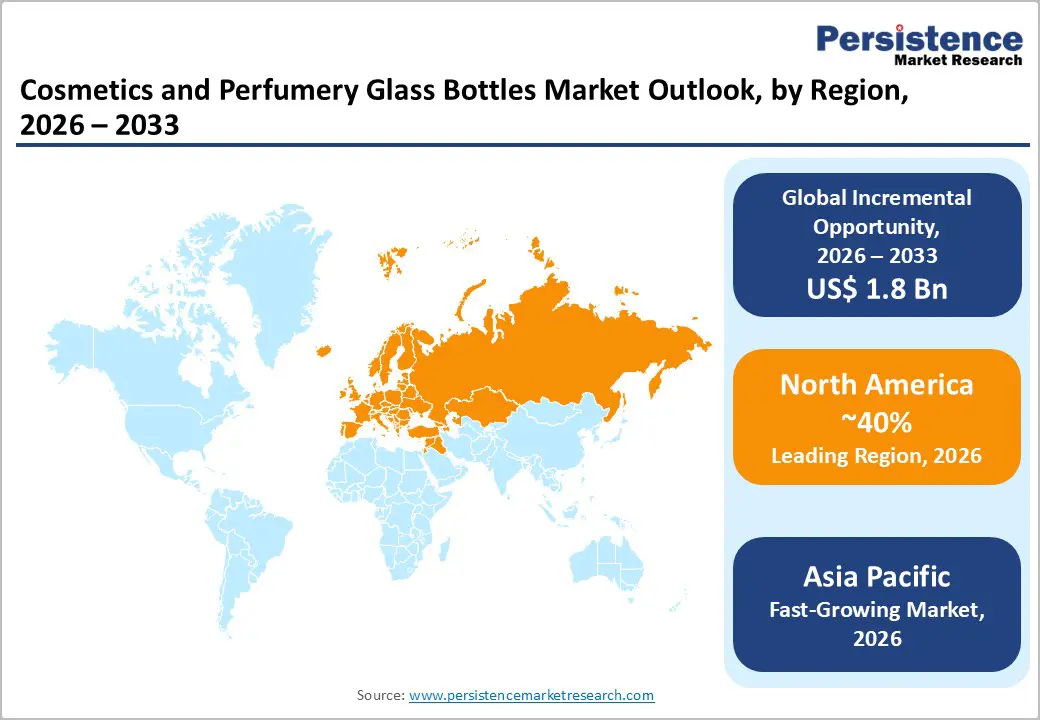
- Dominant Region: Europe is set to hold an estimated 40% revenue share in 2026, driven by the deep presence of luxury fragrance and premium cosmetic brands.
- Fastest-growing Market: Asia Pacific is projected as the fastest-growing market between 2026 and 2033, stimulated by a surging demand for premium, functional, and visually appealing glass packaging.
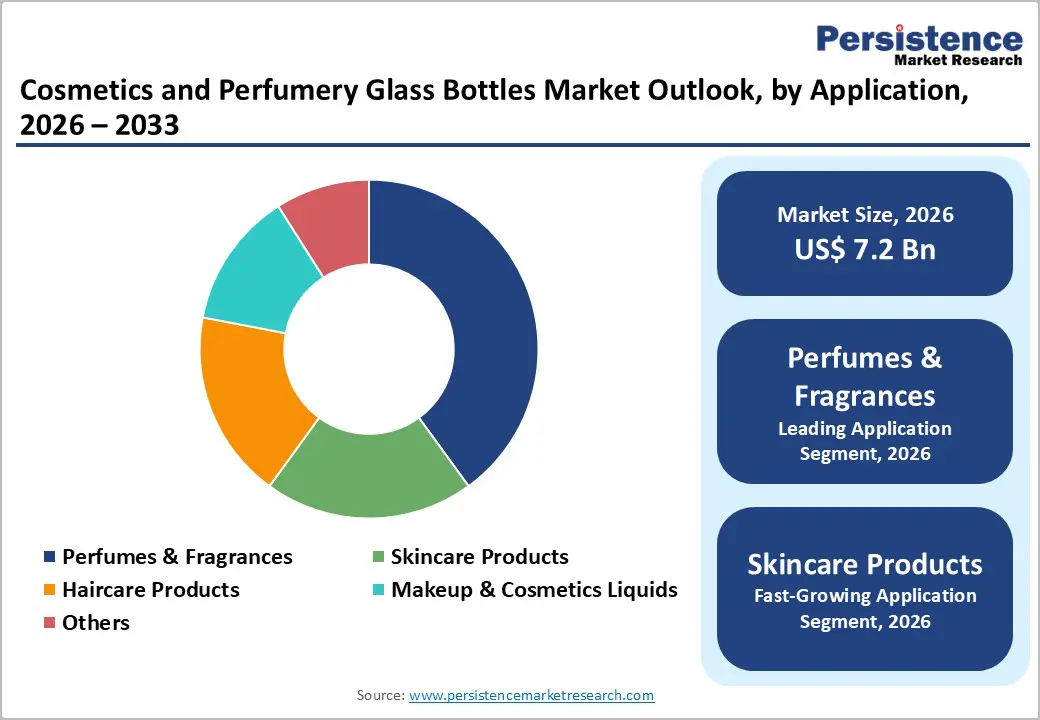
- Leading Application: Perfumes & fragrances are likely to lead with nearly 40% share in 2026, supported by heritage branding, high-margin economics, and sustained consumer loyalty.
- Fastest-growing Application: Skincare products are projected as the fastest-growing through 2033, owing to dermatological awareness, regimen-based consumption, and innovative glass packaging.
| Key Insights | Details |
|---|---|
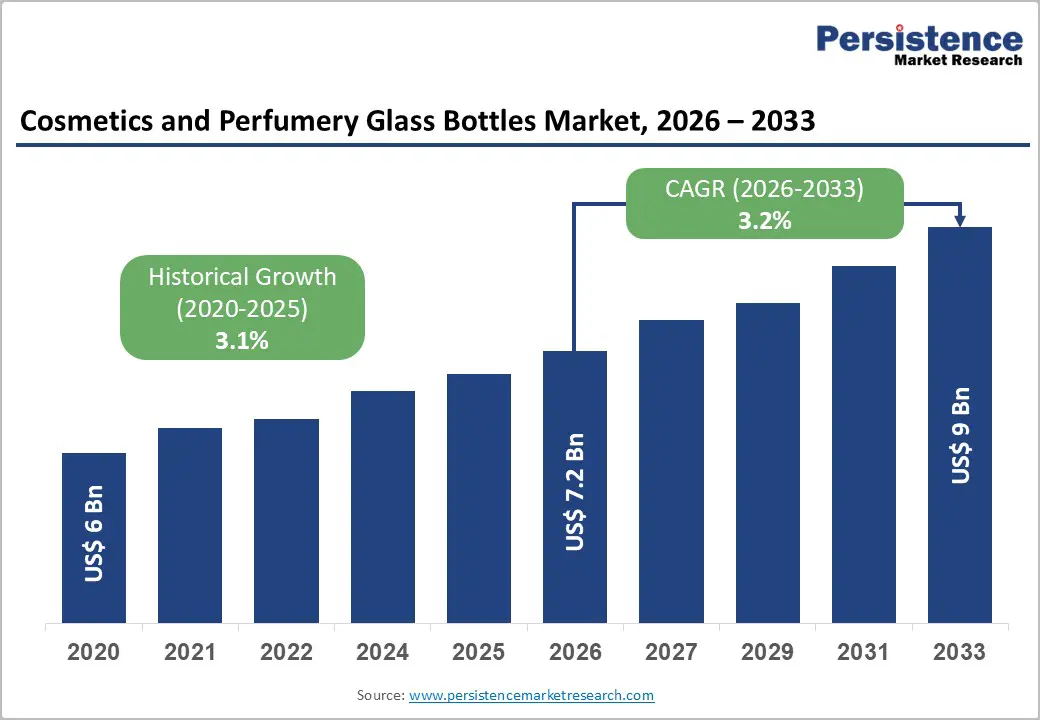
| Cosmetics and Perfumery Glass Bottles Market Size (2026E) | US$ 7.2 Bn |
| Market Value Forecast (2033F) | US$ 9 Bn |
| Projected Growth (CAGR 2026 to 2033) | 3.2% |
| Historical Market Growth (CAGR 2020 to 2025) | 3.1% |
Market Factors – Growth, Barriers, and Opportunity Analysis
Premiumization and Brand Differentiation across Beauty and Fragrance Segments
Elevated positioning across beauty and fragrance categories transforms packaging from a purely functional element into a strategic value asset. Glass containers signal quality, authenticity, and permanence, aligning with premium brand narratives that emphasize craftsmanship, formulation integrity, and sensory appeal. High-end consumers increasingly associate weight, clarity, and tactile refinement of glass with product efficacy and brand credibility. Design-led investment in custom molds, sculpted silhouettes, thick bases, and refined finishes such as frosting, lacquering, and metallization supports visual distinction at point of sale and in digital merchandising.
Competitive intensity within beauty and fragrance portfolios drives differentiation through form, decoration, and sustainability signaling. Glass allows precise execution of bespoke designs that remain difficult to replicate, strengthening protection of brand identity across global launches. Refill-ready formats, recycled glass content, and mono-material structures support premium sustainability narratives without compromising aesthetics. Limited editions, seasonal collections, and personalization strategies leverage glass versatility to deliver exclusivity and scarcity cues. E-commerce expansion amplifies the role of visually distinctive packaging, where first impressions form through imagery rather than physical interaction.
Increasing Consumer Preference for Sustainable Packaging
Rising awareness among consumers regarding environmental impact is reshaping packaging choices in cosmetics and perfumery. Consumers are increasingly favoring products with recyclable and reusable containers, seeking to minimize plastic waste and reduce carbon footprint. Glass bottles offer inherent sustainability through durability, infinite recyclability, and chemical stability, ensuring product integrity without contributing to pollution. This alignment with eco-conscious values strengthens brand perception and enhances consumer loyalty, prompting companies to adopt glass as a preferred packaging solution.
Sustainability-driven demand also intersects with regulatory pressures and corporate responsibility initiatives. Governments and industry bodies are promoting stricter packaging guidelines, encouraging adoption of materials with lower environmental impact. Glass packaging supports compliance with these regulations while serving as a premium, visually appealing option for high-end products. The convergence of consumer expectations, regulatory frameworks, and brand positioning creates a strong impetus for widespread adoption of environmentally responsible packaging solutions in the cosmetics and perfumery industry.
Logistical Complexity and Breakage Risk in Global Supply Chains
Supply networks for delicate items require intricate planning and execution across multiple transport modes, regulatory environments, and handling protocols. Each transfer point, whether a port, warehouse, or last-mile delivery hub, adds procedural steps that must be synchronized to prevent delays and maintain product quality. When documentation rules vary between customs jurisdictions and carriers apply different packaging acceptance criteria, coordination costs rise and visibility into schedules diminishes. The United States Trade Representative’s 2025 Trade Policy Agenda emphasizes enhancing trade facilitation and supply chain resilience to reduce unnecessary obstacles to commerce, highlighting how policy efforts aim to streamline these complex movements. Cumbersome logistics operations also raise insurance costs and working capital requirements, as firms hold buffer stock to hedge against transit uncertainties.
Fragile packaging intensifies the operational burden since glass-contained products demand specialized cushioning, dedicated freight classifications, and careful crate loading to reduce breakage exposure. A single mishandled pallet can disrupt entire delivery schedules, trigger returns, and tarnish service commitments, eroding partner confidence and demanding costly remediation. Breakage events also inflate claims and limit carrier options, as logistics providers bake risk into freight rates for sensitive consignments. These factors stretch planning horizons and reduce flexibility to respond to market shifts, lowering supply performance metrics and financial returns.
Cost Sensitivity and Margin Pressure across Mass-Market Applications
Cost sensitivity and margin pressure in mass-market applications arise from fundamental cost dynamics that directly influence pricing, competitiveness, and profitability. Governments’ price indices show underlying inflation trends that affect all consumer goods costs, including packaging inputs. For example, the U.S. Consumer Price Index (CPI) for personal care rose 2.7%over the 12 months ending December 2025 according to official data, reflecting broader cost inflation pressures on end products. Raw materials such as glass and related packaging components are subject to global commodity fluctuations and energy costs, which are significant in glass production. These input cost changes cannot always be passed through fully to consumers in mass-market segments without eroding demand, so manufacturers face compression of gross margins.
Mass-market products are highly price elastic, meaning consumers are highly responsive to price changes and are inclined toward lower price points. When upstream packaging and production costs increase, firms either raise prices and risk losing volume or retain prices and accept reduced profitability. In many mass-market beauty and personal care categories, packaging accounts for a meaningful portion of total product cost; heavier, premium, or specialized glass formulations often cost significantly more than standard alternatives, contributing to margin pressure. Competitive forces in mass markets also limit pricing freedom, as retailers and distributors negotiate aggressively on price to attract cost-conscious buyers.
Expansion through Antimicrobial and Active Glass Technologies
The underlying rationale for prioritizing antimicrobial and active glass technologies in advanced packaging lies in strong public health and regulatory imperatives that increasingly influence consumer goods sectors. Governments and health authorities globally maintain stringent safety standards for materials that contact products used on or near the human body, mandating rigorous safety assessments for substances intended to prevent microbial contamination. For example, in the United States, the Food and Drug Administration (FDA) requires that any substance used on packaging surfaces intended to interact with products potentially affecting hygiene or safety be authorized and proven safe before commercialization; this includes certain antimicrobial additives on packaging materials.
Consumer demand trends show heightened sensitivity to hygiene performance while maintaining sustainability credentials and premium aesthetics. Active surface functionalities distinguish packaging in crowded categories by offering a tangible hygiene performance benefit without compromising clarity and recyclability that glass inherently delivers. The integration of antimicrobial agents within glass matrices or surface treatments contributes to competitive differentiation and supports premium pricing strategies, particularly in segments where product safety and sensory experience are core purchase drivers.
Growth via Smart and Interactive Packaging Integration
The rising adoption of smart and interactive packaging in the cosmetics and perfumery sector stems from the increasing demand for enhanced consumer engagement and personalized experiences. Embedded technologies such as QR codes, near-field communication (NFC) tags, and augmented reality (AR) elements allow brands to connect directly with consumers, offering product information, usage tutorials, and loyalty programs through digital interfaces. This approach strengthens brand recognition, encourages repeat purchases, and provides data-driven insights into consumer behavior. Integration of smart packaging also supports premiumization strategies, allowing brands to differentiate products in a highly competitive environment while reinforcing perceptions of quality and innovation.
Smart packaging contributes to operational efficiency by enabling real-time tracking, anti-counterfeiting measures, and supply chain transparency. Consumers gain confidence in product authenticity, while manufacturers benefit from reduced losses due to counterfeit goods. Interactive designs enhance product visibility on retail shelves and e-commerce platforms, stimulating consumer curiosity and engagement. The convergence of functionality and aesthetics in packaging aligns with evolving lifestyle preferences, particularly among digitally connected consumers seeking seamless and informative brand experiences.
Category-wise Analysis
Product Type Insights
Perfume bottles is likely to be the leading segment with approximately 45% revenue share in 2026, due to strong alignment with premium branding, formulation protection requirements, and gifting-driven consumption patterns. Fragrance products rely on glass for chemical stability, aroma preservation, and visual differentiation, reinforcing supplier preference for customized glass formats. High-quality glass ensures longevity of fragrance notes while maintaining product integrity during transport and storage. Intricate bottle designs support brand storytelling, enabling luxury and designer houses to create memorable consumer experiences. Provider preference across luxury and designer fragrance houses supports sustained demand through long product life cycles and global distribution networks.
Specialty bottles are expected to witness the fastest growth between 2026 and 2033, as brands adopt unique shapes, artisanal finishes, and limited-edition designs to enhance consumer engagement. Innovation in decoration and mold design supports differentiation across niche cosmetics and prestige skincare, improving accessibility for emerging brands and independent labels. Custom finishes, color gradients, and textural effects appeal to younger, trend-conscious consumers seeking exclusivity. Specialty bottles also facilitate collaborations with artists and influencers, creating collectible products that drive social media visibility.
Application Insights
Perfumes & fragrances are positioned as the top segment with nearly 40% of the cosmetics and perfumery glass bottles market revenue share in 2026, supported by heritage branding, high-margin economics, and sustained consumer loyalty. Glass packaging reinforces clinical credibility related to formulation integrity and aroma preservation. Premium glass bottles protect delicate fragrance compounds from environmental factors such as light, heat, and air exposure, ensuring consistent scent profile over time. Elaborate designs, intricate closures, and embossed branding strengthen brand perception, attracting luxury consumers and gift buyers. Global distribution networks and long product life cycles allow consistent revenue generation, while brand storytelling through bespoke glass formats enhances consumer engagement and reinforces market dominance.
Skincare products are expected to emerge as the fastest-growing segment between 2026 and 2033, driven by dermatological awareness, regimen-based consumption, and material-enabled service delivery through refill and dispensing systems. Innovative packaging solutions, including airless pumps, dropper bottles, and refillable glass containers, enhance product hygiene and dosing accuracy. Consumers increasingly seek sustainable and functional packaging, which supports both environmental objectives and convenience. The integration of smart dispensing systems allows precise delivery of active ingredients, improving efficacy and user satisfaction. Growing interest in daily skincare routines and wellness-focused consumption propels demand, positioning glass-based packaging as a critical enabler of product differentiation and market expansion.
Regional Insights
North America Cosmetics and Perfumery Glass Bottles Market Trends
North America maintains a significant position in the market for cosmetics and perfumery glass bottles, aided by well-established premium and mass-market cosmetic brands and a highly developed retail and e-commerce infrastructure. Strong consumer preference for high-quality packaging that preserves product integrity and enhances brand perception drives consistent demand for glass bottles across fragrances, skincare, and color cosmetics. Manufacturers leverage precision molding, advanced surface finishing, and decorative technologies to create visually distinctive bottles that cater to diverse product portfolios. The presence of multinational players ensures broad distribution, while partnerships with specialized packaging suppliers enable rapid innovation in shape, finish, and functionality, reinforcing adoption across both luxury and mainstream segments.
Growth in this market is further fueled by increasing emphasis on sustainability and regulatory compliance, encouraging the use of recyclable, refillable, and material-efficient glass formats. Rising consumer awareness regarding product authenticity and quality encourages investment in anti-counterfeiting measures, smart packaging integration, and interactive designs that enhance engagement and loyalty. Expansion of premium and niche cosmetic lines, combined with seasonal limited-edition launches, stimulates demand for collectible and aesthetically unique bottles. The convergence of technological innovation, consumer sophistication, and structured distribution networks positions the market for steady growth.
Europe Cosmetics and Perfumery Glass Bottles Market Trends
Europe is expected to account for an estimated 40% of the cosmetics and perfumery glass bottles market share in 2026, reflecting a concentration of luxury and heritage fragrance manufacturers and premium cosmetic producers. The dominance is supported by established industrial infrastructure specializing in precision glass manufacturing, which enables high-quality, intricate bottle designs that align with brand storytelling and premium positioning. Advanced production technologies, such as automated molding, precision decoration, and surface treatment techniques, allow creation of bespoke and collectible packaging formats. High consumer expectations for product authenticity, aroma preservation, and aesthetic appeal reinforce supplier preference for glass over alternative materials. Integrated supply chains linking manufacturers, designers, and distributors facilitate consistent delivery of innovative formats, ensuring brand differentiation across competitive segments.
Key factors driving leadership include alignment with high-margin product strategies and sustained brand loyalty in premium fragrances and cosmetics. Emphasis on formulation integrity, particularly for aromatic and sensitive compounds, makes glass the preferred material for long-term storage and retail display. Strong adoption of sustainability initiatives, such as recyclable and refillable bottles, enhances consumer perception and regulatory compliance, supporting continued investment in high-quality packaging solutions. Concentration of luxury retailers, flagship stores, and global distribution networks ensures broad market access and visibility. In parallel, continuous innovation in decorative finishes, multi-component closures, and interactive packaging features allows differentiation in saturated product categories.
Asia Pacific Cosmetics and Perfumery Glass Bottles Market Trends
Asia Pacific is forecasted to be the fastest-growing market for cosmetics and perfumery glass bottles between 2026 and 2033, stimulated by rising disposable income, expanding urban populations, and increasing adoption of premium and niche beauty products. Rapid growth of digital commerce platforms and omnichannel retail networks provides broader access to international and domestic brands, accelerating demand for visually appealing and durable glass packaging. Consumers increasingly seek products that combine aesthetic appeal with functional benefits such as aroma preservation, refillability, and hygiene, prompting manufacturers to innovate in bottle design, finishes, and smart packaging solutions to capture attention in competitive segments.
Market expansion is further reinforced by heightened interest in skincare routines, wellness-oriented cosmetics, and gifting culture, driving preference for distinctive, collectible, and limited-edition bottles. Localized design adaptations, including cultural motifs, artisanal textures, and vibrant color palettes, enhance brand resonance while catering to diverse consumer tastes. Integration of interactive elements, such as QR codes and augmented reality features, strengthens engagement and loyalty among digitally connected consumers. Investment in advanced molding, surface treatment, and decoration technologies allows smaller and emerging brands to compete alongside established players, stimulating overall sector growth.
Competitive Landscape
The global cosmetics and perfumery glass bottles market landscape is strongly influenced by a few key players, including Apackaging Group, Berlin Packaging, Bormioli Luigi, CAG-Holding, Vidraria Anchieta, and Nekem Packaging. Market dynamics are being shaped by the ability to deliver customized glass bottles tailored to brand identity, product formulation, and consumer experience. Companies invest in advanced molding, surface finishing, and decorative technologies to create distinctive, premium packaging that supports differentiation in competitive segments such as fragrances, skincare, and color cosmetics. Emphasis on high-quality glass and precision manufacturing ensures formulation integrity, product longevity, and visual appeal, reinforcing supplier relevance across multiple distribution channels.
Competitive positioning in the sector centers on sustainability compliance, geographic reach, and responsiveness to evolving consumer trends. Glass manufacturers adopt eco-friendly processes, recyclable materials, and refillable designs to meet regulatory requirements and sustainability expectations. Geographic reach allows firms to supply regional and global markets efficiently, catering to both established luxury brands and emerging niche labels. Integration of interactive and smart packaging solutions enhances engagement, drives brand loyalty, and creates additional value for clients. Companies that combine customization expertise, operational efficiency, and sustainability adherence strengthen market share while maintaining adaptability to emerging trends.
Key Industry Developments
- In November 2025, Bormioli Luigi introduced Edge, a new standard 100ml glass bottle offering a sharp-edged design with recyclable and refillable features for both feminine and masculine fragrances to support rapid production and brand customization.
- In May 2025, Stirling Square completed the sale of glass bottle maker Verescence to Movendo Capital and Draycott, marking a major ownership transition for the luxury perfumery and cosmetics packaging specialist.
- In January 2025, PGP Glass expanded its Kosamba facility with a new high-capacity furnace to strengthen its position as a leading supplier of premium cosmetics and perfumery glass packaging while advancing sustainability efforts.
Companies Covered in Cosmetics and Perfumery Glass Bottles Market
- Apackaging Group LLC
- Berlin Packaging LLC
- Bormioli Luigi SpA
- CAG-Holding GmbH
- Vidraria Anchieta
- Nekem Packaging
- Piramal Glass Private Limited
- Pragati Glass Pvt Ltd
- Roetell Group
- SKS Bottle & Packaging Inc
- SGB Packaging Group Inc
- Verescence France
- Zignago Vetro SpA
- Baralan International SpA
Frequently Asked Questions
The global cosmetics and perfumery glass bottles market is projected to reach US$ 7.2 billion in 2026.
Rising demand for premium and sustainable packaging, product differentiation, and consumer engagement are driving the market.
The market is poised to witness a CAGR of 3.2% from 2026 to 2033.
Growing adoption of smart packaging, customized designs, and refillable or eco-friendly glass formats presents key market opportunities.
Some of the key market players include Apackaging Group LLC, Berlin Packaging LLC, Bormioli Luigi SpA, CAG-Holding GmbH, Vidraria Anchieta, Nekem Packaging, and Piramal Glass Private Limited.


