


- Executive Summary
- Global Face Color Cosmetics Market Snapshot, 2025 and 2032
- Market Opportunity Assessment, 2025 - 2032, US$ Bn
- Key Market Trends
- Future Market Projections
- Premium Market Insights
- Industry Developments and Key Market Events
- PMR Analysis and Recommendations
- Market Overview
- Market Scope and Definition
- Market Dynamics
- Drivers
- Restraints
- Opportunity
- Challenges
- Key Trends
- COVID-19 Impact Analysis
- Forecast Factors - Relevance and Impact
- Value Added Insights
- Value Chain Analysis
- Key Market Players
- Regulatory Landscape
- PESTLE Analysis
- Porter’s Five Force Analysis
- Consumer Behavior Analysis
- Price Trend Analysis, 2019 - 2032
- Key Factors Impacting Product Prices
- Pricing Analysis, By Product Type
- Regional Prices and Product Preferences
- Global Face Color Cosmetics Market Outlook
- Market Size (US$ Bn) Analysis and Forecast
- Historical Market Size (US$ Bn) Analysis, 2019-2024
- Market Size (US$ Bn) Analysis and Forecast, 2025-2032
- Global Face Color Cosmetics Market Outlook: Product Type
- Historical Market Size (US$ Bn) Analysis, By Product Type, 2019-2024
- Market Size (US$ Bn) Analysis and Forecast, By Product Type, 2025-2032
- Foundation
- Blush
- Bronzer
- Highlighter
- Concealer
- Others
- Market Attractiveness Analysis: Product Type
- Global Face Color Cosmetics Market Outlook: Distribution Channel
- Historical Market Size (US$ Bn) Analysis, By Distribution Channel, 2019-2024
- Market Size (US$ Bn) Analysis and Forecast, By Distribution Channel, 2025-2032
- Online Stores
- Supermarkets/Hypermarkets
- Specialty Stores
- Others
- Market Attractiveness Analysis: Distribution Channel
- Global Face Color Cosmetics Market Outlook: End-Use
- Historical Market Size (US$ Bn) Analysis, By End-Use, 2019-2024
- Market Size (US$ Bn) Analysis and Forecast, By End-Use, 2025-2032
- Individual
- Professionall
- Market Attractiveness Analysis: End-Use
- Market Size (US$ Bn) Analysis and Forecast
- Global Face Color Cosmetics Market Outlook: Region
- Historical Market Size (US$ Bn) Analysis, By Region, 2019-2024
- Market Size (US$ Bn) Analysis and Forecast, By Region, 2025-2032
- North America
- Latin America
- Europe
- East Asia
- South Asia and Oceania
- Middle East & Africa
- Market Attractiveness Analysis: Region
- North America Face Color Cosmetics Market Outlook
- Historical Market Size (US$ Bn) Analysis, By Market, 2019-2024
- By Country
- By Product Type
- By Distribution Channel
- By End-Use
- Market Size (US$ Bn) Analysis and Forecast, By Country, 2025-2032
- U.S.
- Canada
- Market Size (US$ Bn) Analysis and Forecast, By Product Type, 2025-2032
- Foundation
- Blush
- Bronzer
- Highlighter
- Concealer
- Others
- Market Size (US$ Bn) Analysis and Forecast, By Distribution Channel, 2025-2032
- Online Stores
- Supermarkets/Hypermarkets
- Specialty Stores
- Others
- Market Size (US$ Bn) Analysis and Forecast, By End-Use, 2025-2032
- Individual
- Professional
- Market Attractiveness Analysis
- Historical Market Size (US$ Bn) Analysis, By Market, 2019-2024
- Europe Face Color Cosmetics Market Outlook
- Historical Market Size (US$ Bn) Analysis, By Market, 2019-2024
- By Country
- By Product Type
- By Distribution Channel
- By End-Use
- Market Size (US$ Bn) Analysis and Forecast, By Country, 2025-2032
- Germany
- France
- U.K.
- Italy
- Spain
- Russia
- Rest of Europe
- Market Size (US$ Bn) Analysis and Forecast, By Product Type, 2025-2032
- Foundation
- Blush
- Bronzer
- Highlighter
- Concealer
- Others
- Market Size (US$ Bn) Analysis and Forecast, By Distribution Channel, 2025-2032
- Online Stores
- Supermarkets/Hypermarkets
- Specialty Stores
- Others
- Market Size (US$ Bn) Analysis and Forecast, By End-Use, 2025-2032
- Individual
- Professional
- Market Attractiveness Analysis
- Historical Market Size (US$ Bn) Analysis, By Market, 2019-2024
- East Asia Face Color Cosmetics Market Outlook
- Historical Market Size (US$ Bn) Analysis, By Market, 2019-2024
- By Country
- By Product Type
- By Distribution Channel
- By End-Use
- Market Size (US$ Bn) Analysis and Forecast, By Country, 2025-2032
- China
- Japan
- South Korea
- Market Size (US$ Bn) Analysis and Forecast, By Product Type, 2025-2032
- Foundation
- Blush
- Bronzer
- Highlighter
- Concealer
- Others
- Market Size (US$ Bn) Analysis and Forecast, By Distribution Channel, 2025-2032
- Online Stores
- Supermarkets/Hypermarkets
- Specialty Stores
- Others
- Market Size (US$ Bn) Analysis and Forecast, By End-Use, 2025-2032
- Individual
- Professional
- Market Attractiveness Analysis
- Historical Market Size (US$ Bn) Analysis, By Market, 2019-2024
- South Asia & Oceania Face Color Cosmetics Market Outlook
- Historical Market Size (US$ Bn) Analysis, By Market, 2019-2024
- By Country
- By Product Type
- By Distribution Channel
- By End-Use
- Market Size (US$ Bn) Analysis and Forecast, By Country, 2025-2032
- India
- Indonesia
- Thailand
- Singapore
- ANZ
- Rest of South Asia & Oceania
- Market Size (US$ Bn) Analysis and Forecast, By Product Type, 2025-2032
- Foundation
- Blush
- Bronzer
- Highlighter
- Concealer
- Others
- Market Size (US$ Bn) Analysis and Forecast, By Distribution Channel, 2025-2032
- Online Stores
- Supermarkets/Hypermarkets
- Specialty Stores
- Others
- Market Size (US$ Bn) Analysis and Forecast, By End-Use, 2025-2032
- Individual
- Professional
- Market Attractiveness Analysis
- Historical Market Size (US$ Bn) Analysis, By Market, 2019-2024
- Latin America Face Color Cosmetics Market Outlook
- Historical Market Size (US$ Bn) Analysis, By Market, 2019-2024
- By Country
- By Product Type
- By Distribution Channel
- By End-Use
- Market Size (US$ Bn) Analysis and Forecast, By Country, 2025-2032
- Brazil
- Mexico
- Rest of Latin America
- Market Size (US$ Bn) Analysis and Forecast, By Product Type, 2025-2032
- Foundation
- Blush
- Bronzer
- Highlighter
- Concealer
- Others
- Market Size (US$ Bn) Analysis and Forecast, By Distribution Channel, 2025-2032
- Online Stores
- Supermarkets/Hypermarkets
- Specialty Stores
- Others
- Market Size (US$ Bn) Analysis and Forecast, By End-Use, 2025-2032
- Individual
- Professional
- Market Attractiveness Analysis
- Historical Market Size (US$ Bn) Analysis, By Market, 2019-2024
- Middle East & Africa Face Color Cosmetics Market Outlook
- Historical Market Size (US$ Bn) Analysis, By Market, 2019-2024
- By Country
- By Product Type
- By Distribution Channel
- By End-Use
- Market Size (US$ Bn) Analysis and Forecast, By Country, 2025-2032
- GCC Countries
- Egypt
- South Africa
- Northern Africa
- Rest of Middle East & Africa
- Market Size (US$ Bn) Analysis and Forecast, By Product Type, 2025-2032
- Foundation
- Blush
- Bronzer
- Highlighter
- Concealer
- Others
- Market Size (US$ Bn) Analysis and Forecast, By Distribution Channel, 2025-2032
- Online Stores
- Supermarkets/Hypermarkets
- Specialty Stores
- Others
- Market Size (US$ Bn) Analysis and Forecast, By End-Use, 2025-2032
- Individual
- Professional
- Market Attractiveness Analysis
- Historical Market Size (US$ Bn) Analysis, By Market, 2019-2024
- Competition Landscape
- Market Share Analysis, 2024
- Market Structure
- Competition Intensity Mapping By Market
- Competition Dashboard
- Company Profiles (Details - Overview, Financials, Strategy, Recent Developments)
- L’Oréal Group
- Overview
- Segments and Product Type
- Key Financials
- Market Developments
- Market Strategy
- Estée Lauder Companies
- Unilever
- Coty Inc.
- Shiseido
- Avon Products
- Colorbar Cosmetics
- MAC Cosmetics
- Fenty Beauty
- Maybelline
- Urban Decay
- Charlotte Tilbury
- Others
- L’Oréal Group
- Appendix
- Research Methodology
- Research Assumptions
- Acronyms and Abbreviations


- Beauty & Personal Care
- Face Color Cosmetics Market
Face Color Cosmetics Market Size, Share, and Growth Forecast, 2025 - 2032
Face Color Cosmetics Market by Product Type (Foundation, Blush, Bronzer, Highlighter, Concealer, Others), End-Use (Individual, Professional), Distribution Channel (Online Stores, Supermarkets/Hypermarkets, Specialty Stores, Others), and Regional Analysis for 2025 - 2032
Face Color Cosmetics Market Size and Trends Analysis
The global face color cosmetics market size is likely to be valued at US$ 31.0 Bn in 2025 and is expected to reach US$ 43.3 Bn by 2032, growing at a CAGR of 4.9% during the forecast period from 2025 to 2032.
Key Industry Highlights:
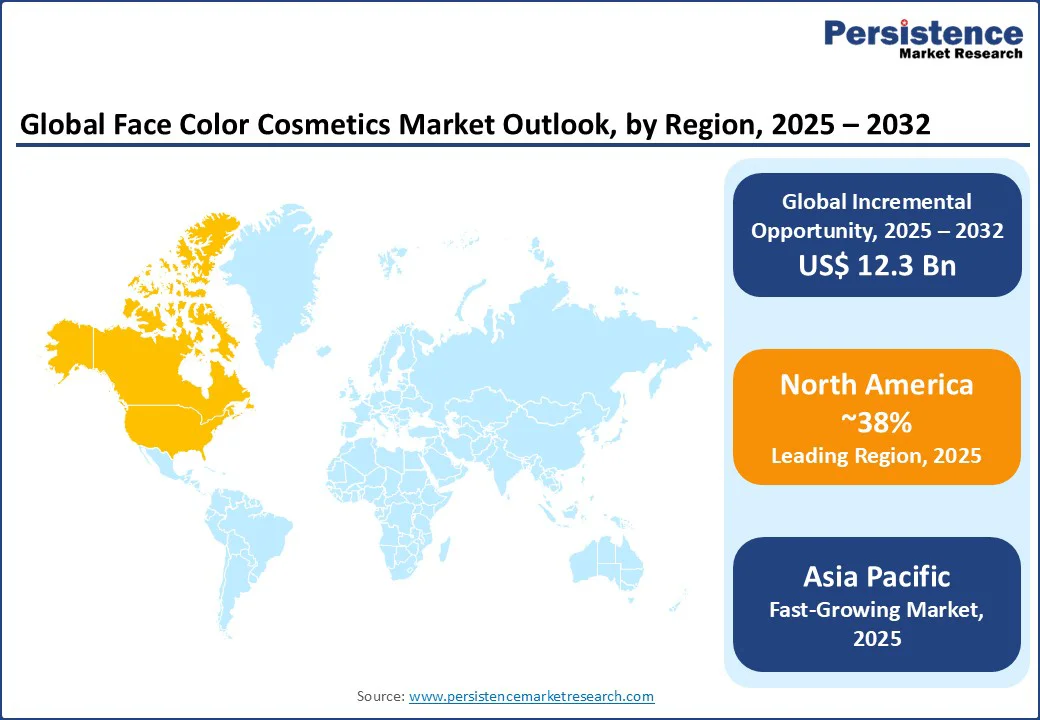
- Leading Region: North America, holding a 38% market share in 2025, driven by high consumer spending on premium cosmetics, strong brand presence, and advanced retail infrastructure in the U.S.
- Fastest-growing Region: Asia Pacific, fueled by rapid urbanization, rising disposable incomes, and growing demand for beauty products in countries such as China, India, and South Korea.
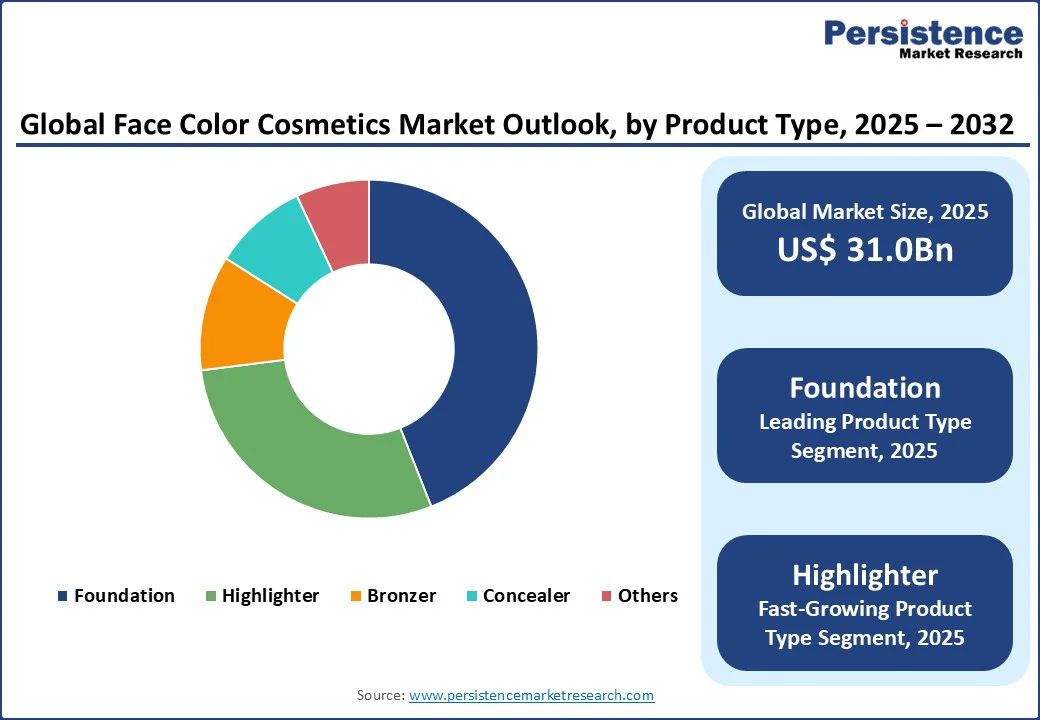
- Dominant Product Type: Foundation, commanding nearly 44% market share, due to its widespread use as a base for makeup routines across diverse consumer segments.
- Leading Distribution Channel: Online Stores, accounting for over 36% of market revenue, driven by the convenience of e-commerce platforms and increasing digital penetration in cosmetics retail.
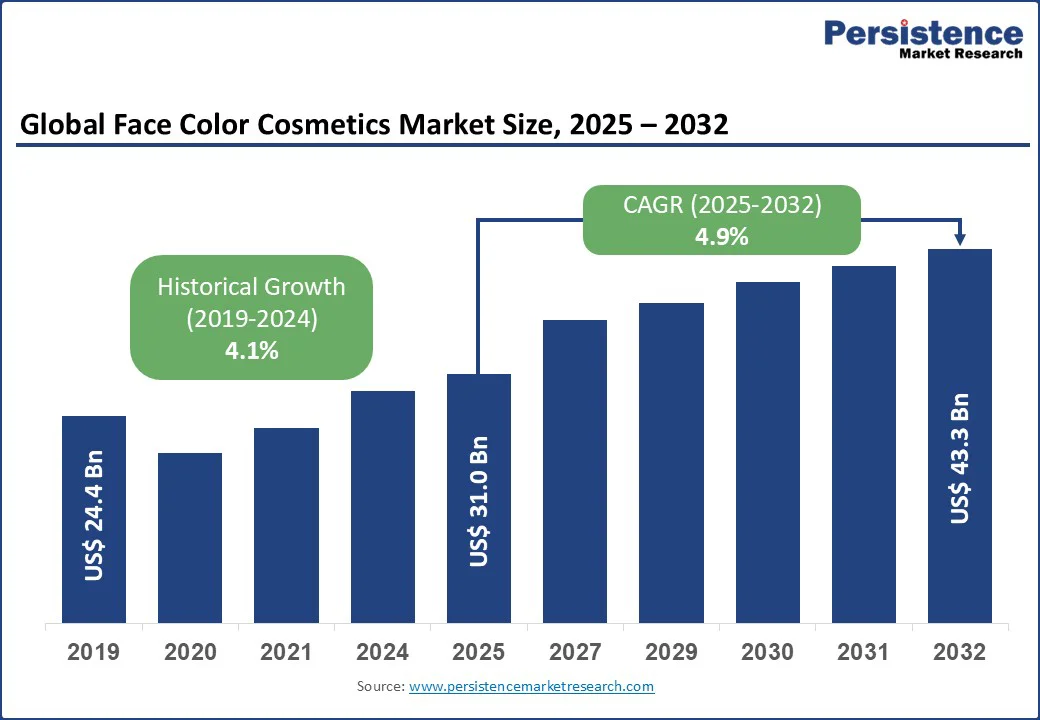
|
Global Market Attribute |
Key Insights |
|
Face Color Cosmetics Market Size (2025E) |
US$ 31.0 Bn |
|
Market Value Forecast (2032F) |
US$ 43.3 Bn |
|
Projected Growth (CAGR 2025 to 2032) |
4.9% |
|
Historical Market Growth (CAGR 2019 to 2024) |
4.1% |
The face color cosmetics market has witnessed steady growth, driven by increasing consumer demand for personalized beauty products, advancements in cosmetic formulations, and the rising influence of social media and beauty influencers. The growing popularity of inclusive and sustainable beauty products, coupled with the expansion of e-commerce platforms, has further propelled market growth.
Market Dynamics
Driver - Rising influence of social media and beauty influencers
The rising influence of social media and beauty influencers has become a significant driver in the growth of the face color cosmetics market. Platforms such as Instagram, TikTok, YouTube, and Pinterest have transformed the way consumers discover, evaluate, and purchase cosmetic products. Beauty influencers, ranging from macro-influencers with millions of followers to niche micro-influencers, create tutorials, product reviews, and live demonstrations that showcase the effectiveness, shade range, and application techniques of various makeup products. This direct engagement builds trust and credibility, often influencing purchasing decisions more effectively than traditional advertising.
The interactive nature of social media allows consumers to engage with brands through comments, polls, and virtual try-on tools, enhancing the online shopping experience. Influencer-driven campaigns also promote inclusivity and diversity by highlighting products suitable for various skin tones, ethnicities, and personal styles. For instance, MAC Cosmetics' collaboration with Johnny Ross, a makeup artist who champions gender inclusivity, reinforced its brand values and connected with a broader, more diverse audience, resulting in increased brand loyalty and visibility. As a result, brands are increasingly collaborating with influencers to launch new collections, create buzz around product releases, and drive e-commerce sales. This trend not only boosts brand visibility but also accelerates market penetration, particularly among younger, digitally active demographics, making social media influence a critical growth catalyst.
Restraint - High costs of sustainable and premium formulations
The high costs associated with developing sustainable and premium cosmetic formulations pose a significant restraint on market growth. Consumers are increasingly demanding eco-friendly, cruelty-free, and high-performance products that use natural, organic, or ethically sourced ingredients. While this trend supports brand reputation and aligns with environmental and social responsibility, it significantly increases production costs. Premium ingredients, advanced formulations, and clean-label certifications require substantial investment in research and development, sourcing, and quality control. For instance, sustainable products can be 75–85% more expensive than their conventional counterparts, primarily due to higher raw material costs and limited economies of scale.
Sustainable packaging, such as biodegradable containers or refillable systems, adds to the overall expense. These higher costs are often passed on to consumers, making products less accessible to price-sensitive segments, particularly in emerging markets. Consequently, some brands face challenges in balancing sustainability commitments with market competitiveness. Smaller and niche players may struggle to scale such offerings, limiting their reach and market penetration. Furthermore, the premium pricing of sustainable cosmetics can slow adoption rates, as mass-market consumers may prioritize affordability over ethical considerations. Overall, while sustainability is a growth opportunity, the associated high costs act as a significant restraint on widespread market expansion.
Opportunity - Advancements in inclusive and technology-driven cosmetic solutions
Advancements in inclusive and technology-driven cosmetic solutions present a significant growth opportunity for the face color cosmetics market. Consumers today demand products that cater to a wide spectrum of skin tones, types, and preferences, pushing brands to develop inclusive shade ranges, adaptable formulations, and personalized solutions.
Technological innovations such as augmented reality (AR) virtual try-on tools, artificial intelligence (AI)-powered skin analysis, and smart color-matching apps enable consumers to accurately select foundations, concealers, and other face color products tailored to their unique skin characteristics. For instance, L’Oréal’s ModiFace AR technology allows users to try on multiple shades virtually, increasing confidence in purchase decisions and enhancing customer engagement. Similarly, Fenty Beauty has set industry benchmarks with its 50-shade foundation range, demonstrating the sector's potential for inclusivity-driven products. Additionally, technology enables brands to gather data on consumer preferences, guiding product development and personalized marketing campaigns. The integration of inclusivity with digital tools not only enhances user experience but also drives brand loyalty, online sales, and market penetration. Overall, leveraging technology to create inclusive cosmetic solutions allows companies to address diverse consumer needs while capturing emerging opportunities in both mature and emerging markets.
Category-wise Analysis
Product Type Insights
Foundation dominates the face color cosmetics market, expected to account for approximately 44% share in 2025. Its dominance is driven by its essential role in makeup routines, offering coverage, skin tone correction, and a base for other products. Brands such as L’Oréal and MAC Cosmetics offer a wide range of foundation formulas, including long-wear, matte, and hydrating options, catering to diverse consumer preferences. The segment’s popularity is further boosted by the demand for inclusive shade ranges and clean beauty formulations, appealing to both individual and professional users.
The highlighter segment is the fastest-growing, driven by the rising popularity of glow-enhancing makeup trends, such as “dewy” and “glass skin” looks. Highlighters are increasingly favored by younger consumers influenced by social media trends. Brands such as Fenty Beauty and Charlotte Tilbury have introduced innovative highlighter formulations, such as cream and liquid options, which appeal to consumers seeking versatile, radiant products. The segment’s growth is also supported by its use in professional settings, such as fashion and entertainment, where highlighters enhance on-camera appearances.
End-Use Insights
The individual end-use segment is expected to approximately account for 52% of revenue in 2025. Individual consumers drive demand through daily makeup use, fueled by trends in self-expression and personalization. Brands such as Maybelline and Urban Decay cater to this segment by offering affordable, high-quality products suitable for everyday application. The rise of e-commerce and influencer-driven marketing has made it easier for individuals to access a wide range of products, further boosting this segment’s dominance.
The professional end-use segment is the fastest-growing, driven by increasing demand from makeup artists, salons, and the entertainment industry. Professionals require high-performance products, such as long-wear foundations and concealers, to meet the demands of photoshoots, film production, and events. Brands such as MAC Cosmetics and Charlotte Tilbury are preferred in this segment due to their durable, versatile formulations. The growth of beauty training academies and freelance makeup artistry further accelerates adoption in this segment.
Distribution Channel Insights
Online stores dominate the distribution channel segment, is likely to hold a 36% share in 2025. The convenience of e-commerce platforms, coupled with features such as virtual try-ons and customer reviews, has made online shopping the preferred choice for cosmetics consumers. Major brands such as L’Oréal and Sephora have invested heavily in their online platforms, offering personalized recommendations and subscription models. The integration of social media marketplaces, such as Instagram and TikTok Shops, further drives online sales.
Specialty stores are the fastest-growing distribution channel, fueled by the demand for curated, in-store experiences. Retailers such as Sephora and Ulta Beauty offer hands-on product testing, expert consultations, and exclusive brand partnerships, appealing to consumers seeking premium and niche products. The growth of beauty-focused pop-up stores and experiential retail concepts in urban areas further supports this segment’s rapid expansion.
Regional Insights
North America Face Color Cosmetics Market Trends
North America is expected to hold a dominant position in the global face color cosmetics market, accounting for approximately 38% of market share in 2025. The region’s leadership is largely driven by high consumer spending on premium and luxury cosmetic products, particularly in the United States, where consumers are increasingly willing to invest in high-quality makeup solutions that offer advanced formulations, long-lasting performance, and brand prestige.
Strong brand presence further reinforces North America’s dominance, as leading global companies such as L’Oréal, Estée Lauder, MAC Cosmetics, and Fenty Beauty have established extensive retail and online networks, ensuring widespread availability and accessibility of their product portfolios. Advanced retail infrastructure, including flagship stores, department store counters, specialty beauty retailers, and integrated e-commerce platforms, facilitates seamless consumer experiences, offering personalized services, virtual try-on tools, and loyalty programs that enhance customer engagement.
Additionally, North American consumers are highly receptive to new trends, inclusive shade ranges, and sustainable formulations, which encourages innovation and frequent product launches. The combination of robust purchasing power, brand loyalty, and sophisticated retail channels positions North America as a key growth engine, making it a critical market for both global and regional cosmetic companies aiming to expand their presence.
Europe Face Color Cosmetics Market Trends
Europe is a significant player in the face color cosmetics market, driven by strong consumer demand in countries such as France, the UK, and Germany. France, home to L’Oréal and other luxury beauty brands, leads the region due to its heritage in high-end cosmetics and a strong export market.
The UK’s vibrant beauty influencer scene and Germany’s focus on clean and organic beauty products further drive growth. The European Union’s stringent regulations on cosmetic safety and sustainability, such as the EU Cosmetics Regulation, encourage innovation in eco-friendly formulations. Companies such as Shiseido and Coty are investing in sustainable packaging and inclusive shade ranges to meet consumer preferences. The rise of e-commerce and beauty subscription services, such as LookFantastic and Glossybox, also supports market expansion. Europe’s emphasis on premium beauty and sustainability ensures steady growth in the face color cosmetics market.
Asia Pacific Face Color Cosmetics Market Trends
Asia Pacific is the fastest-growing market for face color cosmetics, driven by rapid urbanization, rising disposable incomes, and cultural emphasis on beauty in countries such as China, India, and South Korea. China leads the region, with a booming beauty market fueled by e-commerce platforms such as Tmall and JD.com. South Korea’s K-beauty trends, emphasizing innovative formulations such as cushion foundations and highlighters, have gained global popularity, driving exports. India’s growing middle class and increasing adoption of Western beauty trends are boosting demand for affordable cosmetics from brands such as Maybelline and Colorbar. Government initiatives supporting local manufacturing, campaigns, and encouraging domestic production of cosmetics. The region’s youthful population and social media penetration further accelerate market growth, positioning Asia Pacific as a key hub for future expansion.
Competitive Landscape
The global face color cosmetics market is highly competitive, characterized by a blend of established multinational leaders and fast-growing regional players. In North America and Europe, companies such as L’Oréal Group, Estée Lauder Companies, Coty Inc., Unilever, MAC Cosmetics, and Fenty Beauty hold strong positions through extensive R&D, large-scale production capabilities, and strategic collaborations with influencers, retailers, and e-commerce platforms. In the Asia Pacific, regional players such as Shiseido and Colorbar Cosmetics are gaining prominence by offering culturally relevant products and tapping into rapidly growing urban and digital markets.
Competition is driven by product innovation, development of inclusive shade ranges, sustainable formulations, and digital-first marketing strategies, including AR-powered virtual try-on solutions. Companies are also pursuing strategic acquisitions, influencer partnerships, and investments in omnichannel retail to strengthen market presence. While global leaders consolidate their dominance, regional and niche brands focus on specialized consumer segments, ensuring a dynamic, fragmented, and innovation-driven market landscape.
Key Developments
- In January 2024, L’Oréal acquired the Swiss startup Gjosa, specializing in water-saving technologies for professional hair salons. This acquisition aimed to scale the deployment of Gjosa's eco-friendly showerhead, which had already saved over 182 million liters of water across more than 10,000 salons in Europe and the Middle East.
- In May 2024, Fenty Beauty launched its "Bronze All Ova" collection, featuring a range of products designed for diverse skin tones. The collection includes highlighters, bronzers, and blushes, with prices ranging from $1.50 to $26.
Companies Covered in Face Color Cosmetics Market
- L’Oréal Group
- Estée Lauder Companies
- Unilever
- Coty Inc.
- Shiseido
- Avon Products
- Colorbar Cosmetics
- MAC Cosmetics
- Fenty Beauty
- Maybelline
- Urban Decay
- Charlotte Tilbury
- Others
Frequently Asked Questions
The global face color cosmetics market is projected to reach US$ 31.0 Bn in 2025.
The rising influence of social media and beauty influencers is a key driver.
The face color cosmetics market is poised to witness a CAGR of 4.9% from 2025 to 2032.
Advancements in inclusive and technology-driven cosmetic solutions are a key opportunity.
L’Oréal Group, Estée Lauder Companies, Unilever, Coty Inc., and Shiseido are key players.


