




- Medical Devices
- Breast Biopsy Market
Breast Biopsy Market Size, Share and Growth Forecast, 2026 - 2033
Breast Biopsy Market by Procedure Type (Core Needle Biopsy, Vacuum-Assisted Biopsy, Others), Guidance Technology (Ultrasound-guided biopsy, Others), Product Type (Biopsy needles, Others), and Regional Analysis for 2026 - 2033

Breast Biopsy Market Share and Trends Analysis
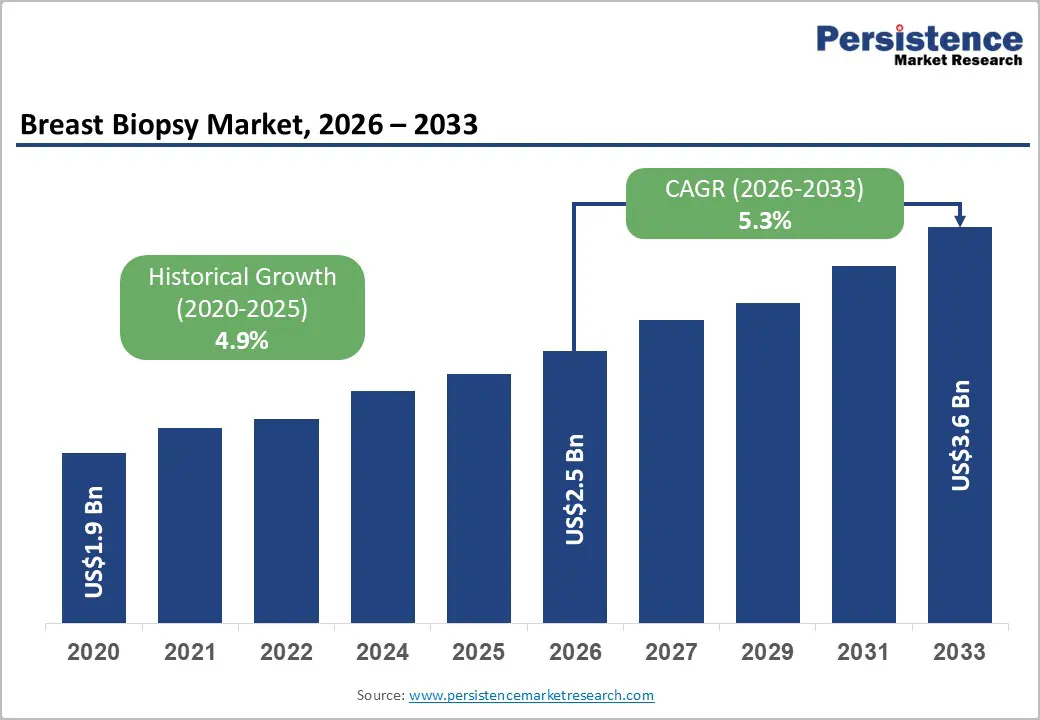
The global breast biopsy market size is likely to be valued at US$2.5 billion in 2026 and is projected to reach US$3.6 billion by 2033, growing at a CAGR of 5.3% during the forecast period from 2026 to 2033, driven by rising breast cancer screening rates, wider use of image-guided biopsy systems, and advances in minimally invasive diagnostics.
The WHO identifies breast cancer as the most common cancer in women, supporting strong demand for early detection. The growth is also driven by better healthcare access in emerging economies and a shift from surgical to precision-guided procedures. Adoption of AI-enabled imaging and robotic systems is improving accuracy and reducing complications, while FDA approvals for minimally invasive devices are further accelerating market expansion.
Key Industry Highlights:
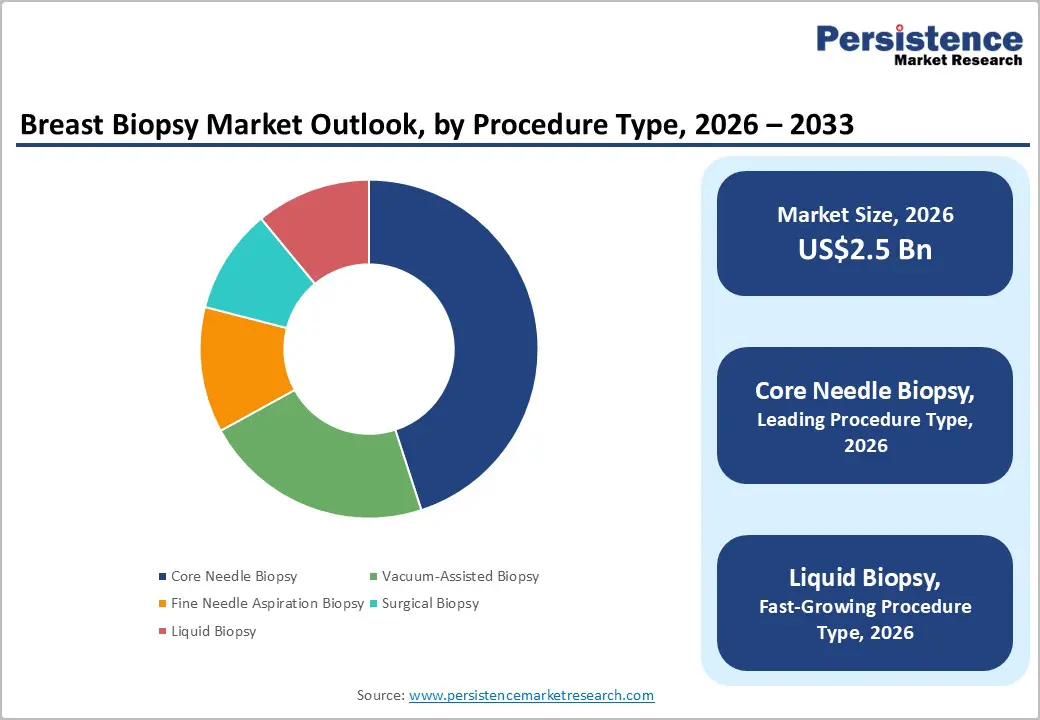
- Procedure Type Leadership: Core needle biopsy is expected to lead the breast biopsy market with around 45% share in 2026, driven by high clinical reliability and minimally invasive nature, while AI and robotic-assisted biopsy systems are projected to grow the fastest through 2033 due to precision oncology and workflow automation.
- Guidance Technology Trend: Image-guided biopsy systems dominate with an estimated 55% share in 2026, supported by higher diagnostic accuracy and efficiency, with ultrasound, stereotactic, and MRI-guided methods widely used across clinical settings.
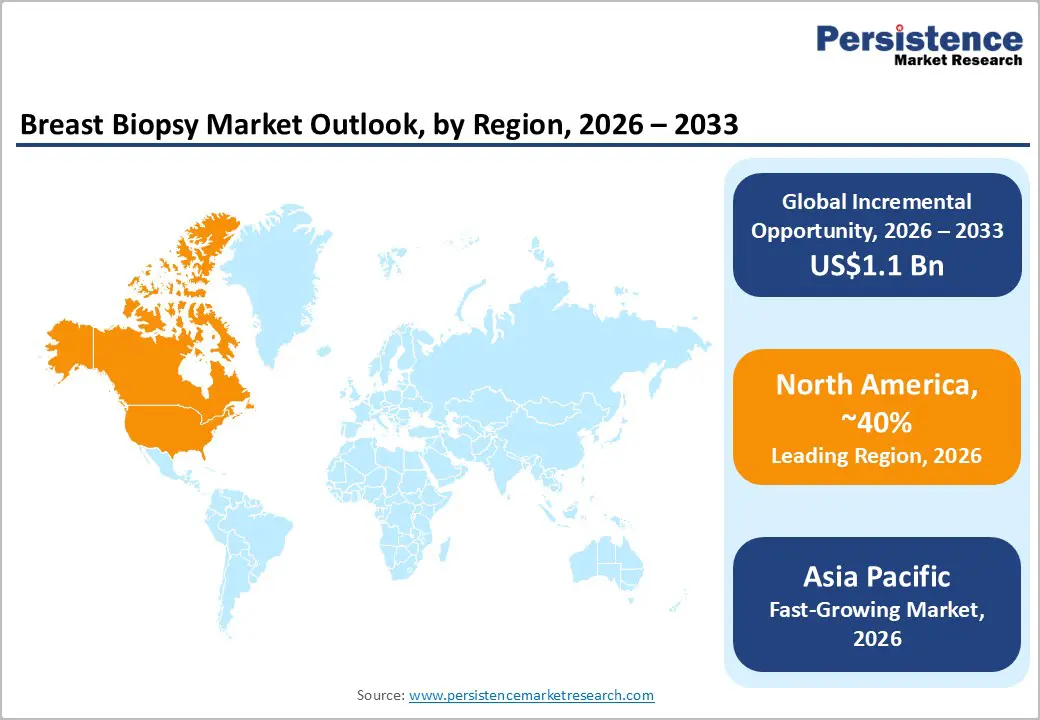
- Regional Leadership: North America is expected to lead with an estimated 38% share in 2026, due to strong healthcare infrastructure and screening programs, while Asia Pacific is the fastest-growing region, driven by expanding access and rising cancer awareness.
- Product Type Outlook: Biopsy needles are expected to lead with an estimated 40% share in 2026, due to consistent procedural demand, while localization systems are the fastest growing, supported by precision tumor targeting needs.
- Competitive Environment: Companies such as Hologic Inc. and Siemens Healthineers are driving innovation through AI-enabled imaging and integrated biopsy solutions, strengthening competitive positioning.
DRO Analysis
Driver - Rising Global Breast Cancer Burden and Expansion of Screening Programs
The most significant driver of the breast biopsy market is the increasing global incidence of breast cancer, supported by large-scale screening initiatives. According to the WHO, breast cancer accounts for more than 2.3 million new cases annually, making early detection a global healthcare priority. Government-backed programs such as the U.S. Centers for Disease Control and Prevention (CDC) Breast and Cervical Cancer Early Detection Program and Europe’s population-based mammography screening initiatives are significantly increasing biopsy volumes.
These programs directly translate into higher demand for core needle biopsy systems and image-guided biopsy technologies. In addition, rising awareness in Asia Pacific is accelerating diagnostic penetration rates. The market impact is substantial, as early-stage diagnosis improves survival rates and increases procedural adoption rates in hospitals and diagnostic centers globally.
Restraint - High Cost and Limited Accessibility of Advanced Biopsy Technologies
A key restraint affecting the breast biopsy market growth is the high cost associated with advanced biopsy systems, including MRI-guided biopsy systems and AI-enabled robotic-assisted platforms. These systems require significant capital investment, often exceeding the budgets of small and mid-sized healthcare facilities, particularly in low- and middle-income countries. Additionally, reimbursement variability across regions creates financial uncertainty for providers and patients.
According to healthcare expenditure data from the World Bank, many emerging economies still allocate less than 5% of GDP to healthcare, limiting access to advanced diagnostic infrastructure. Furthermore, maintenance costs, training requirements, and the shortage of skilled radiologists create operational inefficiencies. These factors collectively slow adoption rates despite strong clinical demand for precision diagnostics.
Opportunity - Expansion of AI-Driven and Liquid Biopsy-Based Diagnostic Platforms
A major opportunity in the breast biopsy market lies in the rapid evolution of AI-assisted imaging and liquid biopsy technologies. AI-enabled diagnostic systems improve lesion detection accuracy and reduce false-negative rates, enhancing clinical decision-making. Liquid biopsy, though still emerging in breast cancer diagnostics, is expected to complement traditional tissue biopsy by enabling non-invasive molecular profiling.
The global liquid biopsy segment is estimated to represent a multi-billion-dollar adjacent opportunity within oncology diagnostics. Increasing R&D investments from institutions such as the National Institutes of Health (NIH) and private medtech firms are accelerating commercialization. The convergence of digital pathology, cloud-based imaging, and precision oncology is expected to unlock significant growth potential, particularly in outpatient diagnostic centers and tele-radiology networks.
Category-wise Analysis
Procedure Type
Core needle biopsy is expected to lead the breast biopsy market with an estimated 45% share in 2026, driven by high diagnostic accuracy, minimal invasiveness, and cost efficiency. It is preferred over surgical biopsy as it reduces complications, recovery time, and supports outpatient workflows. Its dominance is reinforced by the global adoption of early cancer screening and minimally invasive diagnostic guidelines. Increasing standardization of biopsy protocols and wider use of automated tissue sampling workflows in diagnostic networks are further improving consistency and strengthening market leadership.
Liquid biopsy is expected to be the fastest-growing segment through 2033, due to rising demand for non-invasive, repeatable cancer detection using circulating biomarkers. It enables real-time disease monitoring without surgical intervention, aligning with precision oncology and personalized treatment trends. Growth is driven by expanding clinical validation of blood-based genomic testing and increasing integration into oncology workflows. Its adoption is further supported by the shift toward molecular-level diagnostics for treatment selection and therapy monitoring.
Guidance Technology
Ultrasound-guided biopsy is expected to dominate with an estimated 55% share in 2026, supported by real-time imaging, affordability, and wide clinical availability. It enables accurate lesion targeting with low procedural complexity, making it the preferred option for high-volume diagnostic settings. Its dominance is reinforced by compatibility with core needle biopsy and growing demand for scalable imaging solutions. Ongoing improvements in ultrasound imaging systems are further enhancing visualization and procedural accuracy.
AI and robotic-assisted biopsy systems are expected to be the fastest-growing segment through 2033, due to rising demand for precision, automation, and reduced operator dependency. These systems improve lesion detection accuracy and procedural consistency, especially in complex cases. Growth is driven by increasing adoption of AI-based imaging analytics and robotic navigation in oncology workflows. Expanding investment in digital diagnostic ecosystems is accelerating clinical adoption across advanced healthcare centers.
Product Type
Biopsy needles are expected to lead the breast biopsy market with an estimated 40% share in 2026, driven by continuous procedural demand across healthcare settings. Their dominance is supported by the need for consumable, single-use instruments in every biopsy procedure, ensuring steady, recurring demand. Growth is reinforced by rising screening volumes and the shift toward minimally invasive diagnostics. Standardization of biopsy workflows and expansion of high-throughput diagnostic infrastructure further strengthen market stability.
Localization systems are expected to be the fastest-growing segment through 2033 due to rising demand for precise tumor mapping in breast-conserving surgeries. They improve preoperative localization accuracy, reduce surgical uncertainty, and enhance clinical outcomes. Growth is driven by increasing adoption of minimally invasive surgical approaches and advancements in imaging-guided planning. Wider integration of wireless and advanced tracking-based localization technologies is accelerating adoption in modern oncology surgical workflows.
Regional Analysis
North America Breast Biopsy Market Trends
North America is expected to account for 40% of the global breast biopsy market in 2026, driven by strong screening penetration, advanced imaging infrastructure, and rapid adoption of minimally invasive diagnostics. The region is witnessing increasing use of AI-assisted imaging, robotic navigation, and outpatient biopsy workflows to improve diagnostic efficiency and early cancer detection. Favorable reimbursement policies and continued FDA approvals for advanced biopsy systems are further supporting market growth.
U.S. Breast Biopsy Market Trends
The U.S. is projected to contribute 74% of the North America market in 2026, supported by high healthcare spending and strong adoption of precision-guided biopsy technologies. Growth is fueled by rising screening volumes, expansion of digital pathology, and increasing integration of AI-based imaging systems across hospitals and cancer centers. Continued investment in oncology-focused diagnostic infrastructure is further accelerating demand for advanced biopsy procedures.
Canada Breast Biopsy Market Trends
Canada is estimated to hold 26% of the regional market in 2026, driven by public screening programs and ongoing healthcare infrastructure upgrades. Rising awareness of early-stage breast cancer detection and growing adoption of minimally invasive procedures are supporting market expansion. Increasing investments in diagnostic imaging and digital healthcare technologies are also improving patient access and procedural efficiency.
Europe Breast Biopsy Market Trends
Europe is expected to account for 25% of the global breast biopsy market in 2026, supported by organized cancer screening programs and strong public healthcare systems. Market growth is driven by increasing use of MRI-guided and image-assisted biopsy procedures, alongside rising adoption of digital pathology and AI-supported imaging analysis. EU Medical Device Regulation (MDR) standards are also encouraging the deployment of advanced and high-quality diagnostic technologies.
Germany Breast Biopsy Market Trends
Germany is projected to represent 32% of the Europe market in 2026, driven by advanced radiology infrastructure and high healthcare expenditure. The country is increasingly adopting AI-integrated imaging systems and minimally invasive oncology diagnostics to improve cancer detection accuracy. Strong investment in precision diagnostics and hospital modernization continues to strengthen market growth.
U.K. Breast Biopsy Market Trends
The U.K. is estimated to account for 18% of the regional market in 2026, supported by broad screening access under the National Health Service (NHS). Growth is being driven by the expansion of digital pathology programs and the increasing use of image-guided biopsy systems in cancer care. Ongoing modernization of diagnostic infrastructure is also accelerating the adoption of advanced biopsy technologies.
Asia Pacific Breast Biopsy Market Trends
Asia Pacific is expected to be the fastest-growing region and account for 24% of the global breast biopsy market revenue in 2026. Growth is driven by rising breast cancer prevalence, improving healthcare access, and expanding awareness regarding early diagnosis. Rapid expansion of diagnostic infrastructure, increasing adoption of minimally invasive procedures, and government-led screening initiatives are further strengthening market demand across the region.
China Breast Biopsy Market Trends
China is projected to hold 38% of the Asia Pacific market in 2026, supported by large-scale healthcare modernization and expanding oncology screening programs. Rapid adoption of AI-enabled imaging systems and precision diagnostics is improving cancer detection efficiency across hospitals. Government investment in cancer care infrastructure and rising domestic medical device production are further supporting market expansion.
India Breast Biopsy Market Trends
India is estimated to account for 18% of the regional market in 2026, driven by rising breast cancer awareness and improving access to diagnostic services. Growth is supported by increasing investments in private oncology centers, expansion of affordable imaging services, and greater adoption of minimally invasive biopsy procedures. Government healthcare initiatives and ongoing healthcare digitization are also improving diagnostic penetration across developing regions.
Competitive Landscape
The global breast biopsy market is moderately consolidated, with leading players such as Hologic Inc., GE HealthCare, Siemens Healthineers, and Becton Dickinson holding a significant share of market revenue. These companies leverage strong hospital networks, advanced imaging portfolios, and integrated biopsy platforms to strengthen their market position. Continuous investment in AI-assisted imaging, robotic-guided diagnostics, and minimally invasive biopsy technologies is further driving competitive differentiation.
Regional and niche players are focusing on specialized segments such as biopsy consumables, localization systems, and precision-guided diagnostics. High regulatory requirements, clinical validation needs, and imaging infrastructure costs remain key barriers for new entrants. However, increasing adoption of digital pathology and AI-enabled imaging platforms is creating opportunities for technology-focused companies. The market is expected to see gradual consolidation through strategic partnerships, technology integration, and targeted acquisitions.
Key Industry Developments:
- In October 2025, Blackstone and TPG announced an acquisition agreement worth up to US$18.3 billion for Hologic Inc., marking one of the largest medical device buyouts in nearly two decades.
- In February 2025, Hologic Inc. received CE Mark approval for its Affirm® Contrast Biopsy Software, enabling contrast-enhanced mammography-guided tissue sampling and improving lesion targeting accuracy in breast biopsy procedures.
Companies Covered in Breast Biopsy Market
- Hologic Inc.
- GE HealthCare
- Siemens Healthineers
- Becton Dickinson (BD)
- Canon Medical Systems
- Fujifilm Holdings Corporation
- Cook Medical
- Boston Scientific
- Argon Medical Devices
- Merit Medical Systems
- Esaote S.p.A.
- Koninklijke Philips N.V.
- Terumo Corporation
- Samsung Medison
- Mindray Medical International
Frequently Asked Questions
The global breast biopsy market is projected to reach US$2.5 billion in 2026.
Rising breast cancer screening rates, growing adoption of image-guided diagnostics, and increasing demand for minimally invasive procedures drive the market.
The market is expected to grow at a CAGR of 5.3% from 2026 to 2033.
Growth opportunities lie in AI-assisted imaging, liquid biopsy technologies, and expansion of precision oncology diagnostics.
Hologic Inc., GE HealthCare, Siemens Healthineers, and Becton Dickinson are key players in the market.


