




- Beauty & Personal Care
- Teeth Whitening Kits Market
Teeth Whitening Kits Market Size, Share, and Growth Forecast 2026 – 2033
Teeth Whitening Kits Market by Product Type (Whitening Toothpaste, Whitening Gels and Strips), Application (Home Use, Commercial), Distribution Channel (Supermarkets and Hypermarkets), and Regional Analysis, 2026 – 2033

Teeth Whitening Kits Market Size and Trends Analysis
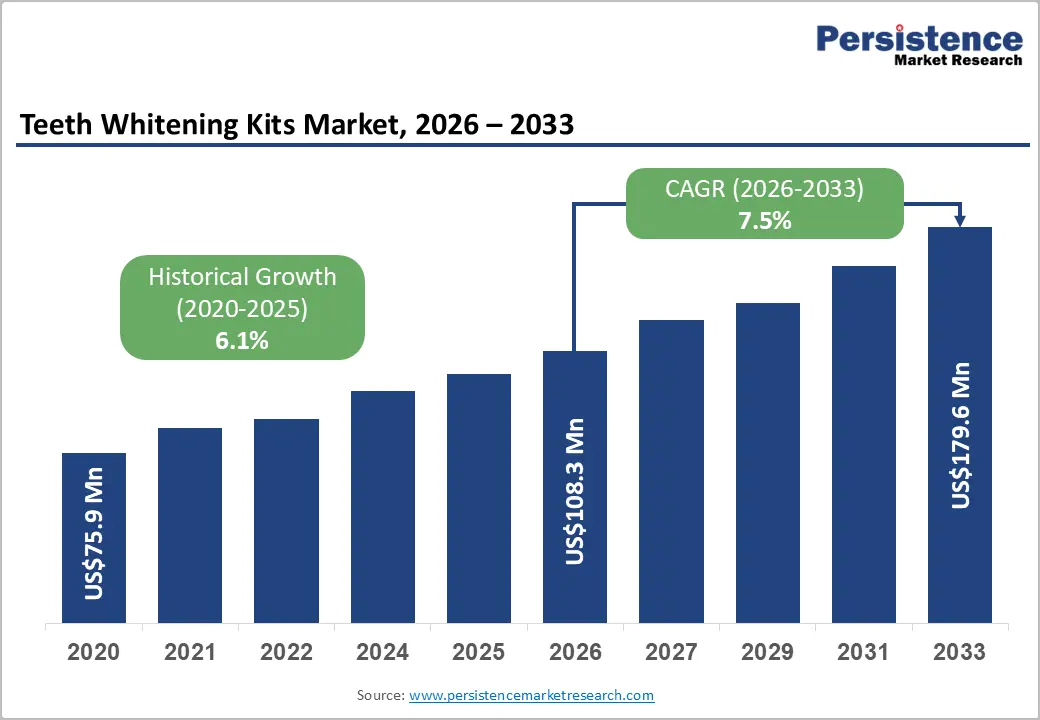
The global teeth whitening kits market size is likely to be valued at US$108.3 million in 2026 and is expected to reach US$179.6 million by 2033, growing at a CAGR of 7.5% during the forecast period from 2026 to 2033, driven by rising consumer focus on aesthetic dentistry and increasing influence of social media on personal appearance standards. Easy availability of at-home LED whitening kits and peroxide-free formulations is also extending adoption among sensitivity-prone users.
Key Industry Highlights:
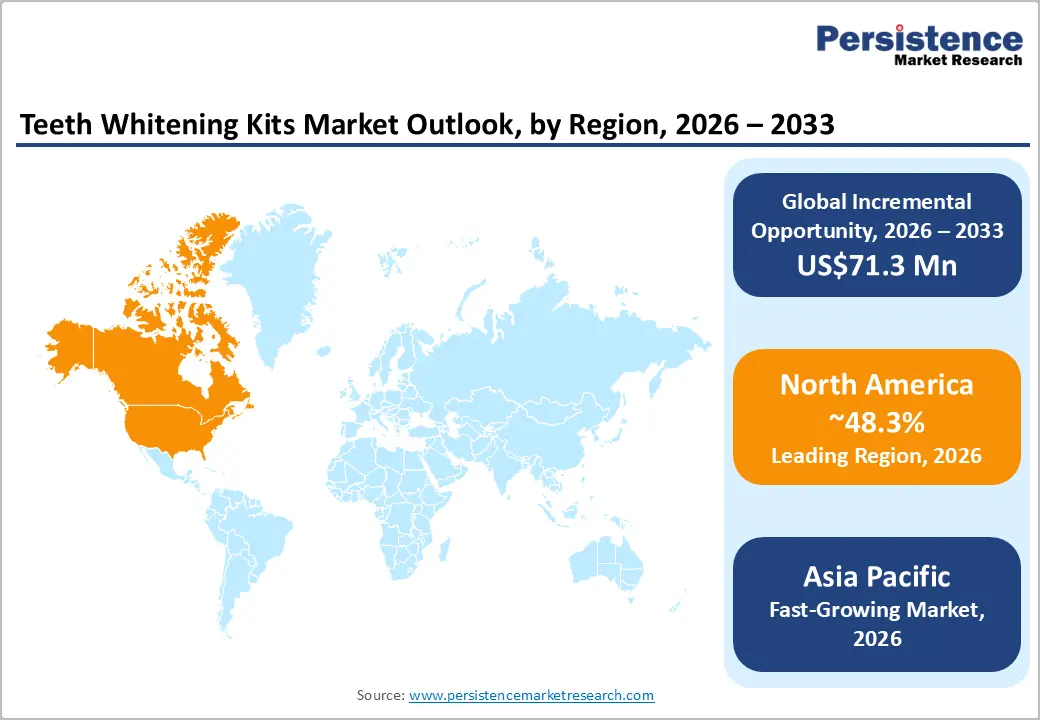
- Leading Region: North America, with about a 48.3% share in 2026, spurred by high awareness of cosmetic dentistry and the presence of premium brands.
- Fast-growing Region: Asia Pacific, backed by increasing urban beauty consciousness and expanding e-commerce access to global whitening brands.
- Rebranding Initiative: In October 2025, Ultradent Products launched a full rebrand of its Opalescence whitening line, renaming and modernizing the product family while retaining its existing formulas. This rebrand was aimed at better connecting with both patients and clinicians.
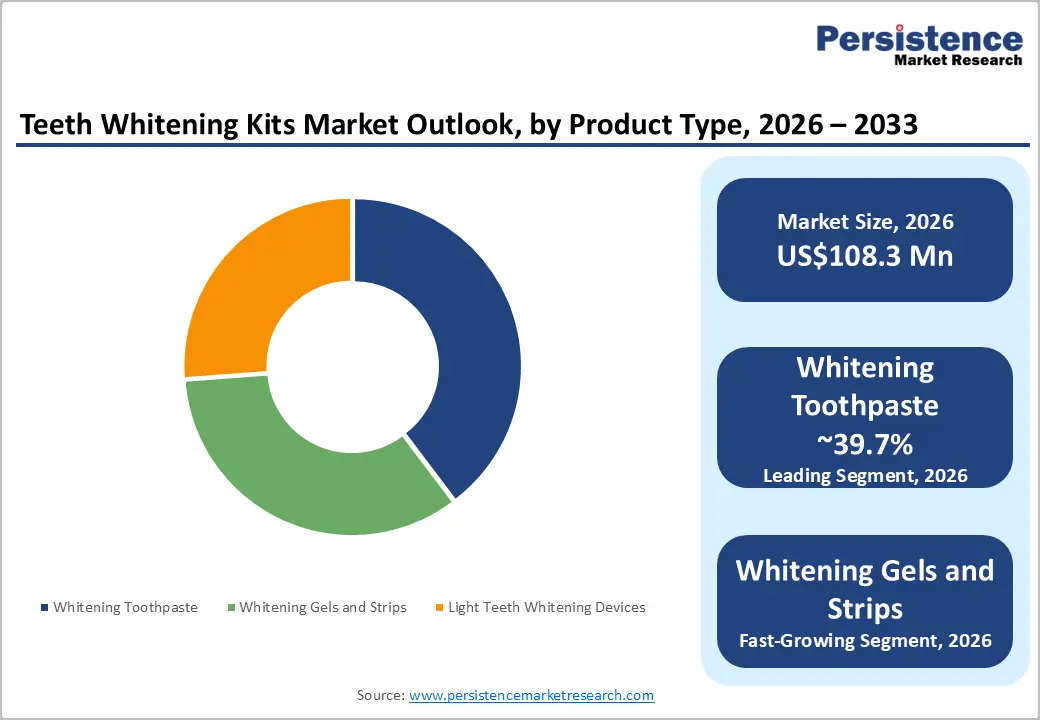
- Leading Product Type: Whitening toothpaste, approximately 39.7% share in 2026, as it integrates easily into daily oral care routines and requires no additional effort or devices.
- Dominant Application: Home use, nearly 67.2% in 2026, as consumers prefer convenient and self-administered whitening solutions that avoid dental visits and fit flexible schedules.
DRO Analysis
Driver- Rising Social Media and Selfie Culture
Platforms such as TikTok and Instagram have made bright teeth a visible social currency. A meta-analysis across 15 studies involving over 10,000 participants found that 72% of patients were motivated by influencer posts when choosing cosmetic dental treatments, including teeth whitening. This translates directly into at-home kit purchases, since followers want accessible and affordable alternatives to clinic visits.
A 2025 survey by the American Academy of Cosmetic Dentistry found that smile appearance is the top aesthetic concern for adults aged 25 to 45, surpassing even skin and hair. The pressure is not just cosmetic. Delta Dental's 2024 State of America's Oral Health and Wellness Report confirmed that 52% of adults now rank tooth brightness as a top oral health priority.
Booming Digital Retail to Make Whitening Kits Easy to Buy
E-commerce has removed the friction from buying whitening kits. Shoppers can compare formulas, read ingredient lists, and check verified reviews before checkout, something in-store shelves cannot replicate. Data shows a 55% shift toward digital sales in this category, with direct-to-consumer brands expanding speedily through subscriptions and targeted digital marketing.
Brands such as SmileDirectClub have used this model effectively, extending their online product line with developments such as a sensitivity-free kit featuring a 20-LED wireless accelerator light. It is capable of delivering up to seven shades of whitening in one week.
Restraint - Sensitivity and Gum Irritation to Limit Consumer Confidence
Tooth sensitivity remains the most commonly cited reason consumers stop using or avoid whitening kits. A review published in the British Dental Journal found that sensitivity affects 15 to 78% of patients undergoing external tooth bleaching. The bleaching agent, typically hydrogen peroxide, penetrates the enamel and reaches the dentin, triggering nerve responses. A 2024 literature review in the International Journal of Research and Review confirmed that extended use of peroxides can alter enamel's chemical structure and cause enamel loss.
Ill-fitting trays make this worse as excess gel spills onto gum tissue, thereby causing chemical burns and inflammation. The Food and Drug Administration (FDA) has not yet formally classified hydrogen peroxide as a whitening agent. The American Academy of Pediatric Dentistry recommends that whitening only be performed under dental supervision. These concerns push hesitant buyers away from repeat purchases.
Opportunity - Violet Light Technology to Deliver Quick and Superior Results
Standard blue-light LEDs are giving way to violet-spectrum technology. A randomized clinical trial published in Frontiers in Dental Medicine (2024) by researchers at the University of São Paulo found that violet LED systems operating at 405 to 410 nm can break down chromophore macromolecules through a physical process, without relying entirely on chemical agents. This matters for at-home kits as it shortens exposure time and reduces chemical load on enamel.
Research shows that violet LED combined with carbamide peroxide achieves color change values up to 5.20 immediately post-session, with results remaining stable at 4.05 after 12 months. It hence outperforms traditional LED systems. As kit manufacturers integrate these optics into consumer-grade mouthpieces, the technology is moving from clinic to countertop.
Phthalimidoperoxycaproic Acid to be a Sensitivity-Free Alternative to Peroxide
Phthalimidoperoxycaproic acid (PAP) is changing the formulation landscape by targeting stains without the side effects associated with hydrogen peroxide. A 2025 in vitro study approved by the Ethics Committee of Universitat de València found that PAP provides similar whitening efficacy to hydrogen peroxide with potentially less enamel damage. Clinical evidence shows PAP can achieve up to 8.13 shade units of improvement while maintaining a 0% sensitivity rate among subjects after 14 days of treatment.
A June 2025 study published in the Journal of Pharmacy and Bioallied Sciences from Bharati Vidyapeeth Dental College evaluated PAP activated with an 810-nm diode laser. It confirmed its efficacy in patients with mild to moderate stains, pointing toward broad applicability in consumer whitening kits. This makes PAP-based formulas especially compelling for the sensitivity-conscious segment.
Category-wise Analysis
Product Type Insights
Whitening toothpaste is predicted to lead with a share of approximately 39.7% in 2026, as it fits into daily routines without any extra effort. Consumers do not need additional steps, trays, or devices. This makes it the first choice for beginners. Most products use mild abrasives and low-dose peroxide, which reduces the risk of sensitivity. According to the American Dental Association, whitening toothpastes can remove surface stains effectively when used regularly, though they do not change the natural tooth color. This clarity builds trust and propels consistent use.
Whitening gels and strips are estimated to be the fastest-growing segment over the forecast period, as they deliver visible results in a short time. Unlike toothpaste, they penetrate deeper stains. Clinical guidance from the National Health Service (NHS) notes that peroxide-based products can lighten teeth by several shades when used correctly. This makes them appealing to users preparing for events such as weddings or interviews. Brands are also introducing enamel-safe formulas and non-peroxide alternatives to attract consumers.
Application Insights
The home use segment is anticipated to dominate with a share of nearly 67.2% in 2026, as modern consumers prefer convenience and privacy. They can whiten teeth on their own schedule without visiting clinics. This behavior increased after COVID-19, when access to dental clinics was limited. According to reports from the Centers for Disease Control and Prevention (CDC), dental visits declined significantly during the pandemic, pushing consumers toward at-home oral care solutions.
The commercial segment is expected to remain in the second position in 2026, as it provides high efficacy and professional supervision. Dental clinics use strong peroxide concentrations, which deliver fast and more noticeable results. According to clinical literature published in journals such as the Journal of Dentistry, in-office whitening can achieve significantly greater shade improvement in a single session compared to over-the-counter products. Dental chains and cosmetic clinics are also extending whitening services as part of aesthetic packages.
Regional Insights
North America Teeth Whitening Kits Market Trends
North America is predicted to lead in 2026 with a share of approximately 48.3%, due to advanced cosmetic dentistry infrastructure, insurance coverage, and a strong cultural emphasis on aesthetic norms. What sets this region apart is how deeply whitening is woven into everyday life. Employers in hospitality, beauty, and customer-facing roles subtly reward confident smiles. Delta Dental's 2024 State of America's Oral Health and Wellness Report confirmed that 91% of adults now equate dental check-ups with annual physicals, effectively embedding whitening into their preventive care budgets.
U.S. Teeth Whitening Kits Market Trends
In 2026, the U.S. will likely account for a share of around 58.8%. According to the American Dental Association (ADA), teeth whitening ranks among the top-requested cosmetic dental treatments in the country, with millions of procedures performed annually. Consumer adoption is remarkably high. Around 67% of adults in the U.S. have tried to whiten their teeth, and 35.22 million Americans used tooth whitening products in 2024. Partnerships like the one between Aspen Dental and GLO Science, rolled out across over 1,000 locations nationwide in March 2025, show how professional and consumer channels are converging to boost repeat demand.
Asia Pacific Teeth Whitening Kits Market Trends
Asia Pacific is anticipated to witness the fastest growth in 2026 with a share of nearly 29.6%, propelled by urbanization and beauty-conscious middle classes embedding whitening into grooming rituals. China's e-commerce festivals move high-volume LED kits, India's dental chains bundle whitening with orthodontic aligners, and Japan merges vitamin C and collagen into pastes to satisfy synergistic wellness demand. The shift in consumer behavior is rooted in rising incomes and Western beauty influence. Urbanization has played a key role in exposing consumers to Western lifestyle habits and dental aesthetics, including teeth whitening treatments and orthodontic aligners, thereby creating new revenue opportunities.
China Teeth Whitening Kits Market Trends
China will likely account for a share of approximately 32.6% in 2026. The demand for sophisticated services such as dental implants and cosmetic operations, including veneers and teeth whitening, has increased alongside rising disposable incomes. A shift in consumer behavior toward high-quality dental care is partly a result of increased ability to prioritize oral health as part of one’s wellness. E-commerce is the key distribution engine here, with prominent shopping festivals such as 11.11 (Singles' Day) channeling bulk LED whitening kit purchases at scale.
Japan Teeth Whitening Kits Market Trends
Japan’s market is predicted to account for a share of about 18.7% in 2026, as consumers have strong preferences for cosmetic dentistry, which increases demand for procedures such as veneers, orthodontics, and tooth whitening. The oral care sector is significantly influenced by technological development. Increasing cosmetic awareness, surging local beauty standards, and an aging population with dental care needs are further anticipated to speed up growth.
Europe Teeth Whitening Kits Market Trends
Europe will likely see decent growth over the forecast period with a share of nearly 11.2% in 2026, as strict regulations influence what products can enter the market. In March 2023, the European Commission updated its regulations limiting the allowable concentration of hydrogen peroxide in cosmetic whitening products sold over the counter, citing concerns over oral tissue irritation and long-term enamel erosion. This has not dampened growth, but it has redirected it. Hydrogen peroxide caps have fueled the adoption of PAP and blue-filter technologies that promise sensitivity-free whitening, protecting enamel while complying with CE labeling norms.
U.K. Teeth Whitening Kits Market Trends
In 2026, the U.K. is projected to hold a share of approximately 24.8%. The country benefits from both a large private dental network and a public health push that keeps oral care visible. The General Dental Council recorded 125,736 dental professionals on the U.K. register at the end of 2024, including 46,362 dentists and 79,374 dental care professionals. It is hence creating a broad professional base for cosmetic and preventive oral care recommendations. NHS initiatives are also strengthening the category. NHS England's dental recovery plan committed to 1.5 million additional dental treatments or 2.5 million appointments, pushing preventive care visibility and category education.
Germany Teeth Whitening Kits Market Trends
Germany is expected to account for a share of around 16.4% in 2026, owing to its high oral care standards and its superior sustainability ethos. The strong environmental movement in the country has fostered the demand for natural and plastic-free toothpaste options. Consumers are showing a higher willingness to pay for sustainable packaging compared to the European average. Nearly 68% of the country’s citizens have expressed willingness to pay a premium for zero-waste oral care. Regulators are also keeping the market growth steady. Germany's Federal Office of Consumer Protection issued warnings against charcoal toothpaste for enamel abrasion. A 2024 Eurobarometer survey revealed that only 32% of EU citizens trust natural oral care labels without third-party certification.
Competitive Landscape
The global teeth whitening kits market is moderately fragmented with the presence of multinational oral care companies, professional dental brands, and fast-growing direct-to-consumer (DTC) players. The market is led by Procter & Gamble (Crest 3D Whitestrips), Colgate-Palmolive (Optic White), Church & Dwight, and Ultradent Products. Crest continues to be the benchmark brand in several developed markets due to its long clinical track record, broad retail distribution, and continuous product innovation.
Companies are constantly launching LED-assisted whitening kits, sensitivity-reduction technologies, express whitening treatments, and enamel-safe formulations. Recent examples include Crest's expansion of LED-enhanced whitening products, Colgate's Optic White LED-compatible gels, and Ultradent's launch of Opalescence whitening strips for at-home use. The focus has shifted from simply whitening teeth to delivering quick results with low sensitivity and high convenience.
Key Industry Developments:
- In April 2026, Philips introduced Zoom! Delivered, an at-home whitening kit available through select dentists across the U.S. The service allows dental professionals to order custom trays and Philips Zoom whitening gels that are shipped directly to patients' homes within 10 business days.
- In March 2026, Colgate-Palmolive launched the Colgate Optic White Pro Series Toothpaste with ActivShine Technology in the U.S. Powered by a Hydrogen Peroxide Complex, the toothpaste is clinically proven to achieve visibly whiter teeth in three days and dissolve 15 years of deep-set stains after two weeks of twice-daily brushing.
- In February 2026, Colgate-Palmolive India launched a multi-platform campaign for Colgate Visible White Purple, a toothpaste based on color-correction science that neutralizes yellow tones in teeth. The campaign was positioned to reframe teeth whitening as a daily beauty ritual rather than a purely functional oral care step.
Companies Covered in Teeth Whitening Kits Market
- Active Wow
- AuraGlow
- Bright White Smiles
- CCA Industries Inc.
- Colgate Palmolive Co.
- Creightons Plc
- Dabur India Ltd.
- Empressly Beauty Products Pvt. Ltd.
- GlaxoSmithKline Plc
- GLO Science
- GoSmile LLC
- Ivismile LLC
- Perrigo Co. Plc
- SmileDirectClub Inc.
- Spicta Consumer Pvt. Ltd.
- Spotlight Oral Care Ltd.
- Starlite Smile
- Supersmile
- Ultradent Products Inc.
- Unilever PLC
- Universal Corp. Ltd.
Frequently Asked Questions
The global teeth whitening kits market is projected to be valued at US$108.3 million in 2026.
The teeth whitening kits market is expected to reach US$179.6 million by 2033.
Key market trends include the rise of LED-based kits and the launch of personalized whitening solutions targeting sensitivity.
Whitening toothpaste is expected to be the leading product type with a share of nearly 39.7% in 2026, backed by its low cost, high retail availability, and safe profile.
The market is expected to grow at a CAGR of 7.5% from 2026 to 2033.
Active Wow, AuraGlow, Bright White Smiles, and CCA Industries Inc. are a few key market players.


