




- Technology
- Sales Pipeline Management Software Market
Sales Pipeline Management Software Market Size, Share and Growth Forecast, 2026 - 2033
Sales Pipeline Management Software Market by Functional Capability (Lead Management & Capture, Deal & Pipeline Management, Others), Technology Type (Traditional CRM Systems, Others), Organization Size, and Regional Analysis for 2026 - 2033

Sales Pipeline Management Software Market Size and Trends Analysis
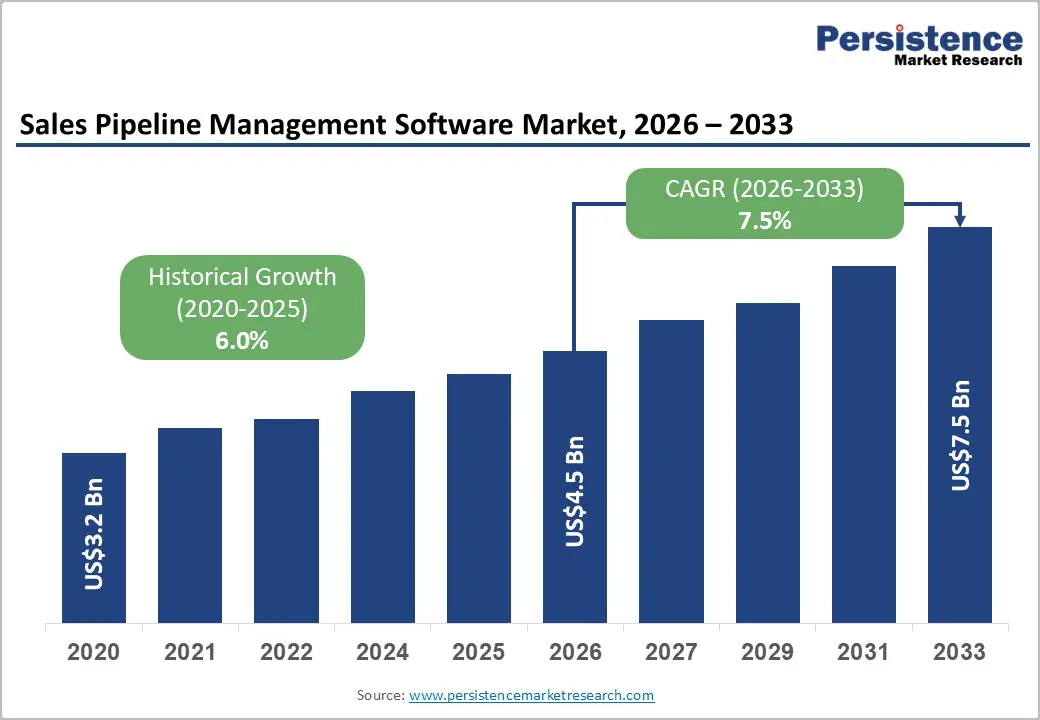
The global sales pipeline management software market size is likely to be valued at US$4.5 billion in 2026 and is projected to reach US$7.5 billion by 2033, growing at a CAGR of 7.5% during the forecast period from 2026 to 2033, driven by rapid enterprise adoption of CRM software platforms, increasing demand for revenue intelligence platforms, and the shift toward data-driven sales force automation systems.
The integration of AI and predictive analytics into pipeline workflows is significantly improving conversion visibility. The rising SaaS penetration among SMEs and enterprises is also accelerating cloud-based deployment models across global sales organizations.
Key Industry Highlights:
- Dominant Functional Capability: Deal & pipeline management is expected to lead with a 38% share in 2026, driven by enterprise dependence on structured pipeline visibility and CRM-driven deal tracking, while forecasting & revenue intelligence is likely to be the fastest-growing at 9% CAGR through 2033, supported by AI-based forecasting and decision intelligence adoption.
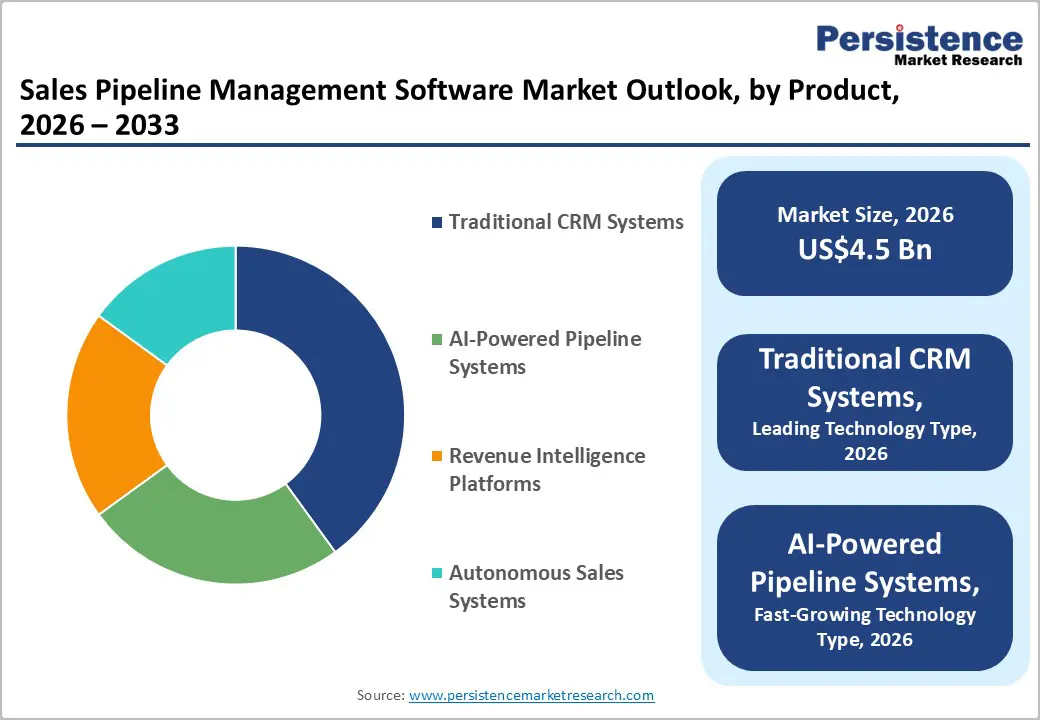
- Leading Technology Type: Traditional CRM systems are projected to dominate with a 40% share in 2026, reflecting deep enterprise penetration, while AI-Powered Pipeline Systems are expected to grow the fastest at 10% CAGR through 2033, driven by automation and revenue intelligence platforms adoption.
- Organization Size Leadership: Large enterprises are set to dominate with a 55% share in 2026, supported by complex sales structures, while SMEs are likely to grow the fastest at 8% CAGR by 2033, driven by SaaS-based CRM software platforms adoption and cost efficiency.
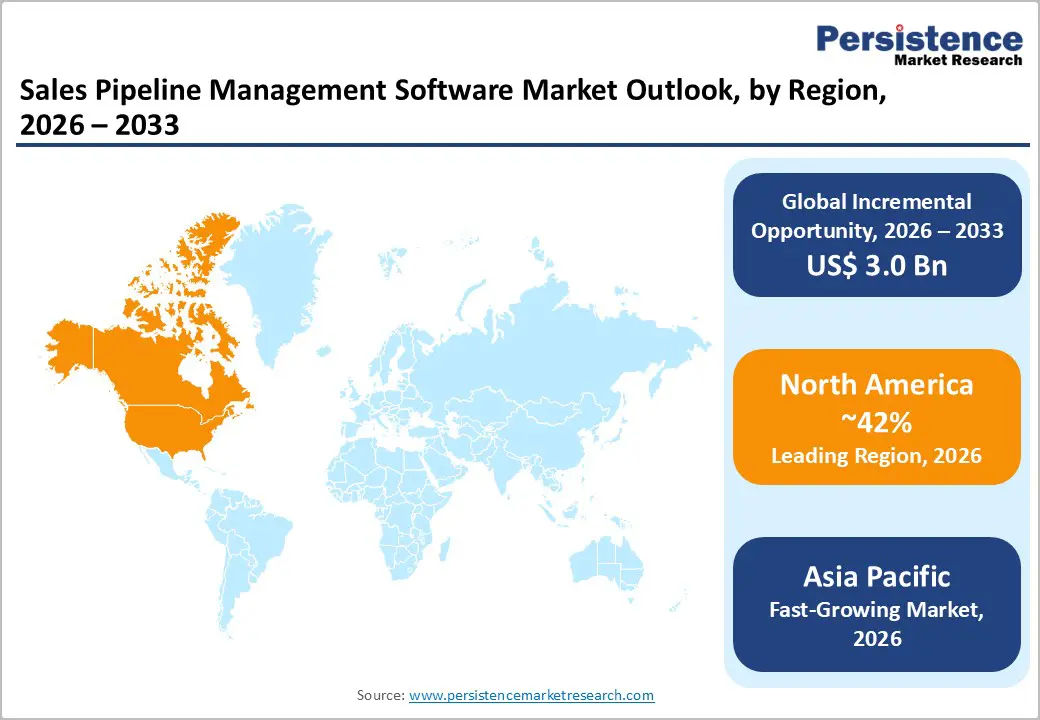
- Regional Leadership: North America is expected to lead with a 42% share in 2026, supported by mature enterprise software ecosystems, while Asia Pacific is projected to be the fastest-growing at 8.5% CAGR through 2033, driven by SME digitization and rising adoption of sales pipeline management software.
- Competitive Environment: Market growth is shaped by rapid expansion of revenue intelligence platforms, AI-driven automation, and movement toward autonomous sales systems, with vendors focusing on cloud-native CRM innovation and ecosystem integration.
DRO Analysis
Driver - Rapid Adoption of AI-Enabled Revenue Intelligence and CRM Ecosystems
The key driver of the sales pipeline management software market is the rapid shift toward AI-powered CRM software and revenue intelligence platforms, enabling predictive forecasting, automated lead scoring, and pipeline optimization. According to the Salesforce State of Sales 2026 report, 87% of sales organizations use AI in at least one sales workflow, showing mainstream enterprise adoption.
This trend is reinforced by McKinsey & Company (2025) reporting ~78% enterprise AI adoption across business functions, and by Deloitte noting a 20-25% improvement in forecasting accuracy from AI-driven sales tools. Government initiatives such as the U.S. Small Business Administration (SBA) digital programs and the European Commission’s Digital Economy and Society Index (DESI) framework further accelerate cloud CRM adoption, with vendors reporting 20-30% gains in lead conversion efficiency through AI-enabled workflows.
Restraint - Integration Complexity and Data Fragmentation across Enterprise Systems
A major restraint in the sales pipeline management software market is the difficulty of integrating modern CRM software systems with fragmented enterprise IT environments. According to the IBM Institute for Business Value (IBV) 2025 AI study, 53% of organizations cite poor data quality as the top barrier to AI adoption, limiting effective deployment of sales force automation systems.
Salesforce ecosystem research also indicates that only ~26-30% of enterprises have fully unified CRM data architecture, while integration costs account for 15-25% of total CRM implementation spend. Regulatory frameworks such as GDPR (General Data Protection Regulation) and emerging Asia Pacific data laws further increase the compliance burden, slowing adoption of advanced revenue intelligence platforms.
Opportunity - Expansion of Autonomous and AI-Driven Sales Pipeline Systems
The key opportunity lies in the rise of autonomous sales pipeline systems powered by GenAI and machine learning, enabling end-to-end sales workflow automation. According to Deloitte, over 80% of organizations are exploring GenAI use cases, while 26% are already testing autonomous AI agents, signaling early commercialization of AI-driven sales execution.
McKinsey & Company and PwC estimate 3-5% productivity gains in sales operations from AI adoption, creating large-scale efficiency potential across CRM ecosystems. Government programs in India (Digital India initiative), China (cloud-first enterprise strategy), and the European Union (EU AI Act framework) are accelerating SaaS-based CRM (Customer Relationship Management) software platform adoption, expanding the addressable market for sales pipeline management software through SME digitalization.
Category-wise Analysis
Functional Capability Insights
The deal & pipeline management segment is estimated to be the leading subsegment, accounting for approximately 38% share in 2026, largely due to its central role in enterprise-grade opportunity tracking and structured revenue execution within sales pipeline management software. Its position is supported by widespread deployment of enterprise CRM ecosystems such as Salesforce Sales Cloud and Microsoft Dynamics 365 (2025-2026 enhancements), which are estimated to remain core platforms for pipeline visibility and deal governance across global sales teams.
The lead management & capture segment is estimated to be the fastest-growing, holding around 18-22% share in 2026 and expanding at approximately 9% CAGR by 2033, driven by increasing reliance on AI-enabled lead qualification and enrichment. Industry surveys such as Salesforce State of Sales (2026) indicate that a majority of sales organizations are now integrating AI into prospecting workflows, while vendor-level benchmarks suggest ~20-30% uplift in lead conversion efficiency when AI-based scoring is embedded into CRM software platforms, accelerating adoption across digitally mature enterprises.
Technology Type Insights
Traditional CRM Systems are estimated to remain the leading sub-segment, with a market share of approximately 40% in 2026, supported by entrenched deployment across large enterprises in banking, manufacturing, and telecom sectors. Platforms such as Oracle CRM and SAP C/4HANA continue to serve as foundational systems for customer data management and pipeline tracking, with replacement cycles remaining slow due to high integration dependency and enterprise-scale customization requirements.
In contrast, AI-powered pipeline systems are projected to expand at around 10% CAGR through 2033. Growth is being driven by increasing enterprise adoption of generative AI capabilities embedded in tools such as Microsoft Copilot in Dynamics 365 and Salesforce Einstein AI (2025-2026 rollouts), which are enhancing forecasting accuracy and automating deal insights, with industry studies indicating ~20-25% improvement in sales forecasting precision in AI-enabled environments.
Organization Size Insights
Large enterprises are estimated to remain the leading sub-segment, capturing approximately a 55% share in 2026, driven by complex global sales structures and high-volume pipeline management requirements. These organizations increasingly rely on integrated revenue intelligence platforms and enterprise CRM ecosystems such as Salesforce and SAP, which are widely deployed to enable unified forecasting, pipeline governance, and performance analytics across multi-region operations.
Meanwhile, Small & Micro Businesses (SMEs) are estimated to be the fastest-growing segment, expanding at around 8% CAGR by 2033. Growth is supported by increasing adoption of cost-efficient SaaS-based CRM software platforms, alongside SME digitalization initiatives such as India’s MSME digitization programs and EU SME cloud adoption frameworks, while platforms like Zoho CRM and Freshworks continue to report rising traction due to demand for simplified and scalable sales pipeline management software solutions.
Regional Analysis
North America Sales Pipeline Management Software Market Trends
North America is estimated to lead the sales pipeline management software market with approximately 42% global share in 2026, supported by high enterprise readiness for CRM software platforms and early-scale adoption of AI-enabled sales workflows. The region shows strong acceptance of sales pipeline management software across SaaS, healthcare, and financial services, where pipeline tracking and forecasting automation are increasingly embedded into core revenue operations.
In 2025, deployments such as Microsoft Copilot for Sales and Salesforce Einstein AI enhancements are estimated to have further strengthened AI-driven pipeline intelligence and reduced manual sales reporting dependency.
U.S. Sales Pipeline Management Software Market Trends
The U.S. is estimated to account for around 80% of the regional market in 2026, driven by large-scale enterprise CRM penetration and AI integration across Fortune 500 sales organizations. Adoption of platforms such as Salesforce ecosystem solutions and Microsoft Dynamics 365 Copilot-enabled deployments is estimated to be accelerating automation of lead scoring, forecasting, and deal tracking functions within enterprise sales pipelines.
Canada Sales Pipeline Management Software Market Trends
Canada is estimated to hold approximately 20% of the regional share in 2026, with steady adoption among SMEs and mid-sized enterprises. Growth is supported by increasing usage of SaaS-based tools such as HubSpot CRM and Zoho CRM, particularly in retail, logistics, and services sectors. The Canada Digital Adoption Program (CDAP) is estimated to be contributing to rising cloud CRM migration, improving pipeline visibility and structured sales execution.
Europe Sales Pipeline Management Software Market Trends
Europe is estimated to account for approximately 25% of the global share in 2026, with the adoption of sales pipeline management software shaped by regulatory compliance requirements and gradual enterprise digital transformation. The region is witnessing steady migration toward cloud-based CRM software platforms, particularly in banking, manufacturing, and public services, where secure data handling and pipeline transparency are key priorities. In 2025, adoption of solutions such as SAP Sales Cloud and Oracle CX Cloud is estimated to have expanded across large enterprises to support integrated sales tracking and forecasting.
Germany Sales Pipeline Management Software Market Trends
Germany is estimated to represent around 32% of the regional market in 2026, driven by strong industrial digitization across automotive and manufacturing sectors. Enterprises such as BMW, Siemens, and Volkswagen are estimated to be integrating revenue intelligence platforms into sales and distribution workflows, supporting improved pipeline forecasting and alignment with production planning under Industry 4.0 initiatives.
U.K. Sales Pipeline Management Software Market Trends
The U.K. is estimated to contribute around 18% of Europe’s share in 2026, supported by strong adoption in financial services and insurance. Institutions such as Barclays and HSBC are estimated to be modernizing CRM infrastructure using platforms like Salesforce Financial Services Cloud to enhance pipeline tracking and customer lifecycle visibility. In parallel, fintech firms such as Revolut and Monzo are estimated to be accelerating SaaS-based CRM adoption for real-time sales and customer engagement management.
Asia Pacific Sales Pipeline Management Software Market Trends
Asia Pacific is estimated to be the fastest-growing regional market in 2026, driven by rapid digital transformation, expanding SME ecosystems, and increasing adoption of cloud-based CRM software platforms. The region is witnessing a strong shift toward integrated sales pipeline management software, particularly across e-commerce, fintech, and manufacturing sectors. In 2025, expansion of Salesforce Asia Cloud infrastructure and Zoho CRM enhancements for SMEs is estimated to have accelerated regional CRM penetration.
China Sales Pipeline Management Software Market Trends
China is estimated to account for around 35% of the regional market in 2026, supported by large-scale enterprise digitization and AI-driven CRM adoption across digital ecosystems. Enterprises within platforms such as Alibaba Cloud and Tencent ecosystem businesses are increasingly estimated to be deploying revenue intelligence platforms to improve forecasting accuracy and automate pipeline management functions. These trends are supported by ongoing national initiatives promoting cloud adoption and enterprise AI integration.
India Sales Pipeline Management Software Market Trends
India is estimated to contribute around 18% of the regional share in 2026, driven by rapid SME digitalization and strong SaaS adoption. Enterprises such as Infosys, TCS client ecosystems, and fintech firms like Razorpay and Paytm are increasingly estimated to be embedding CRM systems into sales operations for improved pipeline visibility and customer engagement. Domestic SaaS providers such as Zoho CRM and Freshworks are also estimated to be expanding penetration across SMEs, supported by growing adoption of cloud-first sales force automation systems.
Competitive Landscape
The global sales pipeline management software market is estimated to be moderately consolidated, with leading players such as Salesforce, Microsoft, Oracle, SAP, and HubSpot collectively accounting for approximately 45-55% of the 2026 revenue share. These vendors maintain dominance through deep enterprise CRM penetration, strong ecosystem integration, and continuous enhancement of AI-powered CRM software platforms, particularly in forecasting, automation, and revenue intelligence capabilities within enterprise sales workflows.
Mid-tier and niche players such as Zoho, Freshworks, Pipedrive, Monday.com, and SugarCRM are estimated to be expanding their presence in SME and mid-market segments through cloud-native deployment, flexible pricing models, and scalable sales force automation systems. Competitive barriers remain relatively high due to integration complexity and enterprise switching costs; however, increasing API-based ecosystems and modular SaaS adoption are enabling newer AI-focused entrants to integrate into existing CRM software platforms, gradually intensifying competition through partnerships and acquisitions.
Key Industry Developments:
- In January 2026, Freshworks completed its acquisition of FireHydrant to build a unified AI-native ServiceOps platform combining ITSM and ITOM capabilities. The integration improves incident management through AI automation, strengthening Freshworks’ position in enterprise workflow and pipeline automation ecosystems.
- In November 2025, Salesforce agreed to acquire Informatica to strengthen its AI-driven data and revenue intelligence platforms, improving enterprise pipeline forecasting and data unification. The deal enhances integration across CRM software platforms, enabling more accurate sales pipeline management software insights.
Companies Covered in Sales Pipeline Management Software Market
- Salesforce Inc.
- Microsoft Corporation
- Oracle Corporation
- SAP SE
- HubSpot Inc.
- Zoho Corporation
- Adobe Inc.
- Freshworks Inc.
- Pipedrive
- SugarCRM
- Monday.com
- Zendesk
- Insightly
- Creatio
- Copper CRM
Frequently Asked Questions
The global sales pipeline management software market is projected to reach US$4.5 billion in 2026.
Rising adoption of AI-enabled CRM software, demand for revenue intelligence platforms, and enterprise sales automation drive market growth.
The sales pipeline management software market is expected to grow at a CAGR of 7.5% from 2026 to 2033.
Opportunities emerge from AI-driven autonomous sales systems, SME digitalization, and expansion of cloud-based CRM ecosystems.
Key players include Salesforce, Microsoft, Oracle, SAP, HubSpot, Zoho, Freshworks, Pipedrive, Monday.com, and SugarCRM.


