


- Executive Summary
- Global Plant Based Omega Flaxseed Market Snapshot, 2026 and 2033
- Market Opportunity Assessment, 2026 - 2033, US$ Bn
- Key Market Trends
- Future Market Projections
- Premium Market Insights
- Industry Developments and Key Market Events
- PMR Analysis and Recommendations
- Market Overview
- Market Scope and Definition
- Market Dynamics
- Drivers
- Restraints
- Opportunity
- Key Trends
- Macro-economic Factors
- Global Sectoral Outlook
- Global GDP Growth Outlook
- COVID-19 Impact Analysis
- Forecast Factors - Relevance and Impact
- Value Added Insights
- Tool Adoption Analysis
- Regulatory Landscape
- Value Chain Analysis
- PESTLE Analysis
- Porter’s Five Force Analysis
- Price Analysis, 2025A
- Key Highlights
- Key Factors Impacting Deployment Costs
- Pricing Analysis, By Technology
- Global Plant Based Omega Flaxseed Market Outlook
- Key Highlights
- Market Volume (Units) Projections
- Market Size (US$ Bn) and Y-o-Y Growth
- Absolute $ Opportunity
- Market Size (US$ Bn) and Volume (Units) Analysis and Forecast
- Historical Market Size (US$ Bn) Analysis, 2020-2025
- Current Market Size (US$ Bn) Analysis and Forecast, 2026 - 2033
- Global Plant Based Omega Flaxseed Market Outlook: Technology
- Introduction / Key Findings
- Historical Market Size (US$ Bn) and Volume (Units) Analysis, By Technology, 2020 - 2025
- Current Market Size (US$ Bn) and Volume (Units) Analysis and Forecast, By Technology, 2026 - 2033
- Whole Flaxseed
- Flaxseed Powder
- Flaxseed Oil
- Supplements
- Market Attractiveness Analysis: Technology
- Global Plant Based Omega Flaxseed Market Outlook: Application
- Introduction / Key Findings
- Historical Market Size (US$ Bn) Analysis, By Application, 2020 - 2025
- Current Market Size (US$ Bn) Analysis and Forecast, By Application, 2026 - 2033
- Food & Beverage
- Dietary Supplements
- Animal Feed
- Market Attractiveness Analysis: Application
- Global Plant Based Omega Flaxseed Market Outlook: Labeling Insights
- Introduction / Key Findings
- Historical Market Size (US$ Bn) Analysis, By Labeling Insights, 2020 - 2025
- Current Market Size (US$ Bn) Analysis and Forecast, By Labeling Insights, 2026 - 2033
- Organic
- Non-GMO
- Gluten Free
- Clean Label
- Market Attractiveness Analysis: Labeling Insights
- Key Highlights
- Global Plant Based Omega Flaxseed Market Outlook: Region
- Key Highlights
- Historical Market Size (US$ Bn) and Volume (Units) Analysis, By Region, 2020 - 2025
- Current Market Size (US$ Bn) and Volume (Units) Analysis and Forecast, By Region, 2026 - 2033
- North America
- Europe
- East Asia
- South Asia and Oceania
- Latin America
- Middle East & Africa
- Market Attractiveness Analysis: Region
- North America Plant Based Omega Flaxseed Market Outlook
- Key Highlights
- Historical Market Size (US$ Bn) Analysis, By Market, 2020 - 2025
- By Country
- By Technology
- By Application
- By Labeling Insights
- Current Market Size (US$ Bn) Analysis and Forecast, By Country, 2026 - 2033
- U.S.
- Canada
- Current Market Size (US$ Bn) and Volume (Units) Analysis and Forecast, By Technology, 2026 - 2033
- Whole Flaxseed
- Flaxseed Powder
- Flaxseed Oil
- Supplements
- Current Market Size (US$ Bn) Analysis and Forecast, By Application, 2026 - 2033
- Food & Beverage
- Dietary Supplements
- Animal Feed
- Current Market Size (US$ Bn) Analysis and Forecast, By Labeling Insights, 2026-2033
- Organic
- Non-GMO
- Gluten Free
- Clean Label
- Market Attractiveness Analysis
- Europe Plant Based Omega Flaxseed Market Outlook
- Key Highlights
- Historical Market Size (US$ Bn) Analysis, By Market, 2020 - 2025
- By Country
- By Technology
- By Application
- Labeling Insights
- Current Market Size (US$ Bn) Analysis and Forecast, By Country, 2026 - 2033
- Germany
- France
- U.K.
- Italy
- Spain
- Russia
- Türkiye
- Rest of Europe
- Current Market Size (US$ Bn) and Volume (Units) Analysis and Forecast, By Technology, 2026 - 2033
- Whole Flaxseed
- Flaxseed Powder
- Flaxseed Oil
- Supplements
- Current Market Size (US$ Bn) Analysis and Forecast, By Application, 2026 - 2033
- Food & Beverage
- Dietary Supplements
- Animal Feed
- Current Market Size (US$ Bn) Analysis and Forecast, By Labeling Insights, 2026-2033
- Organic
- Non-GMO
- Gluten Free
- Clean Label
- Market Attractiveness Analysis
- East Asia Plant Based Omega Flaxseed Market Outlook
- Key Highlights
- Historical Market Size (US$ Bn) Analysis, By Market, 2020 - 2025
- By Country
- By Technology
- By Application
- By Labeling Insights
- Current Market Size (US$ Bn) Analysis and Forecast, By Country, 2026 - 2033
- China
- Japan
- South Korea
- Current Market Size (US$ Bn) and Volume (Units) Analysis and Forecast, By Technology, 2026 - 2033
- Whole Flaxseed
- Flaxseed Powder
- Flaxseed Oil
- Supplements
- Current Market Size (US$ Bn) Analysis and Forecast, By Application, 2026 - 2033
- Food & Beverage
- Dietary Supplements
- Animal Feed
- Current Market Size (US$ Bn) Analysis and Forecast, By Labeling Insights, 2026-2033
- Organic
- Non-GMO
- Gluten Free
- Clean Label
- Market Attractiveness Analysis
- South Asia & Oceania Plant Based Omega Flaxseed Market Outlook
- Key Highlights
- Historical Market Size (US$ Bn) Analysis, By Market, 2020 - 2025
- By Country
- By Technology
- By Application
- By Labeling Insights
- Current Market Size (US$ Bn) Analysis and Forecast, By Country, 2026 - 2033
- India
- Southeast Asia
- ANZ
- Rest of South Asia & Oceania
- Current Market Size (US$ Bn) and Volume (Units) Analysis and Forecast, By Technology, 2026 - 2033
- Whole Flaxseed
- Flaxseed Powder
- Flaxseed Oil
- Supplements
- Current Market Size (US$ Bn) Analysis and Forecast, By Application, 2026 - 2033
- Food & Beverage
- Dietary Supplements
- Animal Feed
- Current Market Size (US$ Bn) Analysis and Forecast, By Labeling Insights, 2026-2033
- Organic
- Non-GMO
- Gluten Free
- Clean Label
- Market Attractiveness Analysis
- Latin America Plant Based Omega Flaxseed Market Outlook
- Key Highlights
- Historical Market Size (US$ Bn) Analysis, By Market, 2020 - 2025
- By Country
- By Technology
- By Application
- By Labeling Insights
- Current Market Size (US$ Bn) Analysis and Forecast, By Country, 2026 - 2033
- Brazil
- Mexico
- Rest of Latin America
- Current Market Size (US$ Bn) and Volume (Units) Analysis and Forecast, By Technology, 2026 - 2033
- Whole Flaxseed
- Flaxseed Powder
- Flaxseed Oil
- Supplements
- Current Market Size (US$ Bn) Analysis and Forecast, By Application, 2026 - 2033
- Food & Beverage
- Dietary Supplements
- Animal Feed
- Current Market Size (US$ Bn) Analysis and Forecast, By Labeling Insights, 2026-2033
- Organic
- Non-GMO
- Gluten Free
- Clean Label
- Market Attractiveness Analysis
- Middle East & Africa Plant Based Omega Flaxseed Market Outlook
- Key Highlights
- Historical Market Size (US$ Bn) Analysis, By Market, 2020 - 2025
- By Country
- By Technology
- By Application
- By Labeling Insights
- Current Market Size (US$ Bn) Analysis and Forecast, By Country, 2026 - 2033
- GCC Countries
- Egypt
- South Africa
- Northern Africa
- Rest of Middle East & Africa
- Current Market Size (US$ Bn) and Volume (Units) Analysis and Forecast, By Technology, 2026 - 2033
- Whole Flaxseed
- Flaxseed Powder
- Flaxseed Oil
- Supplements
- Current Market Size (US$ Bn) Analysis and Forecast, By Application, 2026 - 2033
- Food & Beverage
- Dietary Supplements
- Animal Feed
- Current Market Size (US$ Bn) Analysis and Forecast, By Labeling Insights, 2026-2033
- Organic
- Non-GMO
- Gluten Free
- Clean Label
- Market Attractiveness Analysis
- Competition Landscape
- Market Share Analysis, 2025
- Market Structure
- Competition Intensity Mapping By Market
- Competition Dashboard
- Company Profiles (Details - Overview, Financials, Strategy, Recent Developments)
- TA Foods Ltd.
- Overview
- Segments and Deployments
- Key Financials
- Market Developments
- Market Strategy
- AgMotion Specialty Grains
- Simosis International
- Heartland Flax
- Healthy Food Ingredients LLC
- Stokke Seeds
- S.S Johnson Seeds
- CanMAr Grain Products Ltd
- Zeghers Seed Inc.
- Stober Farms LLC
- Archer Daniels Midland Company
- Bioriginal Food & Science Corp.
- Cargill, Incorporated
- Glanbia Nutritionals
- TA Foods Ltd.
- Appendix
- Research Methodology
- Research Assumptions
- Acronyms and Abbreviations


- Nutraceuticals & Functional Foods
- Plant Based Omega Flaxseed Market
Plant Based Omega Flaxseed Market Size, Share and Growth Forecast, 2026 - 2033
Plant Based Omega Flaxseed Market by Product Form (Whole Flaxseed, Flaxseed Powder, Flaxseed Oil, Supplements), Application (Food & Beverage, Dietary Supplements, Animal Feed), Labeling Insights (Organic, Non-GMO, Gluten-Free, Clean Label), and Regional Insights for 2026 - 2033
Key Industry Highlights
- Dominant Product Form: Flaxseed oil is projected to command the largest revenue share at 43% in 2026, while flaxseed powder is expected to be the fastest-growing form at a CAGR of 9.2% through 2033, driven by innovations in functional foods and convenience-oriented formulations.
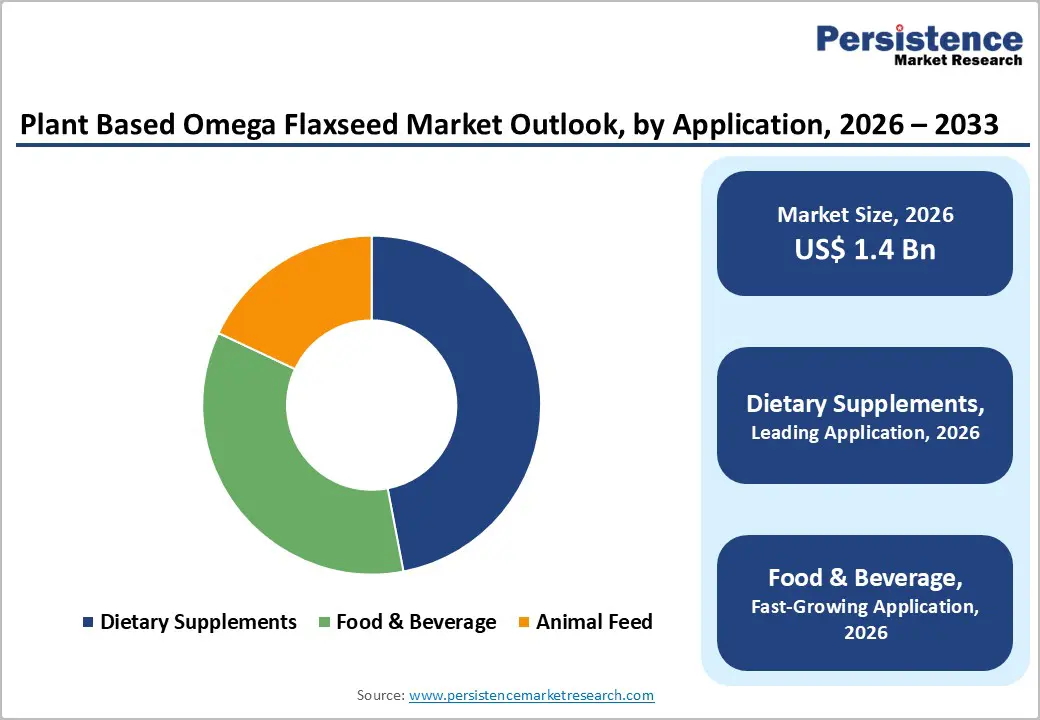
- Leading Application Segment: Dietary supplements are expected to lead with an estimated 47% share in 2026, while the food & beverage segment is likely to grow fastest at a CAGR of 8.7%, reflecting rising consumer demand for omega-3 fortified products.
- Labeling Insights: Organic products are projected to hold the largest share at 40% in 2026, while clean-label flaxseed offerings are likely to register the fastest growth at a CAGR of 9.5%, driven by increasing consumer demand for transparency, minimal processing, and natural ingredient claims.
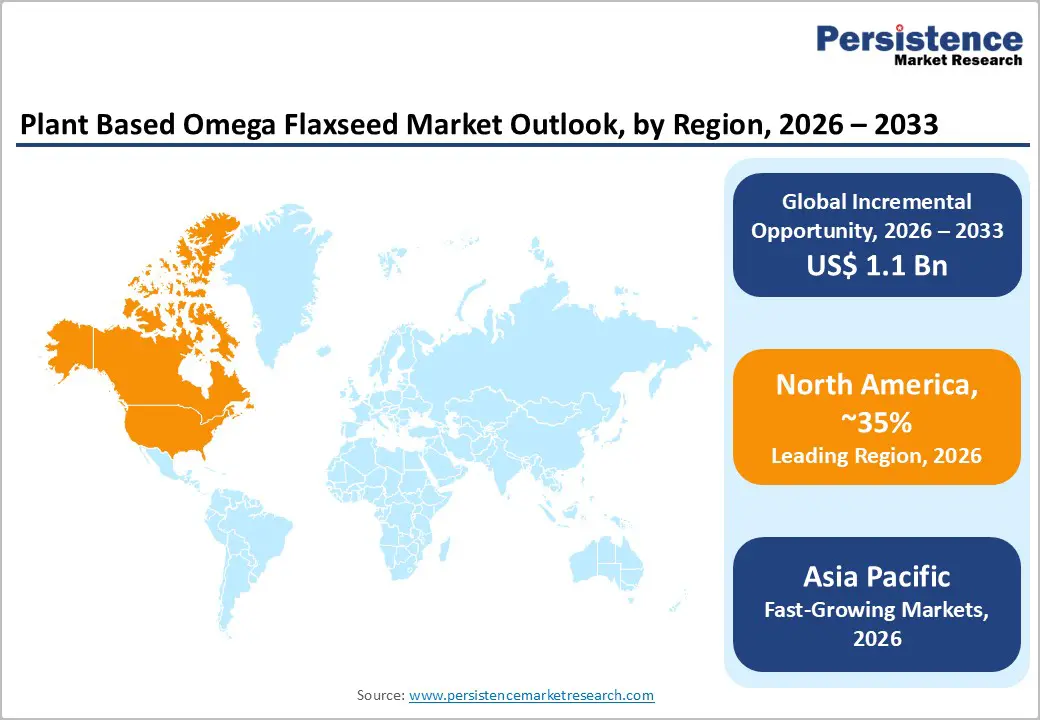
- Regional Leadership: North America is poised to account for the largest market share at 35% in 2026, while Asia Pacific is expected to be the fastest-growing region at a CAGR of 10.1% through 2033, supported by rising health awareness, urbanization, and increasing disposable incomes in China, India, and Japan.
- Key Market Developments: Strategic initiatives include high-potency product launches and supply chain expansions to enhance market penetration, support scalability, and meet rising global demand, particularly in emerging markets.
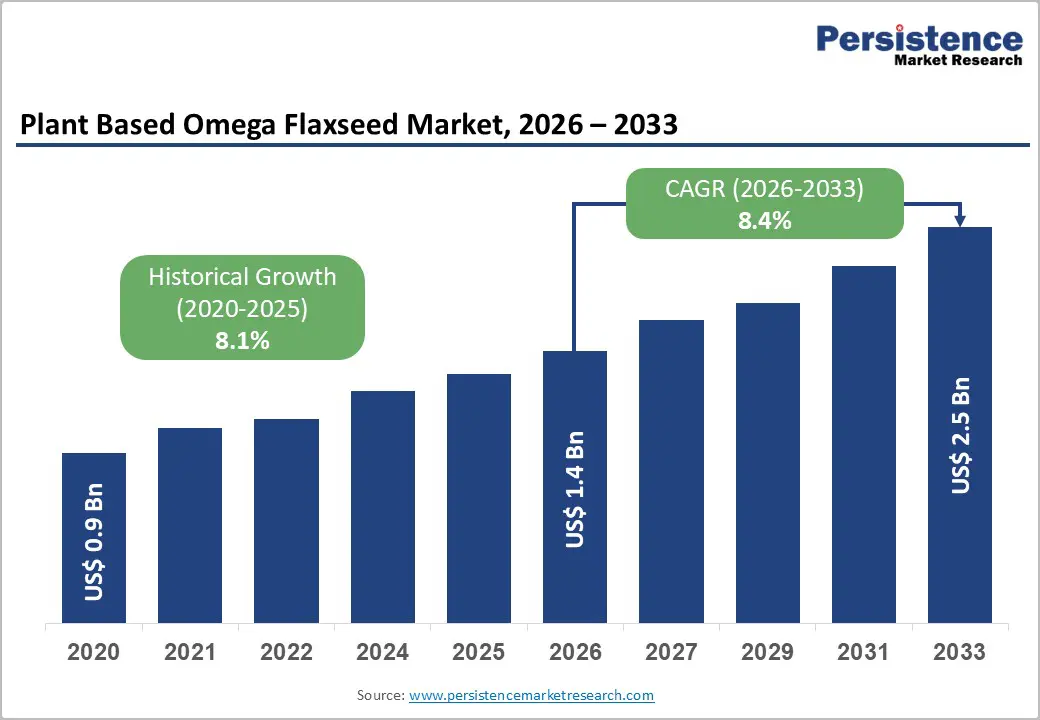
| Key Insights | Details |
|---|---|
|
Plant-Based Omega Flaxseed Market Size (2026E) |
US$ 1.4 Bn |
|
Market Value Forecast (2033F) |
US$ 2.5 Bn |
|
Projected Growth (CAGR 2026 to 2033) |
8.4% |
|
Historical Market Growth (CAGR 2020 to 2025) |
8.1% |
DRO Analysis
Driver - Rising Global Health Consciousness and Preventive Nutrition Demand
The growing focus on health and preventive care is driving consumer interest in nutrient-rich foods, especially those that support heart, brain, and immune health. Flaxseed, a rich source of omega-3 fatty acids, dietary fiber, and antioxidants, aligns with this shift toward functional eating patterns. In March 2026, the American Heart Association (AHA) issued updated dietary guidance emphasizing plant-based protein and unsaturated fats to improve cardiovascular outcomes, reinforcing public adoption of plant-derived nutrients. These recommendations also highlight the importance of integrating nutrient-dense seeds into daily diets to support long-term health outcomes.
This authoritative guidance recommends prioritizing foods such as legumes, nuts, and seeds in a heart-healthy diet, encouraging consumers and clinicians to value plant-based nutrient sources. As a result, the incorporation of flaxseed into food & beverages and dietary supplements is expanding across retail and online channels. The combination of policy-related signals, rising health awareness, and educational campaigns is driving sustained year-on-year market growth, enabling product diversification in functional nutrition categories and increasing adoption across multiple end-use applications. Growing demand from urban and higher-income populations further accelerates the uptake of flaxseed products worldwide.
Shift Toward Plant-Based Diets, Sustainable Foods, and Government Support
Global dietary patterns are increasingly shifting toward plant-based and sustainable nutrition choices, reflecting health, environmental, and ethical considerations. Flaxseed, as a plant-derived omega-3 source, addresses both consumer and environmental priorities. International research indicates that over three-quarters of the global population fail to meet the recommended omega-3 intake, underscoring a public health gap that plant-based oils such as flaxseed can help fill. Simultaneously, consumer preference for clean-label, minimally processed, and traceable ingredients is increasing, strengthening demand for flaxseed in functional foods and dietary supplements.
In addition, government support programs for oilseed crops, particularly in the European Union, provide direct payments, eco-schemes, and coupled support that encourage sustainable flax cultivation, improve yields, and stabilize production costs. Such programs reduce price volatility and improve the reliability of raw materials for food and supplement manufacturers. The combined impact of consumer preference for sustainable, clean-label foods and institutional support for flaxseed farming accelerates market penetration, facilitates product innovation, and drives cross-category growth in functional foods, beverages, and dietary supplements. These factors create a robust growth environment, particularly in developed and emerging markets with rising health awareness.
Restraints - Supply Chain and Price Volatility
The supply of flaxseed is highly sensitive to agricultural and climatic conditions, including extreme weather, seasonal variability, and geopolitical tensions that disrupt planting, harvesting, and logistics. Global oilseed markets have been affected by rising energy and fertilizer costs, making yield forecasting and long-term production planning difficult for farmers. In April 2026, the United Nations Food and Agriculture Organization (FAO) reported a surge in global food prices, warning that continued geopolitical and cost pressures could reduce fertilizer use and crop plantings. These dynamics create supply inconsistency for downstream manufacturers producing flaxseed oil, powder, and supplements. Manufacturers must navigate volatility in commodity pricing to maintain competitiveness. The unpredictability of supply contributes to risk in both production planning and global logistics management.
These supply challenges directly drive price volatility for flaxseed, increasing production costs and affecting retail pricing strategies. Unstable prices make it harder for companies to compete with alternative omega-3 sources such as chia seeds or algal oils. Persistent market uncertainty complicates margin management, particularly for nutritional supplement producers operating on tight profit margins. Disruptions in raw material availability may also limit market expansion and constrain new product launches. Price volatility can reduce adoption in cost-sensitive markets, discouraging new competitors from entering. Overall, supply instability creates operational and financial challenges for the global plant-based omega flaxseed industry.
Limited Consumer Awareness of ALA Conversion Efficacy
Flaxseed’s primary omega-3 component, α-linolenic acid (ALA), is beneficial but converts only partially into EPA and DHA in the human body, reducing perceived potency relative to marine-derived omega-3s. In March 2026, health reporting highlighted that while ALA contributes to omega-3 intake, its limited conversion can prevent meeting long-chain omega-3 needs without supplementation. Many consumers are unaware of this nuance, which can impact their perception of flaxseed efficacy for cardiovascular, cognitive, or inflammatory health support. This knowledge gap may slow adoption among health-conscious consumers.
Without clear educational campaigns or labeling initiatives, this misconception can restrict growth in premium supplement segments. Consumers who prioritize direct EPA/DHA intake may perceive flaxseed products as less effective than marine alternatives. Limited awareness can reduce market penetration for fortified foods and beverages containing flaxseed. Companies must address these gaps through informative marketing and transparent labeling. Educating consumers about the complementary benefits of ALA and plant-based omega-3 sources is critical. Failure to do so may slow adoption despite rising interest in plant-based diets.
Opportunity - Expansion in Emerging Markets
The Asia Pacific region, including China, India, and Japan, presents substantial growth potential for the plant-based omega flaxseed market. Rapid urbanization, rising disposable incomes, and increasing awareness of preventive healthcare are driving demand for nutrient-rich and functional foods. Industry reports from 2026 highlight that Asia’s food and beverage sector is embracing plant-based, holistic, and tech-driven nutrition trends, reflecting consumer readiness for health-promoting products. Expanding retail and e-commerce networks improve accessibility, while government health awareness campaigns further support the adoption of functional foods. These factors create a fertile environment for market expansion and innovation.
Market forecasts suggest that Asia Pacific could drive over 30 % of global market expansion by 2033, offering significant revenue opportunities for manufacturers and investors. Events such as Expo West 2026 showcase surging consumer interest in clean, functional foods, reinforcing the potential for mainstream adoption. Strategic entry can leverage modern retail, online sales, and urban health consciousness. Early movers can establish brand loyalty and supply chain networks. Rising middle-class health spending and government-endorsed preventive nutrition initiatives amplify market attractiveness. Collectively, these trends position the Asia Pacific as a primary growth engine for the global flaxseed market.
Innovation in Product Formats and Functional Foods
Innovation in flaxseed-based product formats presents a substantial opportunity to capture new revenue streams. Value-added derivatives, such as encapsulated oil supplements, flaxseed-infused functional beverages, and fortified baked goods, cater to the rising consumer demand for convenience, enhanced functionality, and health-oriented products. The U.S. superfoods market in 2026 illustrates growing mainstream adoption of nutrient-dense, multi-benefit products, highlighting global consumer readiness for functional innovations. Packaging, fortification, and flavor innovations enhance usability and shelf appeal, reinforcing preference for premium, health-oriented solutions.
Updated dietary guidance from the American Heart Association (AHA, 2026) emphasizes plant-based proteins and minimally processed foods, supporting regulatory and consumer focus on functional, clean-label nutrition. These endorsements strengthen opportunities for product diversification in functional foods, beverages, and supplements. By leveraging scientific credibility and innovation in convenience and bioavailability, manufacturers can capture health-conscious segments, including millennials and Gen-Z. Cross-category integration of flaxseed into snacks, meal replacements, and fortified products further amplifies market reach. This combination of consumer readiness, regulatory support, and functional innovation positions the sector for accelerated growth globally.
Category-wise Analysis
Product Form Insights
Flaxseed oil leads is poised to lead the product form category with an estimated 43 % revenue share in 2026, driven by high α-linolenic acid (ALA) content and versatile applications in nutraceuticals, dietary supplements, and functional foods. Consumer preference for liquid sources, along with cold-pressed and organic variants, strengthens clean-label appeal. Its efficacy in cardiovascular, cognitive, and anti-inflammatory health supports adoption across retail and online channels. Urbanization, rising disposable incomes, e-commerce penetration, and premium certifications further reinforce market dominance globally. Product innovations such as fortified and flavored oils enhance differentiation.
Flaxseed powder is anticipated to be the fastest-growing product form, with a 9.2% CAGR (2026–2033), driven by functional foods such as bakery items, smoothies, protein mixes, and plant-based meal replacements. Convenience, nutrient density, and compatibility with clean-label, gluten-free, and vegan diets support adoption. Fiber- and omega-3-enrichment trends and rising plant-based diet penetration in Asia Pacific and Latin America accelerate growth. Product innovations in taste, texture, and bioavailability enhance appeal. Collaborations with food manufacturers expand their use in fortified foods and beverages.
Application Insights
Dietary supplements are likely to dominate, with an estimated 41% revenue share in 2026, supported by the widespread use of flaxseed oil and powder in capsules, soft gels, and fortified tablets targeting cardiovascular, cognitive, and immune health. Adoption is reinforced by consistent purchasing patterns in North America and Europe, clean-label positioning, and preventive healthcare trends. Regulatory support for plant-based health claims strengthens consumer confidence. Retail and e-commerce expansion improves accessibility, especially in emerging markets. Product innovations in bioavailability and multi-nutrient formulations enhance market appeal. Overall, supplements remain the core revenue driver in the flaxseed market.
Food & beverage is projected to be the fastest-growing application segment, expanding at a 9.5% CAGR (2026–2033), driven by the integration of flaxseed into baked goods, cereals, plant-based dairy alternatives, and functional beverages. Health-conscious consumers increasingly seek fiber-, omega-3-, and nutrient-enriched products aligned with plant-based diets. Innovation in fortified snacks, smoothies, and ready-to-drink items enhances convenience and appeal. Urbanization, rising disposable incomes, and e-commerce penetration in the Asia Pacific and Latin America accelerate adoption. Collaborations between food manufacturers and ingredient suppliers drive market integration. Regulatory guidance and clean-label trends reinforce consumer trust, positioning food & beverage as the fastest-growing application segment.
Regional Insights
North America Plant Based Omega Flaxseed Market Trends
North America is expected to remain the leading regional market, holding around 35 % of global revenue share in 2026 due to high consumer health awareness and a mature functional nutrition ecosystem. The functional food and beverage market in North America generated approximately USD 98.41 billion in 2025 and continued growth into 2026 reflects strong demand for ingredients such as omega-3s, fiber, and clean-label products that align with preventive health trends. Established regulatory frameworks and advanced labeling standards reinforce quality assurance and amplify consumer trust in plant-based omega products. Retailers are expanding shelf space for fortified foods and supplements to meet broad distribution and e-commerce demand. Strategic investment activity in R&D and food innovation hubs drives new product development. Clean-label and organic certifications further bolster premium positioning.
Growth continues on multiple fronts, with consumer appetite for nutrient-dense, preventive nutrition solutions supporting innovation in fortified beverages, omega-3-enriched foods, and plant-based supplements. Recent industry data show the functional food and beverage sector expanding rapidly, led by health-oriented products and fortified formats that resonate with preventive health objectives. Urbanization and lifestyle shifts toward wellness further increase the adoption of functional ingredients such as flaxseed across applications. High retail penetration and well-developed e-commerce channels make these products easily accessible. Collaborations between ingredient suppliers and food manufacturers also broaden product portfolios. Combined, these factors reinforce North America’s leadership role and strategic importance in the global plant-based omega market.
Europe Plant-Based Omega Flaxseed Market Trends
Europe represents a significant established regional market, with countries such as Germany, the U.K., France, and Spain showing sustained demand for plant-based nutrition and functional foods. Regulatory frameworks across the EU enable standardized nutrient claims and facilitate health-oriented product launches, encouraging adoption of fortified and clean-label flaxseed offerings. The functional food sector in Europe is witnessing strong demand for protein and fiber-fortified products, reflecting broader consumer interest in proactive health and nutritional wellbeing. Clean-label and ingredient-transparency trends are particularly strong, with 62% of European consumers actively seeking products without artificial additives.
Investment trends show increased innovation in functional food technology and ingredient extraction, strengthening Europe’s manufacturing capabilities. Food brands are responding with enhanced formulation strategies that emphasize nutrient enrichment, sustainability, and allergen-free profiles. Retail penetration of fortified and omega-rich products is expanding across both traditional and modern trade channels. Public health initiatives and sustainability policies also encourage healthier eating patterns, reinforcing market growth. Urban populations with high purchasing power are driving demand for nutrient-boosted foods and wellness supplements.
Asia Pacific Plant-Based Omega Flaxseed Market Trends
Asia Pacific is projected to be the fastest-growing regional market, with a CAGR of 10.1% from 2026 to 2033, driven by rising health awareness, increasing disposable incomes, and rapid urbanization. Shifts toward preventive nutrition, plant-based diets, and wellness-oriented lifestyles are fueling strong consumer demand for omega-3 and fiber-rich products. Expanding retail infrastructure, including supermarkets, modern trade, and e-commerce platforms, improves product accessibility across China, India, Japan, and Southeast Asian nations. Regulatory frameworks are evolving to support functional food labeling, clean-label certifications, and quality standards, attracting global manufacturers to invest in local production and partnerships.
The region’s young, urban population exhibits higher health literacy and is increasingly seeking convenient, fortified, and plant-based food options. Lifestyle changes, including sedentary work patterns and greater awareness of chronic diseases, drive preventive health consumption. Functional beverages, fortified snacks, and dietary supplements are witnessing strong uptake. Collaborations between multinational brands and local distributors enhance supply chain efficiency and cultural alignment. Rising middle-class incomes and willingness to pay for premium, certified products further accelerate growth. These factors collectively position Asia Pacific as the fastest-growing market for plant-based omega flaxseed products globally.
Competitive Landscape
The global plant based omega flaxseed market is moderately consolidated, with major players such as TA Foods Ltd, Archer Daniels Midland Company, Cargill, Inc., and Bioriginal Food & Science Corp. capturing a significant revenue share. These companies leverage extensive supply networks, ingredient quality control, and innovation in clean-label, omega-3 rich formulations to maintain market leadership.Regional and mid-tier competitors, including Healthy Food Ingredients LLC, CanMar Grain Products Ltd, and Heartland Flax, focus on niche segments such as organic oils or fortified functional ingredients. They benefit from localized distribution, agility, and specialization in functional foods, dietary supplements, and plant-based nutrition products.
Technological adoption, including digital traceability and blockchain-enabled quality tracking, supports product differentiation and supply chain transparency. Collaborations with food manufacturers enable innovation in fortified beverages, bakery products, and personalized nutrition solutions.Market consolidation is expected to grow gradually as leading players pursue capacity expansions, strategic partnerships, and M&A, while software and technology integration strengthen supply chain efficiency and consumer trust. Agile innovators continue to capture opportunities in specialty and emerging market segments.
Key Industry Developments
- In May 2025, Danone announced the acquisition of a majority stake in California-based Kate Farms, finalized on July 1, 2025, to strengthen its specialized nutrition portfolio in plant-based and organic products. This move expands Danone’s U.S. medical and everyday nutrition offerings, leveraging Kate Farms’ expertise while integrating it under Danone’s specialized nutrition segment alongside Nutricia.
Companies Covered in Plant Based Omega Flaxseed Market
- TA Foods Ltd
- AgMotion Specialty Grains
- Simosis International
- Heartland Flax
- Healthy Food Ingredients LLC
- Stokke Seeds
- S.S Johnson Seeds
- CanMAr Grain Products Ltd
- Zeghers Seed Inc.
- Stober Farms LLC
- Archer Daniels Midland Company
- Bioriginal Food & Science Corp.
- Cargill, Incorporated
- Glanbia Nutritionals
Frequently Asked Questions
The global market is projected to reach US$ 1.4 billion in 2026.
Rising health consciousness, plant-based diet adoption, and preventive nutrition demand drive market growth.
The market is expected to grow at a CAGR of 8.4 % from 2026 to 2033.
Expansion in emerging markets and innovation in functional foods and supplements offer high growth potential.
TA Foods Ltd, Archer Daniels Midland Company, Cargill, Inc., and Bioriginal Food & Science Corp. are leading players.


