




- Home Care & Utilities
- Paint Pole Market
Paint Pole Market Size, Share, Trends, Growth, Regional Forecasts, 2026 to 2033
Paint Pole Market by Product Type (Telescopic Paint Poles, Fixed-Length Paint Poles, Specialty Paint Poles), Length Type (Up to 4 feet, 4-8 feet, Above 8 feet), End-User (Residential Users, Commercial Sector, Industrial Sector, Professional Painters & Contractors), and Regional Analysis for 2026 - 2033

Paint Pole Market Share and Trends Analysis
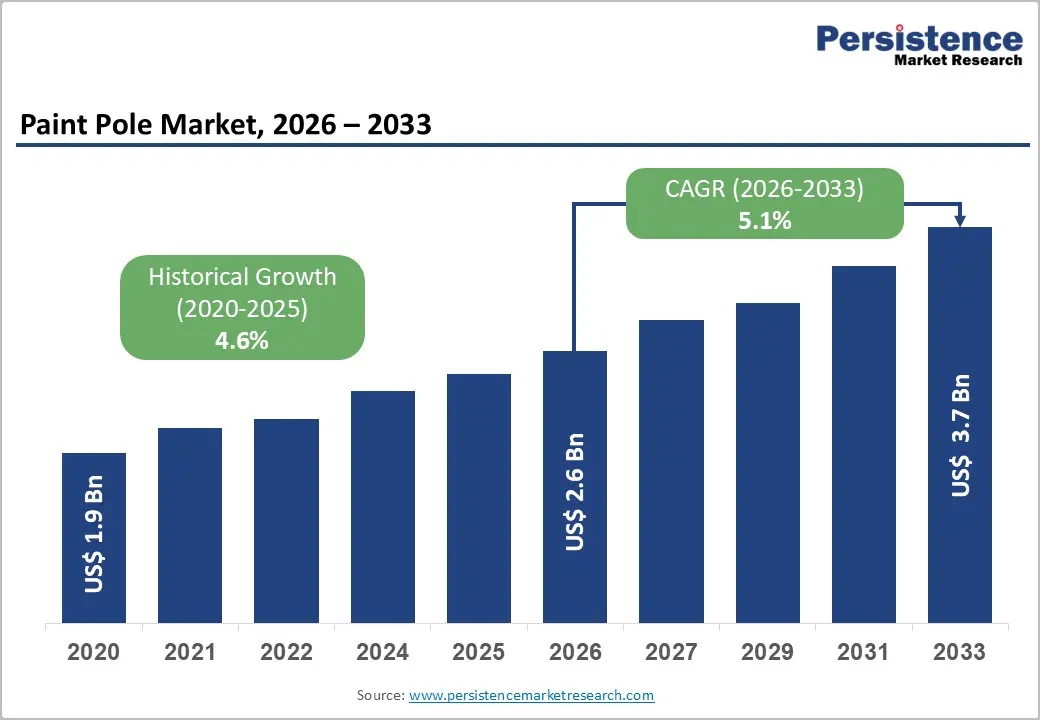
The global paint pole market size is likely to be valued at US$ 2.6 billion in 2026, and is projected to reach US$ 3.7 billion by 2033, growing at a CAGR of 5.1% during the forecast period 2026 - 2033.
Market growth is driven by rising adoption of advanced painting tools across residential, commercial, and industrial users, enhancing operational efficiency and reducing labor intensity. Urbanization and construction expansion create demand for versatile solutions suited for high ceilings, complex structures, and large-scale projects. Technological improvements in telescopic and specialty paint poles boost durability, ergonomics, and user safety, encouraging use among professional painters and do-it-yourself (DIY) consumers.
Supportive workplace safety policies incentivize equipment upgrades, while enhanced retail and electronic commerce channels improve accessibility. Growing awareness of ergonomic and safe painting practices further increases preference for adjustable, innovative paint poles across end users.
Key Industry Highlights
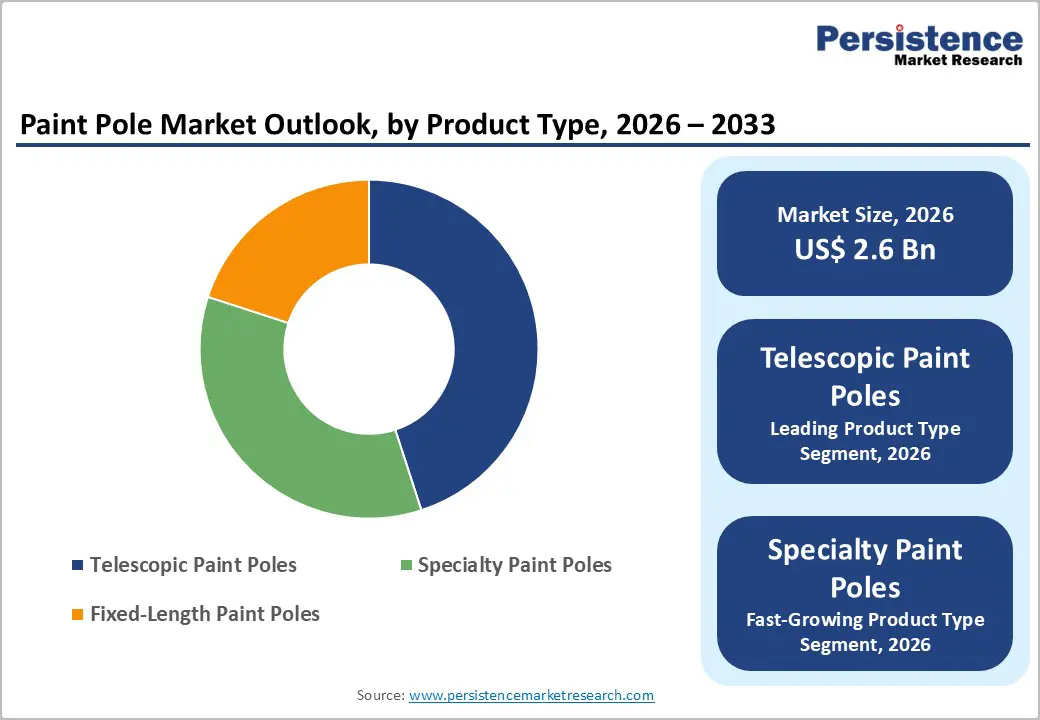
- Leading Product Type: Telescopic paint poles are expected to command around 45% of revenue in 2026, driven by ergonomic design and commercial adoption.
- Fastest-Growing Product Type: Specialty paint poles are likely to be the fastest-growing during 2026 - 2033, propelled by innovative attachments and industrial application demand.
- Leading End-User: Commercial sector is expected to lead with 40% share in 2026, supported by large-scale projects.
- Fastest-Growing End-User: Professional painters & contractors are expected to be the fastest-growing segment, driven by operational efficiency and technology adoption.
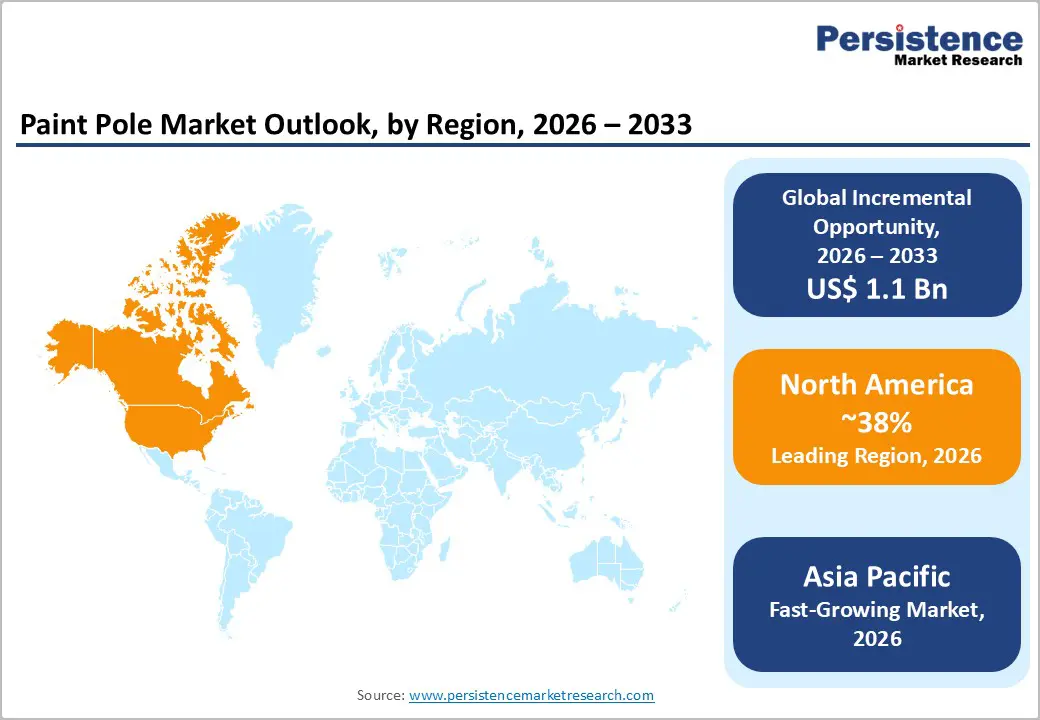
- Dominant Region: North America is expected to hold about 38% market share, supported by mature construction infrastructure and safety regulations.
- Fastest-growing Regional Market: Asia Pacific is forecasted to be the fastest-growing market through 2033, stimulated by high-rise construction and digital distribution.
| Key Insights | Details |
|---|---|
| Paint Pole Market Size (2026E) | US$ 2.6 Bn |
| Market Value Forecast (2033F) | US$ 3.7 Bn |
| Projected Growth (CAGR 2026 to 2033) | 5.1% |
| Historical Market Growth (CAGR 2020 to 2025) | 4.6% |

DRO Analysis
Advanced Tools to Boost Efficiency and Reduce Labor
The adoption of advanced tools in painting operations drives growth through measurable gains in productivity and cost efficiency. Technological upgrades in equipment link directly to output per labor hour, aligning with broader productivity trends where U.S. nonfarm labor output per hour rose by 2.8% in 2025 as reported by the Bureau of Labor Statistics. By enabling workers to cover larger surface areas with fewer strokes and reduced physical strain, these tools shorten task durations and reduce cumulative labor hours. Firms gain flexibility to allocate labor to value-added activities instead of repetitive painting tasks, strengthening operational throughput. When equipment reduces manual effort, firms can bid more competitively for projects with tight timelines and fixed costs, improving capacity utilization and contracting success rates. Customer demand expands as service providers promise faster turnaround, translating tool efficiency into differentiation and revenue capture.
From a demand perspective, advanced features such as adjustable length, integrated rollers, and lightweight composites reduce operator fatigue and injury risk. These characteristics support safer worksites and lower indirect labor costs related to downtime and turnover. Enhanced tools smooth workflow planning on complex jobs, minimizing schedule volatility that typically inflates labor costs and delays project deliveries. In environments with acute labor shortages, equipment that amplifies individual productivity sustains output without proportionate hiring, supporting stable gross margins. Reduced reliance on manual effort shifts workforce deployment toward higher-skill tasks, raising overall labor efficiency and reinforcing capital investment in advanced solutions.
DIY Trends to Expand Consumer Base
Rising participation in DIY projects drives demand for paint poles by linking homeowner behavior with tool adoption. The U.S. Census Bureau reported total residential construction and renovation spending reached $926.5 billion in October 2025, indicating strong investment in home improvements. Homeowners increasingly undertake painting tasks themselves, reducing reliance on professional services. Digital tutorials and social media enhance skill confidence, promoting routine tool use. Frequent touch-ups and aesthetic updates create recurring purchase patterns, expanding the consumer base beyond contractors to casual DIY participants.
Growth of the DIY segment stimulates operational and demand-side expansion by broadening market reach. Households favor versatile tools that reduce external labor costs while supporting routine maintenance cycles. A larger DIY audience encourages retail and e-commerce channel growth, increasing accessibility. Ergonomic and user-friendly innovations gain preference among value-conscious buyers, strengthening brand differentiation. Repeated usage, upgrades, and diversified applications in residential projects sustain long-term demand. This structural behavioral shift generates consistent adoption and expands the addressable market for painting tools.
Maintenance and Replacement Concerns to Reduce Long-term Usage
Frequent maintenance and replacement requirements create significant cost burdens that limit long-term adoption. Paint poles experiencing wear or damage require recurring expenses for parts, servicing, and skilled labor, raising total cost of ownership. Users often delay purchases when replacement cycles shorten, reducing repeat sales and slowing market growth. Operational disruptions from unexpected failures decrease efficiency on job sites and extend project timelines. Contractors and DIY consumers may choose multipurpose or lower-maintenance tools to minimize downtime and expenses. Ongoing maintenance demands also discourage new buyers seeking reliable, ready-to-use equipment, constraining overall demand and slowing adoption across commercial and residential segments.
High replacement frequency directly affects workflow reliability and user confidence. Equipment failure during projects reduces productivity and increases labor requirements, raising operational costs. Limited availability of trained personnel for maintenance further intensifies downtime and inefficiency. Persistent repair needs create uncertainty about tool longevity, prompting buyers to allocate capital elsewhere. In commercial applications, delayed project completion from equipment issues can reduce profit margins and adoption willingness.
Fluctuating Raw Material Prices to Impact Manufacturing Costs
Volatility in raw material costs directly increases manufacturing expenses for paint poles. Metals, plastics, and composite inputs experience frequent price swings, creating uncertainty in production budgets. Rising input costs force manufacturers to either absorb the additional expense, reducing profit margins, or increase selling prices, which may depress demand. Procurement strategies become reactive, with firms overstocking to hedge against future spikes or maintaining minimal inventory that exposes production to sudden cost surges. Operational planning suffers, as fluctuating material prices disrupt cost forecasting, labor allocation, and supply chain scheduling. These inefficiencies reduce overall production flexibility and limit the ability to maintain consistent pricing structures.
Unstable input costs also affect supplier negotiations and working capital management. When manufacturers cannot secure long-term contracts at predictable rates, they face sudden financial pressures that impact cash flow and investment planning. Increased production costs can weaken competitive positioning, especially in price-sensitive customer segments. Recurrent price variability discourages scaling initiatives, limits efficiency upgrades, and constrains strategic expansion. The interplay between input cost instability, operational inefficiencies, and potential demand suppression creates structural limitations, making consistent growth and profitability challenging within the paint pole sector.
Development of Eco-friendly and Sustainable Materials to Broaden Market Scope
Shifting toward eco-friendly and sustainable materials offers a strategic opportunity by aligning products with structural demand shifts and regulatory incentives. Incorporating recycled, bio-based, or low-impact inputs reduces reliance on virgin polymers and metals, mitigating raw material cost volatility and supply disruptions. The U.S. Environmental Protection Agency (EPA) reported a 32.1% municipal solid waste recycling and composting rate in 2018, highlighting growing regulatory emphasis on circular resource use. Institutional buyers and large-scale construction projects increasingly prefer tools with measurable sustainability credentials, driving demand and encouraging manufacturers to adopt life-cycle optimized solutions with reduced environmental impact compared to conventional alternatives.
Sustainable materials enhance brand positioning among environmentally conscious consumers and institutional clients that assign economic value to environmental performance. Inputs with lower volatile organic compound content or recycled components improve workplace safety, reduce compliance costs, and support green building certification criteria. As construction and renovation sectors implement stricter sustainability standards, demand grows for tools compatible with low-impact coatings, expanding addressable segments and enabling differentiation through verifiable sustainability attributes and transparent supply chain practices, strengthening competitive positioning and long-term adoption potential.
Integration of Smart and Adjustable Features for Professional Use to Spur Growth
Smart and adjustable features in professional paint poles create structural growth potential through efficiency gains and precision improvements. Digital angle indicators, feedback sensors, and telescopic adjustments allow consistent coverage, reducing errors and task repetition. Contractors face tight schedules and rising labor costs, making tools that accelerate workflows highly attractive. U.S. nonfarm business sector labor productivity increased 2.1% in 2025, reflecting output growth exceeding hours worked. Adjustable designs minimize ergonomic strain and tool changeovers, supporting crew endurance and reducing fatigue. Demand stems from professional users seeking measurable performance gains and lifecycle efficiency for high-volume projects.
At the supply level, manufacturers offering smart adjustable poles can target premium buyers prioritizing capability and operational transparency. Sensors and modular extensions allow tailoring of reach, torque, and motion to task requirements. Commercial interior and industrial finishing segments adopt tools reducing rework and standardizing outcomes. Labor shortages and skill gaps heighten appeal for productivity-amplifying equipment. Decision makers allocate budgets to tools delivering visible schedule compression and cost control. Adoption incentives increase where performance metrics tie directly to project efficiency, reinforcing demand for professional-grade poles with integrated intelligent and ergonomic functionality.
Category-wise Analysis
Product Type Insights
Telescopic paint poles are projected to capture about 45% of the market in 2026 due to strong professional and commercial adoption. Adjustable-length designs enable access to high ceilings and complex architecture, improving efficiency and safety. Ergonomic benefits reduce strain for painters and contractors, while lightweight alloys, anti-slip grips, and modular attachments enhance durability and usability. Wide distribution through dealers and digital platforms ensures accessibility for commercial and residential users. Regulatory focus on workplace safety encourages preference for adjustable solutions.
Specialty paint poles are expected to be the fastest-growing segment during the 2026-2033 forecast period, propelled by demand for task-specific solutions and innovative designs. They serve industrial, commercial, and niche residential applications requiring unique attachments and durability. Versatile designs integrate with rollers, sprayers, and extension platforms, enhancing efficiency and precision. Lightweight materials, anti-vibration technology, and modular attachments improve user experience. Rising focus on productivity and safety drives adoption, while e-commerce and collaborations with technology providers expand accessibility and accelerate innovation, enabling rapid response to evolving painting and construction requirements.
End-User Insights
Commercial sector is likely to be the leading segment with a projected 40% of the paint pole market share in 2026 due to high-volume painting requirements across offices, retail outlets, hospitality, and institutional buildings. Contractors prioritize efficiency, safety, and reliability, favoring durable, ergonomic, and versatile poles. Regulatory focus on workplace safety drives demand. Telescopic and specialty poles reduce labor and time for large projects. Distribution through professional suppliers, e-commerce, and rental partnerships, combined with modular designs, lightweight materials, and professional endorsements, enhances accessibility, usability, and credibility across commercial applications.
Professional painters & contractors are anticipated to be the fastest-growing segment from 2026 to 2033, fueled by increasing specialization and demand for high-quality painting services. The segment favors ergonomic, advanced tools such as telescopic and specialty poles to enhance efficiency and safety across commercial and residential projects. Lightweight, modular, and adjustable-length solutions address complex structures and high ceilings. Growth is supported by digital channels, training programs, and manufacturer partnerships, while urbanization, high-rise construction, and integration with specialized rollers or coatings drive adoption and enable service differentiation.
Regional Insights
North America Paint Pole Market Trends and Insights
North America is expected to lead with an estimated 38% of the paint pole market share, driven by high commercial and residential construction activity in the United States, Canada, and Mexico. Demand for efficient and ergonomic painting solutions is elevated by stringent safety and labor regulations. Contractors and professional painters prefer adjustable-length and specialty poles that reduce labor intensity and improve precision for large-scale projects. Well-established distribution networks, including professional supply channels and e-commerce platforms, ensure wide product accessibility. Technological adoption, such as lightweight alloys, modular attachments, and anti-slip grips, supports consistent utilization across diverse applications. Urban infrastructure projects and high-rise construction further reinforce tool demand.
Strong market dominance is supported by professional training programs and endorsements in the United States, Canada, and Mexico, enhancing credibility and encouraging adoption of advanced poles. Firms invest in research and development to introduce task-specific solutions tailored to complex architectural requirements. Operational efficiency gains and productivity improvements incentivize continued procurement of advanced equipment. Integration with rollers, sprayers, and coatings increases versatility and usability in industrial, commercial, and high-end residential projects. Strategic partnerships with distributors and equipment rental services enable rapid regional penetration, supporting consistent availability and market responsiveness while maintaining competitive positioning in price-sensitive segments.
Europe Paint Pole Market Trends and Insights
Europe is projected to maintain a strong position in the paint pole market between 2026 and 2033, driven by commercial and residential construction in Germany, France, and United Kingdom. High demand for efficient, ergonomic poles supports adoption of telescopic and specialty models. Contractors prioritize tools that reduce labor, improve precision, and comply with safety and ergonomic standards. Refurbishment and renovation projects increase reliance on adjustable-length and modular solutions. Lightweight alloys, anti-slip grips, and modular attachments enhance usability and durability across applications.
Growth is reinforced by professional training, endorsements, and partnerships with distributors and rental services ensuring accessibility and technical support. Italy and Spain drive demand through high-end residential and commercial projects requiring specialized poles compatible with rollers, sprayers, and coatings. Task-specific solutions improve efficiency and productivity. Investments in ergonomic designs and vibration-reduction technology meet professional needs. Well-developed supply chains, digital channels, and strong contractor networks enable rapid market penetration, consistent availability, and competitive positioning in cost-sensitive and quality-focused segments.
Asia Pacific Paint Pole Market Trends and Insights
Asia Pacific is forecasted to be the fastest-growing market for the paint pole market between 2026 and 2033, propelled by rapid urbanization and industrial expansion in China and India, which drive large-scale commercial and residential painting requirements. Growing high-rise construction and infrastructure development create strong demand for efficient and versatile painting solutions. In Japan and South Korea, adoption of advanced and ergonomic tools by professional painters supports market acceleration. Rising awareness of workplace safety and productivity among contractors encourages procurement of adjustable-length and specialty poles. Expanding e-commerce and professional supply networks improve accessibility to both urban and emerging markets, further reinforcing growth.
Market growth is supported by innovation in lightweight materials, modular attachments, and anti-vibration technology, which increase operational efficiency and usability across diverse applications. Strategic partnerships between manufacturers and regional distributors enable rapid market penetration and localized service support. Adoption of specialty poles for industrial and niche commercial tasks increases differentiation and reduces substitution risk. Contractors and professional painters in these countries prioritize equipment that reduces labor intensity and improves precision for complex projects. Technology integration with rollers, sprayers, and coatings enhances versatility and aligns with evolving construction and painting standards, sustaining adoption momentum across the regional market.
Competitive Landscape
The global paint pole market shows a moderately fragmented structure with multiple regional and global manufacturers competing across product types and end-user segments. Key players such as Mr. LongArm, GORDON BRUSH, Focus Technology, UNGER, and Australian Brushware Corporation hold significant market share, while smaller regional suppliers serve local demand. North America and Europe demonstrate higher consolidation due to established distributor networks and compliance with safety and regulatory standards, giving leading manufacturers competitive advantages.
Competition focuses on innovation, ergonomic design, durability, and safety compliance. Top companies differentiate with telescopic and specialty poles, modular attachments, and lightweight materials. Product credibility is strengthened through professional endorsements and training programs, driving preference among contractors and commercial users. These approaches support market relevance, allow entry into emerging segments, and enhance operational positioning across industrial, commercial, and residential applications, promoting sustained growth and competitive strength.
Key Industry Development
- In March 2026, Haydn Brush Company’s industry guidance on key extension pole features highlighted growing professional and DIY demand for ergonomic, durable paint poles with versatile locking systems, materials, and thread compatibility to improve efficiency and safety in high-reach painting tasks.
- In April 2025, Purdy launched the POLE+ extension pole, featuring enhanced adjustability, stability, and reduced flex, reflecting growing demand for ergonomic, high-reach painting tools that improve control and efficiency. This innovation aligns with trends toward durability, precision handling, and productivity optimization for professional painting applications.
Companies Covered in Paint Pole Market
- Mr. LongArm
- GORDON BRUSH MFG. CO., INC.
- Focus Technology Co., Ltd.
- UNGER
- Australian Brushware Corporation Pty Ltd
- Stanley Black & Decker, Inc.
- TapeTech Tool Co. Inc.
- Kansai Paint Co.,Ltd.
- Titan Tool Inc.
- NESPOLI GROUP
- Akzo Nobel N.V.
Frequently Asked Questions
The global paint pole market is projected to reach US$ 2.6 billion in 2026.
Rising construction, renovation demand, and adoption of ergonomic, versatile, and durable painting tools are driving the market.
The market is poised to witness a CAGR of 5.1% from 2026 to 2033.
Integration of smart, modular, and lightweight paint poles for professional and commercial applications offers key market opportunities.
Some of the key market players include Mr. LongArm, GORDON BRUSH, Focus Technology, UNGER, and Australian Brushware Corporation.


