




- Specialty & Fine Chemicals
- Methane Sulfonic Acid Market
Methane Sulfonic Acid Market Size, Share, and Growth Forecast, 2026 - 2033
Methane Sulfonic Acid Market by Product Type (Pharmaceutical Grade, Industrial Grade), Application (Electroplating, Pharmaceuticals & Medicine, Organic Synthesis, Industrial Cleaning), and Regional Analysis for 2026 - 2033

Methane Sulfonic Acid Market Size and Trends Analysis
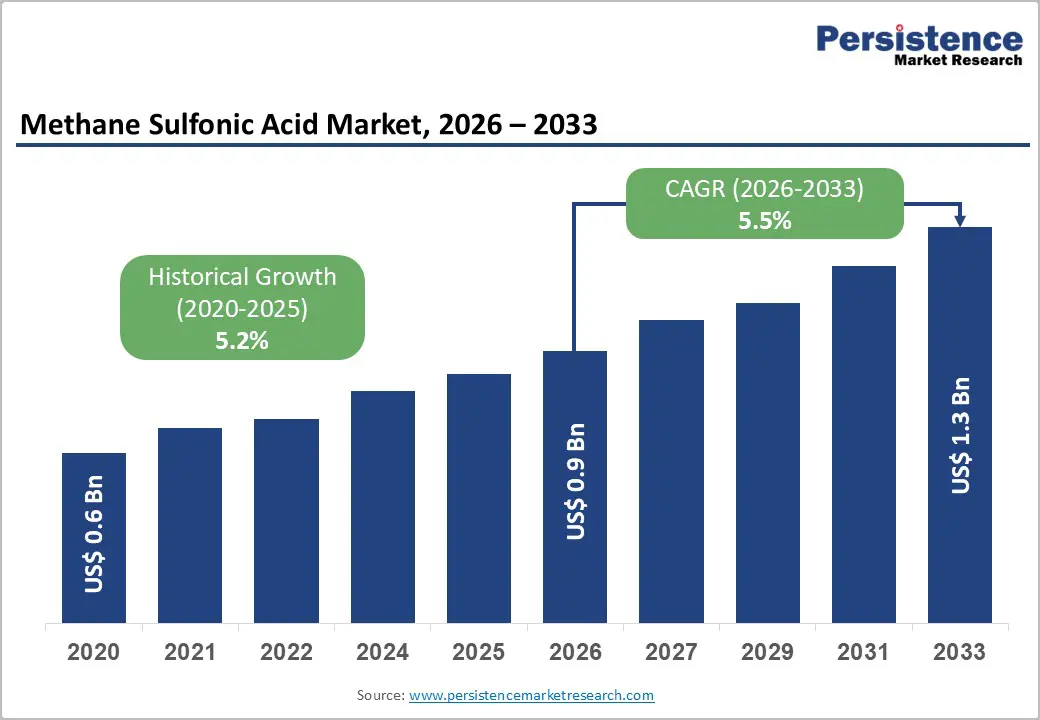
The global methane sulfonic acid market size is likely to be valued at US$0.9 billion in 2026 and is expected to reach US$1.3 billion by 2033, growing at a CAGR of 5.5% during the forecast period from 2026 to 2033, driven by increasing preference for high-performance, environmentally safer acid systems across electroplating, pharmaceuticals, and organic synthesis industries.
Its biodegradable nature and low toxicity make it a suitable replacement for traditional mineral acids under evolving environmental regulations such as REACH and EPA guidelines. The market is supported by growing semiconductor manufacturing, expansion in pharmaceutical API production, and rising industrial cleaning applications. Continuous investment in specialty chemicals and green chemistry adoption is reinforcing steady, long-term market growth.
Key Industry Highlights:
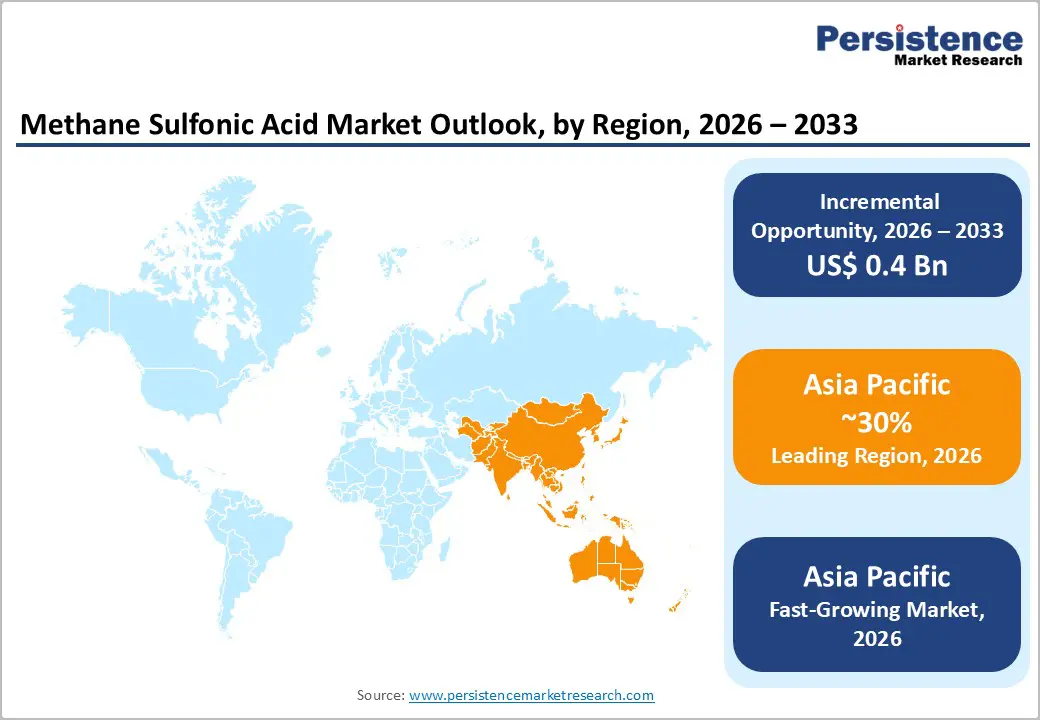
- Leading Region: Asia Pacific is anticipated to be the leading region, accounting for a market share of 30% in 2026, driven by strong demand from electronics, pharmaceuticals, and metal finishing industries.
- Fastest-growing Region: Asia Pacific is likely to be the fastest-growing region, supported by rapid industrialization, expanding specialty chemical production, and increasing adoption of eco-friendly acid alternatives across countries.
- Leading Product Type: The industrial-grade segment is projected to represent the leading product type in 2026, accounting for 73% of the revenue share, driven by its widespread use in electroplating, cleaning, and synthesis applications across large industrial demand bases.
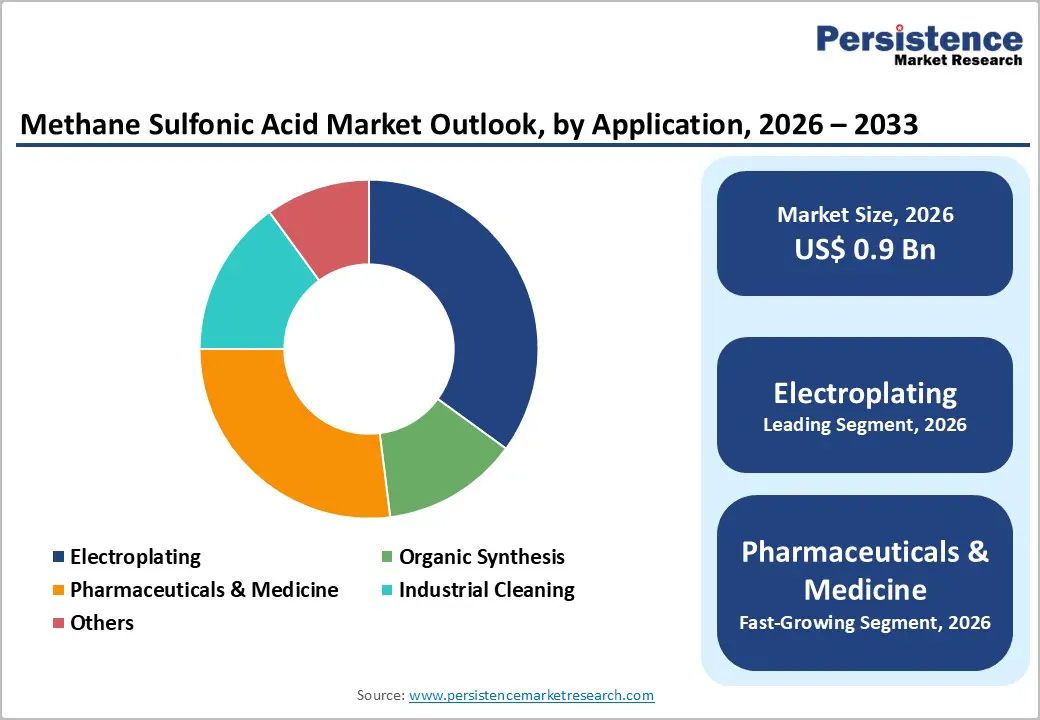
- Leading Application: Electroplating is anticipated to be the leading application, accounting for over 50% of the revenue share in 2026, supported by its extensive use in metal finishing across electronics, automotive, and industrial components.
- Key Opportunity: The key market opportunity lies in the accelerating shift toward sustainable and high-purity chemical processes, driving widespread replacement of traditional mineral acids with methane sulfonic acid across pharmaceuticals, electronics, and industrial applications.

DRO Analysis
Driver - Growing Demand from Electroplating and Metal Finishing
Industries increasingly prefer methane sulfonic acid (MSA) based electrolytes for their high efficiency and stability. MSA is widely used in tin, lead, and copper plating due to its superior conductivity and lower environmental impact compared to traditional mineral acids.
According to recent chemical industry insights from S&P Global Commodity Insights (2025), expansion in electronics manufacturing, automotive components, and precision metal parts is significantly increasing the consumption of plating chemicals, directly supporting steady demand growth for MSA across industrial processing applications.
Electroplating applications are also expanding due to stricter environmental regulations promoting safer and less toxic chemical systems in surface treatment industries. MSA enables high-quality finishes while reducing hazardous waste generation, making it a preferred alternative in modern plating technologies.
Restraint - Complex and Evolving Regulatory Approval Landscape
The methane sulfonic acid market faces restraints due to a complex and continuously evolving regulatory approval landscape governing chemical manufacturing and usage. Compliance with frameworks such as the EU REACH, US EPA guidelines, and OECD chemical safety standards increases documentation, testing, and approval timelines for producers.
According to chemical regulatory reviews by the European Chemicals Agency (ECHA, 2025), stricter classification, labeling, and handling requirements for industrial acids create additional operational burdens, especially for small and mid-sized manufacturers. These regulatory complexities can slow product approvals and increase overall compliance costs across supply chains. Varying regulations across regions create fragmentation in market access, making distribution and standardization more challenging.
Opportunity - Green-Process Substitution in Industrial Cleaning and Synthesis
MSA is increasingly replacing traditional strong acids such as hydrochloric and sulfuric acid due to its biodegradable nature and lower environmental toxicity. According to OECD green chemistry principles (2025) and industry sustainability reports, manufacturers are prioritizing safer chemical alternatives that reduce hazardous emissions and wastewater treatment burdens. This shift is creating strong demand for MSA in environmentally conscious cleaning formulations and sustainable industrial processing systems worldwide.
The opportunity is strengthened by rising investment in sustainable manufacturing across pharmaceuticals, electronics, and specialty chemicals. MSA’s non-oxidizing and stable properties make it suitable for cleaner synthesis routes and high-performance formulations. As industries transition toward low-carbon and eco-compliant production systems, the adoption of MSA is accelerating in both developed and emerging economies.
Category-wise Analysis
Product Type Insights
The industrial grade segment is expected to lead the market, accounting for approximately 73% of the revenue in 2026, driven by its extensive use in electroplating, metal cleaning, and large-scale chemical synthesis applications across multiple industries. Industries prefer industrial-grade MSA as it offers stable performance, easy handling, and a consistent supply for continuous manufacturing operations. For example, it is widely used in copper and tin electroplating processes in electronics and automotive component production.
The pharmaceutical-grade segment is likely to represent the fastest-growing segment, supported by rising demand for high-purity reagents in active pharmaceutical ingredient (API) synthesis and regulated drug manufacturing. It is expanding rapidly, contributing an increasing share in the specialty chemicals segment as pharma companies shift toward stricter impurity control standards. For instance, it is increasingly used in complex intermediate synthesis for cardiovascular and oncology drug production, where precision and purity are critical.
Application Insights
Electroplating is projected to lead the market, capturing around 50% of the revenue share in 2026, supported by its widespread use in metal finishing industries, particularly in electronics, automotive, and industrial hardware manufacturing. It accounts for the largest application share, supported by strong demand for high-quality, corrosion-resistant metal coatings. For instance, MSA is widely used in printed circuit board (PCB) plating in semiconductor manufacturing, where precision and conductivity are critical.
The pharmaceuticals & medicine segment is likely to be the fastest-growing application, driven by increasing demand for high-purity chemical reagents in drug synthesis and advanced pharmaceutical formulations. It is gaining a rising share within the overall application mix as pharmaceutical production becomes more complex and quality-sensitive. For example, MSA is used in API synthesis pathways for advanced therapeutic drugs where reaction control and purity are essential. Growth is strongly supported by expansion in healthcare manufacturing and stricter regulatory requirements for impurity control.
Regional Insights
North America Methane Sulfonic Acid Market Trends
North America is likely to be a significant market for methane sulfonic acid, driven by strong demand from pharmaceuticals, semiconductors, and specialty chemical industries, supported by strict environmental regulations and advanced industrial infrastructure. A key example includes Thermo Fisher Scientific, which has expanded its high-purity chemical supply chain in the U.S. to support pharmaceutical and laboratory-grade applications.
U.S. Methane Sulfonic Acid Market Trends
The U.S. dominates the regional market, driven by pharmaceuticals, electronics, and advanced manufacturing sectors. The country is a major hub for semiconductor production, supported by the CHIPS Act, which is increasing demand for high-purity chemicals. MSA is widely used in electroplating, API synthesis, and industrial cleaning applications. Strong environmental regulations from the EPA are encouraging the substitution of traditional acids with safer alternatives.
Canada Methane Sulfonic Acid Market Trends
Canada is a significant market for methane sulfonic acid, supported by a steady growth in specialty chemicals, mining-related processing, and industrial cleaning applications. The country is increasingly adopting environmentally compliant chemical systems under strict regulations from Environment and Climate Change Canada (ECCC). Demand is also rising from pharmaceutical formulation and laboratory applications.
Europe Methane Sulfonic Acid Market Trends
Europe is likely to be a significant market for methane sulfonic acid, due to strict environmental regulations under REACH, strong pharmaceutical demand, and advanced chemical manufacturing infrastructure. The region emphasizes sustainable and low-toxicity chemical systems, supporting increased adoption of MSA in electroplating, synthesis, and cleaning applications. For instance, BASF SE has expanded its sustainable chemical solutions portfolio across Europe, strengthening the supply of eco-friendly acid systems.
U.K. Methane Sulfonic Acid Market Trends
The U.K. is a significant market for methane sulfonic acid, supported by strong pharmaceutical R&D and specialty chemical industries. The country has a well-developed contract manufacturing ecosystem, which drives demand for high-purity reagents in drug synthesis and advanced therapeutics. MSA is increasingly used in pharmaceutical intermediates and precision chemical processes. The U.K. is also focusing on sustainable chemical manufacturing and low-emission industrial systems.
Germany Methane Sulfonic Acid Market Trends
Germany dominates the regional market, driven by its strong automotive, chemical, and industrial manufacturing base. The country is a leader in electroplating, surface finishing, and advanced engineering applications. Germany also has a strong R&D ecosystem supporting innovation in specialty chemicals. Demand is driven by electronics, automotive components, and precision manufacturing sectors.
Asia Pacific Methane Sulfonic Acid Market Trends
The Asia Pacific region is anticipated to be the leading region, accounting for a market share of 30% in 2026, driven by rapid industrialization, strong electronics manufacturing, and expanding pharmaceutical production. The region benefits from large-scale chemical production hubs and cost advantages in these countries. For example, SIPCAM OXON has expanded its specialty chemical presence in Asia to support high-performance acid and industrial chemical applications.
China Methane Sulfonic Acid Market Trends
China dominates the regional market, driven by strong electronics manufacturing, semiconductor production, and electroplating industries. MSA is widely used in PCB manufacturing, automotive components, and industrial cleaning applications. China also has a massive chemical production base supporting both domestic consumption and exports.
India Methane Sulfonic Acid Market Trends
India is a significant market for methane sulfonic acid, supported by rapid expansion in pharmaceutical manufacturing and specialty chemical production. The country is a major hub for API production, increasing demand for high-purity chemical reagents such as MSA. Growth is also supported by rising industrial cleaning and metal processing applications.
Competitive Landscape
The global methane sulfonic acid market exhibits a moderately fragmented structure, driven by the presence of large multinational chemical companies alongside regional and niche specialty manufacturers. Competition is shaped by increasing demand from the pharmaceuticals, electroplating, and electronics industries, where product purity and regulatory compliance are critical.
With key leaders, including BASF SE, Arkema Group, SIPCAM OXON, Hydrite Chemical Co., and Haihang Industry Co., the industry demonstrates a balance between dominance and regional specialization. These players compete through product differentiation, development of high-purity and low-corrosion MSA grades, and alignment with green chemistry standards. Companies are investing in sustainable production methods and expanding manufacturing capacities to meet rising demand from the semiconductor and pharmaceutical sectors.
Key Industry Developments:
- In February 2026, Arkema announced a strategic Memorandum of Understanding with Senior to strengthen collaboration on next-generation battery materials. The partnership focuses on advancing innovation across the battery value chain by combining Arkema’s specialty materials expertise with Senior’s separator technologies and industrial capabilities.
- In May 2025, BASF SE announced the startup of a new methane sulfonic acid (MSA) production plant at its Ludwigshafen site in Germany, significantly expanding its global production capacity. The investment increases the total MSA capacity at the site to around 50,000 metric tons per year, strengthening BASF’s position as a leading global supplier.
Companies Covered in Methane Sulfonic Acid Market
- Arkema
- Ataman Chemicals
- BASF
- BLDpharm
- CDH Fine Chemicals
- Finar Chemicals
- Glentham Life Sciences
- Haihang Industry Co., Ltd.
- Hebei Yanuo Bioscience Co Ltd.
- Hydrite Chemical Co.
- Richman Chemical
- SIPCAM OXON
Frequently Asked Questions
The global methane sulfonic acid market is projected to reach US$0.9 billion in 2026.
The methane sulfonic acid market is driven by rising demand for eco-friendly, high-performance acid solutions in electroplating, pharmaceuticals, and industrial cleaning applications.
The methane sulfonic acid market is expected to grow at a CAGR of 5.5% from 2026 to 2033.
Key opportunities in the methane sulfonic acid market lie in the growing shift toward green chemistry and the replacement of conventional mineral acids with biodegradable, high-performance alternatives across industrial and pharmaceutical applications.
Arkema, Ataman Chemicals, BASF, BLDpharm, CDH Fine Chemicals, Finar Chemicals, and Glentham Life Sciences are the leading players.


