




- Healthcare IT
- Healthcare Information Systems Market
Healthcare Information Systems Market Size, Share, and Growth Forecast 2026 – 2033
Healthcare Information Systems Market by Application (Hospital Information Systems, Pharmacy Information Systems, Laboratory Information Systems, Revenue Cycle Management Systems, Others), Deployment Mode (Web-based, On-premise, Cloud-based), Components (Software, Hardware, Services), by Regional Analysis, 2026–2033

Healthcare Information Systems Market Size and Trend Analysis
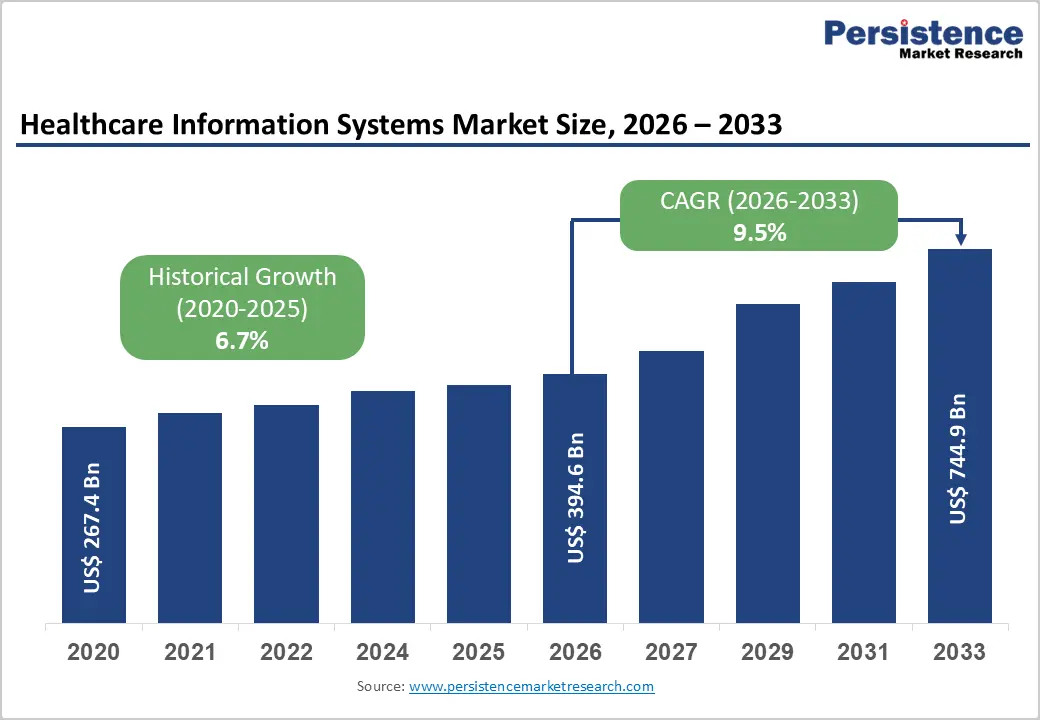
The global Healthcare Information Systems market size is expected to be valued at US$ 394.6 billion in 2026 and projected to reach US$ 744.9 billion by 2033, growing at a CAGR of 9.5% between 2026 and 2033. The rise in digital transformation across hospitals, clinics, and diagnostic centers worldwide and demand for efficient patient data management, electronic health records (EHR), hospital management systems, telehealth platforms, and clinical decision support tools is driving market expansion.
Governments and healthcare providers are investing heavily in healthcare IT infrastructure to improve operational efficiency, reduce medical errors, and enhance patient outcomes. Cloud-based HIS solutions are gaining rapid adoption due to scalability, cost-effectiveness, and remote accessibility. North America emerges as a leader due to advanced healthcare infrastructure and high IT spending, while Asia-Pacific is the fastest-growing region driven by healthcare modernization, government digital health initiatives, and expanding healthcare access across emerging economies.
Key Industry Highlights
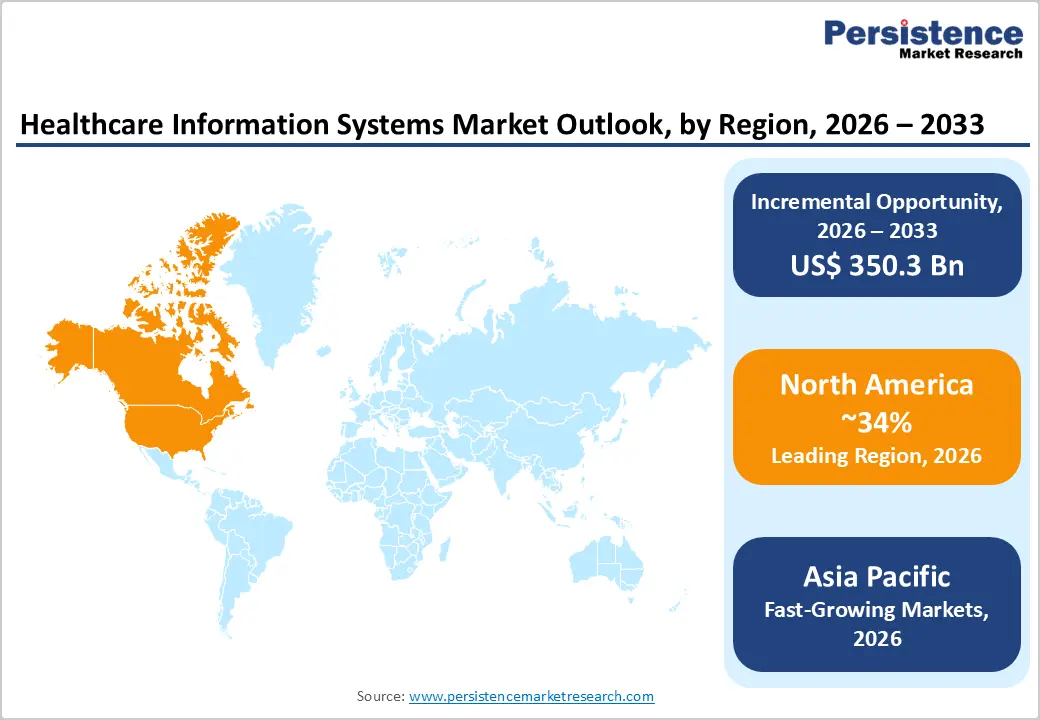
- Leading Region: North America dominates the global Healthcare Information Systems market with approximately 34% market share in 2025, supported by mature health IT infrastructure, HIPAA/HITECH regulatory frameworks, and high per-capita healthcare spending.
- Fast-Growing Market: Asia Pacific is the fast-growing regional market, driven by government digital health mandates such as India's Ayushman Bharat Digital Mission and China's Healthy China 2030, alongside expanding hospital infrastructure.
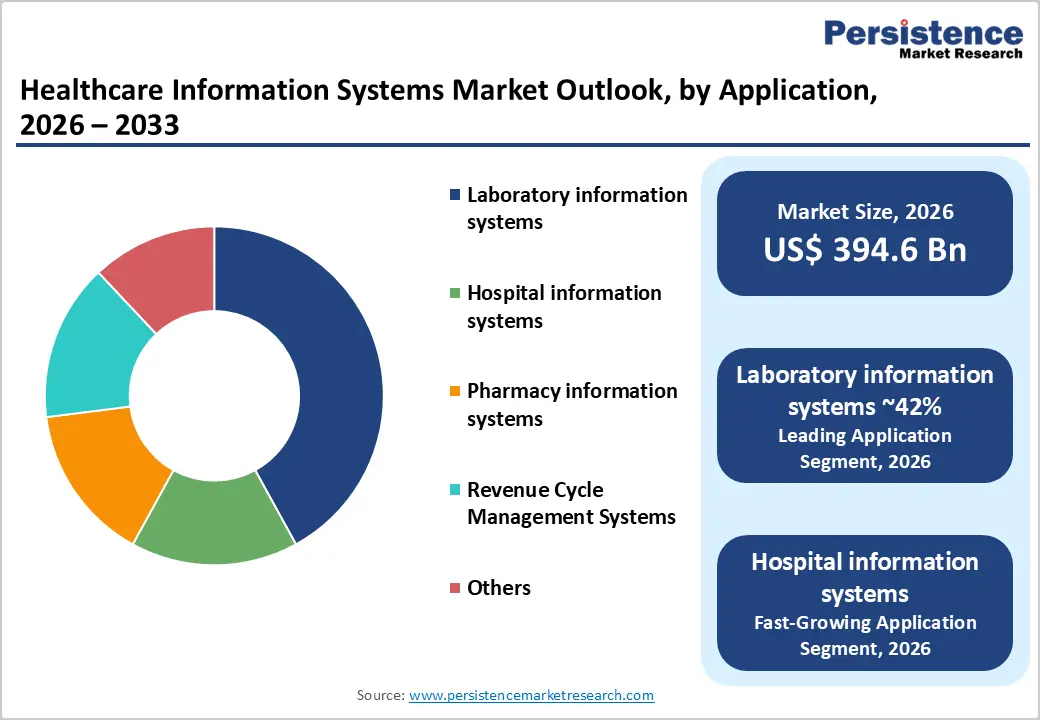
- Dominant Applications: Laboratory information systems lead the application category with approximately 42% market share in 2025, driven by exponential diagnostic testing volumes and the rise of precision medicine and genomics.
- Fastest Growing Applications: Hospital information systems represent the fastest growing application segment for 2026–2033, fueled by accelerated hospital digitalization programs globally and integration of AI-enabled clinical decision support tools.
- Key Opportunity: Cloud-based HIS adoption in emerging economies offers significant revenue potential, supported by government digital health initiatives, lower deployment costs, and rapidly improving broadband infrastructure across Asia Pacific, Latin America, and MEA.
Market Dynamics
Drivers - Trend of Digitalization of Healthcare Sector Fuels with Novel Regulations
Since the digitalization of the healthcare sector, establishments working with electronic health records are increasingly integrating novel technologies, such as cloud-based databases and artificial intelligence, to streamline the implementation of healthcare information systems in hospitals. With these advancements in healthcare IT, governing authorities worldwide are mandating stringent regulations.
For example, regulatory mandates such as the U.S. 21st Century Cures Act require hospitals and clinics to ensure seamless patient data sharing. In Europe, the European Health Data Space (EHDS) initiative aims to standardize health data exchange across EU countries.
Furthermore, AI-powered clinical decision support systems are helping healthcare providers optimize treatment plans, reduce errors, and enhance patient outcomes. As hospitals make investments in IoT-based diagnostics, cybersecurity frameworks, and remote patient monitoring to enhance patient involvement and data security, the telemedicine industry is further propelling the use of healthcare information systems.
Restraints - Data Security and Privacy Concerns in the Healthcare Sector Limit the Adoption of Technology
In the healthcare industry, information systems are dealing with interoperability problems, data security threats, and poorly designed user interfaces. Potential medical mistakes can result from data input problems, patient identity mismatches, and accidental medicine choices caused by a lack of user-friendly design. Concerns regarding system usability, such as difficult navigation and sluggish processing speeds, lead to clinician annoyance and reduced productivity.
A smooth transmission of patient data is also hampered by technical errors such as data fragmentation, a lack of standardization, and trouble integrating outdated systems. The implementation of HIS is further complicated by security concerns, such as cyberattacks and compromises of patient data. Liability and quality issues were brought to light in a 2019 National Institutes of Health study, which also emphasized the necessity of improved cybersecurity and system architecture.
Opportunities - Adoption of AI in the Healthcare Sector Streamlines the Everyday Activities
As the healthcare sector moves towards digital implementation in everyday operations, the reliance on novel technologies is expected to increase with the integration of AI and ML in clinical decision support systems. By incorporating these technologies into healthcare, diagnostic accuracy, treatment planning, and patient management are likely to improve in the forthcoming years.
Organizations are enhancing AI integration in their activities owing to the ways AI-driven imaging technologies and predictive analytics are helping healthcare practitioners diagnose illnesses early and improve results. For instance, the World Health Organization launched the MEDEVIS platform in July 2024 to expand global access to AI-powered medical devices, ensuring equitable healthcare solutions.
Healthcare organizations are partnering with technology firms to enhance operations, as seen with GE HealthCare and RadNet's strategic collaboration in November 2024, integrating SmartTechnology™ AI solutions into imaging systems.
The growing adoption of AI-based CDSS is projected to reduce diagnostic errors by up to 30% and enhance clinical efficiency by 40%. Such innovations not only improve patient safety but also streamline hospital operations, making AI a cornerstone of next-generation healthcare delivery.
Category-wise Analysis
Application Insights
By application, the growing need for automated diagnostic solutions and real-time patient data management is expected to propel the laboratory information systems market share to 42% in 2025. The implementation of LIS is being fueled by the growth of molecular diagnostics and personalized medication for chronic patients.
As hospitals continue to invest in electronic health records, AI-driven clinical decision support, and interoperability solutions, the hospital information systems (HIS) segment is predicted to account for 38% of the global healthcare information system market.
As e-prescriptions, medication tracking, and the integration of AI-driven drug management systems rise, pharmacy information systems (PIS) will take up 20% of the market. The future of healthcare information systems is envisioned to be shaped by advanced data analytics and AI-driven solutions as digital transformation picks up speed in the projected period.
Deployment Mode Insights
Based on the Deployment mode, cloud-based systems are anticipated to account for 45% of the market in 2026. This is due to their cost-effectiveness, scalability, and remote accessibility. The acceleration of cloud migration is being driven by the growing use of telemedicine services, interoperability solutions, and analytics driven by AI. Companies such as Epic Systems, Cerner (Oracle Health), and GE HealthCare are extending their cloud-based capabilities with innovative features.
As healthcare providers look for secure online portals that allow real-time access to patient data, the web-based sector is anticipated to account for 35% of the market. Web-based solutions are popular in pharmacies and small clinics due to their cheaper IT infrastructure expenses.
Since big hospitals and research facilities want in-house servers for increased security and compliance with laws such as HIPAA and GDPR, the on-premise category is expected to make up 20% of the market. Healthcare providers are, however, being pushed into cloud and web-based solutions due to the high maintenance expenditure.
Regional Insights
North America Healthcare Information Systems Market Trends and Insights
North America leads the global Healthcare Information Systems market with approximately 34% market share in 2025, driven by a mature health IT infrastructure, strong regulatory frameworks including HIPAA and HITECH, and robust private sector investment. High per-capita healthcare expenditure and early EHR adoption continue to sustain market leadership, with growing focus on interoperability and cloud migration.
U.S. Healthcare Information Systems Market Size
The United States accounts for approximately 85% of the North American market, driven by comprehensive federal EHR incentive programs. With the ONC reporting near-universal certified EHR adoption among hospitals, and CMS expanding value-based models, the U.S. remains the single largest national market for healthcare IT globally.
Europe Healthcare Information Systems Market Trends and Insights
Europe represents the second-largest regional market, with growth supported by the European Health Data Space (EHDS) initiative and increasing public investment in digital health infrastructure. Regulatory harmonization across EU member states and growing emphasis on cross-border health data interoperability are key market trends accelerating HIS adoption throughout the region.
Germany Healthcare Information Systems Market Size
Germany holds the largest share within Europe's HIS market, representing approximately 22% of the regional revenue. The Hospital Future Act (Krankenhauszukunftsgesetz) raised €3 billion toward hospital digitalization, directly stimulating demand for advanced information systems, EHR platforms, and clinical analytics solutions.
UK Healthcare Information Systems Market Size
The UK contributes approximately 18% of European market revenues. The NHS Long Term Plan has allocated significant resources toward digitizing patient records and deploying AI-powered clinical decision tools, positioning the U.K. as a high-priority adoption market with strong demand for integrated HIS platforms.
France Healthcare Information Systems Market Size
France accounts for approximately 15% of European HIS market share. The Espace Numérique de Santé (ENS) initiative, France's national digital health strategy, mandates the creation of personal digital health spaces for all citizens, driving substantial procurement of interoperable healthcare information systems and patient portal solutions.
Asia Pacific Healthcare Information Systems Market Trends and Insights
Asia Pacific is the fast-growing regional market for Healthcare Information Systems, fueled by large-scale government digitization programs, expanding hospital infrastructure, and rising healthcare expenditure across China, India, Japan, and Southeast Asia. China's Healthy China 2030 initiative and India's Ayushman Bharat Digital Mission are major demand catalysts accelerating HIS adoption across the region.
India Healthcare Information Systems Market Size
India represents one of the highest-growth individual markets in the region, supported by the National Health Authority (NHA)'s mandate under ABDM to create interoperable digital health IDs for all citizens. The country's healthcare IT market is anticipated to grow at a double-digit rate, with hospital network expansion and government-funded EHR rollouts serving as primary demand drivers.
Japan Healthcare Information Systems Market Size
Japan holds approximately 20% of the Asia Pacific HIS market, underpinned by a highly developed healthcare system and government initiatives to standardize electronic patient records. The Ministry of Health, Labour and Welfare (MHLW)'s health IT roadmap is accelerating HIS investments among major hospital networks and specialty care centers.
Southeast Asia Healthcare Information Systems Market Size
Southeast Asia is an emerging hotspot for healthcare IT investment, with Singapore, Thailand, Indonesia, and Malaysia spearheading regional digital health programs. The ASEAN Digital Masterplan 2025 emphasizes e-health infrastructure, while growing medical tourism and private hospital proliferation drive demand for scalable cloud-based HIS solutions.
Competitive Landscape
The global healthcare information systems market exhibits a moderately consolidated competitive structure, with global technology leaders coexisting alongside specialized regional vendors. Leading firms, including GE Healthcare, Philips Healthcare, McKesson Corporation, and Nextgen Healthcare, differentiate through interoperability, AI integration, and cloud-native architectures.
Key strategic trends include mergers and acquisitions to expand product portfolios, increased R&D investment in predictive analytics and ambient clinical intelligence, and strategic cloud partnerships. Emerging business models emphasize subscription-based SaaS delivery and outcome-linked pricing, intensifying competition and innovation across all market tiers.
Key Developments:
- In January 2025, the Healthcare Information and Management Systems Society (HIMSS) and the Association of Medical Directors of Information Systems (AMDIS) partnered to advance clinical innovation through education, digital transformation, and leadership networking for healthcare professionals, initially focusing on North America but expanding internationally.
- In August 2024, Jarrard Inc. launched a health technology practice, led by SVP Alex Hunter, to assist health IT companies in regulatory environments, stakeholder engagement, and digital marketing strategies.
- In July 2024, WHO launched MeDevIS, the first global open-access clearing house for medical device information, facilitating decision-making and improving access to life-saving technologies worldwide.
- In April 2024, WHO launched S.A.R.A.H., an AI-powered digital health promoter, assisting users in understanding risk factors for leading causes of death, requiring further research for ethical considerations.
Global Healthcare Information Systems Market – Key Insights & Details
| Key Insights | Details |
|---|---|
|
Historical Market Value (2020) |
US$ 267.4 billion |
|
Current Market Value (2026) |
US$ 394.6 billion |
|
Projected Market Value (2033) |
US$ 744.9 billion |
|
CAGR (2026–2033) |
9.5% |
|
Leading Region |
North America, 34% market share (2025) |
|
Dominant Application Segment |
Laboratory Information Systems, ~42% market share (2025) |
|
Top-ranking Deployment Mode |
Cloud-based, ~44% market share (2025) |
|
Incremental Opportunity |
US$ 350.3 billion |
Companies Covered in Healthcare Information Systems Market
- GE Healthcare
- Philips Healthcare
- McKesson Corporation
- Nextgen healthcare Information System Inc.
- Others
Frequently Asked Questions
The global market is valued at approximately US$ 394.6 billion in 2026.
health informatics is poised for a promising future due to advanced technologies and personalized medicine, making it crucial in the evolving healthcare sector.
North America is the leading region, accounting for approximately 34% of the global market share in 2025.
Key opportunity lies in expanding cloud-based HIS solutions across emerging markets, supported by digital health initiatives and broadband growth.
Philips Healthcare, Nextgen healthcare Information System Inc., GE Healthcare and McKesson Corporation, are a few leading players.


