Direct Endoscopic Necrosectomy Market Size, Share, Growth, and Regional Forecast, 2026 to 2033

Direct Endoscopic Necrosectomy Market by Diagnosis (Abdominal Scan, Urine Test, Abdominal Biopsy), Application (Pancreatitis, Abdominal Pain, Abdominal Infection, Others), End User (Hospitals, Ambulatory Surgical Centers, Specialty Clinics), and Regional Analysis from 2026 to 2033.

ID: PMRREP32325
Calendar

December 2025

199 Pages

Author : Abhijeet Surwase

Direct Endoscopic Necrosectomy Market Outlook

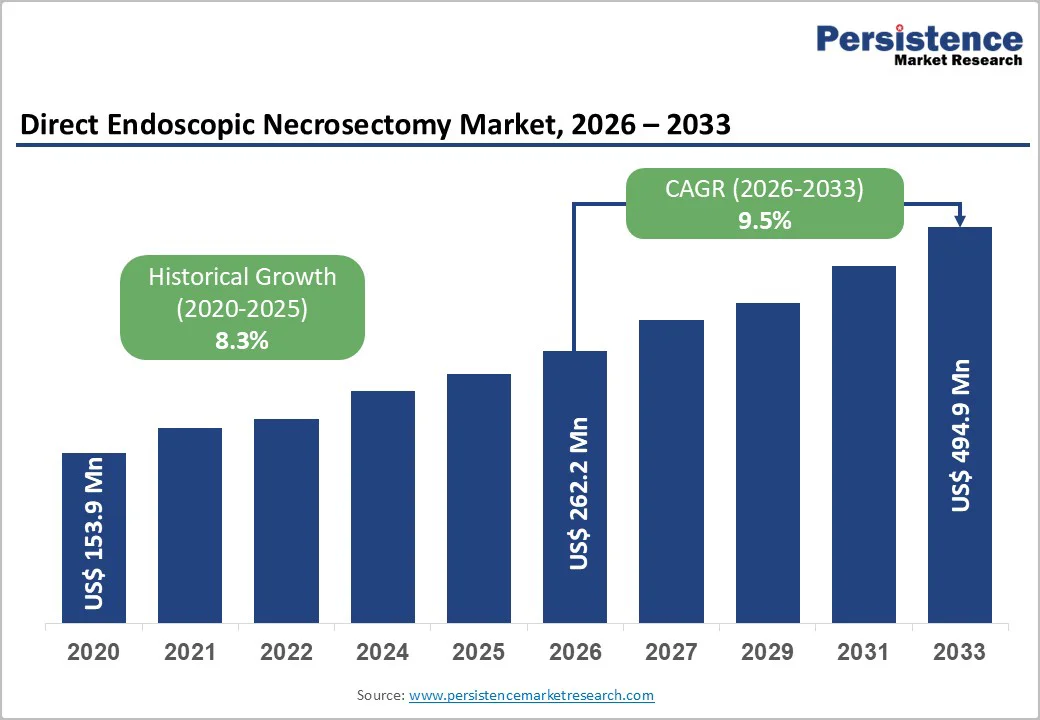
The global direct endoscopic necrosectomy market is estimated to grow from US$ 262.2 Mn in 2026 to US$ 494.9 Mn by 2033. The market is projected to record a CAGR of 9.5% during the forecast period from 2026 to 2033.

The direct endoscopic necrosectomy market is growing steadily, fueled by increasing demand for advanced imaging in oncology, drug discovery, and translational research. North America leads, supported by strong research funding and infrastructure. At the same time, Asia-Pacific is experiencing rapid growth driven by expanding research facilities, healthcare investments, and rising adoption of hybrid imaging technologies, thereby enhancing procedural efficiency and outcomes.

Key Industry Highlights

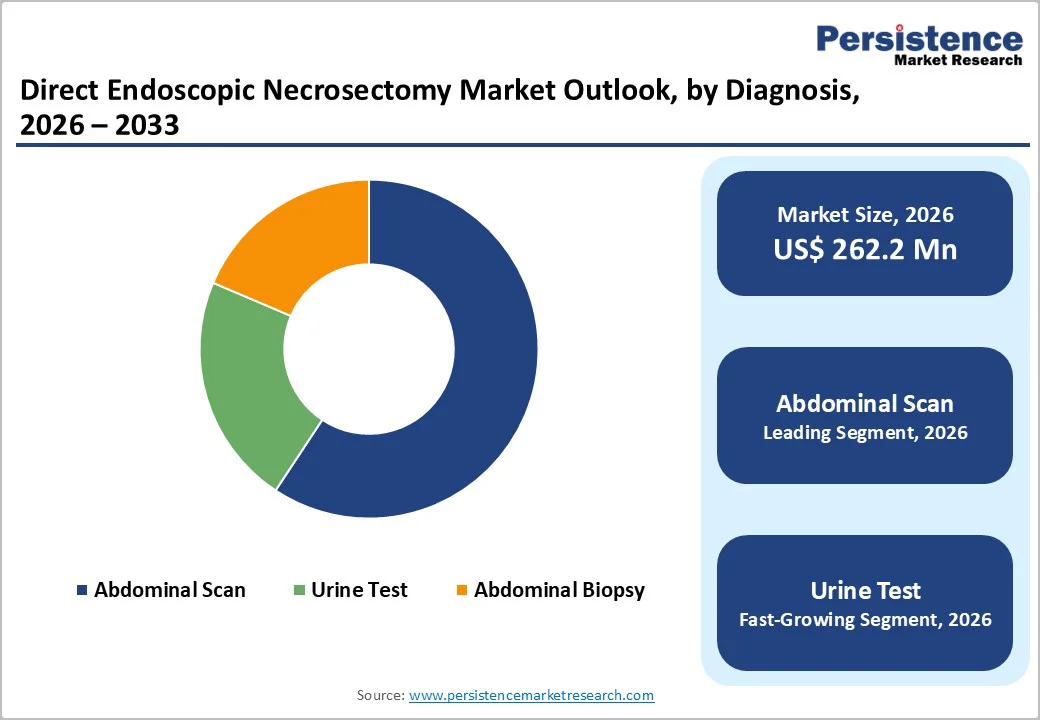
  • Dominant Segment: Abdominal Scan is the leading diagnostic method, with a 59.3% share in 2025, in the direct endoscopic necrosectomy market, valued for its non-invasive detection of necrotic tissue, high-resolution imaging, and its ability to guide procedural planning. It enables accurate assessment of the extent of necrosis, supports real-time decision-making for intervention, and is widely adopted in hospitals, specialty clinics, and research facilities that perform minimally invasive necrosectomy.
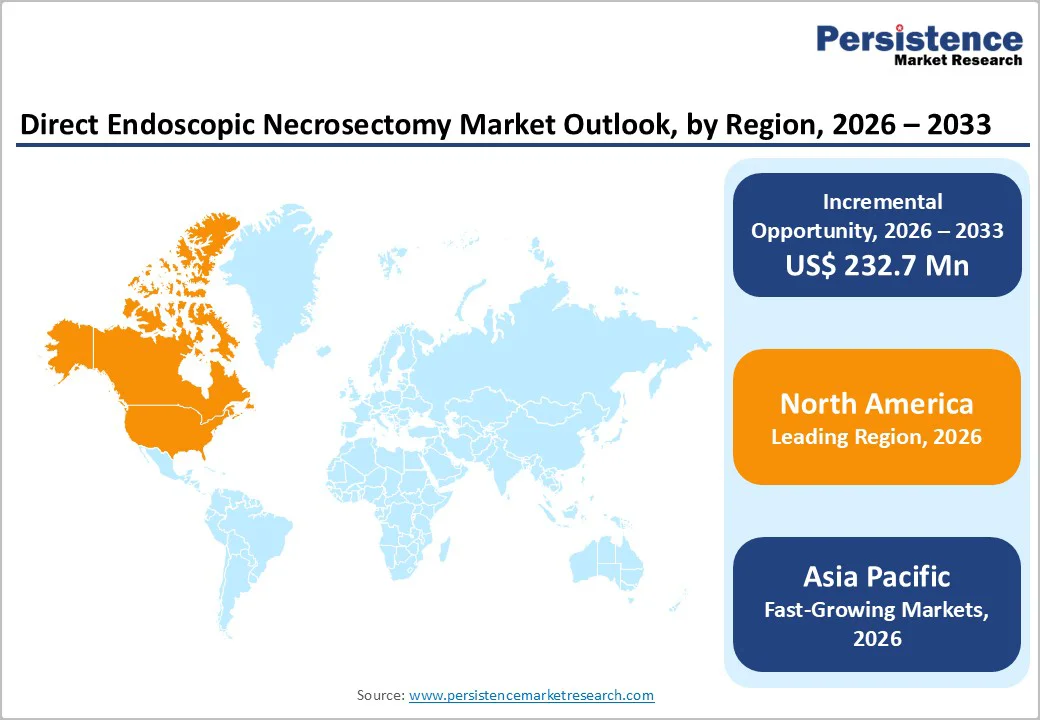
  • Dominant Region: North America leads the market with the largest share, supported by strong research funding, advanced healthcare infrastructure, and high adoption of minimally invasive procedures. Asia-Pacific is the fastest-growing region, driven by expanding healthcare facilities, rising adoption of advanced endoscopic technologies, and increasing clinical awareness of direct endoscopic necrosectomy.
  • Market Drivers: Market growth is fueled by the increasing prevalence of pancreatitis and necrotizing conditions, rising demand for minimally invasive necrosectomy procedures, growth in hospital and specialty clinic infrastructure, and adoption of advanced imaging-guided endoscopic systems.
  • Market Opportunity: Key opportunities include development of AI-enabled endoscopic systems, integration with advanced imaging technologies, expansion into emerging healthcare markets, increased collaboration with research institutions and CROs, and broader applications in translational and interventional gastroenterology.
Key Insights Details
Global Direct Endoscopic Necrosectomy Market Size (2026E) US$ 262.2 Mn
Market Value Forecast (2033F) US$ 494.9 Mn
Projected Growth (CAGR 2026 to 2033) 9.5%
Historical Market Growth (CAGR 2020 to 2025) 8.3%

direct-endoscopic-necrosectomy-market-2026–2033

Market Dynamics

Driver – Rising Prevalence of Necrotizing Pancreatitis

The prevalence of severe pancreatitis, particularly necrotizing pancreatitis, is a significant driver for the direct endoscopic necrosectomy market. Acute pancreatitis affects tens of millions globally, with estimated incidence rates of around 20–40 per 100,000 people per year in high-income countries. income regions and increasing overall cases worldwide. Approximately 10–20% of acute pancreatitis cases progress to necrotizing pancreatitis, a condition where pancreatic tissue undergoes irreversible necrosis. Patients with necrotizing pancreatitis face substantially higher morbidity and mortality (20–45% in complicated cases) compared with non-necrotizing forms, increasing the need for effective interventions such as direct endoscopic necrosectomy.

The growing burden of acute and necrotizing pancreatitis is expanding procedural demand for therapeutic interventions. Globally, acute pancreatitis incidence has risen to nearly 2.8 million new cases annually, with moderate to severe forms causing significant hospitalizations and complications. Severe necrotizing pancreatitis, occurring in about one-fifth of acute cases, is associated with serious complications, including organ failure and infected necrosis, often necessitating interventional debridement. This clinical burden drives adoption of minimally invasive procedures like direct endoscopic necrosectomy, particularly in regions with advanced healthcare infrastructure, aligning market expansion with the epidemiological trend of increasing severe pancreatic disease.

Restraints – Complexity of Procedures

Direct Endoscopic Necrosectomy (DEN) is technically demanding, which contributes to its restraint as a market driver despite its clinical benefits. The procedure involves navigating a flexible endoscope through pancreatic fluid collections and removing necrotic debris, often requiring multiple sessions per patient (median of ~6 procedures) to achieve complete debridement, reflecting procedural complexity and variability. DEN’s complication rates reported in larger patient series range roughly from 14% to 36%, including bleeding, perforation, and fistula formation. Such adverse events demand high-endoscopic skill and multidisciplinary coordination, deterring broader adoption in centers lacking specialized gastroenterology expertise or standardized protocols.

Evidence underscores the complexity of DEN as a barrier to wider adoption, despite it being less invasive than traditional surgery. Studies show DEN’s overall complication rate can reach up to ~36%, with bleeding occurring in about 18% of patients and perforations in approximately 4%, reflecting procedural challenges. The need for multiple sessions increases hospital stay duration and resource utilization, placing pressure on clinician availability and facility throughput. These factors not only heighten procedural risk but also improve training requirements and operational costs, thereby constraining expansion in centers with limited therapeutic endoscopy experience and hindering faster market growth of DEN.

Opportunity – Integration with Advanced Imaging Modalities

Integration of advanced imaging modalities with Direct Endoscopic Necrosectomy (DEN) represents a major opportunity to improve procedural precision and outcomes. Techniques such as contrast-enhanced computed tomography (CT) and magnetic resonance imaging (MRI) provide detailed cross-sectional views and high soft-tissue contrast, significantly aiding in delineating pancreatic anatomy and necrosis extent before intervention. For example, CT accuracy in pancreatic evaluation is reported at approximately 83.3%, whereas MRI reaches 89.1%, thereby enhancing diagnostic confidence. Combining these imaging data with endoscopic planning allows clinicians to target necrotic collections better and optimize debridement strategies, ultimately improving clinical decision-making and reducing complication risks.

Advanced imaging integration also supports real-time procedural guidance and risk mitigation in complex endoscopic interventions. Endoscopic ultrasound (EUS) alone demonstrates diagnostic accuracy of up to 93.7% when enhanced with contrast and elastography, underscoring how imaging advancements improve lesion characterization. Such precision is critical in selecting appropriate intervention timing and minimizing invasive debridement sessions. Moreover, advanced imaging modalities like narrow-band imaging and AI-based optical enhancement consistently improve diagnostic yield and reduce procedural variability. These improvements encourage broader adoption of DEN by increasing clinician confidence and procedural efficacy, thereby expanding the market in centers equipped with modern imaging systems and trained multidisciplinary teams.

Category-wise Analysis

By Diagnosis, Abdominal Scan Dominates the Direct Endoscopic Necrosectomy Market

Abdominal Scan dominates with 59.3% share of the global market in 2025, because they provide highly reliable, non?invasive visualization of pancreatic necrosis and complications. CT is the imaging modality of choice for evaluating the extent and severity of acute and necrotizing pancreatitis in clinical practice, with reported diagnostic accuracy of approximately 89.7% compared with surgical findings, indicating strong reliability in identifying necrotic tissue. Additionally, CT sensitivity for detecting pancreatic necrosis exceeds 90% in many protocols and demonstrates excellent specificity in extensive necrosis, making it superior to other modalities for procedural planning. This high diagnostic performance enables clinicians to assess necrosis location, fluid collections, and severity, guiding endoscopic intervention timing and strategy more effectively than urine tests or biopsies, which lack comparable anatomical detail or broad clinical utility.

By Application, Pancreatitis dominates, driven by high cancer incidence and extensive preclinical imaging needs

Pancreatitis dominates the By Application segment of the direct endoscopic necrosectomy market because it is a highly prevalent condition that frequently leads to complications requiring intervention. Acute pancreatitis is one of the most common gastrointestinal disorders globally, with an estimated 33.7 cases per 100,000 person-years and accounting for over 275,000 hospital admissions annually in the United States alone. Severe forms of acute pancreatitis can progress to pancreatic necrosis in approximately 10–20% of patients, significantly increasing morbidity and need for procedural treatment. Moreover, necrotizing pancreatitis carries mortality rates of up to 20–45% in complicated cases and often results in walled-off necrosis or infected collections that necessitate direct endoscopic necrosectomy for effective debridement and patient management.
direct-endoscopic-necrosectomy-market-outloo,-by-diagnosis-2026–2033

Regional Insights

North America Direct Endoscopic Necrosectomy Market Trends

North America dominates the direct endoscopic necrosectomy market with a 39.6% share in 2025, driven by advanced healthcare infrastructure, strong procedural adoption, and a high disease burden. In the United States, acute pancreatitis an indication frequently requiring interventions such as endoscopic necrosectomy accounts for more than 275,000 hospital admissions annually, driving clinical demand for advanced diagnostic and therapeutic endoscopic procedures.?Contrast?enhanced imaging and minimally invasive endoscopic techniques are widely available and integrated into standard care pathways in North American hospitals, supported by leading medical centers and well?established referral networks.?Additionally, North America historically holds the largest share of endoscopic procedures globally due to high healthcare spending, favorable reimbursement policies, and broad access to innovative technologies, which collectively reinforce its leadership in the DEN market.

Europe Direct Endoscopic Necrosectomy Market Trends

Europe is an important region in the direct endoscopic necrosectomy market due to its substantial burden of pancreatitis and well-developed endoscopic practice infrastructure. Across Europe, incidence rates of acute pancreatitis vary widely from as low as 4.6 to as high as 100 cases per 100,000 population in different countries indicating significant clinical demand for interventions associated with complications such as necrosis.?The region’s strong healthcare systems, particularly in Western Europe, support widespread adoption of advanced endoscopic diagnostics and therapeutic procedures, with increasing volumes of pancreaticobiliary and interventional endoscopy reported historically. National clinical guidelines and investment in interventional endoscopy training further strengthen Europe’s role, helping maintain high procedural standards and broader access to minimally invasive necrosectomy options.

Asia-Pacific Direct Endoscopic Necrosectomy Market Trends

Asia Pacific is the fastest-growing region in the direct endoscopic necrosectomy marketdue to increasing prevalence of pancreatitis and related complications, expanding healthcare infrastructure, and rising adoption of minimally invasive procedures. Acute pancreatitis incidence in countries like China and India is reported at approximately 33–40 cases per 100,000 population per year, with severe necrotizing forms affecting 10–20% of patients. Government initiatives to improve hospital facilities, expand gastroenterology training programs, and install advanced imaging and endoscopic equipment are accelerating access. Growing awareness among clinicians and patients of the benefits of endoscopic necrosectomy over surgical interventions further drives market adoption across the region.
direct-endoscopic-necrosectomy-market-outlook-by-region-2026–2033

Market Competitive Landscape

Leading imaging applications in the direct endoscopic necrosectomy market focus on precise pancreatic necrosis assessment, procedural planning, and minimally invasive intervention. High-resolution abdominal scans and imaging guidance improve visualization of necrotic tissue, enhance procedural accuracy, and support efficient clinical workflows, reducing complications. These capabilities drive adoption across hospitals and specialty centers, fueling market growth and expanding clinical acceptance globally.

Key Industry Developments:

  • In April 2025, Medtronic announced a distribution agreement with Dragonfly™ Endoscopy, expanding its offerings in pancreaticobiliary endoscopy. Through this partnership, Medtronic became the authorized distributor of Dragonfly™ Endoscopy’s products, aiming to enhance clinical access to advanced endoscopic tools for diagnosing and treating pancreatic and biliary conditions. The collaboration strengthened Medtronic’s portfolio in minimally invasive gastrointestinal interventions.
  • In March 2024, Cook Medical and Bentley entered a distribution agreement for the BeBack® Catheter in the United States. Under the agreement, Cook Medical became the official distributor of Bentley’s BeBack® Catheter, expanding its portfolio in interventional devices. The partnership aimed to enhance market reach and provide U.S. healthcare providers with improved access to the catheter for advanced vascular procedures.

Companies Covered in Direct Endoscopic Necrosectomy Market

  • Boston Scientific Corporation
  • Cook Medical
  • Medtronic plc
  • Karl Storz SE & Co. KG
  • Fujifilm Corporation
  • PENTAX Medical
  • Richard Wolf GmbH
  • Karl Storz SE & Co. KG
  • CONMED Corporation
  • Others
Frequently Asked Questions

The global Direct Endoscopic Necrosectomy Market is projected to be valued at US$ 262.2 Mn  in 2026.

Rising pancreatitis prevalence, demand for minimally invasive procedures, advanced imaging, and expanding healthcare infrastructure drive growth.

The global Direct Endoscopic Necrosectomy Market is poised to witness a CAGR of 9.5% between 2026 and 2033.

Integration with advanced imaging, AI-enabled endoscopes, emerging markets, collaborations, and broader gastrointestinal procedure applications.

Boston Scientific Corporation, Cook Medical, Medtronic plc, Karl Storz SE & Co. KG, Fujifilm Corporation, PENTAX Medical.

Global Direct Endoscopic Necrosectomy Market Report Scope
Report Attribute Details
Historical Data/Actuals 2020 - 2025
Forecast Period 2026 - 2033
Market Analysis Value: US$ Mn
Geographical Coverage
  • North America
  • Europe
  • East Asia
  • South Asia & Oceania
  • Latin America
  • Middle East & Africa
Segmental Coverage
  • Diagnosis
  • Application
  • End User
  • Region
Competitive Analysis
  • Boston Scientific Corporation
  • Cook Medical.
  • Medtronic plc
  • Karl Storz SE & Co. KG.
  • Fujifilm Corporation
  • PENTAX Medical
  • Richard Wolf GmbH.
  • Karl Storz SE & Co. KG
  • CONMED Corporation.
  • Others
Report Highlights
  • Market Forecast and Trends
  • Competitive Intelligence and Share Analysis
  • Growth Factors and Challenges
  • Strategic Growth Initiatives
  • Pricing Analysis
  • Future Opportunities and Revenue Pockets
  • Market Analysis Tools
Global Direct Endoscopic Necrosectomy Market Segmentation

By Technology

  • Abdominal Scan
  • Urine Test
  • Abdominal Biopsy

By Application

  • Pancreatitis
  • Abdominal Pain
  • Abdominal Infection
  • Others

By End User

  • Hospitals
  • Ambulatory Surgical Centers
  • Specialty Clinics

By Region 

  • North America 
  • Europe 
  • East Asia 
  • South Asia & Oceania 
  • Latin America
  • Middle East and Africa 

Related Reports

  1. Executive Summary
    1. Global Direct Endoscopic Necrosectomy Market Snapshot, 2026 and 2033
    2. Market Opportunity Assessment, 2026 – 2033, US$ Mn
    3. Key Market Trends
    4. Future Market Projections
    5. Premium Market Insights
    6. Industry Developments and Key Market Events
    7. PMR Analysis and Recommendations
  2. Market Overview
    1. Market Scope and Definition
    2. Market Dynamics
      1. Drivers
      2. Restraints
      3. Opportunity
      4. Challenges
      5. Key Trends
    3. Macro-Economic Factors
      1. Global Sectorial Outlook
      2. Global GDP Growth Outlook
    4. COVID-19 Impact Analysis
    5. Forecast Factors – Relevance and Impact
  3. Value Added Insights
    1. Regulatory Landscape
    2. Product Adoption Analysis
    3. Value Chain Analysis
    4. Key Deals and Mergers
    5. PESTLE Analysis
    6. Porter’s Five Force Analysis
  4. Global Direct Endoscopic Necrosectomy Market Outlook:
    1. Key Highlights
      1. Market Size (US$ Mn) and Y-o-Y Growth
      2. Absolute $ Opportunity
    2. Market Size (US$ Mn) Analysis and Forecast
      1. Historical Market Size (US$ Mn) Analysis, 2020-2025
      2. Market Size (US$ Mn) Analysis and Forecast, 2026–2033
    3. Global Direct Endoscopic Necrosectomy Market Outlook: Diagnosis
      1. Introduction / Key Findings
      2. Historical Market Size (US$ Mn) Analysis, By Diagnosis, 2020 – 2025
      3. Market Size (US$ Mn) Analysis and Forecast, By Diagnosis, 2026 – 2033
        1. Abdominal Scan
        2. Urine Test
        3. Abdominal Biopsy
      4. Market Attractiveness Analysis: Diagnosis
    4. Global Direct Endoscopic Necrosectomy Market Outlook: Application
      1. Introduction / Key Findings
      2. Historical Market Size (US$ Mn) Analysis, By Application, 2020 – 2025
      3. Market Size (US$ Mn) Analysis and Forecast, By Application, 2026 – 2033
        1. Pancreatitis
        2. Abdominal Pain
        3. Abdominal Infection
        4. Others
      4. Market Attractiveness Analysis: Application
    5. Global Direct Endoscopic Necrosectomy Market Outlook: End User
      1. Introduction / Key Findings
      2. Historical Market Size (US$ Mn) Analysis, By End User, 2020 – 2025
      3. Market Size (US$ Mn) Analysis and Forecast, By End User, 2026 – 2033
        1. Hospitals
        2. Ambulatory Surgical Centers
        3. Specialty Clinics
      4. Market Attractiveness Analysis: End User
  5. Global Direct Endoscopic Necrosectomy Market Outlook: Region
    1. Key Highlights
    2. Historical Market Size (US$ Mn) Analysis, By Region, 2020 – 2025
    3. Market Size (US$ Mn) Analysis and Forecast, By Region, 2026 – 2033
      1. North America
      2. Europe
      3. East Asia
      4. South Asia and Oceania
      5. Latin America
      6. Middle East & Africa
    4. Market Attractiveness Analysis: Region
  6. North America Direct Endoscopic Necrosectomy Market Outlook:
    1. Key Highlights
    2. Historical Market Size (US$ Mn) Analysis, By Market, 2020 – 2025
      1. By Country
      2. By Diagnosis
      3. By Application
      4. By End User
    3. Market Size (US$ Mn) Analysis and Forecast, By Country, 2026 – 2033
      1. U.S.
      2. Canada
    4. Market Size (US$ Mn) Analysis and Forecast, By Diagnosis, 2026 – 2033
      1. Abdominal Scan
      2. Urine Test
      3. Abdominal Biopsy
    5. Market Size (US$ Mn) Analysis and Forecast, By Application, 2026 – 2033
      1. Pancreatitis
      2. Abdominal Pain
      3. Abdominal Infection
      4. Others
    6. Market Size (US$ Mn) Analysis and Forecast, By End User, 2026 – 2033
      1. Hospitals
      2. Ambulatory Surgical Centers
      3. Specialty Clinics
    7. Market Attractiveness Analysis
  7. Europe Direct Endoscopic Necrosectomy Market Outlook:
    1. Key Highlights
    2. Historical Market Size (US$ Mn) Analysis, By Market, 2020 – 2025
      1. By Country
      2. By Diagnosis
      3. By Application
      4. By End User
    3. Market Size (US$ Mn) Analysis and Forecast, By Country, 2026 – 2033
      1. Germany
      2. France
      3. U.K.
      4. Italy
      5. Spain
      6. Russia
      7. Rest of Europe
    4. Market Size (US$ Mn) Analysis and Forecast, By Diagnosis, 2026 – 2033
      1. Abdominal Scan
      2. Urine Test
      3. Abdominal Biopsy
    5. Market Size (US$ Mn) Analysis and Forecast, By Application, 2026 – 2033
      1. Pancreatitis
      2. Abdominal Pain
      3. Abdominal Infection
      4. Others
    6. Market Size (US$ Mn) Analysis and Forecast, By End User, 2026 – 2033
      1. Hospitals
      2. Ambulatory Surgical Centers
      3. Specialty Clinics
    7. Market Attractiveness Analysis
  8. East Asia Direct Endoscopic Necrosectomy Market Outlook:
    1. Key Highlights
    2. Historical Market Size (US$ Mn) Analysis, By Market, 2020 – 2025
      1. By Country
      2. By Diagnosis
      3. By Application
      4. By End User
    3. Market Size (US$ Mn) Analysis and Forecast, By Country, 2026 – 2033
      1. China
      2. Japan
      3. South Korea
    4. Market Size (US$ Mn) Analysis and Forecast, By Diagnosis, 2026 – 2033
      1. Abdominal Scan
      2. Urine Test
      3. Abdominal Biopsy
    5. Market Size (US$ Mn) Analysis and Forecast, By Application, 2026 – 2033
      1. Pancreatitis
      2. Abdominal Pain
      3. Abdominal Infection
      4. Others
    6. Market Size (US$ Mn) Analysis and Forecast, By End User, 2026 – 2033
      1. Hospitals
      2. Ambulatory Surgical Centers
      3. Specialty Clinics
    7. Market Attractiveness Analysis
  9. South Asia & Oceania Direct Endoscopic Necrosectomy Market Outlook:
    1. Key Highlights
    2. Historical Market Size (US$ Mn) Analysis, By Market, 2020 – 2025
      1. By Country
      2. By Diagnosis
      3. By Application
      4. By End User
    3. Market Size (US$ Mn) Analysis and Forecast, By Country, 2026 – 2033
      1. India
      2. Southeast Asia
      3. ANZ
      4. Rest of South Asia & Oceania
    4. Market Size (US$ Mn) Analysis and Forecast, By Diagnosis, 2026 – 2033
      1. Abdominal Scan
      2. Urine Test
      3. Abdominal Biopsy
    5. Market Size (US$ Mn) Analysis and Forecast, By Application, 2026 – 2033
      1. Pancreatitis
      2. Abdominal Pain
      3. Abdominal Infection
      4. Others
    6. Market Size (US$ Mn) Analysis and Forecast, By End User, 2026 – 2033
      1. Hospitals
      2. Ambulatory Surgical Centers
      3. Specialty Clinics
    7. Market Attractiveness Analysis
  10. Latin America Direct Endoscopic Necrosectomy Market Outlook:
    1. Key Highlights
    2. Historical Market Size (US$ Mn) Analysis, By Market, 2020 – 2025
      1. By Country
      2. By Diagnosis
      3. By Application
      4. By End User
    3. Market Size (US$ Mn) Analysis and Forecast, By Country, 2026 – 2033
      1. Brazil
      2. Mexico
      3. Rest of Latin America
    4. Market Size (US$ Mn) Analysis and Forecast, By Diagnosis, 2026 – 2033
      1. Abdominal Scan
      2. Urine Test
      3. Abdominal Biopsy
    5. Market Size (US$ Mn) Analysis and Forecast, By Application, 2026 – 2033
      1. Pancreatitis
      2. Abdominal Pain
      3. Abdominal Infection
      4. Others
    6. Market Size (US$ Mn) Analysis and Forecast, By End User, 2026 – 2033
      1. Hospitals
      2. Ambulatory Surgical Centers
      3. Specialty Clinics
    7. Market Attractiveness Analysis
  11. Middle East & Africa Direct Endoscopic Necrosectomy Market Outlook:
    1. Key Highlights
    2. Historical Market Size (US$ Mn) Analysis, By Market, 2020 – 2025
      1. By Country
      2. By Diagnosis
      3. By Application
      4. By End User
    3. Market Size (US$ Mn) Analysis and Forecast, By Country, 2026 – 2033
      1. GCC Countries
      2. Egypt
      3. South Africa
      4. Northern Africa
      5. Rest of Middle East & Africa
    4. Market Size (US$ Mn) Analysis and Forecast, By Diagnosis, 2026 – 2033
      1. Abdominal Scan
      2. Urine Test
      3. Abdominal Biopsy
    5. Market Size (US$ Mn) Analysis and Forecast, By Application, 2026 – 2033
      1. Pancreatitis
      2. Abdominal Pain
      3. Abdominal Infection
      4. Others
    6. Market Size (US$ Mn) Analysis and Forecast, By End User, 2026 – 2033
      1. Hospitals
      2. Ambulatory Surgical Centers
      3. Specialty Clinics
    7. Market Attractiveness Analysis
  12. Competition Landscape
    1. Market Share Analysis, 2025
    2. Market Structure
      1. Competition Intensity Mapping By Market
      2. Competition Dashboard
    3. Company Profiles (Details – Overview, Financials, Strategy, Recent Developments)
      1. Boston Scientific Corporation
        1. Overview
        2. Segments and Products
        3. Key Financials
        4. Market Developments
        5. Market Strategy
      2. Cook Medical
      3. Medtronic plc
      4. Karl Storz SE & Co. KG
      5. Fujifilm Corporation
      6. PENTAX Medical
      7. Richard Wolf GmbH
      8. Karl Storz SE & Co. KG
      9. CONMED Corporation
      10. Others
  13. Appendix
    1. Research Methodology
    2. Research Assumptions
    3. Acronyms and Abbreviations

Research Methodology Framework for Market Research Excellence

At Persistence Market Research, we implement a comprehensive, validated, and multi-dimensional approachto market analysis that delivers actionable insights across complex market landscapes. Our methodology combines the analytical rigor of leading consulting firms with innovative research techniques, ensuring robust market assessments that guide strategic decision-making with confidence.

Core Research Philosophy

Our methodology is built on four foundational pillars:

Research Philosophy Image

At Persistence Market Research, our methodology is designed to transcend conventional market studies by combining analytical rigor, multi-source validation, and future-focused insights.

We integrate advanced research frameworks, robust data collection strategies, cutting-edge analytics, and innovative technologies to deliver a 360-degree view of complex markets.

We integrate advanced research frameworks, robust data collection strategies, cutting-edge analytics, and innovative technologies to deliver a 360-degree view of complex markets.

Each stage spanning from strategic scoping and hypothesis-building to competitive intelligence, quality validation, and actionable recommendations is engineered to provide clients with unmatched clarity, precision, and confidence in decision-making.

By embedding innovation and technology at the core, our approach ensures that insights are not only comprehensive but also predictive, empowering businesses to seize opportunities, mitigate risks, and achieve sustainable growth

Research Philosophy Image

Capturing Key Information and Events

During this phase, key research objectives focus on essential information and data points for assessing the market, including:

Research Philosophy Image

TAM-SAM-SOM Framework Implementation

We employ both top-down and bottom-up approaches to ensure accurate market sizing.

Top-Down Market SizingBottom-Up Market Sizing
Universe Definition: Total global/regional market identificationUnit Economics: Average transaction values, purchase frequencies, customer lifecycle
Segmentation Filters: Geographic, demographic, and behavioral constraintsCustomer Segmentation: Detailed buyer persona development and sizing
Market Share Analysis: Competitive landscape assessment and share allocationPenetration Analysis: Market penetration rates by segment and geography
Growth Rate Application: Historical trends and forward-looking growth assumptionsScaling Methodology: Extrapolation techniques with confidence intervals

Validation & Cross-Verification

  • Triangulation: Comparing top-down and bottom-up results for consistency
  • Sensitivity Analysis: Testing key assumptions and parameter variations
  • Peer Benchmarking: Comparison with analogous markets and industry benchmarks
  • Expert Review: External validation through industry specialist consultation

Research Philosophy Image

Forecasting & Projection Modeling

Our proprietary forecasting models incorporate multiple variables and scenarios.

Forecasting Components

  • Historical Trend Analysis: 10-year historical growth patterns and cyclical variations
  • Driver-Based Modeling: Economic indicators, demographic shifts, technology adoption
  • Scenario Planning: Base case, optimistic, and conservative projections
  • Monte Carlo Simulations: Probability-weighted outcomes and risk assessments

Model Validation

  • Back-Testing: Historical accuracy assessment over 3–5-year periods
  • Cross-Validation: Multiple modeling approaches for result comparison
  • External Benchmarking: Comparison with established market forecasts
  • Continuous Calibration: Quarterly model updates based on new data

Comprehensive Data Collection Strategy

Our secondary research phase establishes a robust knowledge base utilizing diverse, credible sources.

Secondary Data Sourcess

  • Industry Publications & Reports
  • Government & Regulatory Data
  • Financial Intelligence (filings & reports)
  • Academic Research & Digital Intelligence

Quality Assurance Protocol

  • Source credibility assessment and publication date validation
  • Data consistency checks across multiple sources
  • Bias identification and neutralization techniques
  • Information gap tracking for primary research prioritization

Research Philosophy Image

Primary Research Excellence

Our primary research methodology employs best-in-class techniques to capture unique market insights.

Quantitative Research Methods

  • Large-Scale Surveys: Statistically representative samples with 95% confidence intervals
  • Survey Methodology: Multi-channel deployment (online, telephone, in-person)
  • Question Architecture and Response Optimization

Qualitative Research Methods

  • Executive Interviews
  • Focus Groups
  • Expert Consultations

Quality Assurance & Validation Framework

Multi-Stage Validation Process

  • Source Verification and Consistency Testing
  • Outlier Detection and Bias Assessment
  • Peer Review Process and External Validation
  • Sensitivity Analysis and Confidence Intervals

Research Philosophy Image

Methodology Validation & Credibility

Our research methodology has been extensively validated through:

  • Academic Partnerships: Collaborations with top-tier business schools and research institutions
  • Client Success Stories: Documented case studies demonstrating research impact and ROI
  • Continuous Benchmarking: Performance comparison with leading global research firms

This comprehensive methodology framework positions Persistence Market Research at the forefront of market intelligence, combining the analytical sophistication of top-tier consulting firms with innovative research techniques. Our approach ensures that every market assessment delivers precise, actionable, and strategically valuable insights that drive business success in competitive market environments.

Ready to unlock your market potential? Contact our research experts to discuss how our validated methodology can transform your strategic decision-making with data-driven market intelligence.

Copyright © 2026 Persistence Market Research. All Rights Reserved

Connect With Us -
Direct Endoscopic Necrosectomy Market Analysis - 2033