Diaper Rash Cream Market Size, Share, and Growth Forecast 2026 - 2033

Diaper Rash Cream Market by Category-1 (Organic, Conventional), by Category-2 (Infants, Adults), by Category-3 (Household, Hospitals and Clinics, Day Care), by Category-4 (Hypermarkets/Supermarkets, Specialty Retailers, Multi-brand Stores, Drug Stores and Pharmacies, Online Retailers, Others), by Regional Analysis, 2026 - 2033

ID: PMRREP33987
Calendar

January 2026

200 Pages

Author : Likhit Meshram

Diaper Rash Cream Market Size and Trend Analysis

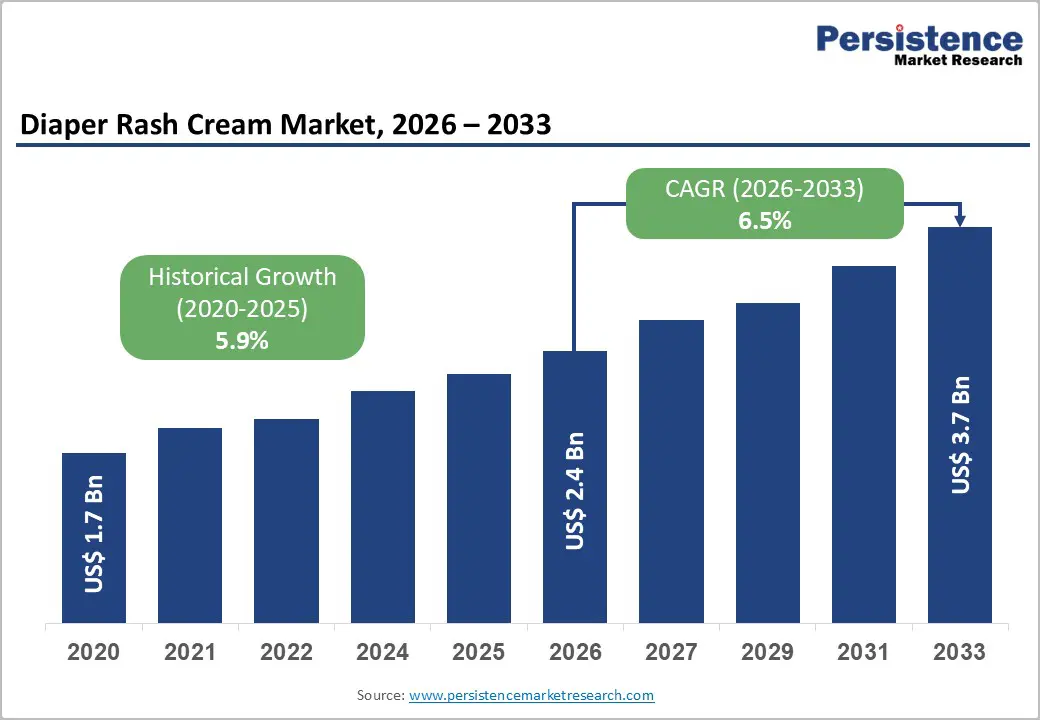
The global diaper rash cream market size is projected to be valued at US$ 2.4 billion in 2026 and is expected to reach US$ 3.7 billion by 2033, expanding at a CAGR of 6.5% during the forecast period.

Market growth is driven by sustained birth rates in emerging economies and by a growing elderly population in developed regions that requires incontinence care. The rising incidence of diaper dermatitis and incontinence-associated dermatitis is accelerating demand for effective skin protection solutions. Additionally, increasing consumer preference for preventive skin care, coupled with premiumization trends and demand for zinc oxide-based, dermatologist-tested formulations, is encouraging manufacturers to innovate advanced, breathable, and skin-friendly products.

Key Market highlights

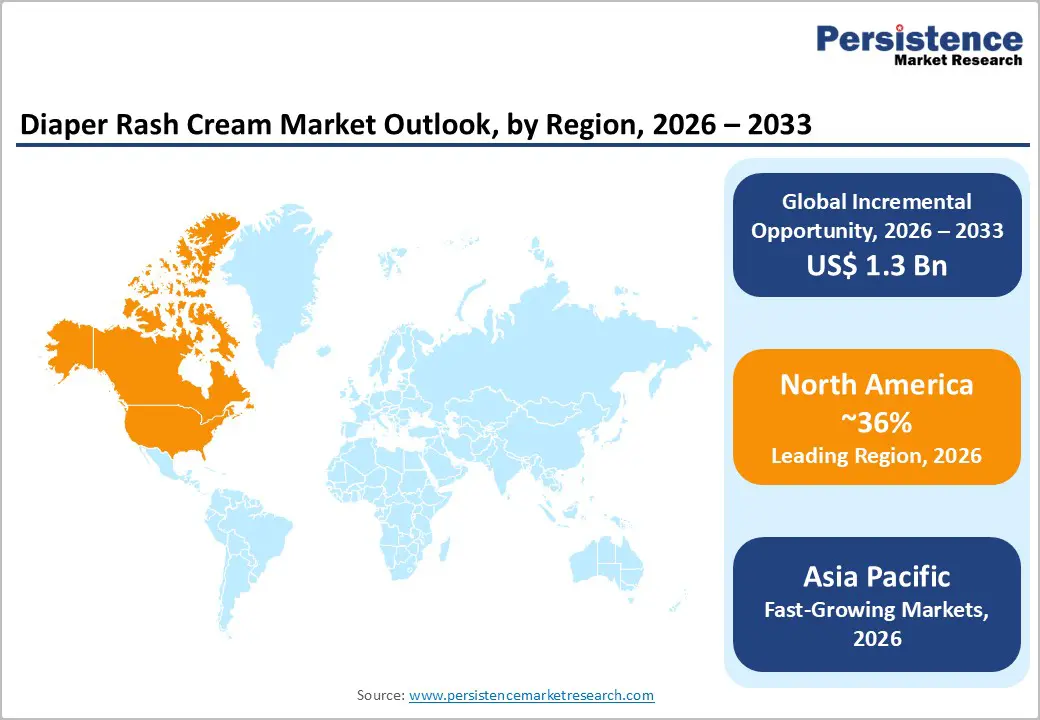
  • Regional Leadership: North America holds approximately 36% share of the global Diaper Rash Cream Market, driven by high per-capita spending and a mature baby hygiene and adult incontinence care ecosystem.
  • Fastest-Growing Region: Asia Pacific accounts for nearly 32% share and represents the fastest-growing regional market, supported by high birth rates, rising disposable incomes, and expanding brand awareness.
  • Dominant End User: The Infants segment holds around 75% market share, reflecting universal diaper use and high application frequency during the first three years of life.
  • Fastest-Growing Ingredient: Conventional formulations retain a leading 62% share, supported by zinc oxide and petrolatum-based products, while the Organic and plant-based segment is expanding rapidly and gaining traction.
  • Key Market Opportunity: Developing specialized, high-efficacy barrier creams for the Geriatric/Adult Incontinence population represents a massive, untapped revenue pocket for future expansion.
Key Insights Details
Diaper Rash Cream Market Size (2026E) US$ 2.4 Billion
Market Value Forecast (2033F) US$ 3.7 Billion
Projected Growth CAGR (2026 - 2033) 6.5%
Historical Market Growth (2020 - 2025) 5.9%

diaper-rash-cream-market-2026–2033

Market Dynamics

Drivers - High Clinical Incidence of Diaper Dermatitis and Incontinence-Associated Skin Conditions Driving Sustained Demand

The diaper rash cream market is driven by the widespread clinical occurrence of skin conditions associated with prolonged diaper use across infant and adult populations. Diaper dermatitis remains among the most frequently reported dermatological conditions in infancy, particularly during early developmental stages that require frequent diaper changes. This persistent exposure to moisture and friction necessitates the routine, preventive use of barrier creams as part of daily hygiene.

In parallel, rising cases of incontinence-associated dermatitis among elderly and immobile patients are expanding demand within healthcare and long-term care settings. Hospitals and geriatric facilities increasingly rely on medically validated skin protectants to prevent complications, skin breakdown, and secondary infections. This clinical reliance creates a stable, non-discretionary consumption pattern, ensuring consistent product utilization and long-term revenue continuity for manufacturers.

Accelerating Consumer Shift Toward Organic, Clean-Label, and Ingredient-Safe Formulations

A pronounced shift toward organic and clean-label diaper rash creams is reshaping market dynamics, driven by heightened consumer awareness around ingredient safety. Modern parents are actively avoiding formulations containing parabens, synthetic fragrances, and harsh preservatives, favoring transparency and minimal ingredient lists. This scrutiny has transformed clean-label positioning from a value-add to a core purchasing requirement.

Natural emollients such as shea butter, calendula, beeswax, and plant-derived oils are increasingly preferred over petroleum-based alternatives. This trend is reinforced by advocacy groups and safety-focused organizations highlighting potential chemical exposure risks. As a result, brands offering certified organic, dermatologist-tested, and hypoallergenic formulations are gaining stronger shelf presence, enhanced consumer trust, and improved pricing leverage, collectively supporting premium market growth.

Restraints - Rising Consumer Skepticism Toward Chemical Additives and Increasing Skin Sensitivity Concerns

One of the key restraints on the diaper rash cream market is growing consumer skepticism about the chemical ingredients used in conventional formulations. Despite regulatory approvals, preservatives, synthetic fragrances, and petroleum derivatives are increasingly viewed with caution, especially by parents of infants with sensitive skin. Heightened access to ingredient information has amplified concerns around potential irritation and long-term exposure.

This skepticism often results in reduced product usage or substitution with perceived safer alternatives such as coconut oil, shea butter, or diaper-free time. As a result, established brands face a persistent trust gap rooted in historical reliance on chemical-heavy formulations. Overcoming this restraint requires not only reformulation but also transparent communication, clinical validation, and sustained consumer education to rebuild credibility and consumer confidence in use.

High Price Sensitivity and Strong Competition from Low-Cost and Multi-Purpose Alternatives

Price sensitivity remains a major limiting factor, particularly in emerging and price-conscious markets, where premium diaper-rash creams face adoption barriers. Organic, dermatologist-tested, and therapeutic products typically carry significantly higher price points compared to basic petroleum jelly or generic zinc oxide ointments, limiting affordability for large consumer segments.

In such regions, caregivers often opt for low-cost substitutes, including general moisturizers, antiseptic creams, or home remedies, rather than specialized diaper care products. Private-label offerings from large retailers provide functional alternatives at substantially lower prices. This widespread availability of economical substitutes intensifies market commoditization, compresses margins, and restricts volume growth for established branded manufacturers.

Opportunity - Strategic Expansion into Geriatric Care and Adult Incontinence Skin Protection Solutions

A major growth opportunity for the diaper-rash cream market lies in expanding beyond infant care into the rapidly growing geriatric and adult incontinence segments. Global aging trends and rising life expectancy are increasing the prevalence of incontinence associated with chronic illness, mobility limitations, and post-surgical recovery. Unlike infant care, this segment benefits from a steadily expanding user base driven by demographic aging rather than birth rates.

Manufacturers that successfully reposition diaper rash creams as dignified, medical-grade skin protectants for adults can unlock a largely underpenetrated market. Opportunities are particularly strong in home healthcare and long-term care environments, where caregiver-friendly application, odor control, and prolonged barrier protection are critical. Purpose-built packaging and stigma-free branding will further support adoption and premium positioning.

Product Innovation Through Microbiome-Friendly and Probiotic-Enhanced Skincare Formulations

Innovation centered on microbiome-friendly skincare presents a high-value opportunity for future market expansion. Emerging dermatological research underscores the importance of preserving the skin’s natural microbiome to strengthen barrier function and reduce irritation. This has created demand for advanced diaper-rash creams formulated with prebiotics, probiotics, or skin-conditioning bioactives that support microbial balance, rather than relying solely on physical moisture barriers.

Developing formulations enriched with probiotic ferments, panthenol, or regenerative actives allows brands to position products as therapeutic skin treatments. This “skinification” trend enables meaningful differentiation, supports ultra-premium pricing strategies, and appeals to consumers seeking long-term skin health benefits, thereby elevating both product value perception and brand equity.

Category-wise Analysis

Ingredient Insights

The conventional ingredient segment dominates the diaper rash cream market, accounting for approximately 62% of total revenue. This leadership is supported by the widespread use of clinically proven ingredients, such as zinc oxide and petrolatum, which pediatricians recommend for their effective moisture-barrier properties. Their affordability, mass-market availability, and long-standing consumer trust ensure strong penetration across pharmacies and supermarkets globally.

The Organic and clean-label ingredient segment is emerging as the fastest-growing category. Rising parental awareness around ingredient safety, combined with increasing scrutiny of synthetic additives, is accelerating demand for formulations containing plant-based emollients and non-nano zinc oxide. This shift reflects a broader consumer move toward preventive, skin-friendly, and transparency-driven personal care solutions.

End-user Insights

The Infants segment remains the dominant end-user category, holding approximately 75% of total market share. This is driven by the unavoidable and continuous need for diaper usage during the first few years of life, resulting in frequent product application and high consumption intensity. Parents’ strong emotional focus on infant comfort and skin health further reinforces consistent demand.

The Adults segment represents the fastest-growing end-user category. Aging populations, rising cases of mobility limitations, and increased prevalence of incontinence-related skin conditions are expanding demand beyond infant care. Growing acceptance of home healthcare and improved positioning of adult skin protection products are accelerating adoption across geriatric and assisted-care settings.

Application Insights

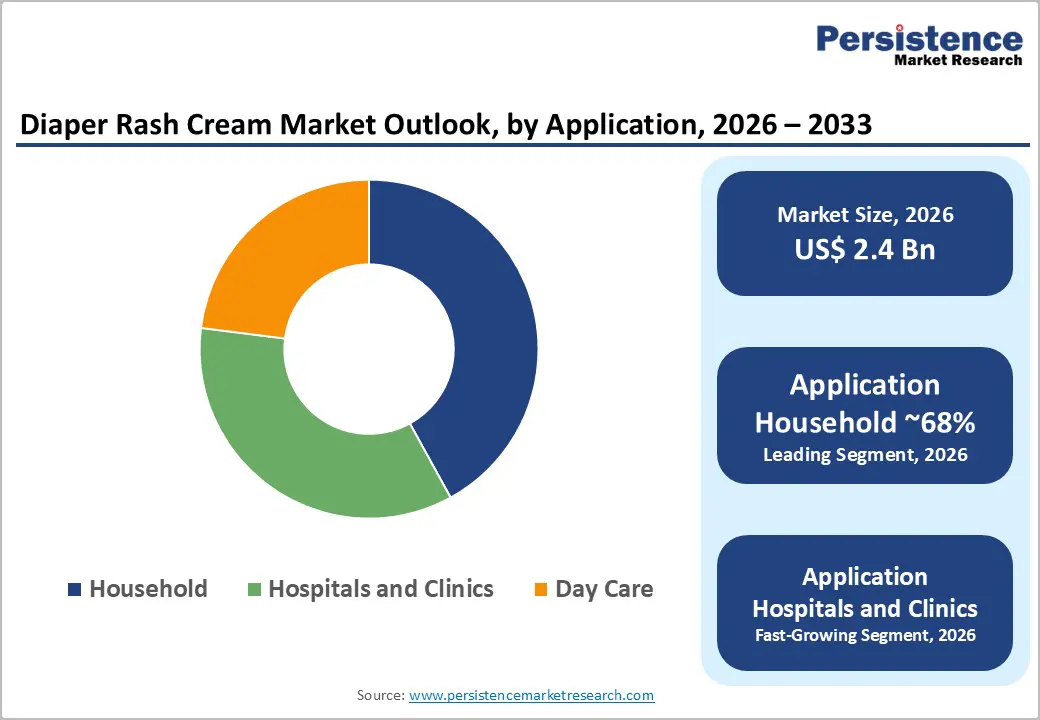
The Household application segment leads the market with an estimated share of 68%, as most diaper rash prevention and treatment occurs in home settings. Daily hygiene routines managed by parents and caregivers drive frequent product usage, while easy retail access through supermarkets and pharmacies sustains high household penetration.

The hospitals and clinics segment is the fastest-growing application area. Increased focus on preventive skin care in neonatal units, elderly care facilities, and post-acute settings is boosting institutional adoption. Clinical validation in healthcare environments also plays a critical role in influencing long-term consumer brand preferences after discharge.

Sales Channel Insights

Hypermarkets and supermarkets dominate the sales channel landscape, accounting for approximately 41% of the total market share. Their leadership is driven by high footfall, convenience-driven purchasing behavior, and extensive shelf presence for established baby care brands, enabling bundled purchases alongside diapers and related essentials.

Online retail is the fastest-growing sales channel, fueled by rising e-commerce adoption, subscription-based purchasing, and access to premium and niche brands. Digital platforms allow consumers to compare ingredients, read reviews, and access specialized formulations, accelerating the shift toward direct-to-consumer and online-first purchasing models.
diaper-rash-cream-market-outlook-by-application-2026–2033

Regional Insights

North America Diaper Rash Cream Market Trends

North America accounts for approximately 36% of the global diaper rash cream market, led by the United States’ high per-capita spending and well-developed retail and healthcare infrastructure. The region is strongly shaped by clean-label and safety-driven purchasing behavior, with parents prioritizing dermatologist-tested, fragrance-free, and third-party certified products. Established players have responded by reformulating and upgrading their portfolios to align with evolving safety perceptions.

Beyond infant care, North America shows strong traction in the adult incontinence segment, driven by insurance-backed long-term care facilities and the adoption of home healthcare. The region also serves as an innovation hub, where niche and premium brands focused on sustainability, plant-based ingredients, and transparent labeling continue to influence global product trends.

Europe Diaper Rash Cream Market Trends

Europe represents a mature and regulation-intensive market, projected to grow at a CAGR of approximately 5.8% during the forecast period. Stringent European Union cosmetic regulations significantly influence product formulation, favoring dermatologically approved and ingredient-compliant solutions. Countries such as Germany, France, and the U.K. lead demand for pharmacy-grade and organic diaper care products.

A defining characteristic of the region is strong consumer reliance on apothecaries and drugstores for baby skincare purchases, reinforcing trust in clinically positioned brands. Additionally, Europe’s rapidly aging population is driving increased demand for incontinence-related skin protection, prompting manufacturers to expand geriatric-focused and medically positioned product lines.

Asia Pacific Diaper Rash Cream Market Trends

Asia Pacific holds an estimated 32% share of the global market and represents the fastest-expanding regional opportunity. Growth is underpinned by high birth volumes in China and India, alongside rising disposable incomes, which are accelerating the shift from traditional home remedies to branded diaper-rash creams. Premiumization is particularly evident among urban middle-class households.

The region is also witnessing intensifying competition between international and domestic brands, with local players leveraging herbal and culturally familiar ingredients. The rapid expansion of e-commerce platforms has significantly improved product accessibility in tier-2 cities and rural areas, enabling deeper market penetration and sustained volume growth beyond metropolitan centers.
diaper-rash-cream-market-outlook-by-region-2026–2033

Competitive Landscape

The Diaper Rash Cream Market exhibits a moderately consolidated competitive structure, with a limited number of large multinational players accounting for a significant share of global revenues. These companies benefit from extensive research capabilities, established brand equity, and wide-reaching distribution networks, enabling consistent product availability and strong consumer recall across mass retail and pharmacy channels.

The competitive environment is becoming increasingly fragmented due to the rise of independent and direct-to-consumer brands focused on organic, clean-label, and niche positioning. Competition is shifting toward transparency, ingredient traceability, and third-party certifications as trust becomes a core differentiator. Larger players are responding through strategic acquisitions and portfolio diversification to strengthen credibility in premium and natural segments.

Key Market Developments:

  • In November 2025, Johnson & Johnson announced a major brand refresh titled "It's Pure Love," introducing updated, doctor-tested formulations enriched with aloe and Vitamin B5 to better protect baby skin in varying climates.
  • In July 2025, The Honest Company launched its new and improved "Clean Conscious Diapers" and associated care products, featuring enhanced breathable layers designed to minimize moisture-related skin irritation.
  • In October 2024, Bayer AG officially launched its globally recognized Bepanthen skincare brand in India, backed by a survey revealing a high prevalence of dry skin conditions among the Indian population.

Companies Covered in Diaper Rash Cream Market

  • Johnson & Johnson
  • Bayer AG
  • Beiersdorf AG
  • Procter & Gamble
  • Unilever
  • Himalaya Wellness
  • Weleda AG
  • Laboratoires Expanscience (Mustela)
  • The Honest Company
  • Burt’s Bees
  • Sebapharma
  • Summer Laboratories
  • Pigeon Corporation
  • Artsana Group (Chicco)
  • Earth Mama Organics
Frequently Asked Questions

The global market is forecast to reach a valuation of US$ 3.7 Billion by the end of 2033, expanding from US$ 2.4 Billion in 2026.

Demand is driven by the high prevalence of diaper dermatitis among infants, who account for nearly 75% of total consumption, along with rising cases of incontinence-associated dermatitis in the elderly population and increasing preference for preventive skin protection products.

The Conventional ingredient segment dominates with approximately 62% share, supported by the affordability and widespread use of zinc oxide and petrolatum-based formulations, while organic and plant-based products are gaining momentum.

North America leads the market with around 36% share, supported by high disposable incomes, advanced retail infrastructure, and strong adoption of both infant and adult incontinence skincare products.

A major opportunity lies in targeting the expanding adult incontinence care segment, alongside innovation in clean-label, microbiome-friendly formulations to capture premium demand.

Major players include Johnson & Johnson, Bayer AG, Beiersdorf AG, Procter & Gamble, Weleda AG, and The Honest Company, among others.

Global Diaper Rash Cream Market Report Scope
Report Attribute Details
Historical Data/Actuals 2020 - 2025
Forecast Period 2026 - 2033
Market Analysis Units Value: US$ Mn/Bn, Volume: As Applicable
Geographical Coverage
  • North America
  • Europe
  • East Asia
  • South Asia and Oceania
  • Latin America
  • Middle East and Africa
Segmental Coverage
  • Ingredient
  • End User
  • Application
  • Sales Channel
  • Regiob
Competitive Analysis
  • Johnson & Johnson
  • Bayer AG
  • Beiersdorf AG
  • Procter & Gamble
  • Unilever
  • Himalaya Wellness
  • Weleda AG
  • Laboratoires Expanscience (Mustela)
  • The Honest Company
  • Burt’s Bees
  • Sebapharma
  • Summer Laboratories
  • Pigeon Corporation
  • Artsana Group (Chicco)
  • Earth Mama Organics
Report Highlights
  • Market Forecast and Trends
  • Competitive Intelligence & Share Analysis
  • Growth Factors and Challenges
  • Strategic Growth Initiatives
  • Pricing Analysis
  • Future Opportunities and Revenue Pockets
  • Market Analysis Tools
Market Segmentation

By Ingredient

  • Organic
  • Conventional

By End User

  • Infants
  • Adults

By Application

  • Household
  • Hospitals and Clinics
  • Day Care

By Sales Channel

  • Hypermarkets/Supermarkets
  • Specialty Retailers
  • Multi-brand Stores
  • Drug Stores and Pharmacies
  • Online Retailers
  • Others

By Region

  • North America
  • Europe
  • East Asia
  • South Asia & Oceania
  • Latin America
  • Middle East & Africa

Related Reports

  1. Executive Summary
    1. Global Diaper Rash Cream Market Snapshot 2026 and 2033
    2. Market Opportunity Assessment, 2026 - 2033, US$ Bn
    3. Key Market Trends
    4. Industry Developments and Key Market Events
    5. Demand Side and Supply Side Analysis
    6. PMR Analysis and Recommendations
  2. Market Overview
    1. Market Scope and Definitions
    2. Value Chain Analysis
    3. Macro-Economic Factors
      1. Global GDP Outlook
      2. Global Wellness Industry Overview
      3. Global Consumer Goods Industry Overview
    4. Forecast Factors - Relevance and Impact
    5. COVID-19 Impact Assessment
    6. PESTLE Analysis
    7. Porter's Five Forces Analysis
    8. Geopolitical Tensions: Market Impact
    9. Regulatory and Technology Landscape
  3. Market Dynamics
    1. Drivers
    2. Restraints
    3. Opportunities
    4. Trends
  4. Price Trend Analysis, 2020 - 2033
    1. Region-wise Price Analysis
    2. Price by Segments
    3. Price Impact Factors
  5. Global Diaper Rash Cream Market Outlook: Historical (2020 - 2025) and Forecast (2026 - 2033)
    1. Key Highlights
    2. Global Diaper Rash Cream Market Outlook: Ingredient
      1. Introduction/Key Findings
      2. Historical Market Size (US$ Bn) and Volume (Units) Analysis by Ingredient, 2020-2025
      3. Current Market Size (US$ Bn) and Volume (Units) Forecast, by Ingredient, 2026-2033
        1. Organic
        2. Conventional
      4. Market Attractiveness Analysis: Ingredient
    3. Global Diaper Rash Cream Market Outlook: End User
      1. Introduction/Key Findings
      2. Historical Market Size (US$ Bn) and Volume (Units) Analysis by End User, 2020-2025
      3. Current Market Size (US$ Bn) and Volume (Units) Forecast, by End User, 2026-2033
        1. Infants
        2. Adults
      4. Market Attractiveness Analysis: End User
    4. Global Diaper Rash Cream Market Outlook: Application
      1. Introduction/Key Findings
      2. Historical Market Size (US$ Bn) and Volume (Units) Analysis by Application, 2020-2025
      3. Current Market Size (US$ Bn) and Volume (Units) Forecast, by Application, 2026-2033
        1. Household
        2. Hospitals and Clinics
        3. Day Care
      4. Market Attractiveness Analysis: Application
    5. Global Diaper Rash Cream Market Outlook: Sales Channel
      1. Introduction/Key Findings
      2. Historical Market Size (US$ Bn) and Volume (Units) Analysis by Sales Channel, 2020-2025
      3. Current Market Size (US$ Bn) and Volume (Units) Forecast, by Sales Channel, 2026-2033
        1. Hypermarkets/Supermarkets
        2. Specialty Retailers
        3. Multi-brand Stores
        4. Drug Stores and Pharmacies
        5. Online Retailers
        6. Others
      4. Market Attractiveness Analysis: Sales Channel
  6. Global Diaper Rash Cream Market Outlook: Region
    1. Key Highlights
    2. Historical Market Size (US$ Bn) and Volume (Units) Analysis by Region, 2020-2025
    3. Current Market Size (US$ Bn) and Volume (Units) Forecast, by Region, 2026-2033
      1. North America
      2. Europe
      3. East Asia
      4. South Asia & Oceania
      5. Latin America
      6. Middle East & Africa
    4. Market Attractiveness Analysis: Region
  7. North America Diaper Rash Cream Market Outlook: Historical (2020 - 2025) and Forecast (2026 - 2033)
    1. Key Highlights
    2. Pricing Analysis
    3. North America Market Size (US$ Bn) and Volume (Units) Forecast, by Country, 2026-2033
      1. U.S.
      2. Canada
    4. North America Market Size (US$ Bn) and Volume (Units) Forecast, by Ingredient, 2026-2033
      1. Organic
      2. Conventional
    5. North America Market Size (US$ Bn) and Volume (Units) Forecast, by End User, 2026-2033
      1. Infants
      2. Adults
    6. North America Market Size (US$ Bn) and Volume (Units) Forecast, by Application, 2026-2033
      1. Household
      2. Hospitals and Clinics
      3. Day Care
    7. North America Market Size (US$ Bn) and Volume (Units) Forecast, by Sales Channel, 2026-2033
      1. Hypermarkets/Supermarkets
      2. Specialty Retailers
      3. Multi-brand Stores
      4. Drug Stores and Pharmacies
      5. Online Retailers
      6. Others
  8. Europe Diaper Rash Cream Market Outlook: Historical (2020 - 2025) and Forecast (2026 - 2033)
    1. Key Highlights
    2. Pricing Analysis
    3. Europe Market Size (US$ Bn) and Volume (Units) Forecast, by Country, 2026-2033
      1. Germany
      2. Italy
      3. France
      4. U.K.
      5. Spain
      6. Russia
      7. Rest of Europe
    4. Europe Market Size (US$ Bn) and Volume (Units) Forecast, by Ingredient, 2026-2033
      1. Organic
      2. Conventional
    5. Europe Market Size (US$ Bn) and Volume (Units) Forecast, by End User, 2026-2033
      1. Infants
      2. Adults
    6. Europe Market Size (US$ Bn) and Volume (Units) Forecast, by Application, 2026-2033
      1. Household
      2. Hospitals and Clinics
      3. Day Care
    7. Europe Market Size (US$ Bn) and Volume (Units) Forecast, by Sales Channel, 2026-2033
      1. Hypermarkets/Supermarkets
      2. Specialty Retailers
      3. Multi-brand Stores
      4. Drug Stores and Pharmacies
      5. Online Retailers
      6. Others
  9. East Asia Diaper Rash Cream Market Outlook: Historical (2020 - 2025) and Forecast (2026 - 2033)
    1. Key Highlights
    2. Pricing Analysis
    3. East Asia Market Size (US$ Bn) and Volume (Units) Forecast, by Country, 2026-2033
      1. China
      2. Japan
      3. South Korea
    4. East Asia Market Size (US$ Bn) and Volume (Units) Forecast, by Ingredient, 2026-2033
      1. Organic
      2. Conventional
    5. East Asia Market Size (US$ Bn) and Volume (Units) Forecast, by End User, 2026-2033
      1. Infants
      2. Adults
    6. East Asia Market Size (US$ Bn) and Volume (Units) Forecast, by Application, 2026-2033
      1. Household
      2. Hospitals and Clinics
      3. Day Care
    7. East Asia Market Size (US$ Bn) and Volume (Units) Forecast, by Sales Channel, 2026-2033
      1. Hypermarkets/Supermarkets
      2. Specialty Retailers
      3. Multi-brand Stores
      4. Drug Stores and Pharmacies
      5. Online Retailers
      6. Others
  10. South Asia & Oceania Diaper Rash Cream Market Outlook: Historical (2020 - 2025) and Forecast (2026 - 2033)
    1. Key Highlights
    2. Pricing Analysis
    3. South Asia & Oceania Market Size (US$ Bn) and Volume (Units) Forecast, by Country, 2026-2033
      1. India
      2. Southeast Asia
      3. ANZ
      4. Rest of SAO
    4. South Asia & Oceania Market Size (US$ Bn) and Volume (Units) Forecast, by Ingredient, 2026-2033
      1. Organic
      2. Conventional
    5. South Asia & Oceania Market Size (US$ Bn) and Volume (Units) Forecast, by End User, 2026-2033
      1. Infants
      2. Adults
    6. South Asia & Oceania Market Size (US$ Bn) and Volume (Units) Forecast, by Application, 2026-2033
      1. Household
      2. Hospitals and Clinics
      3. Day Care
    7. South Asia & Oceania Market Size (US$ Bn) and Volume (Units) Forecast, by Sales Channel, 2026-2033
      1. Hypermarkets/Supermarkets
      2. Specialty Retailers
      3. Multi-brand Stores
      4. Drug Stores and Pharmacies
      5. Online Retailers
      6. Others
  11. Latin America Diaper Rash Cream Market Outlook: Historical (2020 - 2025) and Forecast (2026 - 2033)
    1. Key Highlights
    2. Pricing Analysis
    3. Latin America Market Size (US$ Bn) and Volume (Units) Forecast, by Country, 2026-2033
      1. Brazil
      2. Mexico
      3. Rest of LATAM
    4. Latin America Market Size (US$ Bn) and Volume (Units) Forecast, by Ingredient, 2026-2033
      1. Organic
      2. Conventional
    5. Latin America Market Size (US$ Bn) and Volume (Units) Forecast, by End User, 2026-2033
      1. Infants
      2. Adults
    6. Latin America Market Size (US$ Bn) and Volume (Units) Forecast, by Application, 2026-2033
      1. Household
      2. Hospitals and Clinics
      3. Day Care
    7. Latin America Market Size (US$ Bn) and Volume (Units) Forecast, by Sales Channel, 2026-2033
      1. Hypermarkets/Supermarkets
      2. Specialty Retailers
      3. Multi-brand Stores
      4. Drug Stores and Pharmacies
      5. Online Retailers
      6. Others
  12. Middle East & Africa Diaper Rash Cream Market Outlook: Historical (2020 - 2025) and Forecast (2026 - 2033)
    1. Key Highlights
    2. Pricing Analysis
    3. Middle East & Africa Market Size (US$ Bn) and Volume (Units) Forecast, by Country, 2026-2033
      1. GCC Countries
      2. South Africa
      3. Northern Africa
      4. Rest of MEA
    4. Middle East & Africa Market Size (US$ Bn) and Volume (Units) Forecast, by Ingredient, 2026-2033
      1. Organic
      2. Conventional
    5. Middle East & Africa Market Size (US$ Bn) and Volume (Units) Forecast, by End User, 2026-2033
      1. Infants
      2. Adults
    6. Middle East & Africa Market Size (US$ Bn) and Volume (Units) Forecast, by Application, 2026-2033
      1. Household
      2. Hospitals and Clinics
      3. Day Care
    7. Middle East & Africa Market Size (US$ Bn) and Volume (Units) Forecast, by Sales Channel, 2026-2033
      1. Hypermarkets/Supermarkets
      2. Specialty Retailers
      3. Multi-brand Stores
      4. Drug Stores and Pharmacies
      5. Online Retailers
      6. Others
  13. Competition Landscape
    1. Market Share Analysis, 2025
    2. Market Structure
      1. Competition Intensity Mapping
      2. Competition Dashboard
    3. Company Profiles
      1. Johnson & Johnson
        1. Company Overview
        2. Product Portfolio/Offerings
        3. Key Financials
        4. SWOT Analysis
        5. Company Strategy and Key Developments
      2. Bayer AG
      3. Beiersdorf AG
      4. Procter & Gamble
      5. Unilever
      6. Himalaya Wellness
      7. Weleda AG
      8. Laboratoires Expanscience (Mustela)
      9. The Honest Company
      10. Burt’s Bees
      11. Sebapharma
      12. Summer Laboratories
      13. Pigeon Corporation
      14. Artsana Group (Chicco)
      15. Earth Mama Organics
  14. Appendix
    1. Research Methodology
    2. Research Assumptions
    3. Acronyms and Abbreviations

Research Methodology Framework for Market Research Excellence

At Persistence Market Research, we implement a comprehensive, validated, and multi-dimensional approachto market analysis that delivers actionable insights across complex market landscapes. Our methodology combines the analytical rigor of leading consulting firms with innovative research techniques, ensuring robust market assessments that guide strategic decision-making with confidence.

Core Research Philosophy

Our methodology is built on four foundational pillars:

Research Philosophy Image

At Persistence Market Research, our methodology is designed to transcend conventional market studies by combining analytical rigor, multi-source validation, and future-focused insights.

We integrate advanced research frameworks, robust data collection strategies, cutting-edge analytics, and innovative technologies to deliver a 360-degree view of complex markets.

We integrate advanced research frameworks, robust data collection strategies, cutting-edge analytics, and innovative technologies to deliver a 360-degree view of complex markets.

Each stage spanning from strategic scoping and hypothesis-building to competitive intelligence, quality validation, and actionable recommendations is engineered to provide clients with unmatched clarity, precision, and confidence in decision-making.

By embedding innovation and technology at the core, our approach ensures that insights are not only comprehensive but also predictive, empowering businesses to seize opportunities, mitigate risks, and achieve sustainable growth

Research Philosophy Image

Capturing Key Information and Events

During this phase, key research objectives focus on essential information and data points for assessing the market, including:

Research Philosophy Image

TAM-SAM-SOM Framework Implementation

We employ both top-down and bottom-up approaches to ensure accurate market sizing.

Top-Down Market SizingBottom-Up Market Sizing
Universe Definition: Total global/regional market identificationUnit Economics: Average transaction values, purchase frequencies, customer lifecycle
Segmentation Filters: Geographic, demographic, and behavioral constraintsCustomer Segmentation: Detailed buyer persona development and sizing
Market Share Analysis: Competitive landscape assessment and share allocationPenetration Analysis: Market penetration rates by segment and geography
Growth Rate Application: Historical trends and forward-looking growth assumptionsScaling Methodology: Extrapolation techniques with confidence intervals

Validation & Cross-Verification

  • Triangulation: Comparing top-down and bottom-up results for consistency
  • Sensitivity Analysis: Testing key assumptions and parameter variations
  • Peer Benchmarking: Comparison with analogous markets and industry benchmarks
  • Expert Review: External validation through industry specialist consultation

Research Philosophy Image

Forecasting & Projection Modeling

Our proprietary forecasting models incorporate multiple variables and scenarios.

Forecasting Components

  • Historical Trend Analysis: 10-year historical growth patterns and cyclical variations
  • Driver-Based Modeling: Economic indicators, demographic shifts, technology adoption
  • Scenario Planning: Base case, optimistic, and conservative projections
  • Monte Carlo Simulations: Probability-weighted outcomes and risk assessments

Model Validation

  • Back-Testing: Historical accuracy assessment over 3–5-year periods
  • Cross-Validation: Multiple modeling approaches for result comparison
  • External Benchmarking: Comparison with established market forecasts
  • Continuous Calibration: Quarterly model updates based on new data

Comprehensive Data Collection Strategy

Our secondary research phase establishes a robust knowledge base utilizing diverse, credible sources.

Secondary Data Sourcess

  • Industry Publications & Reports
  • Government & Regulatory Data
  • Financial Intelligence (filings & reports)
  • Academic Research & Digital Intelligence

Quality Assurance Protocol

  • Source credibility assessment and publication date validation
  • Data consistency checks across multiple sources
  • Bias identification and neutralization techniques
  • Information gap tracking for primary research prioritization

Research Philosophy Image

Primary Research Excellence

Our primary research methodology employs best-in-class techniques to capture unique market insights.

Quantitative Research Methods

  • Large-Scale Surveys: Statistically representative samples with 95% confidence intervals
  • Survey Methodology: Multi-channel deployment (online, telephone, in-person)
  • Question Architecture and Response Optimization

Qualitative Research Methods

  • Executive Interviews
  • Focus Groups
  • Expert Consultations

Quality Assurance & Validation Framework

Multi-Stage Validation Process

  • Source Verification and Consistency Testing
  • Outlier Detection and Bias Assessment
  • Peer Review Process and External Validation
  • Sensitivity Analysis and Confidence Intervals

Research Philosophy Image

Methodology Validation & Credibility

Our research methodology has been extensively validated through:

  • Academic Partnerships: Collaborations with top-tier business schools and research institutions
  • Client Success Stories: Documented case studies demonstrating research impact and ROI
  • Continuous Benchmarking: Performance comparison with leading global research firms

This comprehensive methodology framework positions Persistence Market Research at the forefront of market intelligence, combining the analytical sophistication of top-tier consulting firms with innovative research techniques. Our approach ensures that every market assessment delivers precise, actionable, and strategically valuable insights that drive business success in competitive market environments.

Ready to unlock your market potential? Contact our research experts to discuss how our validated methodology can transform your strategic decision-making with data-driven market intelligence.

Copyright © 2026 Persistence Market Research. All Rights Reserved

Connect With Us -