




- Animal Feed & Additives
- Blood Meal Market
Blood Meal Market Size, Share, and Growth Forecast, 2026 - 2033
Blood Meal Market by Source (Poultry Blood, Porcine Blood, Ruminant Blood), Application (Poultry Feed, Ruminant Feed, Others), and Regional Analysis 2026 - 2033

Blood Meal Market Size and Trends Analysis
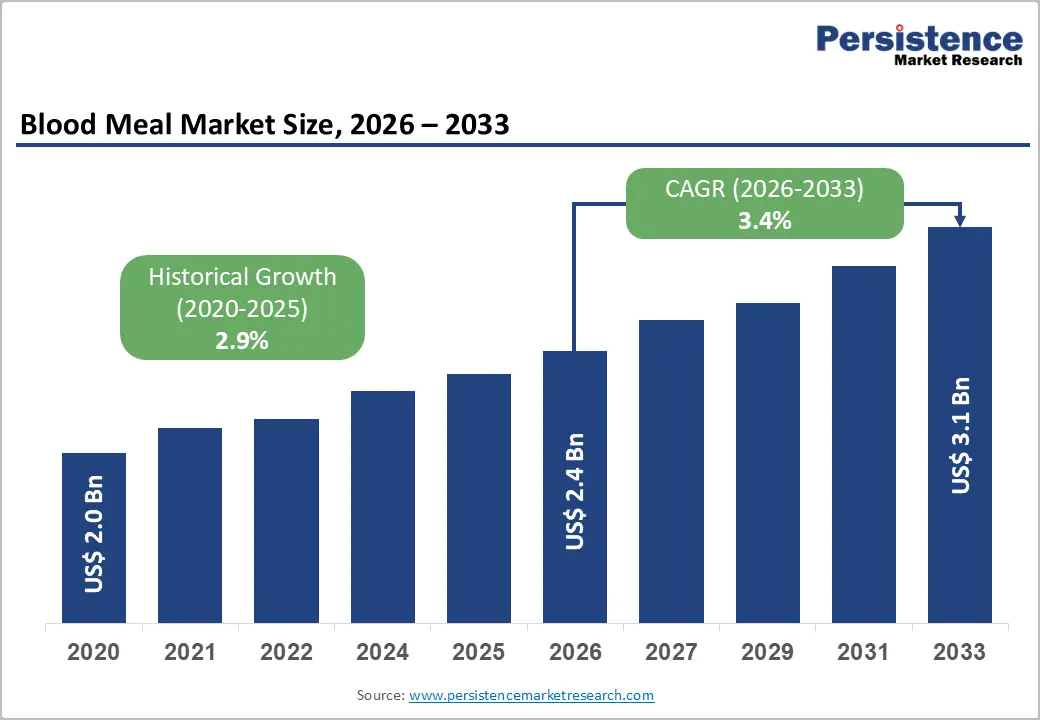
The global blood meal market size is likely to be US$2.4 billion in 2026 and is expected to reach US$3.1 billion by 2033, growing at a CAGR of 3.4% during the forecast period from 2026 to 2033, driven by the increasing demand for high-protein inputs in livestock production, particularly across large-scale industrial farming operations.
The emphasis on sustainable utilization of animal byproducts continues to play a vital role in modern rendering and feed manufacturing processes. Advancements in processing technologies are further improving nutrient retention and ensuring higher safety standards. Procurement strategies are increasingly shifting toward sustainable sourcing to address rising feed costs. Global meat consumption trends also significantly impact the availability of raw blood materials, supporting the steady expansion of the processed animal protein market.
Key Industry Highlights:
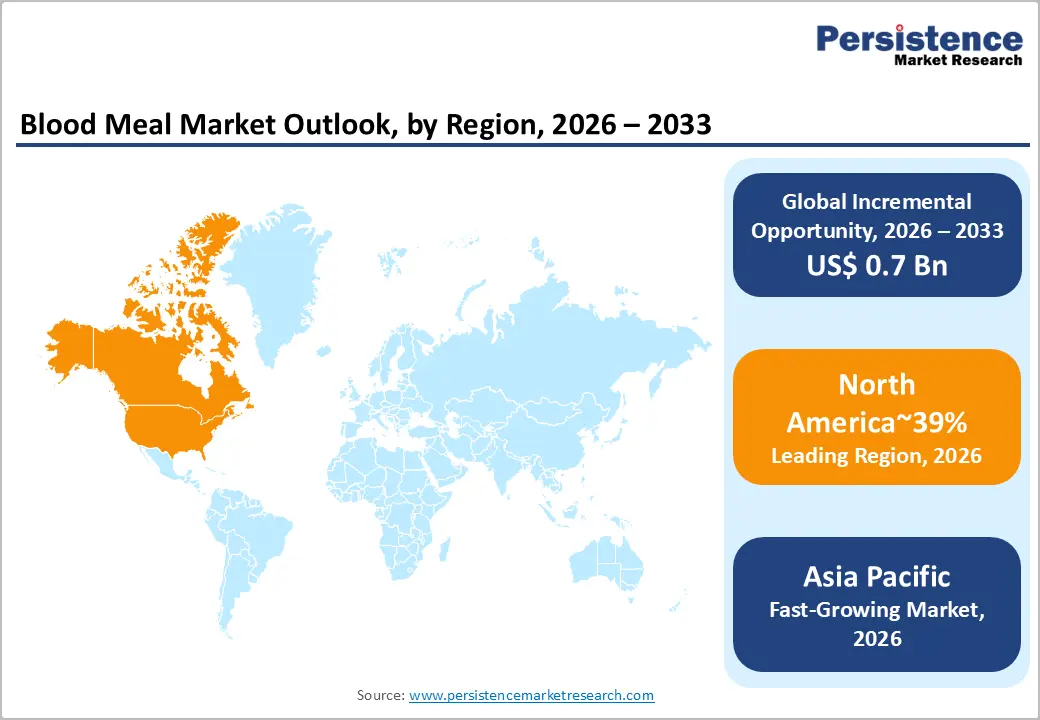
- Leading Region: North America is projected to lead, accounting for approximately 39% share in 2026, supported by integrated supply chains and high rendering capacity.
- Fastest Growing Region: Asia Pacific is anticipated to grow fastest, driven by rapid aquaculture expansion and increasing livestock population density.
- Leading Source: Poultry is expected to lead, accounting for approximately 44% share in 2026, anchored by high lysine content and widespread availability.
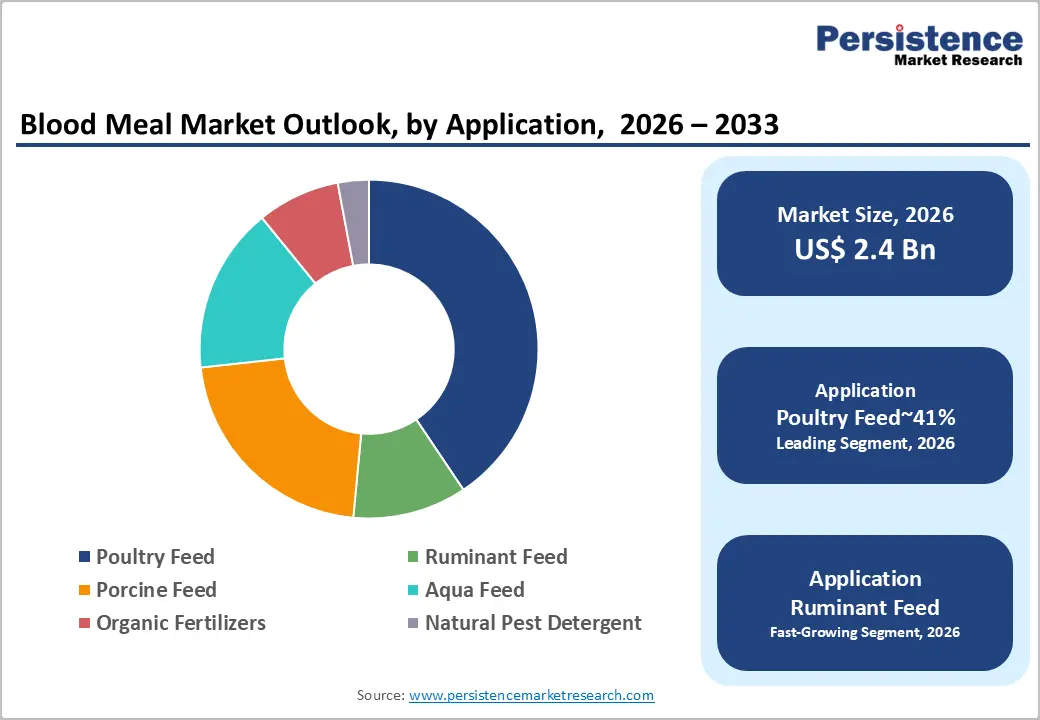
- Leading Application: Poultry feed is anticipated to dominate, accounting for approximately 41% of the market in 2026, anchored by intensive broiler and layer production.
| Key Insights | Details |
|---|---|
|
Blood Meal Market Size (2026E) |
US$2.4 Bn |
|
Market Value Forecast (2033F) |
US$3.1 Bn |
|
Projected Growth (CAGR 2026 to 2033) |
3.4% |
|
Historical Market Growth (CAGR 2020 to 2025) |
2.9% |

DRO Analysis
Driver Analysis – Aquaculture Feed Formulation Shifts
The expansion of aquaculture production intensifies the demand for alternative protein inputs amid global constraints on marine resources. Declining availability of fishmeal is driving formulators toward nutritionally dense substitutes in commercial aquafeed systems. Blood-derived ingredients provide high lysine and phosphorus content, supporting optimized growth and metabolic efficiency. This substitution reduces reliance on soy and marine proteins while stabilizing feed cost structures. Increasing farming density in emerging regions amplifies demand for digestible and performance-oriented feed components. Regulatory focus on sustainability further accelerates the integration of alternative protein sources within aquaculture diets. These factors collectively sustain consumption growth of specialized feed inputs across hatchery and grow-out operations.
Ridley Corporation’s AquaBlood Meal supports omega fatty acid enrichment and nutrient optimization within formulated aquafeed applications. Feed producers leverage such inputs to enhance species-specific dietary performance across diverse aquaculture systems. Long-term supply agreements strengthen procurement stability amid fluctuating raw material availability. Nutritional consistency improves survival rates in intensive farming environments that require balanced feed compositions. Advancements in processing ensure the bioavailability and safety of blood-derived ingredients in aquatic diets. These dynamics reinforce sustained expansion of aquaculture feed markets as production systems modernize globally.
Organic Fertilizer Adoption Momentum
Sustainable agriculture policies increasingly favor natural nutrient inputs over synthetic fertilizers globally. Blood meal provides slow-release nitrogen, supporting consistent crop yield performance across diverse soil conditions. Farmers adopt such inputs to align with organic certification requirements and regulatory compliance frameworks. Soil structure and microbial activity improve with repeated applications, thereby enhancing long-term agronomic productivity. Regulatory incentives reinforce the transition toward environmentally sustainable fertilization practices within commercial farming systems. Cost structures shift toward premium organic inputs justified by certification-linked pricing advantages. These dynamics collectively sustain demand expansion for natural fertilizers across regulated agricultural markets.
Down to Earth Distributors’ Blood Meal 12-0-0 supports certified organic applications across field crops and specialty farming operations. Nutrient profiles enable gradual nitrogen release, improving soil fertility and crop nutrient uptake efficiency. Farmers integrate such products within rotational systems to maintain compliance with organic farming standards. Distribution networks align offerings with evolving regulatory mandates, favoring sustainable agricultural inputs. Procurement volumes increase as growers accept premium pricing linked to certification and yield consistency. These trends reinforce the steady growth of organic fertilizer adoption across global agricultural ecosystems.
Restraint Analysis – Volatility from Slaughter Fluctuations
Seasonal variations in meat processing disrupt consistent availability of blood-derived raw materials across supply chains. Cyclical demand patterns within the porcine sector create intermittent shortages, affecting the stability of feed ingredient procurement. Logistics constraints in remote production regions further exacerbate supply inconsistencies and delivery timelines. These disruptions trigger price volatility, complicating budgeting and cost forecasting for feed manufacturers globally. Inventory planning becomes increasingly complex under fluctuating input availability and unpredictable sourcing conditions. Regulatory oversight on handling and transport adds additional constraints to already fragmented supply networks. These factors collectively undermine reliability within blood-based feed ingredient markets.
APC Inc.’s Stabilized Blood Meal improves storage efficiency and shelf stability within constrained supply environments. However, technological mitigation cannot fully compensate for upstream raw material shortages and procurement gaps. Feed producers encounter operational disruptions as inconsistent inputs affect formulation precision and production continuity. Price fluctuations ripple through value chains, impacting end-user affordability and feed cost structures. Supply instability reduces confidence in long-term sourcing agreements across commercial feed operations. These interdependencies collectively weaken formulation stability during peak shortage cycles within aquafeed and livestock systems.
Stringent Biosecurity and Regulatory Oversight
Strict regulatory frameworks governing animal-derived proteins impose substantial compliance burdens across feed ingredient manufacturing ecosystems. Authorities mandate rigorous pathogen testing protocols to prevent disease transmission within integrated feed supply chains. Cross-border trade restrictions on ruminant-derived inputs limit market accessibility and constrain global distribution strategies. Compliance requirements for sterilization, documentation, and traceability elevate operational expenditure across processing facilities. Divergent regional standards necessitate continuous investment in quality assurance infrastructure and monitoring systems. Regulatory scrutiny intensifies audit frequency, increasing administrative complexity within rendering and feed production networks. These factors, collectively, compress margins and limit scalability across animal protein processing markets.
Sanimax’s Sanimax Blood Meal adheres to stringent biosecurity protocols ensuring product safety and regulatory alignment. Processors implement advanced traceability systems to meet evolving international hygiene and compliance standards. Operational strategies increasingly prioritize adherence to certification requirements to maintain access to regulated export markets. Elevated compliance costs influence pricing structures and competitive positioning across feed ingredient segments. Regulatory tightening reduces flexibility in the sourcing and distribution of animal-derived materials globally. These constraints collectively shape long-term operational planning within rendering industry participants.
Opportunity Analysis – High-Nitrogen Organic Fertilizer Demand
The rising adoption of organic farming practices is driving global demand for nitrogen-rich natural fertilizers. Blood meal is valued for its slow-release nitrogen, supporting sustained plant growth and soil vitality. This application enhances nutrient cycling while maintaining ecological balance within sustainable agricultural systems. The horticulture and residential gardening segments increasingly prefer organic inputs that meet environmental safety standards. Regulatory expansion of organic certification frameworks further reinforces adoption of compliant soil amendment products. Cost structures reflect premium pricing supported by certification, performance reliability, and environmental compliance benefits. These dynamics collectively strengthen the market position of blood-based fertilizers across diversified agricultural applications.
Sanimax’s Sanimax Blood Meal supplies specialized fertilizer grades tailored for certified organic agricultural and horticultural use. Nutrient-dense formulations support improved soil fertility and plant development across diverse cultivation environments. Producers align product portfolios with regulatory standards governing sustainable and eco-friendly farming practices. Expansion into non-feed applications diversifies revenue streams beyond traditional livestock and aquafeed segments. Supply chains adapt to serve landscaping and residential gardening markets seeking natural nutrient solutions. These interlinked trends reinforce sustained demand for organic blood meal within environmentally focused agricultural systems.
Pest Deterrent Bio-Formulations
Integrated pest management frameworks increasingly prioritize natural repellents within organic and sustainable cropping systems globally. Blood meal exhibits deterrent properties by disrupting insect life cycles through nitrogen volatilization mechanisms. This functional characteristic supports its integration into broader biopesticide and soil treatment strategies. Regulatory approvals for bio-based crop protection inputs expand permissible application scopes across agricultural markets. High-value horticulture segments demonstrate rising demand for environmentally compliant pest control alternatives. Cost structures align with premium positioning of bio-formulations supported by regulatory and environmental benefits. These dynamics collectively strengthen adoption of blood-based deterrents within modern crop protection ecosystems.
Certis USA’s Nemaguard Blood Meal integrates into soil drench programs targeting pest suppression within organic farming operations. Application strategies enhance soil health while providing protection against harmful organisms. Growers increasingly adopt such formulations to comply with evolving organic certification requirements. Product innovation focuses on improving efficacy, ease of application, and compatibility with existing cultivation practices. Commercial pathways expand through structured grower education and demonstration initiatives. These developments reinforce niche growth opportunities for bio-based pest deterrent solutions across regulated agricultural systems.
Category–wise Analysis
Source Insights
Poultry blood is expected to lead the market, accounting for approximately 44% share in 2026, supported by the intensive expansion of global poultry production networks. The widespread availability of raw material from high-volume broiler and layer facilities ensures a consistent supply for rendering. Poultry-sourced meal is highly valued for its superior lysine concentration and balanced amino acid profile. This nutritional profile aligns with the requirements of diverse livestock and aquaculture feed formulations. Darling Ingredients’ Sonac Blood Meal and Tyson Foods’ Tyson Animal Nutrition Blood Meal demonstrate the structural importance of poultry-based proteins. Procurement remains anchored in the cost-efficiency and nutritional density provided by poultry rendering. This convergence of supply stability and nutritional efficacy sustains the segment's leadership within the market.
Ruminant blood is forecast to be the fastest-growing segment, driven by emerging needs for specialized nutritional additives in diverse livestock sectors. Ongoing advancements in processing technologies are improving the safety and digestibility of cattle-sourced proteins. These enhancements enable manufacturers to effectively address specific metabolic requirements in high-performance animal diets. Saria Group’s Saria Blood Meal and FASA Group’s FASA Blood Meal exemplify the strategic shift toward high-purity ruminant products. Integration of rigorous biosecurity protocols supports the expansion of this segment into previously restricted regional markets. As producers prioritize functional health and rapid growth, ruminant-derived proteins are gaining traction across evolving agricultural ecosystems.
Application Insights
Poultry feed is anticipated to lead, accounting for approximately 41% of the market in 2026, driven by the continued expansion of commercial avian production systems. High-intensity broiler operations necessitate concentrated protein sources to achieve rapid weight gain and efficient feed conversion. Blood meal provides a bioavailable source of essential nutrients that support muscle development and overall flock health. Adoption remains anchored in the structural requirement for high-density diets in modern poultry farming. Ridley Corporation’s Ridley Blood Meal and Allanasons Pvt. Ltd.’s Alana Blood Meal address these intensive production needs through targeted feed ingredients. Ongoing optimization of feed formulations further strengthens the utilization of blood products in poultry diets. This alignment between industrial scale and nutritional necessity sustains the segment's dominant position.
Ruminant feed is expected to be the fastest-growing segment, driven by increasing utilization of bypass proteins in dairy and beef production. Precision nutrition strategies are highlighting the benefits of high-protein additives in optimizing milk yield and animal growth. Blood meal serves as a valuable source of rumen-undegradable protein, enhancing nutrient delivery to the small intestine. APC’s AP 301 and Sanimax’s Sanimax Blood Meal support these advanced feeding strategies through high-quality rendered products. Growing awareness of the economic benefits of protein supplementation is accelerating adoption among commercial cattle farmers. As livestock managers seek to maximize productivity and animal health, specialized ruminant feed applications are expanding globally.
Regional Analysis
North America Blood Meal Market Trends
North America is expected to remain the leading regional market, accounting for approximately 39% share in 2026, supported by highly integrated rendering infrastructure and established livestock supply chains. The region's dominance is anchored in the presence of large-scale meat processing facilities that provide a consistent volume of raw blood. Advanced manufacturing technologies are deeply embedded within North American rendering operations, ensuring the production of high-purity and stable meal. Strict quality assurance systems and comprehensive regulatory frameworks further reinforce the regional market's structural stability. Demand is projected to remain concentrated in high-efficiency livestock and pet food sectors requiring traceable protein ingredients.
The U.S. is expected to anchor regional momentum through sustained investments in automated rendering technologies aligned with sustainable byproduct management strategies. Government-led trade policies and domestic agricultural incentives are anticipated to influence the procurement dynamics of rendered animal proteins. Tyson Foods’ Tyson Animal Nutrition Blood Meal is expected to benefit from localized sourcing and extensive distribution networks across the country. Regulatory focus on environmental sustainability and circular economy models is projected to increase the utilization of upcycled animal byproducts. Domestic demand for organic fertilizers and premium pet food ingredients is likely to drive further market expansion.
Asia Pacific Blood Meal Market Trends
Asia Pacific is expected to register the fastest growth trajectory, as rapid aquaculture buildout and livestock manufacturing scale accelerate regional market expansion. The region's growth is anchored in the intensive expansion of shrimp and fish farming in emerging coastal economies. High demand for cost-effective protein sources to replace traditional fishmeal is driving the adoption of blood meal in aquafeed. Increasing urbanization and rising middle-class meat consumption are further necessitating the intensification of poultry and swine production. Policy support for agricultural modernization and food security initiatives is anticipated to strengthen the regional supply chain.
India is poised to anchor regional momentum through policy shifts promoting livestock self-sufficiency. Investments in coastal shrimp farms heighten aqua feed requirements. BioMar’s Nutra Blood Meal Blend aligns with localization efforts. China is expected to lead regional growth through massive investments in industrial-scale livestock facilities and advanced feed manufacturing hubs. The government's focus on self-sufficiency in protein production is anticipated to accelerate the uptake of high-efficiency rendered ingredients. Darling Ingredients’ Sonac Blood Meal is likely to expand its footprint through strategic partnerships within the Chinese animal nutrition sector. Regulatory tightening around feed safety and disease management is projected to favor large-scale, technologically advanced rendering participants. Continued aquaculture expansion in inland and coastal regions is forecast to sustain high procurement volumes for blood meal.
Europe Blood Meal Market Trends
Europe is expected to remain a mature and structurally stable regional market, with demand primarily anchored in high-value specialty feed and organic fertilizer segments. The region's market dynamics are heavily influenced by stringent European Union regulations regarding animal byproducts and feed safety. Mature rendering industries are focusing on premiumization and the production of highly digestible meal for niche applications. Environmental sustainability mandates and carbon reduction goals are compelling manufacturers to optimize their energy consumption and waste recovery processes. Replacement cycles and compliance-driven upgrades are likely to sustain consistent demand for advanced processing equipment.
Germany is expected to serve as a key anchor for European market stability through its advanced rendering sector and strong focus on circular agricultural practices. High standards for animal welfare and feed quality are anticipated to drive the adoption of premium, traceable blood meal products. Saria Group’s Saria Blood Meal is positioned to leverage its extensive regional processing network to meet diverse industrial requirements. Regulatory updates regarding the use of processed animal proteins are projected to create new opportunities in the domestic aquaculture and poultry sectors. Ongoing investment in bio-based circularity and organic farming is likely to reinforce the demand for blood-based fertilizers.
Competitive Landscape
The global blood meal market is moderately consolidated, with leadership shared between global rendering conglomerates and regional processing operators. This structure reflects capital-intensive infrastructure requirements alongside localized raw material collection networks supporting distributed production systems. Leading participants influence procurement through advanced drying technologies, pathogen control standards, and consistent nutrient profiling across feed applications. Their scale enables stable supply relationships with major meat processors and commercial feed manufacturers globally. Established players such as Darling Ingredients, Tyson Foods, and Saria Group set benchmarks for traceability and operational reliability.
Competitive positioning reflects vertical differentiation between premium spray-dried products and value-oriented bulk meal offerings for livestock nutrition. Premium providers emphasize enhanced protein bioavailability and functional benefits, while value players prioritize cost efficiency and volume scalability. Companies such as APC advance specialized formulations targeting immunological performance and feed efficiency improvements. Industry dynamics include consolidation of regional rendering assets to secure raw material access and optimize processing capacity. Forward-looking strategies prioritize environmental efficiency and supply chain transparency across global animal nutrition ecosystems.
Key Industry Developments:
- In February 2026, Darling Ingredients Inc. reported net income of US$56.9 million for Q4 2025, emphasizing sequential strengthening in its core ingredients and rendering business. The stabilization of the core ingredients signals a recovery in rendering margins, allowing for sustained investment in circular economy infrastructure. It signals a stabilized supply chain and improved margins, ensuring a consistent flow of high-quality protein to global aquaculture and livestock markets.
- In November 2025, Cargill Animal Nutrition & Health completed a 50% capacity expansion at its flagship micronutrition facility in Engerwitzdorf, Austria. This expansion supports the growing demand for "precision nutrition" solutions where blood meal is often utilized as a high-performance amino acid source in specialized feed.
Companies Covered in Blood Meal Market
- Darling Ingredients Inc.
- Tyson Foods, Inc.
- Saria Group
- Cargill
- APC (The Lauridsen Group)
- DSM
- Kemin Industries
- Ridley Corporation Limited
- BioMar
- Skretting
- Alltech
- Sanimax
- Valley Proteins, Inc.
- West Coast Reduction Ltd.
- FASA Group
- Allanasons Pvt Ltd
Frequently Asked Questions
The global blood meal market is projected to be valued at US$2.4 billion in 2026 and is expected to reach US$3.1 billion by 2033, driven by rising demand for high-protein animal feed and increasing utilization of rendering byproducts across livestock and aquaculture industries.
Rapid aquaculture expansion is a major driver, as declining fishmeal availability compels feed manufacturers to adopt alternative protein inputs such as blood meal, which offers high lysine content, improved digestibility, and cost stability within intensive fish and shrimp farming systems.
The blood meal market is forecast to grow at a CAGR of 3.4% from 2026 to 2033, reflecting steady demand from livestock nutrition, aquafeed formulation, and organic fertilizer applications.
North America is the leading regional market, accounting for approximately 39% share, supported by advanced rendering infrastructure, integrated meat processing supply chains, and strong regulatory frameworks ensuring product quality and traceability.
The blood meal market is moderately consolidated, with key players including Darling Ingredients, Tyson Foods, Saria Group, Cargill, and APC (The Lauridsen Group), competing through processing technology, supply chain integration, and nutritional product differentiation.


