




- Automation & Robotics
- Traffic Barriers Market
Traffic Barriers Market Size, Share, and Growth Forecast, 2026 - 2033
Traffic Barriers Market by Product Type (Concrete Barriers, Steel Barriers, Plastic Barriers, Water-Filled Barriers, Cable Barriers, Self-weighted/Hybrid Barriers), Material Type (Concrete, Metal, Plastic, Others), Application (Highways and Roads, Others), and Regional Analysis for 2026 - 2033

Traffic Barriers Market Share and Trends Analysis
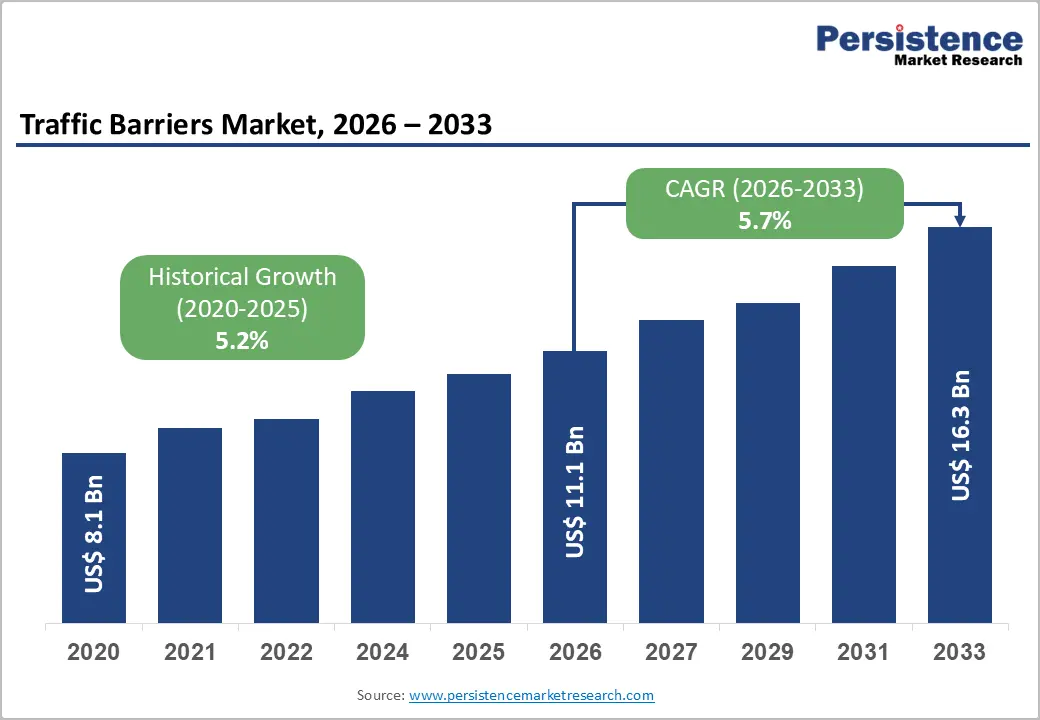
The global traffic barriers market size is likely to be valued at US$11.1 billion in 2026 and is estimated to reach US$16.3 billion by 2033, growing at a CAGR of 5.7% during the forecast period from 2026 to 2033, driven by the rising population density in emerging economies necessitating the expansion of road networks and safety containment systems.
Strict government mandates regarding road safety and crashworthiness standards compel the replacement of legacy systems with high-performance barriers. Advancements in sensor-integrated and energy-absorbing barrier technologies improve real-time traffic management and incident response capabilities. Rapid investments in smart city development and highway modernization projects are driving sustained demand for dependable physical security infrastructure.
Key Industry Highlights:
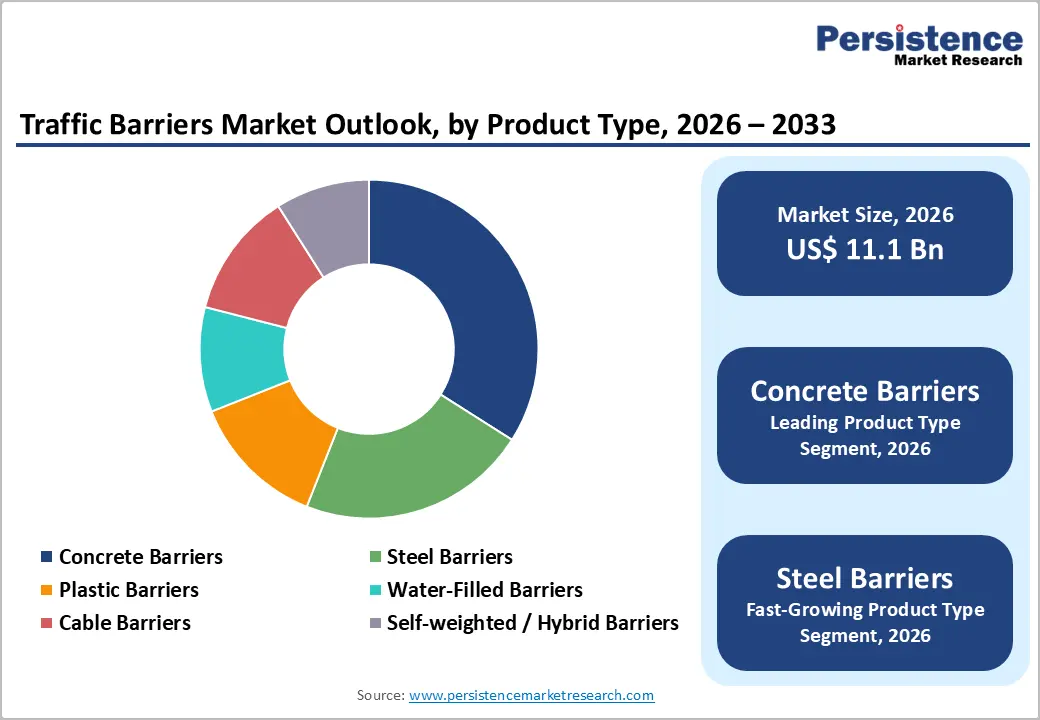
- Leading Product Type: Concrete barriers are set to hold around 34% revenue share in 2026, driven by high durability in permanent highway installations.
- Fastest-Growing Product Type: Steel barriers are projected as the fastest-growing segment, supported by the shift toward energy-absorbing safety hardware.
- Leading Application: Highways and roads are estimated to hold roughly 45% revenue share in 2026, due to massive global investment in national transportation corridors.
- Fastest-growing Application: Construction sites are forecast to record the fastest growth, driven by stringent temporary work zone safety mandates in urban areas.
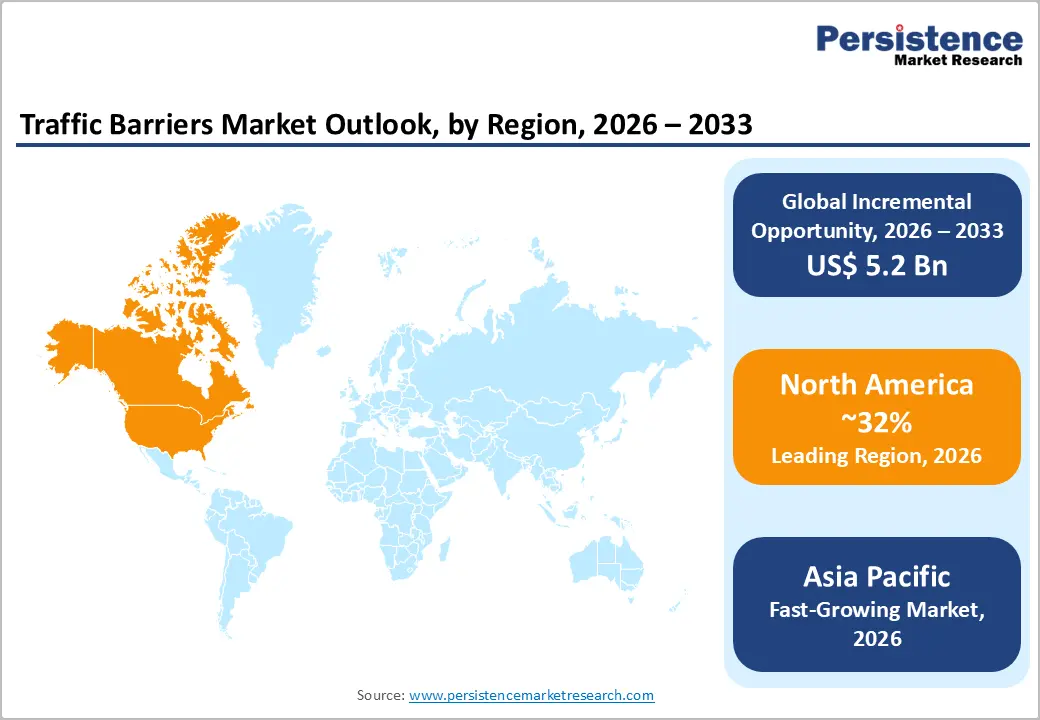
- Regional Leadership: North America is projected to capture roughly 32% of the market share by 2026, while Asia Pacific is forecast to record the fastest growth due to rapid infrastructure expansion.
- Competitive Environment: The market reflects a moderately fragmented structure, with top players like Lindsay and Trinity leveraging MASH-compliance and global distribution to maintain dominance.
- Innovation Trends: Integration of IoT-based impact sensors, development of low-carbon materials, and modular barrier designs are shaping long-term market evolution and investment direction.
DRO Analysis
Driver - Federal Infrastructure Investment and Modernization Programs
Legislative actions and sovereign funding initiatives for transportation infrastructure act as primary catalysts for expansion. The Ministry of Road Transport and Highways in India is estimated to spend approximately INR 287,333 crore (US$34.6 billion) in 2025-2026, a 2% increase over previous revised estimates, with significant allocations directed toward roads and bridges. National governments prioritize the reduction of traffic-related fatalities, leading to the mandatory installation of certified containment systems on high-speed corridors.
High-speed rail developments and airport landside expansions further broaden the scope of applications. Persistent investment in Greenfield expressways and access-controlled corridors necessitates the deployment of high-performance safety hardware. Strategic budgetary support for national highway authorities ensures a consistent pipeline of projects, driving long-term demand for structural protection. Integrated asset monetization and public-private partnerships facilitate the capital flow required for large-scale safety infrastructure procurement.
Restraint - Raw Material Price Volatility and Supply Chain Vulnerabilities
Fluctuations in the global prices of steel, cement, and plastic resins directly influence the manufacturing costs of containment systems. Since these materials constitute a significant portion of the total product value, price surges compress profit margins for manufacturers and delay project timelines. Trade realignments and rising protectionism contribute to supply-side volatility, affecting the cost structures of structural safety components.
Geopolitical tensions and trade restrictions impact the availability of specialized high-strength alloys, limiting production scalability. Supply chain disruptions increase lead times for large-scale infrastructure deliveries, hindering the ability of firms to meet urgent procurement needs. Persistent price pressures in the metals and minerals markets necessitate strategic inventory management and cost-absorption measures, which often restrict aggressive market expansion efforts.
Opportunity - Adoption of Smart and Energy-absorbing Barrier Systems
Technological innovation enables the development of barriers integrated with sensors and impact-detection systems. These systems improve accident response time and enhance traffic management efficiency. This creates a transition from traditional passive barriers to intelligent safety infrastructure, opening new revenue streams for advanced solutions.
Infrastructure modernization programs increasingly prioritize smart transport integration. Manufacturers investing in connected barrier technologies can capitalize on high-value contracts, particularly in urban mobility and smart city developments where digital monitoring systems are essential.
Category-wise Analysis
Product Type Insights
Concrete barriers are anticipated to secure around 34% of the traffic barrier market share in 2026, reflecting high durability and low maintenance requirements in permanent installations. Precast concrete medians provide superior vehicle redirection on high-volume interstate highways. This segment remains dominant due to the structural rigidity required for heavy vehicle containment.
Steel barriers are expected to be the fastest-growing segment, propelled by the increasing demand for flexible, energy-absorbing systems that reduce occupant injury risks. W-beam guardrails installed along rural mountain passes offer cost-effective protection against run-off-road accidents. Rapid installation capabilities and high recyclability drive the accelerated adoption of steel-based hardware.
Material Type Insights
Concrete materials are poised to dominate with a forecast market share of over 38% in 2026, powered by extensive use in long-term infrastructure projects. Slip-formed concrete barriers used during bridge construction provide continuous protection for workers and motorists. High compressive strength ensures longevity under extreme environmental conditions.
Composite materials are estimated to be the fastest-growing segment, fueled by the search for lightweight and corrosion-resistant alternatives to traditional metals. Fiber-reinforced polymer barriers deployed in coastal areas resist salt-induced degradation better than steel. Advanced material science enables the engineering of specific deflection characteristics for varying road types.
Application Insights
Highways and roads are likely to be the leading segment with a projected 45% of the traffic barriers market share in 2026, due to extensive global road expansion. Longitudinal barriers placed on multi-lane expressways prevent crossover collisions between opposing traffic streams. Persistent government investment in national corridor connectivity stabilizes this application's market lead.
Construction sites are anticipated to be the fastest-growing segment, fueled by rising urban redevelopment and utility maintenance activities. Water-filled plastic barriers used for temporary work zone delineation improve worker safety in high-density city centers. Short-term deployment needs and strict work zone safety regulations accelerate the demand for portable solutions.
Regional Insights
North America Traffic Barriers Market Trends
North America is expected to lead with an estimated 32% of the traffic barriers market share in 2026, supported by strong industrial infrastructure and advanced production capabilities. Regulatory frameworks emphasizing quality compliance and sustainability standards drive consistent product adoption.
U.S. Traffic Barriers Market Insights
The U.S. market is projected to maintain a leading position in 2026, driven by strong domestic production capacity and technological advancement. Recent developments involve the 2025 release of advanced MASH-compliant crash cushions, aligned with Federal Highway Administration safety mandates, supporting compliance standards, and enhancing overall production efficiency.
Canada Traffic Barriers Market Insights
The Canada regional market is expected to witness steady expansion, driven by increasing emphasis on sustainable production and specialized industrial applications. Strategic developments include 2024 expansions of galvanized steel coating facilities, supported by regulatory initiatives promoting environmental compliance and infrastructure modernization across key production sectors.
Europe Traffic Barriers Market Trends
Europe maintains a strong market position driven by stringent regulatory frameworks and sustainability-focused industrial policies. Implementation of environmental directives and circular economy initiatives accelerates the adoption of compliant and resource-efficient solutions. Advanced traceability systems and quality standards enhance product consistency, reinforcing demand across manufacturing industries and supporting long-term market stability.
Germany Traffic Barriers Market Insights
The Germany regional market is forecast to maintain significant demand in 2026, supported by advanced manufacturing capabilities and strong industrial integration. Key participants such as Volkmann & Rossbach and Pass+Co focus on high-efficiency production systems. Recent developments include 2025 advancements in noise-absorbing integrated barrier systems, aimed at improving process optimization and aligning with regulatory requirements for sustainable and high-performance industrial output.
France Traffic Barriers Market Insights
The France regional market is projected to drive innovation through high-value applications and sustainability-focused product development. Leading companies, including Aximum and Ternon, emphasize premium-quality production and strategic collaborations. Recent developments involve the 2024 deployment of solar-integrated smart barriers, supporting regulatory alignment and strengthening market positioning within environmentally responsible and high-performance product segments.
Asia Pacific Traffic Barriers Market Trends
Asia Pacific is forecast to be the fastest-growing market for traffic barriers, stimulated by rapid industrial expansion and increasing infrastructure development. Rising urbanization and cost-efficient manufacturing capabilities drive strong production growth. Government initiatives supporting industrial development and domestic manufacturing further accelerate demand, reinforcing the region’s role as a key global production and consumption hub.
China Traffic Barriers Market Insights
The China regional market is forecast to maintain its position as a major production hub in 2026, supported by large-scale manufacturing infrastructure and integrated supply chains. Leading participants such as Hengfeng and Shijiazhuang Wonray leverage extensive production networks. Recent developments include the 2025 Smart Highway policy, strengthening capacity, and meeting rising domestic and export demand.
India Traffic Barriers Market Insights
The India regional market is expected to witness rapid expansion, driven by increasing industrialization and supportive government initiatives. Key players, including Tata Steel and Utkarsh India, focus on expanding production capabilities and improving efficiency. Recent strategic investments target the Bharatmala Pariyojana infrastructure project, enhancing infrastructure and supporting growing domestic demand across multiple application sectors.
Competitive Landscape
The global traffic barriers market is moderately fragmented, with five players controlling approximately 42% of total market share. Leading manufacturers dominate due to strong production capacity, raw material integration, and continuous product innovation. High entry barriers persist due to capital-intensive manufacturing processes and stringent road safety and transportation infrastructure regulations.
Lindsay Corporation, Trinity Industries, and Valmont Industries lead the competitive landscape with extensive global manufacturing networks. Hill & Smith Holdings maintains a strong position through innovative traffic safety systems, reflective signage technologies, and highway infrastructure solutions. These companies leverage capacity expansion, product innovation, and regulatory compliance to sustain market leadership across transportation infrastructure and construction sectors.
Key Industry Developments:
- In May 2026, the National Highways Authority of India (NHAI) launched India’s first Multi-Lane Free Flow (MLFF) barrier-less tolling system on NH-48 in Gujarat, eliminating physical barriers and enabling seamless, high-speed vehicle movement, marking a significant shift toward digital and infrastructure-efficient traffic management systems.
- In February 2026, Lindsay Corporation launched the AlphaGuard traffic barrier system, a modular and reusable safety solution designed for rapid deployment in construction zones and temporary traffic management applications, strengthening product innovation in the traffic barriers segment.
Companies Covered in Traffic Barriers Market
- Lindsay Corporation
- Trinity Industries, Inc.
- Valmont Industries, Inc.
- Hill & Smith Holdings PLC
- Avery Dennison Corporation
- Volkmann & Rossbach
- Tata Steel Limited
- Arbus Limited
- Delta Scientific Corporation
- Avon Barrier Corporation Ltd.
- Gramm Barrier Systems Limited
- Frontier Pitts Ltd.
- Road Rockers
- Transpo Industries, Inc.
- Zandun
Frequently Asked Questions
The traffic barriers market is projected to reach US$11.1 billion in 2026.
Rising road safety regulations and expanding transportation infrastructure investments drive the traffic barriers market.
The traffic barriers market is poised to witness a CAGR of 5.7% from 2026 to 2033.
Adoption of smart barrier systems and increasing demand for sustainable, recyclable materials create key market opportunities.
Some of the key market players include Lindsay Corporation, Trinity Industries, Inc., Valmont Industries, Inc., Hill & Smith Holdings PLC, and Avery Dennison Corporation.


