




- Media & Entertainment
- Still Images Market
Still Images Market Size, Share, and Growth Forecast, 2026 - 2033
Still Images Market by Content Creation Source (Professional Photography, Others), End-User Industry (Advertising & Marketing, Others), Licensing & Monetization Model (Royalty-Free, Rights-Managed, Subscription-Based, Others), and Regional Analysis for 2026 - 2033

Still Images Market Share and Trends Analysis
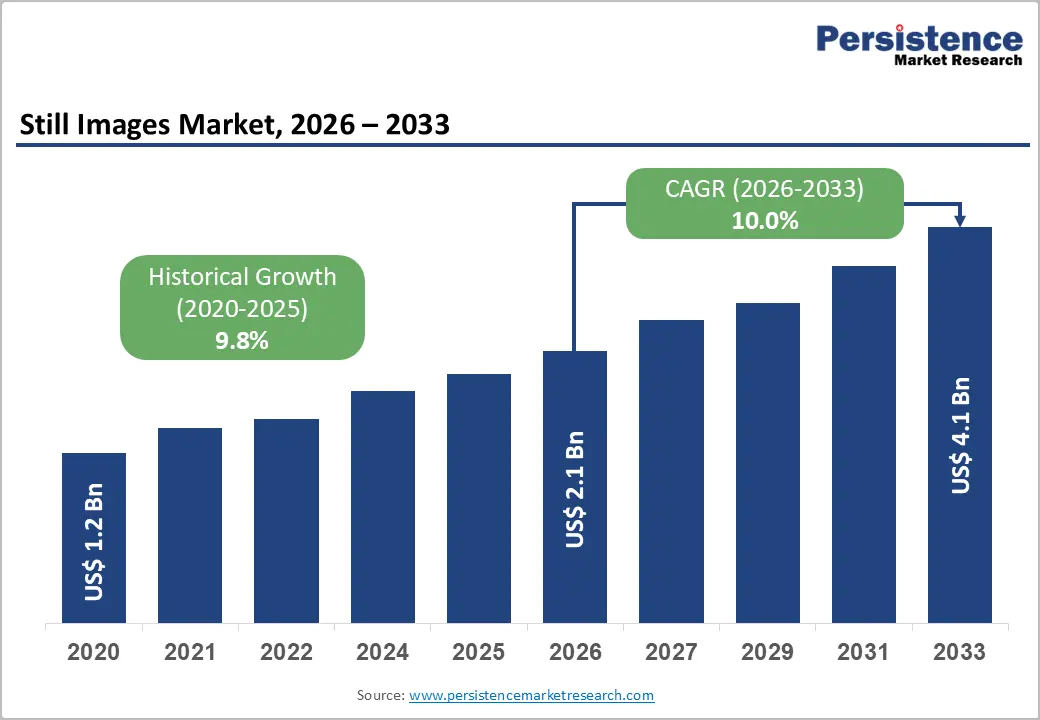
The global still images market size is likely to be valued at US$2.1 billion in 2026 and is projected to reach US$4.1 billion by 2033, growing at a CAGR of 10.0% during the forecast period from 2026 to 2033, driven by accelerating demand for digital content creation, rapid adoption of AI-generated images, and exponential growth in e-commerce visual marketing.
Increasing reliance on stock image market platforms by enterprises for cost-effective branding further strengthens demand. Additionally, the surge in mobile-first content consumption and social media advertising continues to amplify the requirement for scalable visual assets across industries globally.
Key Industry Highlights
- Licensing Model Structure: The royalty-free images market is projected to lead with around 45% share in 2026, while subscription-based licensing is the fastest-growing model, supported by enterprise demand for predictable pricing and scalable content access across digital workflows.
- Application Demand Split: Advertising & marketing remains the leading application with 32% share in 2026, while the e-commerce & retail segment is the fastest-growing at 10.4% CAGR through 2033, driven by visual commerce adoption and conversion-focused product imagery.
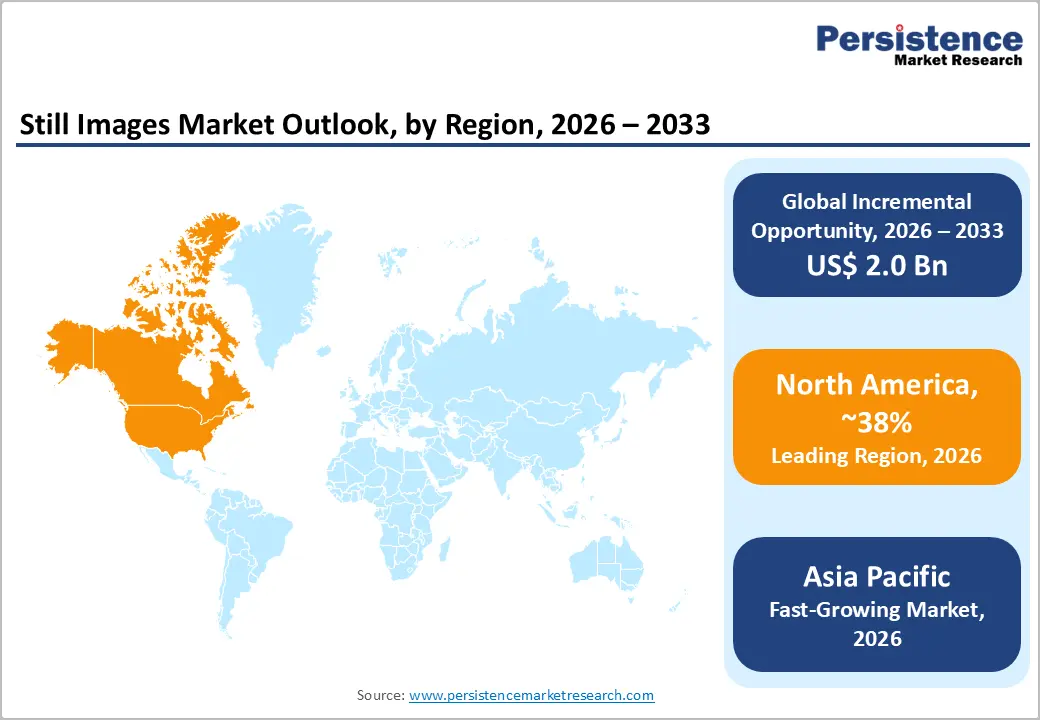
- Regional Market Positioning: North America is set to dominate with 38% share in 2026, while Asia Pacific is the fastest-growing region, fueled by rapid digitalization, mobile commerce expansion, and rising AI-driven content creation ecosystems.
- Platform Monetization Trend: Contributor networks and royalty-free platforms together account for the largest share, while subscription-based visual content platforms are the fastest-growing monetization model, driven by enterprise adoption and workflow integration needs.
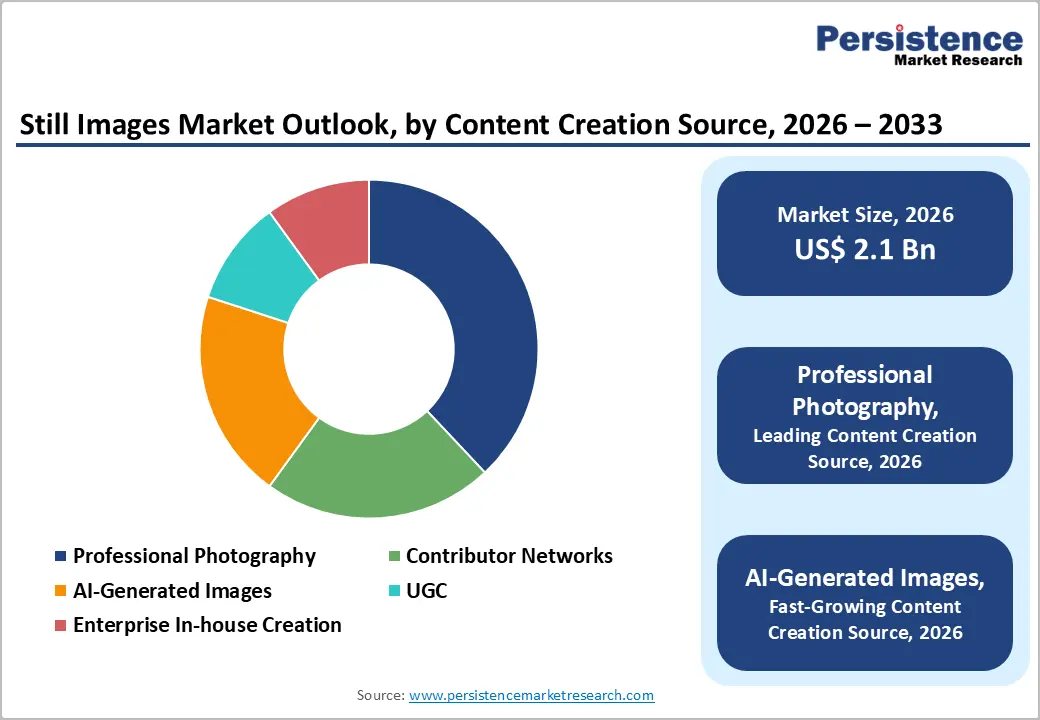
- Content Ecosystem Shift: Traditional professional photography remains the dominant supply source with approximately 38% share in 2026, while the hybrid AI-human content ecosystem is the fastest-growing structural shift, redefining production efficiency, scalability, and licensing economics in the global stock images market.
DRO Analysis
Driver - Rising Demand for Digital Content across Industries
According to official estimates, global digital advertising expenditure surpassed US$720 billion in 2025, significantly increasing demand for high-quality visual assets. Enterprises are rapidly adopting still-image market solutions to enable faster content deployment across digital campaigns. E-commerce platforms such as Amazon, Shopify, and Alibaba depend heavily on visual storytelling, where product imagery directly impacts conversion rates by up to 35-40%, reinforcing the shift toward visual-first marketing strategies.
Recent industry developments are further accelerating this growth, particularly the integration of AI-powered image generation and editing tools into mainstream workflows, improving speed and personalization in content creation. Consolidation among leading visual content providers has expanded access to larger licensed image libraries, strengthening enterprise adoption of scalable content ecosystems. The increasing global focus on digital content licensing and intellectual property enforcement is driving greater reliance on verified royalty-free image market platforms, reinforcing compliance-driven adoption across enterprises.
Restraint - Copyright Complexity and Licensing Fragmentation
One of the primary constraints in the stock images market is the complexity of global copyright enforcement and fragmented licensing frameworks. Despite advancements in digital rights management, misuse of visual assets remains a persistent issue. WIPO estimates that over 30% of online images are used without proper licensing.
Enterprises face legal and compliance risks due to unclear attribution requirements across jurisdictions. This leads to increased operational costs for monitoring, licensing audits, and compliance management. Additionally, inconsistent monetization models across platforms create friction for creators and enterprises, limiting the seamless scalability of digital image licensing ecosystems.
Opportunity - Expansion of AI-Generated and Synthetic Visual Content Ecosystem
The emergence of the AI-generated images market presents a major opportunity, projected to contribute over US$900 million in incremental value by 2033. Generative AI platforms such as diffusion models and multimodal systems are enabling hyper-personalized image creation at scale, reducing dependency on traditional photography. This is particularly valuable for SMEs and digital-first startups where fast content output is critical. Integration of AI tools in platforms such as Adobe Stock and Shutterstock is reshaping workflows into hybrid AI-human content creation models.
Recent industry developments, such as Shutterstock expanding its licensed AI training and generative content infrastructure, have strengthened its role in rights-cleared AI ecosystems. Adobe has also integrated external AI models into its Firefly platform, enabling seamless AI-driven image generation within professional workflows. The evolving regulatory focus on AI training data transparency is encouraging the adoption of compliant synthetic content systems. These advancements are accelerating AI adoption across advertising, e-commerce, and SaaS-driven marketing ecosystems.
Category-wise Analysis
Content Creation Source Insights
Professional photography is expected to continue to anchor the market with a 38% share in 2026, driven by sustained demand for premium, brand-safe visuals across advertising, publishing, and regulated industries. Despite rapid AI advancement, enterprises continue prioritizing human-shot imagery for high-trust use cases such as healthcare, luxury, and automotive branding.
However, a structural shift is underway as the AI-generated images market grows, reshaping production economics through automation and speed. Platforms such as Meta’s AI advertising tools and Canva’s enterprise AI suite are accelerating the adoption of hybrid workflows. The result is a dual-track ecosystem where professional photography preserves premium positioning, while AI-driven content significantly reduces turnaround time and production costs, improving scalability across digital marketing operations.
End-user Industry Insights
Advertising & marketing is likely to remain the dominant application with a 32% share in 2026, underpinned by continuous demand for campaign-ready visuals across omnichannel digital ecosystems. Agencies increasingly depend on stock image market platforms to meet high-volume creative needs driven by performance-based advertising models.
E-commerce & retail is projected to be the fastest-growing segment at 10.4% CAGR, fueled by product visualization, AR commerce, and conversion optimization. Amazon’s AI-driven product image tools and Shopify’s automated visual enhancement features are redefining digital merchandising workflows. The shift reflects a broader transformation where visual content is no longer supportive but central to conversion strategy, making scalable imagery a critical growth lever across digital commerce ecosystems.
Licensing & Monetization Model Insights
The royalty-free model is poised to lead the market with a 45% share in 2026, driven by flexibility, affordability, and seamless integration into high-volume digital content workflows. Enterprises increasingly standardize royalty-free libraries to reduce legal complexity while enabling faster campaign execution across global markets.
The fastest structural shift is toward subscription-based licensing, expanding rapidly as organizations prioritize predictable pricing and unlimited access. Adobe’s AI-enhanced Creative Cloud and Microsoft 365 Copilot integrations highlight the transition toward bundled, AI-enabled content ecosystems. This evolution is reshaping monetization from transactional licensing to continuous access models, improving scalability, compliance, and operational efficiency across enterprise content supply chains.
Regional Insights
North America Still Images Market Trends
North America is expected to lead the still images market with 38% global share in 2026, supported by advanced digital advertising infrastructure, strong enterprise adoption of AI-driven content workflows, and mature SaaS ecosystems. Robust intellectual property enforcement under DMCA and USPTO frameworks ensures structured licensing compliance, encouraging enterprise reliance on verified platforms.
The region also benefits from strong venture capital activity in generative AI and creative tools, accelerating innovation in digital content creation. In 2025, the U.S. Copyright Office initiated formal reviews on AI-generated content and copyrightability, signaling tighter regulatory clarity for synthetic media adoption.
The U.S. is projected to account for nearly 55% of the regional market in 2026, driven by its dominance in digital advertising and concentration of leading platforms. In 2025, OpenAI expanded image-generation capabilities within ChatGPT and enterprise APIs, enabling businesses to create and deploy visual assets directly within workflows. This reflects the rapid commercialization of AI-generated imagery across marketing and SaaS ecosystems.
Meanwhile, Canada is likely to contribute close to 10% of the regional share, supported by government-backed initiatives such as the expansion of the Pan-Canadian AI Strategy in 2025, accelerating the adoption of AI-powered design tools among startups and SMEs.
Europe Still Images Market Trends
Europe is likely to hold approximately 27% of the global market share in 2026, shaped by strict regulatory oversight and emphasis on ethical content usage. GDPR compliance continues to influence how stock image market platforms manage data privacy and licensing transparency, while demand remains strong across advertising, publishing, and enterprise communication. The region is also advancing regulatory frameworks for emerging technologies, with the European Union progressing AI governance measures in 2025 to strengthen accountability in AI-generated content ecosystems.
Within the region, Germany is expected to account for around 22% of the market in 2026, driven by enterprise demand for compliant visual content and increased funding under its federal digital strategy for AI innovation. The U.K. is anticipated to represent nearly 20% of the regional share, supported by its strong media and advertising ecosystem. In 2025, the U.K. Intellectual Property Office updated copyright guidance on AI-generated works, enabling businesses to adopt AI-driven creative tools with greater legal clarity and confidence.
Asia Pacific Still Images Market Trends
Asia Pacific is projected to be the fastest-growing region, projected to expand at 11% CAGR through 2033, driven by rapid digitalization, mobile-first consumption, and strong e-commerce expansion. The region benefits from a large creator economy and cost-efficient content production ecosystems, while the increasing adoption of AI-generated image market solutions is transforming scalability across industries. Governments across the region are also strengthening digital copyright enforcement, improving monetization frameworks for creators and platforms.
China is expected to lead the region with approximately 35% share in 2026, supported by advanced AI infrastructure and platform-driven digital ecosystems. In 2025, the Chinese government expanded regulations on generative AI services to ensure compliance and data transparency, strengthening trust in AI-generated content.
India follows with nearly 20% share, driven by rapid digital commerce growth and startup expansion. The Government of India’s continued push under Digital India initiatives in 2025 is accelerating AI adoption across marketing and e-commerce platforms, boosting demand for scalable visual content solutions.
Competitive Landscape
The global still images market is moderately consolidated, with leading platforms such as Adobe, Shutterstock, and Getty Images collectively accounting for over 55% of total revenue share. These players leverage extensive content libraries, strong contributor ecosystems, and integrated AI-powered creative tools to maintain market leadership. Their competitive advantage lies in scalable subscription-based models, enterprise licensing capabilities, and continuous investment in generative AI to enhance content creation, discovery, and personalization across digital workflows.
Mid-tier and niche platforms such as Canva, Freepik, and Envato are strengthening their positions through design-centric ecosystems, freemium models, and creator-driven marketplaces. Entry barriers remain moderate due to content licensing complexities and platform scale requirements; however, AI is lowering production barriers for new entrants. The market is witnessing a gradual shift toward consolidation, with leading firms expanding through AI partnerships, dataset licensing, and platform integrations, while smaller players compete through specialization, pricing flexibility, and community-driven content models.
Key Industry Developments:
- In November 2025, Freepik launched its AI-powered collaboration platform “Freepik Spaces,” integrating generative AI tools with traditional stock imagery to streamline content creation workflows and enable scalable, team-based visual production.
- In January 2025, Getty Images and Shutterstock announced a US$3.7 billion merger, aiming to consolidate content libraries, strengthen global market leadership, and enhance competitiveness against rapidly growing AI-driven image generation platforms.
Companies Covered in Still Images Market
- Shutterstock
- Getty Images
- Adobe Inc.
- iStock
- Alamy
- Depositphotos
- Canva
- Dreamstime
- Envato Elements
- 500px
- Freepik
- EyeEm
- Unsplash
- Adobe Stock
Frequently Asked Questions
The global still images market is projected to reach US$2.1 billion in 2026.
Rising demand for digital content creation, growth in e-commerce visual marketing, and rapid adoption of AI-generated images are driving the market.
The still images market is expected to grow at a CAGR of 10.0% from 2026 to 2033.
Expansion of AI-generated content ecosystems and increasing enterprise adoption of subscription-based visual platforms create key opportunities.
Adobe Inc., Shutterstock, Getty Images, Canva, and Freepik are key players in the market.


