




- Beauty & Personal Care
- Shaving Pen Market
Shaving Pen Market Size, Share, and Growth Forecast 2026 - 2033
Shaving Pen Market by Material Type (Stainless Steel, Plastic, Others (Copper, Metal)), Application (Hairstyling, Eyebrow Styling, Tattooing, Beard Styling), End User (Retail, Commercial, Fashion Industry, Salon & Spa), Distribution Channel (Direct, Indirect, Hypermarket/Supermarket, Specialty Stores, Independent Stores, Online Store, Others), and Regional Analysis for 2026 - 2033

Shaving Pen Market Size and Trend Analysis
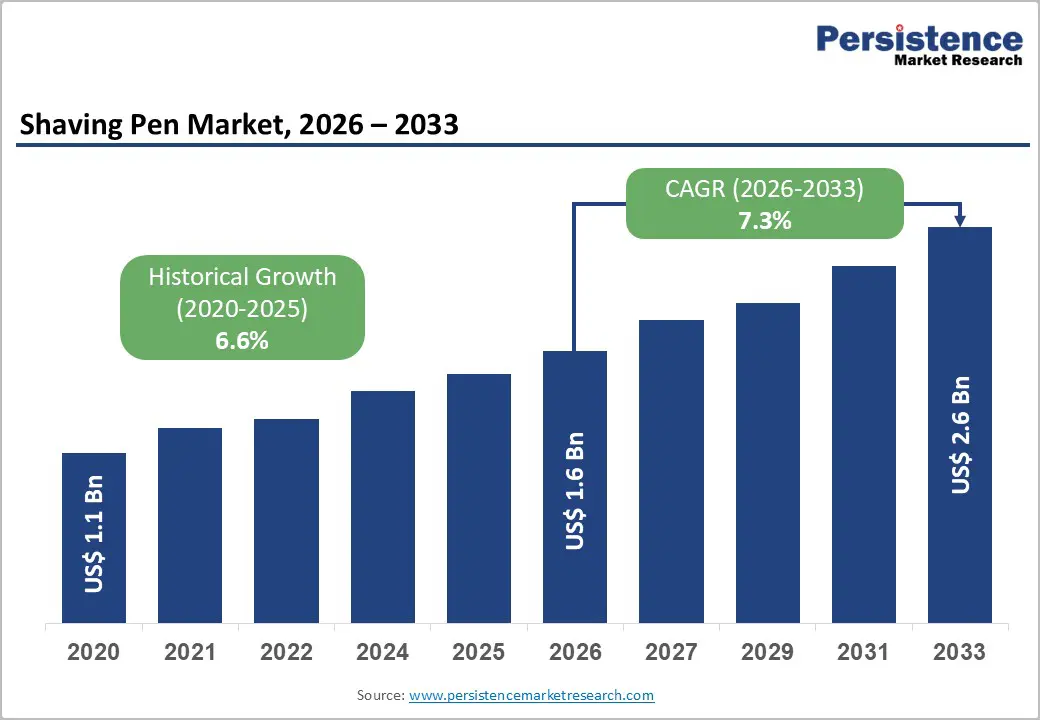
The global Shaving Pen Market is valued at US$ 1.6 Bn in 2026 and is projected to reach US$ 2.6 Bn by 2033, growing at a CAGR of 7.3% between 2026 and 2033.
The market is on a sustained growth trajectory driven by the intersection of rising personal grooming consciousness, the proliferating influence of social media grooming culture, and continuous product innovation across precision trimming and styling categories. Grooming has broadly transitioned from a gender-specific routine to a universal lifestyle practice a shift supported by data from the global men's grooming market, which is projected to grow at a CAGR of 8.0% through 2030 according to industry analysis.
Key Market Highlights
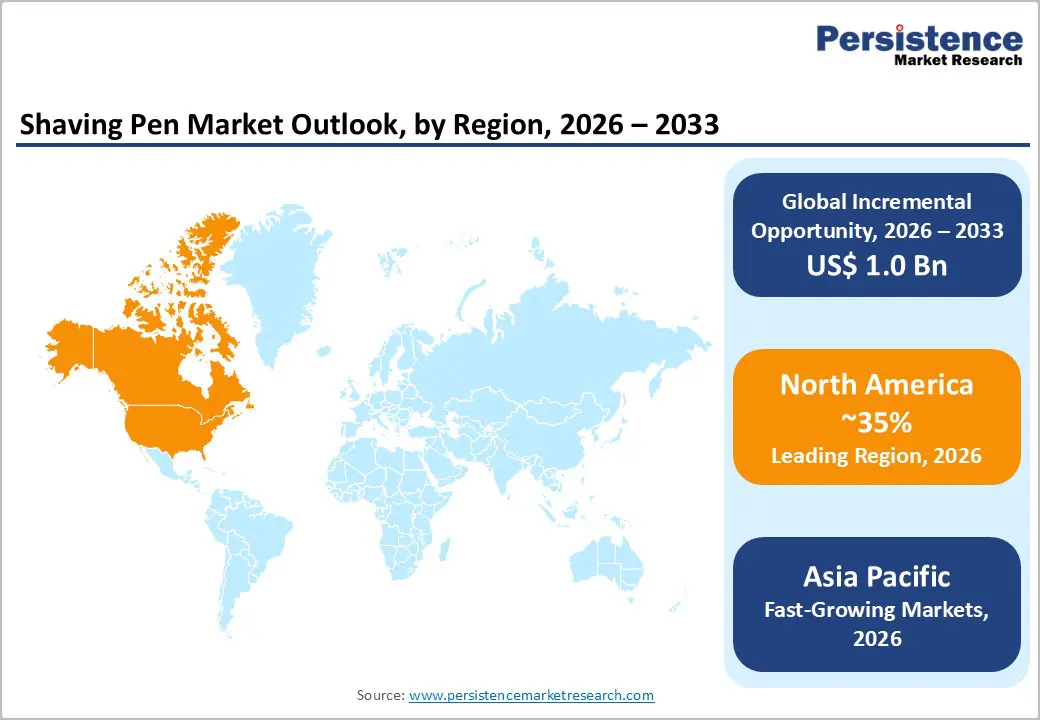
- Leading Region: North America leads the global Shaving Pen Market, driven by the US$ 4.62 Bn electric shaver sector, high consumer willingness to pay premium for eco-friendly products (38% per NACS 2024), and successive product launches by Philips Norelco, MANSCAPED, and Gillette through major e-commerce and mass retail channels.
- Fastest Growing Region: Asia Pacific is the fastest growing regional market, propelled by rapid urbanization, rising middle-class grooming expenditure, Philips' flagship i9000 Series launch in India in April 2025, and South Korea's K-beauty industry setting global precision grooming aesthetics trends across China, Japan, and ASEAN markets.
- Dominant Segment: Stainless Steel is the dominant material type segment with approximately 47% market share, preferred for its superior durability, corrosion resistance, and premium aesthetic in professional salon environments, aligned with growing consumer preference for sustainable, long-lasting grooming tools over single-use disposable plastic alternatives.
- Fastest Growing Segment: The Online Store distribution channel is the fastest growing segment, with digital channels accounting for approximately 41.3% of personal grooming product sales and growing at the highest forecast CAGR among all distribution channels, driven by search interest spikes of 52% year-on-year for precision grooming tool terms through August 2025.
- Key Market Opportunity: The integration of AI-powered sensing and smart personalization technology exemplified by Philips' SkinIQ Pro AI reading hair density 500 times per second and the i9000 Series' 2025 iF Design Award represents the most significant premium market opportunity, enabling brands to command substantially higher margins while addressing individualized grooming precision needs.
| Key Insights | Details |
|---|---|
|
Shaving Pen Market Size (2026E) |
US$ 1.6 Bn |
|
Market Value Forecast (2033F) |
US$ 2.6 Bn |
|
Projected Growth CAGR (2026-2033) |
7.3% |
|
Historical Market Growth (2020-2025) |
6.6% |
Market Dynamics
Market Growth Drivers
Social Media and Influencer Culture Driving Precision Grooming Demand
The exponential rise of social media platforms as grooming education and inspiration channels is one of the most impactful catalysts for the Shaving Pen Market. Professional barbers, beauty influencers, and content creators on Instagram, YouTube, and TikTok regularly demonstrate intricate beard styling, hairline detailing, and eyebrow shaping techniques that require precision tools directly translating into consumer demand for shaving pens. Search interest data validates this trend: according to industry tracking, search volume for terms related to electric trimmers rose approximately 52% year-on-year between August 2024 and August 2025, with seasonal peaks aligning with summer grooming periods.
Growing Male Grooming Culture and Gender-Neutral Grooming Trends
The structural evolution of grooming from a predominantly female domain to a universal personal care practice is sustaining long-term demand momentum for the Shaving Pen Market. According to data from the U.S. Bureau of Labor Statistics, women's employment rate in the United States rose from 53.2% in 2021 to 55.2% in 2024, contributing to increased female disposable income and personal grooming expenditure. On the male side, approximately 68% of U.S. Gen Z men used facial skincare products in 2024, signalling a deeply normalized grooming culture among the next-generation consumer cohort. Shaving pens by virtue of their compact pen-style form enabling precision across eyebrow shaping, hairline definition, beard edge detailing, and body grooming are inherently versatile across gender and application contexts.
Market Restraints
Competition from Conventional Grooming Tools Limiting Market Penetration
The Shaving Pen Market faces persistent competitive pressure from established conventional grooming tools including standard razors, traditional trimmers, and electric shavers which command strong brand loyalty particularly among cost-sensitive consumers in emerging markets. The U.S. razor market alone was valued at approximately US$ 2.73 Bn in 2024 according to industry analysis, reflecting the scale and entrenchment of legacy grooming categories. In price-sensitive markets across Asia, Africa, and Latin America, consumers frequently default to familiar, widely distributed conventional tools, while shaving pens being a relatively niche and specialized format lack equivalent retail footprint, consumer education infrastructure, and competitive pricing at entry-level tiers, constraining adoption in the highest population-density consumer markets globally.
Limited Awareness and Distribution Infrastructure in Emerging Markets
Despite rising grooming awareness across emerging economies, the Shaving Pen Market remains considerably underpenetrated in markets across Sub-Saharan Africa, Southeast Asia, and parts of Latin America, primarily due to limited retail presence, weak local distributor networks, and insufficient consumer education about product benefits. Shaving pens require a degree of technique and user familiarity that is difficult to convey without in-store demonstrations or strong digital marketing resources that smaller regional markets often lack. The absence of localized product positioning, language-specific packaging, and affordable entry-level variants adapted to regional purchasing power further slows market development in geographies that represent meaningful long-term growth potential for established brands.
Market Opportunities
AI-Powered Smart Grooming Tools Opening Premium Market Segment
The integration of artificial intelligence and smart sensor technology into grooming devices is creating a high-value product tier within the Shaving Pen Market that commands significantly higher margins and stronger consumer loyalty. In April 2025, Koninklijke Philips launched the i9000 Series and Prestige Ultra AI-powered electric shavers in India, featuring SkinIQ Pro AI technology, a Triple Action Lift & Cut system, pressure sensors that read hair density 500 times per second, and a UV power charging pouch that kills 99.9% of bacteria earning a 2025 iF Design Award. In August 2025, Philips Norelco launched the Head Shaver Pro Series in the United States, featuring PowerAdapt Sensor technology responding in real time to hair thickness.
E-Commerce Expansion and Subscription Models as Revenue Growth Levers
The rapid growth of online retail is transforming the distribution economics of the Shaving Pen Market, enabling brands to scale efficiently across geographies without proportional investment in physical retail infrastructure. Online retail channels accounted for approximately 41.3% of personal grooming product sales in 2022 and are projected to register the highest growth rate at a CAGR of 5.67% through 2030, according to industry data. The emergence of grooming subscription models pioneered by platforms and brands such as Dollar Shave Club and Harry's provides a recurring revenue channel particularly well-suited to consumable grooming accessories and blade replacement ecosystems that shaving pen manufacturers can leverage. Wahl Clipper Corporation and Andis Company have both expanded their e-commerce and direct-to-consumer strategies, while Amazon's influence as a primary discovery and purchase channel for precision grooming tools continues to grow.
Category-wise Insights
Material Type Analysis
Stainless Steel is the dominant material type segment in the Shaving Pen Market, commanding approximately 47% of total market share. The primacy of stainless steel is rooted in its superior combination of durability, corrosion resistance, hygiene-friendly properties, and premium aesthetic appeal characteristics that are critically important in professional grooming environments including barbershops, salons, and spas where tools undergo frequent sterilization and intensive daily use. Stainless steel shaving pens are particularly valued by professional stylists and discerning consumers who prioritize product longevity and precision blade retention over multiple use cycles. Leading brands including KAI Group whose heritage spans precision blade manufacturing with a focus on stainless steel alloy composition have built substantial market positions on the quality credentials of metal-bodied grooming tools.
Application Analysis
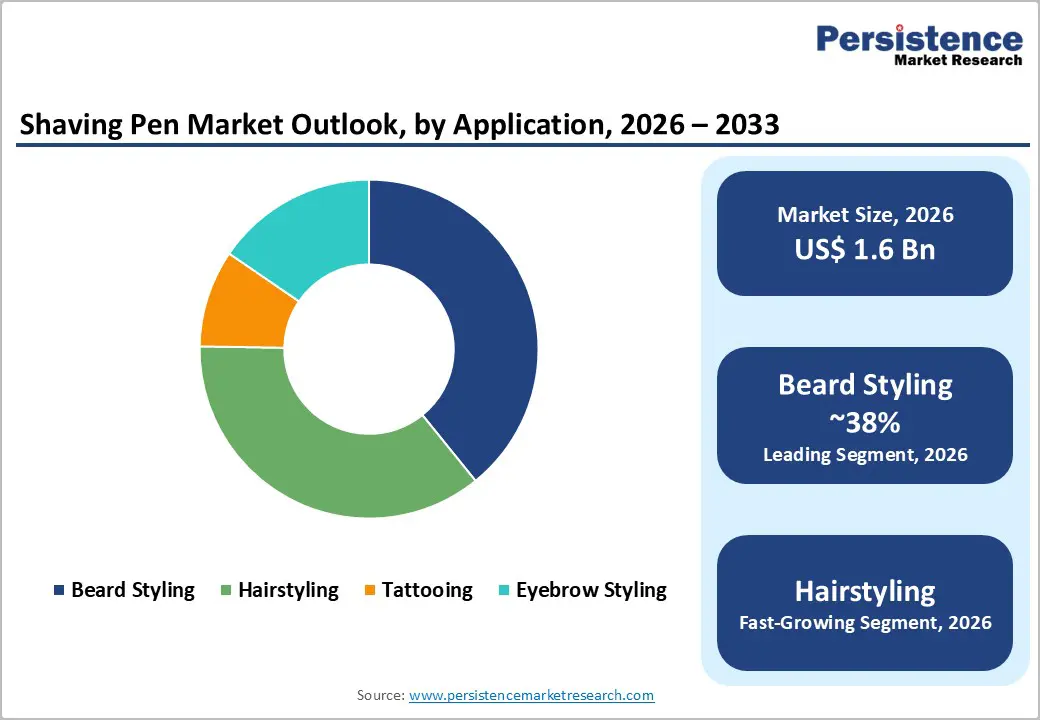
The Beard Styling application segment leads the Shaving Pen Market with approximately 38% market share, sustained by the global male grooming movement and the enduring cultural prominence of beard culture as a form of personal expression and identity. The proliferation of intricate beard styling trends including defined jawline edges, sculptured goatees, and decorative hair tattoo patterns has materially elevated demand for precision shaving pen tools that deliver the millimetre-level control required for professional-grade beard work. According to industry consumer data, approximately 40% of global grooming consumers seek multi-functional tools capable of beard styling, eyebrow shaping, and body grooming within a single compact device a consumer profile naturally served by the shaving pen format. The Eyebrow Styling application follows as the second-largest segment, driven by the beauty industry's sustained emphasis on groomed, defined brows across both professional salon and at-home settings globally.
End User Analysis
The Salon & Spa end-user segment holds the leading position in the Shaving Pen Market, accounting for approximately 34% of total market share. Salons and spas represent the highest intensity use environment for precision grooming pens deploying them daily across multiple clients for beard edging, eyebrow shaping, hairline detailing, and hair tattooing services. The professional credibility associated with branded precision shaving pens within salon environments also exerts a powerful influence on downstream retail consumer purchasing decisions, as clients exposed to specific tools in professional settings frequently seek to replicate results at home. The global beauty salon industry, which has been recovering strongly post-pandemic, saw U.S. barbershop and men's salon revenues surpass US$ 5 billion in recent years, underscoring the commercial scale of the professional end-user ecosystem that supports premium shaving pen demand.
Distribution Channel Analysis
The Online Store distribution channel is the fastest growing segment within the Shaving Pen Market, while Hypermarket/Supermarket channels retain the dominant share at approximately 32% of total distribution, reflecting their role as the primary point of first-exposure purchase for mainstream consumers. However, the structural shift toward e-commerce is unmistakable: online channels accounted for approximately 41.3% of personal grooming product sales in 2022 and are projected to expand at the highest CAGR among all distribution channels through 2030. Search interest for Philips grooming products on digital platforms exhibited a dramatic 52% year-on-year spike between August 2024 and August 2025, reflecting the growing primacy of online discovery in consumer grooming journeys.
Regional Insights
North America
North America is the leading region in the global Shaving Pen Market, anchored by the United States where the convergence of a deeply embedded personal care culture, high per-capita grooming expenditure, and an expansive e-commerce ecosystem creates a structurally favorable demand environment. The U.S. electric shaver market was valued at US$ 4.62 Bn in 2024 and is expected to reach US$ 5.23 Bn by end of 2025, reflecting the region's enormous appetite for precision grooming tools. A 2024 report from the National Association of Convenience Stores (NACS) confirmed that 38% of U.S. consumers are willing to pay a premium for eco-friendly personal care items, directly benefiting brands that position shaving pens around sustainable materials and recyclable packaging.
Key market developments reinforce North America's leadership position: in August 2025, Koninklijke Philips launched its Norelco Head Shaver Pro Series in the United States via Philips.com, Amazon, and Walmart reflecting the primacy of both online and mass retail channels in reaching U.S. consumers. In September 2024, MANSCAPED launched the Chairman Pro Electric Foil Shaver and Premium Face Shaving Kit, targeting grooming enthusiasts with high-performance precision features.
Europe
Europe represents a mature, innovation-oriented market for the Shaving Pen Market, where Germany, the United Kingdom, France, and Spain collectively drive demand through a combination of high grooming standards, strong retail infrastructure, and progressive sustainability regulation. Germany and the United Kingdom are home to leading precision grooming tool brands and manufacturing expertise Braun GmbH, headquartered in Kronberg im Taunus, Germany, has built a decades-long reputation for precision shaving technology, while German-engineered precision tools such as Beurer's MN2X Precision Trimmer launched in January 2024 at Arab Health targeting eyebrow and fine detailing applications exemplify the region's continued product innovation pipeline.
France and Spain are increasingly influenced by professional beauty industry trends, where precision styling tools occupy a central role in salon service portfolios. France's globally renowned beauty and cosmetics culture positions it as a high-value market for premium shaving pens targeted at the fashion and professional grooming segments.
Asia Pacific
Asia Pacific is the fastest growing regional market in the global Shaving Pen Market, propelled by rapid urbanization, rising disposable incomes, an expanding middle class, and deep-rooted grooming cultures in Japan, South Korea, and China. Japan represents one of the world's most demanding precision grooming markets, with KAI Group headquartered in Seki City, Gifu Prefecture being a globally recognized leader in precision blade manufacturing for professional and consumer grooming applications.
China represents the largest single market volume within Asia Pacific, with its domestic precision grooming sector benefiting from manufacturing scale advantages, a growing e-commerce ecosystem reaching tier-3 and tier-4 cities, and strong government-backed retail infrastructure. In March 2024, Procter & Gamble introduced advanced U.S. and German technologies in Vietnam to expand razor and blade production for Asia-Pacific export signalling international brand confidence in the region as both a consumption and manufacturing hub.
Competitive Landscape
The global Shaving Pen Market is moderately fragmented, featuring a blend of large diversified consumer electronics and personal care conglomerates including Koninklijke Philips, Panasonic Corporation, Procter & Gamble (Gillette), and Braun GmbH (Procter & Gamble) alongside specialist grooming tool manufacturers such as Wahl Clipper Corporation, Andis Company, and KAI Group. Key competitive differentiators include blade metallurgy and sharpness retention, ergonomic design and portability, motor performance in electric variants, battery life, and premium accessory ecosystems. Emerging business model trends include subscription-based blade replenishment programs, direct-to-consumer e-commerce channels, and premium product bundles targeting professional salon buyers.
Key Market Developments
- In April 2025, Philips rolled out premium electric shavers, Philips Series 7000, i9000 and Philips i9000 Prestige Ultra in India. These products are equipped with cutting-edge AI-powered SkinIQ technology.
- In August 2025, Philips Norelco launched the Head Shaver Pro Series in the United States, featuring PowerAdapt Sensor technology providing real-time response to hair thickness, 36 Comfort Cut blades, a 360-degree Flexing Head, and 90 minutes of cordless runtime, available via Philips.com, Amazon, and Walmart at US$ 79.99–US$ 139.99.
Companies Covered in Shaving Pen Market
- Koninklijke Philips
- Panasonic Corporation
- Gillette (Procter & Gamble)
- Wahl Clipper Corporation
- Remington
- Braun GmbH
- Veet (Reckitt Benckiser Group)
- KAI Group
- Andis Company
- Conair Corporation
Frequently Asked Questions
The global Shaving Pen Market is valued at approximately US$ 1.6 Bn in 2026 and is projected to reach US$ 2.6 Bn by 2033, growing at a CAGR of 7.3% during the forecast period.
The primary demand drivers include the rapid cultural normalization of male and gender-neutral personal grooming with approximately 68% of U.S. Gen Z men using facial skincare products in 2024 and the proliferating influence of social media grooming content, which drove a 52% year-on-year spike in electric trimmer search interest between August 2024 and August 2025.
Stainless Steel is the leading material type segment in the Shaving Pen Market with approximately 47% market share. Stainless steel shaving pens are preferred for their superior durability, resistance to corrosion during sterilization, and premium aesthetic appeal qualities that are particularly critical in professional salon and barbershop environments.
North America is the leading region in the global Shaving Pen Market, driven by the United States' high per-capita grooming expenditure, dominant e-commerce infrastructure, and the concentrated commercial activity of global grooming brands including Koninklijke Philips, Wahl Clipper Corporation, Gillette (Procter & Gamble), and Andis Company.
The leading companies in the global Shaving Pen Market include Koninklijke Philips, Wahl Clipper Corporation, Gillette (Procter & Gamble), Panasonic Corporation, Braun GmbH, KAI Group, Andis Company, Remington, Conair Corporation, and Veet, among others.


