




- Medical Devices
- Photon-Counting CT Market
Photon-Counting CT Market Size, Share, and Growth Forecast, 2026 - 2033
Photon-Counting CT Market by Product Type (Single Channel Counting System, Multichannel Counting System), Application (Cardiology, Oncology, Neurology, Others), and Regional Analysis for 2026 - 2033

Photon-Counting CT Market Size and Trends Analysis
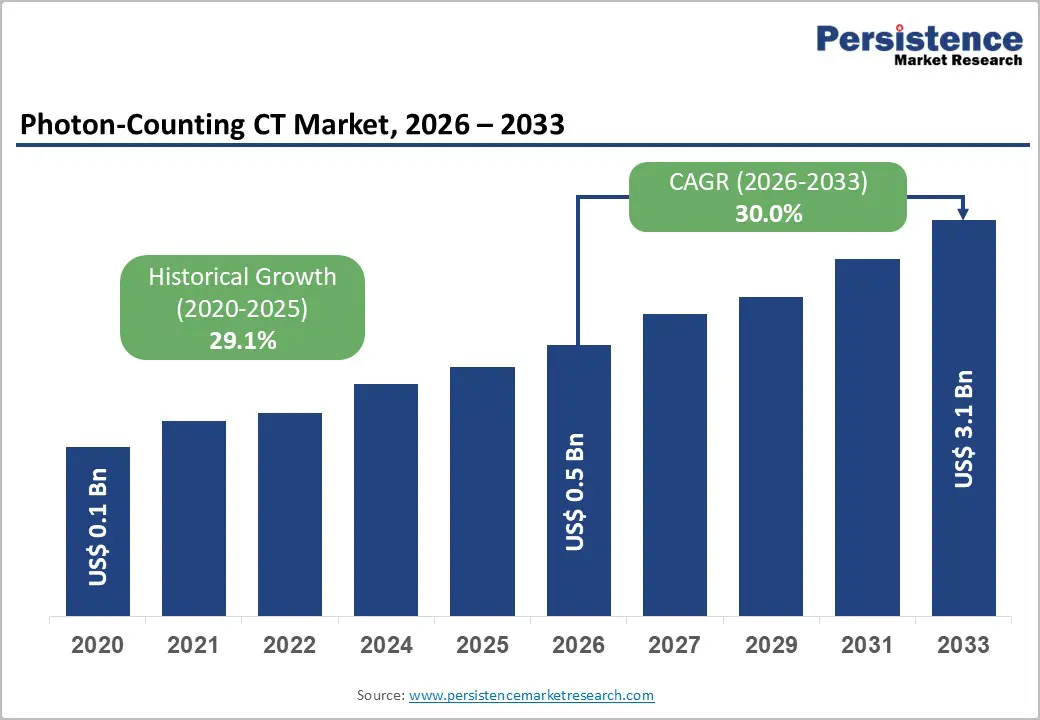
The global photon-counting CT market size is likely to be valued at US$0.5 billion in 2026, and is expected to reach US$3.1 billion by 2033, growing at a CAGR of 30.0% during the forecast period from 2026 to 2033, driven by superior image quality, lower radiation dose, and increasing adoption in advanced diagnostic imaging. Increasing demand for high-resolution, low-dose CT imaging in cardiology, oncology, and neurology remains a major driver of photon-counting CT market growth.
Key Industry Highlights:
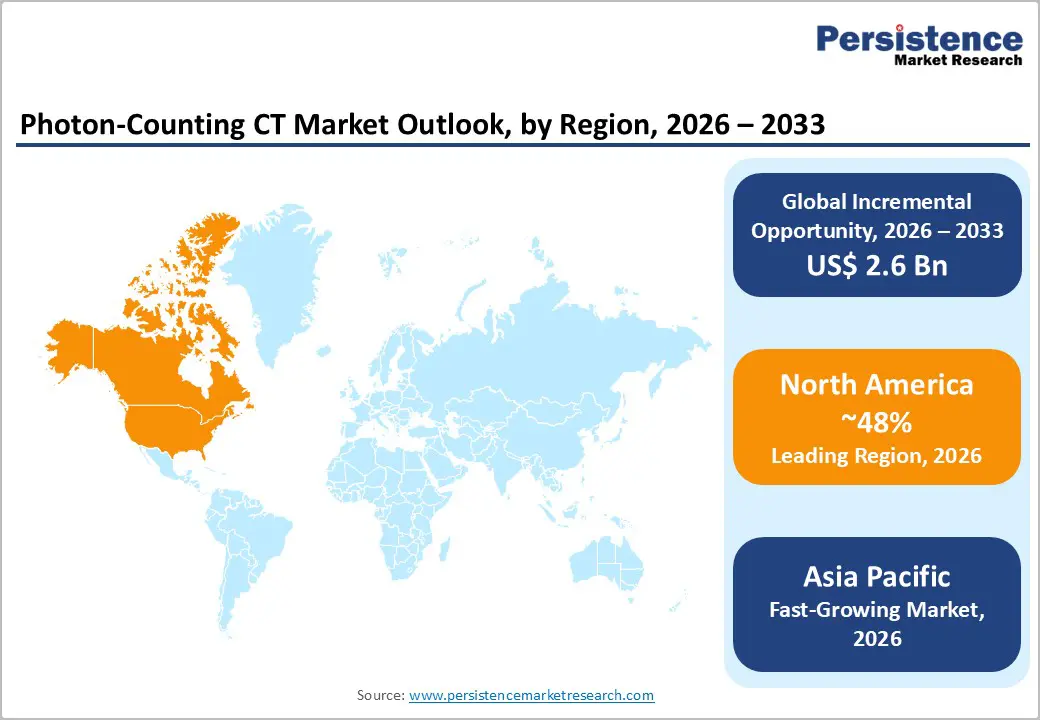
- Leading Region: North America, anticipated to account for a 48% market share in 2026, driven by advanced healthcare infrastructure, high-tech adoption, and demand for high-quality, low-dose imaging in oncology, cardiology, and neurology.
- Fastest-growing Region: Asia Pacific, fueled by hospital modernization, growing clinician awareness, and rising demand for high-resolution, low-dose imaging.
- Dominant Product Type: The multichannel counting system is projected to dominate with 50% share in 2026, offering advanced spectral imaging, precise material differentiation, and improved tissue characterization for cardiology and oncology.
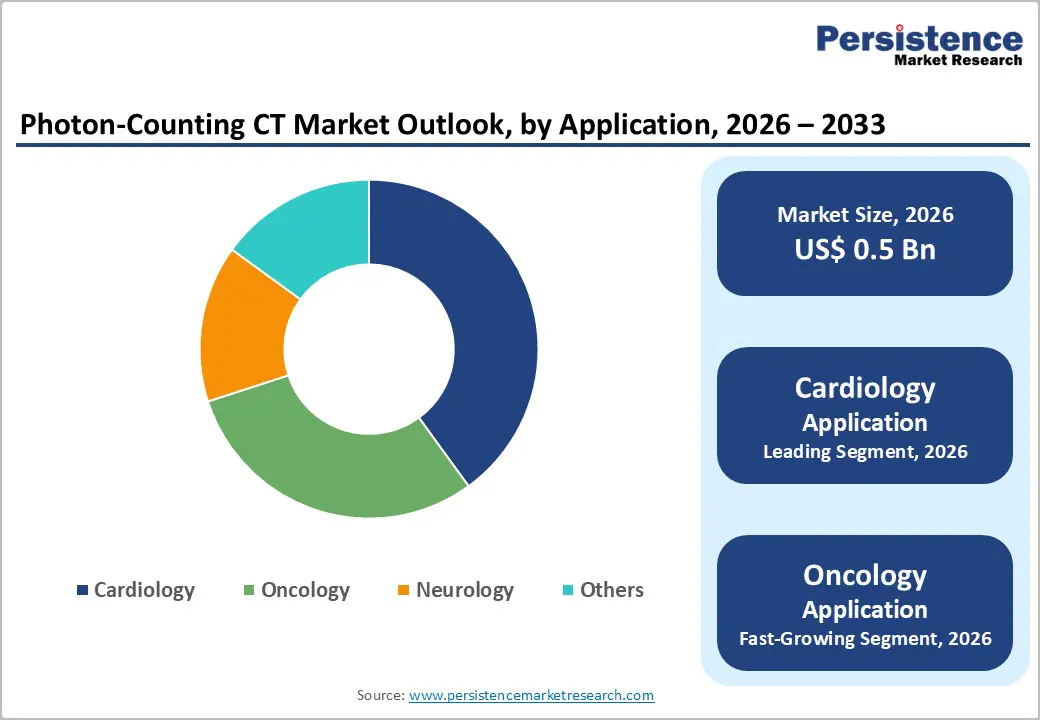
- Leading Application: Cardiology is set to dominate with over 40% share in 2026, driven by demand for high-resolution, low-dose coronary and cardiac imaging.
| Key Insights | Details |
|---|---|
| Photon Counting CT Market Size (2026E) | US$0.5 Bn |
| Market Value Forecast (2033F) | US$3.1 Bn |
| Projected Growth CAGR (2026 - 2033) | 30.0% |
| Historical Market Growth (2020 - 2025) | 29.1% |

DRO Analysis
Driver - High-Resolution Imaging
Photon-counting CT’s ability to directly detect individual X-ray photons leads to significantly improved spatial and contrast resolution compared with conventional energy-integrating detector (EID) CT systems. By eliminating the need for scintillators and septa between pixels, photon-counting detectors reduce electronic noise and allow much finer detector elements, resulting in images with clearer delineation of small anatomical structures and lesions. In some ultra-high-resolution PCCT modes, spatial detail as fine as 0.11 mm can be achieved, enabling visualization of subtle tissue differences that are difficult to discern on traditional CT scans.
This sharp imaging is particularly valuable in complex diagnostic areas such as vascular plaque assessment, lung pathology, and tumor characterization, where subtle contrast differences matter for accurate diagnosis and treatment planning. Clinical studies have shown that PCCT can provide similar or better image quality with reduced noise and potentially lower radiation doses compared with conventional CT, enhancing diagnostic confidence while adhering to safety principles of minimizing exposure.
Growing Oncology and Cardiology Applications
Clinical demand for advanced imaging continues to rise due to the high global burden of cancer and cardiovascular disease, making photon-counting CT increasingly relevant in both fields. According to World Health Organization data, around 20 million new cancer cases were diagnosed worldwide in 2022, and nearly 9.7 million cancer deaths occurred, underscoring the critical need for precise diagnostic tools. CT imaging plays a central role in detecting, staging, and monitoring cancer, and photon-counting CT offers enhanced lesion visualization, superior tissue characterization, and improved contrast differentiation that can significantly impact treatment planning and outcomes.
Cardiovascular diseases remain a leading health challenge globally. CT imaging is frequently used to assess coronary artery disease, evaluate plaques, and guide intervention strategies. Photon-counting CTs’ improved spatial resolution and material differentiation enable more accurate visualization of vascular structures and calcifications, supporting early and accurate cardiac diagnosis. Early adoption in cardiology and oncology settings is driven by the technology’s ability to deliver high-resolution images with lower radiation doses, addressing clinical priorities for effective diagnosis with enhanced patient safety.
Restraint - High Cost of Systems
Photon-counting CT (PCCT) systems involve sophisticated detector technology, advanced electronics, and multi-energy imaging capabilities, making them significantly more expensive than conventional CT scanners. The high upfront cost includes not only the purchase price but also installation, calibration, and integration with existing hospital IT infrastructure. Maintenance and specialized training for radiologists and technicians further add to operational expenses. These costs can be a barrier for smaller hospitals, diagnostic centers, and clinics, particularly in emerging markets where healthcare budgets are constrained.
Even in developed regions, institutions must justify the investment against traditional multi-slice CT systems, which continue to meet many diagnostic needs. While PCCT offers superior image quality, lower radiation doses, and advanced spectral imaging, the financial burden can slow adoption rates. Hospitals often require long-term return-on-investment calculations and clinical validation before committing, making cost a key restraint in the market’s growth trajectory.
Infrastructure Requirements
Adopting photon-counting CT (PCCT) systems requires significant upgrades to existing hospital infrastructure. These advanced scanners demand higher electrical power capacity, specialized cooling systems, and increased data storage solutions to manage the large volume of high-resolution spectral imaging data they generate. Integration with hospital PACS (Picture Archiving and Communication System) and radiology IT workflows is essential to ensure seamless image transfer, reconstruction, and analysis.
The installation of PCCT scanners often requires structural modifications to accommodate their size, weight, and vibration isolation requirements. Staff must also be trained in operating the new technology, interpreting multi-energy images, and performing routine maintenance. For smaller hospitals or clinics, these infrastructure investments can be challenging, both financially and logistically.
Opportunity - Spectral and Multi-Energy Imaging
Photon-counting CT (PCCT) enables the simultaneous acquisition of X-ray data at multiple energy levels, providing detailed spectral information that conventional CT scanners cannot capture. By differentiating photons based on their energy, PCCT allows for enhanced tissue characterization, improved contrast resolution, and precise material differentiation. This capability is particularly useful for identifying specific elements such as calcium, iodine, or soft tissue components, which can aid in distinguishing between healthy and diseased tissue, assessing vascular calcifications, or evaluating tumor composition.
Multi-energy imaging also allows for virtual non-contrast images, reducing the need for multiple scans and lowering radiation exposure for patients. Clinicians can generate quantitative maps that measure material concentration, improving diagnostic accuracy and supporting treatment planning in cardiology, oncology, and musculoskeletal imaging. Spectral imaging facilitates artifact reduction by separating materials with overlapping attenuation profiles, improving clarity around implants or dense structures. It also supports advanced imaging techniques, including perfusion assessment and plaque characterization, which were previously challenging with conventional CT.
Integration with AI
Photon-counting CT (PCCT) systems are increasingly leveraging artificial intelligence (AI) to enhance imaging performance, streamline workflows, and improve diagnostic accuracy. AI algorithms can assist in image reconstruction, enabling faster processing of the large, complex datasets generated by photon-counting detectors while reducing noise and preserving high spatial resolution. This allows clinicians to obtain clear, detailed images in shorter scan times, improving patient throughput and comfort. AI also supports automated lesion detection and segmentation, highlighting abnormalities such as tumors, vascular plaques, or subtle tissue changes that may be missed in manual review.
AI-driven analysis can provide quantitative insights from multi-energy and spectral imaging, including material composition, perfusion metrics, and tissue characterization, which aids in personalized treatment planning. Predictive algorithms can further assist radiologists by prioritizing cases, suggesting differential diagnoses, and reducing interpretation variability. By integrating AI into PCCT systems, hospitals can optimize workflow efficiency, minimize human error, and enhance clinical confidence, particularly in complex applications like oncology and cardiology.
Category-wise Analysis
Product Type Insights
The multichannel counting system is anticipated to dominate and be the fastest-growing, accounting for 50% of the share in 2026, fueled by its advanced capabilities in spectral imaging and material differentiation. By simultaneously detecting multiple energy levels, these systems provide enhanced tissue characterization, improved contrast resolution, and more accurate quantification of materials such as calcium, iodine, and soft tissue. This allows clinicians to better identify lesions, assess vascular structures, and optimize treatment planning, particularly in cardiology and oncology applications. Their superior imaging performance also enables reduced radiation exposure while maintaining diagnostic accuracy. The Siemens Healthineers NAEOTOM Alpha photon-counting CT uses a QuantaMax® detector to count individual X-ray photons across multiple energy channels, enabling intrinsic spectral imaging and precise material characterization in a single scan. This multichannel capability improves tissue differentiation, enhances image quality, and supports faster, more accurate diagnostics in cardiology and oncology.
Application Insights
Cardiology is projected to dominate with over 40% of the share in 2026, driven by the increasing demand for high-resolution coronary imaging and precise assessment of cardiac structures. Photon-counting CT provides superior spatial resolution, enhanced tissue differentiation, and significantly lower radiation doses compared to conventional CT, making it particularly valuable for diagnosing coronary artery disease, structural heart conditions, and cardiac calcifications. The GE HealthCare Photonova™ Spectra photon-counting CT system, featuring advanced Deep Silicon detectors, enables ultra-high-definition cardiac imaging with lower radiation. It delivers rapid, high-resolution scans of coronary vessels and cardiac tissue, improving the diagnosis of coronary artery disease and other subtle cardiac conditions.
Oncology is expected to be the fastest-growing application, due to its ability to provide highly detailed tumor visualization and precise tissue characterization. Photon-counting CT enables multi-energy imaging, enhanced contrast differentiation, and improved detection of small lesions, supporting accurate staging, treatment planning, and therapy monitoring. By reducing radiation exposure while maintaining image quality, PCCT is particularly valuable for cancer patients requiring repeated scans. The Siemens Healthineers NAEOTOM Alpha photon-counting CT platform enhances clinical oncology imaging by improving tumor detection, characterization, and treatment monitoring. Its Quantum Technology delivers high-resolution, high-contrast spectral images in a single scan, allowing clinicians to detect small lesions, evaluate tumor-feeding vessels, and accurately quantify tissue properties essential for staging and assessing therapy response.
Regional Insights
North America Photon-Counting CT Market Trends
North America is projected to dominate, capturing the 48% of the market share in 2026, powered by advanced healthcare infrastructure, high adoption of cutting-edge medical technologies, and strong research activity. Hospitals and imaging centers in the U.S. and Canada are increasingly deploying photon-counting CT systems to achieve higher image quality, improved tissue contrast, and more precise diagnostics in oncology, cardiology, and neurology. A key trend is the focus on radiation dose reduction, which aligns with growing awareness of patient safety and regulatory standards, making photon-counting technology an attractive alternative to conventional CT scanners.
Clinical validation and research collaborations are another major driver. Leading hospitals, research institutions, and technology providers are conducting trials to explore the full potential of photon-counting CT, including multi-energy imaging, AI-based image reconstruction, and advanced quantitative analysis. This not only supports faster clinical adoption but also encourages the integration of PCCT into routine diagnostic workflows. Technological innovation remains central, with manufacturers enhancing detector sensitivity, expanding imaging applications, and improving system efficiency. Additionally, strategic partnerships between hospitals and vendors are accelerating deployment while addressing cost and operational challenges.
Europe Photon-Counting CT Market Trends
Market growth in Europe is driven by the region’s advanced healthcare infrastructure and strong focus on medical research and innovation. Hospitals and imaging centers across Germany, France, the U.K., and the Nordic countries are increasingly adopting photon-counting technology to enhance diagnostic accuracy, particularly in oncology, cardiology, and neurology. A major trend is the emphasis on reducing radiation exposure for patients, which aligns with Europe’s stringent regulatory frameworks and growing awareness of patient safety. Photon-counting CT systems, with their ability to provide high-resolution, multi-energy imaging, are meeting this demand by offering clearer images with lower doses compared to conventional CT scanners.
Clinical collaborations and research initiatives are another significant trend shaping the market. European academic hospitals are actively partnering with manufacturers to conduct trials that demonstrate the efficacy of photon-counting CT in complex diagnostic cases, helping to build physician confidence and drive adoption. Technological advancements such as AI-assisted image reconstruction, enhanced detector materials, and integrated software for quantitative imaging are being implemented to improve workflow efficiency and diagnostic accuracy. Sustainability and cost-effectiveness are also becoming important considerations, prompting hospitals to choose energy-efficient systems with longer lifespans.
Asia Pacific Photon-Counting CT Market Trends
Asia Pacific is likely to be the fastest-growing region, propelled by several interrelated trends across healthcare infrastructure, technology adoption, and patient demand. The increasing modernization of hospitals and diagnostic centers in countries, including China, India, Japan, and South Korea, is investing heavily in advanced imaging equipment to improve diagnostic accuracy and patient outcomes. Rising awareness among clinicians about the advantages of photon-counting technology, such as superior image resolution, enhanced tissue differentiation, and significant radiation dose reduction, is fueling adoption in both urban and tier-2 healthcare facilities.
The expansion of local and regional clinical trials and research collaborations. Hospitals and academic institutions are partnering with technology providers to validate the clinical benefits of PCCT in cardiology, oncology, and neurology, accelerating acceptance among physicians. Technological innovation is also prominent, with manufacturers focusing on AI-based image reconstruction, multi-energy imaging, and more compact, cost-efficient systems suitable for diverse hospital settings.
Competitive Landscape
The global photon-counting CT (PCCT) market is characterized by high concentration, dominated by a select group of leading medical imaging companies that are driving innovation in detector technology and system integration. Market competition primarily revolves around enhancing image quality, minimizing radiation exposure, and achieving robust clinical validation. Key players such as PerkinElmer, PicoQuant, Becker & Hickl GmbH, Hidex Oy, ID Quantique (IDQ), Photek, Thorlabs, and GE Healthcare are investing heavily in research and development to improve detector materials, sensitivity, and energy resolution.
These companies actively engage in clinical research collaborations, partnering with hospitals and academic institutions to validate diagnostic efficacy and optimize clinical workflows. Expansion of regulatory approvals across major markets, coupled with strategic alliances, accelerates the adoption of photon-counting CT systems. Ongoing efforts focus on integrating AI-based imaging reconstruction, improving throughput, and reducing operational costs, positioning these firms to capture the growing demand for high-precision, low-dose CT imaging in oncology, cardiology, and other advanced medical applications.
Key Industry Developments:
- In March 2026, GE HealthCare received 510(k) clearance from the U.S. Food and Drug Administration (FDA) for its Photonova™ Spectra, an innovative photon-counting computed tomography (PCCT) system. The company introduced the platform with its novel Deep Silicon detector technology, offering multiple configurations to address diverse clinical needs.
- In August 2025, Neusoft Medical Systems announced that its NeuViz P10 photon-counting CT received market approval from China’s National Medical Products Administration (NMPA). This approval marked the first photon-counting CT cleared in China and the world’s first wide-body system featuring an 8 cm detector.
Companies Covered in Photon-Counting CT Market
- PerkinElmer
- PicoQuant
- Becker &Hickl GmbH
- Hidex Oy
- ID Quantique (IDQ)
- Photek
- Thorlabs
- GE Healthcare
Frequently Asked Questions
The global photon-counting CT market is projected to reach US$0.5 billion in 2026.
The photon-counting CT market is primarily driven by superior image quality, significantly reduced radiation dose, and growing clinical evidence supporting its use in cardiology and oncology. Increasing demand for advanced diagnostic precision further accelerates market growth.
The photon-counting CT market is poised to witness a CAGR of 30.0% from 2026 to 2033.
Key opportunities in the photon-counting CT market include broader clinical adoption in neurology and oncology, development of more affordable systems, and expansion into emerging markets with growing demand for advanced imaging.
Key players in the photon-counting CT market include GE Healthcare, PerkinElmer, and PicoQuant.


