




- Medical Devices
- Ligament Augmentation Market
Ligament Augmentation Market Size, Share, and Growth Forecast, 2026 - 2033
Ligament Augmentation Market by Product Type (Artificial Tendons & Ligaments, Ligament Augmentation Devices, Biological Ligaments, Hybrid Ligaments), End-user (Hospitals, Ambulatory Surgical Centers, Others), and Regional Analysis for 2026 - 2033

Ligament Augmentation Market Size and Trends Analysis
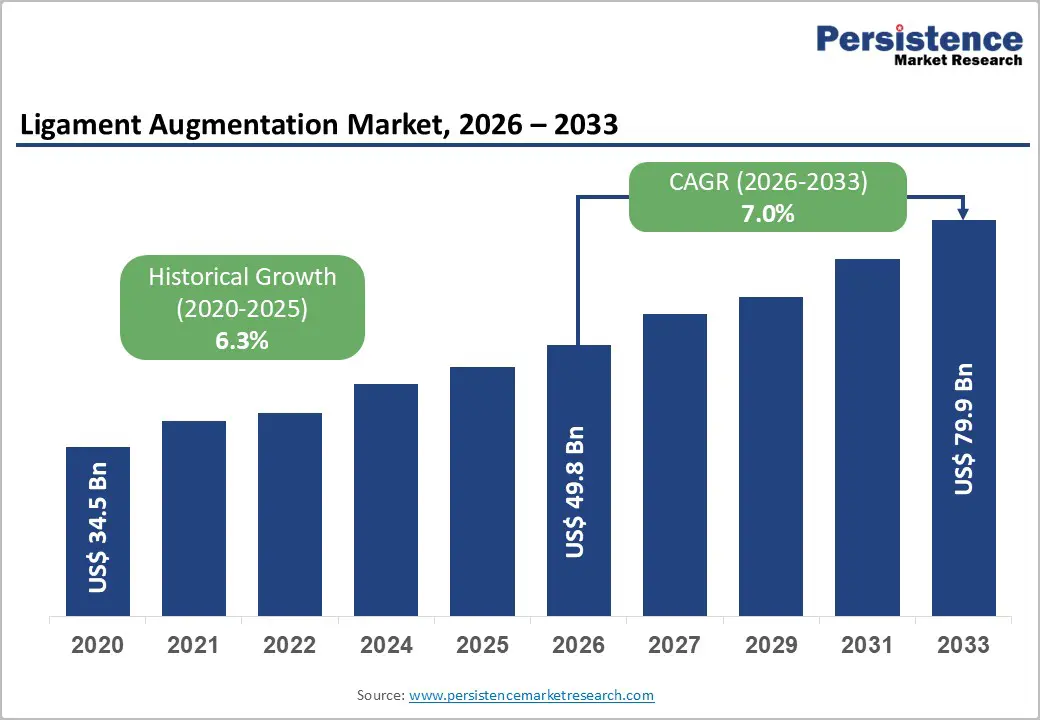
The global ligament augmentation market size is likely to be valued at US$49.8 billion in 2026, and is expected to reach US$79.9 billion by 2033, growing at a CAGR of 7.0% during the forecast period from 2026 to 2033, driven by the increasing prevalence of sports injuries and anterior cruciate ligament (ACL) tears, rising demand for minimally invasive ligament reconstruction procedures, growing adoption of synthetic and hybrid augmentation devices to improve graft strength and reduce rerupture rates, and expanding orthopedic ambulatory surgery centers performing outpatient knee and shoulder procedures.
Increasing recognition of ligament augmentation as critical for restoring joint kinematics, preventing graft failure, and enabling earlier return-to-sport in emerging sports medicine and active-aging populations remains a major driver of market growth.
Key Industry Highlights:
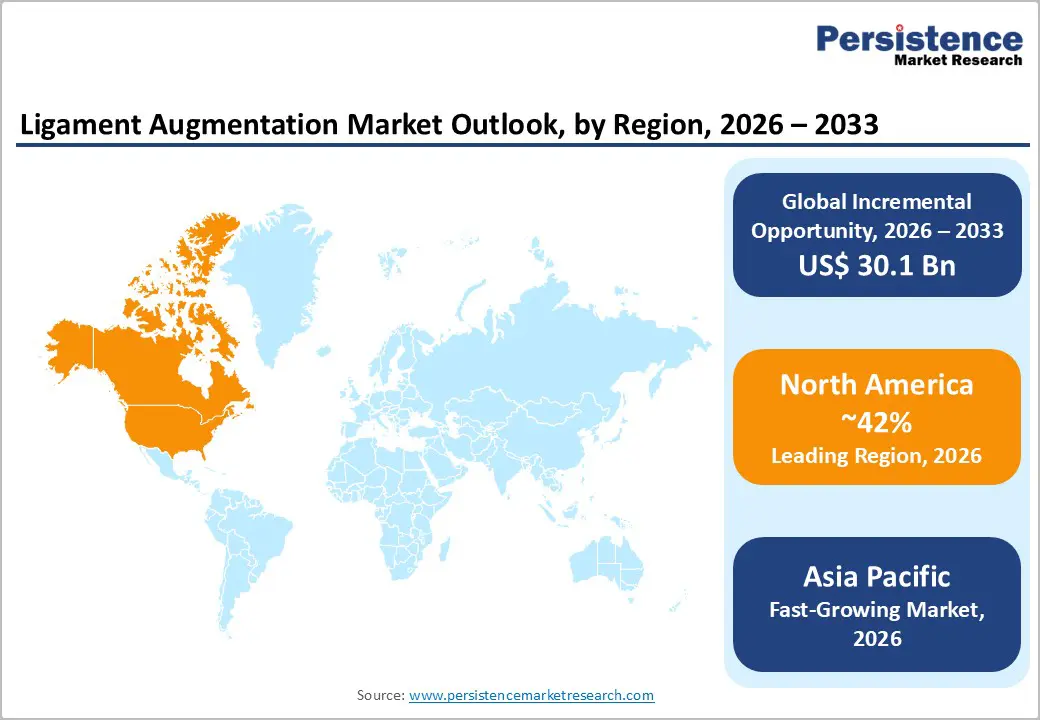
- Leading Region: North America, anticipated to account for a 42% market share in 2026, driven by high ACL injury incidence, advanced sports medicine infrastructure, and strong demand in the U.S.
- Fastest-growing Region: Asia Pacific, fueled by rising sports participation, increasing orthopedic ASC penetration, and growing medical tourism in India and China.
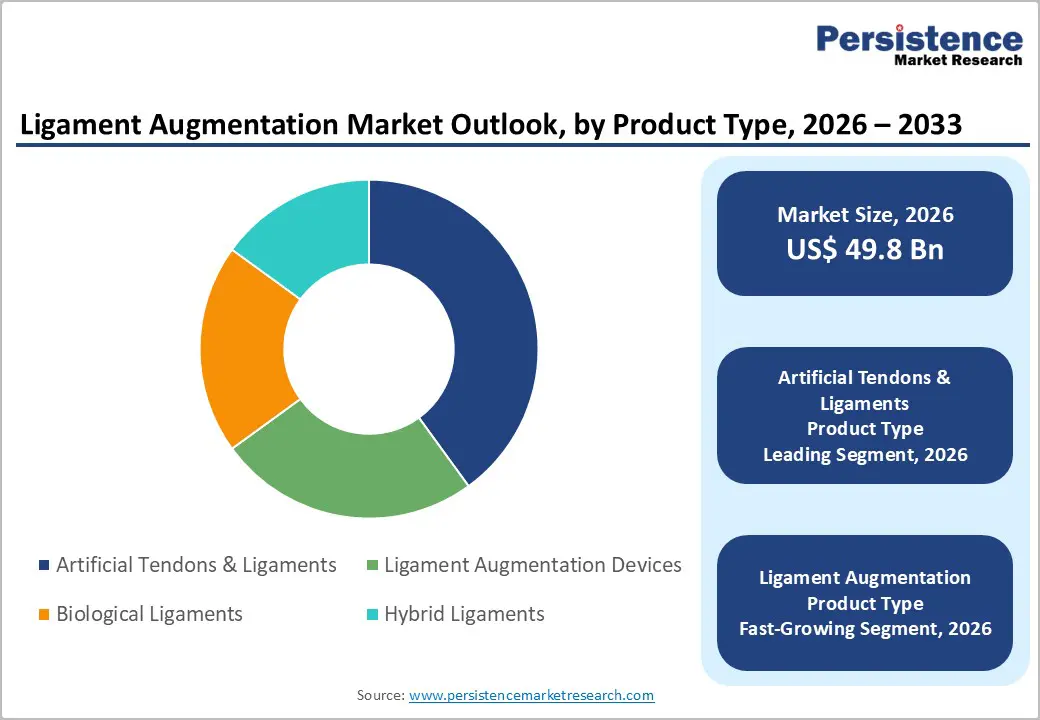
- Dominant Product Type: Artificial tendons & ligaments, to hold approximately 48% of the market share, as they remain the most widely used augmentation solution.
- Leading End-user: Hospitals, contributing nearly 55% of the market revenue, due to the highest procedural volume and complex reconstructions.
| Key Insights | Details |
|---|---|
| Ligament Augmentation Market Size (2026E) | US$49.8 Bn |
| Market Value Forecast (2033F) | US$79.9 Bn |
| Projected Growth CAGR (2026 - 2033) | 7.0% |
| Historical Market Growth (2020 - 2025) | 6.3% |
Market Factors - Growth, Barriers, and Opportunity Analysis
Growth Analysis - Rising Sports Injuries and Outpatient Orthopedic Procedures
Increasing participation in organized sports, fitness activities, and recreational athletics has significantly contributed to the rising incidence of musculoskeletal injuries, particularly ligament tears, tendon ruptures, and joint instability. Athletes involved in high-impact sports such as football, basketball, and soccer frequently experience injuries affecting the knee, ankle, and shoulder, which often require orthopedic evaluation and surgical intervention. According to the U.S. Centers for Disease Control and Prevention (CDC), sports and recreational activities result in over 3.5 million injuries annually among children and adolescents in the U.S., highlighting the growing clinical burden associated with sports participation.
The increasing focus on physical fitness and active lifestyles among adults has expanded the patient population seeking treatment for sports-related injuries. The growing number of injuries has also accelerated the shift toward outpatient orthopedic procedures. Advances in minimally invasive surgical techniques, arthroscopy, and enhanced rehabilitation protocols enable ligament reconstruction and tendon repair to be performed in ambulatory settings, resulting in shorter recovery times and lower healthcare costs. Ambulatory surgical centers and specialty orthopedic clinics increasingly handle procedures that were traditionally performed in hospitals. This trend is driving demand for advanced ligament and tendon repair solutions while supporting the expansion of outpatient orthopedic care globally.
Advancements in Synthetic and Hybrid Augmentation Devices
Continuous improvements in biomaterials, implant design, and tissue-engineering technologies are enhancing the effectiveness of ligament reconstruction and tendon repair procedures. Modern augmentation devices increasingly combine synthetic polymers, bioabsorbable materials, and biological graft components to improve strength, flexibility, and long-term integration with surrounding tissues. Hybrid systems are designed to provide immediate mechanical stability while gradually promoting natural tissue regeneration, helping restore joint function and reduce the risk of reinjury. These technological improvements are particularly important in orthopedic surgery, where high-stress joints such as the knee and shoulder require durable repair solutions that can withstand repetitive movement and physical activity.
The growing clinical demand for such devices is closely linked to the high incidence of ligament injuries. According to data from the U.S. Centers for Disease Control and Prevention (CDC), more than 3.5 million children aged 14 and younger experience sports-related injuries each year, many of which involve sprains, strains, or ligament damage that may require orthopedic treatment. National injury surveillance studies show that ankle and knee injuries account for a significant proportion of sports-related trauma, with sprains and strains representing more than 50% of reported injuries in youth sports activities.
Barrier Analysis - Reimbursement Challenges
Many innovative devices, including synthetic and hybrid ligament augmentation systems, are often categorized under general orthopedic procedures, which can restrict specific reimbursement eligibility. In several healthcare systems, insurers prioritize cost-effective traditional treatments such as autografts or allografts, making it difficult for hospitals and surgical centers to justify the use of newer and more expensive implant technologies.
Reimbursement policies frequently vary across countries and healthcare providers, creating uncertainty for both manufacturers and healthcare institutions. Hospitals may face financial pressure if reimbursement rates do not fully cover the cost of specialized implants, surgical tools, and postoperative care. Administrative complexities, including documentation requirements and coding limitations, further slow the adoption of innovative procedures.
Limited Long-term Clinical Evidence
Limited long-term clinical evidence remains a significant concern for the adoption of advanced ligament and tendon reconstruction technologies. Many synthetic and hybrid ligament augmentation devices have shown promising short-term outcomes, including improved joint stability and faster recovery. Comprehensive long-term data evaluating durability, implant integration, and potential complications are still relatively limited. Orthopedic surgeons and healthcare providers often prefer treatment approaches that have well-established clinical histories, such as autografts and allografts, which have been studied for decades.
The lack of extensive long-term follow-up studies makes it difficult to fully assess potential risks, such as implant wear, inflammatory reactions, or mechanical failure, over time. Some healthcare professionals remain cautious when recommending newer devices, particularly for younger or highly active patients who require durable and long-lasting solutions.
Opportunity Analysis - Advancements in Synthetic Augmentation and Internal Bracing Techniques
Continuous innovation in orthopedic biomaterials and surgical techniques is improving the treatment of ligament and tendon injuries. Modern reconstruction procedures increasingly use high-strength synthetic fibers and internal bracing systems to reinforce repaired tissues during healing. These technologies act as supportive scaffolds that stabilize the joint immediately after surgery while allowing natural ligament regeneration over time. Internal bracing techniques are often combined with traditional grafts to provide additional mechanical strength, particularly in high-stress joints such as the knee and ankle. This approach helps reduce the risk of graft stretching or re-injury during rehabilitation.
Synthetic augmentation devices are typically made from advanced polymer materials designed to be durable, flexible, and biocompatible. Their structure allows them to mimic the mechanical behavior of natural ligaments while maintaining consistent support during movement. These systems also enable surgeons to perform minimally invasive procedures, thereby shortening operating time and reducing postoperative recovery time. The advantage of internal bracing is the ability to support early mobilization and faster rehabilitation, which is particularly important for athletes and physically active individuals.
Expansion in Sports Medicine Clinics
Growing awareness of sports-related injuries and the need for specialized orthopedic care has led to a steady rise in dedicated sports medicine clinics across many regions. These facilities focus on diagnosing, treating, and rehabilitating musculoskeletal injuries related to athletic activities, including ligament tears, tendon injuries, and joint instability. Sports medicine clinics typically bring together orthopedic surgeons, physiotherapists, and rehabilitation specialists, enabling patients to receive comprehensive treatment and faster recovery through coordinated care.
The increasing popularity of recreational sports, fitness programs, and competitive athletics has expanded the patient pool requiring specialized care. Healthcare providers are investing in advanced diagnostic imaging, minimally invasive surgical tools, and rehabilitation technologies within these clinics. This specialized infrastructure supports procedures such as ligament reconstruction, tendon repair, and joint stabilization, which are commonly required after sports injuries. Supporting the growth of sports medicine clinics is the demand for faster treatment and rehabilitation. Athletes and physically active individuals often prefer facilities that offer quicker diagnosis, targeted treatment plans, and structured recovery programs designed to restore mobility and performance.
Category-wise Analysis
Product Type Insights
Artificial tendons & ligaments are anticipated to dominate, accounting for approximately 48% of the market share in 2026. Their dominance is driven by their strong mechanical stability and consistent performance in ligament reconstruction procedures. These implants are widely used in orthopedic surgeries, particularly for treating severe ligament injuries such as anterior cruciate ligament (ACL) tears and tendon ruptures. Artificial materials offer advantages such as immediate structural support, reduced dependence on donor grafts, and shorter surgical preparation time. LARS (Ligament Advanced Reinforcement System) was developed by Corin Group. The LARS ligament is a synthetic implant made from polyethylene terephthalate (PET) fibers and is widely used for anterior cruciate ligament (ACL) and posterior cruciate ligament (PCL) reconstruction in orthopedic surgeries.
Ligament augmentation devices are the fastest-growing product type, as they enhance the strength and stability of repaired ligaments during the healing process. These devices provide immediate structural support, allowing patients to resume mobility sooner while reducing the risk of re-injury. Surgeons increasingly prefer augmentation devices in procedures such as anterior cruciate ligament (ACL) reconstruction as they improve surgical outcomes and accelerate rehabilitation. BioBrace® Extra-Articular Ligament Augmentation Kit from CONMED Corporation is a ready-to-use implant designed to support knee ligament repair and reinforce tissue healing by combining a bioinductive scaffold with suture anchors.
End-user Insights
The hospitals are expected to dominate the market, accounting for nearly 55% of revenue in 2026, driven by high patient volumes, advanced surgical facilities, and a strong preference for in-house procedures. Hospitals can adopt the latest medical technologies, including ligament augmentation devices, ensuring better outcomes and faster recovery for patients. The presence of specialized orthopedic and sports medicine departments enables comprehensive care, from diagnosis to post-operative rehabilitation. King George’s Medical University (KGMU) in Lucknow has introduced an advanced implant for anterior cruciate ligament (ACL) tear treatment in its Sports Medicine Department, using modern reinforced bio-active devices to support faster recovery and stronger knee stability compared with traditional repair methods, illustrating how a hospital setting drives adoption of sophisticated orthopedic technologies.
Ambulatory surgical centers are the fastest-growing end users; they offer specialized, cost-effective, and convenient surgical care outside traditional hospital settings. ASCs focus on outpatient procedures, allowing patients to undergo surgeries such as ligament repairs or joint reconstructions without overnight stays. This reduces overall treatment costs and minimizes hospital congestion while maintaining high-quality care. Surgeons prefer ASCs for their efficiency, advanced equipment, and streamlined workflow, which enable quicker patient turnover and faster recovery times. Surgery Partners, a major ambulatory surgical center operator in the U.S., reported performing over 117,000 orthopedic procedures in its ASC network in 2024, reflecting an 11% increase year-over-year and a strategic shift toward higher-acuity surgeries such as joint replacements outside traditional hospital settings.
Regional Insights
North America Ligament Augmentation Market Trends
North America is projected to dominate, accounting for nearly 42% of the share in 2026, driven by the high incidence of anterior cruciate ligament (ACL) injuries and the extensive use of reconstructive procedures across the U.S. and Canada. In the U.S. alone, tens of thousands of ACL reconstructions are performed each year, reflecting the large number of ligament injuries sustained from sports and physical activities, with estimates of several hundred thousand ligament injuries occurring annually. Government-linked health data indicate that ACL injuries are among the most common orthopedic injuries treated in the U.S. healthcare system, driving a substantial volume of related surgical procedures. Advanced healthcare infrastructure, with hospitals and surgical centers equipped with modern orthopedic technology, which facilitates the widespread adoption of ligament repair and augmentation techniques and improves surgical outcomes.
High sports participation rates in North America contribute to a steady stream of ligament injuries requiring surgical intervention, further fueling market growth. Additionally, the rise of outpatient and ambulatory surgical centers has increased accessibility and lowered costs for ligament reconstruction, with many ACL surgeries now performed outside traditional hospital settings. The U.S. Centers for Disease Control and Prevention (CDC) report highlights hundreds of thousands of ligament reconstruction surgeries conducted annually, emphasizing the strong clinical demand for augmentation technologies within the region.
Europe Ligament Augmentation Market Trends
Europe is witnessing the steady growth propelled by the region’s robust healthcare systems, widespread sports participation, and public health focus on injury treatment and prevention. Across countries such as Germany, France, the U.K., and Italy, strong orthopedic care infrastructure supports a high volume of ligament repair and reconstruction procedures, especially for common injuries such as anterior cruciate ligament (ACL) tears that frequently occur in football and other sports. Population health data show that ligament injuries are a regular feature of sports trauma cases in Europe, with ACL ruptures regularly recorded in professional leagues and contributing to clinical demand for advanced surgical solutions.
Public funding for healthcare and well-established reimbursement frameworks in many European nations further facilitate access to these procedures, encouraging the adoption of minimally invasive and supportive technologies that enhance patient recovery and mobility.
Asia Pacific Ligament Augmentation Market Trends
Asia Pacific is likely to be the fastest-growing market for ligament augmentation in 2026, supported by growing sports participation, rising incidence of ligament injuries, and improvements in healthcare infrastructure across the region. Countries, including China, India, Japan, South Korea, and Australia, are seeing more recreational and competitive athletes, which increases the number of knee and ligament injuries, especially anterior cruciate ligament (ACL) tears that often require surgical repair. This rise in injuries is prompting wider adoption of advanced augmentation techniques and implants to improve surgical outcomes and speed recovery.
Urbanization and lifestyle changes have contributed to more physical activity and related musculoskeletal trauma, further driving clinical demand. Enhanced access to arthroscopic and minimally invasive procedures has also reduced barriers to surgery and encouraged patients to seek treatment earlier, increasing procedure volumes.
Competitive Landscape
The global ligament augmentation market is highly competitive, with established orthopedic device leaders competing alongside emerging sports-medicine specialists. In North America and Europe, companies such as Stryker Corporation and Arthrex Inc. maintain leadership through extensive research and development, strong surgeon networks, and a focus on anterior cruciate ligament (ACL) repair technologies. Their innovative programs, including artificial tendon and ligament augmentation devices, enhance surgical outcomes and drive adoption in advanced orthopedic procedures.
In Asia Pacific markets, local players are witnessing growth from offering cost-competitive solutions that improve accessibility to ligament repair surgeries for a broader population. Advanced technologies, such as artificial tendon delivery systems, provide improved graft protection, reduce the risk of rerupture, and allow integration into multiple surgical procedures. Strategic partnerships, collaborations, and acquisitions enable companies to combine expertise, expand product portfolios, and accelerate commercialization.
Key Industry Developments:
- In March 2025, Medline UNITE unveiled its new Synthetic Ligament Augmentation implant at this year’s American College of Foot and Ankle Surgeons Annual Meeting in Phoenix, Arizona. The company introduced the intelligently designed solution as the next generation in tendon and ligament repair, highlighting its ability to support tissue ingrowth and enhance surgical outcomes.
- In February 2024, Arthrex celebrated the 10th anniversary of its InternalBrace™ ligament augmentation system, highlighting a decade of advancements in minimally invasive surgical technology. The company emphasized how the system improved ligament repair outcomes, reduced re-injury rates, and enhanced recovery for patients.
Companies Covered in Ligament Augmentation Market
- Stryker Corporation
- Arthrex Inc.
- Zimmer Biomet
- DJO Global
- Corin Group
- Neoligaments (Xiros Ltd)
- Mathys AG Bettlach
- Orthomed S.A.S.
Frequently Asked Questions
The global ligament augmentation market is projected to reach US$49.8 billion in 2026.
Rising sports injuries and outpatient orthopedic procedures are key drivers.
The ligament augmentation market is poised to witness a CAGR of 7.0% from 2026 to 2033.
Synthetic augmentation and internal bracing techniques and expansion in Asia Pacific and sports medicine clinics are key opportunities.
Stryker Corporation, Arthrex Inc., Zimmer Biomet, DJO Global, and Corin Group are the key players.


