




- Processed Food
- Honey Market
Honey Market Size, Share, and Growth Forecast, 2026 - 2033
Honey Market by Product Type (Monofloral Honey, Organic Wildflower Honey, Polyfloral Honey), Processing (Conventional, Organic), Packaging (Glass Jars, Bottles, Tubs, Tubes), and Regional Analysis for 2026 - 2033

Honey Market Size and Trends Analysis
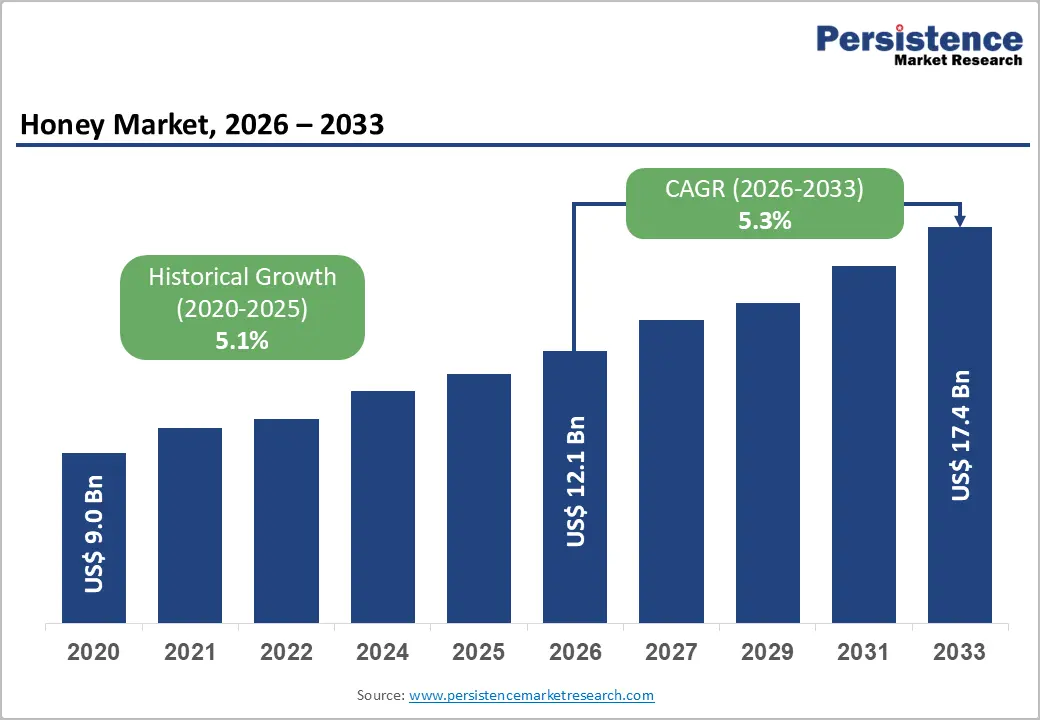
The global honey market size is likely to reach US$12.1 billion in 2026 and US$17.4 billion by 2033, growing at a CAGR of 5.3% over the forecast period from 2026 to 2033, driven by rising preference for natural sweeteners and clean-label food ingredients.
According to the Food and Agriculture Organization (FAO, 2023), global honey production exceeded 1.8 million tonnes, reflecting a stable supply supported by Asia’s strong output. The National Honey Board (2024) reports that consumers are increasingly substituting honey for refined sugar due to perceived health benefits.
Growing consumer awareness of honey's antimicrobial, antioxidant, and nutritional properties is reinforcing demand across both developed and emerging economies. Demand is supported by food processing and functional food applications, while organic honey is gaining traction amid sustainability trends and stricter quality standards across markets.
Key Industry Highlights:
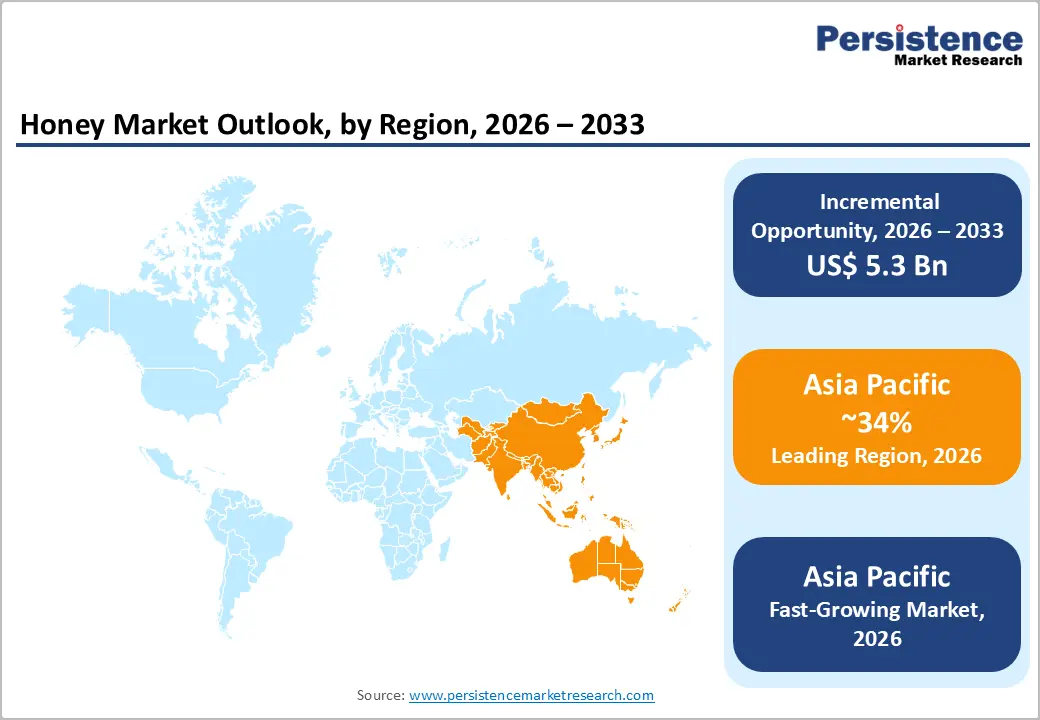
- Leading Region: Asia Pacific is anticipated to be the leading region, accounting for a market share of 34% in 2026, driven by rising health awareness, strong production base, and expanding demand for natural sweeteners.
- Fastest-growing Region: Asia Pacific is likely to be the fastest-growing region, supported by a shift toward natural and functional foods, the rapid expansion of the food processing industry, and the growing adoption of organic honey across emerging economies.
- Leading Product Type: Polyfloral honey is projected to represent the leading product type in 2026, accounting for 46% of the revenue share, driven by its consistent flavor and suitability for large-scale processing.
- Leading Processing: Conventional processing is expected to be the leading processing method, accounting for over 70% of revenue in 2026, supported by its affordability and widespread availability.
- Key Opportunity: Expanding demand for premium, organic, and functional honey, combined with clean-label trends, e-commerce growth, and increasing applications across food, healthcare, and personal care.

DRO Analysis
Driver - Rising Consumer Preference for Natural and Organic Sweeteners
Consumers are actively reducing refined sugar intake due to links with obesity, diabetes, and cardiovascular diseases, shifting toward cleaner alternatives. According to the Food and Agriculture Organization (2025), global honey consumption continues to rise alongside production, indicating stable demand. Honey’s natural composition, including antioxidants, vitamins, and antimicrobial properties, makes it attractive in daily diets.
The expansion of functional foods and beverages is accelerating honey adoption across multiple industries. The National Honey Board (NHB) reports that consumers increasingly prefer honey in beverages, bakery products, and health supplements due to its perceived immunity-increasing benefits.
Rising disposable incomes in emerging economies are also supporting premium product consumption, including organic honey. Food manufacturers are reformulating products to replace sugar with natural alternatives, increasing the demand. This shift is not limited to food but extends to personal care and pharmaceuticals, where honey’s natural healing properties are widely utilized in formulations.
Restraint - Adulteration and Food Safety Concerns
Adulteration remains a major challenge impacting the credibility and growth of the honey market worldwide. Reports from the Food Safety and Standards Authority of India highlight instances where honey products were found mixed with sugar syrups, reducing purity and consumer trust. The European Commission's Joint Research Centre estimates that up to 46% of honey samples tested in EU markets showed signs of adulteration.
Such practices create pricing pressure on genuine producers and disrupt fair competition. Inconsistent quality standards across regions complicate trade, as importing countries enforce strict testing protocols. Lack of standardized global certification creates confusion among consumers regarding authenticity claims, such as organic or pure. These challenges hinder market expansion, particularly in price-sensitive regions where consumers may prioritize cost over quality.
Opportunity - Premium and Functional Honey Product Innovation
Consumers are increasingly seeking value-added products such as medicinal-grade honey, infused honey, and organic variants. According to the Food and Agriculture Organization, diversification in apiculture products is encouraging producers to move beyond traditional offerings. High-value varieties such as Manuka and herbal-infused honey are gaining traction due to their perceived therapeutic benefits. This shift enables companies to target niche segments, improve profit margins, and effectively differentiate their brands in a competitive marketplace.
Innovation in product formats and applications is unlocking new growth avenues. The National Honey Board highlights increasing use of honey in functional foods, nutraceuticals, and skincare products. Companies are introducing convenient packaging formats and blending honey with ingredients such as turmeric, ginger, and vitamins to enhance functionality. E-commerce platforms are also enabling direct-to-consumer sales of premium products, expanding reach.
Category-wise Analysis
Product Type Insights
Polyfloral honey is expected to lead the honey market, accounting for approximately 46% of revenue in 2026, driven by its consistent taste, cost-efficiency, and wide applicability in large-scale food processing. Its blended floral sources ensure a stable supply and uniform flavor, making it highly suitable for bakery, confectionery, and beverage industries. For instance, Dabur India Limited offers a wide range of blended honey variants catering to mass-market consumers.
Organic wildflower honey is likely to represent the fastest-growing segment, supported by rising consumer preference for natural, chemical-free, and sustainably sourced food products. Increasing awareness of pesticide residues and environmental impacts is driving consumers toward organic options, particularly in premium urban markets. Companies such as Comvita Limited market premium organic honey products with a strong emphasis on sustainability and wellness benefits.
Processing Insights
Conventional processing is projected to lead the market, capturing around 70% of the revenue share in 2026, supported by its affordability, large-scale availability, and established supply chains. Conventional honey undergoes standard filtration and heating processes that enhance shelf life and visual appeal, making it suitable for commercial distribution. A notable example includes Dutch Gold Honey, Inc., which supplies conventionally processed honey in large volumes to foodservice and industrial clients.
Organic processing is likely to be the fastest-growing processing, driven by increasing demand for minimally processed and chemical-free food products. Consumers are becoming more conscious of sourcing practices, leading to higher adoption of organically certified honey. For instance, Kashmir Apiaries Exports Private Limited focuses on certified organic honey exports, targeting premium international markets demanding authentic natural products.
Packaging Type Insights
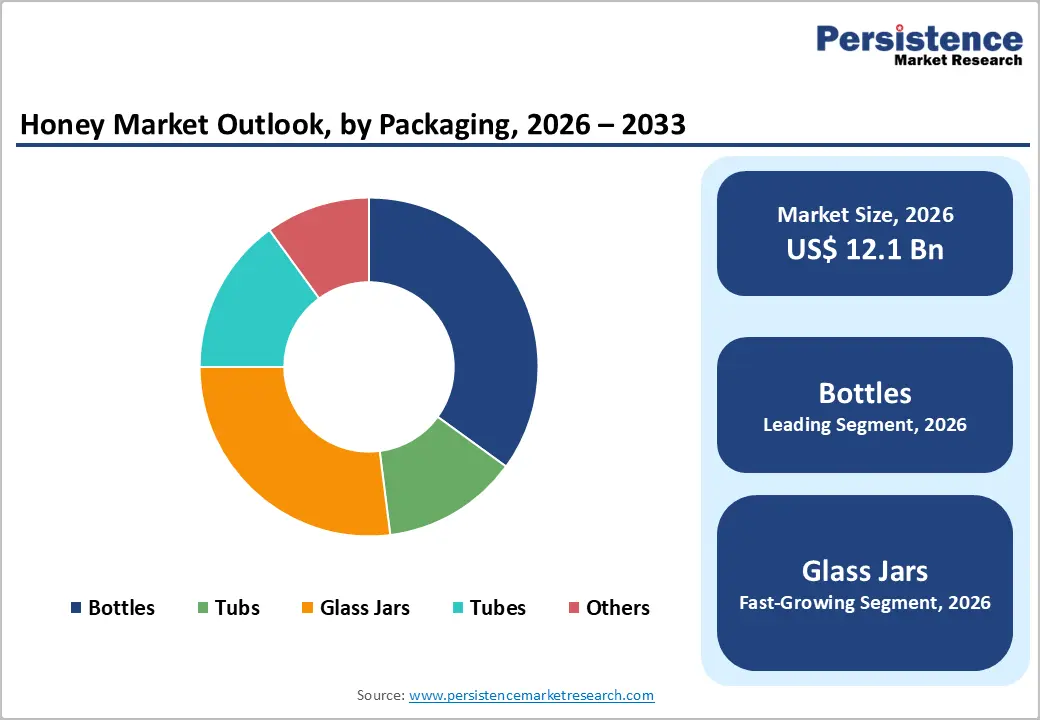
Bottles are expected to lead the honey market, accounting for approximately 35% of revenue in 2026, driven by their convenience, durability, and cost-effectiveness. These packaging formats are widely used for retail distribution as they are lightweight, easy to handle, and suitable for both small and large quantities. For example, Sioux Honey Association Cooperative offers honey in squeezable bottle formats, enhancing user convenience.
Glass jars are likely to represent the fastest-growing segment, supported by increasing consumer preference for sustainable and premium packaging solutions. It also enhances product visibility and preserves honey's natural quality without chemical interaction. Premium and organic honey brands particularly favor glass jars to position their products as high-quality offerings. A notable example includes Langnese Honig GmbH & Co., which markets its premium honey products in glass jars, emphasizing quality, authenticity, and sustainability.
Regional Insights
North America Honey Market Trends
North America is likely to be a significant market for honey, growing at a 5.3% CAGR, driven by rising demand for natural sweeteners, clean-label foods, and functional ingredients across the food and healthcare industries. This growth is supported by rising consumer awareness of the health risks of refined sugar and a shift toward natural alternatives, such as honey, in daily diets. For example, Barkman Honey, LLC is expanding its portfolio with organic and specialty honey offerings, focusing on sustainable sourcing and premium retail segments to meet evolving consumer demand.
U.S. Honey Market Trends
The U.S. dominates the regional market, accounting for approximately 80% of the market share, driven by high consumption, expanding use in bakery and beverage applications, and rising demand for natural immunity-boosting products. Recent trends include growth in e-commerce honey brands and increasing imports to meet domestic demand gaps.
Canada Honey Market Trends
Canada holds a smaller but growing share of approximately 20%, supported by strong domestic production and rising exports. Canada is witnessing increasing demand for organic and raw honey, with consumers prioritizing sustainability and traceability. The country is witnessing rising demand for organic and sustainably sourced honey, along with advancements in beekeeping practices and government support initiatives.
Europe Honey Market Trends
Europe is likely to be a significant market for honey, with a CAGR of 3.7%, driven by strong demand for natural sweeteners, strict quality regulations, and increasing preference for organic and monofloral honey. Functional food applications and medicinal use of honey are also expanding, particularly in countries such as Germany, where medical-grade honey is gaining traction. For example, Langnese Honig GmbH & Co. focuses on premium and traceable honey offerings.
Germany Honey Market Trends
Germany dominates the regional market with approximately 30% share, supported by high per capita consumption, strong retail networks, and increasing demand for premium and functional honey products. Recent developments include the expansion of private-label honey and the use of medical-grade honey in pharmaceutical applications.
U.K. Honey Market Trends
The U.K. holds a significant share in the regional market, with approximately 13%, driven by its high import dependency and rising demand for organic and local honey. According to the Center for the Promotion of Imports from Developing Countries (CBI), the U.K. remains one of Europe’s largest honey importers, with over 50,000 tonnes imported annually (2022), reflecting strong consumer demand and limited domestic production.
Asia Pacific Honey Market Trends
The Asia Pacific region is anticipated to be the leading regional market, accounting for 34% market share in 2026, driven by strong production capacity, rising health awareness, and increasing demand for natural sweeteners across the food and healthcare industries. For instance, Marico Group is expanding its natural foods portfolio, including honey-based products, to cater to evolving health-conscious consumers in the region.
China Honey Market Trends
China dominates the regional market with approximately 50% share, driven by large-scale production and consumption. Recent developments include expanded export capacity and improved beekeeping technologies, which are supporting large-scale output. Modernization of apiculture techniques and improved quality control to meet international standards.
India Honey Market Trends
India holds approximately 10% share, supported by government initiatives such as the National Beekeeping & Honey Mission. Growth in e-commerce and organized retail is improving product accessibility across urban and rural areas. There is also a strong shift toward organic and monofloral honey, driven by health-conscious consumers and premiumization trends.
Competitive Landscape
The global honey market is moderately fragmented, driven by numerous regional producers, cooperatives, and multinational food companies competing across diverse product categories and geographies. The market is characterized by intense competition based on pricing in bulk segments and differentiation in premium categories.
The competitive landscape features key players including Comvita Limited, Dabur India Limited, Capilano Honey Limited, Dutch Gold Honey, Inc., and Barkman Honey, LLC, reflecting a mix of brands and regional specialists. These players compete through product innovation, premiumization, sustainable sourcing, and expansion strategies such as mergers, partnerships, and geographic diversification.
Key Industry Developments:
- In March 2026, Kaatil entered the “swicy” segment with the launch of its Hot Honey No. 7, combining sweet and spicy flavors to tap into growing consumer demand for innovative and functional honey products.
- In February 2026, Comvita Limited expanded its product innovation strategy by launching Manuka honey in new formats such as lozenges and introducing new flavors, aiming to attract new consumers and drive growth in functional honey segments.
Companies Covered in Honey Market
- Comvita Limited
- Hive & Wellness Australia Pty Ltd
- Barkman Honey, LLC
- Dutch Gold Honey, Inc
- Dabur India Limited
- Langnese Honig GmbH & Co.
- Bee Maid Honey Limited
- Valeo Foods Group
- McCormick & Company, Incorporated
- Sioux Honey Association Cooperative
- Florenz
- Hong Leong Group
- Kashmir Apiaries Exports Private Limited
- Marico Group
Frequently Asked Questions
The global honey market is projected to reach US$12.1 billion in 2026.
Rising demand for natural sweeteners, driven by health awareness and increasing use of honey in food, beverages, and functional products, drives the honey market.
The honey market is expected to grow at a CAGR of 5.3% from 2026 to 2033.
Growth in premium, organic, and functional honey products, supported by clean-label trends and expanding applications in food, nutraceuticals, and personal care, creates key market opportunities.
Comvita Limited, Hive & Wellness Australia Pty Ltd, Barkman Honey, LLC, and Dutch Gold Honey, Inc. are the leading players.


