




- Medical Devices
- Hearing Protection Devices Market
Hearing Protection Devices Market Size, Share, and Growth Forecast 2026 - 2033
Hearing Protection Devices Market by Product (Earplugs, Earmuffs, Metal Detectable), Protection Type (Active Hearing Protection Devices, Passive Hearing Protection Devices), End-user (Construction Sites, Industrial/Factories, Recreational Activities, Transportation, Defence, Firearm Shooting, Sleeping, Live Music Concerts, Others), and Regional Analysis, 2026 - 2033

Hearing Protection Devices Market Size and Trend Analysis
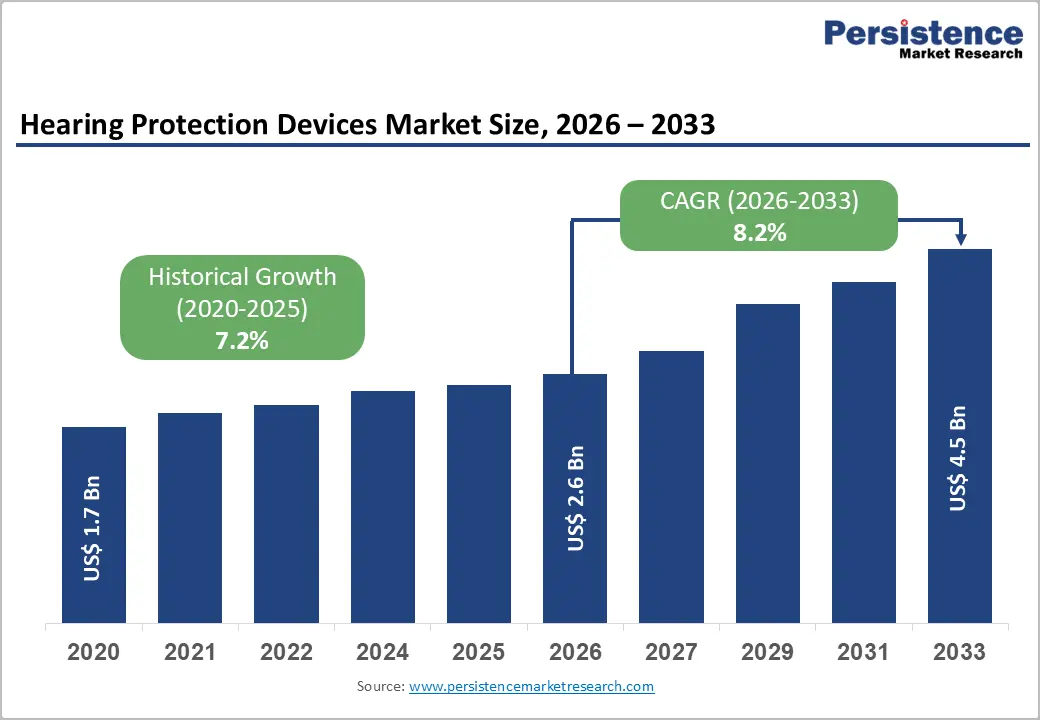
The global hearing protection devices market size is expected to be valued at US$ 2.6 billion in 2026 and projected to reach US$ 4.5 billion by 2033, growing at a CAGR of 8.2% between 2026 and 2033.
Growing awareness of occupational noise-induced hearing loss and a rise in regulatory focus on workplace safety have encouraged the use of hearing protection devices in the population. Industries such as manufacturing, construction, mining, oil & gas, and transportation are major adopters of hearing protection solutions, including earplugs and earmuffs, to safeguard workers from prolonged noise exposure.
Growing cases of hearing impairment, tinnitus, and related auditory disorders further support market demand. According to the World Health Organization, hearing loss is becoming a significant global health concern, increasing the need for preventive solutions. Additionally, stricter workplace safety regulations and employer compliance requirements are driving product adoption. Technological advancements in smart hearing protection devices and rising consumer awareness are further contributing to market expansion globally.
Key Industry Highlights:
- Leading Region – North America leads the market due to OSHA regulations, strong defence spending, and high adoption of premium active hearing protection devices.
- Fastest Growing Region – Asia Pacific grows fastest with rapid industrialization, stricter workplace noise regulations, and rising demand for certified worker hearing protection solutions.
- Dominant Segment – Earplugs dominate the product segment because of affordability, high noise reduction, disposability, and suitability across multiple industrial work environments.
- Fastest Growing Segment – Active hearing protection devices and earmuffs grow fastest due to defence modernization, smart safety integration, and communication-enabled protection demand.
- Key Market Opportunity – Major opportunities exist in connected smart HPDs and Asia Pacific expansion driven by stricter occupational safety compliance and enforcement.

Market Dynamics
Drivers - Rising industrial growth and safety awareness drive global demand for advanced hearing protection devices
Key factors such as rising industrialization and infrastructure development drive the global hearing protection devices market. As noise levels from machinery, equipment, and construction activities increase, so does the risk of noise-induced hearing loss (NIHL) among workers in sectors such as manufacturing, construction, mining, and transportation. Regulatory bodies have implemented strict occupational safety standards mandating the use of hearing protection devices in high-noise environments. This has led to an increased demand for effective solutions such as filtered and custom-made hearing protection devices.
Additionally, growing awareness of occupational safety, the health risks associated with prolonged noise exposure, and the need for ergonomic, comfortable protective equipment is prompting industries to invest in advanced hearing protection solutions. Supporting this trend, in May 2025, the University of Michigan, Apple, and the WHO launched a collaborative study to examine the effects of sound exposure on hearing health, to shape future global public health policies. Such initiatives highlight the increasing global focus on hearing conservation and are expected to further accelerate the adoption of innovative hearing protection devices across industries.
Restraints - Stigma, Design Limitations, And Performance Issues Restrain the Adoption
One of the key restraints hindering the growth of the hearing protection devices market is the persistent stigma associated with hearing impairment and the use of protective devices. Negative perceptions and stereotypes often portray hearing loss as a condition related to aging or disability, discouraging individuals, particularly younger users, from adopting hearing protection.
Many adults deny their hearing problems and avoid seeking a viable diagnosis or treatment, reducing the potential user base for hearing protection devices. Additionally, the bulky or highly visible design of some devices deters users concerned with appearance or social judgment. Social challenges, such as difficulty in regulating voice levels due to impaired hearing, can further contribute to discomfort and reluctance in social settings.
Furthermore, some devices provide inadequate noise attenuation, particularly in environments with high-frequency noise, raising safety concerns in industrial workplaces. This uneven noise suppression can impair communication and situational awareness. Addressing these issues requires improved designs and public awareness campaigns.
Opportunities - Rising Demand for Smart, Comfortable, and Customizable Hearing Protection Devices Creates Ample Opportunities
Consumers prefer comfort, functionality, and smart features, making digital hearing protection devices more popular than traditional analog models. These advanced devices offer benefits such as Bluetooth connectivity, rechargeability, waterproof design, and customizable noise reduction levels, enhancing user experience and satisfaction.
The ability to filter harmful noise while preserving situational awareness makes these devices ideal for industrial workers, athletes, and recreational users. Moreover, rising awareness of hearing health and the link between hearing protection and quality of life is driving adoption. In May 2024, the Defense Health Agency launched a Virtual Education Center to improve service member health literacy, supporting informed choices, including proper selection and use of hearing protector devices in military settings.
Additionally, companies are capitalizing on the growing demand for advanced hearing protection through continuous product innovation and strategic launches. For example, Loop introduced its Engage Kids range in August 2023 to provide comfortable hearing protection for children, while Sonova launched the SilentCloud™ app in February 2023, offering self-paced tinnitus management with therapies, education, and counseling.
Most recently, in January 2025, AXIL unveiled its MX Series earmuffs, featuring passive, electronic, and Bluetooth-enabled models with customizable designs, tailored for outdoor enthusiasts and professionals seeking advanced hearing protection and enhancement. This innovation-driven environment presents significant opportunities for companies to meet diverse consumer needs and strengthen their market presence.
Category-wise Insights
Product Analysis
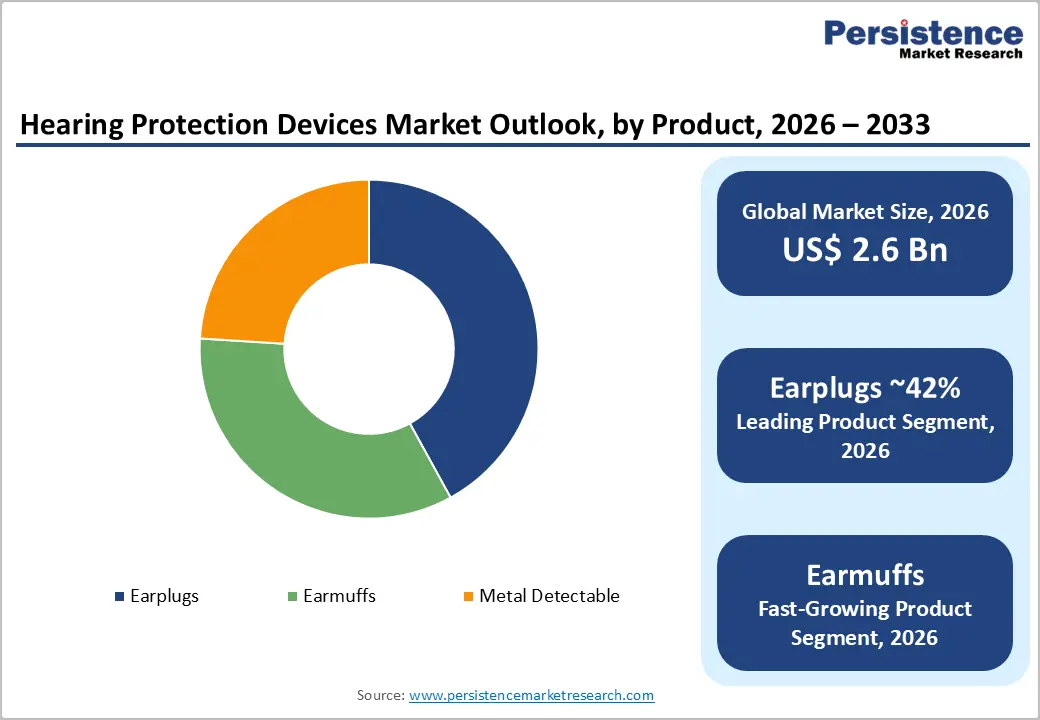
The earplugs segment is set to dominate the global market in 2025 with a revenue share of over 42%. primarily due to their affordability, compact design, and widespread use across industries. Earplugs offer greater comfort for extended wear and are more widely adopted across industries such as construction, manufacturing or music. In comparison, metal-detectable hearing protection remains niche, mainly used in the food and pharmaceutical sectors.
Meanwhile, earmuffs are projected to register the notable CAGR of 9.1%, fuelled by increasing demand for reusable, comfortable, and technologically advanced solutions, including Bluetooth connectivity and noise-cancellation features, especially in high-noise industrial and military settings.
Protection Type Insights
Passive hearing protection devices are poised to capture a considerable share of the global market due to their cost-effectiveness, simplicity, and reliability in consistently reducing hazardous noise levels. These hearing devices work best for those who have lost high-frequency hearing. These devices can attenuate incoming acoustic pressure waves in a pre-described frequency range. They are comparatively cost-effective, require no additional power supply, and are also lightweight and compact.
Unlike active hearing protection, which relies on batteries and electronic components to filter or cancel noise, passive components use physical barriers such as foam or insulating materials, making them more durable and easier to maintain. These benefits lead to the higher adoption of passive devices, thus driving the segment’s dominance.
Regional Insights
North America Hearing Protection Devices Market Trends and Insights
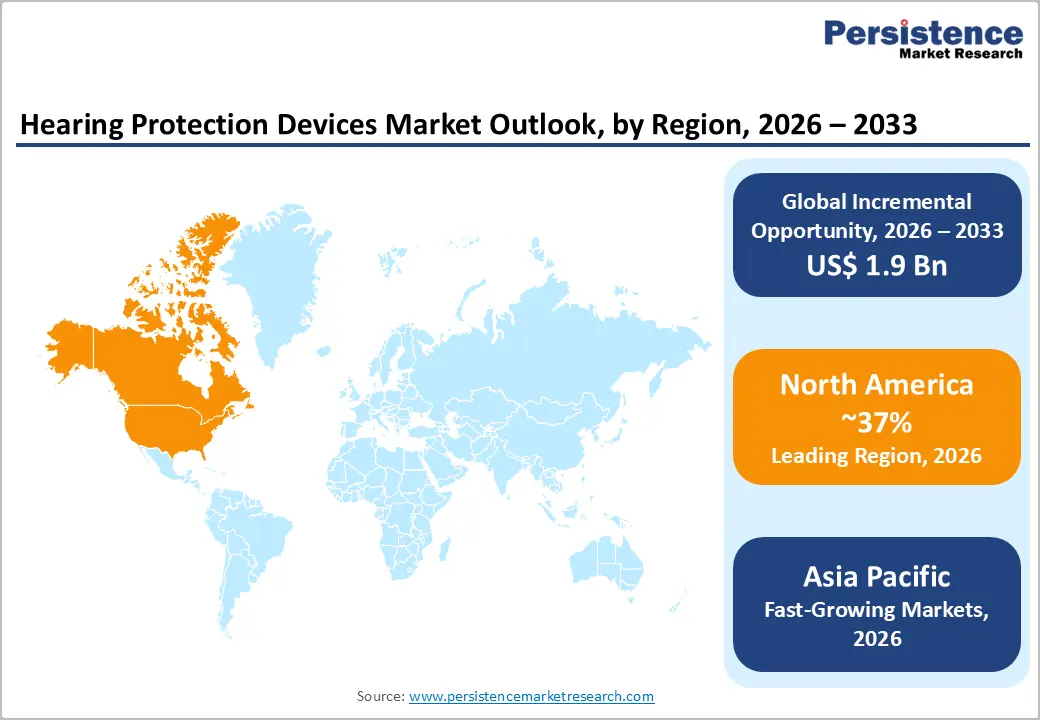
North America leads the global hearing protection devices market, holding nearly 37% of the total revenue share in 2025. The region's dominance is anchored by rigorous OSHA and NIOSH regulatory frameworks, high employer compliance investment, and the presence of leading HPD manufacturers. Growing consumer demand for lifestyle and recreational hearing protection, alongside military procurement of advanced active communication headsets, continues to sustain premium segment growth.
U.S. Hearing Protection Devices Market Size
The U.S. accounts for ~85% of North American HPD revenues, underpinned by OSHA's mandatory hearing conservation programme requirements affecting over 22 million workers in hazardous noise environments. The U.S. Department of Defense is a major procurement driver for tactical and active communication HPDs, while a large recreational shooting and music entertainment sector further expands the consumer HPD addressable market.
Europe Hearing Protection Devices Market Trends and Insights
Europe is the second-largest HPD market, characterised by robust enforcement of EU Directive 2003/10/EC noise exposure limits, mandatory CE certification for all hearing protection products under EU PPE Regulation 2016/425, and a mature industrial safety culture. Demand for smart, ergonomic, and communication-integrated HPDs is growing among European industrial and construction sectors, with sustainability-focused product development emerging as a competitive differentiator.
Germany Hearing Protection Devices Market Size
Germany has a large market for hearing protection devices in Europe, contributing ~23% of European regional revenues. Germany's large automotive, engineering, and chemicals manufacturing base creates extensive institutional HPD demand. The Deutsche Gesetzliche Unfallversicherung (DGUV) Germany's statutory accident insurance body, actively audits workplace noise compliance and mandates certified PPE programmes, driving consistent high-volume procurement from manufacturers including 3M and Hellberg Safety.
U.K. Hearing Protection Devices Market Size
The U.K. accounts for ~16% of European HPD revenues. The Health and Safety Executive (HSE) enforces the Control of Noise at Work Regulations 2005, mandating hearing protection zones and regular audiometric testing across high-noise industries, including construction, manufacturing, and entertainment. Growing awareness of recreational NIHL risk is additionally driving consumer HPD adoption in the U.K. music and live events sector.
France Hearing Protection Devices Market Size
France contributes ~14% of the revenue share. The Institut National de Recherche et de Sécurité (INRS) actively promotes hearing conservation in French workplaces and provides employer guidance on HPD selection and fit testing. France's strong aerospace and automotive manufacturing sectors, combined with active enforcement of EU noise directives through the Direction Régionale des Entreprises (DREETS), sustain consistent institutional HPD demand.
Asia Pacific Hearing Protection Devices Market Trends and Insights
Asia Pacific is the fastest-growing regional HPD market, driven by rapid industrial expansion, tightening occupational safety regulations, and growing occupational health awareness. China is the dominant country market, with the National Health Commission (NHC) enforcing occupational noise standards across its enormous manufacturing workforce, estimated at over 120 million workers in high-noise environments. Investment in smart factory infrastructure and construction expansion across the region is creating structurally durable demand for both passive and active HPD solutions.
India Hearing Protection Devices Market Size
India is a high-growth market, contributing ~12% of Asia Pacific regional revenues in 2025). India's expanding manufacturing sector, accelerated by Make in India and Production Linked Incentive (PLI) schemes, is driving rapid workforce expansion in noise-intensive industries. The Bureau of Indian Standards (BIS) and progressive updates to the Factories Act are compelling large employers to invest in certified HPD programmes across automotive, textiles, and construction sectors.
Japan Hearing Protection Devices Market Size
Japan accounts for ~18% of Asia Pacific HPD revenues, supported by its large, technologically sophisticated manufacturing base and robust occupational health frameworks administered by the Ministry of Health, Labour and Welfare (MHLW). Japan exhibits strong demand for premium-quality, ergonomically engineered HPDs aligned with its high industrial safety culture. The defence and electronics manufacturing sectors are key institutional HPD procurement segments, with Sensear Pty Ltd. and other smart HPD suppliers gaining traction.
Competitive Landscape
The global Hearing Protection Devices market is moderately consolidated, with 3M, Honeywell International Inc., and MSA Safety commanding significant global market share through broad product portfolios, extensive distribution networks, and deep industrial safety relationships. These leaders invest heavily in R&D for smart, connected, and communication-integrated HPDs aligned with Industry 4.0 trends.
Specialist players, including Sensear, AXIL Brands, and Alpine Hearing Protection, compete on technology differentiation, consumer design, and niche segment focus. Key competitive differentiators include regulatory certification breadth, digital integration capabilities, ergonomic design, and sustainable material sourcing. E-commerce and DTC consumer channel expansion are emerging as important growth vectors for specialist brands.
Key Developments:
- In April 2025, Coachella partnered with Loop Earplugs to introduce the limited-edition Loop x Coachella Experience 2 earplugs, offering stylish hearing protection with 17 dB noise reduction for festival-goers.
- In February 2025, Start Hearing and SoundGear, divisions of Starkey, partnered with the Union Sportsmen’s Alliance to offer union members up to 48% off hearing aids and advanced hearing protection, enhancing auditory health for those in high-noise environments.
- In October 2024, 3M launched the WorkTunes Connect + Solar Hearing Protector, integrating Powerfoyle™ solar technology for continuous charging, 26 dB noise reduction, and Bluetooth connectivity, enhancing safety and convenience for users.
- In September 2024, Apple introduced hearing aid functionality in AirPods Pro 2, entering the hearing protection device market with accessible, tech-driven solutions for personalized hearing support.
Global Hearing Protection Devices Market – Key Insights & Details
| Key Insights | Details |
|---|---|
|
Historical Market Value (2020) |
US$ 1.7 Billion |
|
Current Market Value (2026) |
US$ 2.6 Billion |
|
Projected Market Value (2033) |
US$ 4.5 Billion |
|
CAGR (2026–2033) |
8.2% |
|
Leading Region |
North America, 37% market share (2025) |
|
Dominant Product |
Earplugs, ~42% market share (2025) |
|
Top-ranking Protection Type |
Passive Hearing Protection Devices, ~68% |
|
Incremental Opportunity |
US$ 1.9 Billion |
Companies Covered in Hearing Protection Devices Market
- 3M
- MSA
- Honeywell International Inc
- Dynamic Ear Company (Sonova)
- Phonak
- Lucid Hearing Holding Company, LLC
- Starkey
- W.W. Grainger, Inc.
- EAR Customized Hearing Protection
- Alpine Hearing Protection Inc
- Ear Institute
- Hellberg Safety (Hultafors Group)
- Sensear Pty Ltd.
- AXIL Brands Inc.
- Big Ear Inc
- Custom Protect Ear
- Acscustom
- Loop Earplugs
- Walker’s Game Ear
- Crescendo
Frequently Asked Questions
The global hearing protection devices market is estimated to be valued at US$ 2.6 billion in 2026.
Demand for hearing protection devices are growing globally due to rising occupational noise hazards and increasingly stringent safety regulations, heightened awareness of hearing loss prevention, and the rising demand for smart, tech-integrated solutions.
North America leads with approximately 37% of global hearing protection devices market share in 2025.
Key growth opportunities lie in smart active hearing protection devices and rising Asia Pacific demand driven by stricter safety regulations.
3M, MSA, Honeywell International Inc., Dynamic Ear Company (Sonova), Phonak, and Lucid Hearing Holding Company, LLC are a few leading players.


