


- Executive Summary
- Global Glutathione Market Snapshot, 2025 and 2032
- Market Opportunity Assessment, 2025 – 2032, US$ Mn
- Key Market Trends
- Future Market Projections
- Premium Market Insights
- Industry Developments and Key Market Events
- PMR Analysis and Recommendations
- Market Overview
- Market Scope and Definition
- Market Dynamics
- Drivers
- Restraints
- Opportunity
- Key Trends
- Macro-economic Factors
- Global Sectoral Outlook
- Global GDP Growth Outlook
- COVID-19 Impact Analysis
- Forecast Factors – Relevance and Impact
- Value Added Insights
- Tool Adoption Analysis
- Regulatory Landscape
- Value Chain Analysis
- PESTLE Analysis
- Porter’s Five Force Analysis
- Price Analysis, 2024A
- Key Highlights
- Key Factors Impacting Deployment Costs
- Pricing Analysis, By Source
- Global Glutathione Market Outlook
- Key Highlights
- Market Volume (Units) Projections
- Market Size (US$ Mn) and Y-o-Y Growth
- Absolute $ Opportunity
- Market Size (US$ Mn) and Volume (Units) Analysis and Forecast
- Historical Market Size (US$ Mn) Analysis, 2019-2024
- Current Market Size (US$ Mn) Analysis and Forecast, 2025 – 2032
- Global Glutathione Market Outlook: Product Type
- Introduction / Key Findings
- Historical Market Size (US$ Mn) and Volume (Units) Analysis, By Product Type, 2019 – 2024
- Current Market Size (US$ Mn) and Volume (Units) Analysis and Forecast, By Product Type, 2025 – 2032
- Reduced Glutathione
- Oxidized Glutathione
- Liposomal Glutathione
- Market Attractiveness Analysis: Product Type
- Global Glutathione Market Outlook: Source
- Introduction / Key Findings
- Historical Market Size (US$ Mn) Analysis, By Source, 2019 – 2024
- Current Market Size (US$ Mn) Analysis and Forecast, By Source, 2025 – 2032
- Natural Extraction
- Microbial Fermentation
- Synthetic Chemical Routes
- Market Attractiveness Analysis: Source
- Global Glutathione Market Outlook: Application
- Introduction / Key Findings
- Historical Market Size (US$ Mn) Analysis, By Application, 2019 – 2024
- Current Market Size (US$ Mn) Analysis and Forecast, By Application, 2025 – 2032
- Pharmaceutical
- Cosmetics and Personal Care
- Food and Beverages
- Market Attractiveness Analysis: Application
- Key Highlights
- Global Glutathione Market Outlook: Region
- Key Highlights
- Historical Market Size (US$ Mn) and Volume (Units) Analysis, By Region, 2019 – 2024
- Current Market Size (US$ Mn) and Volume (Units) Analysis and Forecast, By Region, 2025 – 2032
- North America
- Europe
- East Asia
- South Asia and Oceania
- Latin America
- Middle East & Africa
- Market Attractiveness Analysis: Region
- North America Glutathione Market Outlook
- Key Highlights
- Historical Market Size (US$ Mn) Analysis, By Market, 2019 – 2024
- By Country
- By Product Type
- By Source
- By Application
- Current Market Size (US$ Mn) Analysis and Forecast, By Country, 2025 – 2032
- U.S.
- Canada
- Current Market Size (US$ Mn) and Volume (Units) Analysis and Forecast, By Product Type, 2025 – 2032
- Reduced Glutathione
- Oxidized Glutathione
- Liposomal Glutathione
- Current Market Size (US$ Mn) Analysis and Forecast, By Source, 2025 – 2032
- Natural Extraction
- Microbial Fermentation
- Synthetic Chemical Routes
- Current Market Size (US$ Mn) Analysis and Forecast, By Application, 2025-2032
- Pharmaceutical
- Cosmetics and Personal Care
- Food and Beverages
- Market Attractiveness Analysis
- Europe Glutathione Market Outlook
- Key Highlights
- Historical Market Size (US$ Mn) Analysis, By Market, 2019 – 2024
- By Country
- By Product Type
- By Source
- Application
- Current Market Size (US$ Mn) Analysis and Forecast, By Country, 2025 – 2032
- Germany
- France
- U.K.
- Italy
- Spain
- Russia
- Türkiye
- Rest of Europe
- Current Market Size (US$ Mn) and Volume (Units) Analysis and Forecast, By Product Type, 2025 – 2032
- Reduced Glutathione
- Oxidized Glutathione
- Liposomal Glutathione
- Current Market Size (US$ Mn) Analysis and Forecast, By Source, 2025 – 2032
- Natural Extraction
- Microbial Fermentation
- Synthetic Chemical Routes
- Current Market Size (US$ Mn) Analysis and Forecast, By Application, 2025-2032
- Pharmaceutical
- Cosmetics and Personal Care
- Food and Beverages
- Market Attractiveness Analysis
- East Asia Glutathione Market Outlook
- Key Highlights
- Historical Market Size (US$ Mn) Analysis, By Market, 2019 – 2024
- By Country
- By Product Type
- By Source
- By Application
- Current Market Size (US$ Mn) Analysis and Forecast, By Country, 2025 – 2032
- China
- Japan
- South Korea
- Current Market Size (US$ Mn) and Volume (Units) Analysis and Forecast, By Product Type, 2025 – 2032
- Reduced Glutathione
- Oxidized Glutathione
- Liposomal Glutathione
- Current Market Size (US$ Mn) Analysis and Forecast, By Source, 2025 – 2032
- Natural Extraction
- Microbial Fermentation
- Synthetic Chemical Routes
- Current Market Size (US$ Mn) Analysis and Forecast, By Application, 2025-2032
- Pharmaceutical
- Cosmetics and Personal Care
- Food and Beverages
- Market Attractiveness Analysis
- South Asia & Oceania Glutathione Market Outlook
- Key Highlights
- Historical Market Size (US$ Mn) Analysis, By Market, 2019 – 2024
- By Country
- By Product Type
- By Source
- By Application
- Current Market Size (US$ Mn) Analysis and Forecast, By Country, 2025 – 2032
- India
- Southeast Asia
- ANZ
- Rest of South Asia & Oceania
- Current Market Size (US$ Mn) and Volume (Units) Analysis and Forecast, By Product Type, 2025 – 2032
- Reduced Glutathione
- Oxidized Glutathione
- Liposomal Glutathione
- Current Market Size (US$ Mn) Analysis and Forecast, By Source, 2025 – 2032
- Natural Extraction
- Microbial Fermentation
- Synthetic Chemical Routes
- Current Market Size (US$ Mn) Analysis and Forecast, By Application, 2025-2032
- Pharmaceutical
- Cosmetics and Personal Care
- Food and Beverages
- Market Attractiveness Analysis
- Latin America Glutathione Market Outlook
- Key Highlights
- Historical Market Size (US$ Mn) Analysis, By Market, 2019 – 2024
- By Country
- By Product Type
- By Source
- By Application
- Current Market Size (US$ Mn) Analysis and Forecast, By Country, 2025 – 2032
- Brazil
- Mexico
- Rest of Latin America
- Current Market Size (US$ Mn) and Volume (Units) Analysis and Forecast, By Product Type, 2025 – 2032
- Reduced Glutathione
- Oxidized Glutathione
- Liposomal Glutathione
- Current Market Size (US$ Mn) Analysis and Forecast, By Source, 2025 – 2032
- Natural Extraction
- Microbial Fermentation
- Synthetic Chemical Routes
- Current Market Size (US$ Mn) Analysis and Forecast, By Application, 2025-2032
- Pharmaceutical
- Cosmetics and Personal Care
- Food and Beverages
- Market Attractiveness Analysis
- Middle East & Africa Glutathione Market Outlook
- Key Highlights
- Historical Market Size (US$ Mn) Analysis, By Market, 2019 – 2024
- By Country
- By Product Type
- By Source
- By Application
- Current Market Size (US$ Mn) Analysis and Forecast, By Country, 2025 – 2032
- GCC Countries
- Egypt
- South Africa
- Northern Africa
- Rest of Middle East & Africa
- Current Market Size (US$ Mn) and Volume (Units) Analysis and Forecast, By Product Type, 2025 – 2032
- Reduced Glutathione
- Oxidized Glutathione
- Liposomal Glutathione
- Current Market Size (US$ Mn) Analysis and Forecast, By Source, 2025 – 2032
- Natural Extraction
- Microbial Fermentation
- Synthetic Chemical Routes
- Current Market Size (US$ Mn) Analysis and Forecast, By Application, 2025-2032
- Pharmaceutical
- Cosmetics and Personal Care
- Food and Beverages
- Market Attractiveness Analysis
- Competition Landscape
- Market Share Analysis, 2024
- Market Structure
- Competition Intensity Mapping By Market
- Competition Dashboard
- Company Profiles (Details – Overview, Financials, Strategy, Recent Developments)
- Kyowa Hakko Bio Co.Ltd
- Overview
- Segments and Deployments
- Key Financials
- Market Developments
- Market Strategy
- Ajinomoto Co.Ltd
- Gnosis S.p.A
- Shandong Jincheng Pharmaceutical Group
- Sigma-Aldrich
- Mitushi Biopharma
- Herbal Creation
- Cayman Chemical
- Chemkart
- Yipin Biotechnology
- BioNutrients Solution
- Kyowa Hakko Bio Co.Ltd
- Appendix
- Research Methodology
- Research Assumptions
- Acronyms and Abbreviations


- Pharmaceuticals
- Glutathione Market
Glutathione Market Size, Trends, Share, and Growth Forecast, 2025 - 2032
Glutathione Market by Product Type (Reduced Glutathione, Oxidized Glutathione, Liposomal Glutathione), Source (Natural Extraction, Microbial Fermentation, Synthetic Chemical Routes), Application (Pharmaceutical, Cosmetics and Personal Care, Food & Beverages), and Regional Analysis for 2025-2032
Glutathione Market Share and Trends Analysis
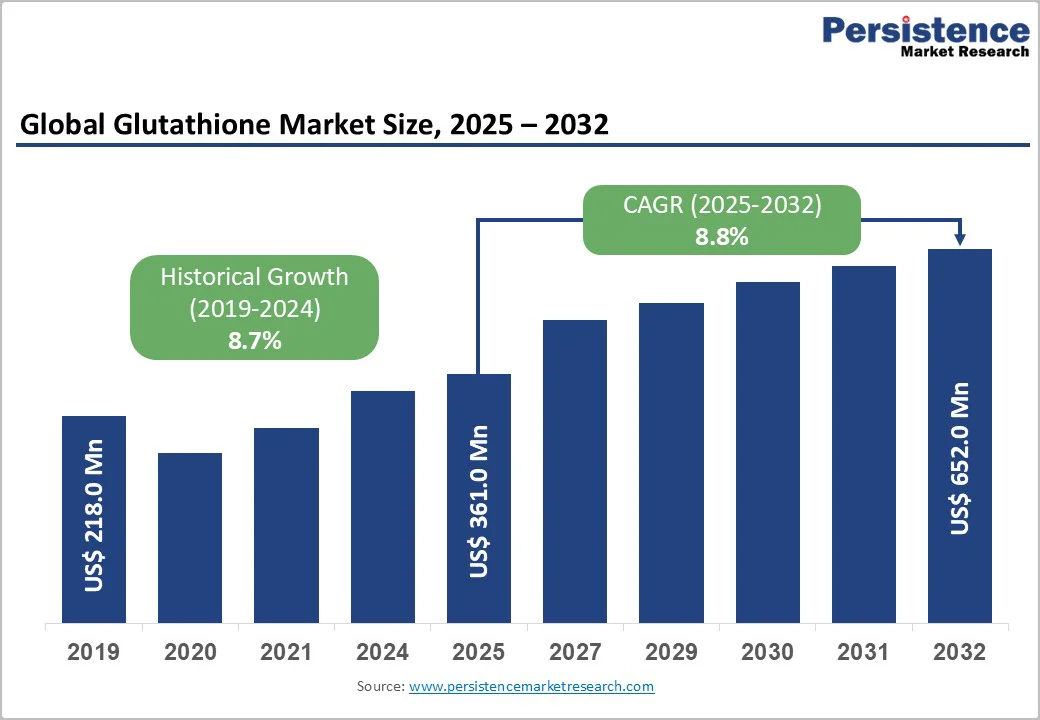
The global glutathione market size is likely to be valued at US$ 361.0 million in 2025, and is estimated to reach US$ 652.0 million by 2032, growing at a CAGR of 8.8% during the forecast period 2025−2032. Robust demand from pharmaceutical and cosmetics has underpinned market expansion, benefiting from heightened health awareness, advanced biotechnology applications, and favorable regulatory endorsements. Innovative processing technologies and diversification in raw material sources amplify growth prospects for leading producers and regional players. Segmental penetration across key end-use verticals and high-growth regions further accentuates overall market momentum, making glutathione one of the most dynamically evolving antioxidant markets globally.
Key Industry Highlights
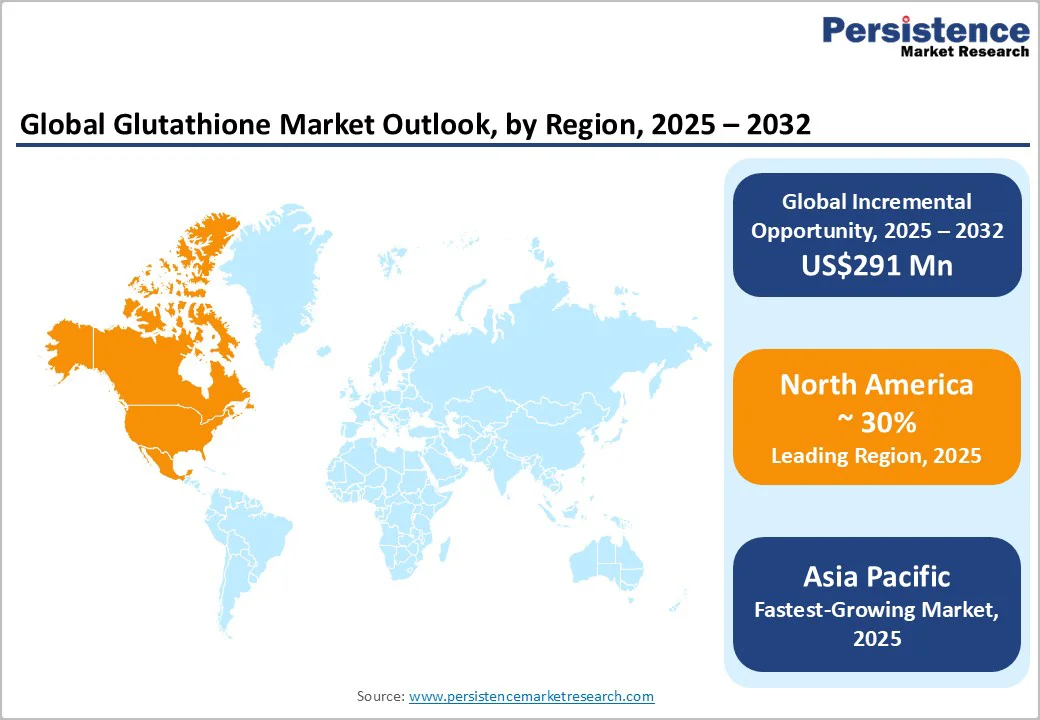
- Dominant Region: North America is set to command approximately 30% of the market share in 2025.
- Fastest-growing Regional Market: Asia Pacific emerges as fastest-growing market for glutathione through 2032, propelled by rising awareness of health, beauty, and wellness in the region.
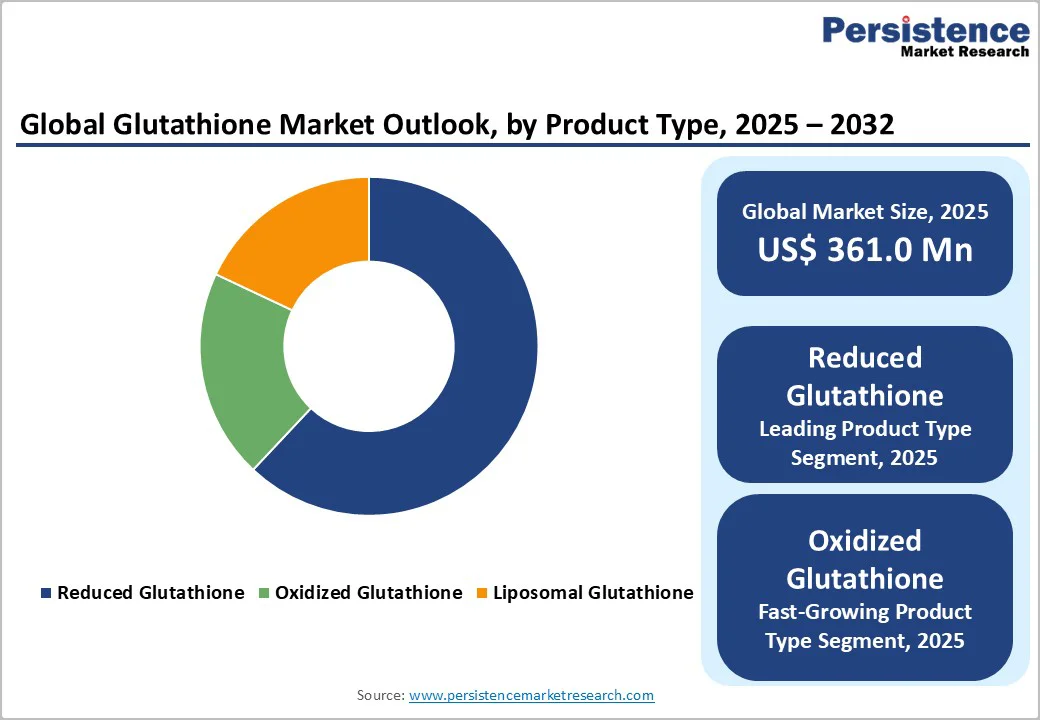
- Leading & Fastest-growing Product Type: Reduced glutathione is the leading product segment with about 62% market share in 2025, owing to several critical advantages tied directly to its biological activity and consumer acceptance.
- Leading Source: Naturally extracted glutathione dominates with around 57% revenue share in 2025, driven by increasing consumer preference for natural and ethically sourced ingredients.
- Prominent Driver: Heightened health awareness and an aging population are major factors behind the increased adoption of glutathione in preventive healthcare.
| Report Attribute | Details |
|---|---|
|
Glutathione Market Size (2025E) |
US$ 361.0 Mn |
|
Market Value Forecast (2032F) |
US$ 652.0 Mn |
|
Projected Growth (CAGR 2025 to 2032) |
8.8% |
|
Historical Market Growth (CAGR 2019 to 2024) |
8.7% |
Market Factors – Growth, Barriers, and Opportunity Analysis
Rising Health Awareness and Aging Population
Growing health awareness and an aging global population are driving increased adoption of glutathione in preventive healthcare applications. As consumers become more educated about oxidative stress, a process where free radicals damage cells, many are turning to antioxidants to protect their health. Glutathione serves a unique function by neutralizing harmful free radicals and supporting cellular and mitochondrial health across various tissues and organs. This growing understanding of cellular protection has positioned glutathione as a preferred supplement among health-conscious individuals seeking to mitigate the effects of environmental stressors.
Health organizations and medical practitioners emphasize the benefits of antioxidants, including glutathione, for general wellness, cellular resilience, and improved tissue repair. The inclusion of glutathione in both clinical treatments and over-the-counter wellness products reflects growing recognition of its role in supporting long-term health and quality of life. This trend is particularly pronounced among older adults who seek proactive approaches to managing age-related health concerns, making glutathione an increasingly important component of preventive healthcare strategies.
High Cost of Basic Materials and Strict Regulations
Reduced or oxidized glutathione serves as a crucial raw material in the synthesis of glutathione-based products. Raw materials and processing account for the majority of the cost structure, with material costs representing the most significant expense followed by processing expenditures. These cost factors significantly influence market pricing dynamics, prompting manufacturers to invest in research and development to identify more cost-effective production alternatives. The economic burden of raw material procurement remains a persistent challenge for market participants seeking competitive positioning.
Regulatory compliance often requires additional documentation, quality assurance protocols, and distinct labeling for different applications. These requirements result in higher compliance costs and sometimes lead to market entry delays or restrictions for smaller manufacturers. While these legal requirements protect end-users, they can meaningfully constrain market expansion. Manufacturers must carefully balance regulatory risk with commercial opportunity, making strategic planning essential for sustainable market participation.
Growing Adoption in the Skincare & Cosmetics Sector
The oxidized glutathione segment accounts for a significant portion of global glutathione demand. Consumer expenditure on skincare and cosmetics, influenced by rising living standards, increasing disposable incomes, and the growing number of working women in the workforce, primarily drives glutathione consumption. Many skincare products, including lotions, moisturizers, and anti-aging creams, incorporate oxidized glutathione as a key ingredient for its beneficial properties. ?
These products help smooth skin texture, increase moisture levels in the stratum corneum, and reduce wrinkle formation. The cosmetics industry has been expanding rapidly and is projected to continue this growth trajectory throughout the forecast period. In the coming years, the glutathione market is expected to benefit from the expanding cosmetic industry due to the substance's extensive use in personal care and cosmetic products, including lotions and sun protection formulations. ?
Category-wise Analysis
Product Type Insights
Reduced glutathione is the leading product segment, holding approximately 62% of the market revenue share in 2025, as a result of several critical advantages tied directly to its biological activity and consumer acceptance. Reduced glutathione operates as the active, functional antioxidant form, making it particularly effective in neutralizing free radicals and supporting essential cellular processes advantages not matched by other variants such as oxidized glutathione.? Broadening adoption of reduced glutathione in nutraceutical and pharmaceutical has allowed brands to command premium pricing and build significant market share, as consumers consistently seek products that deliver tangible health benefits.
Oxidized glutathione is expected to be the fastest-growing segment from 2025 to 2032. The major growth driver for this segment is the increasing focus on metabolic research on the cellular redox balance, where oxidized glutathione plays a pivotal role in assessing oxidative stress and cellular repair mechanisms. Scientists have vested a high value on oxidized glutathione for its ability to regulate redox signaling pathways, making it a critical biomarker and tool in studies of metabolism, cell cycle control, and immune modulation.?
Source Insights
Natural extraction dominates with about 57% of the glutathione market revenue share in 2025, driven by increasing consumer preference for natural and ethically sourced ingredients. Large-scale production in China and India has solidified this segment’s leadership position. Industry standards favor plant-derived variants for use in premium nutraceutical and cosmeceutical products due to traceability and sustainability credentials. The industry’s shift toward plant-derived forms aligns with evolving regulatory and market trends favoring environmental protection, transparency, and consumer safety, reinforcing the segment’s dominance.
Microbial fermentation-based glutathione is the fastest-growing segment through 2032, since this production method delivers a combination of scalability, purity, and sustainability that traditional extraction methods cannot match. Advances in biotechnology have allowed manufacturers to optimize conditions such as nutrient levels, temperature, and pH to greatly increase the yields of glutathione from microorganisms such as yeast and bacteria.
Application Insights
The pharmaceutical segment currently leads with an approximate 42% of the glutathione market share in 2025 due to its unique combination of clinical efficacy, regulatory approvals, and versatility in formulation. Medical science and healthcare providers recognize glutathione's therapeutic benefits for a variety of conditions, especially liver disorders, immune function support, and diseases linked to oxidative stress. Its proven role in detoxifying cells and protecting against tissue damage makes it a preferred ingredient in therapeutic regimens.?
Cosmetics and personal care applications are poised to be the fastest-growing between 2025 and 2032. This is mainly attributable to evolving consumer preferences for visible results in luxury skin care and wellness regimens. The appeal of glutathione in the cosmetics space is centered on its clinically supported abilities to brighten the skin, reduce pigmentation, and help slow the visible signs of aging, such as wrinkles and dullness.
Regional Insights
North America Glutathione Market Trends
North America is expected to capture a substantial share of the global glutathione market, accounting for around 30% of total revenue in 2025. This strong position is underpinned by a highly developed healthcare ecosystem, sophisticated biotechnology capabilities, and established expertise in antioxidant research and supplementation. Strategic capital deployment in nutraceutical and pharmaceutical production facilities continues to scale output and support innovation in dosage forms. In addition, companies across the region are actively advancing novel delivery formats such as liposomal and nano-encapsulated glutathione, which improve bioavailability and consumer convenience, further reinforcing North America’s competitive edge in premium glutathione-based solutions.
The regional demand environment is equally supportive, with consumers in the United States and Canada displaying high awareness of preventive health, oxidative stress, and the role of antioxidants in long-term wellness. This awareness translates into a strong propensity to pay for high-quality, clinically supported supplements and fortified products, which accelerates the premiumization of the glutathione category. A rigorous regulatory framework focused on safety, quality, and evidence-based claims helps build trust in branded formulations and streamlines the path from R&D to commercialization for compliant products. North America’s leadership is further strengthened by a high burden of chronic diseases that heightens interest in detoxification and immune support, as well as by growing incorporation of glutathione into beauty-from-within concepts, functional foods, and advanced skincare regimes across retail and e-commerce channels.
Europe Glutathione Market Trends
Europe is positioned to hold approximately 22% of the global glutathione market in 2025, with Germany, the United Kingdom, and France emerging as the primary regional catalysts for growth. The market is experiencing elevated demand across pharmaceuticals, nutraceuticals, and premium skincare formulations, driven by consumers increasingly seeking evidence-based wellness solutions and effective anti-aging interventions. The region's well-established pharmaceutical sector and the strong international reputation of European beauty and personal care brands reinforce its commanding market position. Additionally, continuous progress in biotechnological innovation and clinical evidence generation strengthens market confidence and expands the therapeutic applications for glutathione across multiple consumer segments.
Europe's strength is rooted in stringent quality assurance protocols, world-class healthcare infrastructure, and mature demand for cosmeceutical and dietary supplement products. The European Union's regulatory harmonization framework streamlines product registration and enables companies to efficiently scale operations across member states, reducing barriers to market entry and fostering healthy competition among both regional players and international corporations. This environment of standardized compliance requirements and cross-border market accessibility allows manufacturers to optimize supply chains, increase brand visibility, and build economies of scale, positioning Europe as a strategically important market within the global glutathione landscape.
Asia Pacific Glutathione Market Trends
Asia Pacific is positioned to emerge as the fastest-growing regional market for glutathione consumption, driven by expanding health consciousness and consumer interest in beauty and wellness across major markets including China, Japan, India, and South Korea. The region possesses significant competitive advantages through established, cost-competitive manufacturing infrastructure and proven expertise in large-scale glutathione production, particularly concentrated in China and India. These production capabilities enable regional and international suppliers to meet surging demand efficiently while maintaining competitive pricing. Growth is further accelerated by rapid expansion within the pharmaceutical, food additive, and cosmetics industries, alongside increasing prevalence of lifestyle-induced diseases and urban air quality concerns that heighten consumer interest in antioxidant protection and cellular health support.
Multi-generational market dynamics are creating substantial long-term demand across the region. Younger consumers, particularly millennials and Gen Z, are driving adoption of anti-aging treatments, immune-supporting supplements, and detoxification products as part of comprehensive wellness strategies, while simultaneously, aging populations are seeking preventive solutions to address chronic disease risk and age-related decline. Rapid urbanization is intensifying this trend, as city dwellers actively seek nutritional interventions to combat oxidative stress, environmental pollution exposure, and immune system challenges. This convergence of demographic shifts, urbanization patterns, and elevated health awareness is establishing Asia Pacific as a structural growth engine for the glutathione market, with sustained momentum expected across the forecast period.
Competitive Landscape
The global glutathione market exhibits a moderately consolidated competitive structure, with leading manufacturers including Kyowa Hakko Bio Co., Ltd., Ajinomoto Co., Inc., and Shandong Jincheng Biological Pharmaceutical Co., Ltd. commanding significant market positions. These established companies have built defensible competitive advantages through proprietary production technologies, vertically integrated manufacturing facilities, and extensive distribution relationships spanning multiple geographies and customer channels. Their ability to maintain consistent quality standards, invest in ongoing research initiatives, and respond rapidly to evolving consumer preferences has enabled them to capture and sustain substantial market share. The consolidation trend reflects the capital intensity and technical complexity required to operate efficient glutathione production operations at scale.
Industry leadership increasingly concentrates among research-intensive firms that combine advanced manufacturing capabilities with innovation in product formulation, bioavailability enhancement, and supply chain optimization. These companies leverage direct-to-consumer platforms, e-commerce capabilities, and relationships with health practitioners to build brand loyalty and capture premium pricing opportunities. Strategic investments in supply chain resilience, including geographic diversification of production sites and long-term raw material contracts, further differentiate market leaders from smaller competitors. As regulatory requirements become more stringent and consumer expectations for product quality and transparency continue to rise, the competitive advantage favoring larger, better-capitalized manufacturers is expected to intensify, potentially resulting in further consolidation within the industry.
Key Industry Developments
- In August 2025, research from Rockefeller University identified mitochondrial glutathione as a critical metabolite enabling breast cancer metastasis, with elevated levels in metastatic cells facilitating survival in new tissues through signaling mechanisms rather than antioxidant activity. The study reveals that the SLC25A39 transporter, which imports glutathione into mitochondria, is essential for cancer spread, and elevated SLC25A39 expression correlates with poorer survival outcomes in breast cancer patients, suggesting potential therapeutic targeting opportunities.
- In June 2025, a meta-analysis of brain imaging studies published in Psychopharmacology reveals that individuals with major depressive disorder exhibit significantly lower glutathione levels in the occipital cortex compared to healthy controls. The findings underscore glutathione's protective function in brain health and indicate that stress-related pathways affecting antioxidant systems may represent new avenues for medication development in treating depression.
- In January 2025, a narrative review in Cureus evaluated the efficacy and safety of oral, topical, and intravenous glutathione for skin lightening. The review found that oral and topical formulations demonstrate significant but variable melanin reduction with minimal side effects, while intravenous glutathione carries serious safety concerns including anaphylaxis and hepatotoxicity.
Companies Covered in Glutathione Market
- Kyowa Hakko Bio Co.Ltd
- Ajinomoto Co., Inc.
- Gnosis S.p.A.
- Shandong Jincheng Pharmaceutical Group
- Sigma-Aldrich
- Mitushi Biopharma
- Herbal Creations
- Cayman Chemical
- Chemkart
- Yipin Biotechnology
- BioNutrients Solutions
Frequently Asked Questions
The global glutathione market is projected to reach US$ 361.0 million in 2025.
Rising consumer consciousness about oxidative stress and aging-related diseases has led to increased adoption of glutathione in preventive healthcare.
The market is poised to witness a CAGR of 8.8% from 2025 to 2032.
Rising integration of glutathione in advanced skincare formulations and cosmeceutical innovations presents numerous business opportunities.
Kyowa Hakko Bio Co. Ltd., Ajinomoto Co. Inc., and Mitushi Biopharma are some of the key players in the market.


