




- Specialty & Fine Chemicals
- Emollients Market
Emollients Market Size, Share and Growth Forecast, 2026 - 2033
Emollients Market by Type (Esters, Fatty Alcohols, Fatty Acids, Ethers, Silicones, Others), Form (Solid, Liquid), Application (Skincare, Hair Care, Deodorants, Oral Care, Others), and Regional Analysis for 2026 - 2033

Emollients Market Size and Trends Analysis
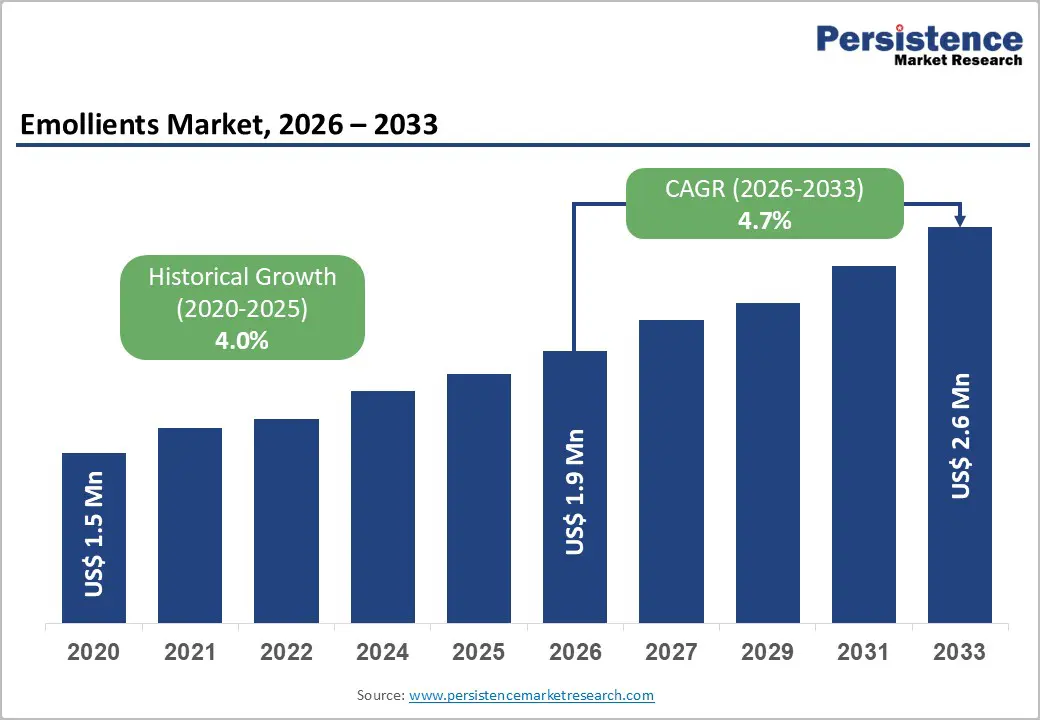
The global emollients market size is likely to be valued at US$1.9 billion in 2026 and is projected to reach US$2.6 billion by 2033, growing at a CAGR of 4.7% during the forecast period from 2026 to 2033, driven by rising demand for personal care ingredients, increasing consumption of skincare products, and growing preference for multifunctional cosmetic formulations.
Demand is further supported by increasing awareness of skin barrier protection, higher spending on premium beauty products, and expansion of dermatology-focused product portfolios. Regulatory emphasis on product safety and the development of bio-based and sustainable emollients are also contributing to long-term market growth across developed and emerging economies.
Key Industry Highlights:
- Dominant Type Segment: Esters are expected to lead with an estimated 34% share in 2026, while fatty acids are projected to be the fastest-growing segment through 2033, driven by increasing demand for sustainable and naturally derived materials.
- Leading Form Segment: Liquid emollients dominated the market with an estimated 72% revenue share in 2026, owing to their ease of formulation, superior blending properties, and extensive use in lotions, creams, serums, and hair care products, while solid formulations are expected to register the fastest growth during 2026 - 2033 due to expanding specialty applications.
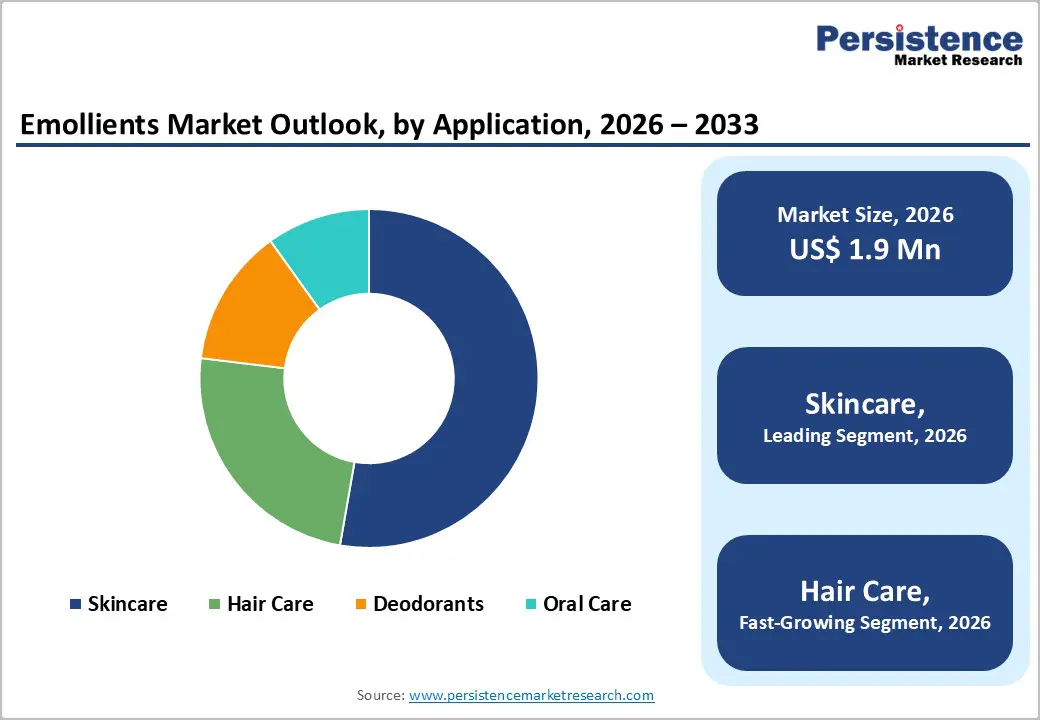
- Dominant Application Segment: Skincare is set to dominate with an estimated 48% share in 2026, while hair care is likely to be the fastest-growing application segment through 2033, supported by rising demand for natural ingredient-based formulations.
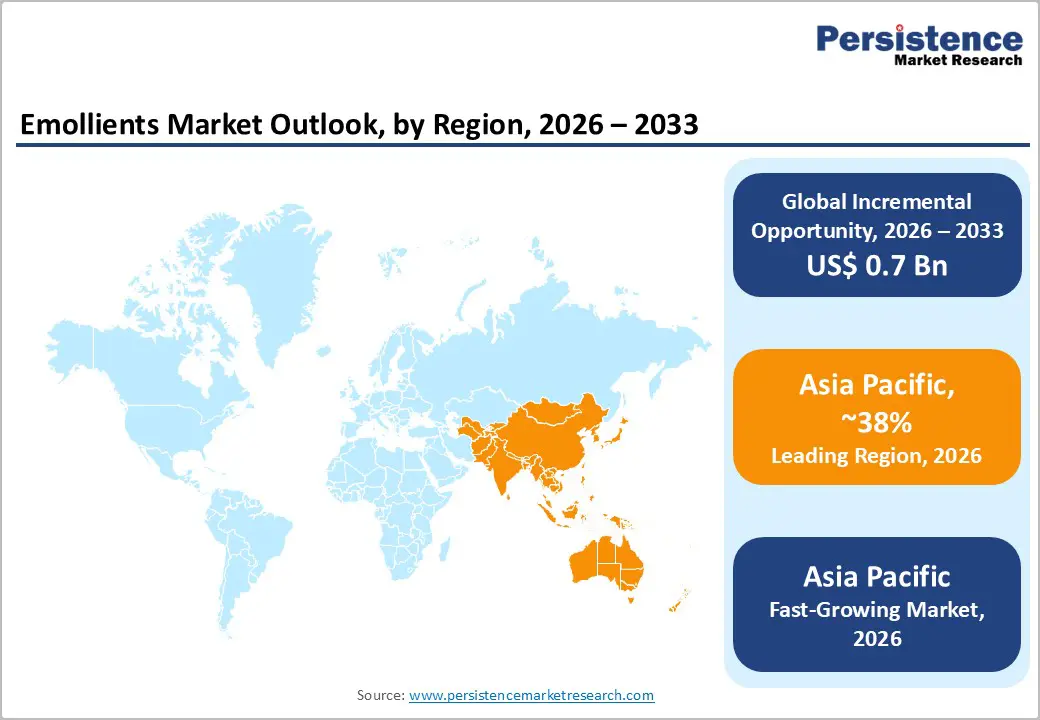
- Regional Leadership: Asia Pacific is poised to lead with an estimated 38% share in 2026 and is expected to record the strongest growth through 2033, supported by abundant agricultural feedstocks, expanding industrialization, and increasing investments in sustainable materials.
- Competitive Environment: Competitive dynamics include strategic acquisitions, capacity expansions, technology investments, and feedstock supply partnerships aimed at strengthening sustainable product portfolios and circular economy capabilities.
DRO Analysis
Driver - Growing Global Demand for Advanced Skincare and Personal Care Products
The primary growth driver for the emollients market is the continuous expansion of the global skincare and personal care products industry. According to the United Nations, the global population aged 65 years and above is projected to increase from approximately 857 million in 2025 to more than 1.2 billion by 2040, creating sustained demand for moisturizing, anti-aging, and skin barrier protection products.
Cosmetics Europe reports that the European cosmetics and personal care industry generated over €104 billion (approximately US$108.4 billion) in retail sales in 2024, while the Personal Care Products Council indicates that the U.S. cosmetics and personal care sector contributes more than US$300 billion annually to the national economy. The World Health Organization estimates that skin diseases affect nearly 1.8 billion people globally at any given time. As emollients are essential ingredients that enhance hydration, texture, and sensory performance in creams, lotions, and dermatological products, rising skincare consumption directly supports long-term market growth.
Restraint - Volatility in Raw Material Supply Chains and Regulatory Compliance Costs
The emollients market faces significant challenges from raw material price volatility and increasing regulatory compliance requirements. According to the World Bank Commodity Markets Outlook, vegetable oil prices experienced fluctuations exceeding 25% between 2022 and 2025 due to weather disruptions, geopolitical tensions, and supply-demand imbalances. Palm oil, coconut oil, fatty alcohols, and specialty esters remain key feedstocks for emollient production, making manufacturers vulnerable to commodity price swings.
Furthermore, the European Chemicals Agency (ECHA) continues to expand registration and safety assessment requirements under REACH, while the European Union Cosmetic Regulation (EC No. 1223/2009) mandates extensive ingredient safety documentation. The European Commission estimates that compliance and testing costs for chemical and cosmetic ingredients can account for a substantial share of product development expenditure, particularly for small and medium-sized enterprises. These factors increase operational costs, lengthen product approval timelines, and pressure profit margins across the value chain.
Opportunity - Expansion of Bio-Based and Sustainable Emollient Technologies
The most promising opportunity in the emollients market is the growing transition toward bio-based, renewable, and sustainable cosmetic ingredients. According to the United Nations Environment Programme (UNEP), the global beauty and personal care industry generates more than 120 billion units of packaging annually, accelerating consumer demand for environmentally responsible products and sustainable ingredient sourcing. A survey conducted by the OECD and multiple consumer research organizations found that more than 60% of beauty consumers globally consider sustainability when purchasing personal care products.
In parallel, major manufacturers, including BASF, Croda, Evonik, and Clariant, have expanded investments in plant-derived esters and naturally sourced emollient technologies. The Roundtable on Sustainable Palm Oil (RSPO) reported certified sustainable palm oil production exceeding 15 million metric tons in recent years, improving access to sustainable feedstocks for cosmetic formulations. As premium natural beauty products gain traction across Asia Pacific and Latin America, suppliers of biodegradable and renewable emollient ingredients are positioned to benefit from one of the fastest-growing segments within the global personal care ingredients market.
Category-wise Analysis
By Type Insights
Esters accounted for an estimated 34% of the global emollients market in 2026, making them the leading type segment due to their excellent spreadability, lightweight feel, and compatibility with premium skincare and cosmetic formulations. Their widespread use in moisturizers, sunscreens, and anti-aging products is supported by the continued expansion of the cosmetics industry, which generated over €104 billion (approximately US$108.4 billion) in retail sales across Europe in 2024, according to Cosmetics Europe. Growing demand for naturally derived ingredients has also encouraged major suppliers such as BASF and Croda to expand bio-based ester portfolios, further strengthening the segment’s market leadership.
Fatty acids are projected to register the fastest growth at an estimated 5.6% CAGR through 2033, driven by rising demand for renewable and plant-based cosmetic ingredients. The segment benefits from increasing adoption of coconut-, palm-, and sunflower-derived feedstocks, supported by the 15+ million metric tons of certified sustainable palm oil produced annually, according to RSPO. As beauty brands accelerate sustainability commitments and consumers increasingly favor natural formulations, fatty acids are gaining prominence as alternatives to synthetic and petrochemical-derived ingredients.
Form Insights
Liquid emollients dominated the market with an estimated 72% revenue share in 2026, owing to their ease of formulation, superior blending properties, and extensive use in lotions, creams, serums, and hair care products. Their leadership is closely linked to the growing demand for lightweight and fast-absorbing skincare products, particularly in Asia Pacific and North America. The continued expansion of premium skincare categories and multifunctional beauty products has further increased reliance on liquid emollient systems across the global personal care industry.
Solid emollients are expected to grow at an estimated 5.3% CAGR through 2033, supported by the increasing popularity of waterless beauty products and sustainable cosmetic formats. According to UNEP, the beauty industry generates more than 120 billion packaging units annually, encouraging brands to develop solid moisturizers, cleansing bars, and balm-based products that reduce packaging waste. Growing consumer interest in eco-friendly and travel-friendly formulations is accelerating adoption of solid emollient technologies across multiple personal care applications.
Application Insights
Skincare remained the largest application segment, accounting for an estimated 48% of global emollient demand in 2026. The segment benefits from strong consumption of moisturizers, anti-aging creams, sunscreens, and dermatological products, all of which rely heavily on emollients for hydration and skin barrier support. According to the World Health Organization, approximately 1.8 billion people worldwide are affected by skin conditions, highlighting the growing importance of skincare solutions. Rising consumer spending on preventive skincare and healthy-aging products continues to reinforce the segment’s dominance.
Hair care is projected to record the fastest growth at an estimated 5.5% CAGR through 2033, fueled by increasing consumer focus on scalp health, hair repair, and moisture retention. The segment has gained momentum through the global influence of K-beauty and J-beauty trends, which emphasize advanced conditioning and treatment products. Growing demand for premium shampoos, conditioners, leave-in treatments, and natural haircare formulations is encouraging manufacturers to incorporate high-performance emollients, creating strong growth opportunities throughout the forecast period.
Regional Analysis
North America Emollients Market Trends
North America is anticipated to account for approximately 26% of the global emollients market in 2026, positioning the region among the most valuable markets for premium cosmetic ingredients. Growth is expected to be supported by sustained demand for advanced skincare formulations, increasing consumer preference for multifunctional beauty products, and rising adoption of dermatologist-recommended solutions. A notable regional trend is the gradual transition toward naturally derived esters and biodegradable emollients as brands continue aligning product portfolios with clean beauty and sustainability objectives.
U.S. Emollients Market Trends
The U.S. is projected to represent nearly 82% of North America market revenue, reflecting its strong concentration of global skincare manufacturers, cosmetic innovators, and specialty ingredient suppliers. Demand is expected to remain particularly robust for anti-aging products, barrier-repair formulations, and science-backed skincare solutions. The increasing commercialization of bio-based cosmetic ingredients and growing investment in sustainable formulation technologies are likely to reinforce the country's leadership position throughout the forecast period.
Canada Emollients Market Trends
Canada is estimated to contribute close to 18% of regional demand in 2026, supported by rising consumer interest in clean-label cosmetics and environmentally responsible personal care products. Market activity is increasingly centered on formulations featuring plant-derived ingredients, vegan claims, and transparent sourcing practices. Continued expansion of sustainable beauty brands and greater emphasis on green chemistry are expected to create favorable conditions for renewable emollient adoption across the Canadian market.
Europe Emollients Market Trends
Europe is expected to capture approximately 27% of the global emollients market share in 2026, supported by a highly developed cosmetics industry and strong regulatory emphasis on ingredient safety and sustainability. The market is increasingly characterized by demand for biodegradable, renewable, and low-carbon cosmetic ingredients. As manufacturers continue reformulating products to meet environmental targets and evolving consumer preferences, adoption of advanced emollient technologies is anticipated to accelerate across multiple personal care categories.
Germany Emollients Market Trends
Germany is projected to account for nearly 24% of the Europe market share, supported by its established position in specialty chemicals and cosmetic ingredient innovation. Industry participants are increasingly focusing on bio-based feedstocks, resource-efficient manufacturing processes, and multifunctional formulation technologies. These developments are expected to strengthen demand for high-performance emollients, particularly within premium skincare and personal care applications requiring enhanced sensory characteristics and sustainability credentials.
France Emollients Market Trends
France is estimated to hold approximately 20% of the regional market value, benefiting from its strong presence in the luxury beauty and premium skincare segments. Market demand is expected to be influenced by continued investments in naturally sourced ingredients and responsible product development strategies. Growing emphasis on formulation performance, ingredient traceability, and environmental responsibility is likely to support increased utilization of specialty emollients across high-value cosmetic applications.
Asia Pacific Emollients Market Trends
Asia Pacific is forecast to account for approximately 38% of the global emollients market in 2026 and is expected to remain the fastest-expanding regional market through 2033. Rising beauty consciousness, increasing disposable incomes, and expanding penetration of premium skincare products are anticipated to support regional growth. Demand is also expected to benefit from the growing popularity of hydration-focused formulations, skin barrier care products, and naturally positioned personal care solutions across both developed and emerging Asian economies.
China Emollients Market Trends
China is projected to represent approximately 42% of the Asia Pacific market revenue, maintaining its position as the region's largest consumer of emollient-based cosmetic products. Market growth is expected to be supported by increasing demand for premium skincare, continued expansion of domestic beauty brands, and growing consumer preference for scientifically formulated products. Rising investments in advanced ingredient manufacturing and sustainable production technologies are likely to further strengthen the demand for specialty emollient solutions.
India Emollients Market Trends
India is anticipated to account for nearly 18% of the regional market share, supported by expanding demand for herbal skincare, botanical beauty products, and premium personal care formulations. Consumer preferences are increasingly shifting toward ingredients perceived as natural, safe, and multifunctional, encouraging broader adoption of plant-derived emollients. Continued expansion of organized beauty retail, growing skincare awareness, and increasing product penetration beyond metropolitan areas are expected to create attractive growth opportunities over the forecast period.
Competitive Landscape
The global emollients market is characterized by a moderately consolidated competitive environment, with leading ingredient manufacturers such as BASF SE, Croda International Plc, Evonik Industries AG, Clariant AG, and Ashland Inc. collectively accounting for a substantial share of global revenue. These companies leverage extensive formulation expertise, global supply networks, and long-standing partnerships with cosmetic and personal care manufacturers while continuously investing in bio-based esters, silicone alternatives, and sustainable ingredient technologies.
Meanwhile, companies such as Nouryon, KLK OLEO, IOI Oleo GmbH, Oleon NV, and Inolex Inc. are strengthening their market presence through renewable feedstocks, specialty oleochemicals, and clean beauty-focused ingredient portfolios. While regulatory compliance, formulation performance requirements, and raw material sourcing create moderate entry barriers, increasing demand for natural, biodegradable, and multifunctional emollients is expected to drive innovation, strategic collaborations, and selective acquisitions across the industry through 2033.
Key Industry Developments:
- In April 2026, Evonik Industries AG introduced ISOLAN® DisperPlus, a natural silicone alternative for cosmetic formulations, supporting growing demand for silicone-free and naturally derived beauty products.
- In May 2025, BASF SE launched its "Beyond Beauty: Thrive into Tomorrow" initiative at NYSCC Suppliers' Day, highlighting sustainable ingredient solutions for skincare, hair care, and sun-care applications.
Companies Covered in Emollients Market
- BASF SE
- Croda International Plc
- Evonik Industries AG
- Clariant AG
- Ashland Inc.
- Lubrizol Corporation
- Nouryon
- KLK OLEO
- IOI Oleo GmbH
- Oleon NV
- Inolex Inc.
- Elementis PLC
- Vantage Specialty Chemicals
- Corbion N.V.
- Stepan Company
Frequently Asked Questions
The global emollients market is projected to reach US$1.9 billion in 2026.
Growing demand for skincare products, premium personal care formulations, and sustainable cosmetic ingredients drives market growth.
The emollients market is expected to grow at a CAGR of 4.7% from 2026 to 2033.
Bio-based emollients, clean beauty trends, and expanding personal care consumption in emerging economies create significant growth opportunities.
BASF SE, Croda International Plc, Evonik Industries AG, Clariant AG, and Ashland Inc. are among the leading market participants.


