




- Home Care & Utilities
- Duvet Market
Duvet Market Size, Share, Trends, Growth, Regional Forecasts 2026 - 2033
Duvet Market By Filling Type (Natural Duvets, Synthetic Duvets), Size (Single / Twin, Double / Full, Queen, King), End User (Residential, Hospitality & Hotels, Healthcare, Institutional, Commercial), Sales Channel (Online Retail, Offline Retail), and Regional Analysis for 2026 - 2033

Duvet Market Trends & Analysis
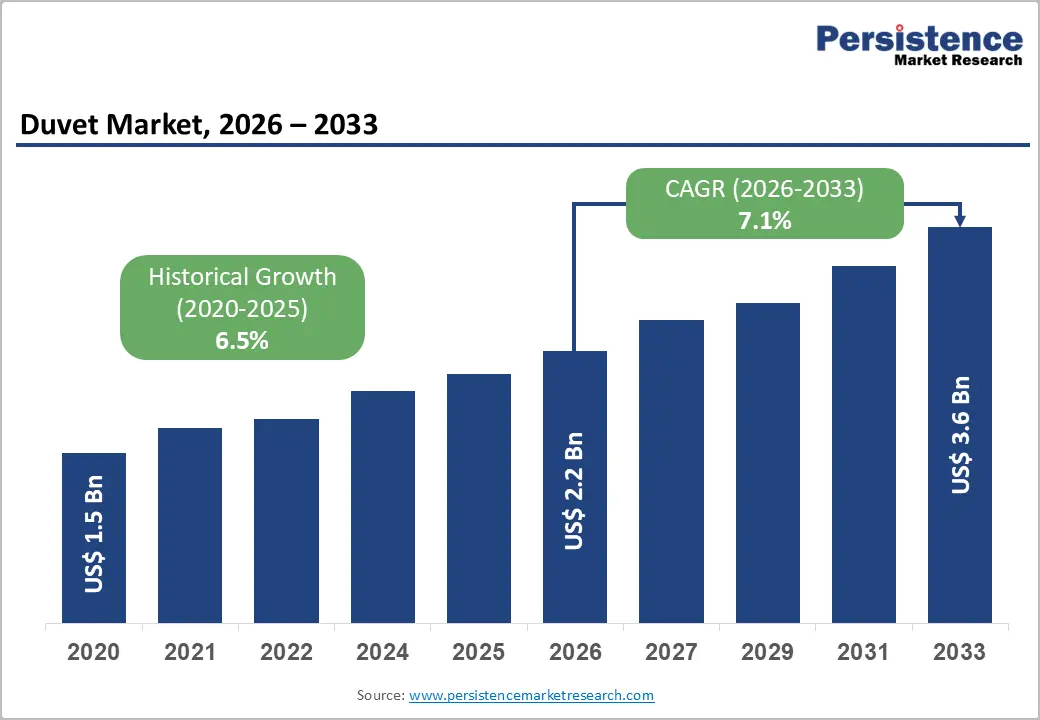
The global duvet market size is projected at US$ 2.2 Bn in 2026 and is projected to reach US$ 3.6 Bn by 2033, growing at a CAGR of about 7.1% between 2026 and 2033.
This growth broadly aligns with global bedding-market expansion of around 6.3% CAGR, as households and hotels worldwide upgrade to premium, wellness-oriented and sustainable bedding products.
The increasing demand for premium bedding and home bedding, projected to be valued at nearly US$ 94.6 billion by 2025, is driving consumers to upgrade from basic comforters to higher-quality, branded products. This growth in online bedding sales, along with the organic bedding segment, which is expected to reach about US$ 0.89 billion by 2026, supports the long-term expansion of the duvet category across various price tiers and regions.
Key Highlights Summary
- Product Mix: Synthetic Duvets lead with roughly 52.7% share in 2026, but Natural Duvets are set to grow at about 7.8% CAGR, capturing value from organic, wellness-driven and luxury bedding trends worldwide.
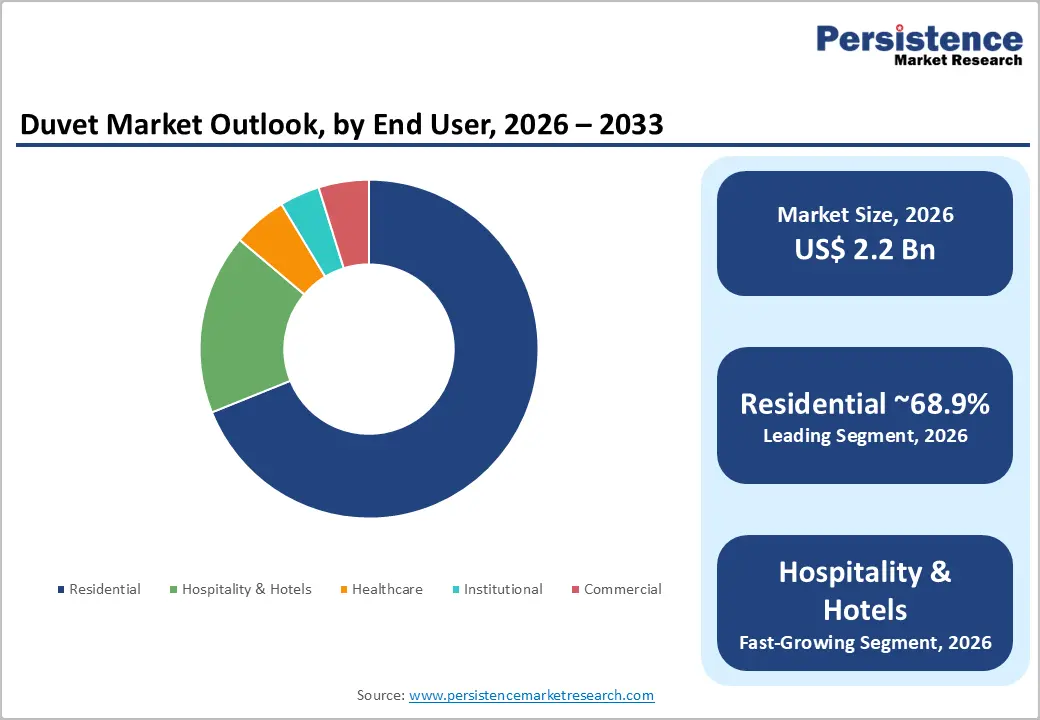
- Usage Patterns: Residential users account for approximately 68.9% of duvet revenues, while Hospitality & Hotels is the fastest-growing end-user segment at about 7.7% CAGR, driven by hotel pipeline expansion and brand-standard upgrades.
- Size & Channel: Queen-size duvets hold around 31.7% share, with King-size growing at roughly 7.9% CAGR; Offline Retail leads at 56.9% share, while Online Retail grows fastest at about 9.2% CAGR on the back of D2C and marketplace expansion.
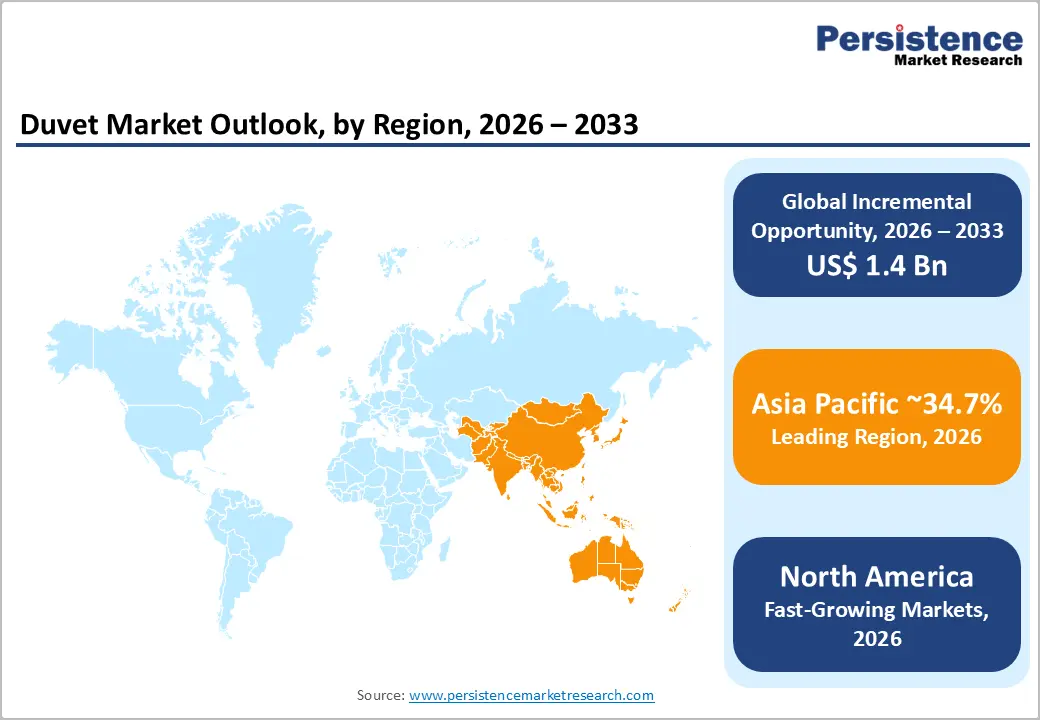
- Regional Leaders: Asia Pacific leads with about 34.7% share, supported by manufacturing strengths and rising middle-class demand; North America grows around 6.6% CAGR, anchored by a US$ 514.9 Mn U.S. market and strong premium and organic bedding uptake.
- Strategic Moves: Collaborations such as Parachute for Target, omnichannel expansion by Brooklinen and Boll & Branch, and rapid growth in OEKO-TEX organic-cotton certifications highlight intensifying focus on distribution reach and verified sustainability.
- Risk-Opportunity Balance: While competition, seasonality and discretionary-spend sensitivity pose risks, sustained growth in premium, certified, and hospitality-grade duvets offers resilient avenues for long-term revenue and margin expansion across regions.
Market Dynamics Analysis
Market Drivers
Rising Sleep-Health Awareness and Premium Bedding Preferences Are Elevating Global Duvet Demand
Consumers worldwide are spending more on better sleep and greater comfort, driving the global home-bedding market from approximately US$ 94.6 Bn in 2025 to over US$ 150 Bn by 2034 at a CAGR of 5.4%. Within this expanding market, duvets consistently represent a meaningful share of bedding expenditure, accounting for an estimated 3-7% by value. Growing awareness of sleep health, temperature regulation, and overall sleep quality is encouraging consumers to upgrade to premium fillings such as down, silk, and advanced synthetics, enabling duvets to outpace broader bedding-market growth.
The shift toward healthier and more sustainable sleep environments is further boosting demand for premium duvets. The global organic-bedding segment is expected to reach around US$ 860 Mn by 2026, growing at a CAGR of 5.8%, as consumers increasingly favor low-toxicity, hypoallergenic materials. This trend is elevating demand for organic cotton covers, OEKO-TEX-certified fillings, and responsibly manufactured products. At the same time, hotels and healthcare facilities are raising comfort and hygiene standards in their purchasing decisions, reinforcing premiumisation and value growth across the duvet market.
Digital-First Shopping and D2C Brands Are Expanding the Global Reach of Duvets
E-commerce is transforming bedding distribution, with online retail emerging as one of the fastest-growing sales channels globally and projected to grow at a CAGR of 7.8%. Consumers are increasingly shifting from store-first to digital-first purchasing journeys, creating new opportunities for duvet brands. The rapid growth of companies such as Brooklinen, Parachute, and Boll & Branch demonstrates strong consumer confidence in purchasing mid- to premium-priced duvets online, supported by detailed product content, customer reviews, and trial programs.
Continued investment and omnichannel expansion are making branded duvet products more accessible to a broader consumer base. Growth funding, including a US$ 50 Mn investment in Brooklinen, has supported retail expansion and international market penetration. Meanwhile, collaborations between established retailers and bedding brands are increasing product visibility and introducing branded duvet collections to mainstream shoppers, significantly expanding the market across regions, demographics, and price segments.
Market Restraints
Seasonality, replacement cycles and discretionary spending sensitivity
Duvet demand is highly seasonal in cold and temperate regions and more replacement-driven than first-time purchase in mature markets, leading to uneven order patterns for manufacturers and retailers. The broader home-decor market, valued around US$ 696 Bn in 2023, has shown sensitivity to macroeconomic slowdowns and discretionary-spend pullbacks, which can delay duvet upgrades or push consumers to lower-priced products. Extended product life and slower replacement cycles, especially in residential segments, dampen unit growth despite premiumisation.
Intense competition and commoditisation risk
Duvets compete within a wider bedding and duvet-covers ecosystem, where scale retailers and private labels capture significant share via aggressive pricing and frequent promotions. Online marketplaces are crowded with unbranded or minimally differentiated products, making it harder for smaller brands to sustain pricing power and margins. At the same time, duvet-cover and layering trends can shift spending away from core inserts, while regulatory and certification costs increase fixed overheads for compliant producers.
Market Opportunities
Rising Preference for Natural and Organic Bedding Is Creating Premium Growth Opportunities for Duvets
Natural-filling duvets, including down, feather, silk, and wool variants, are expected to outperform the broader market, with the Natural Duvets segment projected to grow at around 7.8% CAGR between 2026 and 2033. This trend closely mirrors the expansion of the organic-bedding market, which is forecast to increase from approximately US$ 892 Mn in 2026 to US$ 1.2 Bn by 2034. As consumers increasingly prioritize sustainability, comfort, and wellness, premium duvets are well positioned to capture a meaningful share of this growing value opportunity, particularly across North America and Europe.
Manufacturers emphasizing premium natural materials, traceable sourcing, and wellness-focused features can unlock significant market potential. Products incorporating high-fill-power down, hypoallergenic processing, and luxury fibres such as silk, bamboo, and Tencel blends are increasingly being marketed as sleep and wellness solutions rather than conventional bedding products. In addition, hospitality operators are expanding branded sleep programs and wellness-oriented accommodation concepts, creating a growing institutional demand base for premium and oversized duvet offerings.
Growing Institutional Demand Is Creating New Revenue Streams for Premium Duvet Manufacturers
The Hospitality & Hotels segment is emerging as the fastest-growing institutional buyer category, with duvet demand projected to expand at around 7.7% CAGR between 2026 and 2033. As hotel development pipelines accelerate and existing properties upgrade room inventories more frequently, demand for high-quality bedding continues to rise. Premium and upper-midscale hotels, in particular, are investing in enhanced sleep experiences, making duvets an increasingly important component of brand standards and guest satisfaction strategies.
Hospitality, healthcare, and other institutional sectors are driving demand for certified, hypoallergenic, and easy-care duvet solutions. The increasing focus on infection control, durability, and occupant comfort is encouraging wider adoption of specialized bedding products. With the global duvet market expected to add approximately US$ 1.4 Bn in value between 2026 and 2033, institutional and contract channels are well positioned to capture a larger share of incremental spending, particularly for king-size and custom-dimension duvets designed for commercial applications.
Category-wise Insights
Filling Type Analysis
Synthetic duvets lead the global filling-type market, making up around 52.7% of duvet revenues in 2026, with categories including polyester, microfiber, blended synthetic, and others. Their strong market position is driven by cost-effectiveness, easy maintenance, machine-wash compatibility, and widespread adoption across both residential and institutional applications. Additionally, synthetic fillings offer allergy-friendly alternatives and consistent quality at scale, making them the preferred choice for value and mid-range product categories.
Meanwhile, Natural Duvets are emerging as the fastest-growing filling segment, projected to expand at around 7.8% CAGR between 2026 and 2033. Increasing consumer interest in organic bedding, sustainable materials, and wellness-oriented sleep products is driving demand for down, feather, silk, and wool-filled duvets. Their premium positioning and higher average selling prices are expected to strengthen growth, particularly among affluent and environmentally conscious consumers.
Size Analysis
The Queen segment leads the global duvet market, accounting for approximately 31.7% of revenues in 2026, reflecting its widespread popularity across major bedding markets. Its dominance is supported by strong adoption in primary bedrooms and urban households, where queen-size duvets offer an ideal balance between comfort, coverage, and affordability. As a result, they continue to outperform King, Double/Full, and Single/Twin sizes in value terms across both developed and emerging markets.
King-size duvets are expected to be the fastest-growing size category, expanding at an estimated CAGR of 7.9% between 2026 and 2033. Growth is being fueled by rising demand for premium bedroom upgrades, larger living spaces, and luxury hospitality accommodations, where oversized duvets are increasingly preferred for enhanced comfort, aesthetics, and guest experience.
End User Analysis
The Residential segment remains the largest end-user category, accounting for approximately 68.9% of global duvet revenues in 2026. Growth is supported by rising household spending on bedding, increasing home refurbishment activities, and the continued expansion of e-commerce channels. Consumers are increasingly replacing traditional blankets and comforters with duvets, attracted by their comfort, easy-care covers, and seasonal versatility, making residential demand the primary volume driver of the market.
The Hospitality & Hotels sector is emerging as the fastest-growing end-user segment, projected to expand at around 7.7% CAGR through 2033. Rising hotel construction, property renovations, and stricter brand standards are driving recurring demand for durable, comfortable, and certified duvet products. Demand is particularly strong for queen- and king-size variants that enhance guest comfort and support premium hospitality experiences.
Sales Channel Analysis
Offline Retail remains the dominant distribution channel, accounting for approximately 56.9% of global duvet sales in 2026. Consumers continue to value the ability to physically assess product quality, comfort, and materials before purchase, while immediate product availability further supports store-based sales. Furniture retailers, home-furnishing chains, and department stores remain key touchpoints for showcasing premium bedding collections and complete sleep solutions.
Online retail is the fastest-growing channel, expected to grow at a rate of approximately 9.2% CAGR through 2033. This strong growth is fueled by a wider selection of products, detailed product information, customer reviews, and convenient return policies. Additionally, the ongoing rise of digital-native bedding brands and coordinated online bedding collections is further boosting duvet sales in global markets.
Regional Market Insights
North America
North America is projected to expand at a robust 6.6% CAGR, driven by high household spending on bedding and strong adoption of direct-to-consumer (D2C) brands. Growing consumer preference for organic, hypoallergenic, and premium sleep products across both residential and hospitality sectors continues to support the region’s market growth.
United States Duvet Market
The U.S. duvet market is projected to reach nearly US$514.9 million in 2026, supported by its position as one of the world’s largest bedding and home-textile markets. Rising disposable incomes, growing consumer preference for premium sleep products, and increasing demand for comfort-focused home furnishings are driving duvet sales across residential segments. The expansion of direct-to-consumer bedding brands, omnichannel retail strategies, and heightened awareness of sleep quality are further accelerating the adoption of premium, sustainable, and temperature-regulating duvet products.
Continuous product innovation in filling materials, fabric technologies, and luxury bedding collections continues to strengthen market growth nationwide.
Canada and other North American markets are smaller but significant, benefiting from similar climate-driven duvet usage patterns, strong home-improvement culture, and growing interest in organic textiles; regional suppliers also leverage North America’s robust certification and regulatory frameworks for safety and sustainability.
Europe
Europe accounts for approximately 24.2% of global duvet revenues in 2025, supported by its well-established duvet culture and strong demand across colder-climate countries. The region’s market is further strengthened by a robust home-textile industry and growing consumer preference for organic, sustainable, and eco-labelled bedding products, making Europe a key hub for premium duvet consumption.
Germany Market
The Germany duvet market is projected to reach nearly US$125 million in 2026, supported by a large middle-class consumer base, strong preference for duvets over traditional blankets, and a well-established domestic bedding industry. German consumers increasingly favor premium sleep products featuring high-quality fillings, temperature-regulating fabrics, and sustainable textile materials. The presence of leading bedding manufacturers, growing demand for wellness-oriented home products, and rising consumer focus on sleep comfort continue to drive steady market growth.
Additionally, Germany’s strong retail and e-commerce infrastructure supports widespread availability of both premium and value-oriented duvet offerings.
The U.K., France, and Spain also contribute materially, with harmonized EU and U.K. regulations on product safety, chemicals, and environmental claims encouraging adoption of certified fillings and fabrics. Major national and pan-European retailers continue to influence competitive dynamics through private-label portfolios and curated premium bedding assortments.
Asia Pacific
Asia Pacific leads the global duvet market, accounting for approximately 34.7% of total revenues in 2025. The region’s dominance is fueled by its large and rapidly urbanizing population, rising middle-class purchasing power, and growing demand for premium home-bedding products across key markets such as China, India, Japan, and Southeast Asian nations. Increasing consumer focus on comfort, home aesthetics, and quality sleep continues to strengthen duvet adoption, positioning Asia Pacific as the most influential and fastest-evolving regional market globally.
China Market
The China duvet market is projected to reach nearly US$260 million in 2026, supported by the country’s extensive textile manufacturing capabilities, expanding middle-class population, and rising consumer spending on premium home furnishings. Growing urbanization, increasing awareness of sleep quality, and stronger demand for branded bedding products are encouraging consumers to upgrade to higher-quality duvets featuring advanced fabrics and sustainable fillings. The continued expansion of e-commerce platforms and premium home-textile retail channels is further accelerating market growth, particularly across major metropolitan areas and affluent urban centers.
India contributes approximately US$121 million, supported by a rapidly growing home-textile industry and strong manufacturing and export capabilities. Rising domestic demand for sustainable, certified, and premium bedding products is creating new growth opportunities, while ASEAN economies are contributing additional momentum through competitive manufacturing advantages, expanding hospitality infrastructure, and increasing residential bedding upgrades driven by higher living standards and tourism-related investments.
Competitive Landscape
The global duvet market is moderately fragmented, with a long tail of regional manufacturers and retailers alongside a concentrated group of premium and D2C bedding brands that drive innovation in design, materials and sustainability. Key differentiators include fabric and filling quality, eco-certifications, design aesthetics and omnichannel capabilities, while emerging models focus on subscription-style bedding refreshes and curated sleep bundles that include duvets, covers and pillows.
Strategic themes centre on innovation in sustainable fibres and blends, cost leadership via integrated home-textile manufacturing in Asia and market expansion through store roll-outs, wholesale partnerships and collaborations with major retailers, supported by strong digital engagement and experiential retail.
Strategic Developments
- In Nov 2025, Boll & Branch announced an aggressive plan to more than double its store fleet while deepening partnerships with Bloomingdale’s and Nordstrom, enhancing premium duvet visibility through experiential, organic-focused retail environments.
- By December 2025, OEKO-TEX ORGANIC COTTON certifications grew 381% year-on-year, signalling a rapid shift toward verified organic fibres in home textiles and duvets, and raising the bar for credible sustainability claims.
Companies Covered in Duvet Market
- IKEA
- H&M Home
- Target Corporation
- Williams-Sonoma / West Elm
- Parachute Home
- Brooklinen
- Boll & Branch
- Welspun India
- Trident Group
- Tempur Sealy International
- Coyuchi
- Other regional and private-label duvet producers
Frequently Asked Questions
The global Duvet Market is anticipated at around US$ 2.2 Bn in 2026 and is projected to reach roughly US$ 3.6 Bn by 2033, reflecting sustained premiumisation and channel expansion.
The market is driven by rising home-bedding expenditure, growing sleep-health and wellness awareness, strong e-commerce and D2C bedding growth, and accelerating demand for sustainable, certified materials in both residential and institutional segments.
Between 2026 and 2033, the Duvet Market is expected to grow at an implied CAGR of about 7.1%, underpinned by premium natural fillings, hospitality upgrades and expanding online retail penetration.
Key opportunities lie in premium natural-filling and organic duvets, fast-growing hospitality and healthcare procurement, certified sustainable products, and digitally enabled omnichannel models that capture higher-value demand across regions.
Key players include IKEA, H&M Home, Target, Williams-Sonoma/West Elm, Parachute Home, Brooklinen, Boll & Branch, Welspun India, Trident, Tempur Sealy and Coyuchi, together shaping global duvet supply, design, sustainability standards and distribution strategies.


