




- Healthcare Services
- Condoms Market
Condoms Market Size, Share, and Growth Forecast, 2026 - 2033
Condoms Market by Product Type (Male Condoms, Female Condoms), Material Type (Latex Condoms, Non-Latex Condoms), Flavor (Non-Flavored, Flavored), Distribution Channel (Drug Stores, Online, Supermarkets/Hypermarkets, Others), and Regional Analysis for 2026 - 2033

Condoms Market Share and Trends Analysis
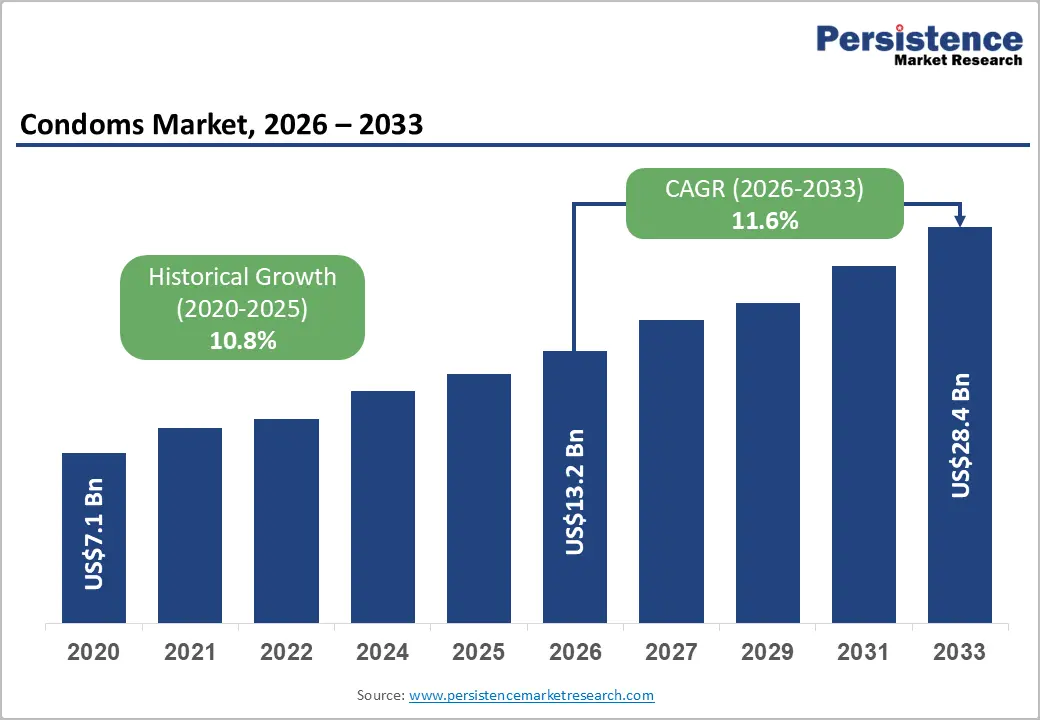
The global condoms market size is likely to be valued at US$13.2 billion in 2026 and is estimated to reach US$28.4 billion by 2033, growing at a CAGR of 11.6% during the forecast period from 2026 to 2033, driven by rising awareness regarding sexually transmitted infection prevention, broader public health distribution programs, and increasing adoption of premium contraceptive products.
Growing urban populations and delayed parenthood trends are strengthening demand across both developed and developing economies. Government-backed HIV prevention campaigns and reproductive health policies are expanding institutional procurement volumes.
Key Industry Highlights:
- Leading Product Type: Male condoms are set to hold around 88% revenue share in 2026, driven by universal consumer familiarity and dominant institutional procurement volumes.
- Fastest-growing Product Type: Female condoms are projected as the fastest-growing segment, supported by UNFPA procurement expansion and rising female autonomy in contraceptive decision-making.
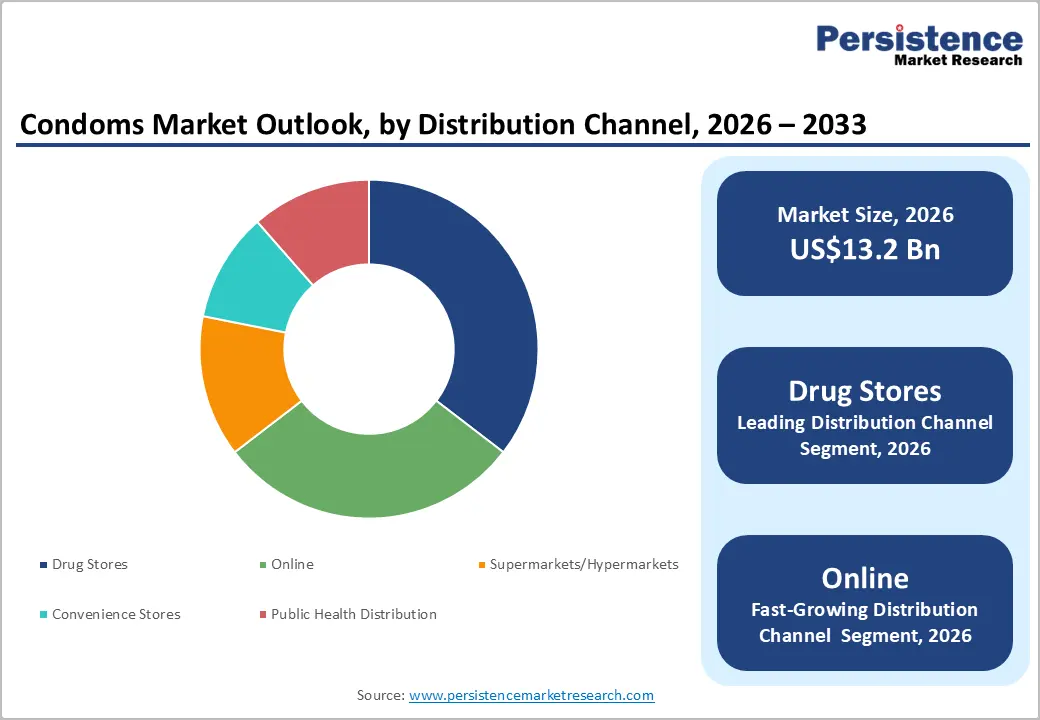
- Leading Distribution Channel: Drug stores are estimated to hold roughly 34% revenue share in 2026, driven by trusted healthcare retail positioning and wide geographic coverage.
- Fastest-growing Distribution Channel: The online channel is forecast to record the fastest growth, driven by discreet purchasing preference and mobile commerce expansion across Asia Pacific.
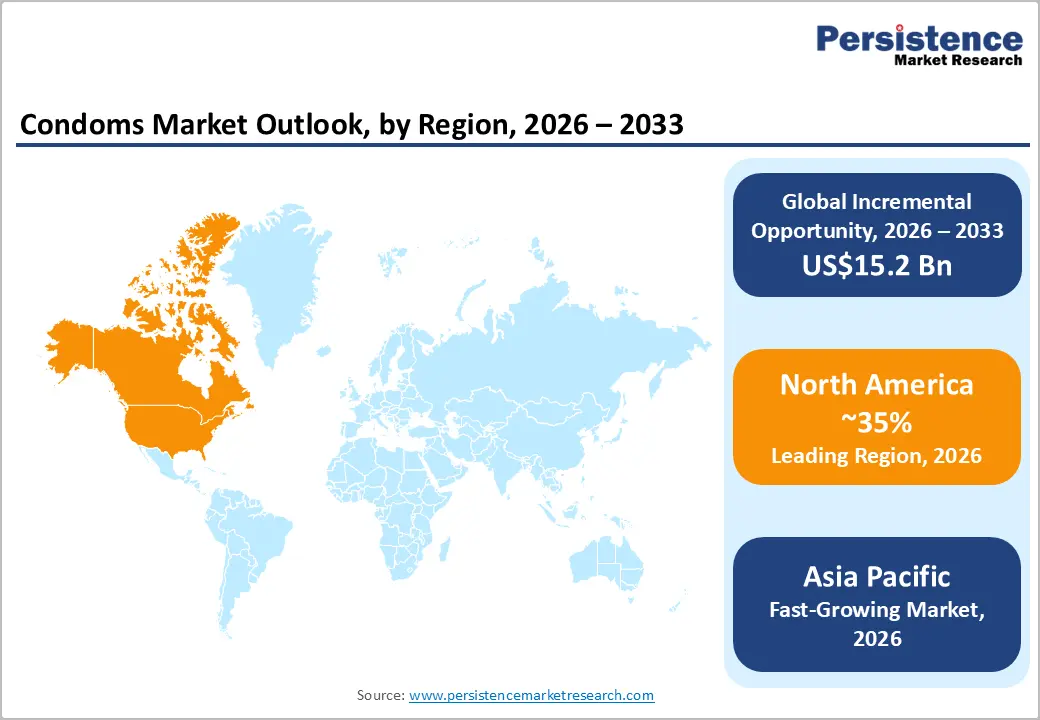
- Regional Leadership: North America is projected to capture roughly 35% of the market share by 2026, driven by high consumer awareness and advanced digital retail infrastructure.
- Competitive Environment: The market is moderately consolidated, with Reckitt Benckiser, Karex Industries, Church and Dwight, Ansell Limited, and Okamoto Industries leading through scale and innovation.
- Innovation Trends: Ultra-thin technology, non-latex biomaterial development, and sustainable latex sourcing are the primary competitive differentiation axes through 2033.

DRO Analysis
Driver - Public Health Initiatives and Disease Prevention Programs
Government bodies globally prioritize the prevention of sexually transmitted infections (STIs) and unintended pregnancies through large-scale distribution initiatives. The United States Centers for Disease Control and Prevention reported that federal funding for domestic HIV prevention reached over 1 billion dollars in 2025, expanding access to barrier methods across public clinics. This systematic deployment of resources guarantees consistent institutional procurement, stabilizing market volume requirements and expanding manufacturing capacity. National healthcare infrastructure reliance on protective measures ensures sustained consumption across diverse socioeconomic demographics.
Institutional purchasing agreements establish long-term baseline demand for manufacturing facilities, driving down unit production costs through economies of scale. Educational campaigns integrated into public school systems and community wellness networks normalize regular procurement, reducing social stigma and expanding the active consumer base. The establishment of state-subsidized distribution logistics ensures reliable product placement in high-vulnerability sectors, accelerating market infiltration and establishing consistent usage behaviors across emerging economies.
Restraint - Volatility in Raw Material and Petroleum-Linked Input Costs
Condom manufacturing depends heavily on natural latex, lubricants, specialty chemicals, and petroleum-derived packaging materials. Volatile crude oil prices and disruptions in rubber supply chains are increasing procurement uncertainty for manufacturers. Rising transportation costs are also affecting global shipment economics, particularly for export-oriented suppliers operating under fixed institutional contracts.
Price-sensitive markets limit the ability to transfer increased production costs directly to consumers. Margin pressure is becoming more evident among mid-sized manufacturers with limited pricing power and lower procurement scale. Supply instability may reduce inventory availability across public health distribution channels, slowing procurement cycles and restricting production scalability in cost-sensitive regions.
Opportunity - Expansion of Female-Centric and Non-Latex Product Categories
Rising consumer preference for inclusive reproductive healthcare products is creating opportunities for female condoms and allergy-free alternatives. Manufacturers are developing polyurethane and polyisoprene variants to address latex sensitivity concerns while improving comfort and usability. Product differentiation through ergonomic design and enhanced lubrication technology is improving consumer acceptance among women and health-conscious buyers.
Healthcare organizations are supporting broader contraceptive accessibility for women through awareness campaigns and institutional distribution programs. Innovation partnerships between healthcare agencies and manufacturers are accelerating the commercialization of advanced materials with improved durability. Expansion of female-focused sexual wellness campaigns is expected to strengthen category visibility, enabling manufacturers to diversify revenue streams beyond conventional male-oriented product portfolios.
Category-wise Analysis
Product Type Insights
Male condoms are expected to lead the condom market, accounting for approximately 88% of revenue in 2026. Brands such as Durex and Trojan anchor demand through established pharmacy and institutional distribution networks. Long-standing consumer familiarity and clinical endorsement sustain repeat purchasing. Mass-market price accessibility reinforces volume dominance across income segments.
Female condoms are likely to represent the fastest-growing segment, propelled by United Nations Population Fund (UNFPA) and WHO procurement expansions across developing nations. The FC2 Female Condom, distributed in over 100 countries, is driving category awareness. Rising female autonomy in contraceptive decisions is compounding adoption rates. Sub-Saharan Africa and Southeast Asia are recording the sharpest demand increases.
Material Type Insights
Latex condoms are projected to lead the market, capturing around 73% of the revenue share in 2026. Karex Industries, the world's largest condom producer, operates high-scale latex manufacturing lines. Cost-efficient production and validated clinical efficacy sustain consumer and prescriber confidence. Institutional procurement frameworks are built around latex-compatible product specifications.
Non-latex condoms are likely to be the fastest-growing segment, fueled by rising latex allergy diagnoses and growing willingness to pay premiums for alternatives. SKYN by Lifestyles, available in over 50 markets, demonstrates the commercial viability of polyisoprene formulations. Dermatologist endorsements and e-commerce visibility are accelerating trial rates.
Flavor Insights
Non-flavored condoms are likely to be the leading segment with a projected 71% of the condom market share in 2026, due to their compatibility with the WHO prequalification standards governing institutional procurement. Government distribution programs do not require flavoring in product specifications. The majority of consumers in developed markets prioritize protection performance over sensory features. Clinical utility across all activity types reinforces category dominance.
Flavored condoms are anticipated to be the fastest-growing segment, fueled by rising acceptance among younger consumers who associate them with enhanced intimacy experiences. Durex Flavours and One Condoms have introduced natural-extract formulations appealing to health-conscious buyers. Digital marketing on platforms such as Instagram is accelerating brand trial among Gen Z and millennial cohorts. Urban lifestyle pharmacy and subscription formats are expanding product visibility.
Distribution Channel Insights
Drug stores are projected to lead the market, capturing around 34% of the revenue share in 2026. Consumer Value Stores (CVS) Health in the U.S. and Boots in the UK maintain dedicated sexual health product sections. The healthcare-adjacent retail environment reduces purchase inhibition for first-time buyers. Consistent pharmacist guidance supports informed and recurring product selection.
The online channel is likely to be the fastest-growing segment, fueled by consumer preference for discreet purchasing and expanding mobile commerce penetration. Amazon, Flipkart, and brand-owned websites are reporting accelerating sexual health category growth. Subscription bundling and competitive pricing are improving customer retention. Asia Pacific mobile commerce adoption is the primary volumetric growth engine for this channel.
Regional Insights
North America Condoms Market Trends
North America is anticipated to be the leading region, accounting for a market share of 35% in 2026. Due to high consumer awareness, favorable reimbursement frameworks for reproductive wellness, and advanced digital retail infrastructure. Premium product line introductions by dominant industry participants captivate affluent consumer groups, supporting high average selling prices across commercial channels.
U.S. Condoms Market Insights
The U.S. market is projected to capture approximately 88.5% of the North America revenue share in 2026, driven by rising investments in automated production infrastructure and the rapid proliferation of direct-to-consumer subscription platforms. Strategic alliances between domestic wellness brands and major retail pharmacies enhance product visibility and optimize shelf placement strategies.
Canada Condoms Market Insights
Canada is forecast to capture approximately 11% of the North America condom market share in 2026, supported by government-backed reproductive healthcare initiatives and rising awareness regarding safe sexual practices. Institutional distribution through universities and healthcare centers is increasing product penetration among younger demographics.
Europe Condoms Market Trends
Europe exhibits robust market maturity, projected to command a 28% global revenue share in 2026, characterized by intensive public health integration, comprehensive sex education mandates, and strong consumer preference for non-latex alternatives. Stringent European Union medical device regulations compel manufacturers to maintain meticulous documentation and strict manufacturing standards, elevating market entry barriers for low-cost foreign producers.
Germany Condoms Market Insights
The Germany market is expected to lead the European theater with a 24.5% regional share in 2026, as local manufacturing facilities implement advanced polyurethane extrusion technologies to meet rising non-latex demand. Strategic brand repositioning focusing on premium sexual wellness attributes rather than basic protection drives higher discretionary spending within digital retail channels.
U.K. Condoms Market Insights
The U.K. market is likely to represent a 19% share of Europe revenue in 2026 as National Health Service free-distribution initiatives expand collaboration with private commercial brands to reach vulnerable demographics. Retail channel restructuring, featuring prominent placement in high-end beauty and wellness boutiques, shifts consumer perceptions toward lifestyle-oriented purchasing.
Asia Pacific Condoms Market Trends
Asia Pacific is forecast to be the fastest-growing market for condoms. Due to rapid urbanization, expanding youth populations, and aggressive state-sponsored awareness campaigns regarding sexual health. Governments are strengthening HIV prevention and family planning investments to improve contraceptive accessibility. Karex Berhad and Mankind Pharma are increasing production capacity to support rising institutional and commercial demand.
China Condoms Market Insights
The China market is projected to claim a dominant 35% share of the Asia Pacific volume in 2026, due to the immense scale of local manufacturing infrastructure and the integration of smart automated quality testing systems. The dynamic expansion of domestic brands into premium tiers challenges established international players, intensifying competition within online marketplace ecosystems.
India Condoms Market Insights
The India market is forecast to record a 28% share of regional revenue in 2026, supported by intense public health outreach programs and a structural shift toward modern retail channels in tier-2 cities. Innovative marketing approaches, utilizing digital media platforms to destigmatize reproductive wellness products, can expand the active consumer base significantly.
Competitive Landscape
The global condom market is moderately fragmented, featuring a dynamic blend of established multinational consumer health corporations and specialized regional manufacturers driving product differentiation. Key industry participants shaping the global operational environment include Reckitt Benckiser Group plc, Church & Dwight Co., Inc., Okamoto Industries, Inc., Lifestyles Healthcare Pte. Ltd., and Karex Berhad.
Corporate entities focus on continuous material innovation, strategic branding adjustments, and distribution network expansion to secure defensible market positions across diverse geographic sectors. The scaling of automated manufacturing systems and strict adherence to international regulatory standards allow dominant enterprises to sustain high barriers to entry, limiting low-cost competitor infiltration.
Key Industry Developments:
- In May 2026, Mankind Pharma indicated potential price increases for Manforce condoms following rising petroleum-linked raw material and packaging costs caused by Middle East oil supply disruptions, reinforcing inflationary pressure across contraceptive manufacturing operations.
- In April 2026, Karex announced plans to increase condom prices by 20%-30% following supply chain disruptions and freight cost inflation linked to the Iran conflict, reinforcing pricing pressure across global contraceptive supply networks.
Companies Covered in Condoms Market
- Reckitt Benckiser Group plc
- Church & Dwight Co., Inc.
- Okamoto Industries, Inc.
- Lifestyles Healthcare Pte. Ltd.
- Karex Berhad
- Veru Inc.
- Mayer Laboratories, Inc.
- Sir Richard's Condom Company
- Cupid Limited
- Sagami Rubber Industries Co., Ltd.
- Shandong Mingyuan Latex Co., Ltd.
- Guangdong Nanbo Latex Products Co., Ltd.
- The Female Health Company
Frequently Asked Questions
The condoms market is projected to reach US$13.2 billion in 2026.
Rising awareness regarding sexually transmitted infection prevention and increasing government-supported reproductive healthcare programs drive growth in the condom market.
The condoms market is poised to witness a CAGR of 11.6% from 2026 to 2033.
Expansion of non-latex products, female-focused contraceptive solutions, and digital retail distribution platforms creates significant growth opportunities in the condom market.
Some of the key market players include Reckitt Benckiser Group plc, Church & Dwight Co., Inc., Okamoto Industries, Inc., Lifestyles Healthcare Pte. Ltd., and Karex Berhad.


