




- Processed Food
- Chocolate Spread Market
Chocolate Spread Market Size, Share and Growth Forecast, 2026 - 2033
Chocolate Spread Market by Product Type (Hazelnut Chocolate Spread, Peanut Chocolate Spread, Milk Chocolate Spread, Others), Packaging Type (Glass Jars, Squeeze Bottles, Others), Distribution Channel (Supermarkets, Others), and Regional Analysis 2026 - 2033

Chocolate Spread Market Share and Trends Analysis
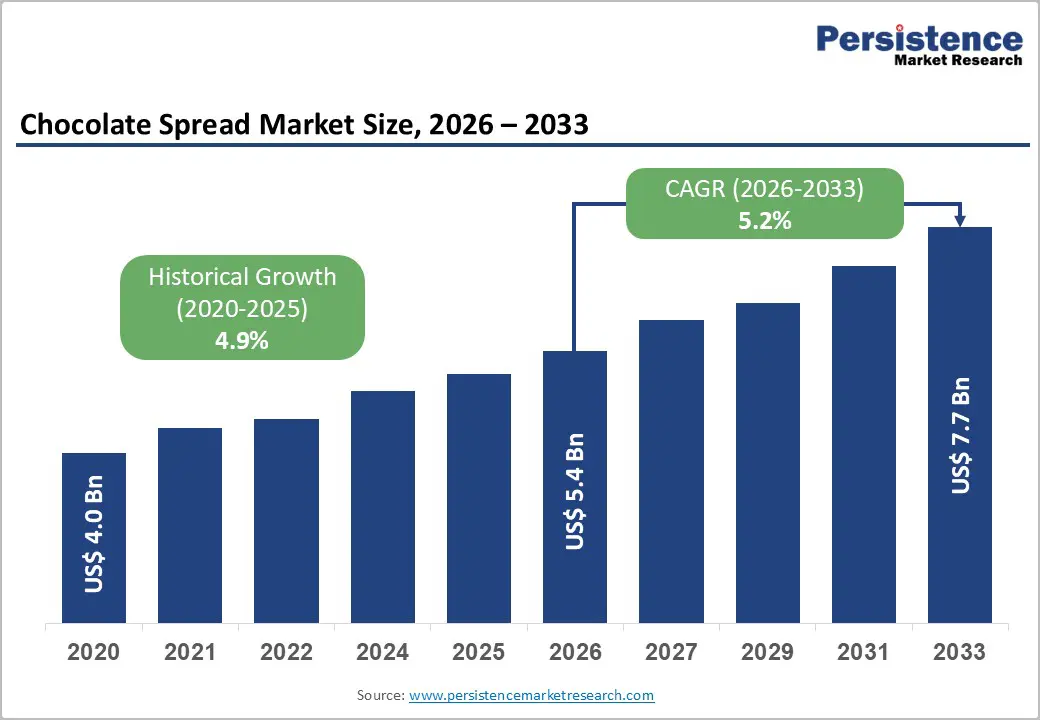
The global chocolate spread market is likely to be valued at US$5.4 billion in 2026 and is anticipated to reach US$7.7 billion by 2033, growing at a CAGR of 5.2% during the forecast period from 2026 to 2033, driven by the expansion of middle-class populations, which is boosting product adoption across a wide range of retail channels.
Ongoing formulation innovations are enabling more sustainable ingredient sourcing, while companies are increasingly focusing on nutritional fortification to strengthen consumer engagement. Rising snacking habits among urban consumers are further supporting demand, alongside manufacturers’ efforts to deliver premium taste experiences. Additionally, the growing penetration of e-commerce platforms and the introduction of health-oriented variants are contributing to the market’s positive outlook.
Key Industry Highlights:
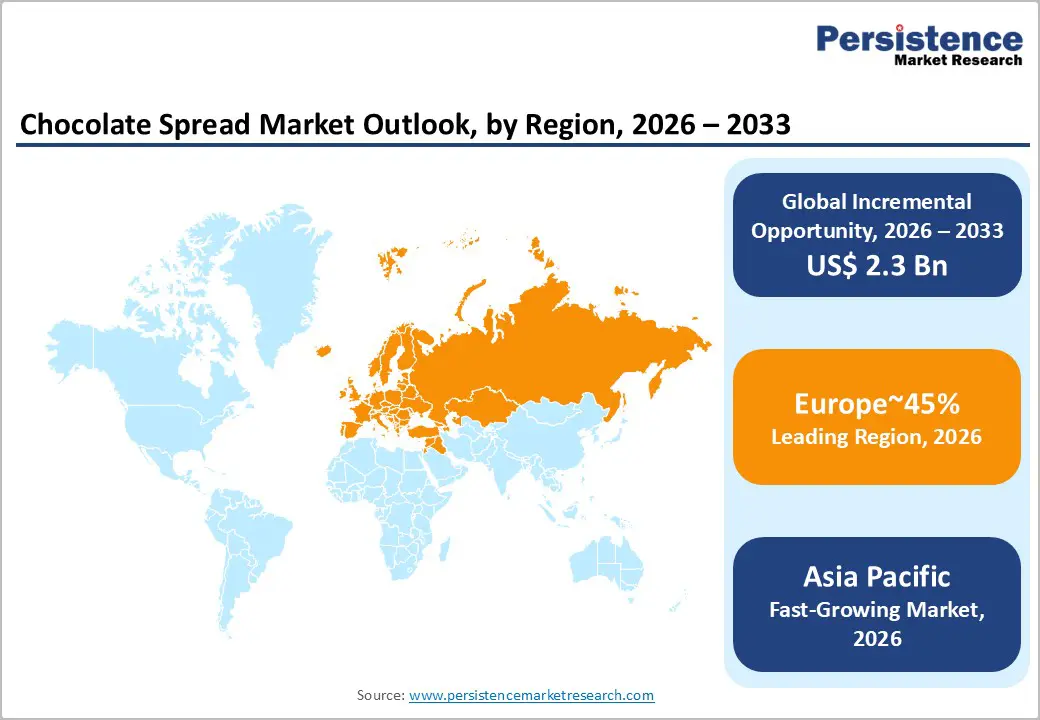
- Leading Region: Europe is anticipated to lead, approximately with 45% share in 2026, established bakery traditions underpin steady consumption. Deeply entrenched distribution networks ensure continuous retail availability.
- Fastest-growing Region: Asia Pacific is anticipated to be the fastest growing, driven by rising disposable incomes, which stimulate novel snacking formats alongside rapid urbanization.
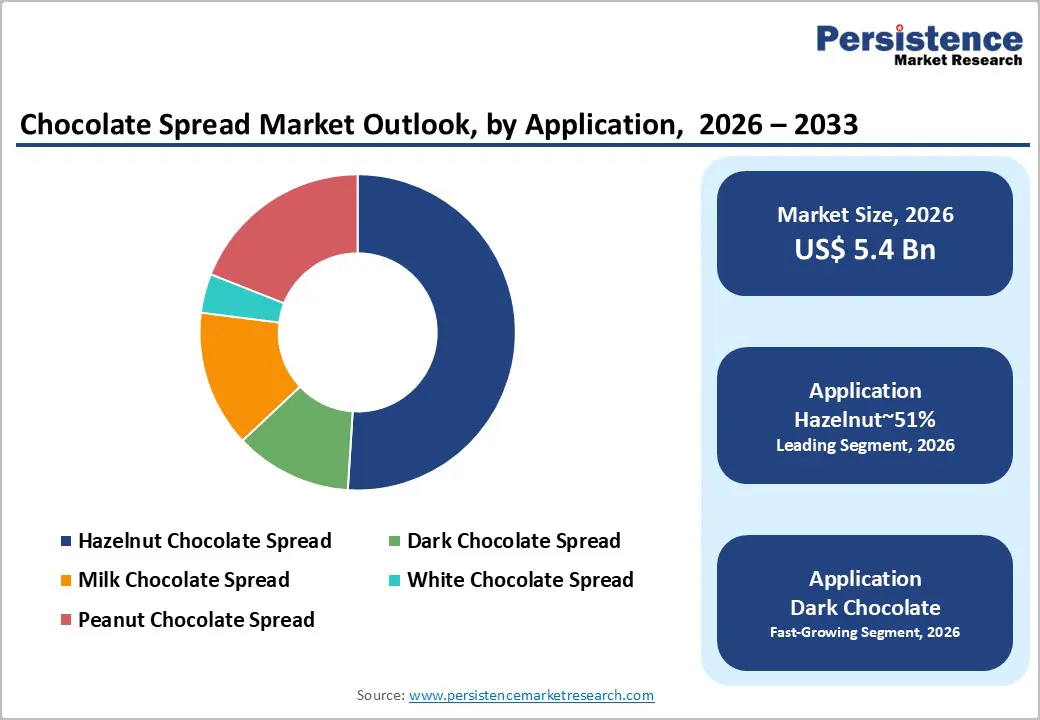
- Leading Product Type: Hazelnut is anticipated to dominate with approximately 51% share in 2026, and entrenched taste profiles anchor dominant shelf space presence.
- Leading Packaging Type: Glass jars are expected to account for approximately 67% of the market share in 2026, and their structural integrity ensures prolonged ambient shelf-life stability.
- Leading Distribution Channel: Supermarkets are anticipated to lead, with approximately 45% share in 2026. An expansive footprint facilitates comprehensive consumer brand exposure.
- Competitive Environment: Leading manufacturers execute aggressive geographical expansion targeting untapped regional demographics. Strategic acquisitions consolidate production capabilities while optimizing supply chain efficiencies. Vendors emphasize plant-based formulations catering toward shifting dietary paradigms.

DRO Analysis
Driver - Urbanization Dynamics
Rapid urban migration patterns fundamentally alter modern daily nutritional consumption paradigms. Consumers increasingly demand convenient breakfast solutions minimizing routine morning preparation times. High-density metropolitan environments drive packaged food accessibility across diverse retail formats. Consequently, swift demographic shifts guarantee consistent sales velocity acceleration within urbanizing populations. This demographic momentum sustains long-term volume expansion across key metropolitan hubs. Retailers prioritize shelf allocations, accommodating rapid lifestyle transitions effectively.
Urban lifestyles catalyze demand cycles, continuously supporting innovative packaging formats. Ferrero International SpA, with Nutella Plant-Based, exemplifies this trend. Compact living spaces require easily storable grocery items to prevent pantry clutter. Manufacturers adapt container dimensions to optimize storage efficiency for urban dwellers. These strategic adaptations capture substantial market value throughout expanding cityscapes. Retail dynamics shift toward smaller format stores, maximizing urban penetration.
Premiumization Trends
Shifting consumer preferences increasingly prioritize premium ingredients containing verified ethical sourcing. Affluent demographics actively seek artisanal formulations featuring elevated cocoa bean concentrations. Stringent clean-label requirements compel manufacturers to adopt transparent raw material procurement practices. This qualitative shift substantially raises overall retail pricing thresholds across markets. Market value escalates proportionately as shoppers willingly absorb incremental premium charges. Sustainable agricultural practices successfully offset higher costs during retail transactions.
Ethical sourcing demands a significant reshaping of standard product development pipelines. The Hershey Company's Organic Cocoa Spread demonstrates this premiumization. Discerning buyers scrutinize ingredient panels and avoid artificial preservatives. Brands reformulating without palm oil capture increased loyalty among conscious consumers. Confectionery vendors leverage superior taste profiles, securing competitive retail positioning. Higher margin products successfully drive profitability despite rising operational expenses.
Restraint - Capital Investment Burden
Advanced manufacturing infrastructure requires continuous, massive upfront financial capital deployment. High-speed automated bottling lines require continuous maintenance to prevent costly operational downtime. Specialized homogenization equipment ensures optimal texture consistency preventing undesirable oil separation. These technological prerequisites create substantial entry barriers, discouraging prospective regional competitors. Consequently, industry consolidation accelerates as smaller entities fail to secure adequate funding. Equipment depreciation schedules negatively impact baseline corporate profitability metrics consistently.
Sophisticated production environments demand highly trained operational personnel managing complex machinery. Lotus Bakeries' Biscoff Chocolate Fusion (Source: Bloomberg, November 2024) leverages advanced lines. Facility hygiene standards require rigorous sanitization protocols to prevent bacterial contamination outbreaks. Upgrading legacy manufacturing plants involves significant facility downtime, hindering output capacity. These capital expenditures routinely suppress short-term shareholder dividend distribution capabilities. Facility modernization projects consume significant administrative bandwidth during implementation.
Supply Chain Volatility
Unpredictable climatic events severely destabilize essential agricultural raw material harvests. Prolonged drought conditions diminish overall hazelnut yields across primary cultivation regions. Consequently, constrained ingredient availability significantly increases baseline manufacturing procurement costs. These cost fluctuations challenge consistent retail pricing strategies over extended horizons. Manufacturers face substantial margin compression during severe raw material shortages.
Commodity price volatility significantly complicates long-term enterprise financial forecasting models. Mars, Incorporated, with Sourced Cocoa Spread, mitigates procurement risks. Forward contracting mechanisms offer limited protection against sustained structural harvest failures. Brands occasionally reformulate recipes, mitigating dependence upon specific vulnerable agricultural commodities. These defensive adjustments sometimes compromise established consumer taste expectation profiles. Supply chain resilience requires continuous capital investment to maintain operational stability.
Opportunity - Digital Commerce Channels
Digital infrastructure expansion dramatically transforms traditional consumer packaged food procurement. Direct-to-consumer platforms bypass conventional supermarket distribution bottlenecks, accelerating market penetration. Subscription models provide predictable recurring revenue streams, stabilizing corporate cash flows. Advanced logistical networks enable rapid fulfillment while preserving the integrity of temperature-sensitive products. Consequently, manufacturers capture vital behavioral data, optimizing future targeted marketing campaigns. Digital storefronts eliminate geographical boundaries, constraining historical retail footprint expansion.
Algorithmic recommendation engines efficiently introduce niche formulations toward receptive audiences. Lindt & Sprüngli, with its Premium Dark Spread, leverages digital algorithms. Social media influencers drive viral product discovery, bypassing the expense of traditional advertising. E-commerce platforms facilitate personalized bundling strategies, increasing average customer transaction values. This digital transition ensures robust revenue generation outside conventional retail hours. Online marketplaces provide critical testing environments for evaluating novel flavor combinations.
Nutritional Fortification
Functional ingredient integration presents highly lucrative product differentiation pathways immediately. Adding whey protein isolates transforms indulgence items into acceptable post-workout snacks. Vitamin enrichment strategies appeal directly to health-conscious parents who monitor their children's nutrition. These functional enhancements justify premium pricing architectures, improving overall profit margins. Consequently, traditional confectionery boundaries blur alongside mainstream sports nutrition categories. Scientific validation of functional claims continuously builds essential consumer trust.
Clinical formulation trials validate functional claims, securing distinct market positioning. The J.M. Smucker Company's Protein Enhanced Spread reflects this shift. Consumers increasingly prioritize multifunctional foods delivering complementary physiological health benefits simultaneously. Formulators actively mask metallic vitamin undertones using advanced flavor-modulation technologies. These scientific breakthroughs unlock entirely new use cases across diverse demographics. Dietary supplementation trends encourage continuous innovation across established product portfolios.
Category-wise Analysis
Product Type Insights
Hazelnut is expected to dominate, accounting for approximately 51% share in 2026, anchored by entrenched consumer taste preferences. Established flavor profiles dominate breakfast consumption rituals across multiple generations consistently. Rigoni di Asiago's Nocciolata Organic Spread maintains dominant visibility. Consistent agricultural supply chains support uninterrupted manufacturing operations, fulfilling baseline demand. This familiarity ensures resilient sales velocity, resisting sudden behavioral market shifts. Retailers prioritize shelf allocations toward these proven high-turnover product formulations.
Dark chocolate and dark chocolate variants are anticipated to be the fastest-growing segment, driven by intensifying mainstream dietary health consciousness. Consumers actively seek antioxidant-rich formulations containing substantially reduced sugar concentrations. Valrhona with Intense Dark Cocoa Spread accelerates this expansion. Mature demographics appreciate sophisticated bitter notes contrasting traditional, overly sweet flavor profiles. Artisanal manufacturing techniques elevate perceived product value, justifying higher retail price points. Premium positioning attracts discerning shoppers upgrading their standard grocery purchases.
Packaging Type Insights
Glass jars are projected to lead the chocolate spread market, accounting for approximately 67% share in 2026, supported by superior structural integrity profiles. Rigid containers effectively prevent oxygen ingress, preserving essential flavor compounds longer. Nutkao's Standard Glass Jar Selection demonstrates this reliability. Transparent packaging allows visual quality inspection, building immediate consumer trust pre-purchase. These traditional formats remain easily recyclable, aligning with modern municipal sustainability programs. Manufacturing facilities possess optimized filling lines accommodating these standard dimensions.
Squeeze bottles are forecast to be the fastest-growing segment, driven by escalating consumer demand for portion control. Active lifestyles require convenient dispensing mechanisms, eliminating messy utensil requirements completely. Kraft Heinz, with Easy Squeeze Chocolate, pioneers this functional design. Flexible formats facilitate the precise application of decorating baked goods without specialized culinary equipment. Families appreciate shatterproof materials preventing dangerous kitchen accidents during independent childhood usage. Ergonomic container designs improve overall user experience during daily consumption.
Distribution Channel Insights
Supermarkets are expected to lead, accounting for approximately 45% share in 2026, underpinned by comprehensive retail geographical footprints. Expansive store layouts allow extensive brand assortments, maximizing consumer choice availability. Pladis's Godiva Premium Spread anchors premium aisle placements. Promotional end-cap displays effectively capture impulse purchasing behaviors during routine grocery shopping. These traditional physical locations provide essential sensory interactions preceding final transactions. Consistent foot traffic guarantees steady inventory depletion rates across quarters.
Online retail is projected to be the fastest-growing segment, driven by algorithmic consumer purchasing recommendation engines. Subscription models provide predictable recurring revenue streams, stabilizing corporate cash flows. Bonne Maman with Hazelnut Chocolate Spread expands digital penetration. Advanced logistical networks enable rapid fulfillment, preserving temperature-sensitive product integrity. Consumers appreciate automated replenishment, preventing sudden pantry stock depletion scenarios. Digital storefronts eliminate geographical boundaries, constraining historical retail footprint expansion.
Regional Insights
Europe Chocolate Spread Market Trends
Europe is expected to account for approximately 45% share in 2026, supported by deeply entrenched cultural bakery traditions. Dense urban populations ensure rapid product turnover across fragmented retail landscapes. Intensive capital investments expand domestic manufacturing capacities, fulfilling continuous regional demand. Dr. Oetker's Dessert Chocolate Spread anchors localized production.
Germany Chocolate Spread Market Trends
Germany is anticipated to account for about 27.8% of the regional market, anchored in strong chocolate consumption and a deeply embedded breakfast spread culture. High per-capita intake and a robust domestic manufacturing base sustain large-scale production and stable demand structures. Manufacturers are accelerating certification alignment to secure ethically verified supply chains and maintain uninterrupted access to European retail channels.
Italy Chocolate Spread Market Trends
Italy is expected to account for about 16.4% of the regional market, anchored by strong legacy demand for hazelnut-cocoa spreads and deep-rooted consumption patterns. Ferrero Group continues to shape category dynamics through scale, branding, and product innovation leadership. The launch of plant-based Nutella has expanded the addressable consumer base, aligning with rising dairy-free and vegan consumption trends across Southern Europe.
North America Chocolate Spread Market Trends
North America is projected to remain a structurally stable market, with demand anchored in mature replacement cycles. Health-conscious demographics increasingly transition toward functionally fortified nutritional alternatives. The Hershey Company, with Organic Cocoa Spread, expands its regional presence.
U.S. Chocolate Spread Market Trends
The U.S. is projected to account for about 80% of the regional market, driven by extensive retail infrastructure and strong consumer purchasing power. Demand dynamics are shifting toward on-the-go formats, with chocolate spreads expanding beyond traditional breakfast usage into portable snacking applications. Ferrero Group is accelerating category disruption through Nutella Peanut and targeted manufacturing expansion in Illinois.
Canada Chocolate Spread Market Trends
Canada is anticipated to account for about 12.6% of the regional market in 2026, supported by strong consumer preference for organic and fair-trade certified chocolate spreads. Demand is concentrated in urban centers, where health-conscious consumption drives uptake of reduced-sugar and functional variants. The Hershey Company and Mondelez International are advancing “next-generation snacking” through protein-enriched and reformulated product lines.
Asia Pacific Chocolate Spread Market Trends
Asia Pacific is anticipated to register the fastest expansion, as rising disposable incomes accelerate product uptake. Western dietary influence transforms traditional morning nutritional consumption habits rapidly. Rapid industrialization improves refrigerated logistical chains, preserving sensitive product integrity successfully. Nestlé S.A.'s Plant-Based Chocolate Spread tests expanding markets.
China Chocolate Spread Market Trends
China is projected to account for about 31.1% of the regional market in 2026, supported by strong premium positioning and culturally embedded gifting practices. Chocolate spreads are increasingly marketed as luxury products, often packaged in high-end formats for festive consumption cycles. Rapid expansion of e-commerce channels is accelerating distribution efficiency and consumer access beyond traditional retail networks. This digital-led growth is reinforcing China’s position as the central demand engine within the regional chocolate spread market.
Japan Chocolate Spread Market Trends
Japan is estimated to account for 25.4% of the regional market in 2026, characterized by maturity and a shift toward functional, health-driven chocolate spread consumption. Meiji Holdings is advancing high-polyphenol dark variants targeting cardiovascular and healthy aging benefits. Investment in cold-chain logistics and specialized R&D is reinforcing premium product stability and quality standards. Fuji Oil is expanding innovation capacity to support temperature-sensitive, artisanal-grade formulations.
Competitive Landscape
The global chocolate spread market exhibits a consolidated structure, with multinational leaders controlling distribution channels and formulation standards. Ferrero International SpA commands strong market influence through Nutella and its plant-based extensions, reinforcing retail shelf dominance. Mondelez International, Inc. drives innovation through reduced-sugar and functional chocolate variants aligned with evolving consumer preferences.
Mars, Incorporated, strengthens regional penetration through diversified spread portfolios and supply chain resilience. Competitive intensity is shifting toward plant-based product pipelines, greater transparency in ethical sourcing, and expansion of the digital retail channel.
Companies Covered in Chocolate Spread Market
- Ferrero International S.A.
- Mondelēz International, Inc.
- Nestlé S.A.
- The Hershey Company
- Mars, Incorporated
- The Kraft Heinz Company
- Lindt & Sprüngli
- Barilla Group
- Lotus Bakeries
- Rigoni di Asiago
- Pladis
- Nutkao S.r.l.
- Dr. Oetker
- Barry Callebaut AG
- Cargill, Incorporated
- Olam Group
Frequently Asked Questions
The global chocolate spread market is projected to be valued at US$5.4 billion in 2026 and is expected to reach US$7.7 billion by 2033.
Unpredictable climatic events diminish hazelnut yields and inflate procurement costs, forcing manufacturers to occasionally reformulate recipes and compromise established taste profiles.
The chocolate spread market is forecast to grow at a CAGR of 5.2% from 2026 to 2033.
Europe leads with approximately 45% share, while Asia Pacific is the fastest-growing, driven by rising disposable incomes and Western dietary influence.
Key players include Ferrero International S.A., Mondelēz International, Nestlé S.A., The Hershey Company, Mars, Incorporated, The Kraft Heinz Company, Lindt & Sprüngli, and Lotus Bakeries.


