


- Executive Summary
- Global Chia Seeds Market Snapshot, 2026 and 2033
- Market Opportunity Assessment, 2026 - 2033, US$ Bn
- Key Market Trends
- Future Market Projections
- Premium Market Insights
- Industry Developments and Key Market Events
- PMR Analysis and Recommendations
- Market Overview
- Market Scope and Definition
- Market Dynamics
- Drivers
- Restraints
- Opportunity
- Challenges
- Key Trends
- Macro-Economic Factors
- Global Sectorial Outlook
- Global GDP Growth Outlook
- COVID-19 Impact Analysis
- Forecast Factors - Relevance and Impact
- Value Added Insights
- Regulatory Landscape
- Technology Adoption Analysis
- Value Chain Analysis
- Key Deals and Mergers
- PESTLE Analysis
- Porter’s Five Force Analysis
- Global Chia Seeds Market Outlook:
- Key Highlights
- Market Size (US$ Bn) and Y-o-Y Growth
- Absolute $ Opportunity
- Market Size (US$ Bn) Analysis and Forecast
- Historical Market Size (US$ Bn) Analysis, 2020-2025
- Market Size (US$ Bn) Analysis and Forecast, 2026-2033
- Global Chia Seeds Market Outlook: Product Type
- Introduction / Key Findings
- Historical Market Size (US$ Bn) Analysis, By Product Type, 2020 - 2025
- Market Size (US$ Bn) Analysis and Forecast, By Product Type, 2026 - 2033
- White Chia Seeds
- Black Chia Seeds
- Brown Chia Seeds
- Market Attractiveness Analysis: Product Type
- Global Chia Seeds Market Outlook: Application
- Introduction / Key Findings
- Historical Market Size (US$ Bn) Analysis, By Application, 2020 - 2025
- Market Size (US$ Bn) Analysis and Forecast, By Application, 2026 - 2033
- Food And Beverages
- Animal Feed
- Nutraceuticals
- Personal Care Products
- Others
- Market Attractiveness Analysis: Application
- Key Highlights
- Global Chia Seeds Market Outlook: Region
- Key Highlights
- Historical Market Size (US$ Bn) Analysis, By Region, 2020 - 2025
- Market Size (US$ Bn) Analysis and Forecast, By Region, 2026 - 2033
- North America
- Europe
- East Asia
- South Asia and Oceania
- Latin America
- Middle East & Africa
- Market Attractiveness Analysis: Region
- North America Chia Seeds Market Outlook:
- Key Highlights
- Historical Market Size (US$ Bn) Analysis, By Market, 2020 - 2025
- By Country
- By Product Type
- By Application
- Market Size (US$ Bn) Analysis and Forecast, By Country, 2026 - 2033
- U.S.
- Canada
- Market Size (US$ Bn) Analysis and Forecast, By Product Type, 2026 - 2033
- White Chia Seeds
- Black Chia Seeds
- Brown Chia Seeds
- Market Size (US$ Bn) Analysis and Forecast, By Application, 2026 - 2033
- Food And Beverages
- Animal Feed
- Nutraceuticals
- Personal Care Products
- Others
- Europe Chia Seeds Market Outlook:
- Key Highlights
- Historical Market Size (US$ Bn) Analysis, By Market, 2020 - 2025
- By Country
- By Product Type
- By Application
- Market Size (US$ Bn) Analysis and Forecast, By Country, 2026 - 2033
- Germany
- France
- U.K.
- Italy
- Spain
- Russia
- Rest of Europe
- Market Size (US$ Bn) Analysis and Forecast, By Product Type, 2026 - 2033
- White Chia Seeds
- Black Chia Seeds
- Brown Chia Seeds
- Market Size (US$ Bn) Analysis and Forecast, By Application, 2026 - 2033
- Food And Beverages
- Animal Feed
- Nutraceuticals
- Personal Care Products
- Others
- East Asia Chia Seeds Market Outlook:
- Key Highlights
- Historical Market Size (US$ Bn) Analysis, By Market, 2020 - 2025
- By Country
- By Product Type
- By Application
- Market Size (US$ Bn) Analysis and Forecast, By Country, 2026 - 2033
- China
- Japan
- South Korea
- Market Size (US$ Bn) Analysis and Forecast, By Product Type, 2026 - 2033
- White Chia Seeds
- Black Chia Seeds
- Brown Chia Seeds
- Market Size (US$ Bn) Analysis and Forecast, By Application, 2026 - 2033
- Food And Beverages
- Animal Feed
- Nutraceuticals
- Personal Care Products
- Others
- South Asia & Oceania Chia Seeds Market Outlook:
- Key Highlights
- Historical Market Size (US$ Bn) Analysis, By Market, 2020 - 2025
- By Country
- By Product Type
- By Application
- Market Size (US$ Bn) Analysis and Forecast, By Country, 2026 - 2033
- India
- Southeast Asia
- ANZ
- Rest of South Asia & Oceania
- Market Size (US$ Bn) Analysis and Forecast, By Product Type, 2026 - 2033
- White Chia Seeds
- Black Chia Seeds
- Brown Chia Seeds
- Market Size (US$ Bn) Analysis and Forecast, By Application, 2026 - 2033
- Food And Beverages
- Animal Feed
- Nutraceuticals
- Personal Care Products
- Others
- Latin America Chia Seeds Market Outlook:
- Key Highlights
- Historical Market Size (US$ Bn) Analysis, By Market, 2020 - 2025
- By Country
- By Product Type
- By Application
- Market Size (US$ Bn) Analysis and Forecast, By Country, 2026 - 2033
- Brazil
- Mexico
- Rest of Latin America
- Market Size (US$ Bn) Analysis and Forecast, By Product Type, 2026 - 2033
- White Chia Seeds
- Black Chia Seeds
- Brown Chia Seeds
- Market Size (US$ Bn) Analysis and Forecast, By Application, 2026 - 2033
- Food And Beverages
- Animal Feed
- Nutraceuticals
- Personal Care Products
- Others
- Middle East & Africa Chia Seeds Market Outlook:
- Key Highlights
- Historical Market Size (US$ Bn) Analysis, By Market, 2020 - 2025
- By Country
- By Product Type
- By Application
- Market Size (US$ Bn) Analysis and Forecast, By Country, 2026 - 2033
- GCC Countries
- Egypt
- South Africa
- Northern Africa
- Rest of Middle East & Africa
- Market Size (US$ Bn) Analysis and Forecast, By Product Type, 2026 - 2033
- White Chia Seeds
- Black Chia Seeds
- Brown Chia Seeds
- Market Size (US$ Bn) Analysis and Forecast, By Application, 2026 - 2033
- Food And Beverages
- Animal Feed
- Nutraceuticals
- Personal Care Products
- Others
- Competition Landscape
- Market Share Analysis, 2025
- Market Structure
- Competition Intensity Mapping By Market
- Competition Dashboard
- Company Profiles (Details - Overview, Financials, Strategy, Recent Developments)
- Nutiva Inc.
- Overview
- Segments and Products
- Key Financials
- Market Developments
- Market Strategy
- The Chia Co
- Navitas Organics
- Glanbia Nutritionals
- Bob's Red Mill
- Mamma Chia
- Benexia
- Sunfood
- Health Warrior
- Naturya
- Salba Smart
- Garden of Life
- Nature's Path
- Manitoba Harvest
- Now Foods
- Spectrum Organics
- Others
- Nutiva Inc.
- Appendix
- Research Methodology
- Research Assumptions
- Acronyms and Abbreviations


- Food Ingredients & Additives
- Chia Seeds Market
Chia Seeds Market Size, Share, and Growth Forecast, 2026 - 2033
Chia Seeds Market by Product Type (White Chia Seeds, Black Chia Seeds, Brown Chia Seeds), Application (Food & Beverages, Animal Feed, Nutraceuticals, Personal Care Products, Others), and Regional Analysis 2026 - 2033
Chia Seeds Market Size and Trends Analysis
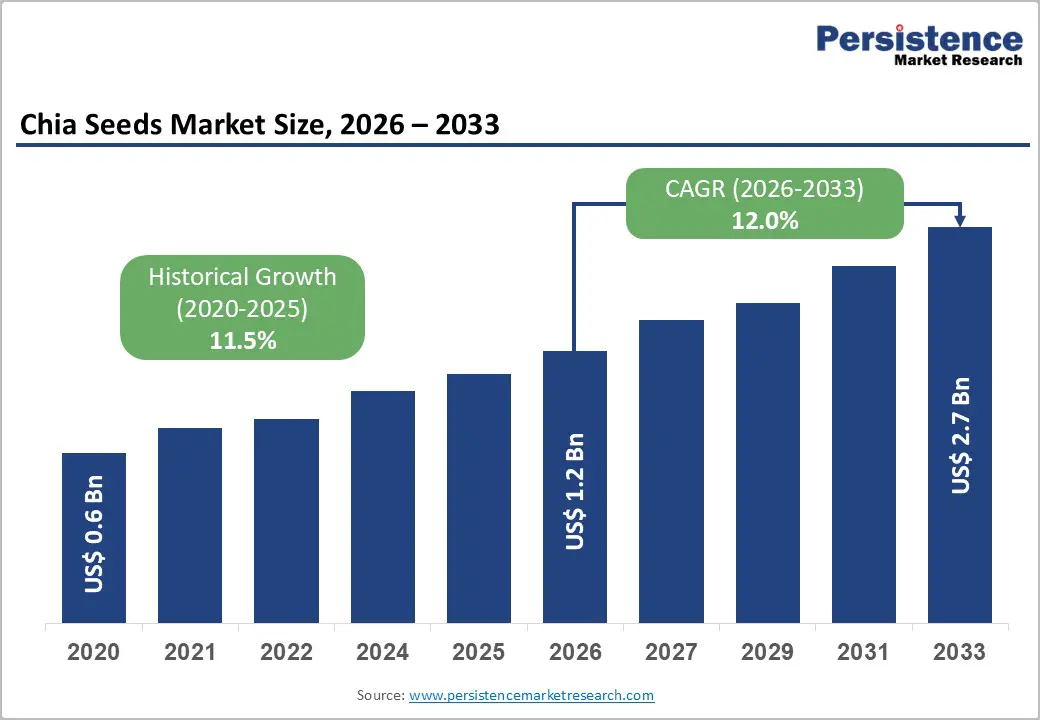
The global chia seeds market size is likely to be valued at US$1.2 billion in 2026 and is expected to reach US$2.7 billion by 2033, growing at a CAGR of 12.0% during the forecast period from 2026 to 2033, driven by rising consumer interest in plant-based nutrition, which fuels this expansion as health-conscious diets gain traction worldwide.
Structural shifts toward functional foods reinforce procurement across food and beverage channels. Market expansion continues to benefit from the increasing shift toward sustainable and organic food consumption. Such patterns are anticipated to sustain demand across major retail and industrial food sectors. Technology advancements in seed processing enhance shelf life and versatility, positioning the market for sustained momentum.
Key Industry Highlights:
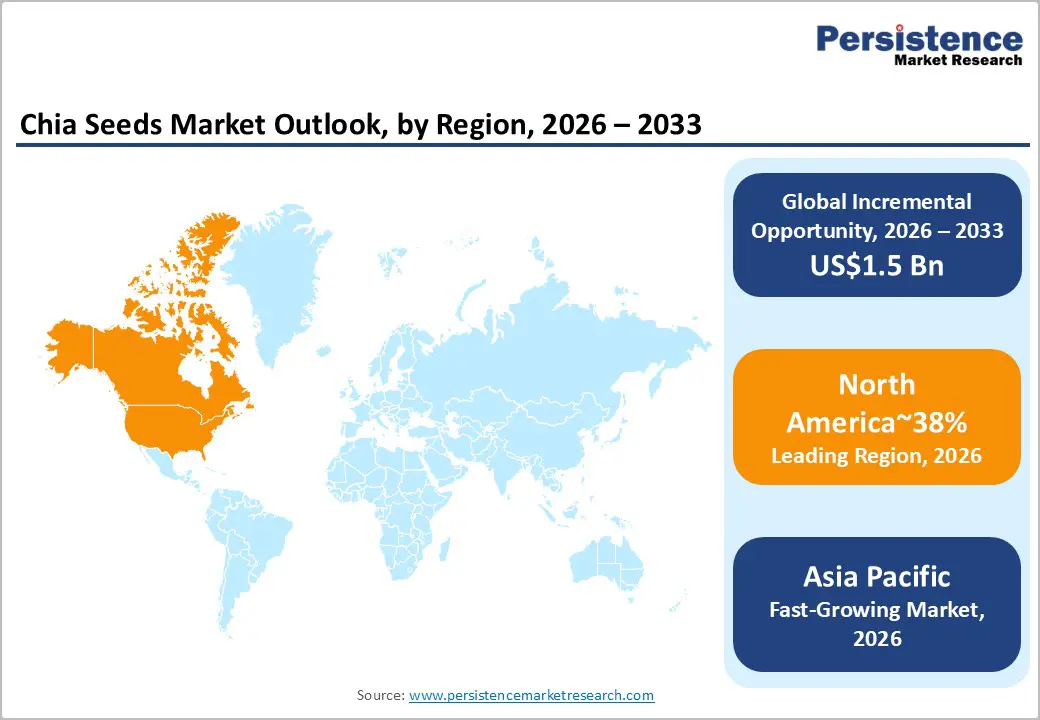
- Leading Region: North America is projected to lead, accounting for approximately 38% share in 2026, supported by established health-food trends and high consumer awareness regarding superfoods.
- Fastest-growing Region: Asia Pacific is anticipated to grow fastest, driven by rapid urbanization and increasing disposable incomes in China and India.
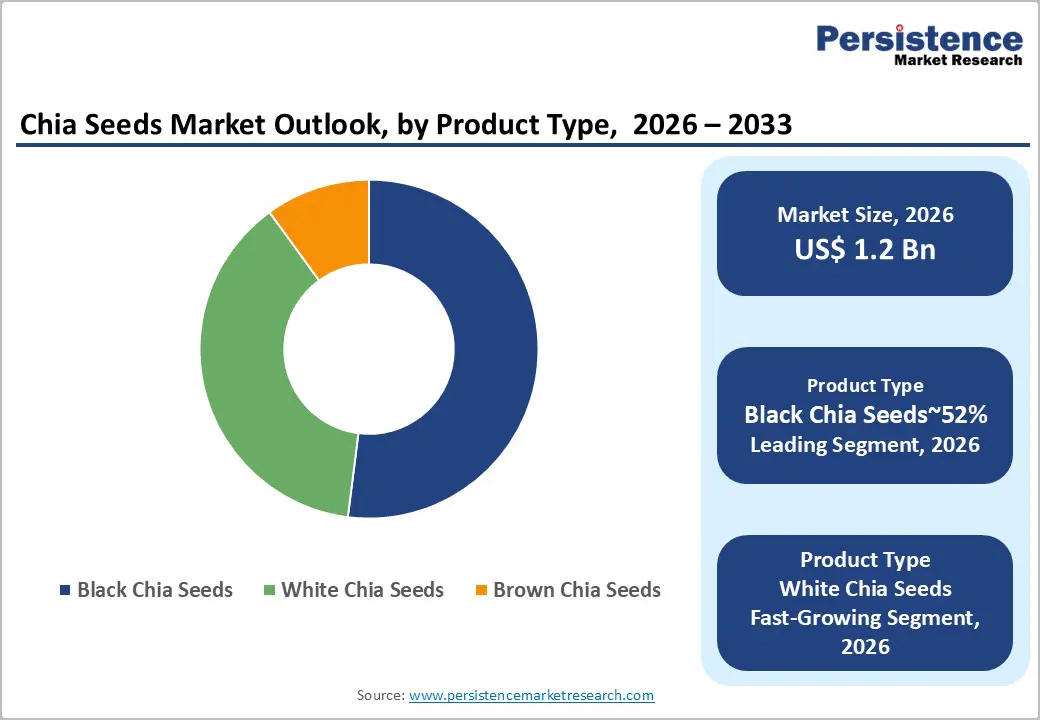
- Leading Product Type: Black chia seeds are expected to lead, accounting for approximately 52% share in 2026, anchored by perceived nutritional superiority and widespread availability.
- Leading Application: The food & beverages segment is anticipated to dominate, accounting for approximately 57% share in 2026, anchored by the high versatility of seeds in snacks and drinks.
| Key Insights | Details |
|---|---|
| Chia Seeds Market Size (2026E) | US$1.2 Bn |
| Market Value Forecast (2033F) | US$2.7 Bn |
| Projected Growth (CAGR 2026 to 2033) | 12.0% |
| Historical Market Growth (CAGR 2020 to 2025) | 11.5% |
DRO Analysis
Driver Analysis - Expansion of Plant-Based Diets in Functional Nutrition
The increasing adoption of vegan dietary patterns drives demand for nutrient-dense plant-based protein sources globally. Consumers prioritize ingredients delivering omega fatty acids and fiber within balanced nutritional profiles. This structural dietary shift reinforces seeds as viable alternatives to conventional animal-based protein sources. Health-conscious populations integrate these superfoods into routine meal preparation and functional snacking occasions. Regulatory focus on clean-label declarations further supports transparency in ingredient sourcing and formulation standards. Cost structures evolve toward scalable sourcing and processing of plant-derived nutritional inputs across supply chains. These factors collectively sustain demand expansion within plant-based functional nutrition markets.
Mamma Chia’s Chia Squeeze addresses the demand for convenient, plant-based snacks tailored for time-constrained consumers. Portable product formats align with urban consumption patterns, emphasizing accessibility and nutritional efficiency. Retail channels increasingly prioritize functional food categories, reflecting shifting consumer lifestyle preferences. Ingredient versatility supports integration into beverages and meal supplements across diverse consumption occasions. Clean-label positioning strengthens product acceptance within health-focused demographic segments. These dynamics reinforce sustained growth across plant-based nutrition categories within modern food systems.
Diversification of Functional Beverage Formulations
The beverage industry increasingly incorporates fiber-rich ingredients to address evolving functional hydration requirements globally. Liquid formats transition beyond basic refreshment into platforms delivering targeted nutritional and wellness benefits. This shift drives innovation across dairy alternatives, fortified waters, and performance-oriented energy beverages. Manufacturers leverage natural hydrocolloids such as mucilage to create differentiated texture and viscosity profiles. Regulatory emphasis on health claims necessitates validated functional benefits within beverage formulations. Cost structures adapt toward ingredient stabilization, processing technologies, and scalable liquid production systems. These dynamics collectively expand the role of beverages within integrated nutrition and wellness consumption patterns.
Benexia with Seeds of Wellness Chia Milk exemplifies innovation in plant-based liquid formulations enriched with functional fiber content. Enhanced nutritional density positions such products as competitive alternatives to established almond and oat-based beverages. Ingredient functionality supports stability and consistency across large-scale beverage manufacturing processes. Processing advancements ensure the safety, bioavailability, and performance of functional components within liquid matrices. Retail and foodservice channels increasingly adopt such formulations aligned with wellness-focused consumer demand. This convergence of hydration and nutrition reinforces the expansion of functional beverage categories within global markets.
Restraint Analysis - Fluctuations in Agricultural Commodity Pricing
Volatile weather patterns across primary cultivation regions disrupt global seed supply and yield consistency. Environmental variability introduces uncertainty in harvest cycles, elevating wholesale procurement costs for processors. Price sensitivity among bulk buyers constrains margin flexibility within downstream food manufacturing segments. Manufacturers face challenges in sustaining stable retail pricing during periods of constrained supply availability. Regulatory pressures on food pricing transparency further complicate cost pass-through mechanisms across distribution channels. Supply-demand imbalances intensify inventory management complexities within global agricultural commodity networks. These dynamics collectively create structural pricing instability across seed-based functional food markets.
Salba Smart with Salba Chia leverages controlled agricultural partnerships to mitigate sourcing volatility and stabilize input availability. Larger players absorb cost fluctuations through scale efficiencies, while smaller vendors encounter operational strain. Procurement strategies increasingly emphasize long-term contracts to hedge against unpredictable commodity price swings. Logistics disruptions amplify cost pressures by delaying shipments and increasing transportation expenditures across regions. Retailers respond cautiously, adjusting product positioning to maintain affordability within price-sensitive consumer segments. These interconnected pressures restrict the broader adoption of seed-based products within lower-income and emerging markets.
Consumer Taste Perception in Functional Seed Integration
Neutral flavor profiles limit seamless incorporation into savory applications across mainstream culinary formats. Taste-sensitive consumer segments exhibit hesitation, reducing adoption within standardized meal kit offerings. Texture characteristics create formulation challenges that restrict versatility across diverse food preparation contexts. Marketing strategies increasingly emphasize consumer education to address sensory acceptance barriers. Regulatory labeling requirements around ingredient transparency further shape perception and trial behavior. Cost implications arise from additional processing required to modify texture and improve palatability outcomes. These constraints collectively moderate penetration of seed-based ingredients within broader food consumption patterns.
Spectrum Organics with Ground Chia addresses formulation challenges through processing techniques designed to improve texture compatibility in recipes. Blending innovations aim to mask undesirable mouthfeel while preserving nutritional integrity within final products. However, limitations persist in achieving widespread acceptance across varied culinary applications and taste preferences. Product developers must balance sensory optimization with clean-label expectations and minimal ingredient alteration. Retail uptake remains uneven due to consumer skepticism toward unfamiliar textures in everyday meals. These factors collectively constrain the expansion of seed-based products within mainstream dietary segments.
Opportunity Analysis - Rising Utilization in Skincare Formulations
The personal care industry increasingly leverages antioxidant-rich seed oils within advanced skincare formulations. Cosmetic developers incorporate these botanical extracts into anti-aging and intensive moisturizing product lines. Expansion into non-food applications diversifies revenue streams for seed producers across adjacent industries. Consumers demonstrate a growing preference for plant-derived alternatives over synthetic chemical-based skincare treatments. Regulatory frameworks favor natural ingredient claims supported by safety and efficacy validation studies. Cost structures evolve toward cold-press extraction and refinement processes, ensuring high-purity cosmetic-grade outputs. These dynamics collectively expand the role of seed derivatives within premium personal care markets.
Benexia’s Xia Oil capitalizes on high omega fatty acid concentrations suitable for advanced skincare applications. Ingredient performance supports skin barrier repair and hydration retention across dermatological formulations. Cosmetic brands integrate such oils within premium product portfolios targeting natural and clean-label positioning. Supply chains adapt to meet quality standards required for cosmetic-grade ingredient certification. Research advancements validate the efficacy of botanical compounds within topical treatment frameworks. This cross-industry convergence strengthens demand beyond traditional food applications into high-value personal care segments.
Expansion of E-Commerce Nutrition Channels
Direct-to-consumer platforms are increasingly driving specialized health food distribution across global markets. Online retail ecosystems enable broader accessibility of niche nutritional products beyond conventional brick-and-mortar limitations. This structural shift reduces dependency on physical infrastructure while enhancing market entry for smaller producers. Subscription-based purchasing models strengthen recurring revenue streams and improve consumer retention within wellness-oriented segments. Digital ecosystems also facilitate rapid product discovery through algorithm-driven recommendation systems. Cost structures shift toward digital acquisition, logistics optimization, and platform-based distribution efficiencies. These dynamics collectively accelerate the transformation of nutrition retail toward digitally integrated consumption frameworks.
Mamma Chia with Chia Prebiotic Squeeze leverages digital marketing channels to engage wellness-focused consumer segments. Social media platforms amplify product visibility and accelerate the adoption of newly launched functional nutrition offerings. E-commerce marketplaces enable scalable distribution of plant-based nutrition products across diverse geographic regions. Data analytics derived from online sales patterns support iterative product refinement and demand forecasting. Brand positioning benefits from direct consumer feedback loops integrated within digital retail environments. These developments reinforce the structural shift toward technology-enabled expansion of functional nutrition markets.
Category-wise Analysis
Product Type Insights
Black chia seeds are expected to lead the market, accounting for approximately 52% share in 2026, underpinned by their widespread recognition as a nutritional powerhouse. Consumers are expected to perceive these darker varieties as having higher antioxidant concentrations relative to other types. This segment remains on track to dominate retail shelves due to its established presence in early health-food trends. Traditional cultivation methods favor the production of black variants, ensuring a stable and cost-effective global supply. Nutiva with Organic Chia Seeds and Mamma Chia with Chia Squeeze exemplify the market reliance on this primary seed type. Ongoing consumer education regarding omega-3 content continues to reinforce the dominance of this specific product category. Large-scale food manufacturers prioritize black seeds for their visual contrast in baked goods and breakfast cereals. This structural alignment between supply availability and consumer perception sustains the segment's leadership within the industry.
White chia seeds are anticipated to be the fastest-growing segment, driven by increasing demand for aesthetically neutral ingredients in the culinary sector. Professional bakers and food stylists are expected to favor the lighter color for maintaining the original appearance of light-colored doughs. This functional preference is positioned to expand the application of seeds in premium pasta and white bread formulations. Salba Smart’s Salba Chia and Benexia with Xia Powder address this specific need for color-sensitive food processing applications. The growth is further supported by the perceived "premium" status of white seeds in high-end specialty markets. As product developers seek to incorporate health benefits without altering food color, the uptake of white variants is projected to accelerate. This shift reflects a move toward invisible fortification in everyday staple foods such as tortillas and muffins. Improved agricultural techniques for breeding stable white varieties are anticipated to lower production costs over time.
Application Insights
The food & beverages segment is anticipated to dominate, accounting for approximately 57% share in 2026, supported by the extreme versatility of seeds in diverse food matrices. The ability of the seed to form a gel-like consistency allows for its use as a natural thickener and egg replacer. This functional property is set to remain a cornerstone of innovation within the dairy-free and gluten-free sectors. The Chia Co with Chia Pods and Health Warrior with Chia Bars demonstrate the successful integration of seeds into convenient snack formats. Modern processing technologies enable the inclusion of whole and milled seeds into shelf-stable beverages without compromising texture. Manufacturers are poised to increase the usage of seeds in breakfast cereals to enhance protein and fiber claims. This consistent integration across multiple food categories ensures a dominant and stable demand profile for the segment.
Personal care is forecast to be the fastest-growing segment, driven by a structural pivot toward botanical ingredients in the global beauty industry. Cold-pressed oils derived from the seeds are positioned to become essential components in high-performance facial serums and hair treatments. The rising awareness of alpha-linolenic acid benefits for skin hydration is expected to propel procurement among cosmetic formulators. Benexia with Xia Oil and Nutiva with organic chia seeds provide the essential lipids required for these sophisticated topical applications. This trend is reinforced by the "clean beauty" movement, which prioritizes plant-derived extracts over synthetic chemicals. As consumers seek natural solutions for skin inflammation and aging, the demand for seed-based extracts is anticipated to rise. The diversification into non-dietary applications is projected to create a robust and high-margin expansion path for providers.
Regional Insights
North America Chia Seeds Market Trends
North America is expected to remain the leading regional market, accounting for approximately 38% share in 2026, supported by established health-food trends. The region's dominance is anchored in a highly developed retail infrastructure that prioritizes organic and clean-label products. Consumers are set to exhibit a strong preference for functional snacks that offer multiple nutritional benefits simultaneously. This market environment encourages constant innovation in product formats, ranging from beverages to baked goods. High awareness of omega-3 benefits among the aging population continues to drive the supplement sector.
The U.S. is expected to anchor regional momentum through sustained investments in plant-based food technologies and health-oriented retail expansion. Government dietary guidelines emphasizing fiber intake are anticipated to accelerate the adoption of seeds in mainstream diets. Mamma Chia with Chia Squeeze remains a dominant player in the American grab-and-go nutrition segment. Procurement volumes are projected to increase as major food companies integrate seeds into large-scale cereal production. Ongoing consumer shifts toward vegan and keto diets are likely to further bolster the national market.
Europe Chia Seeds Market Trends
Europe is expected to remain a mature and structurally stable regional market, with demand primarily anchored in compliance upgrades. The region is positioned to witness steady growth driven by strict regulations regarding food safety and transparent labeling. European consumers are anticipated to favor products with high traceability and ethical sourcing credentials. This focus on sustainability is set to influence the procurement of organic seeds from South American producers. Plant-based dairy alternatives are projected to be a significant growth driver across the continent.
Germany is expected to lead European demand through a robust market for organic bread and specialty health supplements. Stringent European Union Novel Food regulations are anticipated to ensure that only high-quality, safe products reach the local consumer. Benexia with Xia Powder is forecast to benefit from the growing German interest in gluten-free baking ingredients. The rising popularity of veganism in urban centers such as Berlin is set to increase the utilization of seeds in cafes. Local manufacturers are positioned to focus on premiumization to cater to the discerning health-conscious demographic.
Asia Pacific Chia Seeds Market Trends
Asia Pacific is expected to register the fastest growth trajectory, as infrastructure buildout and manufacturing scale accelerate market expansion. The region is positioned to benefit from a rapidly evolving food processing sector that is integrating global superfoods. Growing awareness of cardiovascular health is anticipated to drive the demand for fiber-rich ingredients among urban populations. Increasing disposable income levels allow for a shift toward premium, imported health-focused snacks and beverages. This demographic transition is set to reshape the regional food landscape over the coming decade.
India is expected to anchor regional growth through an expanding wellness market and a burgeoning middle class seeking nutritional supplements. The increasing prevalence of lifestyle-related health concerns is anticipated to drive the adoption of seeds in traditional and modern diets. The Chia Co with Chia Pods is set to find a growing audience among young professionals in metropolitan areas. Government initiatives aimed at improving public nutrition are projected to support the import and distribution of superfoods. Local food startups are likely to introduce innovative seed-blended products to cater to domestic tastes.
Competitive Landscape
The global chia seeds market is moderately fragmented, with leadership dispersed among international brands and regional agricultural processors. This structure reflects varied cultivation geographies and broad application demand across food, nutraceutical, and personal care industries. Leading participants influence procurement through quality certification standards, nutritional consistency, and supply reliability across global retail networks. Their technology footprints shape processing benchmarks for oils, powders, and whole-seed formats. Companies such as Nutiva, Mamma Chia, and Glanbia Nutritionals establish reference standards through integrated sourcing and diversified product portfolios.
Competitive positioning reflects vertical differentiation between premium organic certifications and volume-driven commodity supply models. Premium participants emphasize traceability, regenerative agriculture practices, and clean-label validation frameworks. Value-oriented firms focus on scalable production and affordability for industrial food applications. Industry dynamics include strategic collaborations with beverage manufacturers and food processors to broaden application scope. Platform evolution increasingly focuses on processed formats such as milled seeds, oils, and ready-to-use nutritional blends. Forward-looking strategies prioritize sustainability alignment and functional food innovation across diversified consumption channels.
Key Industry Developments:
- In January 2026, Navitas Organics initiated a voluntary recall of organic chia seeds due to potential supplier contamination. This proactive safety measure highlights the industry's shift toward stricter quality assurance and rigorous supplier verification to maintain consumer trust in the superfood category.
Companies Covered in Chia Seeds Market
- Nutiva Inc.
- The Chia Co
- Navitas Organics
- Glanbia Nutritionals
- Bob's Red Mill
- Mamma Chia
- Benexia
- Sunfood
- Health Warrior
- Naturya
- Salba Smart
- Garden of Life
- Nature's Path
- Manitoba Harvest
- Now Foods
- Spectrum Organics
Frequently Asked Questions
The global chia seeds market is projected to be valued at US$1.2 billion in 2026 and is expected to reach US$2.7 billion by 2033, driven by rising adoption of plant-based diets, functional food demand, and advancements in seed processing technologies.
Increasing consumer preference for vegan and nutrient-dense diets is a key driver, as chia seeds provide omega fatty acids, fiber, and protein, making them suitable for functional foods, beverages, and health-focused snacks while aligning with clean-label and sustainable sourcing trends.
The global chia seeds market is forecast to grow at a CAGR of 12.0% from 2026 to 2033, reflecting consistent demand across food & beverages, nutraceuticals, and personal care applications.
Asia Pacific is expected to grow the fastest, fueled by rising urbanization, increasing disposable incomes, expanding wellness awareness, and the growing adoption of imported superfoods in countries, including China and India.
The chia seeds market is moderately fragmented, with leading players including Nutiva, Mamma Chia, The Chia Co, Glanbia Nutritionals, and Benexia, competing through product innovation, sustainable sourcing, and diversified functional formulations.


