




- Telecommunications
- CATV System Market
CATV System Market Size, Share, and Growth Forecast, 2026 - 2033
CATV System Market by Product Type (Analog Cable Television, Digital Cable Television), Application (Commercial, Household), and Regional Analysis for 2026 – 2033

CATV System Market Size and Trends Analysis
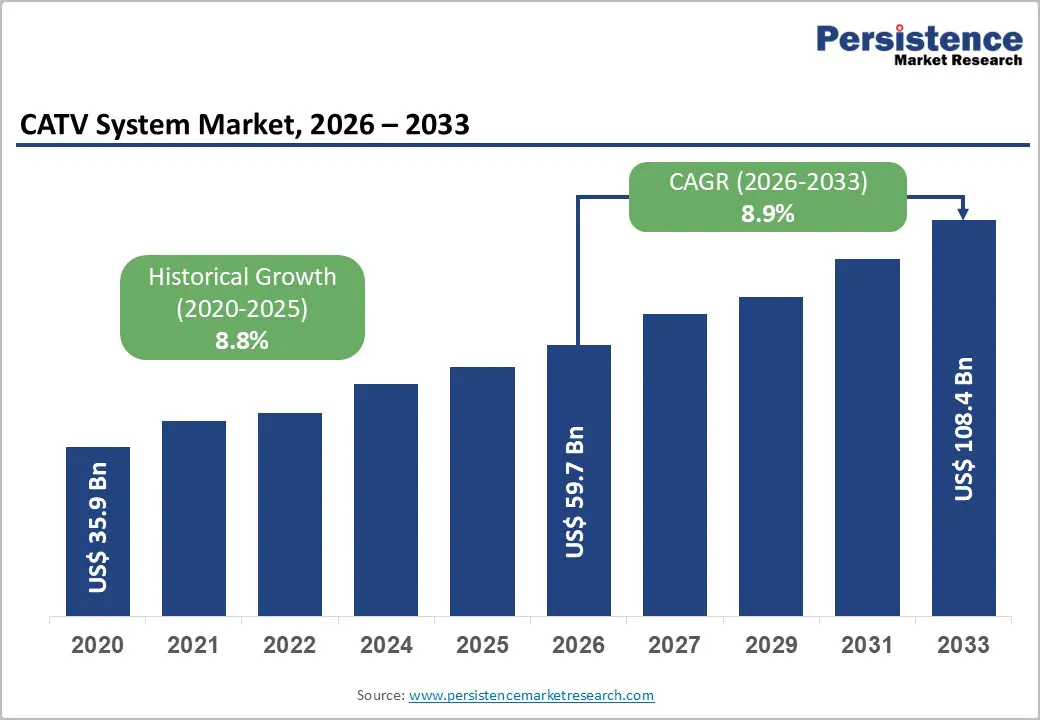
The global CATV system market size is likely to be valued at US$59.7 billion in 2026, and is expected to reach US$108.4 billion by 2033, growing at a CAGR of 8.9% during the forecast period from 2026 to 2033, driven by the increasing prevalence of high-definition and ultra-high-definition content delivery, rising demand for reliable broadband-over-cable services, and advancements in digital cable television infrastructure.
The rising need for scalable, high-bandwidth CATV infrastructure, particularly digital cable television solutions for residential and commercial use, is driving widespread adoption across global markets. Ongoing advancements in hybrid fiber-coaxial (HFC) networks and DOCSIS 4.0 technology are accelerating this trend by enabling multi-gigabit data speeds and reduced latency. The growing recognition of CATV systems as essential enablers of last-mile broadband access and premium video delivery in emerging economies remains a key driver of market expansion.
Key Industry Highlights:
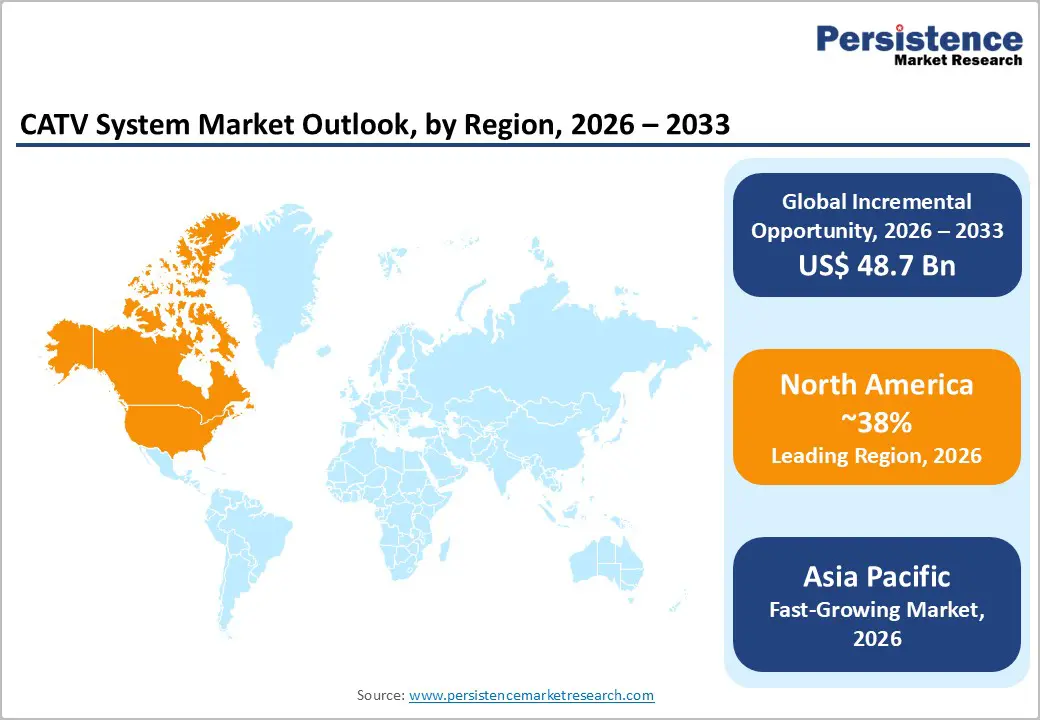
- Leading Region: North America, anticipated to account for a 38% market share in 2026, driven by high household penetration, advanced HFC networks, and strong demand in the U.S.
- Fastest-growing Region: Asia Pacific, fueled by rapid urbanization, expanding pay-TV subscriber base, and growing investments in digital cable infrastructure in China and India.
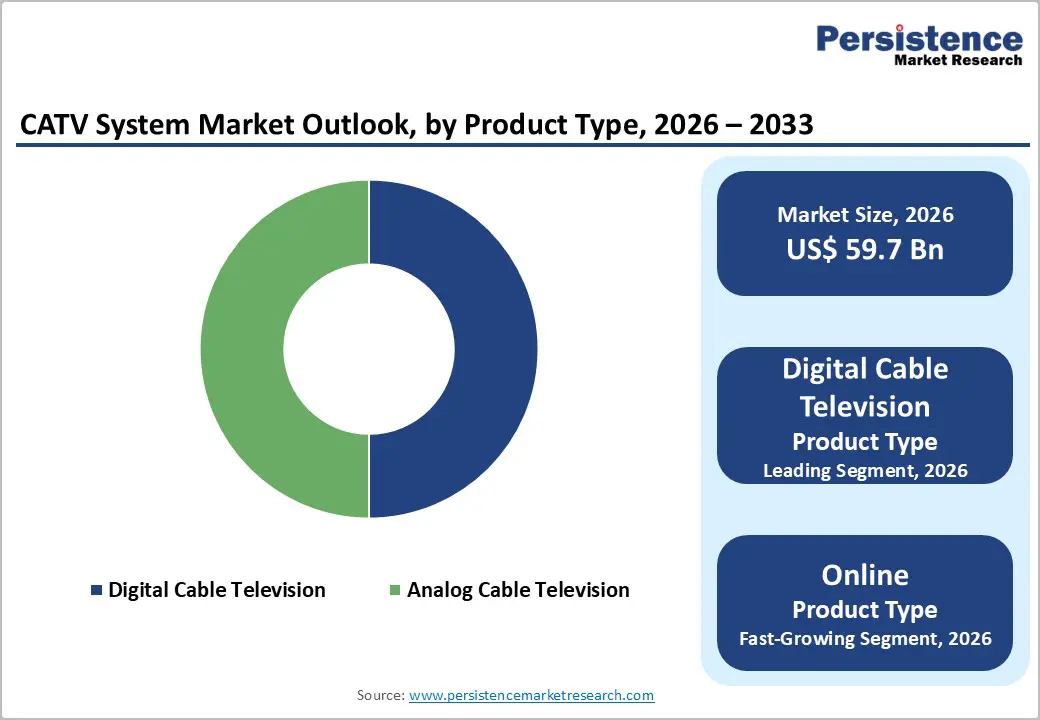
- Dominant Product Type: Digital cable television, to hold approximately 75% of the market share, as analog systems continue their phase-out.
- Leading Application: The household segment, to account for over 65% of the market revenue, due to residential broadband and video service dominance.
| Global Market Attributes | Key Insights |
|---|---|
| CATV System Market Size (2026E) | US$59.7 Bn |
| Market Value Forecast (2033F) | US$108.4 Bn |
| Projected Growth (CAGR 2026 to 2033) | 8.9% |
| Historical Market Growth (CAGR 2020 to 2025) | 8.8% |
Market Factors – Growth, Barriers, and Opportunity Analysis
Increasing Demand for High-Definition Content Delivery and Broadband-Over-Cable Services
The increasing demand for high-definition (HD) content delivery and broadband over cable services is driven by rapid changes in digital consumption behavior and network usage patterns. Consumers are increasingly accessing ultra-high-definition video, including 4K and emerging 8K content, through streaming platforms, live sports broadcasts, and interactive entertainment services. These applications require higher bandwidth, lower latency, and greater network reliability, placing significant pressure on cable and broadband infrastructure to deliver consistent, high-quality performance.
The growth of connected devices within households, such as smart TVs, gaming consoles, tablets, and IoT-enabled appliances, has increased simultaneous data usage. Broadband-over-cable networks are relied upon to support multiple high-bandwidth activities simultaneously, including video streaming, cloud gaming, video conferencing, and remote learning. This has elevated expectations for always-on connectivity and minimal service disruption. To meet these requirements, cable operators are investing in network upgrades, including higher-capacity transmission technologies, advanced signal processing, and improved last-mile connectivity. Enhanced broadband-over-cable services also enable service providers to offer bundled digital experiences that combine high-speed internet, HD video, and value-added services.
High Capital Intensity and Competition from Fiber-to-the-Home Deployments
High capital intensity and increasing competition from fiber-to-the-home (FTTH) deployments represent significant challenges for traditional broadband and cable service providers. Expanding or upgrading network infrastructure requires substantial upfront investment in equipment, network modernization, spectrum management, and ongoing maintenance. Costs associated with advanced transmission technologies, capacity expansion, and compliance with evolving technical standards place financial pressure on operators, particularly in markets where return-on-investment timelines are long and subscriber growth is gradual. Smaller and regional providers often face greater difficulty in securing the capital needed to remain competitive.
FTTH deployments are intensifying competitive dynamics by offering superior performance characteristics, including higher bandwidth, lower latency, and greater long-term scalability. Fiber networks are increasingly attractive to both residential and enterprise customers who demand consistent speeds and support for data-intensive applications, including ultra-high-definition streaming, cloud computing, and smart home ecosystems. Government-backed broadband initiatives and public-private partnerships have further accelerated fiber rollouts, increasing pressure on incumbent cable networks.
Opportunities in DOCSIS 4.0 Roll-Outs and Fixed Wireless Access Convergence
The rollout of DOCSIS 4.0 and the convergence with fixed wireless access (FWA) technologies present significant growth opportunities for broadband and cable service providers. DOCSIS 4.0 enables multi-gigabit symmetric speeds over existing hybrid fiber-coaxial networks, allowing operators to significantly enhance network performance without replacing last-mile infrastructure. This creates a cost-efficient pathway to meet the rising consumer demand for high-speed, low-latency connectivity while extending the useful life of existing assets. Enhanced upstream capacity also supports bandwidth-intensive applications, including cloud services, immersive media, and real-time collaboration.
Convergence with fixed wireless access further expands service flexibility and market reach. FWA allows providers to deliver high-speed broadband in areas where wired deployment is costly or time-consuming, including suburban and semi-rural regions. When integrated with DOCSIS 4.0 backhaul, FWA can serve as a complementary access layer, enabling rapid customer acquisition and scalable network expansion. This hybrid approach supports load balancing, improves service resilience, and reduces dependency on a single access technology.
Category-wise Analysis
Product Type Insights
Digital cable television is projected to dominate the market in 2026, accounting for over 75% of the market share, driven by its extensive infrastructure, reliable service quality, and high consumer familiarity. Established cable networks provide consistent signal transmission, high-definition viewing, and a wide range of channels, making them a preferred option for households. The adoption of digital features, such as interactive program guides, video-on-demand, and bundled broadband services, further enhances its appeal. In 2025, GTPL Hathway, one of India’s largest cable service providers, reported approximately 9.5 million active digital cable subscribers across regions, including Gujarat and the Northeast, reflecting strong consumer uptake.
Analog cable television is emerging as the fastest-growing segment, driven by its affordability, broad compatibility, and continued relevance in price-sensitive and developing markets. Many regions still rely on legacy television infrastructure, in which analog systems provide reliable service without requiring advanced set-top boxes or frequent upgrades. Analog cable remains a preferred choice for basic channel access, particularly in rural and semi-urban areas with limited digital penetration. TrueVisions, Thailand’s largest pay-TV operator, has historically offered both analog cable television (CATV) and digital satellite services, serving millions of subscribers in regions where analog distribution continues alongside digital formats.
Application Insights
The household segment continues to lead the market, accounting for roughly 65% of the share in 2026, driven by the dominance of residential broadband, extensive subscriber programs, and strong global demand for bundled video and internet services. This leadership is reinforced as households increasingly adopt smart devices. The increasing adoption of commercial hospitality and other emerging categories underscores a growing emphasis on the advantages of multi-dwelling. Comcast’s Xfinity brand is among the largest fixed broadband and bundled service providers in the U.S., with over 31 million residential broadband connections, solidifying its position as a major player in household broadband subscriptions. According to the FCC’s latest Internet Access Services report, Comcast, along with Charter Communications and AT&T, collectively accounts for more than 60% of the total U.S. fixed broadband market, highlighting the critical role of household broadband in driving market share and revenue for leading providers.
The commercial segment is the fastest-growing segment, driven by strong momentum in enterprise video and expanding adoption in multi-dwelling units and hotels. The growing shift toward IPTV platforms, along with better scalability, is accelerating adoption. Advancements in distributed access and continued progress of virtual headends are driving market growth. WorldVue was selected as the in-room entertainment provider for Loews Hotels & Co. This partnership entails the deployment of WorldVue’s IPTV-based WorldVue HUB™ platform across 26 hotel properties, enhancing guest entertainment with live streaming, customizable interfaces, mobile casting features, and integrated services. The rollout is planned to continue through 2025 and beyond, showcasing how commercial hospitality demand is driving IPTV adoption and innovation in video delivery beyond traditional residential use.
Regional Insights
North America CATV System Market Trends
North America is projected to lead the market, accounting for nearly 38% of the share in 2026, driven by the region’s high broadband penetration, strong video-on-demand ecosystem, and high public awareness of gigabit services. Network systems in the U.S. and Canada are providing extensive support for upgrade programs, ensuring wide accessibility of CATV systems across household, commercial, and rural populations. Increasing demand for DOCSIS 4.0, convenient, and easy-to-deploy forms is further accelerating the adoption, as these formats are improving speed and reducing barriers associated with legacy HFC networks.
Innovation in CATV system technology, including stable full-duplex capabilities, improved fixed wireless access convergence, and targeted 10G enhancement, is attracting significant investments from both public and private sectors. Government initiatives and FCC campaigns continue to promote adoption to mitigate risks associated with the digital divide, bandwidth constraints, and emerging 8K threats, thereby creating sustained market demand. The growing focus on commercial-grade and specialty uses, particularly in hospitality and related sectors, is expanding the range of applications for CATV systems.
Europe CATV System Market Trends
Europe is driven by increasing awareness of the benefits of gigabit connectivity, robust telecommunications infrastructure, and government-led connectivity programs. Countries such as Germany, France, and the U.K. are maintaining well-established network frameworks that support routine upgrades and encourage adoption of innovative CATV delivery methods, including CATV systems. These high-capacity formulations are particularly appealing for household populations, regulation-conscious operators, and commercial users, improving speed and coverage rates.
Technological advancements in CATV system development, such as enhanced HFC networks, application-specific delivery, and improved DOCSIS standards, are further enhancing market potential. European authorities are increasingly supporting research and trials of systems for both routine and specialized needs, thereby strengthening market confidence. The growing emphasis on convenient, low-latency options aligns with the region’s focus on preventive digital inclusion and on reducing gaps. Public awareness campaigns and promotion drives are expanding reach in both urban and rural areas, while suppliers are investing in fiber and novel variants to increase efficacy.
Asia Pacific CATV System Market Trends
Asia-Pacific is likely to be the fastest-growing market for CATV systems in 2026, driven by rising awareness of connectivity, expanding government initiatives, and growing application programs across the region. Countries such as India, China, Japan, and Southeast Asian nations are actively promoting system campaigns to address broadband growth and emerging video needs. CATV systems are particularly attractive in these regions due to their cost-effective deployment, scalability, and suitability for large-scale network deployment in both urban and rural populations.
Technological advancements are enabling the development of stable, effective, and easy-to-deploy CATV systems that can withstand challenging infrastructure conditions and minimize downtime. These innovations are critical for reaching remote facilities and improving overall coverage. Growing demand for household, commercial, and video applications is contributing to market expansion. Public-private partnerships, increased telecom expenditure, and rising investments in system research and manufacturing capacity are further accelerating growth. The convenience of system delivery, combined with improved bandwidth and reduced risk of congestion, positions CATV systems as a preferred choice.
Competitive Landscape
The global CATV system market features competition between established cable infrastructure leaders and emerging digital network suppliers. In North America and Europe, CommScope and Corning Incorporated are leading through strong R&D, distribution networks, and operator ties, bolstered by innovative HFC and DOCSIS programs. In Asia Pacific, Zhejiang Linquick Technology Co., Ltd. is advancing with localized solutions, enhancing accessibility. DOCSIS 4.0 delivery is boosting capacity, cutting latency risks, and enabling mass integrations across regions. Strategic partnerships, collaborations, and acquisitions are merging expertise, expanding portfolios, and speeding commercialization. Fiber-deep formulations are solving bandwidth issues, aiding penetration in gigabit-focused areas.
Key Industry Developments
- In March 2025, Highwave Optical Technologies, a leading European supplier of Dense Wavelength Division Multiplexing (DWDM) sub-systems for the deployment of high-speed optical telecommunications infrastructures, announced the launch of a new line of products intended for the CATV market (cable internet and television).
Companies Covered in CATV System Market
- Zhejiang Linquick Technology Co., Ltd.
- CommScope
- Belden
- Prysmian Group.
- Corning Incorporated
- Nexans
- Alpha Wire
- Southwire Company
- Hitachi Cable, Ltd.
Frequently Asked Questions
The global CATV system market is projected to reach US$59.7 billion in 2026.
High-definition content demand and broadband-over-cable services are the key drivers.
The CATV system market is poised to witness a CAGR of 8.9% from 2026 to 2033.
DOCSIS 4.0 roll-outs and fixed wireless access convergence are the key opportunities.
CommScope, Corning Incorporated, Prysmian Group, Nexans, and Belden are the key players.


