




- Technology
- Bitcoin Exchange Market
Bitcoin Exchange Market Size, Share, and Growth Forecast, 2026 - 2033
Bitcoin Exchange Market by Product Type (Centralized Exchange, Decentralized Exchange), Component Type (Software, Hardware, Services) Application (Trading, Payment, Remittance, Investment), and Regional Analysis for 2026 - 2033

Bitcoin Exchange Market Size and Trends Analysis
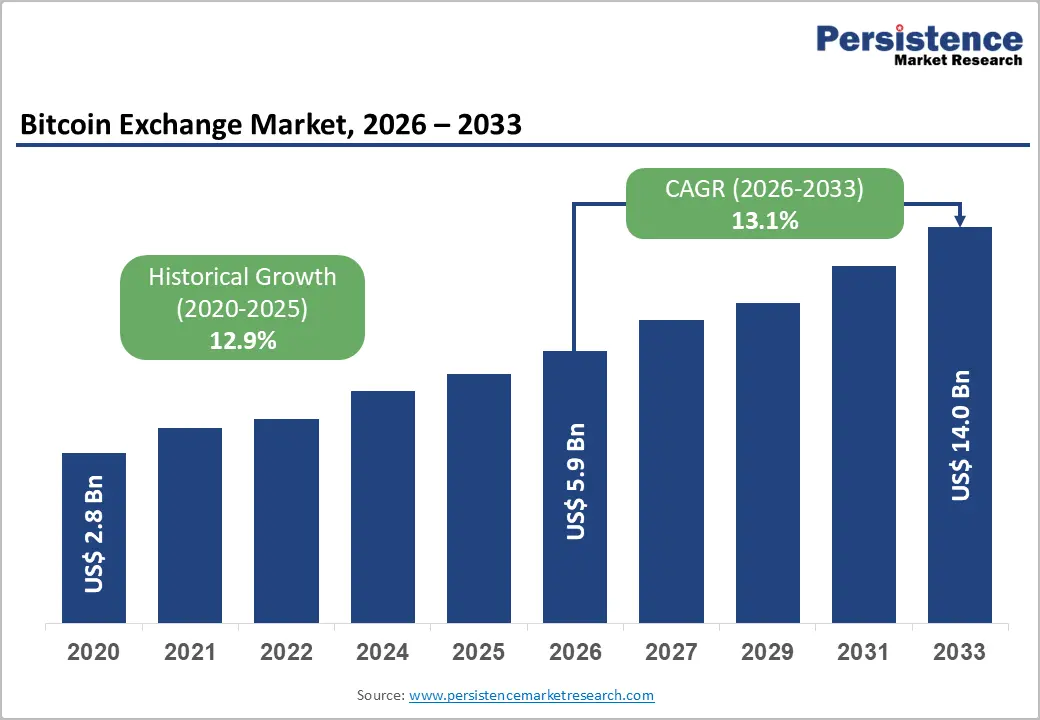
The global bitcoin exchange market size is likely to be valued at US$5.9 billion in 2026 and is expected to reach US$14.0 billion by 2033, growing at a CAGR of 13.1% during the forecast period from 2026 to 2033, driven by increasing adoption of digital assets and stronger regulatory clarity.
Growth is driven by increasing user trust, enhanced platform security, and the shift toward regulated trading environments, with broader financial integration gaining momentum as highlighted by the International Monetary Fund (2023) and rising participation from regulated entities noted by the Bank for International Settlements (2024). Exchanges are continuously upgrading their infrastructure with advanced trading tools, custody solutions, and compliance mechanisms to attract both retail and institutional participants.
Key Industry Highlights:
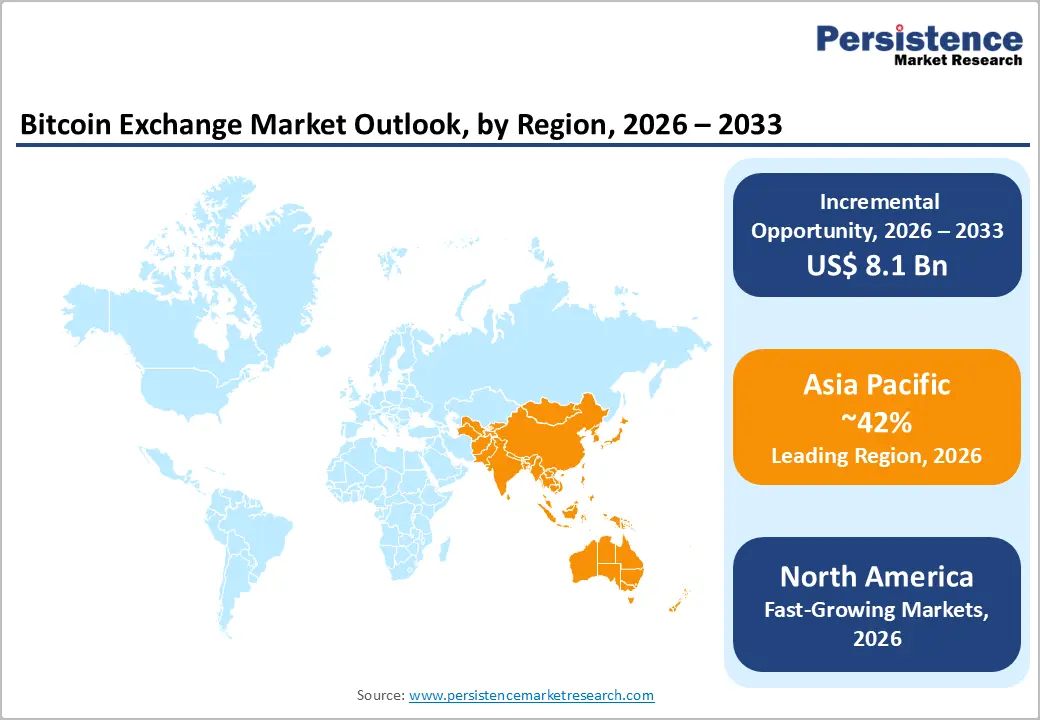
- Leading Region: Asia Pacific is anticipated to be the leading region, accounting for a market share of 42% in 2026, driven by strong retail participation, evolving regulatory frameworks, and rapid digital adoption.
- Fastest-growing Region: North America is likely to be the fastest-growing region, supported by strong institutional participation, regulatory clarity, and advanced fintech infrastructure led by the U.S.
- Leading Product Type: Centralized exchange (CEX) is projected to represent the leading product type in 2026, accounting for 88% of the revenue share, driven by strong liquidity and regulatory compliance.
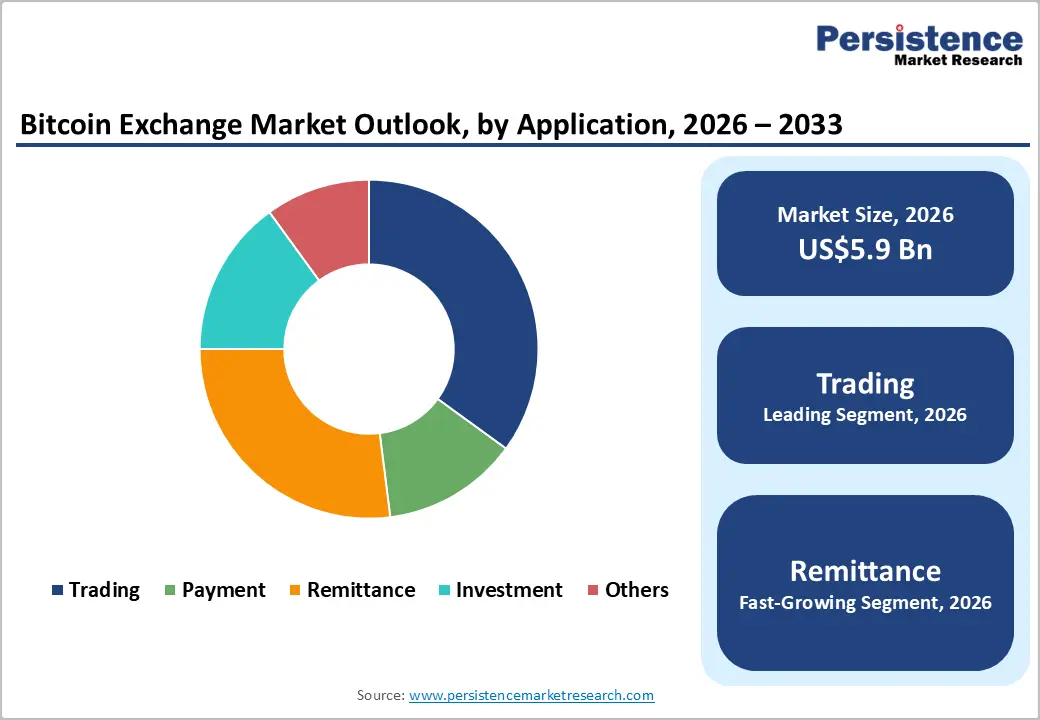
- Leading Application Type: Trading is anticipated to be the leading application type, accounting for over 72% of the revenue share in 2026, supported by its core role in trading infrastructure and exchange operations.
- Key Opportunity: The key market opportunity lies in the transition toward regulated, institutional-grade, and hybrid (CEX-DEX) exchange ecosystems integrated with traditional finance, enabling scalable global adoption and diversified revenue streams.

DRO Analysis
Driver - Institutional Adoption and Corporate Treasury Integration
Institutional adoption is accelerating the Bitcoin exchange market as asset managers, hedge funds, and corporations increasingly allocate capital to digital assets through regulated platforms. According to CoinShares (2024), digital asset investment products recorded consistent inflows driven largely by institutional demand. Exchanges are responding by enhancing custody solutions, compliance standards, and liquidity depth to meet institutional expectations.
International Monetary Fund (2023) highlights growing integration of crypto assets into traditional finance, reinforcing demand for compliant trading venues. This shift may contribute to improved stability over time and attract institutional capital.
The presence of institutional participants is transforming exchanges into sophisticated financial ecosystems offering derivatives, prime brokerage, and risk management tools. Partnerships between exchanges and traditional financial institutions are enhancing credibility and accessibility.
Restraint - Volatility and Counterparty Risk Concerns
Frequent and sharp price fluctuations discourage risk-averse investors and limit broader adoption. Sudden market swings can lead to significant losses, margin liquidations, and reduced trading confidence, particularly among new participants. Counterparty risk continues to challenge centralized exchanges, where users depend on platform security and operational integrity. Exchange failures, liquidity crises, and withdrawal restrictions have undermined trust, exposing custodial risks and the need for stronger risk management.
Counterparty risks are intensified by regulatory inconsistencies and varying compliance standards across jurisdictions, which create uncertainty for both users and institutional investors. While exchanges are improving transparency and implementing proof-of-reserves mechanisms, concerns over asset custody and solvency persist. These risks drive some users toward decentralized alternatives, though such platforms introduce their own complexities.
Opportunity - Expansion of Decentralized Exchange Features and Hybrid Models
The expansion of decentralized exchange (DEX) features presents a significant opportunity in the Bitcoin exchange market, driven by increasing demand for non-custodial trading and enhanced user control over assets. According to Chainalysis (2024), decentralized platforms have witnessed rising adoption as users seek greater transparency and security. Hybrid exchange models, combining centralized liquidity with decentralized custody, are gaining traction by addressing the limitations of both systems.
Hybrid and decentralized models are also fostering integration with broader decentralized finance ecosystems, enabling advanced functionalities such as automated market making, staking, and cross-chain interoperability. Bank for International Settlements (2024) notes increasing experimentation with innovative digital asset infrastructures, supporting this transition. These developments enhance efficiency, reduce reliance on intermediaries, and expand accessibility.
Category-wise Analysis
Product Type Insights
Centralized exchanges (CEX) are expected to lead, accounting for approximately 88% of revenue in 2026, driven by their deep liquidity, high transaction speed, and strong regulatory compliance frameworks. These platforms provide seamless fiat on-ramps, advanced trading tools, and institutional-grade custody solutions, making them the preferred choice for both retail and institutional investors. A notable example includes Coinbase, known for its strong regulatory compliance and security, attracting significant institutional participation.
Decentralized exchanges (DEX) are likely to represent the fastest-growing segment, supported by increasing demand for non-custodial trading and enhanced user control over digital assets. These platforms eliminate intermediaries, allowing users to retain full ownership of their funds while executing peer-to-peer transactions through smart contracts. For instance, Uniswap, widely adopted for its decentralized model, highlights the growing demand for transparency and self-custody.
Component Type Insights
Software is projected to lead the market, capturing around 70% of the revenue share in 2026, as it forms the core infrastructure of Bitcoin exchanges. Trading engines, order-matching systems, security protocols, and user interfaces are all powered by advanced software solutions, enabling efficient and secure transaction processing. For example, Binance leverages advanced software for high-speed trading and efficient operations.
Services are likely to be the fastest-growing component type, driven by increasing institutional participation and the need for regulatory compliance. This segment includes custody services, compliance consulting, risk management, and blockchain analytics, all of which are essential for institutional-grade operations. A notable example includes Kraken, offering custody and advanced trading services that strengthen trust and compliance.
Application Type Insights
Trading is expected to lead the Bitcoin exchange market, accounting for approximately 72% of revenue in 2026, driven by high transaction volumes across spot, margin, and derivatives markets. The speculative nature of cryptocurrencies, combined with increasing participation from both retail and institutional investors, sustains strong demand for trading activities. For instance, Binance, leading in trading volumes with diverse instruments, underscores trading’s central role in the market.
Remittance is likely to represent the fastest-growing segment, supported by the need for faster and more cost-effective cross-border transactions. Bitcoin exchanges enable near-instant fund transfers with lower fees compared to traditional remittance channels, making them particularly attractive in emerging markets. For example, Bitstamp, which facilitates efficient cross-border transactions through its exchange infrastructure, highlights the growing role of Bitcoin exchanges in transforming remittance systems.
Regional Insights
North America Bitcoin Exchange Market Trends
North America region is likely to be the fastest-growing region, driven by strong institutional participation and regulatory evolution. The U.S. leads the region with advanced financial infrastructure, rising adoption of Bitcoin ETFs, and deeper integration of digital assets into traditional finance, driving large-scale trading activity and liquidity expansion. Mexico is gradually emerging with increasing fintech adoption and cross-border crypto use cases, particularly in remittance-driven applications.
A key trend shaping the regional market is the convergence of traditional finance with crypto infrastructure, supported by partnerships, investments, and regulatory advancements. For instance, Kraken has strengthened its institutional positioning through strategic collaborations and regulatory milestones, reflecting the broader shift toward compliant and institutional-grade exchange ecosystems. In Canada, increasing mergers and acquisitions are enhancing platform scalability and service diversification.
Europe Bitcoin Exchange Market Trends
Europe is likely to be a significant market for Bitcoin exchange, due to regulatory standardization and increasing institutional participation. The U.K. is strengthening its position as a crypto hub through new regulatory consultations led by the Financial Conduct Authority in 2026, aimed at bringing crypto exchanges under formal financial oversight and enhancing investor protection frameworks.
Germany continues to lead in regulatory clarity with BaFin’s structured licensing environment, supporting institutional confidence and secure exchange operations. For example, Deutsche Börse recently expanded its involvement in digital assets through a strategic investment in Kraken in 2026, highlighting a growing institutional commitment to regulated crypto trading infrastructure. In France, policymakers are pushing for euro-backed stablecoins and tokenized financial systems to strengthen regional payment sovereignty, while U.K. reforms aim to attract crypto firms post-Brexit.
Asia Pacific Bitcoin Exchange Market Trends
The Asia Pacific region is anticipated to be the leading region, accounting for a market share of 42% in 2026, driven by strong retail participation and evolving regulatory dynamics across China and India. China continues to maintain strict restrictions on cryptocurrency trading, but recent developments around digital yuan expansion and asset tokenization indicate a shift toward controlled digital finance innovation.
Japan’s regulatory modernization and growing acceptance of stablecoins are accelerating exchange activity and institutional trading volumes, while India’s expanding user base is driving demand for secure and compliant platforms. Companies such as bitFlyer, a Japan-based exchange known for operating under strict regulatory compliance, reflect the region’s shift toward secure and transparent trading environments.
Competitive Landscape
The global Bitcoin exchange market exhibits a moderately fragmented structure, driven by the presence of a few dominant platforms alongside numerous regional and niche exchanges competing for liquidity and user base. While the market shows signs of consolidation, with top-tier exchanges collectively controlling a significant share of trading volume, competition remains intense due to continuous innovation and evolving regulatory landscapes.
With key leaders including Binance, Coinbase, Kraken, and OKX, the market reflects a mix of dominance and regional specialization. These players compete through pricing strategies, liquidity depth, trading speed, and diversified product portfolios such as derivatives, staking, and institutional custody services. Binance consistently ranks among the highest by trading volume, while Coinbase focuses on compliance and Kraken on security and advanced trading.
Key Industry Developments:
- In April 2026, Charles Schwab announced plans to launch direct Bitcoin and Ethereum trading for its clients, marking a significant move by a major traditional financial institution into the cryptocurrency exchange market and intensifying competition with existing crypto platforms.
- In April 2026, Goldman Sachs filed for its first Bitcoin ETF with the U.S. SEC, introducing a new income-focused product designed to provide Bitcoin exposure while generating returns through options-based strategies, signaling deeper institutional entry into the crypto investment space.
- In March 2025, BlackRock launched its first Bitcoin exchange-traded product (iShares Bitcoin ETP) in Europe, listed on major exchanges including Paris, Amsterdam, and Frankfurt, marking a significant expansion of institutional crypto investment offerings beyond the U.S. and strengthening regulated market access for European investors.
Companies Covered in Bitcoin Exchange Market
- Coinbase
- Binance
- Kraken
- Bitfinex
- Bittrex
- Gemini
- Huobi
- OKEx
- Bitstamp
- KuCoin
- Poloniex
- Coincheck
- BitFlyer
Frequently Asked Questions
The global Bitcoin exchange market is projected to reach US$5.9 billion in 2026.
Rising institutional adoption, increasing retail participation, and growing demand for secure and regulated cryptocurrency trading platforms drive the Bitcoin exchange market.
The Bitcoin exchange market is expected to grow at a CAGR of 13.1% from 2026 to 2033.
Expansion of decentralized exchange models, integration with traditional financial systems, and growth in cross-border crypto transactions create key opportunities in the Bitcoin exchange market.
Coinbase, Binance, Kraken, Bitfinex, Bittrex, Gemini, and Huobi are the leading players.


