


- Executive Summary
- Global Beauty Devices Market Snapshot 2025 and 2032
- Market Opportunity Assessment, 2025 - 2032, US$ Mn
- Key Market Trends
- Industry Developments and Key Market Events
- Demand Side and Supply Side Analysis
- PMR Analysis and Recommendations
- Market Overview
- Market Scope and Definitions
- Value Chain Analysis
- Macro-Economic Factors
- Global GDP Outlook
- Disposable Income Outlook
- Population Demographics
- Health and Wellness Trends
- Media and Advertising Expenditure
- Forecast Factors - Relevance and Impact
- COVID-19 Impact Assessment
- PESTLE Analysis
- Porter's Five Forces Analysis
- Geopolitical Tensions: Market Impact
- Regulatory and Technology Landscape
- Market Dynamics
- Drivers
- Restraints
- Opportunities
- Trends
- Price Trend Analysis, 2019 - 2032
- Region-wise Price Analysis
- Price by Product
- Price Impact Factors
- Global Beauty Devices Market Outlook: Historical (2019 - 2024) and Forecast (2025 - 2032)
- Key Highlights
- Global Beauty Devices Market Outlook: Product
- Introduction/Key Findings
- Historical Market Size (US$ Mn) Analysis by Product, 2019-2024
- Current Market Size (US$ Mn) Forecast, by Product, 2025-2032
- Acne Treatment Devices
- Anti-Aging Devices
- Cleansing Devices
- Hair Removal & Hair Growth Devices
- Others
- Market Attractiveness Analysis: Product
- Global Beauty Devices Market Outlook: Technology
- Introduction/Key Findings
- Historical Market Size (US$ Mn) Analysis by Technology, 2019-2024
- Current Market Size (US$ Mn) Forecast, by Technology, 2025-2032
- LED
- Microcurrent
- Radiofrequency (RF)
- Ultrasound/Ultrasonic
- Laser-based
- Others
- Market Attractiveness Analysis: Technology
- Global Beauty Devices Market Outlook: Distribution Channel
- Introduction/Key Findings
- Historical Market Size (US$ Mn) Analysis by Distribution Channel, 2019-2024
- Current Market Size (US$ Mn) Forecast, by Distribution Channel, 2025-2032
- Online
- Offline
- Market Attractiveness Analysis: Distribution Channel
- Global Beauty Devices Market Outlook: End User
- Introduction/Key Findings
- Historical Market Size (US$ Mn) Analysis by End User, 2019-2024
- Current Market Size (US$ Mn) Forecast, by End User, 2025-2032
- Salons & Spas
- Personal / At-Home Users
- Hospitals and Dermatology Clinics
- Others
- Market Attractiveness Analysis: End User
- Global Beauty Devices Market Outlook: Region
- Key Highlights
- Historical Market Size (US$ Mn) Analysis by Region, 2019-2024
- Current Market Size (US$ Mn) Forecast, by Region, 2025-2032
- North America
- Europe
- East Asia
- South Asia & Oceania
- Latin America
- Middle East & Africa
- Market Attractiveness Analysis: Region
- North America Beauty Devices Market Outlook: Historical (2019 - 2024) and Forecast (2025 - 2032)
- Key Highlights
- North America Market Size (US$ Mn) Forecast, by Country, 2025-2032
- U.S.
- Canada
- North America Market Size (US$ Mn) Forecast, by Product, 2025-2032
- Acne Treatment Devices
- Anti-Aging Devices
- Cleansing Devices
- Hair Removal & Hair Growth Devices
- Others
- North America Market Size (US$ Mn) Forecast, by Technology, 2025-2032
- LED
- Microcurrent
- Radiofrequency (RF)
- Ultrasound/Ultrasonic
- Laser-based
- Others
- North America Market Size (US$ Mn) Forecast, by Distribution Channel, 2025-2032
- Online
- Offline
- North America Market Size (US$ Mn) Forecast, by End User, 2025-2032
- Salons & Spas
- Personal / At-Home Users
- Hospitals and Dermatology Clinics
- Others
- Europe Beauty Devices Market Outlook: Historical (2019 - 2024) and Forecast (2025 - 2032)
- Key Highlights
- Europe Market Size (US$ Mn) Forecast, by Country, 2025-2032
- Germany
- Italy
- France
- U.K.
- Spain
- Russia
- Benelux
- Nordics
- Rest of Europe
- Europe Market Size (US$ Mn) Forecast, by Product, 2025-2032
- Acne Treatment Devices
- Anti-Aging Devices
- Cleansing Devices
- Hair Removal & Hair Growth Devices
- Others
- Europe Market Size (US$ Mn) Forecast, by Technology, 2025-2032
- LED
- Microcurrent
- Radiofrequency (RF)
- Ultrasound/Ultrasonic
- Laser-based
- Others
- Europe Market Size (US$ Mn) Forecast, by Distribution Channel, 2025-2032
- Online
- Offline
- Europe Market Size (US$ Mn) Forecast, by End User, 2025-2032
- Salons & Spas
- Personal / At-Home Users
- Hospitals and Dermatology Clinics
- Others
- East Asia Beauty Devices Market Outlook: Historical (2019 - 2024) and Forecast (2025 - 2032)
- Key Highlights
- East Asia Market Size (US$ Mn) Forecast, by Country, 2025-2032
- China
- Japan
- South Korea
- East Asia Market Size (US$ Mn) Forecast, by Product, 2025-2032
- Acne Treatment Devices
- Anti-Aging Devices
- Cleansing Devices
- Hair Removal & Hair Growth Devices
- Others
- East Asia Market Size (US$ Mn) Forecast, by Technology, 2025-2032
- LED
- Microcurrent
- Radiofrequency (RF)
- Ultrasound/Ultrasonic
- Laser-based
- Others
- East Asia Market Size (US$ Mn) Forecast, by Distribution Channel, 2025-2032
- Online
- Offline
- East Asia Market Size (US$ Mn) Forecast, by End User, 2025-2032
- Salons & Spas
- Personal / At-Home Users
- Hospitals and Dermatology Clinics
- Others
- South Asia & Oceania Beauty Devices Market Outlook: Historical (2019 - 2024) and Forecast (2025 - 2032)
- Key Highlights
- South Asia & Oceania Market Size (US$ Mn) Forecast, by Country, 2025-2032
- India
- Southeast Asia
- ANZ
- Rest of SAO
- South Asia & Oceania Market Size (US$ Mn) Forecast, by Product, 2025-2032
- Acne Treatment Devices
- Anti-Aging Devices
- Cleansing Devices
- Hair Removal & Hair Growth Devices
- Others
- South Asia & Oceania Market Size (US$ Mn) Forecast, by Technology, 2025-2032
- LED
- Microcurrent
- Radiofrequency (RF)
- Ultrasound/Ultrasonic
- Laser-based
- Others
- South Asia & Oceania Market Size (US$ Mn) Forecast, by Distribution Channel, 2025-2032
- Online
- Offline
- South Asia & Oceania Market Size (US$ Mn) Forecast, by End User, 2025-2032
- Salons & Spas
- Personal / At-Home Users
- Hospitals and Dermatology Clinics
- Others
- Latin America Beauty Devices Market Outlook: Historical (2019 - 2024) and Forecast (2025 - 2032)
- Key Highlights
- Latin America Market Size (US$ Mn) Forecast, by Country, 2025-2032
- Brazil
- Mexico
- Rest of LATAM
- Latin America Market Size (US$ Mn) Forecast, by Product, 2025-2032
- Acne Treatment Devices
- Anti-Aging Devices
- Cleansing Devices
- Hair Removal & Hair Growth Devices
- Others
- Latin America Market Size (US$ Mn) Forecast, by Technology, 2025-2032
- LED
- Microcurrent
- Radiofrequency (RF)
- Ultrasound/Ultrasonic
- Laser-based
- Others
- Latin America Market Size (US$ Mn) Forecast, by Distribution Channel, 2025-2032
- Online
- Offline
- Latin America Market Size (US$ Mn) Forecast, by End User, 2025-2032
- Salons & Spas
- Personal / At-Home Users
- Hospitals and Dermatology Clinics
- Others
- Middle East & Africa Beauty Devices Market Outlook: Historical (2019 - 2024) and Forecast (2025 - 2032)
- Key Highlights
- Middle East & Africa Market Size (US$ Mn) Forecast, by Country, 2025-2032
- GCC Countries
- South Africa
- Northern Africa
- Rest of MEA
- Middle East & Africa Market Size (US$ Mn) Forecast, by Product, 2025-2032
- Acne Treatment Devices
- Anti-Aging Devices
- Cleansing Devices
- Hair Removal & Hair Growth Devices
- Others
- Middle East & Africa Market Size (US$ Mn) Forecast, by Technology, 2025-2032
- LED
- Microcurrent
- Radiofrequency (RF)
- Ultrasound/Ultrasonic
- Laser-based
- Others
- Middle East & Africa Market Size (US$ Mn) Forecast, by Distribution Channel, 2025-2032
- Online
- Offline
- Middle East & Africa Market Size (US$ Mn) Forecast, by End User, 2025-2032
- Salons & Spas
- Personal / At-Home Users
- Hospitals and Dermatology Clinics
- Others
- Competition Landscape
- Market Share Analysis, 2024
- Market Structure
- Competition Intensity Mapping
- Competition Dashboard
- Company Profiles
- L’Oréal SA
- Company Overview
- Product Portfolio/Offerings
- Key Financials
- SWOT Analysis
- Company Strategy and Key Developments
- Panasonic Corporation
- Koninklijke Philips N.V.
- Nu Skin Enterprises Inc.
- TRIA Beauty Inc.
- Home Skinovations Ltd.
- The Procter & Gamble Company
- Lumenis Ltd.
- YA-MAN Ltd.
- MTG Co. Ltd.
- FOREO
- Candela Corporation
- Others
- L’Oréal SA
- Appendix
- Research Methodology
- Research Assumptions
- Acronyms and Abbreviations


- Beauty & Personal Care
- Beauty Devices Market
Beauty Devices Market Size, Share, and Growth Forecast, 2025 - 2032
Beauty Devices Market by Product (Acne Treatment Devices, Anti-Aging Devices, Cleansing Devices, Hair Removal & Hair Growth Devices, Others), Technology (LED, Microcurrent, Radiofrequency (RF), Ultrasound/Ultrasonic, Laser-based, Others), Distribution Channel (Online, Offline), End User, and Regional Analysis for 2025 - 2032
Beauty Devices Market Size and Trends
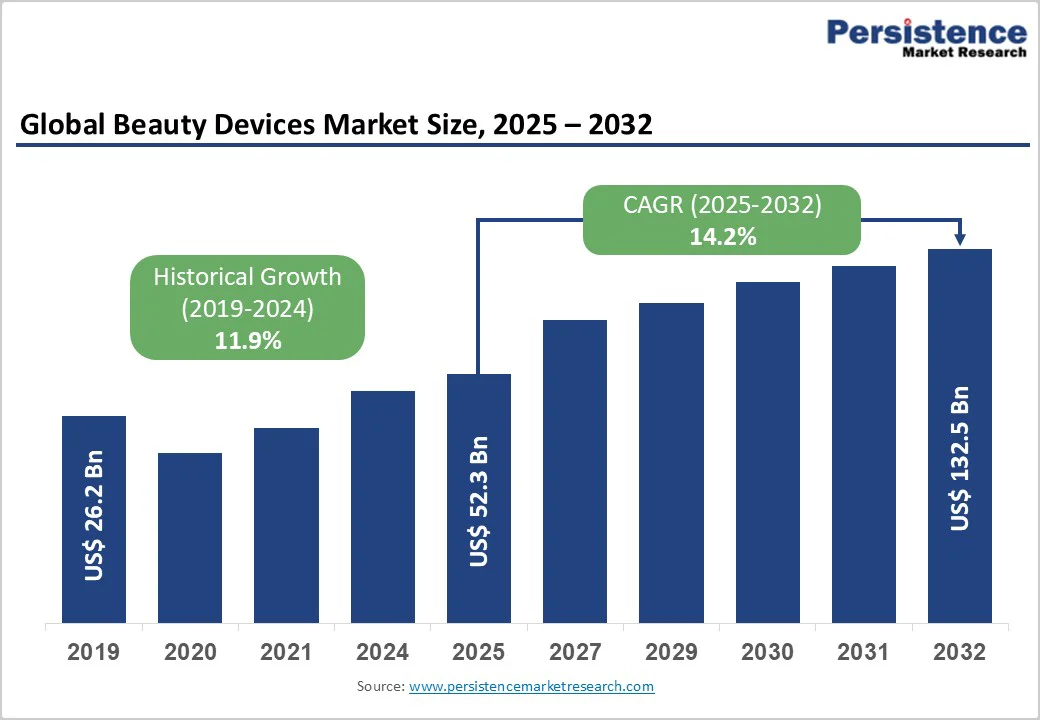
The global beauty devices market size is projected to rise from US$52.3 Bn in 2025 to US$132.5 Bn by 2032. It is anticipated to witness a CAGR of 14.2% during the forecast period from 2025 to 2032.
This growth is driven by rising consumer demand for effective skincare and anti-aging solutions, addressing concerns such as acne, uneven skin tone, and visible signs of aging. Technological advancements are enhancing treatment efficacy and convenience, while the preference for non-invasive, cost-effective, and time-saving devices continues to expand adoption. Increasing awareness of self-care and wellness further supports sustained market growth.
Key Industry Highlights:
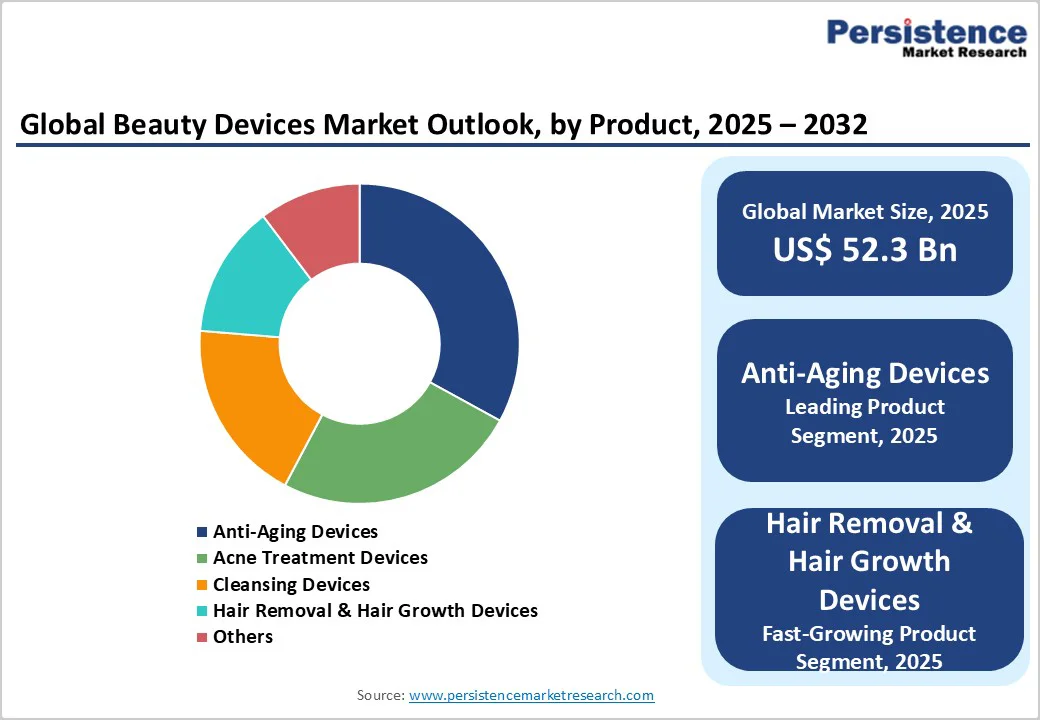
- Leading Product: Anti-aging devices lead with over 30% market share in 2025, driven by demand for wrinkle reduction, skin tightening, and collagen stimulation therapies. Hair removal and hair growth devices are the fastest-growing category, fueled by consumer preference for convenient, safe, and long-term solutions.
- Leading Technology: LED devices dominate with over 35% share in 2025 due to versatility, efficacy, and multi-skin concern treatment capabilities. Radiofrequency (RF) technology is the fastest-growing segment, with a CAGR of 18.7%, driven by non-invasive skin tightening, body contouring, and home-use device miniaturization.
- Leading Distribution Channel: Offline channels capture over 48% share in 2025, supported by hands-on demonstrations, expert guidance, and consumer trust. Online channels grow at a CAGR of 19.1%, benefiting from e-commerce expansion, social media influence, and direct-to-consumer engagement.
- Leading End User: At-home users account for over 43% share in 2025, driven by convenience, privacy, flexible treatment schedules, and integration with AI-enabled apps for personalized skincare. Salons and spas are growing rapidly due to professional adoption of multifunctional beauty devices and wellness-focused service offerings.
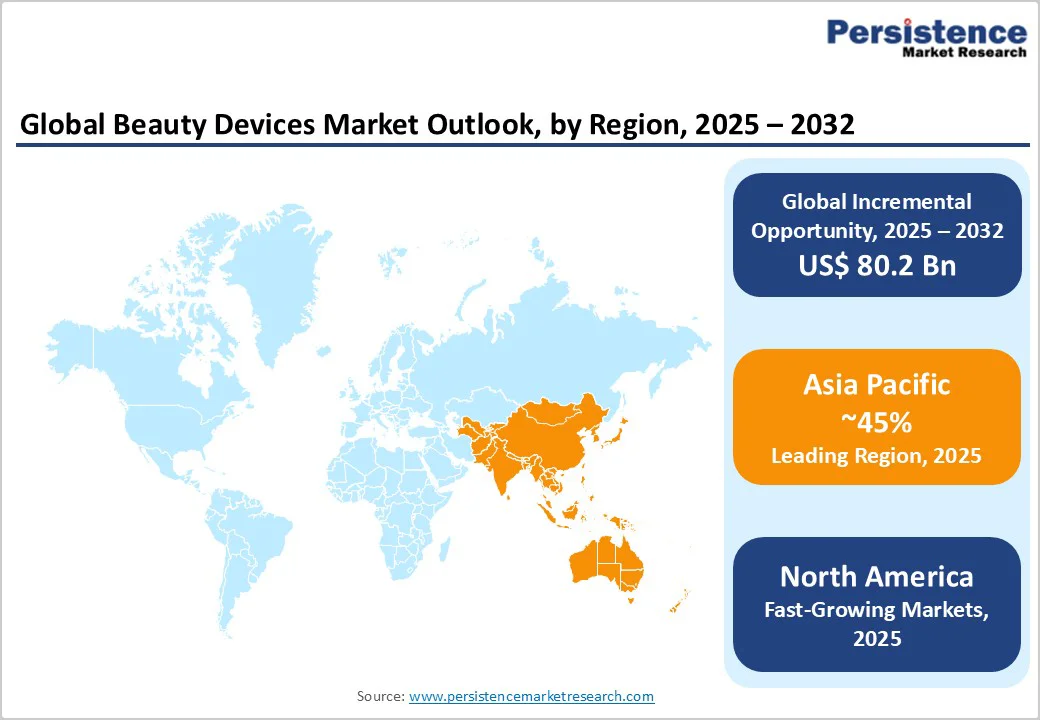
- Leading Region: Asia Pacific is projected to hold over 45% market share by 2025, led by a large population, aging demographics, and rising disposable incomes. North America grows steadily with a CAGR of 14.9% due to advanced healthcare infrastructure, regulatory frameworks, and early technology adoption.
| Global Market Attribute | Key Insights |
|---|---|
| Beauty Devices Market Size (2025E) | US$52.3 Bn |
| Market Value Forecast (2032F) | US$132.5 Bn |
| Projected Growth (CAGR 2025 to 2032) | 14.2% |
| Historical Market Growth (CAGR 2019 to 2024) | 11.9% |
Market Dynamics
Driver
Growing Elderly Population Seeking Anti-Aging Solutions
Rising demographic shifts are fueling demand for anti-aging and skin rejuvenation devices. The global population aged 65+ nearly doubled from 5.5% in 1974 to 10.3% in 2024, according to UN DESA, with older consumers seeking non-invasive solutions for wrinkles, fine lines, and skin laxity.
Younger demographics, including Gen X and Millennials, show heightened appearance consciousness driven by social media, influencer endorsements, and digital beauty communities. This combination of preventive and corrective skincare needs across multiple age groups creates a robust, diversified market for anti-aging beauty devices, particularly for treatments targeting wrinkles, age spots, and skin firmness.
Growing Prevalence of Skin Disorders and Lifestyle-Related Conditions
The rising incidence of skin disorders such as acne, hyperpigmentation, and photoaging is driving demand for beauty devices. According to the World Health Organization and the American Academy of Dermatology, over 85% of individuals aged 12-25 experience acne globally, while chronic skin issues are increasing due to pollution, diet, and stress.
Consumers are increasingly adopting non-invasive, home-use solutions like LED and microcurrent devices for safe, drug-free skincare. This trend expands the market for therapeutic skincare, encouraging hybrid products that merge beauty and dermatology.
A global study by Pierre Fabre Laboratories in 2024 found that the prevalence of acne was approximately 20.5% globally, with higher rates among younger adults, reaching 28.3% in the 16-24 age group.
Restraint
Regulatory Complexities and Clinical Evidence Requirements
Beauty device manufacturers face significant regulatory challenges that extend development timelines and raise commercialization costs. Medical-grade or therapeutic devices require stringent approvals, such as FDA clearance in North America and EU MDR compliance, necessitating extensive clinical trials, safety assessments, and efficacy documentation.
Lack of standardized clinical evidence for certain device categories increases consumer skepticism and regulatory scrutiny. Divergent international standards complicate labeling, adverse event reporting, and post-market surveillance, while MoCRA implementation in North America adds mandatory facility registration, product listing, and safety substantiation, further heightening compliance burdens.
High Initial Cost and Price Sensitivity
The high acquisition cost of advanced beauty devices, especially those with AI, skin analysis, and multifunctional features, limits adoption in price-sensitive regions such as Eastern Europe, Latin America, and parts of Asia-Pacific.
Additional expenses for consumables, replacement heads, and periodic upgrades further raise investment requirements, deterring budget-conscious consumers. Recent tariff increases on imports, including LED therapy panels and microcurrent components from East Asia, have further escalated costs, creating affordability challenges and constraining overall market growth.
Opportunity
Integration of AI, IoT, and Data Analytics for Personalized Skincare
The convergence of AI, IoT, and data analytics is enabling highly personalized skincare solutions, with smart sensors analyzing real-time skin conditions and offering tailored treatment plans. IoT connectivity allows seamless tracking across apps, while predictive analytics anticipate skin concerns, enhancing engagement and adherence.
Innovations like L’Oréal’s AI-powered SkinCeuticals D.O.S.E and Cell BioPrint exemplify precision beauty, driving consumer trust and loyalty. Advanced sensors measuring hydration, oil content, and other parameters provide actionable insights, with 50-60% of consumers in 2025 expressing interest in AI-powered personalized skincare. This integration represents a significant opportunity for manufacturers to differentiate products and command premium pricing.
Medical-Aesthetic Integration and Hybrid Devices
The integration of medical and cosmetic technologies is driving demand for hybrid beauty devices that combine diagnostic and treatment functions, such as LED-laser systems for acne or RF-ultrasound for collagen stimulation. Non-surgical cosmetic procedures grew over 20% between 2019 and 2024 according to the American Society for Dermatologic Surgery, signaling a rising B2B market for clinically validated, multifunctional devices.
Consumer preference for all-in-one solutions creates opportunities for modular add-ons and bundled features. Dermatology clinics, medspas, and aesthetic centers are increasingly adopting multifunctional platforms, enhancing efficiency, credibility, and trust. For example, in February 2024, Nu-Skin Enterprises launched the FDA-cleared RenuSpa iO, a smart microcurrent body device designed to enhance wellness and skin confidence through personalized stimulation.
Category-wise Analysis
By Product
Anti-Aging Devices Driving Wrinkle Reduction, Skin Tightening
Anti-aging devices are expected to account for more than 30% of the market share in 2025, reflecting sustained consumer investment in wrinkle reduction, skin tightening, and collagen stimulation therapies. Rising aesthetic consciousness among aging populations, coupled with the influence of social media and digital beauty trends, is driving adoption.
These devices also support preventive skincare, enabling users to maintain youthful skin from an earlier age. The integration of AI-powered skin analysis allows for personalized anti-aging protocols, enhancing both user satisfaction and treatment efficacy.
Hair removal and hair growth devices are poised for the highest growth, due to the rising consumer demand for convenient, long-term solutions for unwanted hair and thinning hair concerns. Increasing awareness of personal grooming and aesthetic appearance, coupled with technological advancements such as laser, IPL, and LED-based hair treatments, is further boosting adoption.
Growing concerns about side effects from chemical depilatories and hair growth products are pushing consumers toward safe, device-based solutions. This is particularly strong among Millennials and Gen Z, who value efficiency, personalization, and visible results.
By Technology
LED Devices Powering Versatile, Multi-Concern, and Smart Skincare Treatments
LEDs are expected to account for over 35% share in 2025 due to their versatility and proven efficacy in addressing skin concerns such as acne, hyperpigmentation, and signs of aging. Rising consumer awareness about skin health and the growing popularity of personalized skincare routines are driving adoption.
Unlike chemical treatments, LED devices offer anti-aging and skin rejuvenation benefits with minimal side effects. Innovations in wearable and smart LED devices, often integrated with AI and app-based guidance, enhance user experience and convenience. Multi-wavelength LED platforms capable of treating multiple concerns simultaneously create a premium positioning, encouraging sustained consumer investment.
Radiofrequency (RF) technology is expected to grow at a CAGR of 18.7%. RF technology stimulates collagen production and elastin remodeling through controlled thermal energy, providing non-invasive solutions for skin tightening and body contouring.
Recent innovations, including fractional microneedle RF systems and temperature-controlled platforms, enhance treatment precision and patient comfort. Home-use RF devices are experiencing particularly strong growth as miniaturization and user-friendly designs make professional-grade treatments accessible for personal use, driving segment expansion at rates exceeding overall market growth.
By Distribution Channel
Offline Channels Driving Consumer Trust and Enhanced Purchase Experience
Offline channel is expected to account for more than 48% share in 2025 due to consumers’ preference for physically experiencing and testing devices before purchase. Retail stores, specialty beauty outlets, and dermatology clinics allow hands-on demonstrations, personalized consultations, and expert guidance, which build trust in product efficacy.
High-value devices often require professional advice, making offline channels more suitable. Established brand presence and strong in-store promotions drive consumer confidence and purchase decisions. The social experience of shopping in-store and immediate product availability further reinforce offline dominance.
Online is expected to grow at a CAGR of 19.1% fueled by e-commerce expansion, social media influence, and pandemic-driven consumer behavior shifts towards digital purchasing. Online platforms offer convenience, broader product selection, competitive pricing, and direct-to-consumer engagement opportunities.
Social media platforms, particularly Instagram and TikTok, serve as powerful discovery and purchasing channels, with influencer endorsements and user-generated content driving consumer interest. Online channels benefit from lower distribution costs and global market access, enabling brands to reach geographically dispersed consumers and emerging market populations.
By End User
At-Home Beauty Devices Fueling Flexible, Private, and Technology-Enhanced Skincare Experiences
Personal/at-home users are expected to account for over 43% share in 2025, driven by consumer preference for convenience, cost savings, and privacy. At-home users benefit from flexible treatment schedules, elimination of travel time, and sustained usage patterns, enabling gradual result accumulation.
Integration of mobile applications enabling treatment tracking, progress visualization, and personalized protocols enhances engagement and adherence. The at-home segment's dominance reflects broader consumer preference for self-care solutions and independent aesthetic management.
Salons & spas are poised for significant growth as professional centers integrate advanced beauty devices into service offerings. Clients increasingly prefer quick and safe procedures, and advanced devices such as LED therapy, radiofrequency, and microcurrent tools enable salons to deliver superior results.
The trend toward wellness-focused self-care and experiential beauty services encourages frequent visits, driving greater device adoption in these professional settings. The proliferation of medspas, particularly in urban areas, provides dedicated environments for aesthetic treatments, establishing standardized protocols and best practices.
Regional Insights
North America Beauty Devices Market Trends
North America’s beauty devices market is set to grow at a robust CAGR of 14.9%, driven by advanced healthcare infrastructure, strong consumer spending, and early technology adoption. The U.S., supported by FDA oversight and the MoCRA regulations, ensures consumer confidence and safety, while Canada’s aligned Health Canada standards facilitate cross-border growth.
Post-COVID trends, including remote consultations, AI-enabled skin diagnostics, and tele-dermatology-device integrations, have accelerated adoption, particularly for acne, photodamage, eczema, and anti-aging treatments. Investments through acquisitions, dermatology partnerships, and hybrid retail-digital models further support market growth, while U.S. Bureau of Labor Statistics data show a 9.7% rise in personal-care spending in 2023, underlining rising discretionary budgets.
Asia Pacific Beauty Devices Market Trends
Asia Pacific is projected to account for over 45% of the beauty devices market by 2025, with China leading due to its large population, aging demographics, high skin disease prevalence, and rising disposable incomes.
Japan’s market emphasizes premium device adoption, reflecting high per-capita income and quality-conscious consumers, while India is the fastest-growing market with an 18.9% CAGR, driven by a young population, expanding middle class, and rising e-commerce penetration.
High connectivity in India, 945 million broadband subscriptions by end-2024 and digital-first lifestyles across the region enable D2C launches, social commerce, and tele-consultations, while regulatory clarity in Australia (TGA 2024) guides device classification and safety compliance.
Southeast Asian countries such as Vietnam, Thailand, and Indonesia are seeing accelerated adoption as middle-class growth and social media influence e.g., WeChat, Douyin, drive consumer demand.
Europe Beauty Devices Market Trends
Germany and the UK lead Europe in adopting advanced beauty devices, supported by established salon and spa networks and high consumer per-capita spending on personal care. Strict EU regulations, including CE marking and MDR compliance, raise entry barriers but favor established players, ensuring safety, efficacy, and cross-border market harmonization.
Environmental regulations promoting sustainable manufacturing further shape market dynamics. France values premium anti-aging solutions, while Spain and Italy show rapid growth, driven by rising home-use device adoption and tech-savvy, beauty-conscious younger populations. According to Eurostat, 94% of EU households had internet access in 2024, enabling online device sales and teleconsultation services.
Competitive Landscape
The beauty devices market is largely fragmented, with numerous global and regional players competing across product segments and distribution channels. Manufacturers are focusing on product differentiation through advanced technologies and strategic partnerships with salons, spas, and dermatology clinics, as well as direct-to-consumer channels, including e-commerce platforms.
Emphasizing brand reputation, safety certifications, and personalized solutions helps companies build loyalty in a competitive landscape. Companies focus on after-sales services, warranties, and training programs to strengthen customer relationships.
Key Industry Developments
- In May 2025, Tatouche.co launched a dedicated beauty devices marketplace in Saudi Arabia to meet growing demand for advanced at-home skincare solutions. Featuring LED masks, microcurrent, and RF devices, the platform offers seamless shopping, expert guides, and exclusive product launches for professional results.
- In May 2025, FOREO’s premium segment, FAQ™ Swiss, launched the FAQ™ 400 Collection, a trio of advanced at-home beauty devices. Combining four-dimensional microcurrent, LED light therapy, electroporation, and T-Sonic™ massage, the collection delivers clinical-level anti-aging treatments that firm skin, smooth fine lines, and refine facial contours.
- In January 2025, L’Oréal Groupe introduced L’Oréal Cell BioPrint, a tabletop device that delivers personalized skin analysis in just five minutes using advanced proteomics. Developed under L’Oréal’s Longevity Integrative Science and in partnership with Korean startup NanoEnTek, the device assesses skin’s biological age, predicts responsiveness to ingredients like retinol, and helps users take proactive steps against aging and cosmetic issues.
Companies Covered in Beauty Devices Market
- L’Oréal SA
- Panasonic Corporation
- Koninklijke Philips N.V.
- Nu Skin Enterprises Inc.
- TRIA Beauty Inc.
- Home Skinovations Ltd.
- The Procter & Gamble Company
- Lumenis Ltd.
- YA-MAN Ltd.
- MTG Co. Ltd.
- FOREO
- Candela Corporation
- Others
Frequently Asked Questions
The global market is projected to be valued at US$52.3 Bn in 2025.
Rising need to address skin concerns such as aging, acne, and uneven skin tone through advanced, non-invasive, and convenient home-use technologies is a key driver of the market.
The market is poised to witness a CAGR of 14.2% from 2025 to 2032.
Advancements in AI, IoT, and smart technologies that enable personalized skincare are creating strong growth opportunities.
L’Oréal SA, Panasonic Corporation, Koninklijke Philips N.V., Nu Skin Enterprises Inc., TRIA Beauty Inc., Home Skinovations Ltd., The Procter & Gamble Company are among the leading key players.


