




- Inks, Coatings, Adhesives & Sealants (ICAS)
- Redispersible Latex Powder Market
Redispersible Latex Powder Market Size, Share, and Growth Forecast, 2026 - 2033
Redispersible Latex Powder Market by Application (Tile Adhesives & Grouts, Dry-Mix Mortars, EIFS, Others), Polymer Chemistry (VAE Copolymers, Others), End-use Industry (Residential Construction, Infrastructure, Others), and Regional Analysis for 2026 - 2033

Redispersible Latex Powder Market Share and Trends Analysis
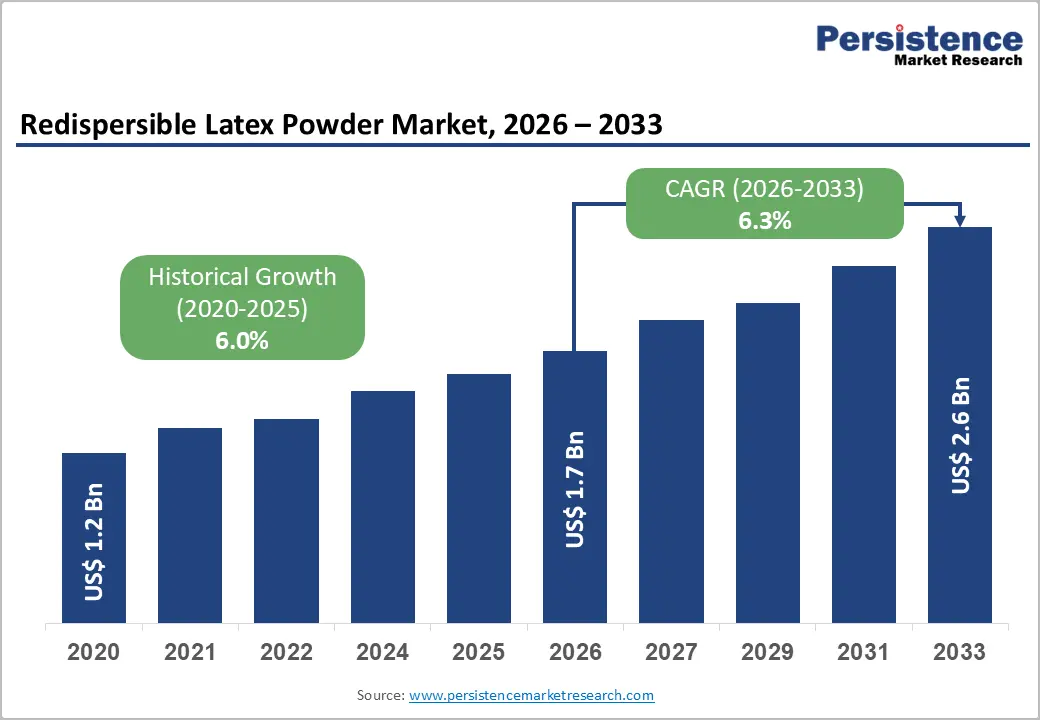
The global redispersible latex powder market size is likely to be valued at US$1.7 billion in 2026 and is projected to reach US$2.6 billion by 2033, growing at a CAGR of 6.3% during the forecast period 2026 - 2033, driven by accelerating global construction activity, rising demand for high-performance dry-mix mortar additives, and increasing adoption of energy-efficient building systems. Infrastructure modernization programs across emerging economies are reinforcing demand for advanced polymer-modified construction materials.
Additionally, sustainability mandates from organizations such as the European Commission and green building councils are supporting water-based, low-VOC formulations. The shift toward prefabrication and rapid construction methods is further strengthening consumption across tile adhesives, EIFS systems, and waterproofing applications.
Key Industry Highlights:
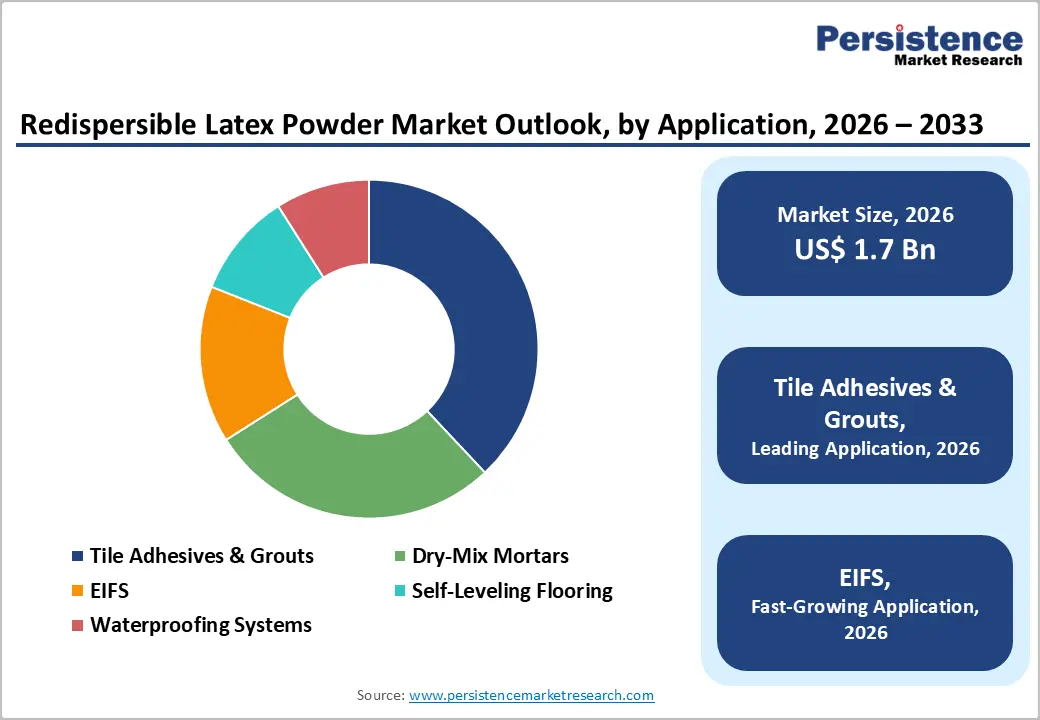
- Dominant Application Segment: Tile adhesives & grouts segment is expected to lead the market in 2026 with 38% share in 2026, driven by high penetration in residential and commercial construction, while EIFS (Exterior Insulation and Finish System) is likely to be the fastest-growing segment through 2033, supported by rising demand for energy-efficient building systems.
- Leading Polymer Chemistry Segment: VAE copolymers are projected to dominate in 2026 with a 45% share, driven by a strong cost-performance balance and widespread use in dry-mix mortars, while acrylic-based RDP is projected to be the fastest-growing segment through 2033, driven by waterproofing and infrastructure applications.
- End-use Industry Dynamics: Residential construction is expected to lead in 2026 with a 40% share, supported by housing demand and renovation activity, while infrastructure is anticipated to be the fastest-growing segment through 2033, driven by large-scale public investment in transport and urban development projects.
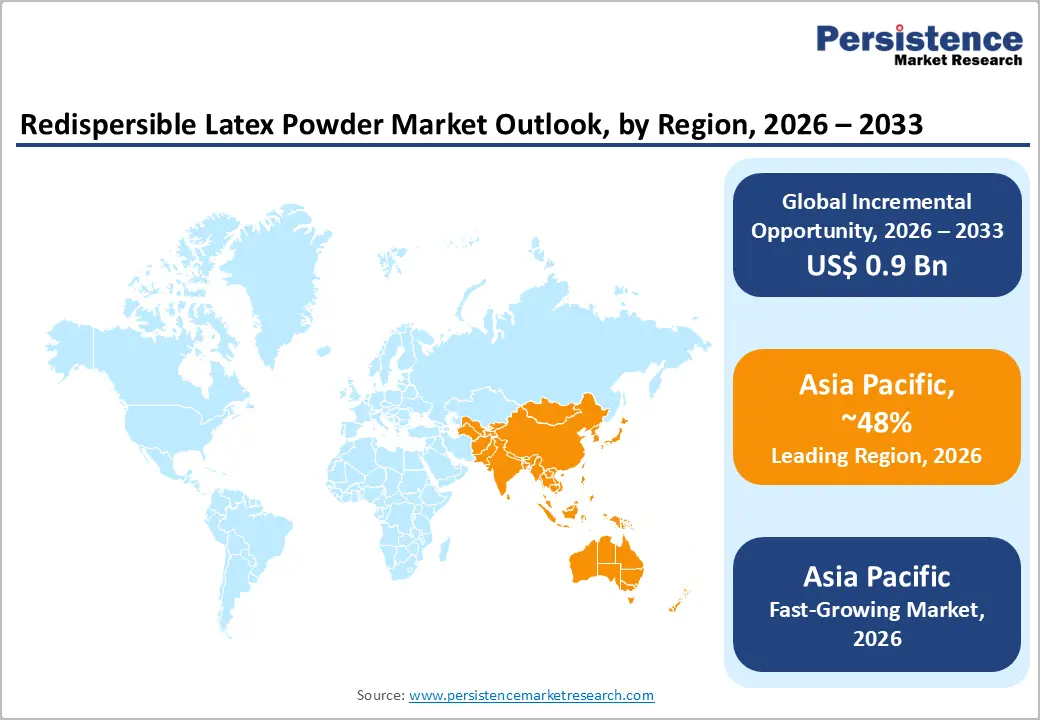
- Regional Leadership: Asia Pacific is expected to dominate in 2026 with 48% share, led by China and India's construction activity, and is also the fastest-growing region through 2033 due to rapid urbanization and infrastructure expansion.
- Growth Accelerators: Green construction regulations, energy-efficiency mandates, and infrastructure investment programs are key market accelerators, driving adoption of low-VOC, high-performance construction materials globally.
DRO Analysis
Driver - Expansion of Global Construction & Infrastructure Development
Global construction spending surpassed US$13 trillion in 2025, supported by large-scale government infrastructure programs across India, China, and the U.S., including India’s Gati Shakti initiative, China’s urban redevelopment push, and the U.S. Infrastructure Investment and Jobs Act. These programs are accelerating the execution of transport, housing, and urban modernization projects at an unprecedented scale.
A clear shift toward faster project delivery and performance-driven construction materials is emerging, with increasing emphasis on durability, energy efficiency, and lifecycle cost optimization. This is driving rapid substitution of conventional binders with polymer-modified solutions such as redispersible latex powder, particularly in tile adhesives, EIFS, and waterproofing systems.
As a result, RDP demand is structurally expanding across both residential and infrastructure applications, positioning it as a critical enabler of modern construction systems focused on strength, speed, and sustainability.
Restraint - Volatility in Petrochemical Feedstock Prices
A key restraint in the redispersible latex powder market is volatility in raw materials, such as vinyl acetate monomer (VAM) and ethylene, derived from petrochemical value chains. According to the International Energy Agency (IEA), petrochemical price fluctuations increased production cost variability by 12-18% over the past few years. This dependency on crude oil-linked inputs continues to expose manufacturers to geopolitical risks and supply chain disruptions, limiting pricing stability and creating persistent procurement challenges across the value chain.
This volatility is directly translating into higher fluctuations in input costs for the redispersible latex powder market, reducing pricing predictability and compressing margins across both integrated and independent producers. As a result, contract stability with downstream construction chemical formulators is weakening, especially in price-sensitive emerging markets, where procurement decisions are highly cost-driven.
Opportunity - Growth in Green Construction & Low-VOC Building Materials
Global construction markets are undergoing a structural shift toward low-carbon, energy-efficient, and environmentally compliant building practices, driven by tightening regulatory frameworks and the expansion of green certification systems such as LEED and BREEAM across public and private infrastructure projects. Governments are increasingly embedding sustainability criteria into building codes and procurement policies, accelerating the adoption of eco-compliant construction materials.
This transition is driving strong substitution of conventional additives with low-VOC, polymer-modified solutions, such as redispersible latex powder, particularly in urban housing, commercial real estate, and retrofit projects. The emphasis on lifecycle efficiency, carbon reduction, and thermal performance is reshaping material selection standards across the construction value chain.
As a result, demand for RDP-based VAE and acrylic systems is expanding rapidly across both developed and emerging markets, positioning green construction as a high-value growth avenue and a key commercialization pathway for next-generation construction chemical manufacturers.
Category-wise Analysis
Application Insights
The tile adhesives & grouts segment is estimated to lead the redispersible latex powder market in 2026 with 38% share, supported by sustained residential and commercial construction activity. Demand is expected to remain structurally strong due to continued urban housing expansion and renovation cycles, where RDP is estimated to enhance adhesion strength, flexibility, and water resistance in tile installation systems. In 2025-2026, ongoing urban redevelopment initiatives across major Asian cities are likely to sustain high-volume consumption in interior finishing applications.
EIFS is estimated to be the fastest-growing application segment through 2033, driven by increasing emphasis on building energy efficiency. Regulatory tightening on thermal performance standards in developed markets is expected to accelerate the adoption of insulation-based façade systems. This shift is likely to significantly increase demand for RDP-modified systems that improve crack resistance and long-term thermal stability in external wall applications.
Polymer Chemistry Insights
VAE copolymers are expected to dominate the polymer chemistry segment, with a 45% share in 2026, supported by their cost-performance balance and broad use in dry-mix mortars and tile adhesives. Their strong compatibility with cementitious systems is expected to sustain large-scale adoption across residential and infrastructure construction. In 2025, continued housing expansion programs in Southeast Asia are likely to reinforce steady demand for VAE-based formulations in standardized construction applications.
Acrylic-based RDP is estimated to be the fastest-growing segment through 2033, driven by superior durability under harsh environmental conditions. The increased focus on climate-resilient infrastructure and waterproofing systems in 2026 is expected to drive higher adoption in exterior and high-exposure applications. This shift is likely to strengthen penetration in infrastructure-grade construction, particularly in coastal and high-moisture regions.
End-use Industry Insights
Residential construction is expected to remain the leading end-use segment, with a 40% share in 2026, supported by sustained urbanization, housing shortages, and ongoing residential development cycles. RDP demand is expected to remain strong due to its critical role in tile adhesives and mortar systems used in large-scale housing projects. In 2025-2026, continued expansion of affordable housing initiatives in emerging economies is likely to support stable consumption growth.
Infrastructure is estimated to be the fastest-growing segment through 2033, driven by large-scale public investment in transport networks, smart cities, and industrial corridors. In 2026, accelerated execution of mega infrastructure programs in the Middle East and Asia is expected to significantly boost demand for high-performance construction chemicals. This is likely to increase adoption of RDP-based waterproofing and flooring systems designed for long-term durability and structural resilience.
Regional Analysis
North America Redispersible Latex Powder Market Trends
North America is estimated to account for 24% share of the redispersible latex powder market in 2026, supported by steady infrastructure modernization, commercial refurbishment activity, and rising adoption of low-VOC construction materials. Market growth is expected to remain structurally driven by public investment in transport, aviation, and civic infrastructure, alongside increasing preference for durable, high-performance construction systems. Demand is largely concentrated in repair and rehabilitation applications where polymer-modified mortars are estimated to deliver superior lifecycle performance.
U.S. Redispersible Latex Powder Market Trends
The U.S. is estimated to account for 45% of North America’s demand, supported by the ongoing implementation of the Infrastructure Investment and Jobs Act (IIJA), which is expected to continue accelerating upgrades to highways, bridges, rail networks, and airports. FAA-led airport modernization programs and state-level transportation rehabilitation projects are estimated to significantly increase consumption of polymer-modified mortars in repair and resurfacing applications, reinforcing long-term structural demand.
Canada Redispersible Latex Powder Market Trends
Canada is estimated to account for 12% of North America in 2026, supported by the National Housing Strategy and ongoing provincial infrastructure renewal initiatives. In 2025-2026, affordable housing expansion programs and public infrastructure modernization efforts are expected to sustain construction activity. Harsh climatic conditions are also expected to drive greater adoption of freeze-thaw-resistant RDP-based systems in exterior construction applications.
Europe Redispersible Latex Powder Market Trends
Europe is estimated to hold 22% share of the redispersible latex powder market in 2026, driven by strict sustainability regulations, renovation-led construction cycles, and rising adoption of energy-efficient building systems. Market expansion is expected to remain policy-driven, with increasing emphasis on decarbonization and large-scale building retrofitting across residential and commercial infrastructure.
Germany Redispersible Latex Powder Market Trends
Germany is estimated to account for 35% share of Europe, supported by the Federal Funding for Efficient Buildings (BEG) program, which is expected to continue driving energy-efficient renovation and insulation upgrades through 2025-2026. Demand for EIFS and polymer-modified construction systems is estimated to increase steadily, supported by large-scale building envelope modernization and sustainability-driven construction investments.
U.K. Redispersible Latex Powder Market Trends
The U.K. is estimated to hold 15% share of Europe in 2026, supported by the Social Housing Decarbonization Fund (SHDF) and Energy Company Obligation (ECO) Scheme, which are expected to continue accelerating retrofit and housing efficiency programs. These initiatives are estimated to increase demand for low-emission construction materials, particularly in insulation and refurbishment applications across residential buildings.
Asia Pacific Redispersible Latex Powder Market Trends
Asia Pacific is estimated to dominate the redispersible latex powder market with 48% global share in 2026, driven by rapid urbanization, large-scale infrastructure development, and strong construction manufacturing capacity. Demand is expected to remain highly volume-oriented, supported by residential expansion, transport infrastructure development, and industrial corridor investments across key economies.
China Redispersible Latex Powder Market Trends
China is estimated to account for 45% share of the Asia Pacific, supported by the 14th Five-Year Plan and the Urban Renewal Initiative, which are expected to drive continued redevelopment of aging urban infrastructure. In 2025-2026, sustained investment in metro systems, rail networks, and urban housing upgrades is estimated to maintain strong demand for RDP-based mortars and adhesives.
India Redispersible Latex Powder Market Trends
India is estimated to hold 18% share of the Asia Pacific market in 2026 and is projected to be the fastest-expanding major market, supported by the PM Gati Shakti National Master Plan and the National Infrastructure Pipeline (NIP). Ongoing execution of highway corridors, logistics infrastructure, industrial clusters, and Smart Cities Mission projects is expected to significantly increase demand for advanced construction chemical systems, including RDP-based waterproofing and flooring solutions.
Competitive Landscape
The global redispersible latex powder market is estimated to remain moderately consolidated in 2026, with leading players such as Wacker Chemie AG, BASF SE, Dow Inc., and Celanese Corporation collectively accounting for 55% of market revenue. These companies are expected to maintain dominance through integrated polymer production, strong construction chemical portfolios, and long-standing supply relationships with global mortar and adhesive manufacturers. Continuous investment in product innovation and low-VOC formulations is further reinforcing their competitive positioning.
Regional and mid-sized manufacturers, particularly in Asia, are estimated to compete strongly on cost efficiency and localized supply networks, especially in VAE-based RDP production. Entry barriers remain relatively high due to capital intensity, raw material integration, and stringent performance requirements in construction applications. Over 2025-2026, the market is expected to witness gradual consolidation, supported by capacity expansions, strategic partnerships, and selective acquisitions aimed at strengthening geographic reach and supply chain control.
Companies Covered in Redispersible Latex Powder Market
- Wacker Chemie AG
- BASF SE
- Dow Inc.
- Celanese Corporation
- Ashland Global Holdings Inc.
- Synthomer plc
- Akzo Nobel N.V.
- LG Chem Ltd.
- Arkema S.A.
- Kuraray Co., Ltd.
- Dairen Chemical Corporation Sika AG
- 3M Company
- Shandong Xindadi Industrial Group
- Vinavil S.p.A
Frequently Asked Questions
The global redispersible latex powder market is projected to reach US$1.7 billion in 2026.
Rising construction activity, infrastructure expansion, and increasing demand for high-performance dry-mix mortar systems drive the market.
The market is projected to grow at a CAGR of 6.3% from 2026 to 2033.
Growing adoption of green construction materials and energy-efficient building systems creates strong opportunities for RDP demand.
Wacker Chemie AG, BASF SE, Dow Inc., and Celanese Corporation are among the key players in the market.


