




- Industrial Machinery
- Plastic Extrusion Machine Market
Plastic Extrusion Machine Market Size, Share, and Growth Forecast, 2026 – 2033
Plastic Extrusion Machine Market by Automation Type (Manual, Semi-Automatic, Fully Automatic), Machine Type (Single Screw Extrusion, Twin Screw Extrusion, Multilayer Extrusion), Application (Building & Construction, Others), and Regional Analysis 2026 – 2033

Plastic Extrusion Machine Market Size and Trends Analysis
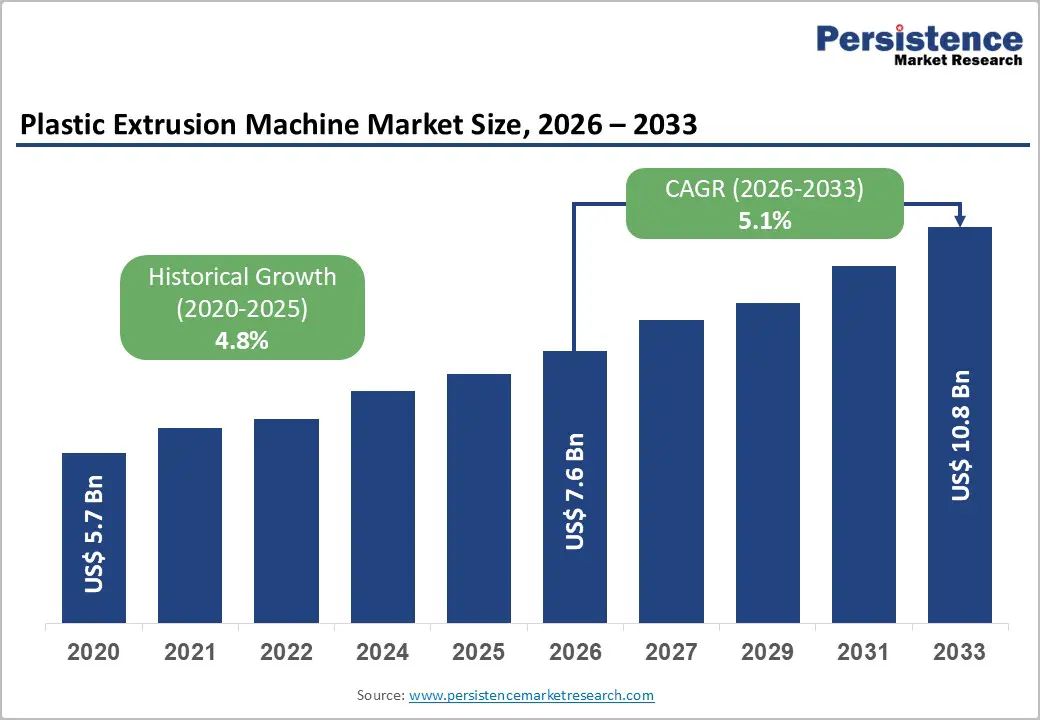
The global plastic extrusion machine market size is likely to be valued at US$7.6 billion in 2026 and is expected to reach US$10.8 billion by 2033, growing at a CAGR of 5.1% during the forecast period from 2026 to 2033, driven by increasing infrastructure development activities, which are driving demand for high-capacity extrusion systems.
The rising focus on sustainable manufacturing is expected to boost the adoption of advanced twin-screw extrusion technologies. The integration of IoT-enabled sensors is further enhancing operational efficiency and process optimization across manufacturing facilities. Expanding applications in the medical sector are creating new growth avenues for high-precision micro-extrusion equipment.
Key Industry Highlights:
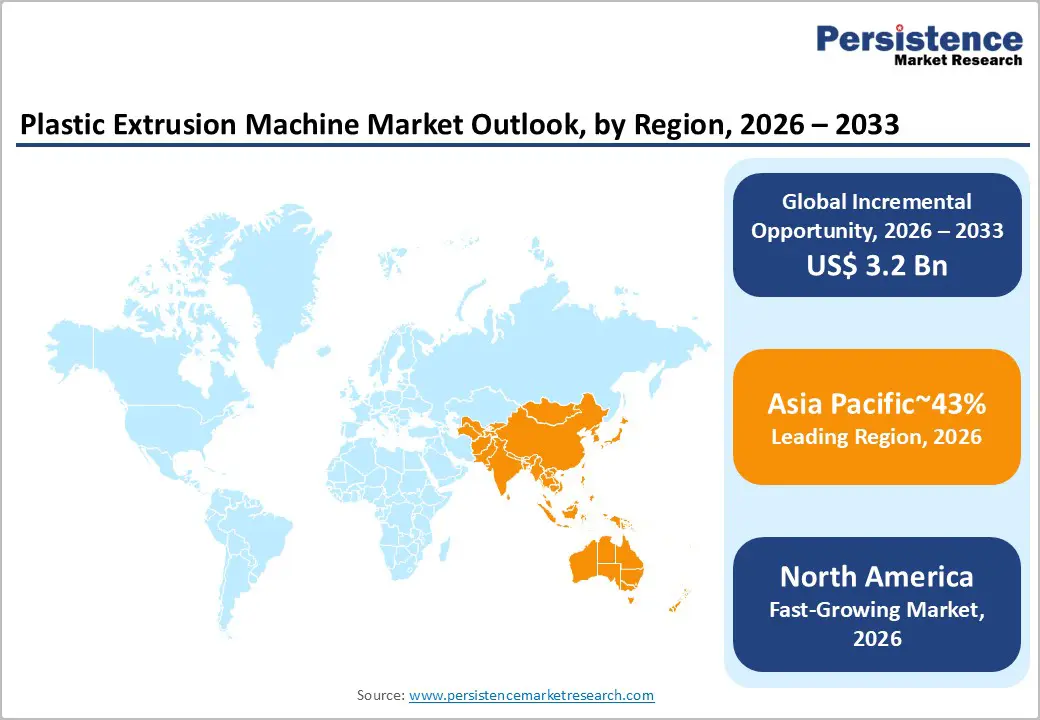
- Leading Region: Asia Pacific is projected to lead, accounting for approximately 43% share in 2026. This position is supported by massive infrastructure projects, rapid industrialization, and favorable manufacturing policies.
- Fastest-growing Region: North America is anticipated to grow fastest, driven by reshoring manufacturing initiatives and high demand for medical-grade plastics.
- Leading Machine Type: Single screw extrusion machines are projected to dominate for simplicity, cost-efficiency, widespread adoption, and versatility in standard plastic processing, holding approximately 64% share in 2026.
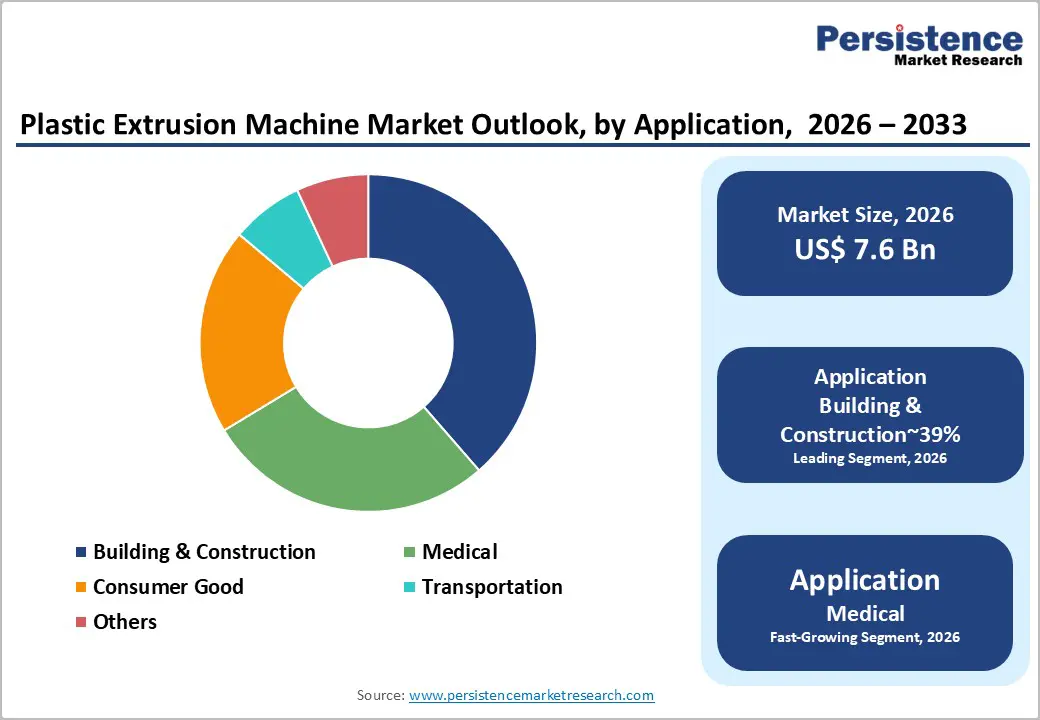
- Leading Application: The building & construction segment is projected to dominate, holding approximately 39% share in 2026, driven by the production of PVC pipes, window profiles, and insulation materials.
| Key Insights | Details |
|---|---|
|
Plastic Extrusion Machine Market Size (2026E) |
US$7.6 Bn |
|
Market Value Forecast (2033F) |
US$10.8 Bn |
|
Projected Growth (CAGR 2026 to 2033) |
5.1% |
|
Historical Market Growth (CAGR 2020 to 2025) |
4.8% |
Market Factors – Growth, Barriers, and Opportunity Analysis
Growth Analysis – Acceleration of Circular Economy and Plastic Recycling Infrastructure
Global initiatives targeting plastic waste reduction are likely to stimulate investments in advanced machinery. Enhanced regulatory frameworks are expected to mandate higher percentages of recycled content in products. These requirements necessitate high-torque extrusion systems capable of processing diverse post-consumer resin streams. Manufacturers are projected to prioritize equipment that maintains material integrity during intensive thermal processing. Increased adoption of closed-loop manufacturing systems is anticipated to bolster long-term market valuation. This shift aligns with broader industrial movements toward sustainable production and reduced carbon footprints.
Integration of advanced filtration technologies from Reifenhäuser with EVO Ultra Stretch enables higher recycled content. This technology is likely to minimize material degradation while maximizing the output of thin-gauge films. Furthermore, the EREMA Group with INTAREMA® TVEplus® is positioned to capture demand for high-contamination recycling. Strategic equipment upgrades are expected to facilitate the transition toward carbon-neutral plastic processing operations globally. Enhanced automation features within these systems are likely to reduce operational costs for recycling facilities. These technical advancements are set to accelerate the global transition toward a circular economy.
Rising Demand for Precision Medical Tubing and Healthcare Components
The healthcare sector is expected to require increasingly complex and biocompatible plastic extruded components. Rising global demand for minimally invasive surgical tools is likely to drive micro-extrusion equipment sales. These specialized machines are projected to produce multi-lumen tubing with extremely tight dimensional tolerances. Technological shifts toward personalized medicine are anticipated to necessitate highly flexible and modular extrusion platforms. Precision manufacturing is set to become a critical differentiator for vendors serving the medical market. Increased healthcare spending globally is expected to provide a stable growth trajectory for this segment.
Strategic focus from Bausano with MD Nextmove illustrates the commitment to high-precision medical manufacturing. This platform is expected to ensure the sterile and consistent production of life-critical medical devices. Furthermore, Davis-Standard with the MEDD Extruder is likely to meet the stringent regulatory requirements. These machines are projected to incorporate advanced sensor arrays for real-time quality monitoring and verification. Enhanced material handling capabilities are anticipated to prevent contamination during the high-speed extrusion process. The medical segment is set to remain the fastest-growing application through the forecast period.
Barrier Analysis – Skilled Labor Shortages Hindering Operational Efficiency
Chronic shortages of trained technicians impede optimal machine utilization, as complex automation demands specialized calibration and troubleshooting expertise. Regional disparities exacerbate this issue, particularly in transitioning markets lacking vocational programs tailored to extrusion technologies. Structural gaps persist despite vendor training initiatives, constraining throughput potential.
Key industry players such as Milacron, with their twin-screw extruders, face downstream impacts as end-users struggle with setup, leading to prolonged commissioning phases and elevated service costs. Distributors encounter deferred orders from cautious buyers wary of operational risks. Manufacturers respond by embedding user-friendly interfaces, yet talent pipelines remain a persistent commercial drag.
Technical Complexity of Processing Advanced Bio-Polymers
Shifting toward biodegradable plastics is expected to introduce significant technical challenges for standard extrusion machinery. These materials often exhibit narrow processing windows and high sensitivity to thermal degradation during extrusion. Existing equipment is likely to require extensive modifications or complete replacement to handle bio-resins effectively. Inconsistent raw material quality is projected to lead to higher scrap rates and production downtime. Operators are anticipated to require specialized training to manage the complexities of sustainable material processing. Technical limitations are set to slow the large-scale adoption of eco-friendly plastic alternatives.
Advanced control systems from Leistritz with ZSE MAXX are designed to manage sensitive bio-polymer melt. This equipment is expected to provide the precise temperature control needed for sustainable material integrity. However, many standard lines from Amut with the ACP series may require significant retrofitting for bio-plastics. The engineering effort required for these upgrades is likely to increase the total cost of ownership. Manufacturers are projected to face a steep learning curve when transitioning away from traditional polymers. Technical complexity remains a primary hurdle for the widespread adoption of bio-extrusion.
Opportunity Analysis – Integration of AI-Driven Predictive Maintenance and Analytics
Digital transformation is expected to unlock significant value through the implementation of predictive maintenance systems. AI-driven analytics are likely to reduce unscheduled downtime by identifying potential component failures before they occur. These smart systems are projected to optimize melt temperature and screw speed for maximum efficiency. Data-driven insights are anticipated to improve overall equipment effectiveness across diverse manufacturing environments. This technology shift is set to create a new market for software-integrated extrusion hardware. Smart factory initiatives are likely to drive the next wave of machinery replacement cycles.
Innovation from KraussMaffei with smartAssist and social production illustrates the potential for digital service integration. These tools are expected to provide remote troubleshooting and real-time performance monitoring for global operators. Furthermore, Battenfeld-Cincinnati with BCtouch Fire control systems is likely to enhance user-machine interaction levels. These digital platforms are projected to facilitate the seamless integration of extruders into broader IoT ecosystems. Enhanced data transparency is anticipated to empower manufacturers to achieve higher levels of operational excellence. The rise of "Intelligent Extrusion" is set to redefine competitive standards in the market.
AI-Optimized Energy Recovery Systems
Digital integration now enables recovery of heat from extrusion dies and barrels. Captured thermal energy significantly reduces electrical demand during continuous production cycles. These efficiency improvements help manufacturers align with stricter industrial energy regulations. Operational monitoring platforms further optimize equipment loads and process stability. Energy-aware automation, therefore, reshapes how extrusion facilities manage power-intensive machinery. Overall, integration of smart systems supports sustainability while maintaining consistent throughput.
Emerging economies present scale opportunities for hybrid electric drive adoption. These systems respond to longstanding criticism regarding energy-intensive legacy extrusion fleets. Technology inflection points increasingly favor innovators developing predictive maintenance algorithms. Nordson Corporation illustrates this shift through sensor-driven controls enabling real-time energy analytics in pipe extrusion. Meanwhile, Kabra Extrusiontechnik targets cost-sensitive markets with efficient single-screw extrusion platforms. Additional demand may emerge as retrofit incentives encourage mid-market manufacturers to upgrade aging equipment.
Category–wise Analysis
Machine Type Insights
Single screw extrusion machine models are anticipated to lead, accounting for approximately 64% share in 2026, anchored by their inherent mechanical simplicity, lower cost, and versatility in standard plastic processing. These machines are projected to remain the primary choice for producing simple profiles, pipes, and basic sheet products. Their ease of maintenance and operational reliability are likely to sustain high demand in emerging industrial sectors. Product reliability from Milacron with the Cincinnati series reinforces the dominance of single-screw technology in infrastructure applications. Furthermore, Amut with the ACP 2000 series is expected to provide the robust performance required for heavy-duty industrial extrusion. Bausano with NEXTFLEX series excels in multi-layer profiles, Reifenhäuser Group sheet lines power infrastructure demands, and Kabra Extrusiontechnik single-screw units support regional manufacturing hubs. The ability to handle a wide range of standard polymers makes these machines indispensable for diverse manufacturers.
Twin screw machines are projected to be the fastest growing segment, driven by technology inflections in polymer compounding and high-intensity plastic recycling requirements. These machines are likely to offer superior mixing and degassing capabilities compared to their single-screw counterparts. Demand is expected to rise as manufacturers shift toward high-performance alloys and bio-plastic compounds. Innovations from Coperion with the ZSK Mc18 are set to lead the market in high-torque compounding applications. Additionally, Leistritz with the ZSE MAXX series is expected to capture demand for sensitive pharmaceutical and bio-polymer processing, while KraussMaffei eco-lines target sustainable compounding. The rise of circular economy mandates is projected to necessitate the intensive processing power of twin-screw systems. These machines are set to become the standard for advanced material science applications.
Application Insights
The building & construction segment is anticipated to lead the application segment, accounting for approximately 39% share in 2026, driven by massive global investments in housing, utilities, and public infrastructure projects. The production of PVC pipes, window profiles, and exterior cladding is projected to remain a primary market anchor. Increasing focus on energy-efficient building materials is likely to drive the demand for extruded insulation panels. Technical leadership from KraussMaffei with the precisionXT series addresses the high-output requirements of the construction pipe market. Technology trends in weather-resistant formulations bolster adoption anchors in urban projects. Reifenhäuser Group with sheet extruders supports cladding production, Davis-Standard single-screw lines enable pipe scalability, and Sumitomo platforms deliver heavy-duty profiles. Furthermore, Battenfeld-Cincinnati with solEX NG is expected to provide the high throughput needed for large-scale utility projects. These machines are projected to deliver the dimensional stability required by modern architectural standards. The construction sector is set to provide a stable foundation for market expansion.
Medical applications are expected to be the fastest-growing segment, driven by unmet needs for high-precision, sterile, and biocompatible healthcare components. The global rise in chronic diseases is likely to increase the demand for catheters, IV tubes, and surgical instruments. These applications require specialized extrusion lines capable of maintaining extremely tight tolerances and ultra-clean environments. Specialized machinery from Bausano with MD Nextmove is expected to set the benchmark for medical-grade plastic production. Unmet needs for micron-tolerance extrusion align with precision medicine advances. Yurefon Machinery with medical hose lines ensures compliance, Luigi Bandera co-extruders produce barrier tubing, and Nordson controls enable gauging accuracy. Additionally, Davis-Standard with the MEDD Extruder is projected to meet the rigorous certification standards of the global medical industry. The shift toward minimally invasive surgeries is likely to drive the demand for multi-lumen micro-tubing. Precision medical extrusion is set to register the most significant technological advancements in the coming decade.
Regional Insights
Asia Pacific Plastic Extrusion Machine Market Trends
Asia Pacific is expected to remain the leading regional market, accounting for approximately 43% share in 2026, supported by massive industrialization and infrastructure scaling. Rapid urban expansion is likely to drive sustained demand for high-output construction-related extrusion machinery across the region. Regional vendors are projected to focus on delivering cost-effective automation to meet the needs of diverse manufacturing hubs. Innovation from Shibaura Machine with the SXIII series is expected to support the high-precision electronics sector in the region. Furthermore, Amut with the ACP series is likely to capture growth in the regional packaging and recycling segments. Technology adoption accelerates via cost-optimized automation, while policy ecosystems promote export-oriented production. Leistritz with ZSE-MAXX establishes compounding leadership, Jwell Machinery expansions via acquisitions like Kautex bolster blow-molding integration, and Nanjing Tengda granulators serve R&D scaling. Large-scale government investments in water management and energy grids are anticipated to bolster the regional market.
China is expected to act as the primary regional anchor, shaping the momentum of the Asian market. The country's focus on "Green Manufacturing" is likely to drive the adoption of energy-efficient extrusion systems. Strategic investments from KraussMaffei with precisionXT are projected to align with China's rapid infrastructure development goals. Furthermore, the expansion of the domestic medical device industry is likely to create new high-value opportunities for vendors. Chinese regulatory shifts toward plastic circularity are anticipated to stimulate the market for advanced recycling machinery. Regulatory environments enforce recycled content quotas, spurring twin-screw upgrades for polymer blending. The nation's manufacturing prowess is likely to maintain its position as the global hub for extrusion technology.
North America Plastic Extrusion Machine Market Trends
North America is expected to register the fastest growth trajectory, as reshoring initiatives and advanced healthcare manufacturing accelerate. The region is projected to experience a surge in demand for high-precision medical micro-extrusion systems and smart machinery. Manufacturers are likely to prioritize investments in Industry 4.0 to offset higher labor costs and improve operational agility. Bio-based polymer adoption shapes consumer behaviors toward barrier films, sustaining vendor service revenues. Technology leadership from Davis-Standard with the SHO Extruder is expected to drive efficiency gains in the domestic market. Additionally, Milacron, with the Cincinnati series, is likely to benefit from renewed investments in North American housing infrastructure. The region is set to lead in the adoption of AI-integrated predictive maintenance solutions.
The U.S. is expected to be the central driver of growth, supported by significant federal infrastructure and healthcare spending. Rising demand for locally produced medical tubing is likely to benefit vendors like Bausano with MD Nextmove. Investment flows prioritize heat-recovery patents, fortifying industry structures around precision engineering. Furthermore, the U.S. focus on sustainable packaging is projected to drive the adoption of Reifenhäuser with EVO Ultra Stretch technology. American manufacturers are anticipated to lead in the integration of digital twin technologies for extrusion process optimization. Federal policies encouraging domestic semiconductor and electronics production are likely to create secondary demand for precision extrusion. The U.S. market is set to remain at the forefront of technical innovation and high-value applications.
Europe Plastic Extrusion Machine Market Trends
Europe is expected to remain a mature and structurally stable regional market, with demand primarily anchored in replacement cycles and compliance. The region is projected to lead in the adoption of machinery designed for high-recycled content processing and biopolymers. Strict environmental regulations are likely to mandate the phase-out of inefficient legacy equipment across the continent. Market leadership from Coperion with the ZSK Mc18 is expected to support the advanced compounding needs of the European automotive sector. Cost-driven adoption favors hybrid machines, and localization counters import reliance. Furthermore, Leistritz with the ZSE MAXX is projected to see steady demand for pharmaceutical-grade extrusion in the region. European vendors are anticipated to focus on premiumization and high-service monetization strategies.
Germany is expected to serve as the regional technology anchor, influencing extrusion standards across the European Union. The country's expertise in mechanical engineering is likely to sustain the global competitiveness of its extrusion machinery exports. Implementation of the EU Packaging and Packaging Waste Regulation is projected to drive demand for EREMA with INTAREMA TVEplus recycling systems. Furthermore, German manufacturers are likely to lead in the development of hydrogen-compatible plastic piping systems. The domestic market is anticipated to prioritize energy-neutral manufacturing processes to meet national climate goals. Germany's focus on "Industrie 4.0" is likely to remain the benchmark for global extrusion automation.
Competitive Landscape
The global plastic extrusion machine market is moderately fragmented, with leadership concentrated among global engineering suppliers such as KraussMaffei, Reifenhäuser, Coperion, and Davis-Standard. Leading firms shape industry standards through deep engineering capabilities, extensive installed bases, and strong procurement relationships with converters and polymer producers, allowing their equipment architectures and process benchmarks to influence manufacturing workflows across packaging, construction, automotive, and medical applications. Competitive positioning reflects a mix of vertically integrated technology platforms and horizontally specialized solutions, where global suppliers emphasize hardware–software integration and lifecycle service capabilities while niche providers focus on micro-extrusion, precision applications, or regional service responsiveness.
Industry behavior increasingly reflects consolidation around technology platforms and service ecosystems as manufacturers expand capabilities through targeted acquisitions, digital integration, and recycling-focused innovations. Strategic moves by companies such as Leistritz, Bausano, and Kabra Extrusiontechnik illustrate the coexistence of premium engineering innovators and value-focused regional specialists addressing diverse converter requirements. Market dynamics are gradually shifting toward service-led business models, platform-based equipment ecosystems, and partnerships with polymer producers and recycling technology providers, reinforcing an industry trajectory toward integrated processing solutions and sustainability-driven extrusion platforms.
Key Industry Developments:
- In March 2026, CCL Industries entered into a binding agreement to acquire Sleever International Company SA for approximately US$151 million, strengthening its global presence in shrink sleeve labeling equipment and decorative packaging solutions across 11 manufacturing sites.
- In February 2026, Mamata Machinery introduced its advanced Rectech recyclable packaging technology at Plastindia 2026, reinforcing its position in sustainable packaging innovation and aligning with growing global demand for circular economy solutions.
Companies Covered in Plastic Extrusion Machine Market
- KraussMaffei
- Reifenhäuser Group
- Davis-Standard
- Coperion
- Milacron
- Battenfeld-Cincinnati
- Leistritz Extrusion
- EREMA Group
- Shibaura Machine
- Amut S.p.A.
- Bausano & Figli
- Nordson Corporation
- Luigi Bandera
- Kabra Extrusiontechnik
- Sumitomo Heavy Industries
- Jwell Machinery
Frequently Asked Questions
The global plastic extrusion machine market is projected to be valued at US$7.6 billion in 2026 and is expected to reach US$10.8 billion by 2033, supported by rising infrastructure investments, expanding medical plastic production, and the modernization of recycling and compounding technologies.
Global sustainability initiatives targeting plastic waste reduction are accelerating demand for advanced extrusion equipment capable of processing recycled polymers. High-torque twin-screw systems, filtration technologies, and integrated recycling platforms enable manufacturers to handle post-consumer resin streams while maintaining material quality, making extrusion machinery central to circular plastic production systems.
The plastic extrusion machine market is forecast to grow at a CAGR of 5.1% from 2026 to 2033, reflecting stable demand from construction materials, packaging production, polymer compounding, and the growing use of precision plastic components in healthcare applications.
Asia Pacific leads the global plastic extrusion machine market, accounting for approximately 43% share in 2026, driven by rapid industrialization, large-scale infrastructure projects, expanding plastics manufacturing hubs, and strong government support for industrial equipment production across China, India, and Southeast Asia.
The plastic extrusion machine market is moderately fragmented, with key players including KraussMaffei, Reifenhäuser Group, Davis-Standard, Coperion, Milacron, Battenfeld-Cincinnati, Leistritz Extrusion, EREMA Group, Shibaura Machine, Amut S.p.A., Bausano & Figli, Nordson Corporation, Luigi Bandera, Kabra Extrusiontechnik, Sumitomo Heavy Industries, and Jwell Machinery.


