




- Hardware & Software IT Services
- Generative AI in Agriculture Market
Generative AI in Agriculture Market Size, Share, and Growth Forecast 2026 - 2033
Generative AI in Agriculture Market by Technology (Machine Learning, Natural Language Processing, Computer Vision), Application (Precision Farming, Livestock Management), and Regional Analysis, 2026 - 2033

Generative AI in Agriculture Market Size and Trends Analysis
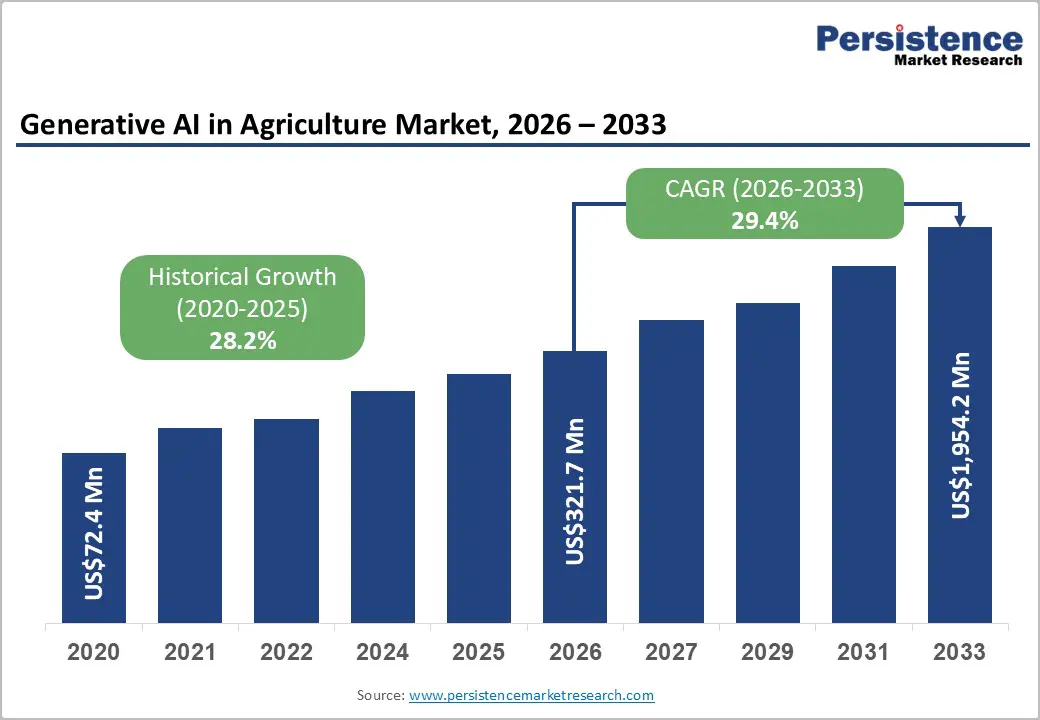
The global generative AI in agriculture market size is likely to be valued at US$321.7 million in 2026 and is expected to reach US$1,954.2 million by 2033, growing at a CAGR of 29.4% during the forecast period from 2026 to 2033, driven by rising adoption of precision farming technologies and increasing use of AI-backed crop monitoring and yield prediction tools.
Surging demand for sustainable agriculture practices and integration of generative AI with IoT are also predicted to boost growth.
Key Industry Highlights:
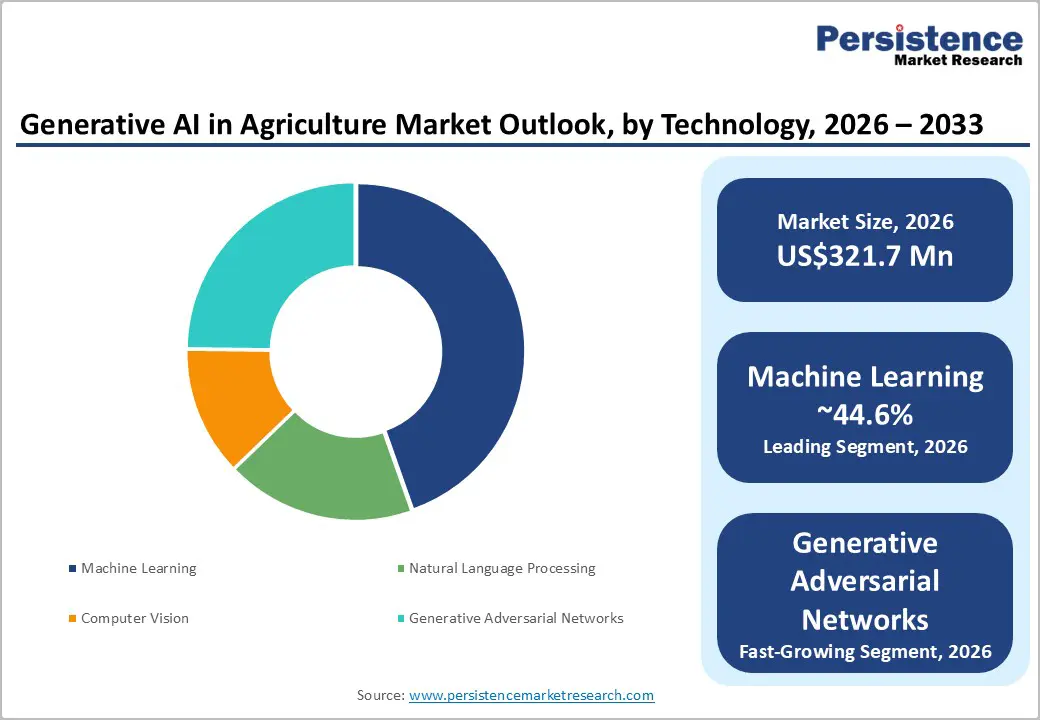
- Leading Technology: Machine learning, approximately 44.6% share in 2026, as it can process large volumes of structured farm data to provide accurate decisions.
- Dominant Application: Precision farming, nearly 39.8% in 2026, as it enables field-level decision-making using real-time data from sensors, drones, and satellites.
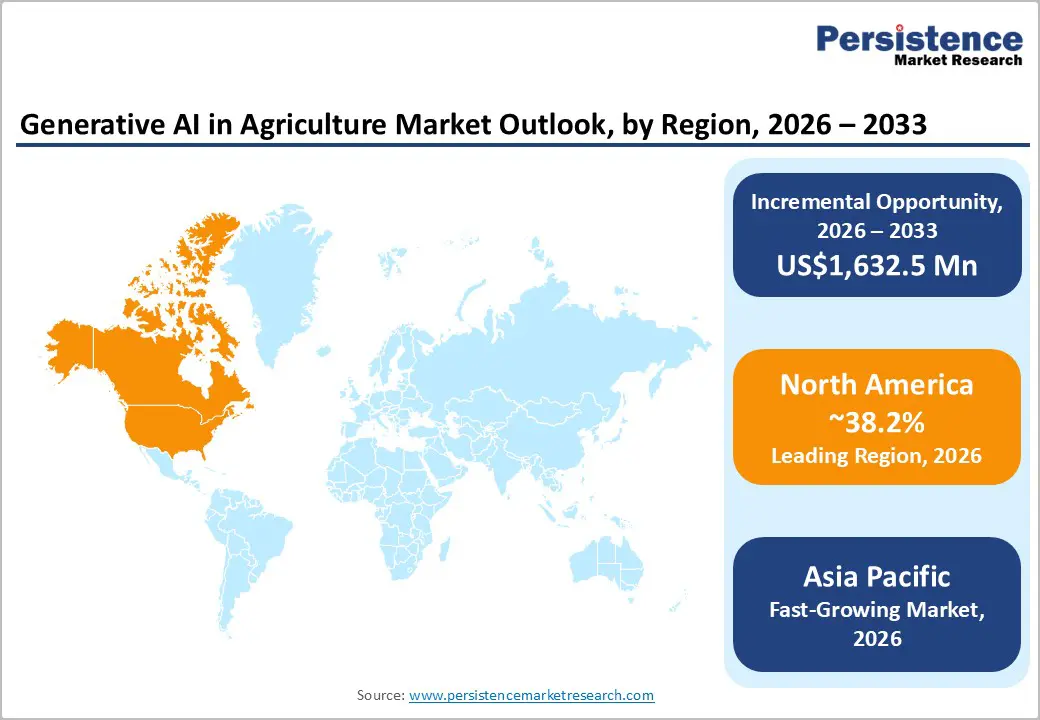
- Leading Region: North America, with about a 38.2% share in 2026, backed by early adoption of precision agriculture and a well-established digital infrastructure.
- Fast-growing Region: Asia Pacific, owing to increasing government-backed digital agriculture initiatives and rising smartphone penetration among farmers.
- Recent Collaboration: In March 2025, Agmatix announced a strategic collaboration with BASF to develop an AI-supported tool for detecting and predicting Soybean Cyst Nematode (SCN) infestations. The initiative was launched through AgroStart, BASF's open innovation platform, and uses Agmatix's AI engine Axiom to harmonize SCN field trial data.
DRO Analysis
Driver - Rising Demand for Hyper-Personalized Agronomy
Generative AI is allowing farmers to move beyond generic advice and ask highly specific questions in their own language. Tools such as ITC's Krishi Mitra were developed using Microsoft Copilot and initially launched for 300,000 users with a target rollout to 10.1 million farmers across India. These let growers ask questions about crop rotation, pest identification, or local soil gaps and get expert-level answers instantly.
CABI's Generative AI for Agriculture Advisory project, a multi-partner initiative, is using LLMs to disseminate complex scientific information in local dialects and through varied formats. It helps in reducing the digital divide compared to traditional communication methods. IFPRI's GAIA Phase I (2023 to 2024) tested a Retrieval-Augmented Generation (RAG) framework with Digital Green's Farmer.Chat in Kenya and India. It examined how CGIAR's open-access research could improve AI-generated advisory accuracy.
Surging Need for Precision Resource Management
Generative models are now synthesizing data from field sensors, satellite imagery, and weather feeds to produce field-specific input plans rather than broad recommendations. Combining UAV and satellite data with machine learning has reduced irrigation costs by 20 to 25%. It has also cut nitrogen fertilizer application by up to 31 kg per hectare without compromising productivity, according to a 2025 study published in Frontiers in Agronomy.
Syngenta's generative AI tools serve as continuous agronomic advisors, providing instant recommendations for fertilization, irrigation, and pest control. Yield variability forecasts usually reach up to 95% accuracy even six months ahead of harvest. This level of precision reduces input waste, cuts costs, and minimizes environmental runoff from over-application.
Restraint - Data Privacy and Ownership Ambiguity
When farmers feed operational data into generative AI systems, they risk exposing financially sensitive details such as crop yields, input costs, and field locations, with little legal protection in return. A 2024 review published in Data & Policy (Cambridge) found that no existing legal framework explicitly grants farmers ownership of the data they generate, leaving ownership to be ambiguously allocated or de facto transferred through contracts.
The Center for International Governance Innovation further notes that farm data is unlikely to qualify for copyright protection. The patent system does not adequately govern its ownership, as raw data does not meet the criteria for patent classification. Even when farmers nominally own their data on a platform, research shows that corporate actors can use aggregated and anonymized data for their own business interests without informing the data owner. This unresolved legal grey area makes several farmers reluctant to adopt AI-supported tools fully.
Opportunity - Dialect-Native Voice Advisory for Rural Farmers
Voice-based generative AI agents are emerging as a key tool to reach farmers who cannot read or type in a digital interface. Farm Vaidya, an AI start-up in India, deploys voice AI agents that communicate with Telugu-speaking farmers in southeast India through their mobile phones, delivering immediate and context-specific advice across a wide range of crop issues. To make this work accurately, the company created over 5,000 agriculture Q&A benchmarks across more than 100 crops, addressing the gap between generic LLM outputs and locally relevant advice.
Consultative Group on International Agricultural Research’s (CGIAR) published account of the project, with the International Food Policy Research Institute (IFPRI) as technical advisor, highlights it as a model for how generative AI can bridge the rural digital divide at scale. The Government of India is also extending this model nationally through Bharat VISTAAR. It is a multilingual platform available in five Indian languages, including Telugu, providing real-time prices for over 100 commodities.
AI as an Autonomous Agronomic Decision-Maker
Generative AI is exhibiting potential to make sound and season-long farm management calls with minimal human input. In a landmark study conducted through the University of Nebraska-Lincoln's TAPS (Testing Ag Performance Solutions) program, researchers evaluated ChatGPT-4o's ability to generate decisions on seed selection, cover crop termination, fertigation, irrigation, and chemigation in real time on sprinkler corn plots. Results showed that the AI-generated recommendations were logical, timely, and operationally feasible.
The AI-managed plot achieved above-average yields, ranking in the top third of all participants and producing statistically higher yields than the average farmer-managed plots. The findings were published in the journal Artificial Intelligence in Agriculture in 2026. The AI-assisted team ultimately earned first place for the highest corn yield in the Mead sprinkler corn competition at the conclusion of the 2025 TAPS season, out of 116 competing teams.
Category-wise Analysis
Technology Insights
The Machine Learning (ML) segment is predicted to lead with a share of approximately 44.6% in 2026, as agriculture already generates structured and repeatable data. This includes satellite images, soil data, weather records, and machinery logs. ML models can process this data and give clear outputs such as yield prediction or disease detection. These tasks do not always require full generative capabilities, so ML remains the most practical and widely deployed option. Companies such as John Deere and Trimble Inc. use ML in equipment and farm management platforms. Their systems analyze real-time field data and guide farmers on seeding density, fertilizer use, and irrigation.
Generative Adversarial Networks (GANs) are estimated to be the fastest-growing segment over the forecast period, as they address a key agricultural problem, the lack of high-quality labeled data. In developing markets, there is limited data on crop diseases, soil conditions, and pest infestations. GANs can generate synthetic datasets that closely resemble real-world farm conditions, helping train more accurate AI models. GANs are also being used in climate simulation. Research published in Nature Machine Intelligence showed how GANs can simulate extreme weather scenarios such as droughts and floods.
Application Insights
The precision farming segment is anticipated to dominate with a share of nearly 39.8% in 2026, as it delivers direct and measurable cost savings. Farmers can reduce inputs such as water, fertilizers, and pesticides while maintaining or improving yield. This creates a return on investment, which pushes adoption. Reports from the U.S. Department of Agriculture (USDA) show that precision agriculture technologies, including AI-assisted variable rate application, can reduce fertilizer use by 10 to 20% while maintaining yields. This is a strong economic incentive, especially in large-scale farming networks.
Agricultural robotics and automation are expected to remain in the second position in 2026, due to labor shortages and rising wage costs. Various farming regions are facing a decline in available manual labor. Automation addresses this issue by replacing repetitive and labor-intensive tasks. For example, Carbon Robotics has developed AI-based laser weeding systems. Its machines can eliminate up to 100,000 weeds per hour without using herbicides. This reduces both labor dependency and chemical costs.
Regional Insights
North America Generative AI in Agriculture Market Trends
North America is anticipated to dominate in 2026, with a share of nearly 38.2%, spurred by a well-established agri-tech infrastructure, a deep pool of private investment, and large-scale farms that make precision AI economically viable. The region's lead is also bolstered by research and development investments from players such as John Deere and Bayer. John Deere alone connected 500,000 machines to its Operations Center by 2025, creating a proprietary data network that makes generative AI recommendations more accurate with every season.
In March 2024, Bayer launched a pilot of an expert generative AI platform built with Microsoft. It uses Bayer's agronomic data to give farmers and agronomists quick and precise answers to crop management questions in natural language.
U.S. Generative AI in Agriculture Market Trends
The U.S. distinguishes itself through the widespread integration of AI into farm management and decision-making processes. Strong research support further reinforces adoption, with a study conducted by the University of Nebraska-Lincoln through the TAPS program demonstrating that AI-driven recommendations were practical, timely, and well-suited to real-world farming operations. Innovation momentum remains robust, with more than 800 agricultural AI patents granted across the country between 2024 and 2025, particularly in areas such as weed detection and yield forecasting, highlighting the nation's strong technological leadership and development pipeline.
Asia Pacific Generative AI in Agriculture Market Trends
Asia Pacific is expected to be the fastest-growing market in 2026, with approximately a 27.4% share. Growth is attributed to increasing food production pressure, large smallholder farmer populations, and surging government-backed digital pushes. The region holds the world's densest concentration of farms and a key demand to lift agricultural productivity without expanding land use. China has surpassed the U.S. in AI and machine learning patents, including in agriculture. India, China, Japan, and Southeast Asian governments are also running concurrent national programs to digitize farming.
China Generative AI in Agriculture Market Trends
China is approaching agricultural AI with the same policy intensity it brings to semiconductors and electric vehicles. In October 2024, China's Ministry of Agriculture and Rural Affairs launched the Smart Agriculture Action Plan 2024 to 2028, which aims to achieve a national rate of digital integration in agricultural production exceeding 32% by 2028. It also calls for over 20 foundational AI model algorithms and SaaS tools to be developed by 2028. The country’s No. 1 Central Document for 2025 identified smart agriculture as a priority, calling for the broadened use of AI, big data, and low-altitude systems in agricultural production.
India Generative AI in Agriculture Market Trends
India is building a strong foundation for AI in agriculture, as it is treating farmer data as public infrastructure. In September 2024, the Government of India launched the Digital Agriculture Mission with an outlay of approximately US$338 million, focused on creating an AgriStack as a Digital Public Infrastructure, including Farmer ID registries, Crop Sown registries, and a Krishi Decision Support System. As of early 2026, over 84 million Farmer IDs have been generated, creating a verified data layer that AI models can query and act on.
The country’s Kisan e-Mitra AI chatbot operates in 11 regional languages and was handling over 8,000 farmer queries each day, responding to more than 93 lakh cumulative queries as of December 2025, showing real grassroots adoption.
Europe Generative AI in Agriculture Market Trends
In 2026, Europe will likely account for nearly 18.6% of the share, influenced by stringent sustainability norms that are compelling AI adoption. The EU's Farm to Fork Strategy and Common Agricultural Policy bind farmers to environmental targets, reducing pesticide use, cutting nitrogen runoff, and improving soil health. These are practically impossible to meet at scale without data-based tools. The European Space Agency's AI4Copernicus initiative funds open-source satellite-based crop classification models.
On governance, the EU launched the Common European Agricultural Data Space (CEADS) and adopted the Data Act, which entered into force in 2025. It aims to facilitate fair data sharing between farmers, machinery companies, and data service providers.
U.K. Generative AI in Agriculture Market Trends
The U.K. is building a distinct agri-tech identity, partly freed from EU regulatory constraints post-Brexit. Its most significant move is in precision breeding. On 13 November 2025, the Genetic Technology (Precision Breeding) Regulations came into effect, creating a regulatory framework for gene-editing techniques that mimic natural processes but achieve results with far greater accuracy and speed. This is paired with a broad industrial push. In June 2025, the government's ten-year Modern Industrial Strategy formally included agri-tech and precision breeding as priority sectors, securing at least £200 million for the Farming Innovation Program through 2030.
Germany Generative AI in Agriculture Market Trends
Germany's agricultural AI adoption is broad and industrially grounded. According to a 2024/25 study by Germany's Federal Ministry of Agriculture (BMLEH), 85.5% of farms already use digital technologies, and 9.1% plan to invest in new digital technologies within the next 12 months. On the investment side, the country’s Digital Farming 2025 initiative targets AI, robotics, automation, smart irrigation, and precision machinery deployment. In October 2025, the Federal Ministry of Food and Agriculture expanded financial incentives specifically for AI-enabled precision farming to improve crop yield and reduce water usage.
Competitive Landscape
The global generative AI in agriculture market is highly fragmented but steadily moving toward platform-led consolidation. Companies such as Deere & Company, Bayer AG, and Syngenta Group are utilizing decades of farm, satellite, equipment, weather, and crop-protection data to train agriculture-specific AI systems that small firms struggle to replicate. John Deere’s See & Spray computer vision platform reportedly reduces herbicide use by up to 90%, making it a key differentiator in precision farming.
Another defining feature of the landscape is the convergence of agriculture, cloud computing, and enterprise AI. Traditional agriculture firms are now partnering with tech giants instead of developing everything internally. The start-up network remains extremely active as agriculture still has several underserved niches. Firms such as Agmatix, Carbon Robotics, CropIn, and DeepAgro are competing through specialized solutions rather than broad platforms.
Key Industry Developments:
- In February 2026, Dr. Sruti Das Choudhury launched a new interdisciplinary course titled ‘Artificial Intelligence, Computer Vision, and Data Analytics for Agriculture and Natural Resources’ at the University of Nebraska-Lincoln. The course is aimed at training students in generative AI, machine learning, computer vision, and AI-based precision agriculture applications.
- In January 2026, Deere & Company announced a partnership with NVIDIA to embed Jetson Orin edge-AI modules into next-generation autonomous tractors. The collaboration targets commercial rollouts across 50,000 hectares in the U.S. Midwest by late 2027, bringing on-device AI inference capabilities to autonomous farm machinery for real-time field decision-making.
- In October 2025, Microsoft Azure Data Manager for Agriculture expanded its capabilities. The platform added 12 crop-specific yield-prediction models and integrated hyperspectral satellite support from Planet Labs, enabling more granular, near-real-time crop health and productivity analysis for farmers and agribusinesses.
Companies Covered in Generative AI in Agriculture Market
- Agmatix
- AgroScout
- Bayer AG
- Carbon Robotics
- Deere & Company (John Deere)
- DeepAgro
- IBM Corporation
- KissanAI
- Microsoft Corporation
- Google LLC
- Syngenta Group
- Others
Frequently Asked Questions
The global generative AI in agriculture market is projected to be valued at US$321.7 million in 2026.
The generative AI in agriculture market is expected to reach US$1,954.2 million by 2033.
Key market trends include the shift toward AI-supported farm automation and rising partnerships between agritech firms and cloud providers.
Precision farming is expected to be the leading application with a share of nearly 39.8% in 2026, as it provides measurable cost savings by optimizing inputs such as water and pesticides.
The generative AI in agriculture market is expected to grow at a CAGR of 29.4% from 2026 to 2033.
Agmatix, AgroScout, Bayer AG, and Carbon Robotics are a few key market players.


