




- Hardware & Software IT Services
- Demand Planning Solutions Market
Demand Planning Solutions Market Size, Share, and Growth Forecast, 2026 - 2033
Demand Planning Solutions Market by Component (Solutions, Services), Deployment (Cloud-Based, On-Premise), Enterprise Size, End User Industry, and Regional Analysis for 2026 - 2033

Demand Planning Solutions Market Size and Trends Analysis
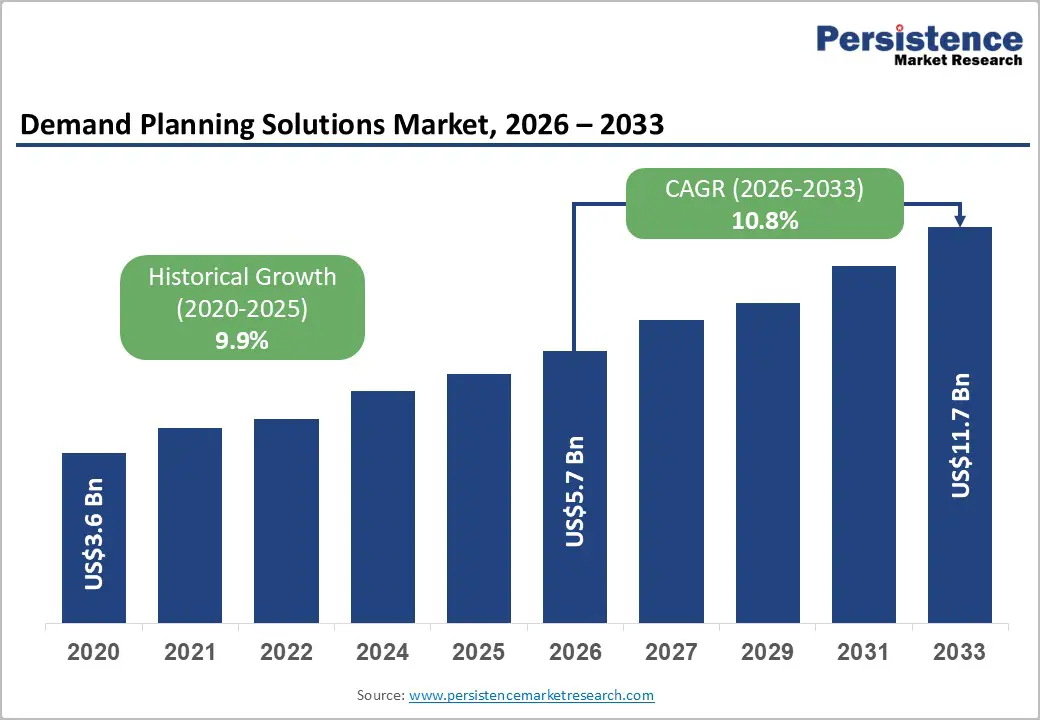
The global demand planning solutions market size is likely to be valued at US$5.7 billion in 2026 and is expected to reach US$11.7 billion by 2033, growing at a CAGR of 10.8% during the forecast period from 2026 to 2033, driven by the increasing need for accurate demand forecasting, efficient inventory management, and enhanced supply chain responsiveness.
As businesses navigate fluctuating market conditions, evolving consumer behavior, and increasingly complex supply networks, demand planning solutions are playing a critical role in improving operational efficiency and strategic decision-making. Furthermore, the adoption of advanced technologies such as artificial intelligence (AI), machine learning (ML), and cloud-based platforms is enabling organizations to gain deeper demand insights, optimize inventory levels, and strengthen collaboration across supply chain functions.
Key Industry Highlights:
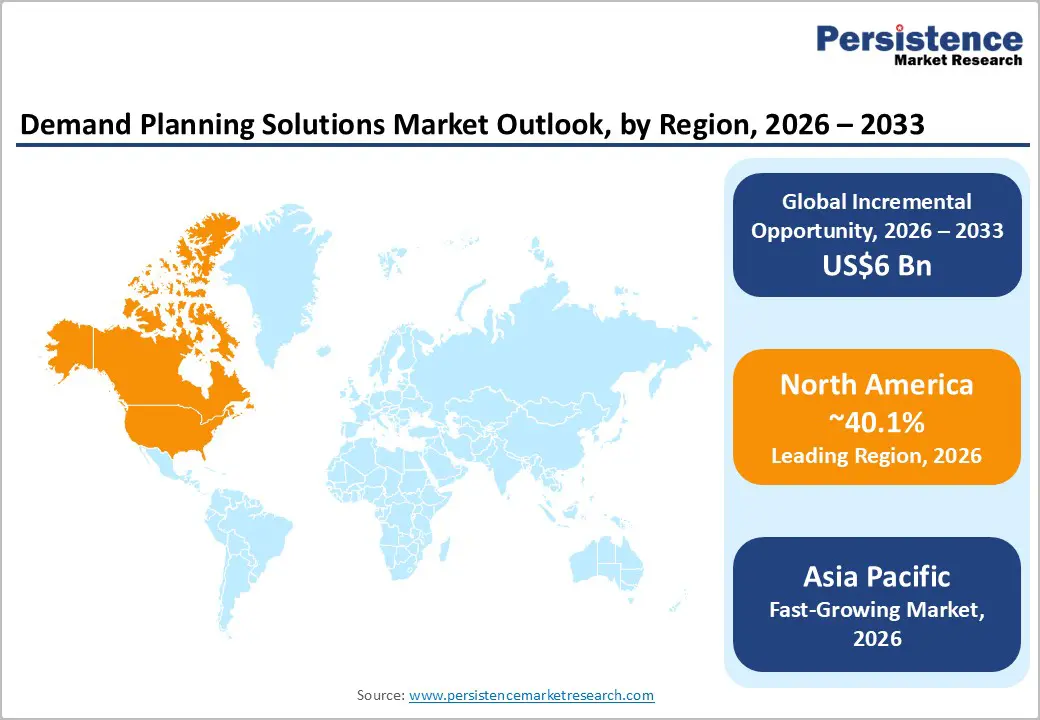
- Leading Region: North America is projected to account for 40.1% of the market share, supported by strong enterprise software adoption, AI integration, and advanced supply chain digitalization.
- Fastest-growing Region: Asia Pacific is expected to register the highest growth rate through 2033, driven by rapid industrialization, manufacturing expansion, increasing cloud adoption, and growing e-commerce activity across China, India, Japan, and ASEAN countries.
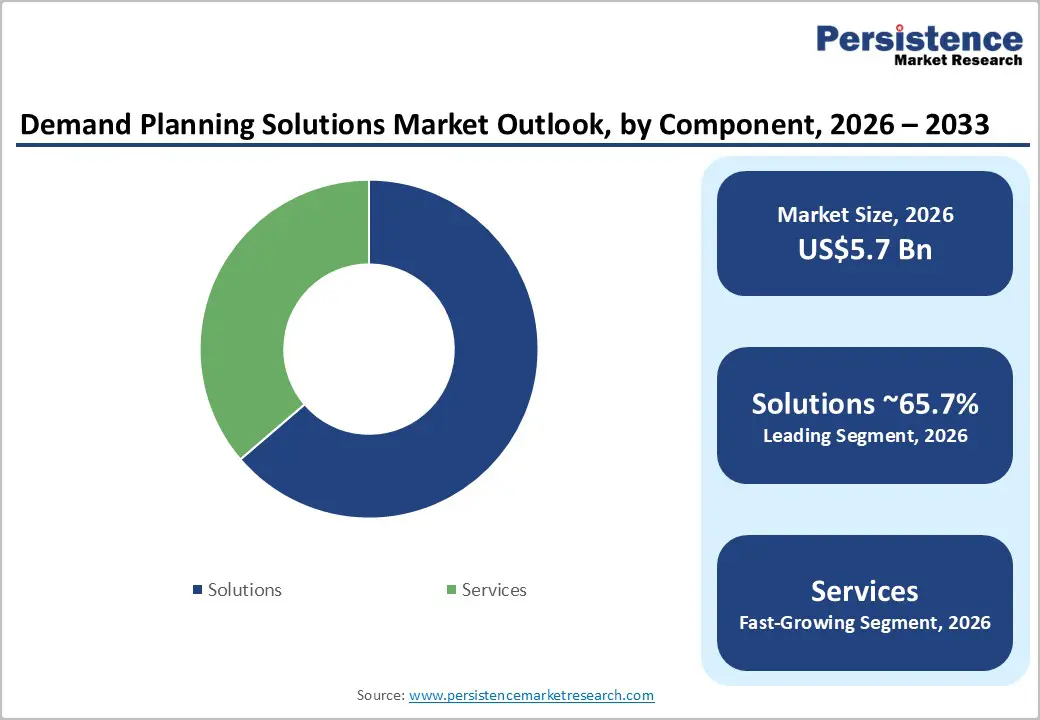
- Dominant Component: Solutions are anticipated to hold 65.7% of the market share in 2026, driven by growing adoption of forecasting, inventory optimization, scenario planning, and supply chain visibility software.
- Leading Deployment: On-Premise is estimated to account for 51.5% of market share in 2026, supported by strong demand from large enterprises requiring enhanced data control, regulatory compliance, and integration with legacy enterprise systems.
DRO Analysis
Driver - Rising Adoption of AI-Powered Forecasting and Advanced Analytics
The increasing adoption of artificial intelligence and machine learning technologies is one of the primary drivers of the demand planning solutions market. Traditional forecasting methods often struggle to manage rapidly changing market conditions, consumer behavior shifts, and supply chain disruptions. AI-enabled demand planning platforms can process large volumes of structured and unstructured data, identify demand patterns, and generate highly accurate forecasts in real time.
Modern solutions incorporate demand sensing, predictive analytics, and automated decision-support capabilities, enabling organizations to improve forecast accuracy while reducing inventory carrying costs. Improved forecasting performance helps businesses minimize stock-outs, optimize working capital utilization, and improve customer service levels. As enterprises prioritize data-driven planning and resilience, investment in AI-powered demand planning platforms continues to accelerate across manufacturing, retail, healthcare, and consumer goods industries.
Growing Cloud Adoption and Digital Supply Chain Transformation
Cloud computing has transformed how organizations deploy and manage demand planning applications. Enterprises increasingly favor cloud-based solutions due to their scalability, lower infrastructure requirements, reduced implementation timelines, and continuous software updates.
Cloud deployment enables organizations to integrate planning functions across multiple business units, regions, and supply chain partners while supporting remote collaboration. The expansion of Software-as-a-Service (SaaS) business models has also made advanced planning capabilities accessible to mid-sized organizations that previously lacked the resources to implement enterprise-scale planning systems.
As companies continue their digital transformation initiatives, cloud-based demand planning platforms are becoming central to broader supply chain modernization strategies. The ability to combine forecasting, inventory planning, sales planning, and operational execution within a unified cloud environment is significantly enhancing market growth.
Restraint - Complex Integration Requirements and High Implementation Costs
Despite strong growth prospects, implementation complexity remains a major challenge for market expansion. Demand planning solutions often require integration with enterprise resource planning (ERP), customer relationship management (CRM), warehouse management systems, transportation management systems, and point-of-sale platforms.
Data inconsistencies, fragmented technology environments, and legacy infrastructure can significantly increase deployment costs and project timelines. Many organizations must undertake extensive data cleansing, process redesign, and employee training before realizing the full benefits of advanced planning systems.
Small and medium-sized enterprises are particularly sensitive to implementation costs and resource constraints. While cloud deployment reduces infrastructure expenses, the overall cost of integration, customization, and organizational change management can still delay adoption and affect return on investment.
Opportunity - Expanding Digitalization among Small and Medium-Sized Enterprises
Small and medium-sized enterprises (SMEs) represent one of the largest untapped opportunities within the demand planning solutions market. As SMEs increasingly embrace digital transformation, many are seeking affordable planning tools that can improve forecasting accuracy, inventory visibility, and operational efficiency.
Cloud-based platforms have significantly lowered adoption barriers by offering subscription-based pricing, simplified deployment, and scalable functionality. Vendors that provide industry-specific templates, preconfigured workflows, and rapid implementation models are well-positioned to capture growing SME demand.
The growing need for operational resilience and improved inventory management is expected to drive strong adoption among regional manufacturers, distributors, wholesalers, and specialty retailers over the forecast period.
Rapid Growth of Omnichannel Retail and E-Commerce Operations
The continued expansion of e-commerce and omnichannel retailing is creating significant opportunities for demand planning solution providers. Consumer purchasing behavior is increasingly influenced by digital channels, promotional campaigns, seasonal demand fluctuations, and real-time fulfillment expectations.
Retailers require advanced planning systems capable of synchronizing inventory, forecasting demand across channels, and optimizing replenishment strategies. Modern demand planning platforms enable organizations to evaluate multiple demand scenarios, anticipate market shifts, and improve inventory allocation across physical and digital sales channels.
As retailers continue investing in data-driven decision-making and customer experience enhancement, demand planning technologies will play an increasingly strategic role in supporting profitable growth.
Category-wise Analysis
Component Analysis
The solutions segment is anticipated to account for over 65.7% of the market share in 2026, maintaining its position as the largest component category. Organizations continue to prioritize software platforms that deliver forecasting, demand sensing, inventory optimization, and scenario-planning capabilities. For example, platforms such as SAP Integrated Business Planning, Oracle Supply Chain Planning, and Kinaxis RapidResponse enable enterprises to improve forecast accuracy and synchronize planning across sales, operations, and finance functions.
Growing adoption of AI-powered forecasting and integrated business planning solutions is strengthening segment growth. As companies increasingly seek unified planning environments rather than standalone forecasting tools, software solutions are expected to remain the dominant revenue contributor throughout the forecast period.
The services segment is projected to register the fastest growth through 2033, driven by increasing implementation complexity and demand for specialized expertise. Organizations frequently require consulting, system integration, employee training, and data management services to maximize the value of demand planning platforms. For instance, large-scale deployments of Oracle, SAP, and Blue Yonder solutions often involve extensive customization, process redesign, and AI model configuration support.
The growing need for managed services, continuous optimization, and digital transformation consulting is expected to accelerate demand across this segment over the forecast period.
Deployment Insights
The on-premise segment is anticipated to hold more than 51.5% of the market share in 2026, retaining its leadership position among deployment models. Large enterprises continue to favor on-premise installations due to greater control over sensitive operational data, regulatory compliance requirements, and compatibility with existing enterprise systems. Industries such as manufacturing, healthcare, and BFSI often operate complex legacy environments that support on-premise deployments.
For example, multinational manufacturers frequently integrate demand planning platforms directly with internal ERP and production management systems, supporting continued adoption of on-premise solutions.
The cloud-based segment is projected to witness the highest CAGR during the forecast period, supported by growing SaaS adoption and supply chain digitalization initiatives. Cloud platforms offer lower upfront costs, faster implementation, scalability, and continuous access to advanced features.
Solutions such as Oracle Fusion Cloud SCM, SAP IBP Cloud, and o9 Digital Brain enable organizations to leverage AI-driven forecasting, real-time analytics, and collaborative planning across multiple locations. As enterprises prioritize agility, remote accessibility, and rapid innovation, cloud-based demand planning solutions are expected to gain market share steadily through 2033.
Regional Insights
North America Demand Planning Solutions Market Trends
North America is expected to account for 40.1% of the market share in 2026, making it the largest regional market. The region benefits from widespread adoption of advanced supply chain technologies, high cloud penetration, and strong investment in AI-enabled business applications. Organizations across manufacturing, retail, healthcare, and consumer goods industries continue investing in demand planning platforms to improve forecast accuracy, inventory visibility, and operational resilience.
U.S. Demand Planning Solutions Market Trends
The U.S. is expected to dominate the North America market due to its advanced digital infrastructure and strong adoption of cloud-based enterprise applications. Large corporations are increasingly implementing AI-powered demand planning solutions to optimize inventory levels, improve customer service, and enhance supply chain responsiveness. Growth in e-commerce, omnichannel retailing, and digital transformation initiatives continues to drive demand for sophisticated forecasting and planning technologies.
Canada Demand Planning Solutions Market Trends
Canada is witnessing steady adoption of demand planning solutions, particularly across manufacturing, retail, and logistics sectors. Organizations are investing in cloud-based planning platforms to improve supply chain efficiency and support data-driven decision-making. Government support for digital innovation and increasing adoption of advanced analytics are contributing to market growth across the country.
Europe Demand Planning Solutions Market Trends
Europe represents a significant market for demand planning solutions, supported by growing investments in supply chain modernization, sustainability initiatives, and operational efficiency improvements. Organizations across the region increasingly prioritize resilient supply chains and advanced forecasting capabilities to address economic uncertainty and changing consumer demand patterns. Regulatory frameworks related to data privacy, governance, and artificial intelligence are encouraging vendors to develop transparent, secure, and compliant planning platforms.
Germany Demand Planning Solutions Market Trends
Germany is the largest market in Europe due to its strong industrial base and leadership in manufacturing. Automotive, industrial equipment, and consumer goods manufacturers are investing heavily in demand planning technologies to improve production planning, inventory management, and supplier coordination. The country's Industry 4.0 initiatives further support adoption of advanced planning solutions.
U.K. Demand Planning Solutions Market Trends
The U.K. is a major adopter of cloud-based planning platforms, driven by strong digital transformation efforts across retail, financial services, and manufacturing sectors. Businesses increasingly rely on AI-powered forecasting tools to improve operational agility and respond to rapidly changing market conditions.
France Demand Planning Solutions Market Trends
France continues to expand its use of demand planning solutions as organizations focus on supply chain optimization and business efficiency. Retailers, consumer goods companies, and manufacturers are increasingly implementing integrated planning systems to improve forecast accuracy and reduce operational costs.
Spain Demand Planning Solutions Market Trends
Spain is emerging as a growing market for demand planning software, supported by expanding digitalization initiatives and increasing adoption among retail and manufacturing organizations. Businesses are investing in cloud-based platforms to enhance supply chain visibility and improve demand forecasting capabilities.
Asia Pacific Demand Planning Solutions Market Trends
Asia Pacific is projected to be the fastest-growing regional market throughout the forecast period. Rapid industrialization, expanding manufacturing activity, accelerating digital transformation, and strong e-commerce growth are creating favorable conditions for demand planning solution adoption. Organizations across the region are modernizing supply chain operations to improve efficiency, reduce costs, and strengthen competitiveness. Growing investments in cloud infrastructure and AI-powered analytics are expected to further accelerate market growth.
China Demand Planning Solutions Market Trends
China represents the largest market in Asia Pacific, supported by its extensive manufacturing ecosystem and rapidly evolving retail sector. Enterprises are adopting advanced planning solutions to manage complex supply chains, improve inventory optimization, and support large-scale production operations. The country's ongoing digital transformation initiatives continue to strengthen market demand.
Japan Demand Planning Solutions Market Trends
Japan remains a significant market due to its technologically advanced manufacturing sector and emphasis on operational excellence. Automotive, electronics, and industrial manufacturers are increasingly deploying AI-enabled planning solutions to improve forecasting precision and enhance supply chain coordination.
India Demand Planning Solutions Market Trends
India is emerging as one of the fastest-growing country markets, driven by rapid digitalization, expanding manufacturing investments, and strong growth in e-commerce. Organizations are increasingly adopting cloud-based planning platforms to improve demand visibility, inventory management, and supply chain efficiency. Government initiatives supporting digital transformation and manufacturing development further contribute to market expansion.
Competitive Landscape
The global demand planning solutions market is moderately fragmented, with several established software providers competing alongside specialized planning technology vendors. Competition is increasingly centered on AI capabilities, cloud deployment models, forecasting accuracy, and platform integration. Leading vendors maintain competitive advantages through extensive product portfolios, global customer bases, and continuous investment in innovation. Smaller providers often compete through industry specialization, faster deployment timelines, and customized service offerings.
Market leaders are focusing on AI innovation, cloud platform expansion, and industry-specific solution development. Vendors increasingly differentiate themselves through demand sensing capabilities, autonomous planning functionality, and integrated decision-making platforms. Subscription-based delivery models, modular deployments, and managed planning services are becoming increasingly common across the industry.
Key Industry Developments:
- In September 2025, Kinaxis Inc. launched Maestro Agents, AI-powered digital co-workers embedded within the Kinaxis Maestro platform to help planners identify supply chain risks, automate routine analysis, and accelerate decision-making in real time.
- In June 2025, o9 Solutions unveiled new capabilities within its Digital Brain Platform featuring specialized AI agents and self-learning models, enabling enterprises to automate planning processes, improve forecasting intelligence, and accelerate decision-making across supply chain, commercial, and financial planning functions.
Companies Covered in Demand Planning Solutions Market
- SAP SE
- Oracle Corporation
- Blue Yonder
- Kinaxis Inc.
- o9 Solutions
- RELEX Solutions
- Anaplan, Inc.
- Logility, Inc.
- Infor
- SAS Institute Inc.
- IBM Corporation
- QAD Inc.
- Slimstock
- ToolsGroup
- Dassault Systèmes (DELMIA Quintiq)
- E2open, LLC.
Frequently Asked Questions
The global demand planning solutions market is estimated to be valued at US$5.7 billion in 2026.
The planning solutions market is projected to reach US$11.7 billion by 2033.
Key trends include the growing adoption of AI and machine learning-based demand forecasting and the rising deployment of cloud-based planning platforms.
The solutions segment is the leading component category, accounting for 65.7% of the global market share, driven by strong demand for forecasting, inventory optimization, and integrated planning software.
The demand planning solutions market is expected to grow at a CAGR of 10.8% between 2026 and 2033.
Some of the major companies include SAP SE, Oracle Corporation, Blue Yonder, Kinaxis Inc., and o9 Solutions.


