




- Hardware & Software IT Services
- Applicant Tracking System Market
Applicant Tracking System Market Size, Share, and Growth Forecast 2026–2033
Applicant Tracking System Market by Component (Software, Services), Deployment Model (Cloud-Based, On-Premises), End-user (IT & Telecommunications, BFSI, Healthcare & Life Sciences, Retail & Consumer Goods, Manufacturing, Government & Public Sector, Others), and Regional Analysis, 2026–2033

Applicant Tracking System Market Size and Trend Analysis
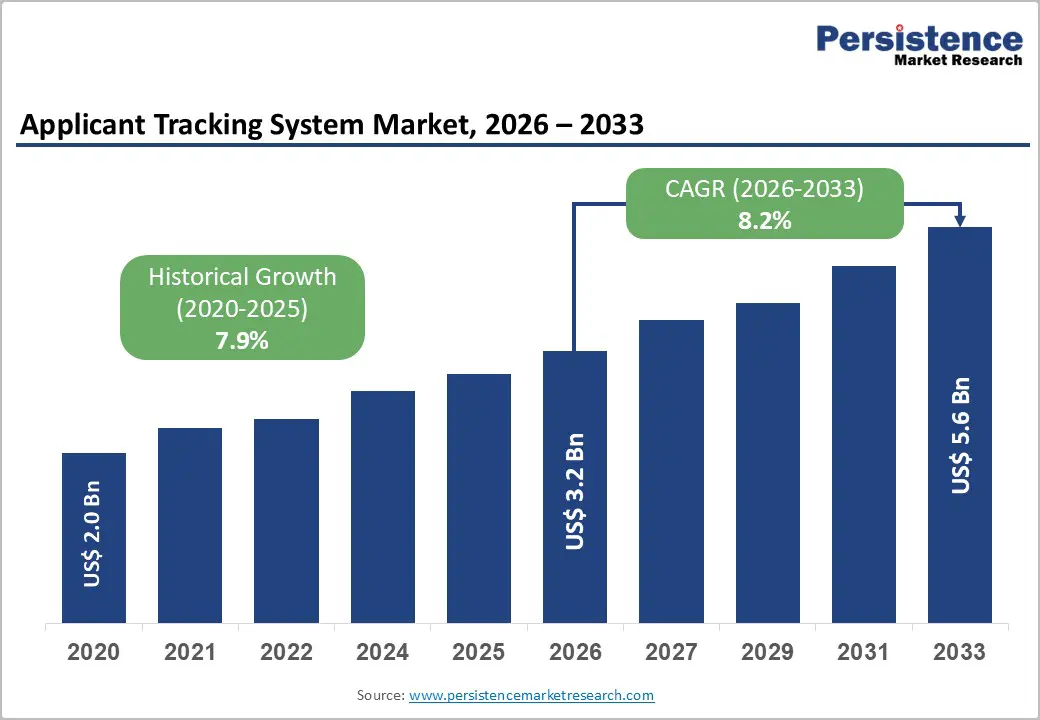
The global applicant tracking system market is expected to be valued at US$ 3.20 billion in 2026 and is projected to reach US$ 5.56 billion by 2033, growing at a CAGR of 8.2% between 2026 and 2033.
It is experiencing steady growth as organizations increasingly digitize recruitment processes to improve hiring efficiency, compliance, and candidate experience. Rising adoption of AI-powered talent acquisition tools, cloud-based HR solutions, and data-driven workforce planning is accelerating ATS deployment across enterprises of all sizes worldwide.
Key Industry Highlights
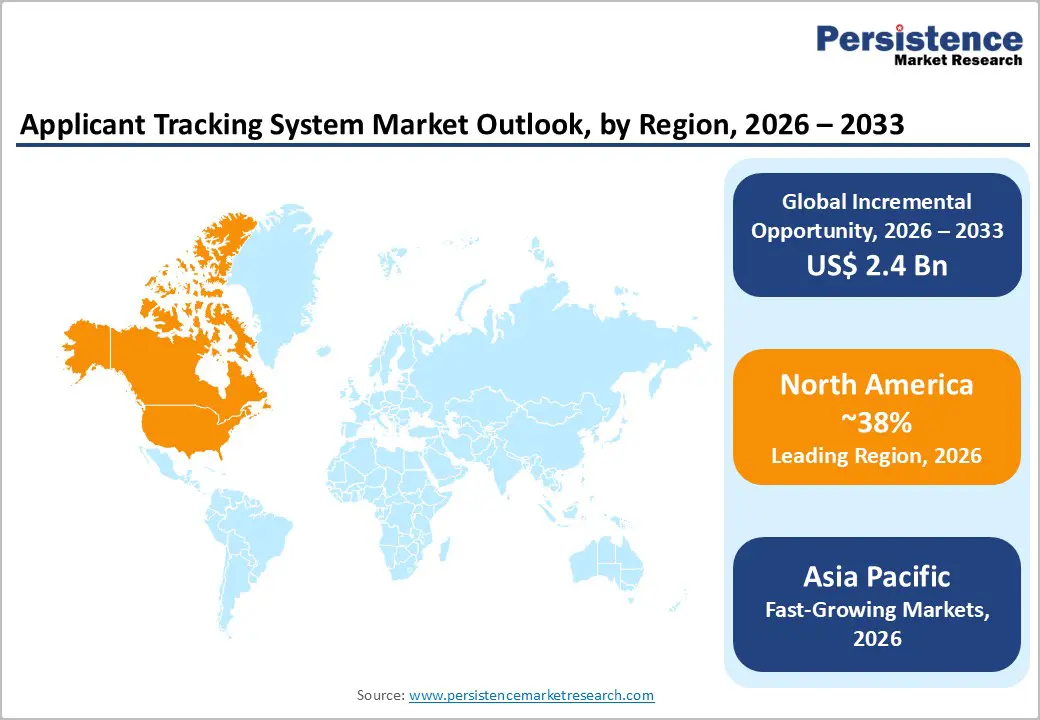
- Leading Region: North America holds 38.0% of the market, generating US$ 1.22 Billion in 2026. Strong ATS adoption, EEOC compliance requirements, and increasing use of AI-driven hiring tools continue to support high enterprise spending and platform upgrades.
- Fastest Growing Region: Asia Pacific is projected to reach a CAGR of 9.8% in the forecast period. Growth is driven by large-scale hiring in India’s IT sector and rising demand for data-compliant recruitment software in China, boosting the adoption of cloud-based ATS platforms.
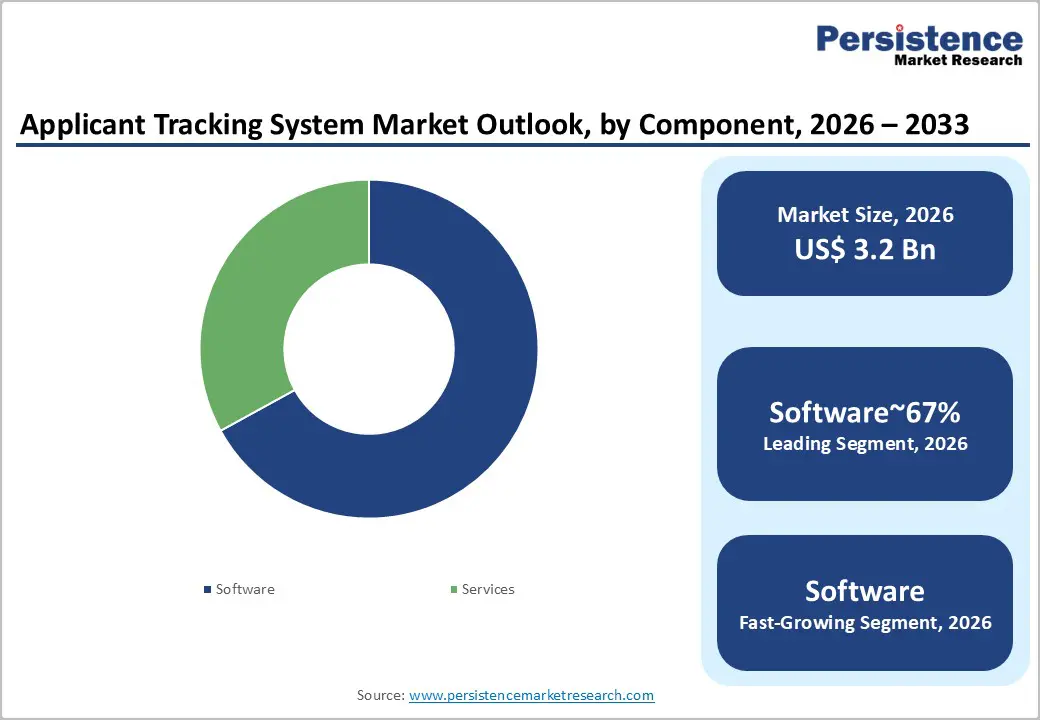
- Leading Segment: Software accounts for 67.0% of the market, valued at US$ 2.14 Billion in 2026. Organizations increasingly rely on ATS software for hiring automation, analytics, compliance reporting, and efficient management of large recruitment volumes.
- Fastest Growing Segment: BFSI is the fastest-growing end-use industry. Regulatory requirements for workforce documentation and operational resilience are increasing ATS adoption among banks, financial institutions, and insurance companies.
- Key Opportunity: AI-powered candidate matching presents a major growth opportunity through 2033. Vendors with extensive hiring data can offer more accurate recruitment outcomes and develop performance-based pricing models that enhance customer value.
Market Dynamics
Drivers - Enterprise-Wide AI Integration Mandates Accelerating ATS Platform Upgrades
Organisations across Fortune 500 cohorts are replacing legacy point-solution hiring tools with end-to-end SaaS hiring platforms that embed large-language-model capabilities directly into candidate management and screening workflows, creating durable upgrade cycles that benefit established ATS vendors.
The U.S. Department of Labor's HIRE Vets Medallion Program, expanded in 2023, requires participating employers to demonstrate structured, documented recruitment processes, and Workday Inc. responded in 2024 by integrating its Illuminate AI layer natively into its recruiting module, enabling real-time bias detection and candidate scoring at scale. Over the next two to three years, this convergence of regulatory documentation requirements and AI-native platform capabilities will push mid-market enterprises, currently underserved by best-in-class solutions, into multi-year ATS subscription agreements, expanding addressable revenue per account.
Remote and Hybrid Work Models Permanently Expanding the Candidate Pool and Volume Requirements
Distributed hiring across geographies has multiplied per-requisition application volumes by an estimated three to five times compared to pre-2020 norms, according to LinkedIn's 2023 Global Talent Trends Report, making manual resume screening operationally untenable for any organisation hiring more than fifty roles annually. The European Union's Remote Work Framework Agreement, which came into force in 2022 for cross-border teleworkers, introduced documentation obligations that effectively mandate employer-side digital hiring records, a compliance burden that recruitment software platforms absorb automatically.
As hybrid workforce models become permanent fixtures across OECD economies, ATS platforms capable of managing multi-jurisdiction candidate pipelines and generating compliant audit trails will transition from optional productivity tools to non-negotiable infrastructure, broadening the buyer base from enterprise to mid-market and SMB segments.
Restraints - Data Privacy Regulation Compliance Costs Creating Adoption Friction among SMBs
The General Data Protection Regulation (GDPR), enforced since 2018 and actively prosecuted by national data protection authorities, including Ireland's Data Protection Commission, imposes strict candidate data retention limits, consent management obligations, and right-to-erasure requirements that are technically complex to implement within legacy or low-cost ATS configurations.
Compliance retrofitting can add an estimated 15% premium to the total cost of ownership for small and medium-sized businesses, compressing the value proposition of ATS adoption relative to manual processes. For new SaaS entrants targeting the SMB segment, the engineering overhead of building GDPR-compliant data architectures represents a material barrier that slows product launch timelines and increases customer acquisition costs versus incumbents with established compliance frameworks.
Integration Complexity with Existing HR Technology Stacks Suppresses Upgrade Velocity
Many mid-market and enterprise HR departments operate heterogeneous technology environments, combining payroll systems from ADP LLC, legacy HCM platforms, and third-party background verification services, creating significant integration costs when transitioning to a new ATS vendor.
The HR Open Standards Consortium estimates that integration and data migration account for approximately 40% of total ATS implementation project budgets, a figure that compresses effective ROI timelines and causes procurement teams to delay vendor switches. Incumbent vendors with pre-built connector libraries retain a structural renewal advantage, while challengers must invest heavily in API infrastructure and professional services capacity before they can compete credibly on total cost of ownership.
Opportunities - AI-Powered Candidate Matching as a Standalone Revenue Layer for ATS Vendors
ATS platform providers can unlock a high-margin, outcome-based pricing model by commercialising AI-driven candidate-to-role matching as a distinct product tier, charging per successful placement prediction rather than per seat, a shift that aligns vendor incentives with recruiter productivity.
iCIMS Inc. validated this direction with its 2024 launch of iCIMS Talent Cloud AI features, including a proprietary candidate match scoring engine trained on anonymised hiring outcome data across its network of over 4,000 enterprise clients, demonstrating that proprietary training data creates a durable competitive moat. Vendors with large, longitudinally rich hiring outcome datasets are best positioned to monetise this opportunity, provided they can demonstrate measurable improvements in quality-of-hire metrics that justify premium pricing to CHRO-level buyers.
Emerging Market SMB Digitalisation: Unlocking a New ATS Buyer Cohort
Venture-backed HR technology distributors and government-led digital infrastructure programmes across Southeast Asia and South Asia are creating a first-time ATS buyer cohort among SMBs that previously relied entirely on job board email submissions and spreadsheet-based candidate tracking.
India's Ministry of Electronics and Information Technology accelerated this shift through the Digital India programme's 2023 MSME digitisation push, which subsidised SaaS adoption for over 1 million registered small businesses, including HR workflow tools. Cloud-native, mobile-first ATS vendors offering freemium or low-friction subscription entry points, such as Zoho Corporation's Zoho Recruit platform, which added vernacular language support across six Indian languages in 2023, are best positioned to capture this cohort, provided localised compliance modules and affordable tiered pricing are in place at market entry.
Category-wise Analysis
Component Insights
Software dominates the global applicant tracking system market, accounting for 67% of total revenue in 2026, equivalent to US$ 2.14 billion. This leadership reflects the growing shift among enterprise HR teams from basic hiring tools to intelligent recruitment platforms. Large financial institutions and technology companies use ATS software to manage interview scorecards, automate offer letter generation, and maintain EEO-1 compliance reporting required by the U.S. Equal Employment Opportunity Commission. Retail giants such as Walmart also depend on ATS platforms to efficiently handle high-volume seasonal recruitment while reducing recruiter workload and operational costs.
Services represent the fast-growing component segment in the applicant tracking system market, supported by rising demand for implementation, configuration, and managed recruiting services that enhance ATS platform performance. Recruitment process outsourcing providers, including Randstad through its Sourceright division, expanded ATS-managed service offerings across Asia Pacific in 2024. Companies increasingly prefer service-led partnerships that combine technology with hiring expertise, helping organisations improve recruitment outcomes, streamline hiring operations, and gain greater accountability, which is expected to drive faster growth for ATS service providers through 2033.
Deployment Model Insights
Cloud-based deployment leads the applicant tracking system market, capturing 53.0% of total revenue in 2026, equivalent to US$ 1.70 Billion. Cloud ATS solutions remain highly preferred because they remove the need for costly on-premises infrastructure while supporting real-time updates and faster AI feature integration. Multinational pharmaceutical companies conducting recruitment across Europe, the United States, and the Asia Pacific rely on cloud-hosted platforms to deliver a unified hiring experience and maintain centralised compliance records.
On-premises deployment is the fastest growing deployment model segment in the applicant tracking system market, driven by increasing data sovereignty and cybersecurity requirements across regulated industries and government organisations. The European Union’s NIS2 Directive, implemented in October 2024, expanded cybersecurity obligations for HR systems managing critical workforce data, encouraging defence contractors and energy companies to adopt on-premises ATS solutions. SAP continued supporting on-premises.
End-user Insights
IT & Telecommunications account for a leading end-user position in the applicant tracking system market, representing 28.0% of total revenue in 2026, equivalent to US$ 900 million. The tech companies generate strong ATS demand due to their large-scale and highly specialised hiring requirements. Major cloud providers such as Microsoft use ATS platforms with AI-driven skills matching, GitHub integration, and coding assessment workflows to efficiently screen thousands of engineering applicants. Telecommunications companies expanding 5G infrastructure also rely on ATS systems to manage contractor hiring and workforce planning across long-term network deployment projects.
BFSI represents the fastest growing end-use segment in the applicant tracking system market, supported by rising regulatory compliance requirements and increasing competition for skilled financial talent. Financial institutions are adopting ATS platforms to strengthen hiring transparency, document recruitment processes, and improve workforce continuity planning. JPMorgan Chase expanded its global campus recruitment programme in 2024, processing more than 500,000 graduate applications through its Workday-integrated ATS platform. This growing recruitment scale highlights strong long-term revenue opportunities for ATS vendors serving the BFSI sector.
Regional Insights
North America Applicant Tracking System Market Trends and Insights
North America is likely to account for 38% of the global applicant tracking system market in 2026, representing US$ 1.22 billion, sustained by the highest enterprise ATS penetration rate globally and a regulatory environment that actively incentivises structured, documented hiring workflows. The Pregnant Workers Fairness Act, enacted in 2023 and enforced by the U.S. Equal Employment Opportunity Commission, added new documentation obligations to the hiring process that ATS platforms operationalise automatically, reinforcing replacement cycles among employers using sub-standard legacy systems.
North America's regional dominance is expected to persist through 2033 as AI-augmented recruiting features, including predictive attrition modelling and skills-gap-based job description generation, become standard ATS requirements for Fortune 1000 HR teams.
- United States Applicant Tracking System Market Size
The United States is poised for an estimated 84% of the North America applicant tracking system market in 2026 driven by the concentration of enterprise SaaS buyers, a mature HR technology vendor ecosystem, and the National Labor Relations Board's 2023 guidance on electronic hiring documentation that accelerated ATS adoption among mid-market employers. As AI hiring tools face expanded federal scrutiny, U.S. enterprises will increasingly require ATS platforms with built-in algorithmic bias audit capabilities, favouring vendors with compliance-as-a-feature product roadmaps.
Europe Applicant Tracking System Market Trends and Insights
Europe is likely to accounts for 25% of the global applicant tracking system market in 2026, representing US$ 800 million with demand shaped primarily by GDPR compliance obligations and the EU AI Act, which entered its phased implementation from 2024 and classifies AI-driven candidate screening tools as high-risk applications requiring mandatory transparency and human oversight provisions. These dual regulatory forces are simultaneously driving ATS procurement to meet documentation standards and product differentiation, as vendors compete on the strength of their explainable AI and data governance architectures. European market growth is further supported by rising cross-border hiring within the EU single market, where enterprises require multi-language ATS configurations with jurisdiction-specific candidate consent workflows.
- Germany Applicant Tracking System Market Size
Germany represents an analyst-estimated 22% of the European applicant tracking system market, underpinned by the Works Constitution Act (Betriebsverfassungsgesetz), which requires works council co-determination in the introduction of ATS systems, creating a procurement process that favours well-documented, enterprise-grade platforms. As Germany's manufacturing sector pursues workforce digitalisation under the Fachkräfteeinwanderungsgesetz (Skilled Immigration Act) amendments effective 2024, ATS platforms with multilingual candidate portals are gaining traction among industrial employers.
- United Kingdom Applicant Tracking System Market Size
The United Kingdom is estimated 19% of the European applicant tracking system market in 2026 with demand anchored in the financial services and professional services sectors that cluster in London and require high-throughput, compliance-ready recruitment software. The UK Information Commissioner's Office published updated employment data guidance in 2023 that tightened candidate data handling requirements, prompting a wave of ATS platform reviews among mid-market employers and expanding the serviceable market for compliant SaaS hiring solutions.
- France Applicant Tracking System Market Size
France accounts for an analyst-estimated 14% of the European applicant tracking system market, where the Commission Nationale de l'Informatique et des Libertés (CNIL) has issued binding decisions on AI recruitment tools since 2022, compelling French employers to deploy ATS platforms with transparent automated decision-making documentation. The French government's France 2030 investment plan, allocating funds to digital transformation of public-sector operations, is creating a nascent government-sector ATS procurement pipeline that did not exist at scale before 2023.
Asia Pacific Applicant Tracking System Market Trends and Insights
Asia Pacific accounts for 22.0% of the global applicant tracking system market in 2026, representing US$ 700 million, and is the fast-growing region with a projected CAGR of 9.8%, driven by the mass formalisation of hiring processes among large employers in China, India, and Southeast Asia as those economies transition toward knowledge-sector dominance. Japan's Ministry of Economy, Trade and Industry (METI) published a 2023 DX (Digital Transformation) workforce guideline specifically recommending structured ATS adoption for mid-sized manufacturers confronting demographic-driven labour scarcity. The Asia Pacific ATS market will be the primary volume growth engine by 2033, with cloud-native, mobile-first platforms capturing the majority of new deployments given low legacy infrastructure penetration across the region's emerging economy segments.
- China Applicant Tracking System Market Size
China is estimated 35% of the Asia Pacific applicant tracking system market in 2026, with adoption concentrated among technology giants, state-owned enterprises undergoing workforce modernisation, and multinational companies operating under the Personal Information Protection Law (PIPL), effective November 2021, which imposes strict candidate data localisation requirements that effectively mandate domestically hosted ATS deployments. As China's platform economy employers, including Alibaba Group and ByteDance, standardise graduate hiring through structured ATS-managed assessment centres, adoption norms established by large employers are cascading down to mid-market domestic firms.
- India Applicant Tracking System Market Size
India accounts for an analyst-estimated 28% of the Asia Pacific applicant tracking system market, the fastest growing country sub-segment, powered by a technology services industry that collectively employed over 5.4 million professionals as of fiscal year 2024, per the National Association of Software and Service Companies (NASSCOM). Leading IT services firms, including Infosys and Tata Consultancy Services, process hundreds of thousands of campus and lateral hire applications annually through integrated ATS platforms, and their vendor choices set adoption benchmarks for the broader Indian corporate sector. The rollout of India's Digital Personal Data Protection Act 2023 is expected to formalise candidate data handling standards, further expanding ATS procurement among compliance-conscious mid-market employers from 2025 onward.
- Japan Applicant Tracking System Market Size
Japan represents an analyst-estimated 18% of the Asia Pacific applicant tracking system market, with demand driven by the structural labour shortage in manufacturing and caregiving sectors. Japan's working-age population declined by approximately 400,000 persons in fiscal year 2023, per the Statistics Bureau of Japan, compelling employers to maximise hiring efficiency through automation.
The Japanese government's Human Resource Development Support Subsidy programme, which funds digital HR tool adoption for SMEs, is actively reducing first-cost barriers to ATS entry for smaller manufacturers and service firms that historically managed hiring through paper-based processes.
Competitive Landscape
The global applicant tracking system market operates as a fragmented-to-consolidating competitive landscape, with Workday Inc. and Oracle Corporation anchoring the enterprise tier through deeply integrated HCM suite strategies that make standalone ATS displacement commercially difficult. iCIMS Inc. competes as the dominant independent ATS specialist, differentiating on recruitment CRM depth and talent pipeline analytics rather than broad HCM bundling.
The defining strategic theme of 2024–2025 is AI-native feature velocity, vendors shipping generative AI job description tools, automated interview scheduling, and predictive candidate quality scores are widening the gap against laggards. Greenhouse Software Inc. has emerged as a disruptive mid-market force by prioritising structured hiring methodology and DEI analytics, attracting a buyer profile that views hiring quality, not just speed, as the primary ATS ROI metric.
Key Developments:
- February 2025: SAP SE announced the general availability of Joule AI copilot integration within its SuccessFactors Recruiting module, enabling recruiters to generate role-specific interview questions and candidate evaluation summaries in natural language, targeting enterprise clients across 60+ countries.
- October 2024: SmartRecruiters Inc. launched SmartAssistant 2.0, an AI-powered candidate engagement tool integrating large-language-model-driven personalised outreach sequences directly within its recruitment CRM, reported to reduce candidate dropout rates in early pipeline stages by approximately 25% in pilot deployments.
- March 2024: Bullhorn Inc. completed the acquisition of Textkernel, a Netherlands-based AI resume parsing and labour market intelligence firm, extending Bullhorn's talent acquisition capabilities into real-time skills ontology matching for staffing agency clients across North America and Europe.
Companies Covered in Applicant Tracking System Market
- Oracle Corporation
- Workday Inc.
- SAP SE
- iCIMS Inc.
- Greenhouse Software Inc.
- SmartRecruiters Inc.
- Jobvite LLC
- Lever
- Bullhorn Inc.
- BambooHR LLC
- JazzHR
- Zoho Corporation Pvt. Ltd.
- ClearCompany
- Pinpoint HQ Ltd.
- ADP LLC
- Cornerstone OnDemand Inc.
- Ceridian HCM Holding Inc.
- Taleo Corporation
- Recruitee
- Ashby Inc.
Frequently Asked Questions
The global applicant tracking system market is valued at US$ 3.20 Billion in 2026 and is projected to reach US$ 5.56 Billion by 2033, growing at a CAGR of 8.2%. The primary growth catalyst is enterprise adoption of AI-driven recruitment automation tools, accelerated by regulatory requirements for documented, auditable hiring processes from bodies such as the U.S. Department of Labor.
Two primary drivers underpin applicant tracking system market growth: first, the EU AI Act's 2024 phased implementation classifying AI screening tools as high-risk, compelling European employers to adopt compliant, auditable ATS platforms, and second, the permanent expansion of remote and hybrid hiring models that have multiplied per-requisition application volumes beyond manual processing capacity. The HR Open Standards Consortium has further validated that organisations standardising on structured ATS workflows achieve measurable reductions in both cost-per-hire and time-to-fill metrics.
Software holds the largest component share at 67.0%, equivalent to US$ 2.14 Billion in 2026, because enterprise HR teams require continuous AI feature updates, EEO compliance reporting automation, and structured interview workflow management that only dedicated SaaS platforms deliver at scale. The International Data Corporation (IDC) data showing average enterprise HCM software contract lengths of 3.2 years confirms strong retention economics that insulate this segment against competitive disruption.
North America dominates the global applicant tracking system market with 38.0% revenue share, representing US$ 1.22 Billion in 2026, driven by the highest enterprise ATS penetration globally and a dense regulatory framework, including EEOC documentation mandates and the Pregnant Workers Fairness Act 2023, that structurally embeds ATS platforms into compliance workflows. North America's position is expected to remain unchallenged by 2033, even as Asia Pacific closes the gap at a 9.8% CAGR.
The two most actionable opportunities are outcome-based AI candidate matching, where vendors monetise proprietary hiring outcome datasets through performance-linked pricing, and SMB market expansion in South and Southeast Asia, enabled by government digitalisation subsidies such as the Digital India programme's MSME outreach. Cloud-native vendors with localised compliance modules and mobile-first interfaces are best positioned to capture both opportunities, provided they can demonstrate measurable quality-of-hire improvements to justify premium tier pricing.
Workday Inc., Oracle Corporation, and SAP SE lead the enterprise tier through integrated HCM suite strategies, while iCIMS Inc. and Greenhouse Software Inc. compete as specialist ATS vendors on depth of recruitment analytics and structured hiring methodology. The competitive landscape is moderately concentrated at the enterprise level but highly fragmented in the mid-market and SMB segments, where AI feature velocity, exemplified by SmartRecruiters' 2024 AI-driven candidate engagement launch, is the primary basis of differentiation and customer acquisition.


