




- Healthcare IT
- Asia Pacific Medical Imaging Informatics Market
Asia Pacific Medical Imaging Informatics Market Size, Share, and Growth Forecast, 2026 - 2033
Asia Pacific Medical Imaging Informatics Market by Product Type (Radiology IT Solutions, Ancillary IT Solutions, Others), Application (Mammography, CT, MRI, Others), Deployment (On-premise, Cloud-based), and Country Analysis for 2026 - 2033

Asia Pacific Medical Imaging Informatics Market Size and Trends Analysis
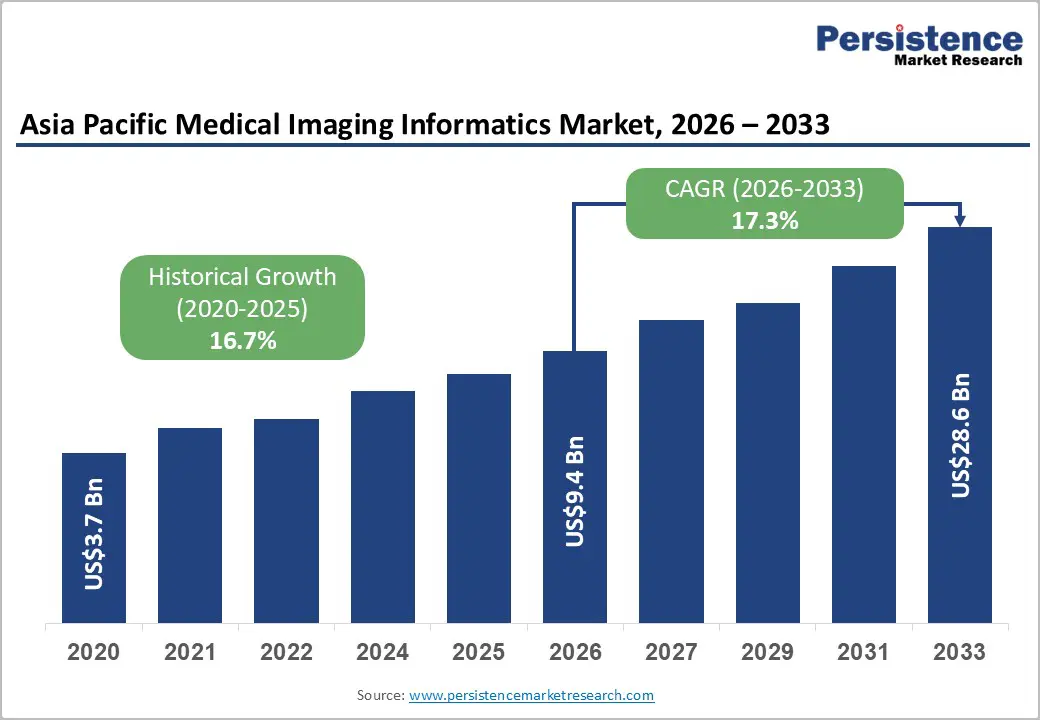
The Asia Pacific medical imaging informatics market size is likely to be valued at US$9.4 billion in 2026 and is expected to reach US$28.6 billion by 2033, growing at a CAGR of 17.3% during the forecast period from 2026 to 2033, driven by increasing healthcare digitalization, rising diagnostic imaging volumes, and expanding adoption of AI-enabled imaging workflows across hospitals and diagnostic centers.
Governments are strengthening digital health infrastructure and interoperability frameworks to improve healthcare efficiency and patient outcomes. In 2025, the World Health Organization (WHO) highlighted that digital health transformation and integrated health information systems remain major priorities across the Asia-Pacific healthcare ecosystem. Rising investments in cloud-based PACS, enterprise imaging, and tele-radiology platforms are further accelerating market expansion.
Key Industry Highlights:
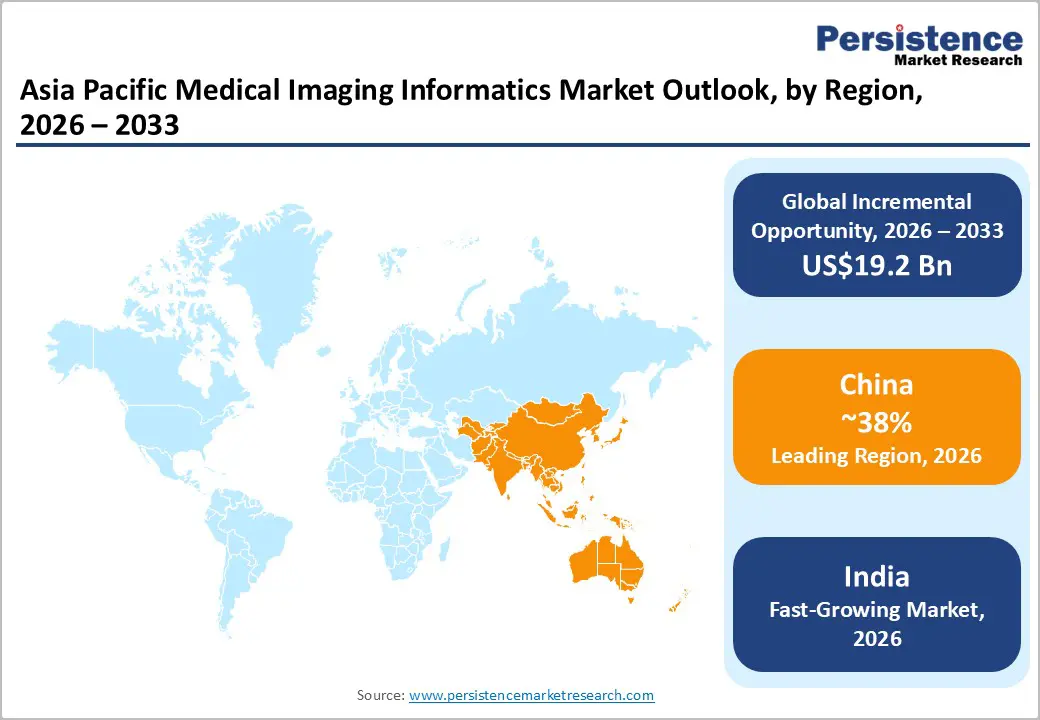
- Leading Region: China is anticipated to be the leading region, accounting for a market share of 38% in 2026, driven by aggressive healthcare infrastructure modernization and digital imaging adoption.
- Fastest-growing Region: India is likely to be the fastest-growing region, supported by expanding diagnostic imaging demand and increasing adoption of cost-efficient digital healthcare solutions.
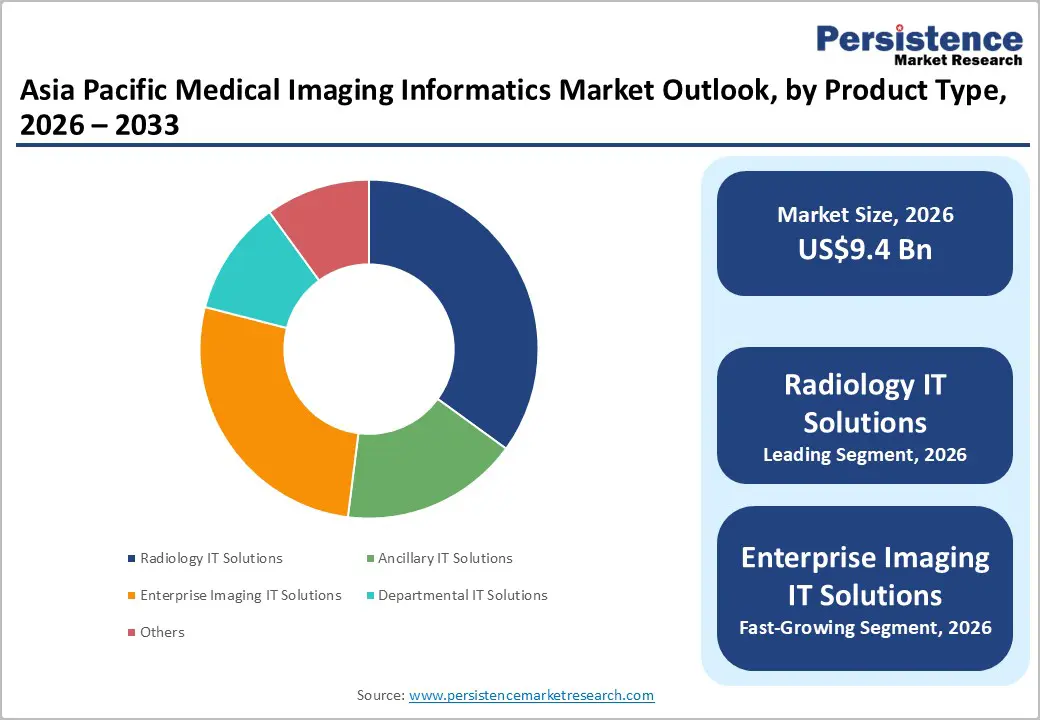
- Leading Product Type: Radiology IT solutions are projected to represent the leading product type in 2026, accounting for 31% of the revenue share, driven by widespread adoption of PACS and RIS platforms.
- Leading Application: CT is anticipated to be the leading application, accounting for over 44% of the revenue share in 2026, owing to high imaging procedure volumes across diagnostic applications.
- Key Opportunity: The key market opportunity in the Asia Pacific medical imaging informatics market lies in expanding adoption of AI-integrated cloud-based enterprise imaging platforms to support scalable diagnostics, tele-radiology, and interoperable digital healthcare ecosystems across rapidly developing healthcare networks.
DRO Analysis
Driver - Healthcare Infrastructure Expansion and Rising Imaging Procedure Volumes
The Asia Pacific Medical Imaging Informatics Market is expanding rapidly due to continuous healthcare infrastructure development and increasing diagnostic imaging volumes across hospitals and diagnostic centers. Governments in countries are investing heavily in digital healthcare modernization, advanced imaging equipment, and interoperable IT ecosystems. Rising prevalence of chronic diseases, including cancer, cardiovascular disorders, and neurological conditions, has significantly increased demand for CT, MRI, ultrasound, and mammography procedures.
This growing imaging burden is encouraging healthcare providers to adopt advanced informatics platforms such as PACS, RIS, and enterprise imaging systems to improve workflow efficiency, storage management, and clinical decision-making capabilities. Growing patient populations and expanding access to healthcare services are accelerating demand for imaging informatics solutions throughout the region.
Large hospitals and multispecialty healthcare networks increasingly require centralized imaging management systems capable of supporting high data volumes and integrated diagnostics. Rapid urbanization and healthcare expansion in emerging economies are also driving the installation of digital radiology systems and cloud-enabled imaging platforms. Increasing adoption of artificial intelligence for image interpretation and workflow automation is supporting operational efficiency and reducing reporting turnaround times.
Restraint - Data Privacy, Regulatory Hurdles, and Skilled Workforce Shortages
Medical imaging platforms manage large volumes of sensitive patient information, making healthcare providers increasingly vulnerable to cyberattacks and data breaches. Countries across the region have varying healthcare regulations and compliance requirements, creating operational difficulties for multinational vendors and healthcare institutions implementing cross-border digital imaging systems. Complex approval procedures and inconsistent interoperability standards slow the deployment of enterprise imaging and cloud-based informatics platforms.
The shortage of skilled healthcare IT professionals and radiology informatics specialists also restrains market expansion across several Asia Pacific countries. Many hospitals and diagnostic centers face difficulties in managing sophisticated imaging workflows, integrating AI-driven analytics, and maintaining advanced PACS or cloud infrastructures. Smaller healthcare facilities particularly struggle with limited technical expertise and inadequate training resources, delaying digital transformation initiatives.
Opportunity - Telemedicine and Remote Diagnostics Integration
Healthcare providers are increasingly integrating cloud-based imaging platforms with tele-radiology services to improve access to diagnostic expertise across rural and underserved regions. Expanding internet penetration, digital health initiatives, and demand for remote patient management are accelerating adoption of virtual healthcare ecosystems throughout Asia Pacific.
Imaging informatics solutions enable secure transmission, storage, and sharing of diagnostic images between hospitals, radiologists, and healthcare specialists located in different regions. This capability supports faster diagnosis, improved clinical collaboration, and more efficient healthcare delivery across geographically dispersed populations and medical institutions.
Rising investments in digital healthcare infrastructure and AI-powered diagnostic technologies are further strengthening opportunities for remote imaging integration. Healthcare organizations are increasingly adopting enterprise imaging systems that support real-time image access, remote consultations, and centralized workflow management. Cloud-enabled PACS and vendor-neutral archives provide scalable solutions for multi-site healthcare networks and telehealth platforms.
Category-wise Analysis
Product Type Insights
Radiology IT solutions are expected to lead the Asia Pacific medical imaging informatics market, accounting for approximately 31% of revenue in 2026, due to widespread adoption of Picture Archiving and Communication Systems (PACS) and Radiology Information Systems (RIS) across hospitals and diagnostic imaging centers. These solutions are essential for image storage, workflow optimization, patient data management, and radiology reporting efficiency.
For example, GE Healthcare provides advanced PACS and imaging workflow solutions that are widely implemented across Asia Pacific healthcare institutions to support digital radiology transformation and enterprise-wide imaging management capabilities.
Enterprise imaging IT solutions are likely to represent the fastest-growing segment in 2026, supported by increasing demand for integrated imaging ecosystems across healthcare networks. Hospitals and multispecialty healthcare providers are rapidly adopting enterprise imaging platforms to consolidate medical imaging data from radiology, cardiology, pathology, and other departments into unified systems. For instance, Siemens Healthineers offers enterprise imaging and AI-powered workflow platforms that help healthcare providers integrate multi-specialty imaging data.
Application Insights
CT is projected to lead the market, capturing around 44% of the revenue share in 2026, supported by high imaging volumes associated with oncology, trauma care, cardiovascular diseases, and neurological disorders. Computed tomography remains one of the most widely utilized diagnostic imaging modalities owing to its rapid imaging capabilities and high diagnostic accuracy. A notable example includes Canon Medical Informatics, Inc., which provides advanced CT imaging workflow and informatics solutions designed to enhance image management.
Combined modality is likely to be the fastest-growing application, driven by increasing demand for integrated diagnostic imaging approaches. Healthcare providers are increasingly utilizing combined modality imaging platforms that integrate multiple imaging techniques to improve disease detection, treatment planning, and clinical decision-making. For instance, Koninklijke Philips N.V. offers integrated multimodality imaging informatics platforms that support centralized image access, workflow optimization, and collaborative diagnostics.
Deployment Insights
On-premise is expected to lead the Asia Pacific medical imaging informatics market, accounting for approximately 58% of revenue in 2026, driven by strong preference among large hospitals and healthcare institutions for greater control over patient data and imaging infrastructure. Healthcare providers handling high imaging volumes often prefer on-premises systems as they offer enhanced data security, direct infrastructure management, and compatibility with existing legacy systems.
For example, Fujifilm Healthcare provides on-premises PACS and enterprise imaging systems that support secure image storage and workflow integration.
The cloud-based segment is likely to represent the fastest-growing segment, supported by increasing demand for scalable, cost-efficient, and remotely accessible imaging solutions. Healthcare providers are rapidly adopting cloud-enabled imaging informatics platforms to reduce infrastructure costs, simplify software updates, and support tele-radiology services across distributed healthcare networks. For example, IBM Corporation offers cloud-enabled healthcare imaging and AI solutions that help healthcare providers improve accessibility and workflow efficiency.
Country Insights
China Medical Imaging Informatics Market Trends
China is anticipated to be the leading country, accounting for a market share of 38% in 2026, driven by rapid healthcare infrastructure modernization, increasing imaging procedure volumes, and rising investments in digital healthcare ecosystems. Government initiatives promoting hospital digitization and AI-enabled healthcare technologies are accelerating adoption of PACS, RIS, enterprise imaging, and cloud-based informatics platforms across public and private hospitals.
Hospitals are increasingly utilizing AI-powered imaging analytics for automated diagnostics, workflow optimization, and clinical decision support. Rising tele-radiology adoption and centralized healthcare data management are also driving demand for advanced enterprise imaging solutions. A notable example includes Huawei Technologies, which has expanded healthcare cloud and AI imaging solutions that support medical data integration and intelligent imaging workflows for hospitals and healthcare institutions.
Japan Medical Imaging Informatics Market Trends
Japan is likely to be a significant market for medical imaging informatics, driven by advanced healthcare infrastructure, strong adoption of digital imaging technologies, and increasing focus on precision diagnostics. The country has one of the highest utilization rates of CT and MRI systems, creating strong demand for efficient imaging data management and workflow optimization platforms. Aging population trends and rising prevalence of chronic diseases continue to increase diagnostic imaging requirements across healthcare institutions.
Healthcare organizations are increasingly investing in AI-based image interpretation tools, automated reporting systems, and centralized imaging archives to improve radiology productivity and reduce diagnostic turnaround times. Expansion of telemedicine services and remote diagnostics is also supporting demand for cloud-based imaging platforms capable of secure image access and multi-site collaboration. For instance, Fujifilm Healthcare continues to expand advanced enterprise imaging and AI-powered diagnostic workflow solutions that help Japanese hospitals optimize radiology operations.
India Medical Imaging Informatics Market Trends
India is likely to be the fastest-growing country in imaging informatics, driven by expanding healthcare infrastructure, rising diagnostic imaging demand, and increasing digital transformation initiatives across hospitals and diagnostic centers. The growing prevalence of chronic diseases, including cancer, cardiovascular disorders, and neurological conditions, is significantly increasing demand for CT, MRI, ultrasound, and mammography procedures.
Cloud-based imaging systems and AI-enabled diagnostics are becoming major trends across India’s medical imaging informatics industry. Hospitals and diagnostic providers are increasingly implementing enterprise imaging solutions to support centralized image management, remote diagnostics, and collaborative healthcare delivery. For example, Agfa-Gevaert Group has strengthened its imaging informatics presence in India through advanced PACS and enterprise imaging solutions designed to improve radiology workflow efficiency and digital healthcare integration.
Competitive Landscape
The Asia Pacific medical imaging informatics market exhibits a moderately fragmented structure, driven by rapid healthcare digitalization, rising diagnostic imaging volumes, and increasing investments in enterprise imaging infrastructure across hospitals and diagnostic centers. The market is characterized by strong competition among healthcare IT providers, imaging software developers, cloud technology companies, and regional healthcare informatics vendors.
With key leaders, including GE Healthcare, Siemens Healthineers, Koninklijke Philips N.V., Fujifilm Healthcare, IBM Corporation, and Canon Medical Informatics, Inc., the competitive environment continues to evolve through technological innovation and strategic healthcare collaborations. These players compete through AI-integrated imaging platforms, cloud-based PACS deployment, enterprise imaging solutions, workflow automation technologies, and interoperability-focused healthcare IT systems.
Key Industry Developments:
- In May 2026, Koninklijke Philips N.V. and the Asian Society of Cardiovascular Imaging (ASCI) signed a memorandum of understanding to strengthen cardiovascular imaging capabilities across Asia Pacific through advanced imaging technologies, AI-enabled platforms, clinical training, and regional knowledge-sharing initiatives supporting healthcare digitalization and diagnostic excellence.
Companies Covered in Asia Pacific Medical Imaging Informatics Market
- IBM Corporation
- Koninklijke Philips N.V.
- Canon Medical Informatics, Inc.
- Fujifilm Healthcare
- GE Healthcare
- Siemens Healthineers
- Merative
- Bayer
- McKesson Corporation
- TIBCO Software Inc.
- Ansys
Frequently Asked Questions
The Asia Pacific medical imaging informatics market is projected to reach US$9.4 billion in 2026.
The Asia Pacific medical imaging informatics market is driven by rising healthcare digitalization, increasing diagnostic imaging volumes, expanding hospital infrastructure, and growing adoption of AI-enabled imaging workflow solutions.
The Asia Pacific medical imaging informatics market is expected to grow at a CAGR of 17.3% from 2026 to 2033.
Key opportunities lie in cloud-based enterprise imaging platforms, tele-radiology integration, AI-powered diagnostics, and expansion of digital healthcare infrastructure across emerging Asia Pacific economies.
IBM Corporation, Dell Technologies, Koninklijke Philips N.V, and Canon Medical Informatics, Inc. are the leading players.


