




- Chipsets & Processors
- Low Noise Amplifiers (LNAs) Market
Low Noise Amplifiers (LNAs) Market Size, Share, and Growth Forecast, 2026 - 2033
Low Noise Amplifiers (LNAs) Market by Product Type (Silicon-Based Amplifiers, Others), Application (Telecommunications, Consumer Electronics, Others), Frequency Range (Low Frequency, Others), End-user (Residential, Others), and Regional Analysis for 2026 - 2033

Low Noise Amplifiers (LNAs) Market Size and Trends Analysis
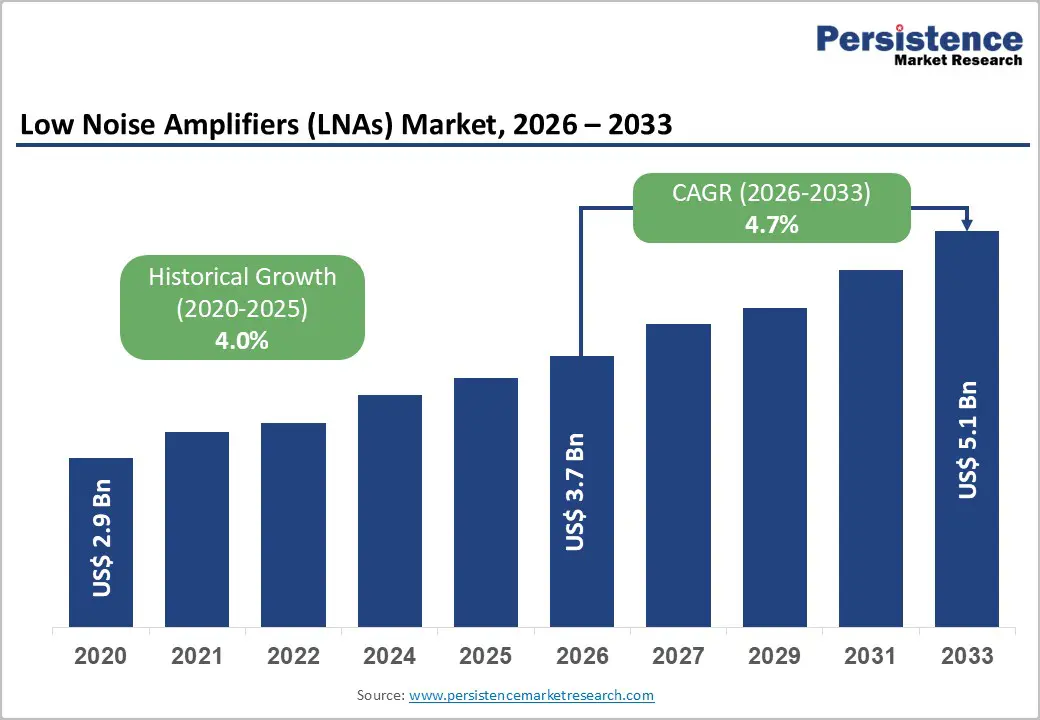
The global low noise amplifiers (LNAs) market size is likely to be valued at US$3.7 billion in 2026, and is expected to reach US$5.1 billion by 2033, growing at a CAGR of 4.7% during the forecast period from 2026 to 2033, driven by the exponential growth of 5G infrastructure, rising demand for high-sensitivity receivers in smartphones and IoT devices, increasing adoption in satellite communication and radar systems, and expanding use in medical imaging and automotive radar applications. Growing demand for gallium arsenide amplifiers in telecommunications and consumer electronics is accelerating adoption among RF designers and device manufacturers.
Key Industry Highlights:
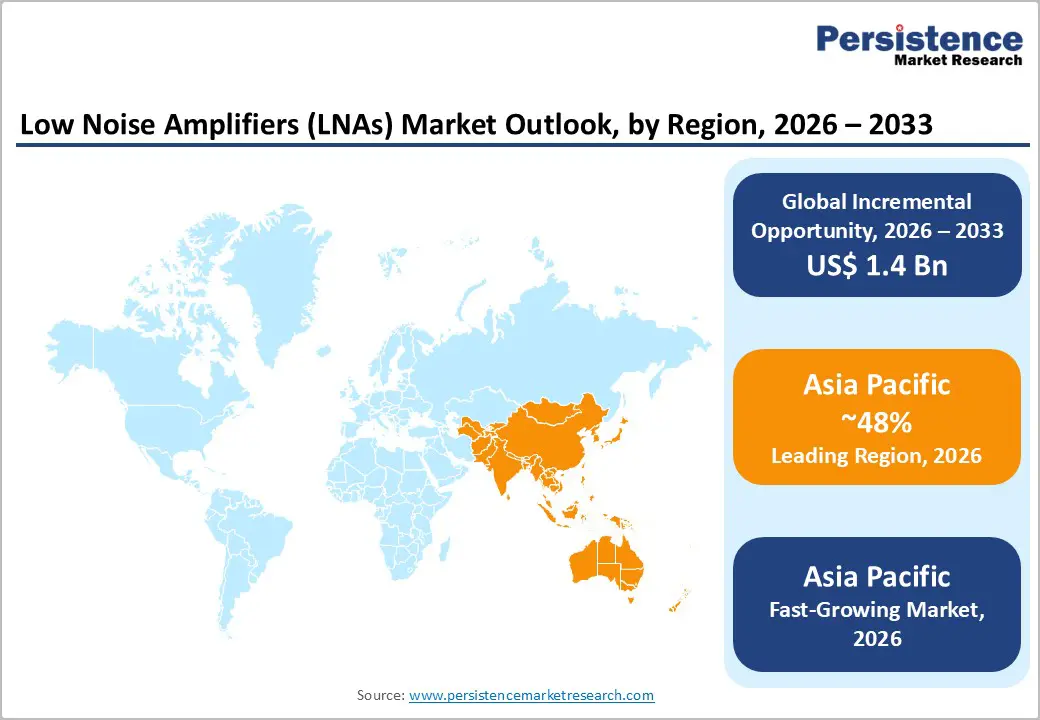
- Leading Region: Asia Pacific, anticipated to account for a 48% market share in 2026, driven by massive 5G rollout, smartphone production, and strong demand in China and India.
- Fastest-growing Region: Asia Pacific, fueled by 5G infrastructure investments, consumer electronics boom, and growing satellite communication projects.
- Dominant Product Type: Gallium arsenide amplifiers, to hold approximately 52% of the market share, as they remain the preferred choice for high-frequency, low-noise performance.
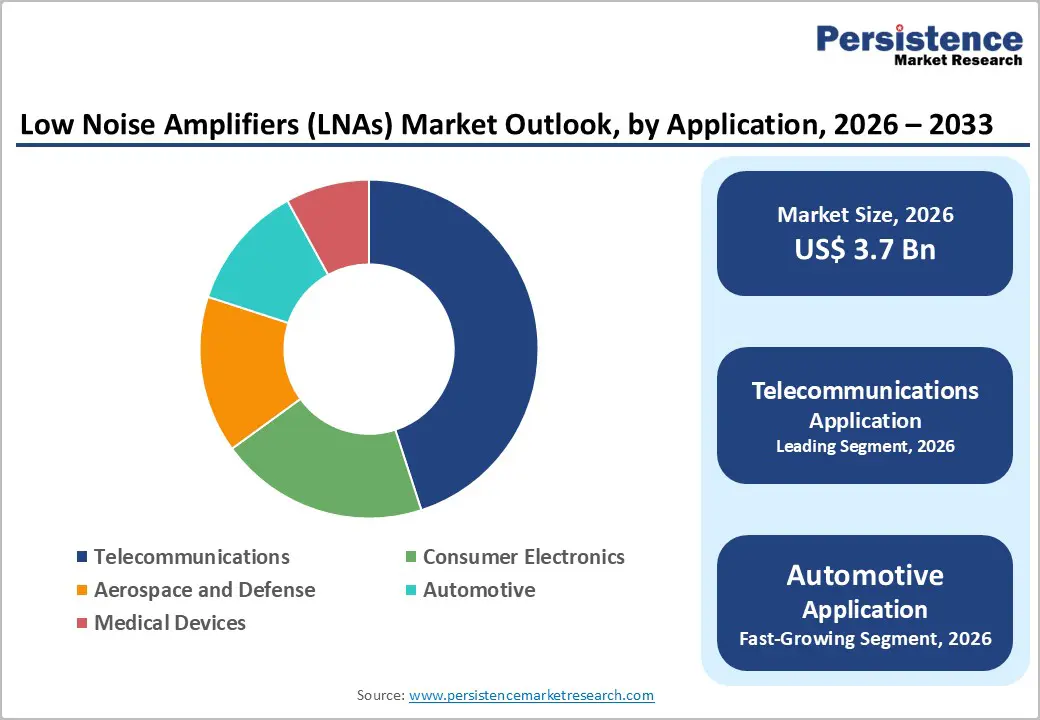
- Leading Application: Telecommunications, accounting for nearly 45% of market revenue due to the highest volume of base stations and mobile devices.
| Key Insights | Details |
|---|---|
| Low Noise Amplifiers (LNAs) Market Size (2026E) | US$3.7 Bn |
| Market Value Forecast (2033F) | US$5.1 Bn |
| Projected Growth CAGR (2026 - 2033) | 4.7% |
| Historical Market Growth (2020 - 2025) | 4.0% |
Market Factors - Driver, Restraint, and Opportunity Analysis
Driver Analysis - 5G Infrastructure Rollout and Consumer Electronics Demand
The rapid expansion of 5G networks is transforming the landscape of connectivity, driving significant changes in consumer behavior and the adoption of electronics. With higher data speeds, lower latency, and greater network reliability, 5G enables seamless streaming, cloud computing, and advanced mobile applications, making next-generation devices more valuable to consumers. Smartphones, smartwatches, tablets, and connected home devices are increasingly designed to leverage 5G capabilities, driving demand for upgraded electronics.
Beyond individual gadgets, 5G facilitates the growth of Internet of Things (IoT) ecosystems, smart homes, and augmented reality (AR) and virtual reality (VR) experiences, creating new avenues for consumer electronics consumption. The promise of faster, uninterrupted connectivity encourages users to invest in devices that can fully exploit these capabilities, from high-performance laptops to wearable tech. Telecommunication companies, meanwhile, are accelerating infrastructure deployment to meet growing data requirements, creating a virtuous cycle: enhanced networks stimulate consumer interest in compatible devices, while rising device adoption justifies further network expansion.
Automotive Radar and Satellite Communication Expansion
Advancements in vehicle safety and connectivity are driving strong adoption of radar technologies and satellite-based communication systems across the automotive sector. Automotive radar plays a critical role in enabling advanced driver assistance systems (ADAS), supporting features such as adaptive cruise control, collision avoidance, blind-spot detection, and automated parking. As regulatory bodies and consumers prioritize safety, automakers are increasingly integrating multiple radar sensors into vehicles to enhance real-time object detection and situational awareness, even in low-visibility conditions.
The expansion of satellite communication is strengthening vehicle connectivity beyond traditional cellular networks. Satellite-enabled systems ensure continuous communication in remote or underserved areas, supporting navigation, emergency response, vehicle tracking, and over-the-air updates. This is particularly valuable for commercial fleets, logistics operations, and autonomous vehicle development, where uninterrupted connectivity is essential. The convergence of radar and satellite technologies is also paving the way for more reliable autonomous driving and connected mobility ecosystems. Vehicles can leverage radar for precise environmental sensing while using satellite communication for data exchange and positioning accuracy.
Restraint Analysis - High Design Complexity and Yield Challenges
Increasing miniaturization and performance demands are making electronic and semiconductor designs significantly more complex, creating challenges across development and manufacturing stages. Modern devices integrate multiple functionalities into compact architectures, requiring precise layouts, advanced materials, and sophisticated fabrication processes. This complexity raises the likelihood of design errors, signal interference, and thermal management issues, all of which can impact overall performance and reliability.
On the manufacturing side, achieving high yield becomes difficult as smaller geometries and tighter tolerances leave little room for defects. Even minor variations in materials or process conditions can result in faulty components, increasing production costs and waste. Additionally, advanced nodes often require expensive equipment and highly controlled environments, further complicating large-scale production.
Intense Competition and Price Pressure
Rising competition across global and regional players is significantly impacting pricing strategies and profit margins. As more companies enter the market with similar products and technologies, differentiation becomes difficult, leading to aggressive pricing tactics to capture or retain market share. This often results in price undercutting, discounts, and bundled offerings, which can erode overall profitability.
Rapid technological advancements shorten product life cycles, forcing companies to frequently update their offerings while keeping prices competitive. Customers, on the other hand, benefit from increased choices and transparency, making them more price-sensitive and less brand-loyal. To remain competitive, companies must balance cost efficiency with innovation, often investing in automation, supply chain optimization, and value-added features.
Opportunity Analysis - Innovation in mmWave LNAs and Integrated Front-End Modules
The rising adoption of high-frequency communication systems is significantly increasing demand for advanced low-noise amplifiers (LNAs), particularly in the millimeter-wave (mmWave) spectrum. As applications such as 5G, satellite communication, and automotive radar operate at higher frequencies, maintaining signal integrity becomes more challenging due to increased path loss and noise. mmWave LNAs are designed to address these issues by providing high gain with minimal added noise, making them essential for reliable signal reception in these environments.
A shift toward integrated front-end modules is transforming how LNAs are deployed in electronic systems. Instead of using discrete components, manufacturers are combining LNAs with filters, switches, and power amplifiers into compact, highly efficient modules. This integration reduces design complexity, saves space, and improves overall system performance, particularly for compact devices such as smartphones, wearables, and connected sensors. The combination of mmWave innovation and front-end integration is enabling more efficient, high-performance communication systems.
Developments in Automotive/Satellite Applications
Rapid advancements in automotive and satellite technologies are significantly expanding the role of high-frequency communication components in modern systems. In the automotive sector, increasing adoption of advanced driver assistance systems (ADAS) and autonomous driving technologies is driving demand for reliable sensing and communication solutions. Vehicles now rely on radar, vehicle-to-everything (V2X) communication, and real-time data processing, all of which require high-performance signal amplification to ensure accuracy and safety in dynamic environments.
Satellite applications are evolving with the deployment of low Earth orbit (LEO) constellations and next-generation communication networks. These systems require efficient signal reception and transmission over long distances and under challenging conditions, underscoring the need for components that maintain signal quality with minimal noise. This is particularly important for applications such as global broadband coverage, navigation, and remote sensing. The convergence of automotive and satellite innovations is also enabling connected mobility, where vehicles can maintain communication even in remote areas without traditional network coverage.
Category-wise Analysis
Product Type Insights
Gallium arsenide amplifiers are anticipated to dominate the market, accounting for 52% of the market share in 2026, driven by superior performance in high-frequency and high-speed applications. GaAs offers higher electron mobility compared to traditional silicon, enabling faster signal transmission with lower noise and better efficiency. These characteristics make it ideal for applications such as wireless communication, satellite systems, and radar technologies. GaAs amplifiers perform well in extreme conditions, including high temperatures and demanding environments, further supporting their widespread adoption. Qorvo, a leading RF semiconductor company specializing in GaAs-based amplifiers. The company offers GaAs MMIC amplifiers such as the CMD292, which operates from DC to 30 GHz and is widely used in satellite communication, radar, and space applications.
Indium phosphate amplifiers are the fastest-growing product type, thanks to their exceptional performance at very high frequencies and low noise. InP materials offer higher electron velocity than many alternatives, enabling superior signal amplification in millimeter-wave and optical communication systems. This makes them highly suitable for advanced applications such as 5G backhaul, satellite communications, and fiber-optic networks. InP amplifiers provide excellent efficiency and thermal stability, supporting reliable performance in demanding environments. Northrop Grumman has developed indium phosphide (InP)-based ultra-low-noise amplifiers (LNAs) for high-frequency applications. The company introduced InP HEMT MMIC LNAs designed for E-band and W-band systems, widely used in satellite communications, radar, and advanced sensing systems.
Application Insights
The telecommunications segment is expected to dominate the market, accounting for nearly 45% of revenue in 2026, driven by the rapid expansion of high-speed connectivity and rising data consumption worldwide. The deployment of 5G networks, fiber-optic infrastructure, and advanced wireless technologies requires efficient signal amplification to ensure strong, low-noise transmission across long distances. Low noise amplifiers play a critical role in maintaining signal quality in base stations, mobile devices, and network equipment. The growing number of connected devices and rising demand for seamless communication services further strengthen this segment. Qorvo is a leading RF semiconductor company supplying low-noise amplifiers for telecommunications infrastructure. In 2025, Qorvo launched a new family of high-performance LNAs specifically designed for 5G base stations, offering improved noise performance and wideband coverage to support high-speed data transmission.
The automotive segment represents the fastest-growing application, driven by the rapid integration of advanced electronic systems into modern vehicles. Features such as advanced driver assistance systems (ADAS), autonomous driving, and vehicle-to-everything (V2X) communication rely heavily on high-frequency signal processing and accurate data transmission. Low noise amplifiers play a crucial role in enhancing weak signals from radar, GPS, and communication modules, ensuring reliability and safety. The shift toward electric and connected vehicles is increasing the need for robust communication and sensing technologies. NXP Semiconductors is a leading company in automotive radar solutions. NXP offers advanced 77 GHz radar transceivers and systems used in ADAS features such as adaptive cruise control, blind-spot detection, and autonomous emergency braking.
Regional Insights
North America Low Noise Amplifiers (LNAs) Market Trends
North America is experiencing steady growth in the market, supported by strong advancements in wireless communication and defense technologies. The rapid rollout of 5G networks across the U.S. and Canada is significantly increasing demand for high-frequency, low-noise signal amplification in base stations, smartphones, and connected devices.
The increasing adoption of LNAs in aerospace and defense applications, such as radar systems, satellite communications, and electronic warfare, is driving demand for highly reliable, low-noise components that enable precise signal detection and transmission in complex environments. The region is also witnessing a shift toward compact, energy-efficient designs, fueled by the growing proliferation of IoT devices and smart technologies. In response, manufacturers are integrating LNAs into multifunctional modules to improve performance while minimizing size and power consumption.
Europe Low Noise Amplifiers (LNAs) Market Trends
Europe is witnessing consistent growth in the market, supported by increasing investments in advanced communication infrastructure and strong regulatory focus on connectivity. The expansion of 5G networks across major economies such as Germany, France, and the U.K. is driving demand for high-frequency LNAs to ensure efficient signal reception and improved network performance.
The rising adoption of LNAs in automotive applications—driven by the advancement of advanced driver assistance systems (ADAS) and autonomous vehicle technologies—is strengthening demand across Europe. The region’s well-established automotive manufacturing base is accelerating the integration of radar and communication systems, increasing the need for reliable low-noise amplification. The aerospace and satellite communication sectors are also supporting market growth through increased investments in space programs and secure communication infrastructure. LNAs play a critical role in preserving signal integrity in these high-precision applications. There is also a growing shift toward compact, energy-efficient designs, influenced by sustainability objectives and the rising demand for miniaturized electronic devices.
Asia Pacific Low Noise Amplifiers (LNAs) Market Trends
Asia Pacific is projected to dominate and is expected to be the fastest growing, accounting for 48% share in 2026, driven by expanding telecommunications infrastructure and increasing adoption of advanced electronics. Countries such as China, India, Japan, and South Korea are investing heavily in 5G deployment, significantly boosting demand for high-frequency LNAs in base stations, smartphones, and connected devices.
The region is experiencing strong growth in consumer electronics manufacturing. Asia Pacific functions as a global hub for smartphones, wearables, and IoT devices, all of which rely on efficient signal amplification to enhance performance and connectivity. This is driving large-scale adoption of compact and cost-effective LNAs. The automotive sector is contributing to market expansion, particularly with the increasing integration of advanced driver assistance systems (ADAS) and in-vehicle connectivity features. LNAs play a key role in radar and communication modules used in modern vehicles. The region is also witnessing rising investments in satellite communication and space programs, further supporting demand.
Competitive Landscape
The global low noise amplifiers (LNAs) market is characterized by strong competition between established RF semiconductor leaders and niche amplifier specialists, each focusing on performance, integration, and cost efficiency. Companies in North America and Europe maintain a technological edge through advanced gallium arsenide (GaAs) and indium phosphide (InP) solutions, enabling superior high-frequency performance, low noise figures, and reliability. Their broad product portfolios and close alignment with 5G infrastructure and automotive radar applications further strengthen their market position.
In Asia Pacific manufacturers are gaining traction by offering cost-effective LNA solutions, making advanced technologies more accessible for high-volume consumer electronics and telecom applications. The widespread adoption of GaAs amplifiers continues to enhance receiver sensitivity, reduce signal distortion, and support compact device integration. Key competitive strategies include technology licensing, collaborations on 5G reference designs, and expansion of manufacturing capacities.
Key Industry Developments
- In February 2026, Broadcom Inc. (AVGO) officially introduced BroadPeak™ (BCM85021), the industry’s first 6G-ready digital front-end (DFE) system-on-chip (SoC), delivering a solution that met the technical requirements for both 5G Advanced and upcoming 6G standards while supporting upper mid-band frequencies ranging from 7 GHz to 8.5 GHz and positioning itself as one of the first silicon platforms capable of addressing the performance demands of the future 6G era.
- In June 2025, Qorvo, a leading global provider of connectivity and power solutions, expanded its SATCOM portfolio by launching a new K-band power amplifier (PA) to enhance the performance and integration of Low Earth Orbit (LEO) satellites, developing the solution to meet the evolving demands of next-generation payloads while strengthening its GaN-on-SiC SATCOM portfolio and providing system designers with a more efficient, compact, and scalable option for advanced space-based communication systems.
Companies Covered in Low Noise Amplifiers (LNAs) Market
- STMicroelectronics
- Qorvo
- Maxim Integrated
- Broadcom Inc.
- Skyworks Solutions
- NXP Semiconductors
- Infineon Technologies
- Texas Instruments
- Analog Devices
Frequently Asked Questions
The global low noise amplifiers (LNAs) market is projected to reach US$3.7 billion in 2026.
The expansion of 5G networks is fueling demand for next-generation consumer electronics by delivering higher data speeds, reduced latency, and improved performance across connected devices, thereby increasing the need for efficient low-noise signal amplification.
The low noise amplifiers (LNAs) market is poised to witness a CAGR of 4.7% from 2026 to 2033.
The increasing adoption of high-frequency applications such as 5G, satellite communication, and automotive radar is creating strong demand for mmWave low noise amplifiers, which deliver high gain with minimal noise to maintain reliable signal integrity in challenging operating environments.
Qorvo, Skyworks Solutions, Broadcom, NXP Semiconductors, and Infineon Technologies are the key players.


