




- Processed Food
- Fruit Spread Market
Fruit Spread Market Size, Share and Growth Forecast, 2026 - 2033
Fruit Spread Market by Product Type (Jams, Jellies, Fruit Butter, Conserve, Preserve, Marmalades), Application (Breakfast Syrup, Bakery Products, Others), Flavor (Strawberry, Raspberry, Tropical Fruits, Citrus Fruits, Others), and Regional Analysis 2026 - 2033

Fruit Spread Market Share and Trends Analysis
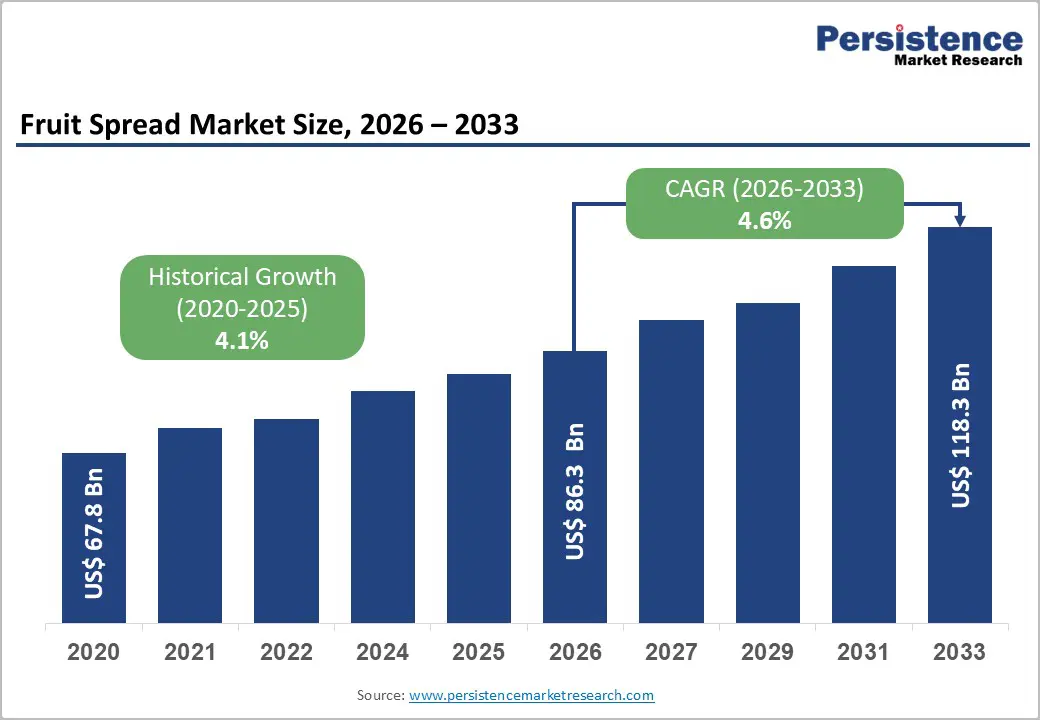
The global fruit spread market is likely to be valued at US$86.3 billion in 2026 and is anticipated to reach US$118.3 billion by 2033, growing at a CAGR of 4.6% during the forecast period from 2026 to 2033, driven by rising health-conscious purchasing habits, with consumers increasingly favoring low-sugar and clean-label formulations.
Regulatory pressure on added sugars is further accelerating this shift. At the same time, innovations such as low-temperature processing technologies are improving nutrient preservation and flavor quality, enabling manufacturers to maintain product appeal without artificial additives. Additionally, a stronger policy focus on sustainable sourcing is enhancing supply chain resilience.
Key Industry Highlights:
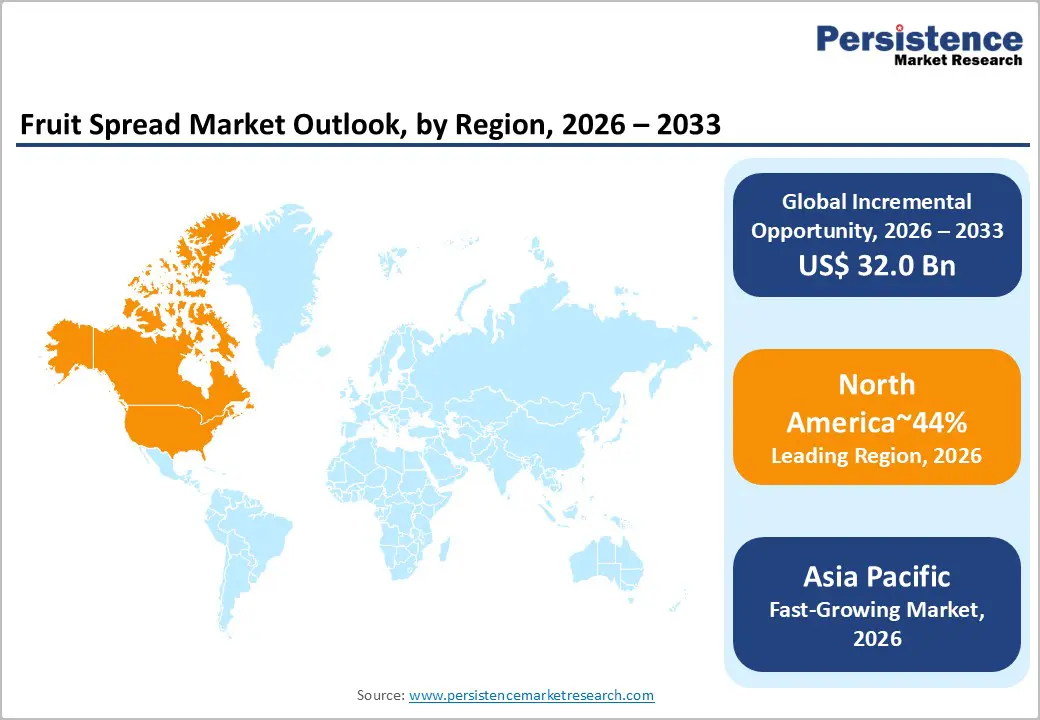
- Leading Region: North America is projected to lead, accounting for approximately 44% share in 2026, anchored by robust bakery sector integration and high breakfast consumption rates.
- Fastest-growing Region: Asia Pacific is anticipated to grow fastest, driven by rising disposable incomes and rapidly expanding organized retail footprints.
- Leading Product Type: Jams are expected to dominate, accounting for approximately 48% share in 2026, sustained by widespread affordability and traditional household adoption.
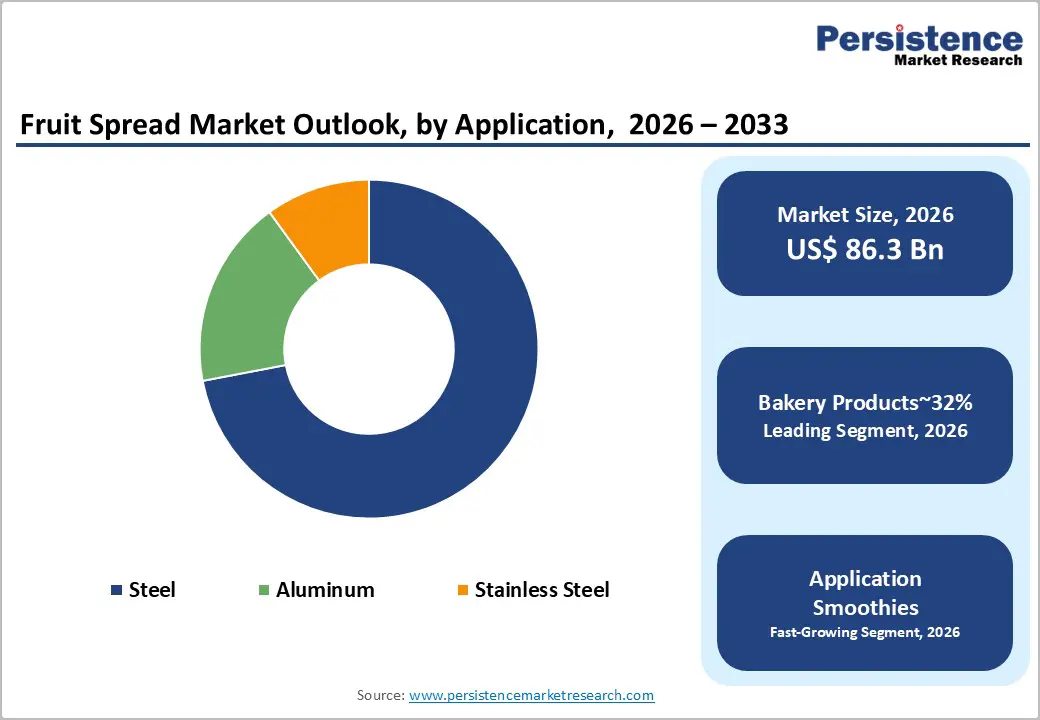
- Leading Application: Bakery products are projected to lead with approximately 32% share in 2026, reinforced by commercial baking expansion and consistent ingredient utilization.
- Leading Flavor: Strawberry is expected to command approximately 31% share in 2026, supported by universal consumer preference and reliable agricultural yields.
- Competitive Environment: Hero Group acquired The Gut Stuff in 2026, expanding its functional food portfolio. Meanwhile, Rigoni di Asiago expanded distribution of its zero-added-sugar organic lines. These strategic moves highlight a broader industry shift toward premium, health-focused offerings.

DRO Analysis
Driver - Clean-Label Demand
Shifting dietary behaviors fundamentally alter procurement patterns across the consumer packaged goods sector. Shoppers prioritize ingredient transparency, driving the movement away from synthetic additives toward natural alternatives. The U.S. FDA’s 2025 regulations proposed front-of-package nutritional labels to accelerate this transition. Such guidelines force brands to reformulate offerings to minimize added sugars. Consequently, retail buyers increasingly stock items featuring whole ingredients and certified organic origins. This regulatory pressure reinforces the commercial viability of premium, health-focused segments within the broader ecosystem.
Evidence of this momentum appears across major manufacturing portfolios. Rigoni di Asiago's Fiordifrutta eliminates artificial sweeteners by utilizing organic apple juice concentrate. This formulation strategy directly answers the growing necessity for low-calorie options without sacrificing taste profiles. As household purchasers gravitate toward these cleaner labels, legacy producers must adapt their legacy product lines. This dynamic is poised to fundamentally reshape supermarket shelf space allocation.
Breakfast Consumption Resurgence
Evolving morning routines significantly expand consumption volume across global retail channels. Remote and hybrid work models generate sustained at-home meal habits, replacing on-the-go convenience foods with traditional morning staples. The Food and Agriculture Organization forecasts that global cereal utilization will reach 2,945 million tonnes in 2025/26, reflecting increased consumption of grain-based morning foods. This surge in baked goods consumption directly correlates with higher utilization of complementary toppings.
Leading vendors capitalize on this behavioral shift by introducing specialized flavor combinations. For instance, Bonne Maman with Concord Grape targets domestic consumers seeking upgraded classic profiles. By providing premium alternatives to standard jellies, manufacturers successfully elevate the average purchase value per transaction. This strategy not only captures immediate demand but also builds long-term brand loyalty among newly established home diners. Ultimately, the sustained integration of these items into daily rituals anchors robust market stability.
Restraint - Supply Chain Volatility
Unpredictable agricultural yields create substantial structural barriers for global manufacturing operations. Climate fluctuations severely impact the harvest volume of delicate crops, directly constraining raw material availability. Such environmental volatility disrupts established procurement contracts, forcing producers to navigate sudden seasonal shortages. Consequently, the cost of sourcing high-quality organic berries often spikes unpredictably. These upstream bottlenecks complicate production scheduling and inventory management across international facilities.
Frequent climate disruptions force strategic adjustments at the corporate level. The J.M. Smucker Company faces ongoing margin pressure when adapting to variable crop yields. To mitigate these risks, organizations must invest heavily in diversified agricultural sourcing networks. However, expanding supplier bases inherently increases logistical overhead and rigorous quality control expenses. These compounding costs compress profitability, particularly for brands committed to strict organic standards.
Stringent Sugar Regulations
Aggressive global health policies introduce complex compliance burdens for traditional processors. International health authorities continuously push for reductions in dietary sugar intake to combat chronic metabolic conditions. Government bodies implement punitive sugar taxes and strict marketing restrictions targeting high-calorie items. These legislative actions compel companies to invest significant capital into research and development for alternative sweetening technologies. Reformulating legacy recipes without compromising texture or shelf life requires extensive scientific validation.
Compliance requirements force a complete overhaul of traditional production methodologies. Hero Group with The Gut Stuff demonstrates how companies pivot toward functional acquisitions to offset regulatory risks in sugary portfolios. Transitioning away from conventional sucrose often demands novel preservation techniques, escalating manufacturing complexity. Furthermore, replacing cheap sweeteners with premium alternatives like steviol glycosides drastically alters unit economics. These compounding pressures restrict the agility of smaller regional players lacking deep research budgets.
Opportunity - Functional Ingredient Integration
The intersection of nutritional science and daily consumption habits creates a lucrative growth avenue. Modern consumers actively seek foods providing supplemental health benefits beyond basic caloric intake. Incorporating functional additives like probiotics, adaptogens, and added fiber transforms standard breakfast items into wellness products. This product evolution allows brands to position themselves within the rapidly expanding functional food ecosystem. Retailers dedicate increasing shelf space to items offering dual benefits, supporting higher consumer price points. This fundamental shift in product perception unlocks entirely new demographic segments.
Manufacturers actively explore these formulations to capture health-oriented consumer spending. Andros Group's Bonne Maman incorporates unique botanical combinations like Cherry Hibiscus to attract experimental buyers. Introducing such specialized blends differentiates portfolios in a highly crowded retail environment. Furthermore, these sophisticated items appeal strongly to younger generations willing to pay premiums for perceived wellness benefits. As scientific understanding of gut health advances, the potential for targeted functional toppings expands significantly. This trajectory promises robust revenue streams for forward-thinking market participants.
E-commerce Expansion Strategies
The rapid maturation of digital retail infrastructure offers unprecedented product distribution capabilities. Online grocery platforms and direct-to-consumer models bypass traditional supermarket bottlenecks entirely. This digital shift enables niche producers to access a global audience without securing expensive physical shelf placements. Additionally, sophisticated data analytics allow brands to execute highly targeted marketing campaigns based on granular purchasing behaviors. Subscription models ensure recurring revenue and deepen direct customer relationships. Such technological momentum democratizes market access, fundamentally altering the traditional competitive hierarchy.
Strategic digital initiatives accelerate geographic penetration and global consumer discovery. Rigoni di Asiago with Fiordifrutta leverages international e-commerce channels to distribute organic lines to specialized health markets globally. Online platforms facilitate detailed storytelling, allowing brands to educate buyers on ingredient sourcing and ethical production methods. This direct engagement fosters robust community loyalty that physical retail environments rarely support. Ultimately, mastering digital logistics provides a critical competitive advantage. Organizations prioritizing online infrastructure are poised to capture outsized market share moving forward.
Category-wise Analysis
Product Type Insights
Jams are projected to lead, accounting for approximately 48% share in 2026, anchored by deep-rooted global consumer habits. This traditional formulation remains a household staple due to its versatile texture and affordable pricing structure. Widespread availability across massive supermarket chains guarantees consistent sales volumes. The J.M. Smucker Company's Smucker's maintains dominant retail positioning through extensive distribution networks. Such mass-market penetration ensures enduring categorical dominance.
Preserves are anticipated to be the fastest-growing segment, driven by escalating consumer demand for premium culinary experiences. Shoppers increasingly reject heavily processed items in favor of rustic, whole-fruit textures. This shift aligns with broader clean-label trends prioritizing ingredient authenticity over artificial consistency. Andros Group, with Bonne Maman, successfully captures this momentum by emphasizing traditional cooking methods and minimal additives.
Application Insights
Bakery products are expected to dominate, accounting for approximately 32% share in 2026, supported by robust commercial manufacturing needs. Large-scale industrial bakers utilize massive quantities of these fillings to produce pastries, cakes, and cookies. The stability of these ingredients under high baking temperatures makes them essential for consistent product quality. Hero Group's Queensberry supplies essential formulations to expanding regional baking sectors.
Smoothies are projected to be the fastest-growing segment, driven by the rapidly expanding wellness beverage sector. Health-conscious consumers increasingly blend nutrient-dense purees into morning drinks to enhance flavor and nutritional value. This specific application requires textures that dissolve easily in cold liquids. Rigoni di Asiago with Natù offers the necessary natural sweetness without adding refined sugars. The rapid proliferation of boutique juice bars further amplifies bulk procurement requirements.
Flavor Insights
Strawberry is anticipated to lead, accounting for approximately 31% share in 2026, underpinned by universal palate acceptance. This classic profile enjoys unmatched cross-generational appeal, making it a low-risk purchase for families. Robust agricultural infrastructure ensures consistent crop availability, maintaining highly stable retail pricing. The J.M. Smucker Company, with Smucker's, dedicates extensive production capacity to this cornerstone flavor.
Tropical fruits are expected to be the fastest-growing, driven by shifting global taste preferences. Expanding culinary globalization introduces consumers to exotic profiles, stimulating a desire for diverse breakfast options. These bold tastes pair exceptionally well with yogurts and modern dessert applications. Andros Group's Bonne Maman incorporates mango and pineapple into limited-edition collections to test consumer reception.
Regional Analysis
North America Fruit Spread Market Trends
North America is expected to be the leading market region, accounting for approximately 44% share in 2026, supported by entrenched breakfast traditions and a highly developed retail ecosystem. Strong commercial baking infrastructure guarantees consistent industrial procurement.
U.S. Fruit Spread Market Trends
The U.S. accounts for about 78.5% of the regional market, supported by strong retail penetration and high per-capita breakfast consumption. Supermarkets dominate distribution, reinforcing volume stability and brand visibility across packaged staple categories. The J.M. Smucker Company is advancing clean-label transitions through portfolio redesigns aligned with evolving nutritional standards.
Canada Fruit Spread Market Trends
Canada accounts for about 16.2% of the regional market, supported by strong demand for organic and natural preserves across major urban centers. National health initiatives and school nutrition standards are accelerating the adoption of fortified and functional fruit-based spreads. Crofter’s Organic is expanding its portfolio with alternative sweetener formulations targeting premium health-conscious consumers.
Europe Fruit Spread Market Trends
Europe is projected to remain a structurally stable market, with demand anchored in deep-rooted culinary heritage and extensive artisanal baking traditions. Stringent regional food safety standards maintain high product quality, while a mature retail landscape ensures steady consumption patterns.
U.K. Fruit Spread Market Trends
The U.K. is projected to dominate the regional market with approximately 35.2% of the regional market, driven by strong consumption of jams and marmalades within a mature food processing ecosystem. Bonne Maman is leveraging seasonal premium launches to drive retail spikes and reinforce premiumization trends. Hero Group is expanding into gut-health segments through targeted acquisitions, reshaping competitive dynamics in functional spreads.
Germany Fruit Spread Market Trends
Germany is anticipated to account for about 14.1% of the regional market, supported by strong demand for organic-certified and plant-based breakfast products. EU-driven sustainability mandates are accelerating the adoption of zero-sugar formulations and environmentally compliant production systems. Rigoni di Asiago is expanding zero-sugar product lines across major retail chains to align with shifting consumption patterns.
Asia Pacific Fruit Spread Market Trends
Asia Pacific is anticipated to be the fastest-growing region, driven by rapid urbanization and the increasing westernization of morning dietary habits. Surging disposable incomes across emerging economies empower consumers to adopt packaged convenience foods previously considered luxury items.
China Fruit Spread Market Trends
China is anticipated to account for about 12.0% of the regional market, supported by rapid urbanization and increasing adoption of Western-style breakfast consumption patterns. State-backed nutritional initiatives and expanding e-commerce grocery platforms are improving premium access to imported fruit-based products. Andros Group is localizing industrial fruit solutions to serve bakery and beverage demand across tier-one urban centers.
India Fruit Spread Market Trends
India is estimated to account for about 4.8% of the regional market, positioned as a high-growth hub driven by rising upper-middle-income consumption and premiumization trends. Demand is rapidly shifting toward protein-rich, functional, and clean-label spreads, reflecting evolving health-oriented purchasing behavior. Hindustan Unilever is expanding manufacturing capacity to support high-growth product formats and distribution scalability.
Competitive Landscape
The global fruit spread market reflects moderate fragmentation, with multinational brands and niche organic players shaping procurement dynamics. The J.M. Smucker Company sustains dominance through its Smucker’s portfolio, leveraging integrated supply chains and retail distribution strength. Hero Group expands influence via diversified product lines and targeted acquisitions across regional markets.
Rigoni di Asiago advances organic leadership through Fiordifrutta’s low-temperature processing, while Crofter’s Organic targets high-margin health-conscious segments. Premium players invest in reduced-sugar formulations and sustainable sourcing, whereas value providers focus on scale-driven affordability. Strategic acquisitions of functional and organic brands continue to reshape portfolios.
Companies Covered in Fruit Spread Market
- The J.M. Smucker Company
- Andros Group
- Hero Group
- B&G Foods Inc.
- Ferrero International S.A.
- The Kraft Heinz Company
- Conagra Brands Inc.
- Orkla ASA
- Rigoni di Asiago
- Zuegg S.p.A.
- Aohata Corporation
- Hain Celestial Group
- Wilkin & Sons Ltd.
- Adolf Darbo AG
- Crofter’s Organic
- St. Dalfour
Frequently Asked Questions
The global market is likely to be valued at US$86.3 billion in 2026 and is anticipated to reach US$118.3 billion by 2033.
Rising clean-label consumer demands and a resurgence in at-home breakfast consumption actively drive market expansion.
The global market is growing at a CAGR of 4.6%, sustained by continuous innovations in functional product formulations.
Expanding digital e-commerce distribution networks and integrating functional ingredients like probiotics present significant commercial opportunities.
The J.M. Smucker Company, Andros Group, Hero Group, B&G Foods, Inc., Rigoni di Asiago, and Crofter’s Organic.


