




- Biotechnology
- Dengue Testing Market
Dengue Testing Market Size, Share, and Growth Forecast, 2026 - 2033
Dengue Testing Market by Product (ELISA-based Tests, Dengue IgG/IgM Detection Kits, RT-PCR Tests, Rapid Diagnostic Tests (RDTs), NS1 Antigen Detection Kits), Service (Centralized Service, POC Service), and Regional Analysis for 2026 - 2033

Dengue Testing Market Size and Trends Analysis
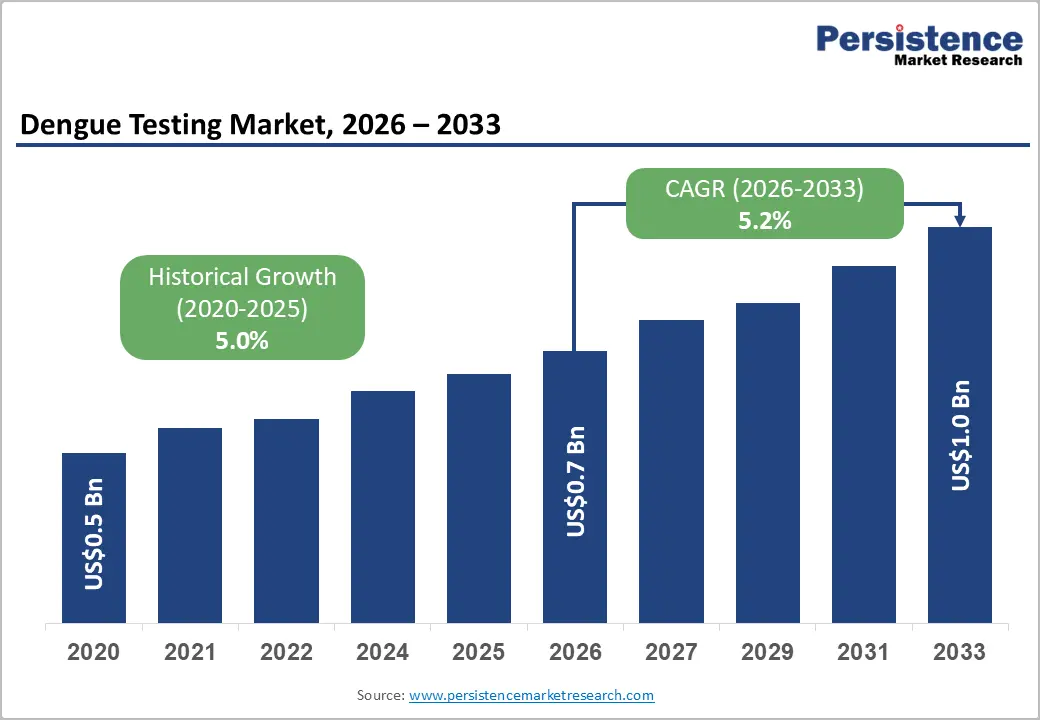
The global dengue testing market size is likely to be valued at US$0.7 billion in 2026 and is expected to reach US$1.0 billion by 2033, growing at a CAGR of 5.2% during the forecast period from 2026 to 2033, driven by increasing dengue incidence across tropical and subtropical regions, rising demand for early and accurate diagnosis, and expansion of public health surveillance programs.
According to the World Health Organization (WHO), dengue cases reached over 14 million globally in 2024, marking one of the highest recorded outbreak years, with significant concentrations in Asia Pacific and Latin America. This surge has intensified the need for rapid diagnostic and molecular testing solutions to enable timely outbreak control. Market expansion is supported by advancements in NS1 antigen detection, RT-PCR molecular assays, and point-of-care rapid diagnostic tests, which are increasingly preferred in resource-limited settings.
Key Industry Highlights:
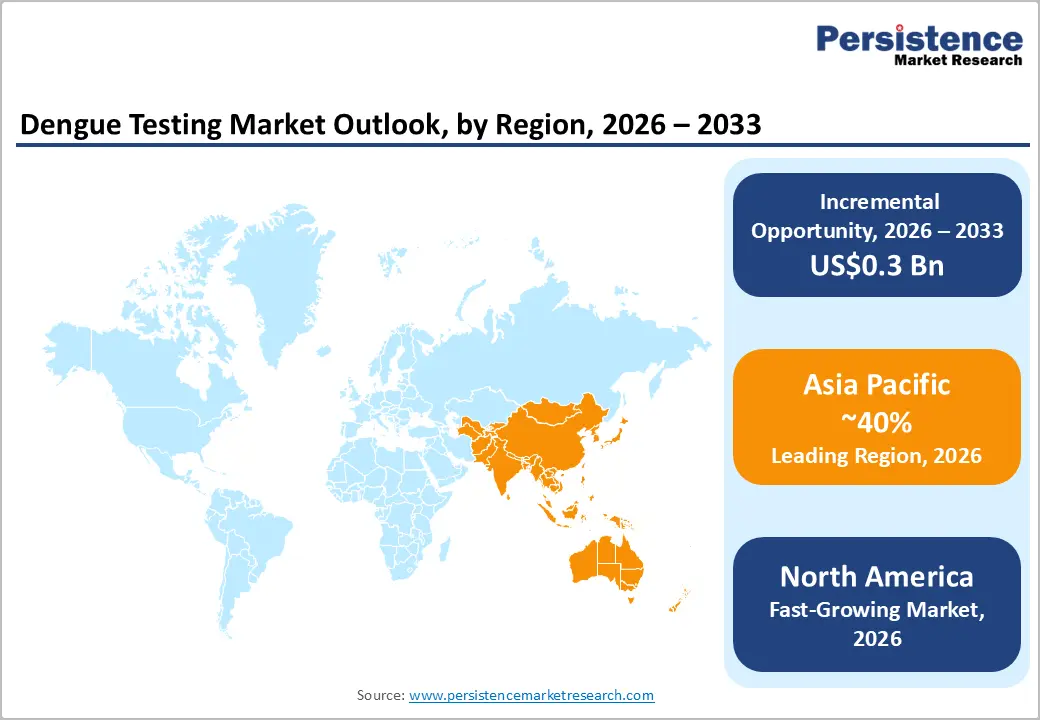
- Leading Region: Asia Pacific is anticipated to be the leading region, accounting for a market share of 40% in 2026, driven by expanding diagnostic access, strong government vector control programs, and urbanization.
- Fastest-growing Region: North America is likely to be the fastest-growing region, supported by strong U.S. diagnostic infrastructure and FDA-regulated molecular testing adoption.
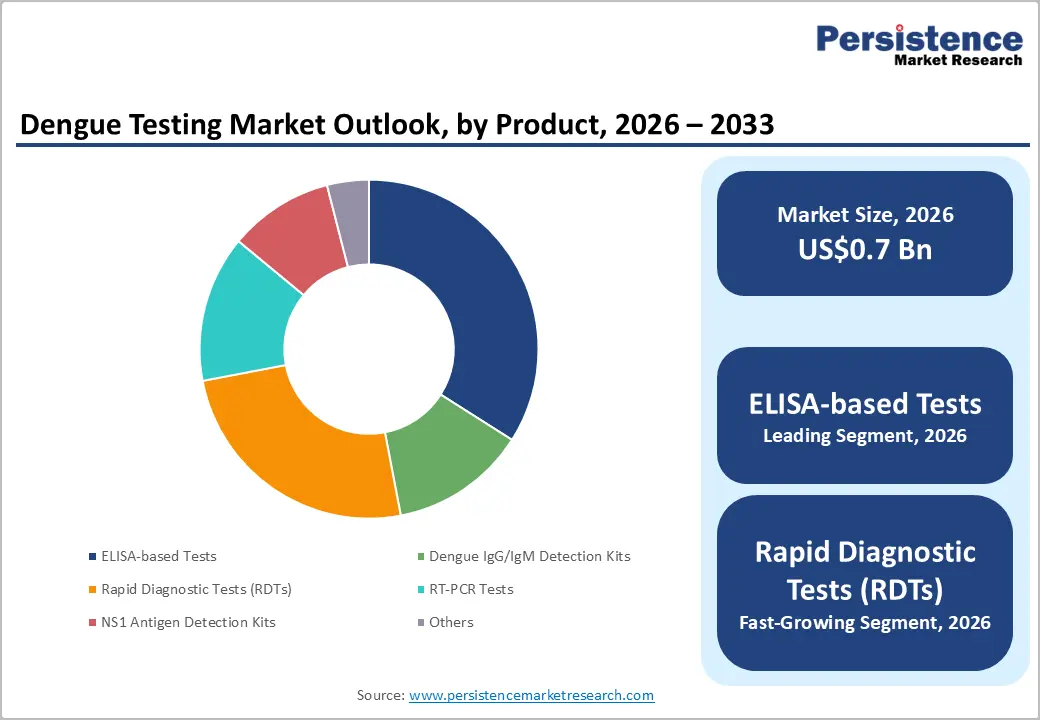
- Leading Product Type: ELISA-based tests are projected to represent the leading product type in 2026, accounting for 45% of the revenue share, due to their high reliability in antibody detection and widespread use in laboratory confirmation.
- Leading Service Type: Centralized service is anticipated to be the leading service type, accounting for over 60% of the revenue share in 2026, supported by strong adoption of high-throughput laboratory-based ELISA and RT-PCR testing systems.
- Key Opportunity: The key market opportunity in the dengue testing market lies in expanding affordable, rapid, and multiplex point-of-care diagnostic solutions across high-burden tropical and resource-limited regions to enable early outbreak detection and effective disease surveillance.

DRO Analysis
Driver - Rising Incidence of Dengue Driven by Climate and Urbanization
The dengue testing market is strongly driven by the increasing incidence of dengue infections worldwide, particularly in tropical and subtropical regions. Climate change has expanded the breeding season and geographic spread of Aedes mosquitoes, leading to higher transmission rates. Rapid urbanization, inadequate sanitation, and population density accelerate outbreaks.
According to the World Health Organization (WHO, 2024), dengue cases have surged to record levels globally, highlighting a growing public health burden. This rising disease prevalence directly increases demand for early and accurate diagnostic testing, including ELISA, RT-PCR, and rapid diagnostic kits used for timely outbreak detection and patient management.
Recurring epidemics in Asia Pacific and Latin America have intensified government focus on surveillance and diagnostic preparedness. Healthcare systems are increasingly adopting routine dengue screening during peak transmission seasons. The growing number of suspected cases places pressure on laboratories and hospitals, driving higher testing volumes. Public awareness campaigns and travel-associated infection risks also contribute to increased testing demand in non-endemic regions.
Restraint - Limited Healthcare Infrastructure and Access in Endemic Low-Resource Settings
Despite high disease burden, access to molecular diagnostics such as RT-PCR and automated ELISA systems remains restricted due to high equipment costs, lack of trained professionals, and inadequate laboratory facilities. Many rural and semi-urban regions depend on basic rapid diagnostic tests, which may have variable accuracy. This gap in diagnostic capacity leads to underreporting and delayed treatment, limiting the overall effectiveness of dengue surveillance systems and affecting market penetration of advanced testing technologies.
Fragmented healthcare delivery systems and inconsistent funding for public health programs restrict large-scale deployment of standardized dengue testing. Supply chain challenges and uneven distribution of diagnostic kits worsen accessibility in remote areas. Patients often rely on symptomatic treatment without laboratory confirmation, reducing testing volumes in certain regions despite high infection rates.
Opportunity - Technological Convergence and Multiplex Diagnostics
Modern systems increasingly integrate molecular techniques, immunoassays, and digital health tools to enable simultaneous detection of multiple arboviruses such as dengue, chikungunya, and Zika. This is especially valuable in regions where co-circulation of mosquito-borne diseases complicates clinical diagnosis.
Advancements in RT-PCR, microfluidics, and automated analyzers are improving test sensitivity, speed, and scalability. These innovations are enabling more efficient outbreak management and expanding the use of laboratory and point-of-care testing across diverse healthcare settings.
The rise of portable diagnostic devices and AI-enabled interpretation tools is transforming dengue detection, particularly in decentralized environments. Governments and healthcare organizations are investing in integrated surveillance systems that combine real-time data analytics with diagnostic testing. This supports early outbreak identification and rapid response strategies.
Category-wise Analysis
Product Type Insights
ELISA-based tests are expected to lead, accounting for 45% of revenue in 2026, driven by their strong reliability, established clinical validation, and widespread use in laboratory confirmation of dengue infections. These tests are highly effective for detecting IgG and IgM antibodies, making them essential for both acute and past infection analysis as well as epidemiological surveillance studies. For example, large diagnostic networks such as public health laboratories in India routinely use ELISA platforms for seasonal dengue screening and outbreak monitoring.
Rapid diagnostic tests (RDTs) are likely to represent the fastest-growing segment, supported by increasing demand for quick, affordable, and point-of-care dengue detection, especially during outbreak situations and in rural or resource-limited regions. These tests provide results within minutes and are widely used in emergency care settings where immediate clinical decisions are required. For instance, during dengue outbreaks in Southeast Asia, community health centers frequently deploy NS1-based RDT kits to quickly identify infected patients and control disease spread.
Service Type Insights
Centralized service is projected to lead the market, capturing around 60% of the revenue share in 2026, supported by its strong reliance on established laboratory infrastructure, high-throughput testing capabilities, and superior diagnostic accuracy. This model is widely adopted in hospitals, reference laboratories, and national disease surveillance programs where ELISA and RT-PCR testing are conducted in bulk for confirmation and reporting purposes. A notable example includes national reference laboratories in Brazil that utilize centralized RT-PCR and ELISA systems to monitor dengue outbreaks and track viral serotypes across regions.
Point-of-care (POC) services are likely to be the fastest-growing service type, increasing demand for rapid, decentralized dengue testing in rural, remote, and outbreak-prone areas. POC testing enables immediate diagnosis at the patient site, reducing dependence on centralized laboratories and significantly improving turnaround time for clinical decisions. For instance, during dengue outbreaks in rural India, POC NS1 antigen test kits are widely used in community clinics to quickly identify cases and initiate early treatment, helping reduce disease complications.
Regional Insights
North America Dengue Testing Market Trends
North America is likely to be the fastest-growing region in dengue testing in 2026, driven by rising travel-associated dengue cases, improved disease surveillance systems, and increasing adoption of advanced molecular diagnostics. The region benefits from strong laboratory infrastructure and early disease detection programs, particularly in the U.S., where climate variability is increasing mosquito habitat suitability. For example, Thermo Fisher Scientific Inc. plays a major role by providing RT-PCR and real-time molecular diagnostic solutions widely used in reference laboratories across the region.
U.S. Dengue Testing Market Trends
The U.S. dominates the regional market, driven by imported cases linked to international travel and increasing concerns about local transmission in southern states such as Florida and Texas. The U.S. Centers for Disease Control and Prevention has strengthened vector surveillance and laboratory reporting systems, improving early outbreak detection. Hospitals and diagnostic labs increasingly use RT-PCR-based confirmatory testing along with rapid antigen tests in emergency settings.
Canada Dengue Testing Market Trends
Canada is a significant market for dengue testing, supported by rising international travel and immigration from endemic regions have increased screening demand in urban centers such as Toronto and Vancouver. Public health agencies actively monitor imported cases and rely on centralized laboratory networks for confirmation using ELISA and RT-PCR methods. Recent developments include enhanced border health surveillance and increased awareness among clinicians regarding tropical disease diagnostics.
Europe Dengue Testing Market Trends
Europe is likely to be a significant market for dengue testing in 2026, due to increasing imported cases from endemic regions, stronger surveillance frameworks, and rising adoption of advanced molecular diagnostics in hospital laboratories. The region benefits from well-established healthcare infrastructure and coordinated disease monitoring systems across EU member states. A notable example includes DiaSorin S.p.A., which supports European laboratories with immunodiagnostic solutions, including serological testing platforms widely used for infectious disease detection.
U.K. Dengue Testing Market Trends
The U.K. is a significant market for dengue testing, supported by travel-associated, with higher screening demand in metropolitan areas such as London due to international mobility. The U.K. Health Security Agency actively monitors imported vector-borne diseases and supports laboratory confirmation through national reference centers. Hospitals and private laboratories increasingly use rapid antigen tests alongside molecular diagnostics for faster detection.
Germany Dengue Testing Market Trends
Germany dominates the regional market, due to increasing international travel and imported infection cases, particularly among travelers returning from Asia and Latin America. The country has a strong laboratory network supported by centralized public health institutions such as the Robert Koch Institute, which monitors vector-borne disease trends. German hospitals increasingly rely on RT-PCR and ELISA-based testing for confirmatory diagnosis.
Asia Pacific Dengue Testing Market Trends
The Asia Pacific region is anticipated to be the leading region, accounting for a market share of 40% in 2026, driven by the rapid urbanization, climate-driven mosquito expansion, and large population exposure. The region is witnessing strong adoption of rapid diagnostic tests, NS1 antigen kits, and RT-PCR assays to manage frequent outbreaks. For example, Abbott Laboratories plays a significant role in the region by supplying rapid diagnostic and molecular testing solutions widely used in outbreak-prone countries.
China Dengue Testing Market Trends
China dominates the regional market, supported by periodic outbreaks in southern provinces such as Guangdong and Yunnan, driven by warmer climates and mosquito expansion. The government has strengthened vector control and surveillance systems, integrating laboratory diagnostics into public health response frameworks. Hospitals widely use ELISA and RT-PCR testing for confirmatory diagnosis during outbreaks.
India Dengue Testing Market Trends
India is a significant market for dengue testing. The country has significantly expanded its diagnostic infrastructure under national vector-borne disease control programs. Rapid diagnostic tests and NS1 antigen kits are widely used in primary healthcare centers for early detection, while RT-PCR is used in reference laboratories for confirmation. Recent developments include increased government procurement of low-cost RDT kits and expansion of district-level laboratory networks.
Competitive Landscape
The global dengue testing market exhibits a moderately fragmented structure, driven by rising dengue outbreaks, continuous advancements in molecular and rapid diagnostic technologies, and increasing investments in infectious disease surveillance programs worldwide. The competitive environment is characterized by the presence of multinational diagnostics companies alongside regional rapid-test manufacturers focusing on affordable and decentralized testing solutions.
With key leaders including Thermo Fisher Scientific Inc., Abbott, F. Hoffmann-La Roche Ltd., DiaSorin S.p.A., and Quest Diagnostics Incorporated, the market is witnessing strong competition in ELISA, RT-PCR, NS1 antigen, and multiplex testing platforms. Companies are increasingly focusing on expanding point-of-care testing portfolios and strengthening regional distribution networks across Asia Pacific and Latin America, where dengue burden remains significantly high.
Key Industry Developments:
- In March 2026, Researchers from the London School of Hygiene & Tropical Medicine launched the world’s first global dengue early warning system, called the Global Dengue Observatory, designed to provide real-time outbreak forecasting and surveillance across 88 countries. The initiative is led by Professor Oliver Brady and aims to help governments, healthcare agencies, and researchers monitor dengue severity and respond faster to emerging outbreaks.
- In February 2026, Panacea Biotec advanced India closer to launching its first indigenous dengue vaccine, “DengiAll,” after entering final Phase III clinical trials involving more than 10,000 volunteers across multiple sites under the supervision of the Indian Council of Medical Research (ICMR).
Companies Covered in Dengue Testing Market
- Thermo Fisher Scientific Inc.
- Abbott
- F. Hoffmann‑La Roche Ltd.
- InBios International, Inc.
- NovaTec Immundiagnostica GmbH
- Abnova Corporation
- PerkinElmer Inc. (Euroimmun AG)
- Certest Biotec
- DiaSorin S.p.A.
- Quest Diagnostics Incorporated
Frequently Asked Questions
The global dengue testing market is projected to reach US$0.7 billion in 2026.
The dengue testing market is driven by the rising incidence of dengue infections, increasing outbreak surveillance programs, and growing demand for rapid and accurate diagnostic solutions.
The dengue testing market is expected to grow at a CAGR of 5.2% from 2026 to 2033.
Key market opportunities in the dengue testing market include the expansion of rapid point-of-care diagnostics, multiplex testing platforms, and affordable screening solutions in high-burden emerging regions.
Thermo Fisher Scientific Inc., Abbott, F. Hoffmann-La Roche Ltd., InBios International, and Abnova Corporation are the leading players.


