




- Home Care & Utilities
- Comic Book Market
Comic Book Market Size, Share, and Growth Forecast 2026 - 2033
Comic Book Market by Format (Physical Comics, Digital Comics), Genre (Superhero, Manga, Sci-Fi/Fantasy, Horror, Others), Distribution Channel (Comic Stores, Bookstores, Online Retail, Digital Platforms), End-user (Children, Teenagers, Adults), and Regional Analysis, 2026-2033

Comic Book Market Size and Trend Analysis
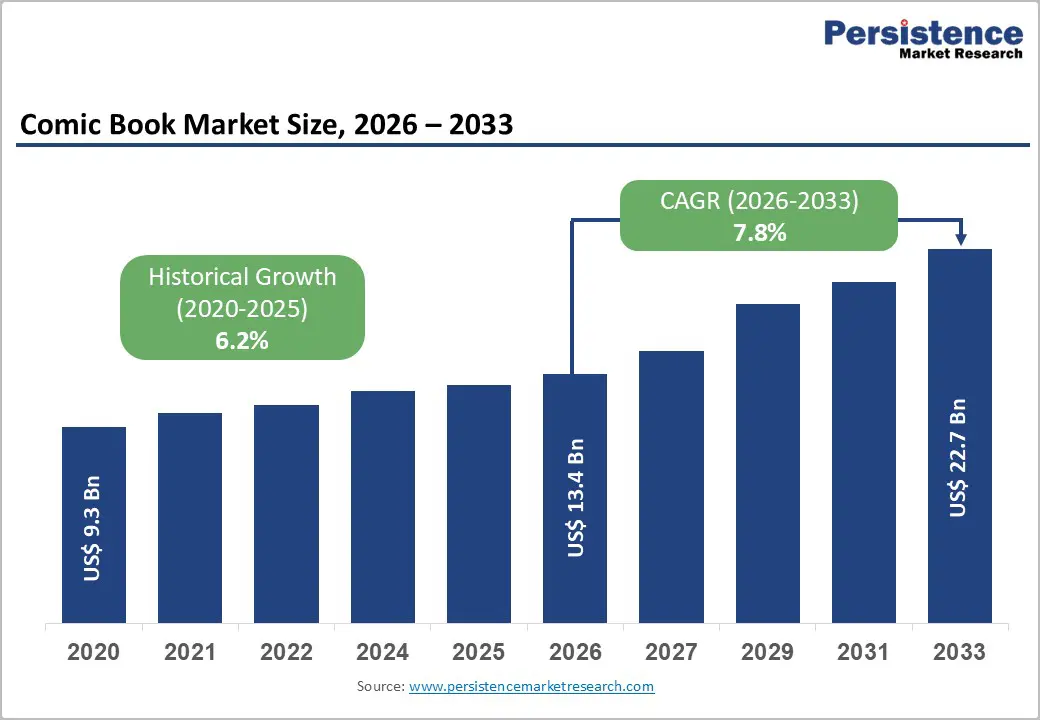
The global comic book market size is projected to reach US$ 13.4 billion in 2026 and expand to US$ 22.7 billion by 2033, registering a CAGR of 7.8%.
The growing trend of graphic storytelling is amplified by cinematic and streaming adaptations from the worldwide entertainment giants. Increasing digital consumption via smartphones, strong global demand for Japanese manga, and the increase in disposable incomes among younger consumers are fueling expansion. Additionally, broader genre diversification and growing inclusion of comics in education and libraries are attracting new reader segments, significantly widening the market’s global audience base.
Key Industry Highlights:
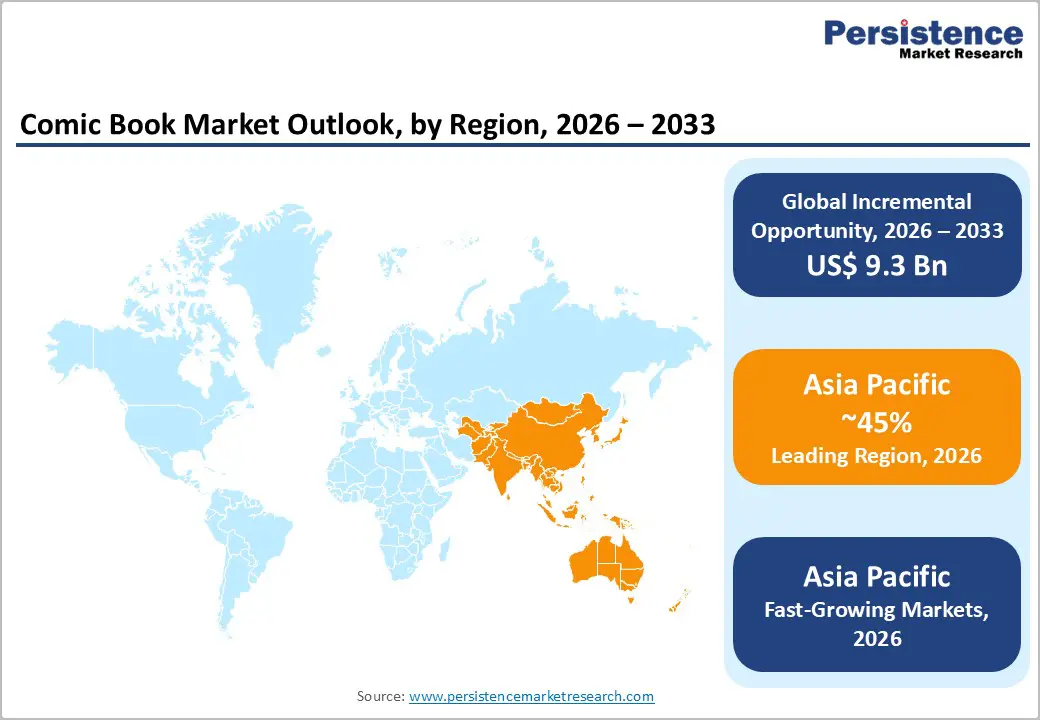
- Leading Region: Asia Pacific leads the comic book market with ~45% share in 2025, driven by strong manga ecosystems, webtoon platforms, and rapid digital adoption across emerging economies.
- Fastest Growing Region: Asia Pacific is the fastest-growing region through 2032, fueled by mobile-first consumption, young demographics, and the expanding global reach of anime-linked content.
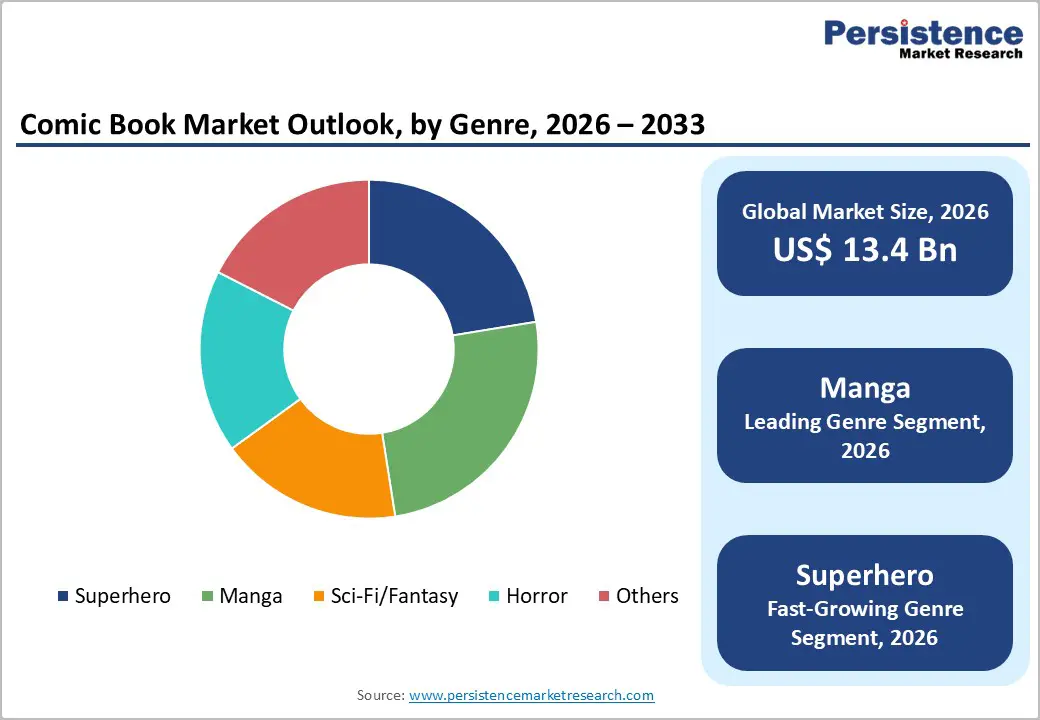
- Dominant Segment: Manga dominates the genre segment with ~42% share in 2025, supported by globally popular franchises and expanding international retail presence.
- Fast-Growing Segment: Superhero comics are the fastest-growing genre, driven by renewed cinematic universes, streaming adaptations, and aggressive audience expansion strategies.
- Key Opportunity: Webtoon formats, digital subscriptions, and adult-focused graphic novels present strong growth potential through mobile distribution and premium content diversification.

Market Dynamics
Market Drivers
Cinematic Adaptations Driving Demand for Original Comic Content
The steady pipeline of comic-based films and streaming series continues to reinforce demand for original source material, creating a strong cross-media consumption loop. Major studios like The Walt Disney Company and Warner Bros. Discovery, along with platforms such as Netflix and Amazon Prime Video, consistently boost visibility of comic narratives globally.
These adaptations often trigger immediate increases in comic and graphic novel sales, converting casual viewers into long-term readers. The accessibility of stories across formats encourages deeper engagement, including purchases, subscriptions, and library borrowing. This ongoing screen-to-page cycle is strengthening brand ecosystems and expanding audience reach across multiple demographics, sustaining long-term growth momentum in the comic book market.
Mobile-First Digital Platforms Expanding Global Comic Readership
The rapid rise of digital comic platforms and mobile-first consumption is significantly broadening readership beyond traditional print audiences. Applications like Webtoon by NAVER Corporation and Manga Plus have introduced accessible, on-demand content globally, enabling simultaneous releases across regions and eliminating geographic barriers.
With widespread smartphone adoption, especially in emerging markets, readers are increasingly engaging with webtoon-style vertical formats. This shift reduces dependency on physical distribution and lowers entry barriers for new consumers. As a result, publishers are reaching younger, digitally native audiences while expanding into regions previously underserved by traditional comic supply chains, accelerating overall market penetration.
Market Restraints
Growing Threat of Piracy and Unauthorized Distribution Networks
Piracy remains a major structural challenge for the comic book industry, significantly impacting revenues and undermining legitimate distribution channels. Unauthorized scanlation websites and torrent platforms distribute translated content within hours of official release, reducing incentives for consumers to purchase licensed versions and weakening monetization strategies for publishers and creators.
Despite regulatory measures and enforcement actions led by organizations like Content Overseas Distribution Association, piracy networks continue to adapt through mirror sites and decentralized hosting. This persistent issue discourages investment in international licensing and localization, particularly for smaller publishers, and limits the industry’s ability to capitalize on global demand for diverse comic content fully.
Rising Input Costs Pressuring Physical Comic Publishing Margins
Rising costs of raw materials and logistics increasingly challenge the production of physical comics. Price increases in paper, ink, and freight have significantly elevated overall production expenses, placing pressure on publishers’ profit margins and complicating pricing strategies across key markets such as North America and Europe.
Smaller publishers and independent comic retailers are particularly affected due to limited purchasing power and scale advantages. As a result, many are raising cover prices, reducing print volumes, or limiting experimental releases. These cost pressures are also influencing consumer behavior, leading to more selective purchasing and impacting overall demand for physical comic formats.
Opportunities
Webtoon Format and Subscription Models Unlocking Growth Potential
The global expansion of webtoon-style vertical comics is creating new growth avenues for publishers and content creators. Platforms such as Webtoon are transforming how audiences consume comics, with mobile-friendly formats and episodic storytelling gaining widespread traction among younger users.
Strategic partnerships between companies such as Crunchyroll and NAVER Corporation are further integrating comics into broader entertainment ecosystems. Subscription models, micropayments, and creator revenue-sharing frameworks are enabling scalable monetization while supporting diverse content production, positioning digital comics as a high-growth segment within the global market.
Expanding Female and Adult Readership Driving Market Diversification
The comic book market is undergoing a demographic transformation, with increasing participation from female and adult readers reshaping content demand. Genres such as romance, slice-of-life, horror, and literary narratives are gaining popularity, attracting audiences beyond traditional superhero-focused readership and expanding the overall consumer base.
Publishers are responding by launching diverse imprints, premium editions, and translated works to cater to evolving preferences. This shift is also supported by growing acceptance of comics in educational and cultural spaces, including libraries and book clubs. As a result, higher-value purchases and broader genre experimentation are driving sustained growth opportunities across global comic markets.
Category-wise Analysis
Format Insights
Physical comics dominate the format segment, accounting for approximately 58% market share in 2025, supported by strong collector culture and tangible ownership appeal. Resale activity on platforms like eBay and auction houses such as Heritage Auctions reinforces value retention. Bookstore chains, including Barnes & Noble and Waterstones, continue to drive visibility and sales of trade paperbacks and graphic novels globally.
Digital comics are emerging as the fastest-growing format, driven by mobile accessibility and evolving reading habits. Platforms offering webtoon-style formats and subscription-based models are attracting younger audiences and first-time readers. The convenience of instant access, lower entry costs, and global distribution capabilities are accelerating adoption, particularly in regions where physical comic infrastructure has historically been limited.
Genre Insights
Manga holds the leading position in the genre segment, capturing approximately 42% market share in 2025 due to Japan’s dominance in serialized storytelling. Major publishers such as Shueisha, Kodansha, and Shogakukan have expanded international reach through globally popular franchises like One Piece and Demon Slayer.
Alternative genres, including webcomics, horror, and slice-of-life narratives, are witnessing the fastest growth. These formats appeal to broader and more diverse audiences, including female readers and adults. Increasing cross-media adaptations and digital-first releases are further accelerating demand, enabling non-traditional genres to gain traction beyond niche readerships and expand the overall market landscape.
Distribution Channel Insights
Online retail leads the distribution channel segment with an estimated 38% market share in 2025, driven by the convenience of digital storefronts and global accessibility. Platforms such as Amazon and Barnes & Noble Online provide extensive catalogs, competitive pricing, and preorder options that appeal to both collectors and casual readers.
Direct-to-consumer platforms and digital storefronts are emerging as the fastest-growing channels, enabling independent creators and niche publishers to reach global audiences. These channels reduce dependency on physical shelf space and allow for personalized recommendations, subscription services, and community-driven discovery, significantly enhancing engagement and repeat purchases across diverse reader segments.
End-user Insights
Adults represent the leading end-user segment, accounting for approximately 52% market share in 2025, reflecting a shift from historically youth-focused consumption. Mature readers are driving demand for premium editions, collector variants, and omnibus formats. Publishers like Image Comics and Dark Horse Comics are actively targeting this demographic with sophisticated storytelling and high-quality production.
Younger audiences are the fastest-growing end-user segment, fueled by digital-native content and cross-platform exposure. Mobile-first platforms, anime adaptations, and social media trends are introducing comics to new readers at earlier ages. This segment’s evolving preferences are shaping future content strategies, encouraging publishers to innovate with interactive formats and genre diversity to sustain long-term growth.
Regional Insights
North America Comic Book Market Trends and Insights
North America remains a cornerstone region with deeply embedded comic culture, supported by an extensive network of specialty comic shops, conventions such as San Diego Comic-Con, and a dominant film-licensing ecosystem. The region accounted for roughly 28% of global revenues in 2025. Trends include surging adult graphic novel sales, record-breaking trade paperback performance in bookstores, and digital subscription growth via Marvel Unlimited and DC Universe Infinite.
- U.S. Comic Book Market Size
The United States is the largest North American market, contributing approximately 88% of regional revenue in 2025, with combined comic and graphic novel sales estimated at US$ 2.0 billion per ICv2 reporting. Demand is driven by Marvel and DC flagship titles, manga's continued bookstore explosion, library acquisitions funded under federal education programs, and a vibrant collector market reflected in record auction results at Heritage Auctions.
Europe Comic Book Market Trends and Insights
Europe is a culturally rich market shaped by the strong Franco-Belgian bande dessinée tradition, expanding manga penetration, and growing graphic novel acceptance in mainstream publishing. The region accounted for roughly 22% of global revenue in 2025. Trends include festival-driven discovery at events such as Festival International de la Bande Dessinée d'Angoulême, rising library procurement, increasing translation activity, and accelerated digital adoption among younger readers in Western Europe.
- Germany Comic Book Market Size
Germany is one of Europe's leading comic markets, accounting for approximately 18% of regional revenue in 2025. Per Börsenverein des Deutschen Buchhandels trade data, manga has driven the country's children's and young adult book segment to record growth, with publishers such as Carlsen Verlag and Tokyopop reporting sustained sales increases. Strong bookstore networks and dedicated youth readership underpin the market.
- U.K. Comic Book Market Size
The United Kingdom held 15% of Europe market revenue in 2025, supported by a sophisticated graphic novel ecosystem and bookstore-centric distribution. Nielsen BookScan data indicates strong year-over-year growth in graphic novel categories, while domestic publishers such as Rebellion (publisher of 2000 AD) and global imprints anchor the market. Manga, indie comics, and adult-oriented graphic literature are key growth drivers.
- France Comic Book Market Size
France accounts for approximately 20% of European comic revenue in 2025, reflecting its world-leading per-capita consumption of bande dessinée. Per Syndicat National de l'Édition (SNE), comics and graphic novels consistently rank among the top-performing book segments, with manga representing over half of unit sales. Government cultural support and Angoulême-anchored prestige reinforce France's position.
Asia Pacific Comic Book Market Trends and Insights
Asia Pacific is the leading and fastest-growing region, holding approximately 45% market share in 2025, anchored by Japan's manga industry, South Korea's webtoon explosion, and rapid digital comic adoption across China, India, and Southeast Asia. China's comic and webcomic market is expanding rapidly via platforms such as Tencent Comics and Bilibili Comics, with regulatory support for domestic IP. The region benefits from mobile-first reading habits and youthful demographics.
- India Comic Book Market Size
India contributes approximately 4% of the Asia Pacific revenue in 2025, but is among the fast-growing country markets. Heritage publishers such as Amar Chitra Katha and Diamond Comics coexist with rapidly scaling digital platforms. Manga translations, rising English-language readership tracked by Nielsen BookScan India, and webtoon-style apps targeting tier-2 and tier-3 cities are accelerating market penetration significantly.
- Japan Comic Book Market Size
Japan is the single largest country market, accounting for over 55% of Asia Pacific revenue in 2025. Per AJPEA, the domestic manga market—including print and digital exceeded ¥696.5 billion in 2023, with digital surpassing print for the first time. Shueisha's Weekly Shonen Jump franchises, anime synergies, and globally hit titles continue to drive both domestic consumption and lucrative export licensing.
- Southeast Asia Comic Book Market Size
Southeast Asia represents approximately 8% of Asia Pacific revenue in 2025, with Indonesia, the Philippines, Thailand, and Vietnam emerging as high-growth markets. Mobile-first webtoon platforms such as Webtoon and Tapas lead engagement, while licensed manga from Kodansha and Shueisha is expanding through local publishers. Rising youth populations, smartphone penetration, and English/Bahasa-language localization are key growth catalysts.
Competitive Landscape
The global comic book market is moderately fragmented, with a mix of legacy publishers, regional manga leaders, and emerging digital-native platforms shaping competition. Established players dominate traditional superhero and print segments, while Asian publishers lead serialized storytelling formats. Companies increasingly differentiate through intellectual property development, exclusive creator partnerships, and vertically integrated publishing ecosystems that combine print, digital, and multimedia content distribution.
Strategic focus areas include cross-media franchising, subscription-based digital services, and technology-driven localization to expand global reach. At the same time, independent publishers and creator-owned imprints continue to play a vital role in driving innovation, introducing diverse narratives, and capturing niche audiences across both physical and digital comic ecosystems.
Key Market Developments
- In June 2024, Webtoon Entertainment Inc. completed its initial public offering on NASDAQ, raising approximately US$ 315 million at a valuation near US$ 2.7 billion, signaling strong investor confidence in the digital vertical comic format.
- In February 2024, Shueisha launched expanded Manga Plus subscription tiers in over 150 countries, adding back-catalog access and ad-free reading to combat piracy and grow international paid readership.
- In October 2023, DC Comics announced a major restructuring under DC Studios leadership, integrating publishing, film, and gaming pipelines to align comic launches with the rebooted DC cinematic universe slate.
Companies Covered in Comic Book Market
- Marvel Entertainment, LLC
- DC Comics
- Shueisha Inc.
- Kodansha Ltd.
- Shogakukan Inc.
- Image Comics, Inc.
- Dark Horse Comics, Inc.
- IDW Publishing
- Boom! Studios
- Viz Media, LLC
- Webtoon Entertainment Inc.
- Kakao Entertainment Corp.
- Rebellion Developments
- Dynamite Entertainment
- Tokyopop GmbH
- Carlsen Verlag GmbH
- Panini S.p.A.
Frequently Asked Questions
The global comic book market size is valued at US$ 13.4 billion in 2026 and is projected to reach US$ 22.7 billion by 2033, growing at a CAGR of 7.8%.
Key demand is driven by cinematic and streaming adaptations from Marvel Studios and DC Studios, alongside digital platforms like Webtoon and Manga Plus.
Asia Pacific leads with ~45% share, supported by Japan’s strong manga industry, South Korea’s webtoon ecosystem, and rapid digital adoption across emerging markets.
Major opportunities lie in webtoon-style formats, subscription-based digital platforms, and expanding adult and female readership segments globally.
Key players include Marvel Entertainment, DC Comics, Shueisha, Kodansha, Shogakukan, Image Comics, Dark Horse Comics, and Viz Media.


