




- Home Care & Utilities
- Car Air Freshener Market
Car Air Freshener Market Size, Share, and Growth Forecast 2026 - 2033
Car Air Freshener Market by Product Type (Hanging Air Fresheners, Vent Clips, Aerosol & Spray, Gel & Can, Diffusers), by Fragrance Type (Floral, Fruity, Citrus, Woody, Fresh), by Distribution Channel (Supermarkets/Hypermarkets, Convenience Stores, Automotive Stores, Online Retail), by Regional Analysis (North America, Europe, Asia Pacific, Latin America, Middle East & Africa), 2026 2033.

Car Air Freshener Market Size and Trend Analysis
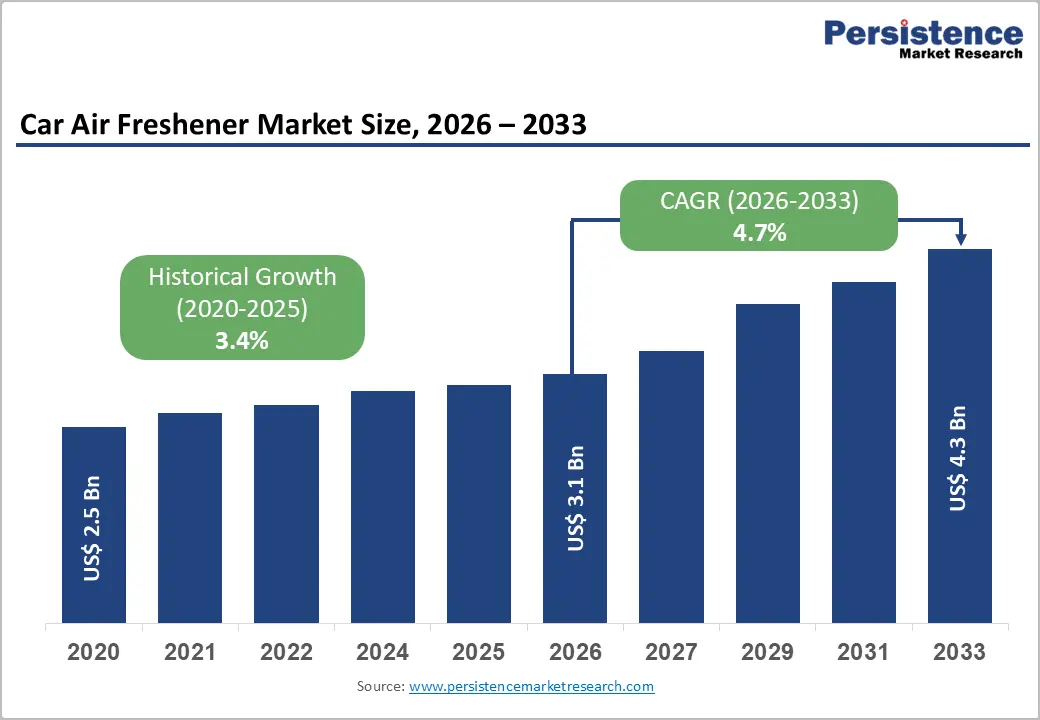
The global Car Air Freshener market is projected to be valued at US$ 3.1 billion in 2026 and is expected to reach US$ 4.3 billion by 2033, expanding at a CAGR of 4.7% during the forecast period. Growth is primarily driven by rising vehicle ownership and increasing awareness of cabin hygiene and in-car comfort. Consumers are increasingly shifting toward premium, long-lasting fragrance solutions that enhance the driving experience. Additionally, rapid urbanization and longer daily commute times, particularly across Asia Pacific and Latin America, are accelerating demand for convenient and effective air freshening products across both developed and emerging markets.
Key Market highlights
- Leading Region: North America leads the market with approximately 36% share, driven by high vehicle ownership and strong spending on automotive interior care products.
- Fastest Growing Region: Asia Pacific is the fastest-growing region, supported by rising incomes, rapid urbanization, and expanding vehicle fleets across emerging economies.
- Leading Product Type: Hanging Air Fresheners dominate with around 35% share in 2025, owing to low cost, wide availability, and strong appeal among price-sensitive consumers.
- Fastest Growing Fragrance Type: Citrus fragrances are witnessing the fastest growth, fueled by increasing preference for fresh and energizing scents among urban consumers.
- Key Market Opportunity: Growth in smart, connected, and IoT-enabled diffuser systems integrated with vehicles offers a high-value opportunity for innovation-driven brands.

Market Dynamics
Market Growth Drivers
Expanding Vehicle Ownership and Daily Usage Driving Consistent Demand
The rapid expansion of the global vehicle fleet, now exceeding 1.5 billion units, is significantly increasing the addressable market for car air fresheners. Rising disposable incomes and improved vehicle financing access in emerging economies such as India, Indonesia, and Brazil are accelerating first-time car ownership. This trend is strengthening demand for basic automotive interior care products, including air fresheners, across both urban and semi-urban populations.
At the same time, longer daily commute times in densely populated regions across Asia Pacific and Latin America are elevating the importance of in-cabin comfort. Consumers increasingly prioritize a pleasant driving environment, leading to more frequent purchases of air fresheners. These products are gradually shifting from occasional purchases to low-cost, regularly used consumables embedded in everyday vehicle maintenance routines.
Premium Fragrance Innovation and Sustainability Trends Enhancing Value
Manufacturers are actively investing in premium fragrance formulations, including essential oil-based blends and natural scent profiles, to align with evolving consumer preferences. Growing awareness around sustainability has accelerated the shift toward eco-friendly packaging, biodegradable materials, and plant-based ingredients. These innovations are helping brands reposition air fresheners as lifestyle-oriented products that combine functionality with environmental responsibility.
Technological advancements such as time-release diffusers and heat-activated vent clips are improving scent longevity and overall product performance. This enhances perceived value while reducing replacement frequency for consumers. By integrating premium fragrances with sustainable design and improved usability, companies are able to command higher price points and build stronger brand loyalty, particularly among younger, urban consumers.
Market Restraints
Health and Safety Concerns Around Synthetic Fragrance Ingredients
Increasing consumer awareness regarding the potential health risks associated with volatile organic compounds (VOCs) and synthetic chemicals is emerging as a significant restraint. Many traditional air fresheners, especially aerosol sprays and gels, contain ingredients that may trigger respiratory irritation or allergic reactions. This has led to growing caution among consumers, particularly those with sensitivities or pre-existing health conditions.
Regulatory authorities in developed regions are tightening standards around indoor air quality and chemical transparency, prompting manufacturers to reformulate products and improve labeling practices. As a result, some consumers are shifting toward fragrance-free or low-chemical alternatives. This trend may limit growth opportunities for low-cost, synthetic air freshener products, especially in health-conscious and high-income markets.
Highly Fragmented Market Leading to Intense Price Competition
The car air freshener market remains highly fragmented, with numerous global, regional, and local players competing across retail channels. Low entry barriers, particularly for simple products like hanging fresheners and aerosol sprays, encourage the participation of small manufacturers. This intensifies competition and leads to price pressure, reducing overall profit margins across the industry.
Established brands must continuously invest in branding, packaging innovation, and promotional strategies to maintain premium positioning. Additionally, frequent product refresh cycles driven by seasonal scents and design trends increase operational complexity. Companies face risks related to unsold inventory and shorter product lifecycles if consumer preferences shift rapidly, further challenging profitability.
Market Opportunities
Integration of Smart Technologies into Vehicle Fragrance Systems
The growing integration of connected technologies in modern vehicles is opening new avenues for smart air freshening systems. Advanced diffusers equipped with IoT capabilities can be controlled through smartphone applications, allowing users to customize scent intensity, duration, and scheduling. This enhances convenience and provides a more personalized in-car experience aligned with evolving consumer expectations.
Collaborations between air freshener manufacturers and automotive OEMs are also gaining traction, enabling factory-installed or dealer-integrated fragrance systems. These innovations align with the broader trend of smart vehicle ecosystems, where infotainment and climate control systems are increasingly interconnected. This segment holds strong potential as a high-value, technology-driven extension of traditional air freshener products.
Growth of Eco-Friendly Products and Subscription-Based Retail Models
The rising popularity of direct-to-consumer (DTC) channels and subscription-based models is transforming the way car air fresheners are marketed and sold. Consumers are increasingly opting for convenient, home-delivered solutions that offer refillable and customizable options, reducing the need for frequent store visits. This trend aligns with fast-paced urban lifestyles and growing digital adoption.
Eco-conscious consumers are also driving demand for biodegradable materials, non-toxic formulations, and sustainable packaging. Brands that emphasize transparency and environmental responsibility are gaining traction in this evolving market landscape. By combining sustainability with subscription convenience and strong online presence, companies can establish recurring revenue streams and strengthen long-term customer relationships.
Category wise Insights
Product Type
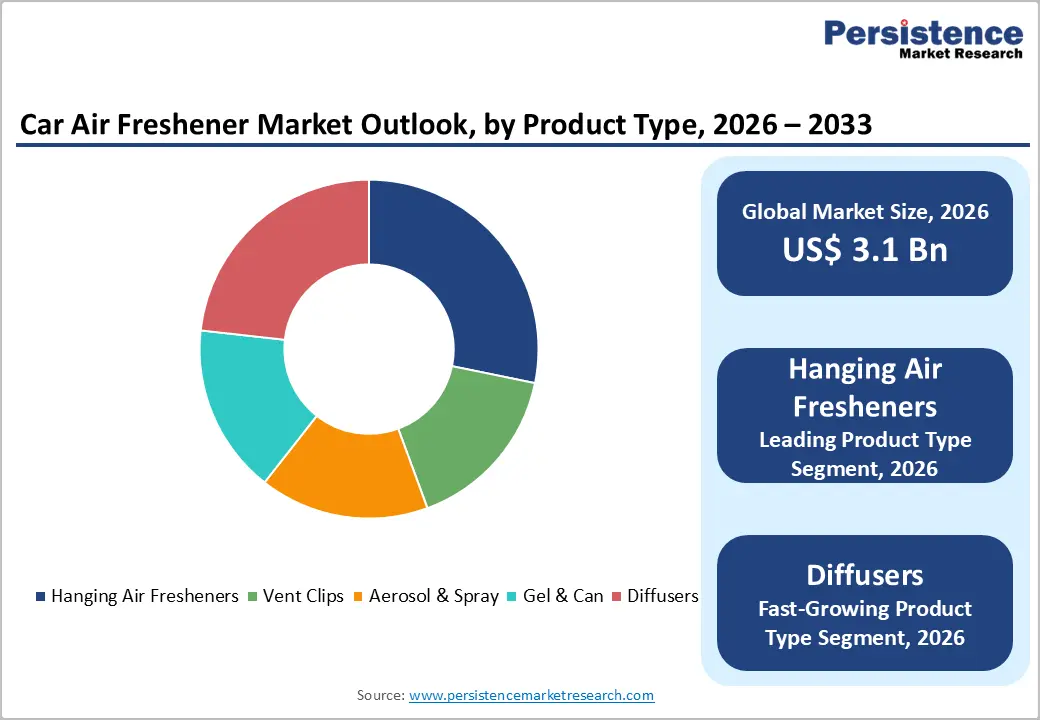
Hanging air fresheners dominate the product type segment, accounting for approximately 35% of the market share in 2025. Their leadership is supported by low manufacturing costs, simple usability, and widespread availability across supermarkets, convenience stores, and automotive outlets. The variety of shapes, colors, and themed designs enhances visual appeal, allowing consumers to personalize vehicle interiors while encouraging frequent replacement and repeat purchases.
Diffusers are emerging as the fastest-growing product type, driven by rising demand for premium and long-lasting fragrance solutions. These products offer controlled scent release and improved durability compared to traditional formats. Increasing consumer preference for aesthetic, refillable, and technologically enhanced solutions is pushing adoption, particularly among urban and higher-income users seeking enhanced in-car experiences.
Fragrance Type
Floral fragrances lead the fragrance type segment, capturing nearly 30% of the market share in 2025. Their strong position is driven by long-standing associations with freshness, cleanliness, and sophistication. Widely used across multiple formats such as hanging fresheners, vent clips, and gels, floral scents offer versatility for manufacturers and consistent consumer appeal across both personal and family vehicle segments.
Citrus fragrances are the fastest-growing category, gaining traction due to their perceived odor-neutralizing properties and refreshing characteristics. Consumers increasingly prefer lighter, energizing scents that are not overpowering during long commutes. The growing shift toward natural and wellness-oriented fragrance profiles is also encouraging innovation in citrus-based blends, supporting their rising popularity across diverse user groups.
Distribution Channel
Supermarkets and hypermarkets hold the leading position in distribution channels, accounting for around 40% of the market share in 2025. Their dominance is attributed to high consumer footfall, wide product availability, and strategic placement within automotive or home care sections. In-store displays and fragrance testing options further enhance consumer engagement, driving impulse purchases and repeat buying behavior.
Online retail is the fastest-growing distribution channel, supported by increasing e-commerce penetration and changing consumer shopping habits. Digital platforms provide access to a broader range of brands, fragrances, and product formats. The convenience of home delivery, combined with subscription models and targeted marketing, is accelerating online adoption, particularly among younger and tech-savvy consumers.
Regional Insights
North America Car Air Freshener Market Trends and Insights
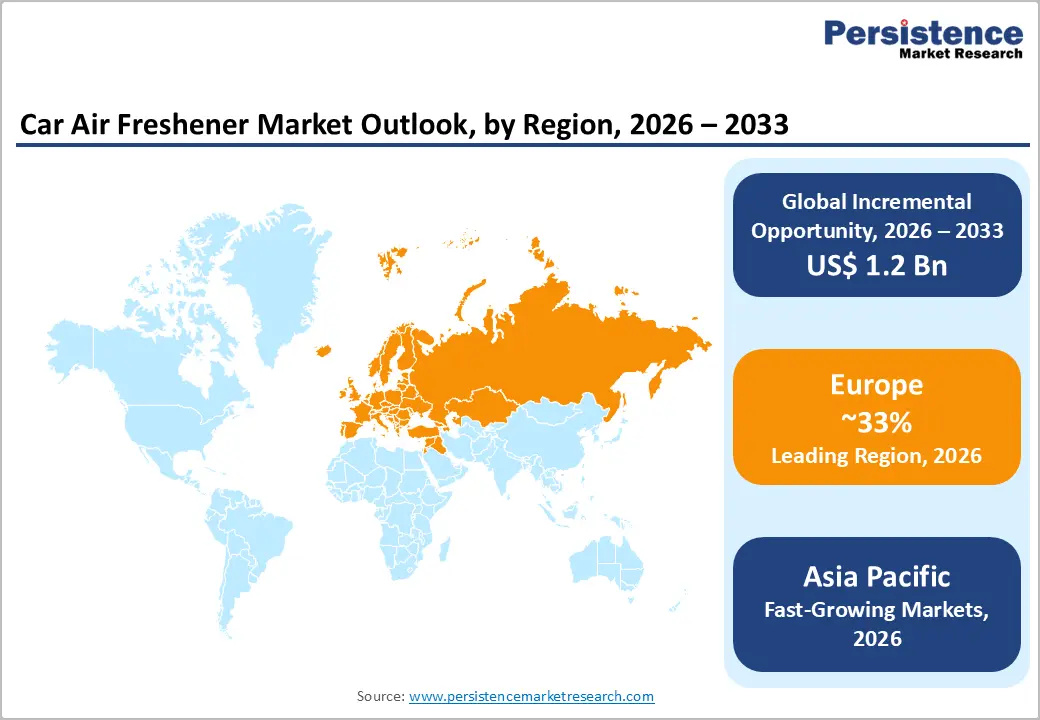
North America remains the largest regional market of 36% for Car Air Fresheners, supported by a high vehicle ownership rate, strong consumer spending on car-care products, and a mature retail infrastructure. The region is also characterized by a growing preference for premium, long-lasting, and eco-friendly fragrance options, especially in vent-clip and diffuser formats. Consumers in urban and suburban markets are increasingly viewing air fresheners as part of a broader vehicle wellness and personalization strategy, similar to car detailing and interior-cleaning products.
- U.S. Car Air Freshener Market Size
The U.S. accounts for approximately 70% of North America’s market share and represents one of the largest single-country markets globally. The size of the market is underpinned by a large automotive fleet, a culture of car customization, and a well-developed retail ecosystem spanning supermarkets, convenience stores, automotive-specific chains, and online retail. Growth drivers include rising demand for premium and subscription-style air-freshening products, as well as the introduction of smart, tech-integrated diffusers that align with the country’s strong digital-device-adoption trends.
Europe Car Air Freshener Market Trends and Insights
Europe exhibits steady growth, with demand shaped by regulatory focus on indoor air quality, chemical safety, and environmental sustainability. Many European consumers favor subtle, natural-feeling fragrances and minimalist packaging, which has pushed brands to invest in essential-oil-based formulations and refillable or recyclable designs. The region is also seeing increased interest in premium and design-oriented products from established fragrance-centric brands, particularly in Western European markets such as Germany, France, and the U.K.
- Germany Car Air Freshener Market Size
Germany holds an estimated 25% share of the European market and is a key hub for premium automotive-care products. German consumers place a high value on product quality, longevity, and technical performance, which benefits vent-clips and diffusers with advanced fragrance-release mechanisms. The market is also influenced by strict chemical-regulation standards and a growing preference for natural, low-emission ingredients, which are reshaping product portfolios across major brands.
- U.K. Car Air Freshener Market Size
The U.K. accounts for roughly 18% of Europe’s market share and is characterized by a highly competitive retail landscape. Both mass-market and boutique brands coexist, offering a wide range of hanging fresheners, aerosol sprays, and gel-type products. Consumer interest in eco-friendly and recyclable packaging, along with frequent promotion and discount campaigns, makes the U.K. a dynamic and responsive market for new fragrance launches and seasonal designs.
- France Car Air Freshener Market Size
France represents about 15% of Europe’s total market share and is heavily influenced by the country’s luxury-perfume heritage. French consumers often prefer complex, sophisticated scent profiles and stylish, design-driven air-freshener devices that complement premium vehicle interiors. This has led several fragrance-focused and automotive-lifestyle brands to develop limited-edition or artistic-design products specifically targeted at the French market.
Asia Pacific Car Air Freshener Market Trends and Insights
Asia Pacific is the fastest-growing regional market, driven by rising disposable incomes, rapid urbanization, and a rapidly expanding vehicle fleet in countries such as China, India, and Indonesia. In many emerging markets, air fresheners are becoming basic accessories rather than luxury items, especially in entry-level and compact vehicles where cabin comfort is a key purchase consideration. The region is also witnessing strong demand for low-cost, high-impact formats such as aerosol sprays and simple gel-type cans, which are widely distributed through local retail and motor-bazaar channels.
- India Car Air Freshener Market Size
India is estimated to capture about 20% of Asia Pacific’s market share and is a key growth engine for the region. Rising vehicle ownership among the urban middle class, combined with increasing awareness of cabin hygiene and aroma, is driving demand for both affordable and premium air-freshening products. The market is also supported by a growing aftermarket and automotive-care ecosystem, including service-center sales and online retail, which are expanding accessibility beyond traditional brick-and-mortar stores.
- Japan Car Air Freshener Market Size
Japan holds approximately 15% of Asia Pacific’s share and is known for its high-quality, compact, and design-conscious product demands. Japanese consumers favor subtle, non-overpowering scents and space-efficient formats that fit seamlessly into modern, minimalist vehicle interiors. The market is also influenced by advanced materials and fine-fragrance technology, which are integrated into small-form-factor diffusers and vent-clip designs.
- Southeast Asia Car Air Freshener Market Size
Southeast Asia collectively contributes about 25% of Asia Pacific’s market share, reflecting strong growth across countries such as Thailand, Indonesia, Vietnam, and the Philippines. The region’s automotive market is expanding rapidly, with increasing motorcycle and passenger-car ownership leading to higher demand for affordable, refreshing, and long-lasting air-freshening solutions. Local and regional brands are gaining traction by offering low-priced, high-scent-intensity products that cater to humid, tropical environments.
Competitive Landscape
The car air freshener market is highly fragmented, characterized by the presence of multinational corporations, regional brands, and numerous local manufacturers. Competition is driven by strong branding, wide distribution networks, and continuous innovation in fragrance formulations and product formats. Companies differentiate through scent variety, packaging aesthetics, and claims around sustainability, safety, and long-lasting performance to attract diverse consumer segments.
Market participants are increasingly focusing on advanced product formats and evolving business models to strengthen positioning. Innovations such as smart diffusers and enhanced vent systems are gaining traction. Additionally, subscription-based services, refillable product lines, and collaborations within the automotive ecosystem are emerging as key strategies to improve customer retention and create recurring revenue opportunities.
Key Market Developments
- In January 2025, Car-Freshner Corporation expanded its eco-friendly, essential-oil-based hanging air freshener range through a partnership with a major North American automotive-retail chain to increase shelf coverage and in-store visibility.
- In June 2025, Church & Dwight Co., Inc. launched a smart-enabled vent-clip product that integrates with mobile-app controls and offers adjustable scent intensity and timer settings, targeting tech-savvy drivers in North America and Europe.
- In November 2025, Godrej Group introduced a new line of premium, long-lasting gel-type car air fresheners formulated for tropical climates, aiming to strengthen its position in India and other Southeast Asian markets.
Global Car Air Freshener Market- Key Insights
| Key Insights | Details |
|---|---|
|
Historical Market Value (2020) |
US$ 2.5 billion |
|
Current Market Value (2026) |
US$ 3.1 billion |
|
Projected Market Value (2033) |
US$ 4.3 billion |
|
CAGR (2026–2033) |
4.7% |
|
Leading Region |
North America, 36% |
|
Dominant Product Type |
Hanging Air Fresheners, 35% |
|
Top-ranking Fragrance Type |
Floral, 30% |
|
Incremental Opportunity |
US$ 1.2 billion |
Companies Covered in Car Air Freshener Market
- 3M
- SC Johnson
- Kobayashi Pharmaceutical
- Amway
- House Chem
- Aromate Industries
- Air Wick
- Airpro Car
- Car Freshner Corporation
- Chemical Guys
- Church & Dwight Co., Inc.
- American Covers
- Eikosha Co., Ltd.
- Newell Brands
- Godrej Group
- Unilever
- AirQ
- JRV Industries LLP
- Custom Air Fresheners
- Pongo
- My Air Freshener, Inc.
- IKEDA
Frequently Asked Questions
The market is projected to reach US$ 3.1 billion in 2026, driven by rising vehicle ownership and growing demand for premium interior care products.
Growth is driven by expanding vehicle fleets, longer urban commute times, increasing focus on cabin hygiene, and rising preference for eco-friendly, long-lasting fragrances.
North America leads with approximately 36% market share, supported by high vehicle ownership and strong consumer spending on car care.
Smart, connected, and IoT-enabled diffuser systems offering personalized fragrance control present a significant growth opportunity.
Leading companies include 3M, SC Johnson, Car‑Freshner Corporation, Church & Dwight Co., Inc., Godrej Group, and Unilever.


