




- Specialty & Fine Chemicals
- Bio-based Platform Chemicals Market
Bio-based Platform Chemicals Market Size, Share, and Growth Forecast, 2026 - 2033
Bio-based Platform Chemicals Market by Chemical (Bio-Succinic Acid, Bio-Glycerol, Others), Feedstock (Sugar, Lignocellulosic Biomass, Others), End-use Industry, and Regional Analysis for 2026 - 2033

Bio-based Platform Chemicals Market Size and Trends Analysis
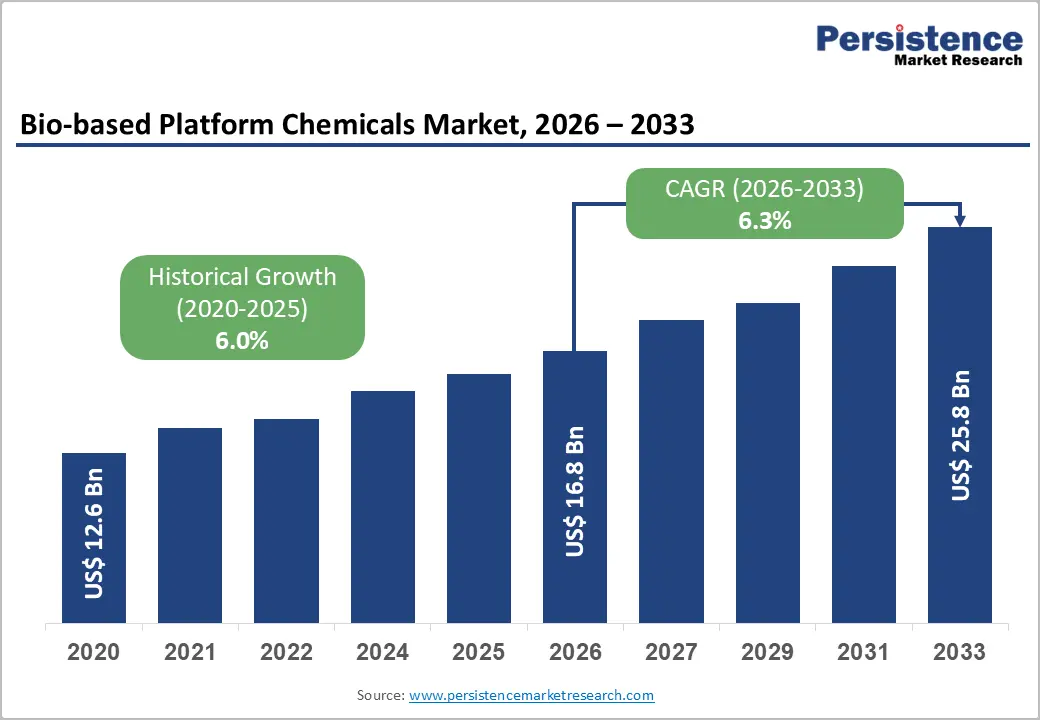
The global bio-based platform chemicals market size is likely to be valued at US$16.8 billion in 2026 and is expected to reach US$25.8 billion by 2033, growing at a CAGR of 6.3% between 2026 and 2033, driven by rising decarbonization targets, increasing demand for renewable-carbon materials, and continuous advancements in industrial biotechnology and biorefinery systems.
Governments across North America, Europe, and Asia Pacific are strengthening support for sustainable chemicals through circular economy initiatives and carbon-reduction regulations. Strong demand from polymers, adhesives, coatings, packaging, and specialty materials industries is also accelerating the commercialization of bio-based intermediates and platform chemicals.
Key Industry Highlights:
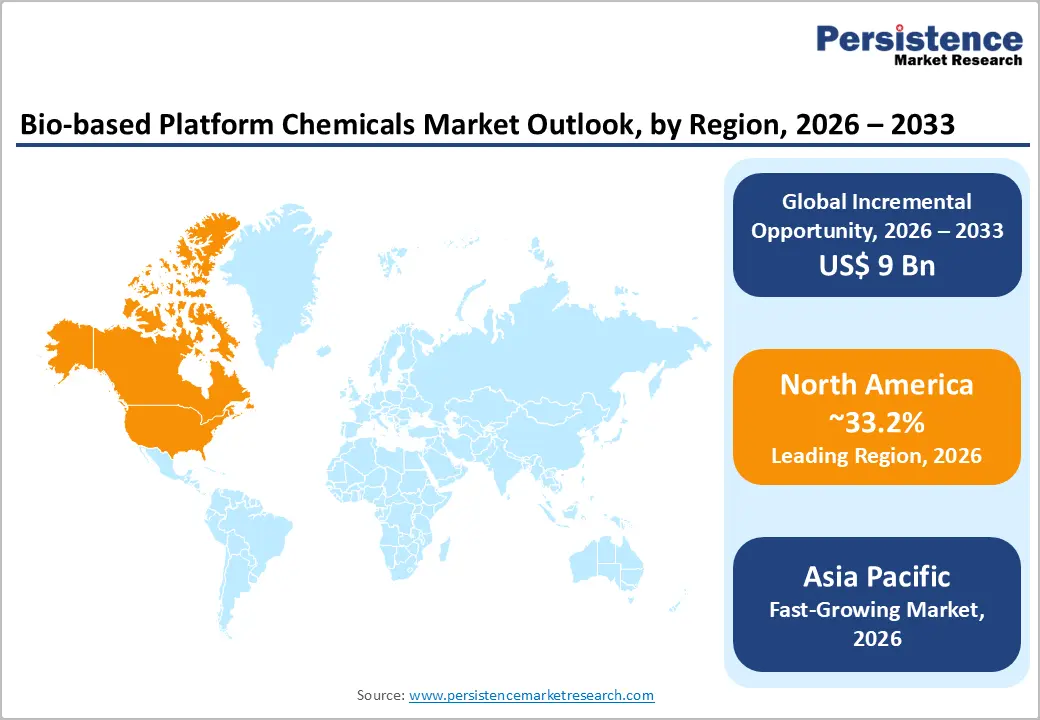
- Leading Region: North America is projected to hold approximately 33.2% market share in 2026, supported by advanced biotechnology infrastructure, strong renewable-carbon policies, and expanding investment in integrated biorefineries.
- Fastest-growing Region: Asia Pacific is projected to register the fastest growth, driven by rapid industrialization, abundant biomass availability, and rising investments in sustainable polymers and renewable chemicals across China, India, Japan, and ASEAN countries.
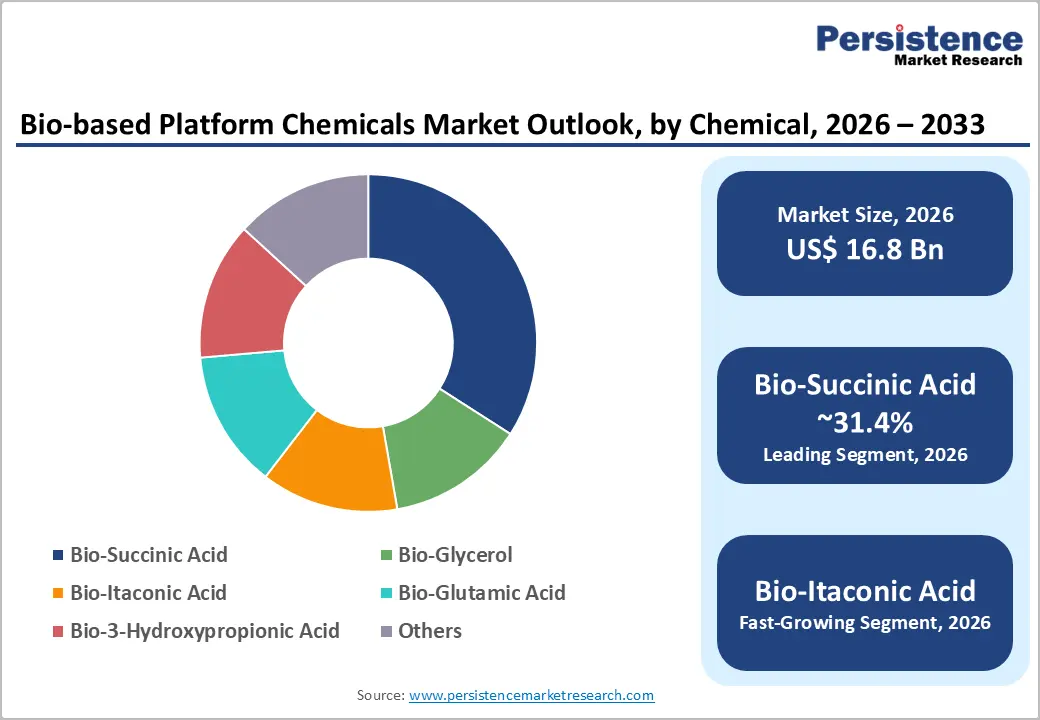
- Dominant Chemical: Bio-succinic acid is projected to lead with nearly 31.4% market share in 2026, due to extensive use in biodegradable plastics, coatings, solvents, and polymer intermediates.
- Leading Feedstock: Sugar-based feedstocks are estimated to account for around 32.1% market share in 2026, supported by strong fermentation efficiency, commercial maturity, and well-established agricultural supply chains.
DRO Analysis
Driver - Decarbonization Policies and Renewable Carbon Transition Supporting Market Expansion
The transition toward low-carbon industrial production remains one of the strongest growth drivers for bio-based platform chemicals. Governments across the U.S., Europe, Japan, and China are implementing stricter climate targets that encourage the replacement of fossil-derived chemicals with renewable alternatives. Regulatory frameworks supporting circular economy systems, sustainable materials procurement, and emissions reduction are increasing investments in biomass-derived chemicals and industrial biotechnology.
The U.S. Department of Energy continues to support biomass utilization through renewable-carbon initiatives, while the European Union’s Bioeconomy Strategy promotes sustainable industrial feedstocks and resource-efficient manufacturing. Major chemical and consumer goods companies are also increasing renewable-carbon procurement to meet corporate sustainability targets and ESG commitments. These developments are creating long-term demand visibility for bio-based intermediates used in polymers, coatings, solvents, and specialty applications.
Advancements in Fermentation Technologies and Feedstock Diversification
Technological improvements in industrial fermentation and biomass conversion are improving production efficiency for bio-based platform chemicals. Advanced microbial engineering, enzyme optimization, and integrated biorefinery technologies are enabling higher conversion yields and lower processing costs for chemicals such as bio-succinic acid, bio-itaconic acid, and bio-glutamic acid.
Industrial biotechnology companies are increasingly shifting from first-generation sugar feedstocks toward lignocellulosic biomass, agricultural residues, forestry waste, and other non-food feedstocks. This diversification reduces exposure to commodity price volatility and addresses concerns surrounding food-versus-fuel competition. Integrated biorefineries are also improving commercial economics by simultaneously producing chemicals, fuels, heat, and power from biomass resources.
The growing ability to utilize multiple feedstocks strengthens supply-chain resilience and supports regional production models. This trend is especially important in Asia Pacific and North America, where agricultural and forestry biomass availability creates favorable conditions for scalable bio-based chemical production. Improved process efficiency is expected to enhance competitiveness against petrochemical alternatives over the forecast period.
Restraint - Commercial Scale-Up Costs and Uneven Cost Competitiveness
Despite strong sustainability momentum, bio-based platform chemicals continue to face commercialization challenges associated with production economics and infrastructure requirements. Bio-based production pathways often involve higher capital expenditure, feedstock preprocessing costs, purification complexity, and limited economies of scale compared with established petrochemical manufacturing systems.
The market also remains sensitive to fluctuations in biomass pricing, transportation costs, and regional policy incentives. In several chemical categories, bio-based alternatives still face pricing pressure from low-cost fossil-derived products, particularly during periods of declining crude oil prices. Commercial deployment can therefore depend heavily on long-term procurement agreements, regulatory support mechanisms, and utilization rates at biorefinery facilities.
These structural cost challenges may delay adoption in highly price-sensitive industrial segments. Companies entering the market must balance sustainability objectives with operational efficiency and scalable production economics. As a result, the pace of commercialization may vary significantly across regions and end-use industries.
Opportunity - Expansion of Lignocellulosic and Waste-Based Feedstocks
Lignocellulosic biomass and waste-derived feedstocks represent one of the largest long-term opportunities in the bio-based platform chemicals market. Agricultural residues, forestry by-products, municipal organic waste, and industrial biomass streams provide abundant renewable carbon sources without directly competing with food production systems.
Governments and industrial stakeholders increasingly support waste-to-chemicals initiatives as part of broader circular economy strategies. The ability to convert low-value waste streams into high-value industrial chemicals creates significant commercial potential while improving sustainability performance. Companies investing in advanced pretreatment technologies and biomass logistics infrastructure are expected to gain competitive advantages in future renewable-chemicals markets.
High-Value Specialty Applications Accelerating Revenue Potential
Bio-based platform chemicals are increasingly penetrating high-value specialty applications where sustainability, performance, and regulatory compliance justify premium pricing structures. Demand from personal care, pharmaceuticals, packaging, coatings, and specialty polymers is creating new commercialization opportunities for renewable intermediates and functional materials.
Bio-itaconic acid, bio-glutamic acid, and bio-based polyols are gaining traction in detergents, adhesives, shampoos, coatings, and performance materials due to biodegradability and lower environmental impact. Rising restrictions on volatile organic compounds (VOCs) and growing consumer preference for sustainable products are also strengthening demand for renewable ingredients.
This transition toward higher-margin specialty markets improves profitability potential for producers while reducing dependence on commodity-scale chemical volumes. Companies capable of combining sustainability benefits with strong technical performance are expected to capture premium market positioning during the forecast period.
Category-wise Analysis
Chemical Insights
Bio-succinic acid is anticipated to account for nearly 31.4% share of the bio-based platform chemicals market in 2026, due to its broad applicability across polymers, solvents, coatings, pharmaceuticals, and industrial intermediates. The chemical is widely used in biodegradable plastics, polyurethanes, resins, and 1,4-butanediol production, supporting strong commercial demand.
Companies such as BASF and Corbion continue to expand investments in renewable polymer systems utilizing succinic acid derivatives. The segment also benefits from improvements in fermentation efficiency and commercial-scale biorefinery operations. Strong adoption in packaging, coatings, and specialty materials industries continues to strengthen market leadership, particularly across North America and Europe, where sustainability-focused manufacturing policies remain favorable.
Bio-itaconic acid is projected to be the fastest-growing chemical segment due to rising demand from adhesives, coatings, detergents, pharmaceuticals, and personal care applications. The material is increasingly adopted as a biodegradable alternative to petroleum-derived intermediates in sustainable industrial formulations.
Growth is supported by expanding use in water-based adhesives, superabsorbent polymers, and high-performance resins. For example, manufacturers are increasingly incorporating bio-itaconic acid into eco-friendly coatings and low-VOC construction materials. Asia Pacific is expected to emerge as a major growth center because of expanding industrial production and increasing demand for sustainable consumer products.
Feedstock Insights
Sugar-based feedstocks are anticipated to hold around 32.1% of the market share of the bio-based platform chemicals market in 2026, due to high fermentation efficiency, commercial maturity, and established agricultural supply chains. Sugar feedstocks are widely utilized in the production of bio-succinic acid, bio-glycerol, and bio-glutamic acid because they provide predictable conversion performance and scalable production economics.
Countries such as Brazil and the U.S. remain major suppliers of sugarcane- and corn-based feedstocks, supporting large-scale industrial biotechnology operations. Existing infrastructure and relatively lower technological complexity continue to make sugar the preferred feedstock for commercial bio-based chemical manufacturing.
Lignocellulosic biomass is expected to register the fastest growth due to increasing focus on waste valorization and non-food renewable-carbon systems. Agricultural residues, forestry waste, and municipal biomass are gaining traction as sustainable alternatives for chemical production. The segment is benefiting from investments in biomass pretreatment technologies and integrated biorefineries.
For instance, companies in North America and Europe are increasingly utilizing forestry by-products and crop residues for renewable chemical manufacturing. Asia Pacific is also witnessing strong growth because of abundant agricultural biomass availability and expanding renewable industrial infrastructure.
Regional Insights
North America Bio-based Platform Chemicals Market Trends
North America is anticipated to account for nearly 33.2% of the market share in 2026, due to strong biotechnology infrastructure, favorable biomass availability, and rising investment in renewable industrial systems.
U.S. Bio-based Platform Chemicals Market Trends
The U.S. leads the regional market because of its advanced chemical manufacturing base, strong industrial biotechnology ecosystem, and growing federal support for renewable-carbon technologies. Companies are increasingly investing in integrated biorefineries utilizing agricultural residues, corn-based feedstocks, and forestry biomass for the production of sustainable polymers, solvents, and specialty chemicals. Rising demand for renewable packaging and low-carbon industrial materials continues to strengthen market expansion.
Canada Bio-based Platform Chemicals Market Trends
Canada supports regional growth through abundant forestry biomass resources and clean-technology initiatives. The country is witnessing increasing investment in waste-based feedstocks and lignocellulosic biomass utilization for renewable chemical production. Strong collaboration between research institutions and biotechnology companies is also supporting the commercialization of advanced fermentation technologies and sustainable industrial materials.
Europe Bio-based Platform Chemicals Market Trends
Europe remains a major market for bio-based platform chemicals due to strong environmental regulations, circular economy policies, and rising demand for sustainable industrial materials.
Germany Bio-based Platform Chemicals Market Trends
Germany represents the leading market in Europe because of its advanced chemical manufacturing industry and strong focus on industrial biotechnology innovation. Companies are investing in renewable polymers, bio-based coatings, and sustainable specialty chemicals to align with emissions reduction targets and circular economy objectives.
France and the Netherlands Bio-based Platform Chemicals Market Trends
France and the Netherlands are strengthening investments in biorefinery infrastructure and renewable industrial chemistry. The countries are increasingly focusing on biomass conversion technologies, biodegradable materials, and waste-to-chemicals systems to improve sustainable manufacturing capabilities.
Asia Pacific Bio-based Platform Chemicals Market Trends
Asia Pacific is projected to be the fastest-growing regional market due to expanding industrial manufacturing capacity, abundant biomass resources, and rising demand for sustainable chemicals and materials.
China Bio-based Platform Chemicals Market Trends
China dominates the regional market owing to its large-scale manufacturing ecosystem and strong government support for green industrial development. The country is expanding investments in renewable chemicals, sustainable polymers, and circular economy systems to reduce industrial emissions and strengthen domestic bio-based manufacturing capacity.
India Bio-based Platform Chemicals Market Trends
India is emerging as a major growth market, due to abundant agricultural feedstocks, expanding industrial biotechnology capabilities, and rising demand for sustainable polymers and specialty ingredients. Increasing utilization of crop residues and biomass waste is supporting the development of renewable industrial materials.
Competitive Landscape
The global bio-based platform chemicals market is moderately fragmented, with competition centered around biotechnology capabilities, feedstock access, fermentation efficiency, and downstream application development. Leading companies focus on renewable polymers, industrial biotechnology, specialty chemicals, and integrated biorefinery systems.
Leading companies are prioritizing innovation, feedstock diversification, and downstream application expansion to strengthen their market position. Strategic focus areas include integrated biorefineries, renewable polymer development, mass-balance certification systems, and sustainable specialty materials. Partnerships, acquisitions, and process optimization initiatives are increasingly used to improve commercialization efficiency and long-term profitability.
Key Industry Developments:
- In June 2025, BASF SE announced the transition of its Rheovis® additives portfolio to bio-based ethyl acrylate, aiming to reduce product carbon footprint by up to 30% while expanding sustainable coatings solutions for industrial customers.
- In April 2025, TotalEnergies Corbion partnered with Useon to commercialize Expanded PLA (EPLA) molded foam products based on Luminy® PLA bioplastics, targeting sustainable packaging and thermal-protection applications.
Companies Covered in Bio-based Platform Chemicals Market
- BASF SE
- Cargill, Incorporated
- Archer Daniels Midland Company
- Braskem
- Corbion
- Evonik Industries AG
- Mitsubishi Chemical Corporation
- Roquette Frères
- DuPont de Nemours, Inc.
- Novonesis
- TotalEnergies Corbion
- LanzaTech Global, Inc.
- NatureWorks LLC
- DSM-Firmenich
- Amyris, Inc.
- Genomatica, Inc.
Frequently Asked Questions
The global bio-based platform chemicals market is estimated to be valued at US$16.8 billion in 2026.
The bio-based platform chemicals market is expected to reach approximately US$25.8 billion by 2033.
The bio-based platform chemicals market is projected to grow at a CAGR of 6.3% between 2026 and 2033.
Major trends include increasing adoption of renewable-carbon feedstocks, expansion of integrated biorefineries, rising investment in lignocellulosic biomass technologies, growing demand for sustainable packaging materials, and advancements in industrial fermentation processes.
Bio-succinic acid is the leading chemical segment, accounting for nearly 31.4% market share due to strong demand from biodegradable plastics, coatings, solvents, and polymer intermediate applications.
Some of the major companies include BASF SE, Cargill, Incorporated, Braskem, Corbion, and DuPont de Nemours, Inc.


