




- Biotechnology
- ATP Assays Market
ATP Assays Market Size, Share, and Growth Forecast 2026 - 2033
ATP Assays Market by Product Type (Luminometric, Enzymatic ATP Assays), Application (Drug Discovery and Development, Clinical Diagnostics), End-user (Pharmaceutical and Biotechnology Companies), and Regional Analysis, 2026 - 2033

ATP Assays Market Size and Trends Analysis
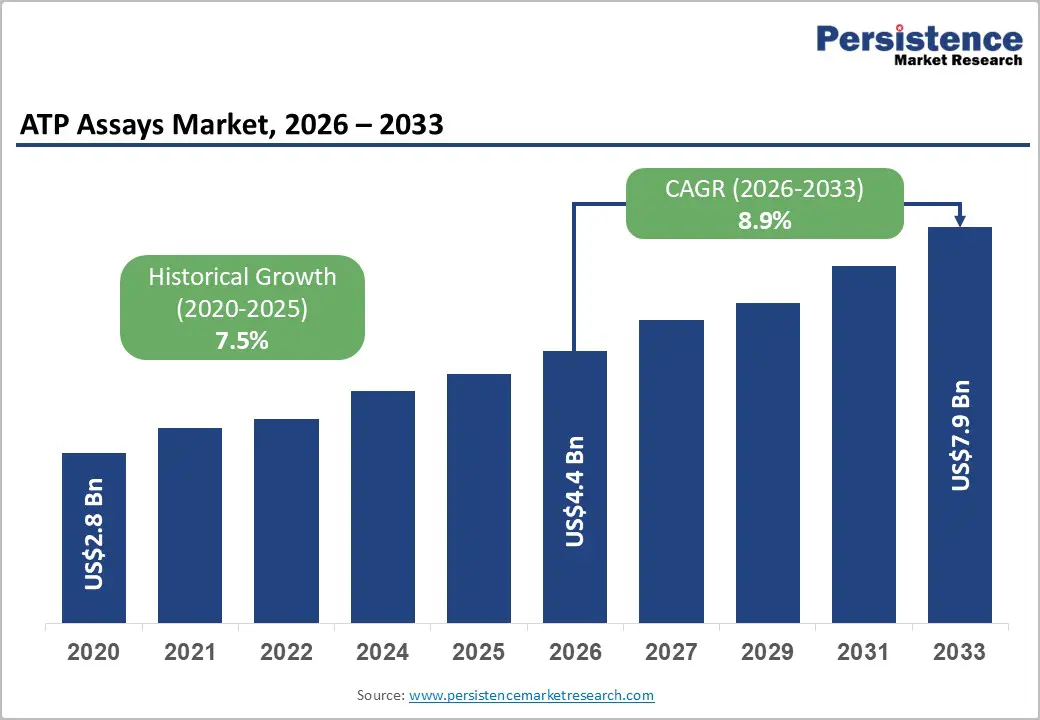
The global ATP assays market size is likely to be valued at US$4.4 billion in 2026 and is expected to reach US$7.9 billion by 2033, growing at a CAGR of 8.9% during the forecast period from 2026 to 2033, driven by rising adoption of cell-based assays in drug discovery and oncology research.
Increasing demand for rapid microbial detection across food safety and clinical diagnostics is further pushing market growth.
Key Industry Highlights:
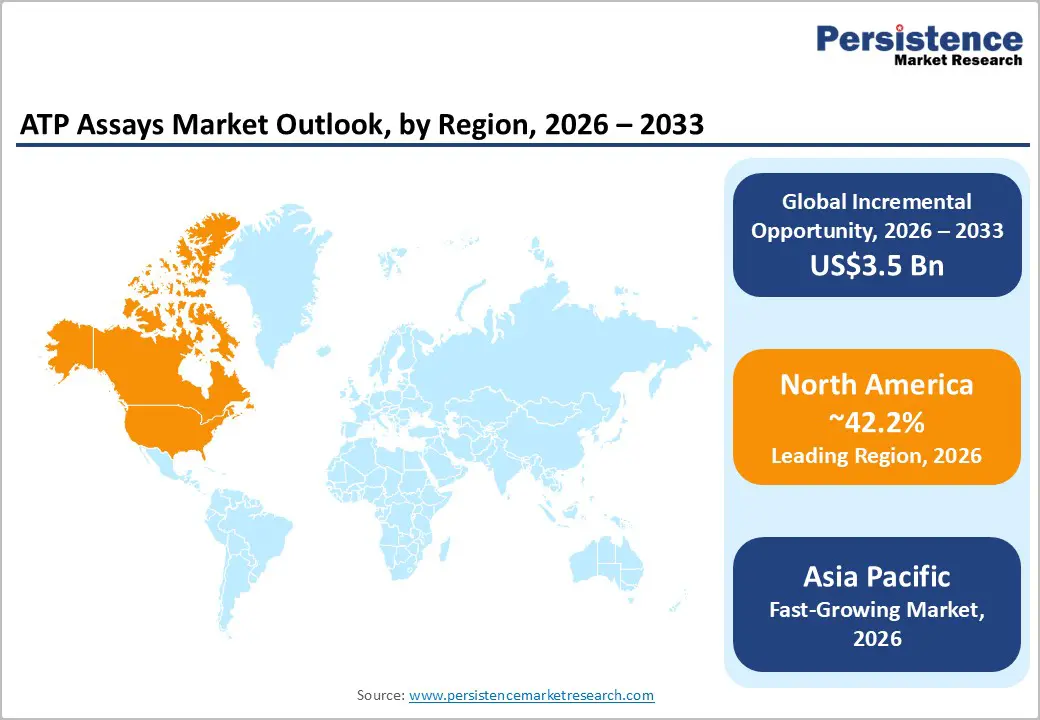
- Leading Region: North America, with about 42.2% share in 2026, owing to early adoption of high-throughput screening and rising NIH-funded research.
- Fast-growing Region: Asia Pacific, fostered by rising biotech manufacturing and government-backed research initiatives.
- Leading Product Type: Luminometric ATP assays, approximately 35.6% share in 2026, because they provide ultra-high sensitivity, enabling detection of very low ATP levels in advanced cell-based and oncology research.
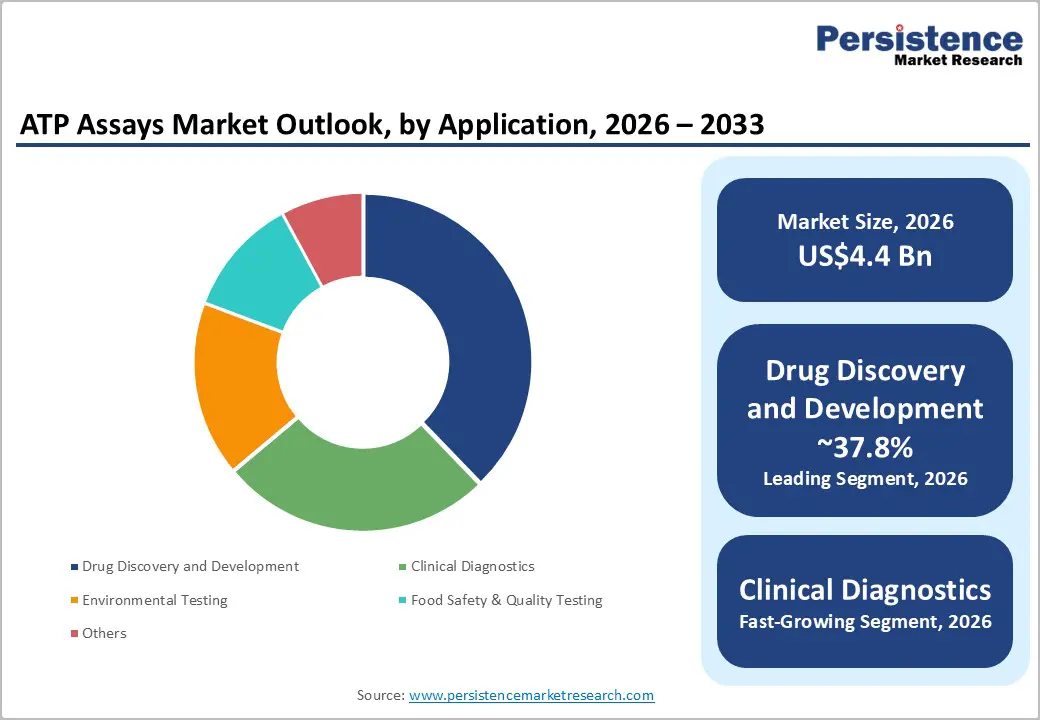
- Dominant Application: Drug discovery and development, nearly 37.8% share in 2026, as ATP assays provide a direct method to measure cell viability and cytotoxicity across large compound libraries.
- Latest Product: In March 2025, Biotium announced the launch of its Steady-ATP HTS Viability Assay Kit. It is a luciferase-based ATP cell viability assay designed for high-throughput screening applications. It can detect as few as 16 cells per well in a 384-well plate format and provides a stable luminescent signal for more than five hours.
DRO Analysis
Driver - High Demand for Real-Time Microbial Contamination Detection
Industries handling perishable goods or sterile products cannot afford to wait days for culture-based contamination results. Adenosine Triphosphate (ATP) bioluminescence testing delivers surface hygiene results in seconds, making it a direct and objective verification tool for cleaning processes. This speed is what sets it apart. The food industry has particularly leaned into this capability, and regulatory pressure is strengthening adoption.
The Food and Drug Administration’s (FDA) Food Safety Modernization Act (FSMA) Food Traceability Final Rule requires fast identification and quick removal of potentially contaminated food from the market. This mandate positions ATP assays as a compliance-ready tool. Beyond food, pharmaceutical manufacturers are also turning to ATP testing. ATP bioluminescence has been validated against standard microbiological methods for screening non-sterile pharmaceutical formulations including creams, tablets, and capsules, thereby confirming its cross-industry relevance. As hygiene standards tighten globally, ATP assays deliver a practical answer.
Rise of Cellular Energy Profiling in Chronic Disease Research
Chronic disease research, particularly in oncology, is generating high demand for precise cellular energy measurement. ATP assays are uniquely positioned here because they reveal how cells generate and consume energy, a process that goes wrong in cancer. Cancer cells often exhibit improved mitochondrial ATP production and metabolic flexibility, switching between glucose, glutamine, and pyruvate depending on growth conditions.
Researchers are now building assays specifically to track this. A 2024 study published in Cancer & Metabolism introduced the MitoRAISE assay, which measures real-time ATP synthesis responses in mitochondria. Using peripheral blood mononuclear cells from breast cancer patients, researchers demonstrated the assay's ability to distinguish cancer-related mitochondrial changes from healthy cell behavior. Tools like these are moving ATP assays from hygiene labs into clinical and translational research settings, widening the market's scope considerably.
Restraint - Prohibitive Equipment Costs May Limit Accessibility
The performance of an ATP assay depends heavily on the quality of the luminometer used to detect the bioluminescent signal. High-sensitivity models, while precise, carry a price tag that shuts out a large portion of potential users. Advanced luminometers equipped with high-precision functions can be prohibitively expensive, posing a significant barrier to adoption in small-scale research laboratories and developing nations. The cost problem extends beyond the instrument itself.
ATP monitoring devices require frequent purchasing of consumables such as swabs and reagents, and many of these products are priced to comply with the standards of countries with advanced healthcare infrastructure, leaving lower-income markets underserved. Efforts to close this gap exist but remain nascent. Until pricing barriers fall, uptake in cost-sensitive settings will remain constrained.
Opportunity - Single-Cell Metabolic Mapping Through Microfluidic Integration
Bulk-sample ATP assays miss a critical reality- not all cells in a population behave the same way. Microfluidics solves this by isolating and analyzing individual cells. Droplet microfluidic platforms separate individual cells within nanoliter- to picoliter-sized droplets, with each droplet functioning as a self-contained reaction vessel. It enables high-throughput exploration of cellular phenotypic variation. This matters especially in cancer research.
A 2022 study published in Nanomaterials (NCBI/PMC) demonstrated that a nanoprobe-enhanced ATP bioluminescence system could rapidly detect E. coli in food-grade milk with a linear correlation coefficient of 0.975, showing the sensitivity gains possible when ATP detection is paired with advanced capture methods. Single-cell analysis platforms using microfluidics are now identifying rare cell subpopulations that drive disease progression and therapeutic resistance, areas where ATP profiling adds direct diagnostic value. The convergence of miniaturized fluidics and ATP detection opens a path toward portable and high-resolution metabolic diagnostic.
AI-Backed Optimization of Low-Volume ATP Assay Processes
Reagent costs and assay consistency are persistent pain points in high-throughput ATP testing. AI and machine learning are beginning to address both. A 2025 study in Biotechnology and Bioengineering demonstrated a machine learning-powered self-driving lab platform capable of autonomously navigating complex enzymatic reaction parameters, the same class of bioluminescent reactions used in ATP assays. An AI-integrated automated biology system, on the other hand, produced enzyme variants with up to 26-fold increased activity and 90-fold greater substrate specificity.
It shows how ML can dramatically improve the luciferase-luciferin reaction efficiency central to ATP measurement. Applied to ATP assay workflows, these capabilities could reduce the volume of reagents required per run while improving signal consistency. For labs running hundreds of samples daily, even modest per-test savings compound into significant operational gains. This positions AI-assisted ATP workflow optimization as a high-value, near-term commercial opportunity.
Category-wise Analysis
Product Type Insights
Luminometric ATP assays are predicted to lead with a share of approximately 35.6% in 2026, as they provide very high sensitivity. They can detect extremely low ATP levels, even from a few cells. This is important in early-stage drug screening and cancer research. The method uses the luciferase reaction, which produces light in direct proportion to ATP concentration. According to studies published in journals such as Nature Methods, luminometric assays can detect ATP in the femtomole range, which is far more sensitive than colorimetric methods.
Enzymatic ATP assays are estimated to be the fastest-growing segment over the forecast period, as they provide superior specificity and stable performance. These assays rely on enzyme-catalyzed reactions that are less affected by external interference. This makes them suitable for complex biological samples such as blood, serum, and tissue extracts. They are also gaining traction in clinical and metabolic research. For instance, studies published in journals such as The Journal of Biological Chemistry show that enzymatic ATP assays are widely used to measure mitochondrial function and cellular energy metabolism. This is important in diseases such as diabetes and neurodegenerative disorders.
Application Insights
The drug discovery and development segment is anticipated to dominate with a share of nearly 37.8% in 2026, as ATP assays are a direct measure of cell viability and cytotoxicity. Researchers use ATP levels to determine whether a drug candidate is killing or supporting cells. This is a core step in screening new compounds. According to data from the National Institutes of Health, over 70% of early-stage drug screening assays involve cell-based testing, where ATP measurement is a standard endpoint.
The clinical diagnostics segment is expected to remain in the second position in 2026, owing to the rising demand for quick and accurate testing. ATP assays enable fast detection of microbial contamination in clinical samples. Traditional culture methods can take 24 to 72 hours, while ATP-based tests can deliver results in minutes. This is important in hospital settings where quick decisions are required. Another driver is the rise in infectious diseases and sepsis cases. Rapid ATP testing helps detect bacterial load early, improving patient outcomes.
Regional Insights
North America ATP Assays Market Trends
North America is predicted to dominate in 2026 with a share of approximately 42.2%, owing to its well-established biotech and pharmaceutical sectors. The region has a high concentration of global players such as Thermo Fisher Scientific and Danaher Corporation. These firms continuously launch advanced ATP assay kits and automation platforms. This keeps the region ahead in technology adoption. Government-backed research funding also plays a key role. The National Institutes of Health invests over US$45 billion annually in biomedical research. A large share goes into cell biology and drug screening, where ATP assays are widely used.
U.S. ATP Assays Market Trends
A share of nearly 63.2% is expected to be held by the U.S. in 2026, backed by rising drug development activity. The U.S. FDA approved over 50 novel drugs in 2023. Each drug goes through extensive cell-based testing, where ATP assays are used to measure cell viability and toxicity. There is also a steady growth in precision medicine. Programs such as the NIH All of Us initiative are extending patient-based research. ATP assays are used to test how patient cells respond to therapies, which is increasing their use in research labs.
Asia Pacific ATP Assays Market Trends
Asia Pacific is anticipated to be the fastest-growing region in 2026 with a share of nearly 28.9%, due to rising investments in biotech manufacturing. China, India, and South Korea are broadening their pharmaceutical production capacity, which increases demand for quality control tools such as ATP assays. Another key factor is cost-sensitive innovation. Several regional labs prefer ATP assays as they provide quick results without complex infrastructure. This makes them suitable for both research and industrial applications.
China ATP Assays Market Trends
China will likely lead Asia Pacific in 2026 with a share of around 38.4% in 2026, owing to heavy funding in life sciences. The National Natural Science Foundation of China continues to support large-scale biomedical projects. Many of these involve cell-based assays and microbial testing. The country is also expanding its pharmaceutical research and development. Local firms are increasing clinical trials and drug pipelines. ATP assays are widely used in early-stage screening and toxicity testing.
India ATP Assays Market Trends
In 2026, India is projected to account for a share of approximately 20.8%, fueled by its booming pharmaceutical and biotech sectors. The country is one of the most prominent producers of generic drugs. Companies are increasing research and development efforts, which is boosting the use of ATP assays in testing workflows. Government support is also improving adoption. The Department of Biotechnology, India, funds research in genomics, cell biology, and diagnostics. These areas rely on ATP-based assays for cell viability and microbial detection.
Europe ATP Assays Market Trends
Europe will likely see decent growth over the forecast period, with a share of nearly 16.7% in 2026, spurred by favorable regulatory frameworks. Agencies such as the European Medicines Agency require strict validation of drug safety and manufacturing processes. ATP assays are used in sterility testing and quality control. The region also has a well-established research base. Germany, the U.K., and France invest heavily in life sciences, which supports the continuous demand for cell-based assays.
Germany ATP Assays Market Trends
Germany will likely register a substantial share of approximately 36.6% in 2026, backed by its well-established biotech and diagnostics industry. The country hosts leading players such as Merck KGaA, which delivers advanced assay technologies. Public research funding is also a key driver. Organizations such as the German Research Foundation support projects in molecular biology and drug discovery. These projects often use ATP assays for cell analysis.
U.K. ATP Assays Market Trends
A share of around 29.2% is predicted to be held by the U.K. in 2026 owing to its focus on life sciences innovation. The government’s Life Sciences Vision strategy aims to strengthen drug discovery and diagnostics, which is increasing the use of ATP assays in research. Institutions such as the U.K. Research and Innovation fund projects in genomics and precision medicine. ATP assays are commonly used in these studies for cell viability testing.
Competitive Landscape
The global ATP assays market is moderately consolidated with a handful of large life-science and diagnostics companies controlling a significant portion of revenues. Various niche assay developers compete in specialized applications such as cell viability testing, microbial detection, food safety, and environmental monitoring. The top five players include Thermo Fisher Scientific, Promega Corporation, Merck KGaA, Danaher Corporation, and 3M Company.
Competition is increasingly centered on assay sensitivity, automation compatibility, and high-throughput screening capabilities rather than pricing alone. Key companies are investing in luminescence-based ATP detection platforms that can be integrated with robotic screening systems used by pharmaceutical and biotechnology firms. Promega and Thermo Fisher have strengthened their positions through advanced cell viability and cytotoxicity assays that support drug discovery and precision medicine workflows.
Key Industry Developments:
- In November 2025, researchers from Guilin University of Technology, China, introduced a gold nanoparticle-based dual-mode aptasensor for ultra-sensitive ATP detection. The platform combines colorimetric and Tyndall effect signals, improving ATP detection sensitivity and expanding potential clinical and biosensing applications.
- In October 2025, MilliporeSigma, the U.S. and Canada Life Science business of Merck KGaA, entered into a partnership with Promega Corporation to co-develop novel technologies that advance drug screening and discovery. The agreement united MilliporeSigma's strength in organoids and synthetic chemistry with Promega's market-leading assay and reporter technologies.
- In August 2025, researchers from South China University of Technology developed a water-soluble NIR-II fluorescent probe for non-invasive and real-time ATP detection in blood through fluorescence and optoacoustic imaging. The innovation was designed to support early disease diagnosis and continuous monitoring of conditions associated with abnormal ATP levels.
Companies Covered in ATP Assays Market
- Thermo Fisher Scientific
- Promega Corporation
- PerkinElmer Inc.
- Becton, Dickinson and Company (BD)
- Lonza Group Ltd.
- Danaher Corporation
- Abcam plc
- Quest Diagnostics Incorporated
- Biomerieux SA
- 3M Company
- Others
Frequently Asked Questions
The global ATP assays market is projected to be valued at US$4.4 billion in 2026.
The ATP assays market is expected to reach US$7.9 billion by 2033.
Key market trends include the shift toward automated assay platforms and the rising use of rapid microbial detection.
Luminometric ATP assays are expected to be the leading product type with a share of nearly 35.6% in 2026, due to their compatibility with automated high-throughput screening platforms.
The ATP assays market is expected to grow at a CAGR of 8.9% from 2026 to 2033.
Thermo Fisher Scientific, Promega Corporation, and PerkinElmer Inc. are a few key market players.


