




- Biotechnology
- Blood-based Biomarker for Parkinson’s Disease Market
Blood-based Biomarker for Parkinson’s Disease Market Size, Share, and Growth Forecast 2026 - 2033
Blood-based Biomarker for Parkinson’s Disease Market, by Biomarker Type (Protein Biomarkers, Inflammatory Markers), Technology (ELISA/Immunoassay, Multiplex Platforms), End-user (Academic/Research Labs), and Regional Analysis, 2026 - 2033

Blood-based Biomarker for Parkinson’s Disease Market Size and Trends Analysis
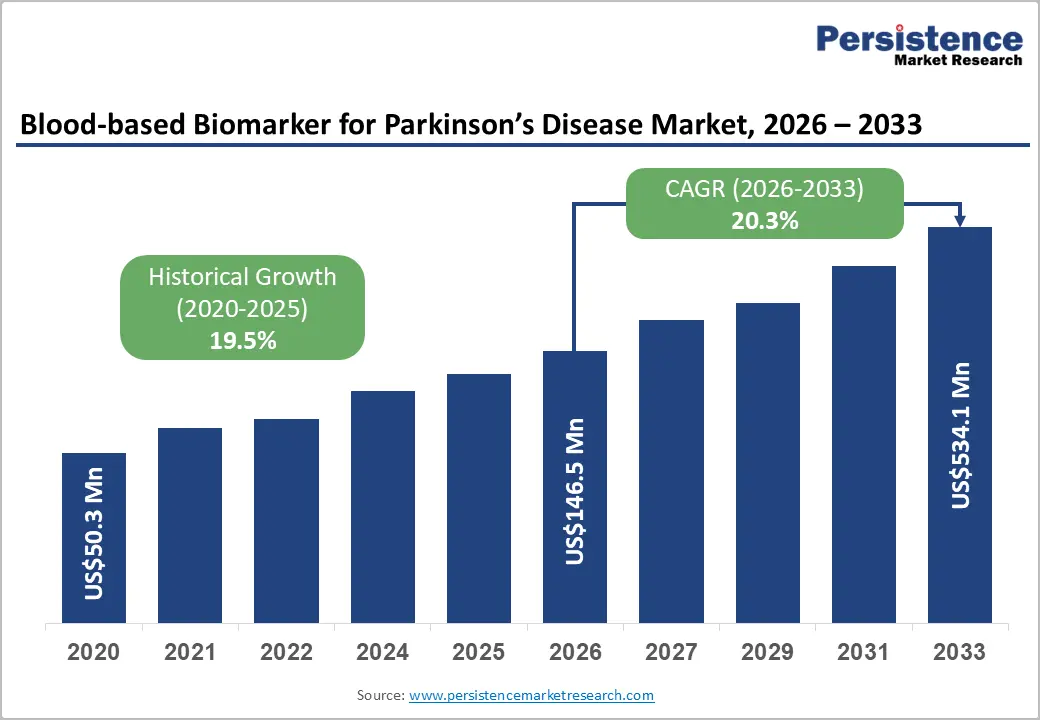
The global blood-based biomarker for parkinson’s disease market size is likely to be valued at US$146.5 million in 2026 and is expected to reach US$534.1 million by 2033, growing at a CAGR of 20.3% during the forecast period from 2026 to 2033, driven by rising focus on early and non-invasive diagnosis of neurodegenerative diseases.
Surging investments from organizations such as the Michael J. Fox Foundation and the National Institutes of Health are also fueling biomarker discovery and validation programs.
Key Industry Highlights:
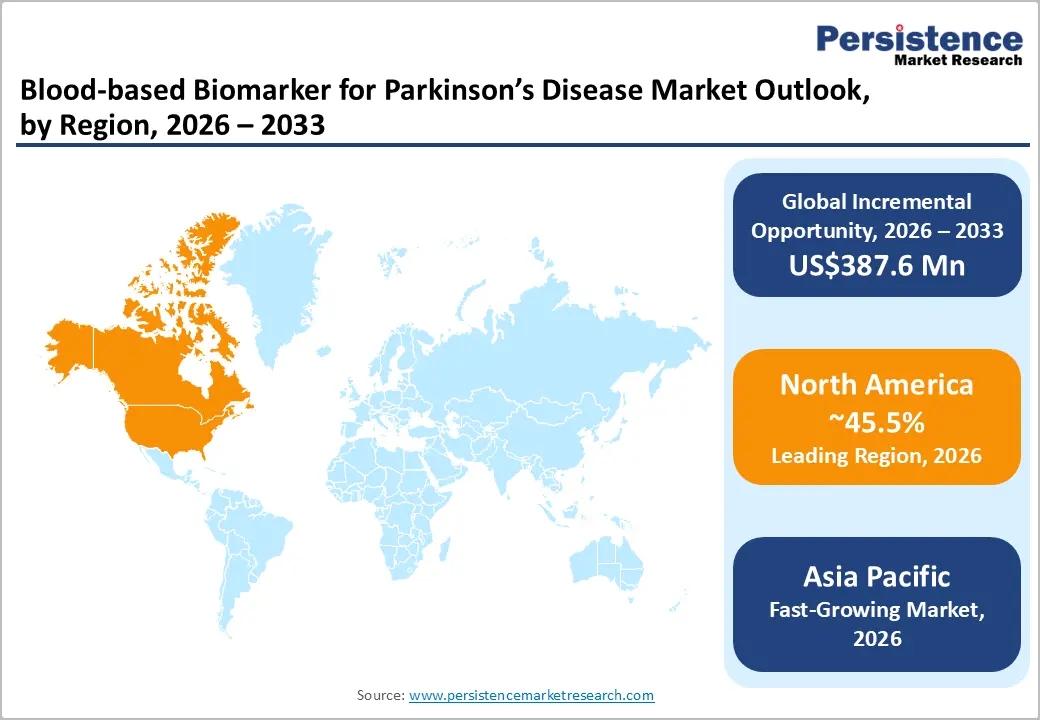
- Leading Region: North America, with about a 45.5% share in 2026, owing to early adoption of advanced diagnostic technologies and superior funding support.
- Fast-growing Region: Asia Pacific, backed by expanding neuroscience research and rising government investments.
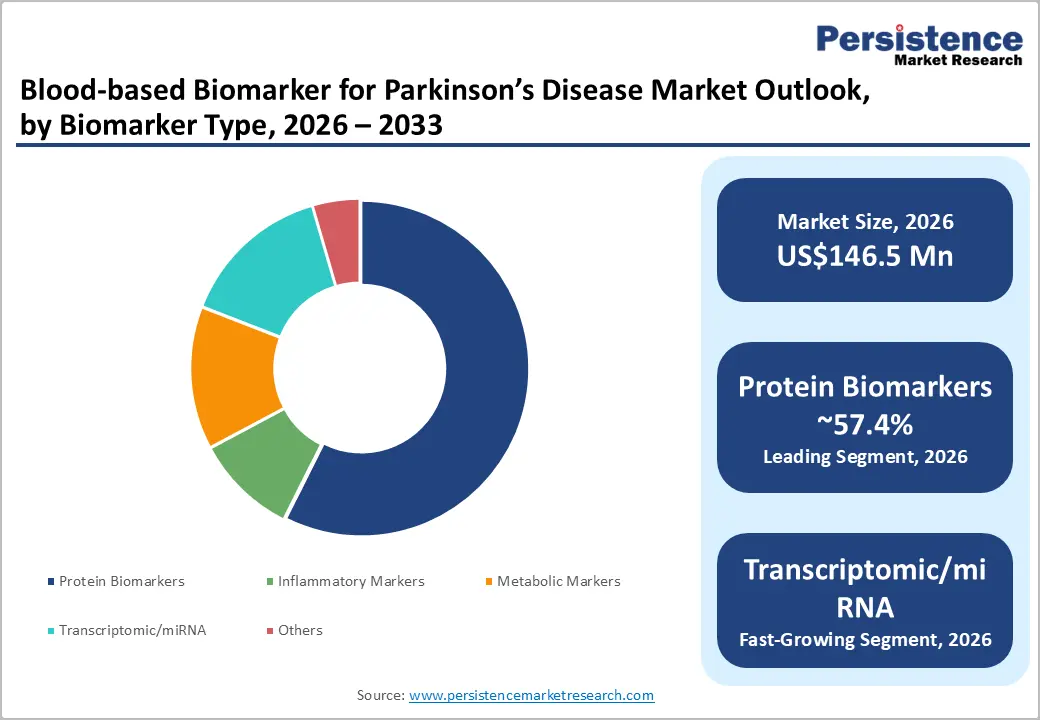
- Leading Biomarker Type: Protein biomarkers, approximately 57.4% share in 2026, fueled by their high clinical acceptance and compatibility with existing diagnostic platforms.
- Dominant Technology: ELISA/immunoassay, nearly 46.2% share in 2026, as it is cost-effective and highly reproducible.
- Recent Partnership: In January 2025, C2N Diagnostics announced a partnership with The Michael J. Fox Foundation for Parkinson's Research (MJFF), supported by a grant of over US$1.5 million from MJFF. The collaboration will use C2N's PrecivityAD2 blood test and its MTBR-tau assay on biosamples collected through MJFF's Parkinson's Progression Markers Initiative (PPMI).
DRO Analysis
Driver - Increasing Demand for Early and Accurate Detection
Traditionally, Parkinson's disease (PD) was confirmed only after visible motor symptoms appeared, by which point, up to 70% of dopamine-producing neurons in the brain's substantia nigra may already be lost. Blood-based biomarkers directly address this gap. Current clinical diagnostic criteria depend on motor features such as bradykinesia and tremors, which appear only after substantial loss of dopaminergic neurons has already occurred.
Identifying misfolded α-synuclein or similar markers in blood opens a pre-symptomatic window. While cerebrospinal fluid alpha-synuclein seeding assays have shown diagnostic promise, they remain invasive and insufficient for widespread clinical use. It makes reliable blood-based alternatives important for early diagnosis and disease monitoring.
Surging Global Burden of Parkinson’s Disease
The intensity of the neurodegenerative disease is rising at a fast pace worldwide. As per the World Health Organization (WHO), Parkinson’s disease prevalence has doubled in the past 25 years, with over 8.5 million individuals affected globally in 2019, resulting in 5.8 million disability-adjusted life years, an 81% rise since 2000. Looking ahead, the trajectory is steep.
A modelling study published in The BMJ projects 25.2 million people will be living with Parkinson's by 2050, a 112% increase from 2021, with population ageing identified as the primary driver behind 89% of this rise. Invasive or imaging-heavy diagnostics cannot serve this volume. Blood tests, by contrast, deliver a practical and expandable screening path for primary care settings across both developed and developing health networks.
Restraint - Overlapping Markers May Hinder Growth
One of the key limitations slowing clinical adoption of blood-based diagnostics is the lack of disease specificity. Neurofilament Light Chain (NfL) provides a sensitive measure of neuroaxonal damage regardless of cause, with elevated levels seen particularly in Multiple System Atrophy (MSA), Progressive Supranuclear Palsy (PSP), and corticobasal syndrome. All of these involve more extensive neurodegeneration than typical Parkinson's. This makes confident differentiation between Parkinson’s disease and atypical parkinsonian syndromes difficult using NfL alone.
A 2024 Nature Reviews Neurology review noted that while NfL differences can be detected at the group level, there is significant individual-level overlap, meaning these differences are not clinically meaningful for differential diagnosis in a single patient. Similarly, plasma NfL was found to be a more specific biomarker for Alzheimer's than for Parkinson's, further complicating its standalone diagnostic value in PD workups.
Opportunity - tRNA Fragments as a New Pre-Symptomatic Signal
A study published in Nature Aging (May 2025) introduced a promising new direction. Researchers at Hebrew University of Jerusalem reported elevated levels of PD-specific transfer RNA fragments carrying a conserved sequence motif (RGTTCRA-tRFs) in the substantia nigra, cerebrospinal fluid, and blood of patients with PD. The test focuses on an increase in PD-specific tRFs alongside a decrease in mitochondrial tRFs, achieving 86% diagnostic accuracy.
Crucially, in patients who underwent deep brain stimulation, RGTTCRA-tRF levels declined. This suggests the test could also be used to monitor treatment response, and not just initial diagnosis. The Hebrew University team is now pursuing large-scale diagnostic trials to prepare the test for clinical rollout. The Food and Drug Administration’s (FDA) recent approval of an Alzheimer's blood test is expected to set a regulatory precedent that may help fast-track similar PD diagnostics.
NfL as a Disease Progression Tool, Beyond Just Diagnosis
Rather than ruling PD in or out, NfL is gaining traction as a longitudinal monitoring marker. NfL levels have been shown to differentiate sporadic PD from multiple system atrophy and progressive supranuclear palsy, giving it practical value in managing ambiguous parkinsonian presentations. A 2024 study in the Journal of Neurology specifically examined plasma NfL, GFAP, amyloid, and p-tau as prognostic tools in PD progression.
The broad opportunity lies in combining NfL with more specific markers. A global survey of clinical centers (data collected from 2023 to 2024) found that NfL measurement is increasingly being used across neurodegenerative, inflammatory, and vascular disorders. However, practices vary significantly across sites, signaling both rising adoption and an urgent need for standardization. Pairing NfL with disease-specific markers such as phosphorylated α-synuclein could significantly raise diagnostic confidence.
Category-wise Analysis
Biomarker Type Insights
Protein biomarkers are predicted to lead with a share of approximately 57.4% in 2026, as they reflect disease biology at the functional level. In Parkinson’s disease, proteins such as alpha-synuclein are not just indicators but are involved in disease progression. This makes them more clinically relevant than upstream markers, including genes or RNA. For example, studies published in journals such as Nature Medicine have shown that misfolded alpha-synuclein detected through seed amplification assays can identify Parkinson’s disease with over 85 to 90% sensitivity in early-stage patients.
Transcriptomic/miRNA biomarkers are estimated to be the fastest-growing segment in the forecast period, as they can detect very early molecular changes before protein-level damage appears. miRNAs regulate gene expression, so changes in their levels can signal disease onset much earlier. A 2023 study in npj Parkinson’s Disease reported that a panel of circulating miRNAs achieved over 80% accuracy in distinguishing Parkinson’s patients from healthy controls. Another driver is the rise of high-throughput sequencing technologies. Platforms such as Next-Generation Sequencing (NGS) allow researchers to analyze thousands of RNA molecules at once.
Technology Insights
The Enzyme-Linked Immunosorbent Assays (ELISA) segment is anticipated to dominate with a share of nearly 46.2% in 2026, as it is simple, reliable, and already integrated into clinical workflows. Most diagnostic labs globally use ELISA-based systems, so there is no need for major infrastructure changes. This makes adoption easier compared to newer technologies. It also delivers high specificity and reproducibility. ELISA uses antibody-antigen binding, which allows accurate detection of target proteins such as alpha-synuclein or neurofilament light chain.
Multiplex platforms are expected to remain in the second position in 2026, as Parkinson’s disease is biologically complex and cannot be explained by a single biomarker. Measuring multiple biomarkers at once improves diagnostic accuracy. For example, combining alpha-synuclein with inflammatory markers and neurodegeneration markers has shown better performance than single-analyte tests in studies published in The Lancet Neurology. These platforms also improve efficiency and sample utilization.
Regional Insights
North America Blood-based Biomarker for Parkinson’s Disease Market Trends
North America is predicted to dominate in 2026 with a share of approximately 45.5%, as it has the world's strongest Parkinson’s research hub. The region hosts leading biomarker initiatives, including the Parkinson’s Progression Markers Initiative (PPMI), which has built one of the most prominent Parkinson’s biomarker databases globally. This database is widely used by academic institutions, biotechnology firms, and pharmaceutical companies to validate new blood biomarkers.
U.S. Blood-based Biomarker for Parkinson’s Disease Market Trends
A share of nearly 63.6% is expected to be held by the U.S. in 2026, as most breakthrough biomarker programs are being developed or validated there. Institutions such as the National Institutes of Health and the Michael J. Fox Foundation continue to invest heavily in Parkinson’s biomarker research. The country is also seeing increasing adoption of blood-based diagnostics. Researchers are moving beyond traditional cerebrospinal fluid testing toward blood biomarkers as blood tests are easier to perform and more suitable for large-scale screening. Recent studies involving plasma proteins, blood transcriptomics, and alpha-synuclein detection have strengthened confidence in blood-based approaches.
Asia Pacific Blood-based Biomarker for Parkinson’s Disease Market Trends
Asia Pacific is anticipated to be the fastest-growing region in 2026 with a share of nearly 27.3%, as Parkinson’s research is extending steadily across China, India, Japan, South Korea, and Australia. Governments and academic institutions are investing more heavily in neuroscience and precision medicine programs than they did a decade ago. The region also provides access to large patient populations. This enables researchers to validate biomarkers across diverse genetic and environmental backgrounds. Such large-scale patient recruitment is especially valuable for biomarker discovery and clinical validation.
China Blood-based Biomarker for Parkinson’s Disease Market Trends
China will likely lead Asia Pacific in 2026 with a share of around 46.2%, as the country has significantly broadened its neuroscience research infrastructure. Leading institutions such as Capital Medical University and key neurological research centers are publishing a surging number of Parkinson’s biomarker studies. Recent studies have identified promising blood biomarkers such as plasma fibronectin and gene-expression signatures that may support earlier diagnosis. China's government has also prioritized biotechnology innovation under national science and healthcare programs. This has increased funding for omics research, biomarker discovery, and precision medicine initiatives.
India Blood-based Biomarker for Parkinson’s Disease Market Trends
In 2026, India is projected to account for a share of approximately 21.5%, as awareness of neurodegenerative diseases has improved significantly. Large academic hospitals and neurology centers are now participating in biomarker and neurodegenerative disease research. India-based researchers are also becoming more active in multi-omics and biomarker studies. A 2025 review from the Institute of Human Behavior and Allied Sciences highlighted rising interest in advanced biomarker technologies such as proteomics, metabolomics, and transcriptomics for Parkinson’s disease.
Europe Blood-based Biomarker for Parkinson’s Disease Market Trends
Europe will likely see decent growth in the forecast period, with a share of nearly 15.8% in 2026, as it has a well-established research environment and superior cross-border collaboration. Several Parkinson’s biomarker projects are funded through multinational research programs involving universities, hospitals, and biotechnology companies from multiple countries. Local researchers have been particularly active in proteomics, metabolomics, and blood-based biomarker discovery. Various influential studies on Parkinson’s biomarkers have emerged from renowned institutions, helping improve scientific understanding of disease progression and diagnosis.
Germany Blood-based Biomarker for Parkinson’s Disease Market Trends
Germany will likely register a substantial share of approximately 39.9% in 2026, owing to its advanced life sciences sector and extensive neurological research network. The country has a long history of involvement in neurodegenerative disease studies and hosts several leading universities and research institutes focused on biomarker development. Researchers have contributed significantly to metabolomics and proteomics-based Parkinson’s biomarker studies. A notable example is a study published in npj Parkinson’s Disease that identified a six-metabolite blood panel with potential diagnostic value for Parkinson’s disease.
U.K. Blood-based Biomarker for Parkinson’s Disease Market Trends
A share of around 28.6% is predicted to be held by the U.K. in 2026, spurred by its well-established academic research base and active Parkinson’s research community. Organizations such as Parkinson's U.K. continue to support biomarker research and early diagnosis initiatives. The country is now focusing on blood-based biomarkers as they provide a more practical alternative to invasive testing methods. In 2025, researchers associated with U.K. institutions highlighted the potential of transfer RNA fragments (tRFs) as blood-based markers capable of identifying Parkinson’s disease before symptom onset. Parkinson’s U.K. described this work as an important new direction in biomarker development.
Competitive Landscape
The global blood-based biomarker for Parkinson’s disease market is highly fragmented and research-driven, with no single company holding a dominant commercial position. Most participants are biotechnology firms, diagnostic assay developers, and life science tool providers competing to establish the first clinically validated and widely adopted blood test for Parkinson’s disease. Unlike Alzheimer's disease, where blood biomarkers are already entering routine clinical practice, Parkinson’s blood biomarker commercialization remains in the early-stage validation phase.
Competition is centered around alpha-synuclein detection, mainly aggregated, phosphorylated, or extracellular vesicle-bound alpha-synuclein, which is considered the most disease-specific biomarker candidate. Companies such as Sunbird Bio are developing blood assays capable of detecting pathological alpha-synuclein directly from plasma samples. In December 2025, the company reported that its blood-based alpha-synuclein assay achieved approximately 81% classification accuracy in Parkinson’s disease cohorts, strengthening its position among emerging diagnostic developers.
Key Industry Developments:
- In April 2026, Biognosys Group announced a collaboration with The Michael J. Fox Foundation to develop highly sensitive, quantitative biomarker assays targeting LRRK2, the most common genetic risk factor for late-onset Parkinson's disease. The partnership supports MJFF's LRRK2 Investigative Therapeutics Exchange (LITE), a global initiative spanning more than 50 academic, industry, and clinical partners.
- In February 2026, Silvi Foundation announced its launch as a non-profit focused on neurodegenerative disease research, awarding a US$100,000 inaugural grant to the Institute for Neurodegenerative Diseases (IND). The grant specifically supports blood-based biomarker research aimed at identifying early signs of Parkinson's disease, Lewy body dementia, Alzheimer's disease, and ALS before symptoms appear.
- In January 2026, researchers at Chalmers University of Technology in Sweden, working alongside colleagues at Oslo University Hospital in Norway, published findings in npj Parkinson's Disease identifying blood-based biomarkers that could detect Parkinson's disease up to 20 years before motor symptoms develop. Using machine learning, the team discovered distinct gene activity patterns linked to DNA damage repair and cellular stress.
Companies Covered in Blood-based Biomarker for Parkinson’s Disease Market
- Abbott
- ACOBIOM
- Alseres Pharmaceuticals
- Banyan Biomarkers
- Bio-Rad Laboratories
- DiaGenic ASA
- Johnson & Johnson Services
- Merck KGaA
- QIAGEN
- Quanterix
- Rules-Based Medicine
- Thermo Fisher Scientific
- Others
Frequently Asked Questions
The global blood-based biomarker for Parkinson’s disease market is projected to be valued at US$146.5 million in 2026.
The market is expected to reach US$534.1 million by 2033.
Key market trends include the shift toward blood-based diagnostics and the rising use of multi-biomarker panels.
Protein biomarkers are expected to be the leading biomarker type with a share of nearly 57.4% in 2026, as they directly reflect disease pathology.
The blood-based biomarker for Parkinson’s disease market is expected to grow at a CAGR of 20.3% from 2026 to 2033.
Abbott, ACOBIOM, Alseres Pharmaceuticals, and Banyan Biomarkers are a few key market players.


