




- Biotechnology
- Biotechnological Enzymes Market
Biotechnological Enzymes Market Size, Share and Growth Forecast, 2026 - 2033
Biotechnological Enzymes Market by Drug class (Enzyme class, Hydrolases, Others), Application (Industrial Catalysts, Therapeutic Others), End-users (Industries, Diagnostic and Forensic Laboratories, Academia and Research), and Regional Analysis for 2026 - 2033

Biotechnological Enzymes Market Size and Trends Analysis
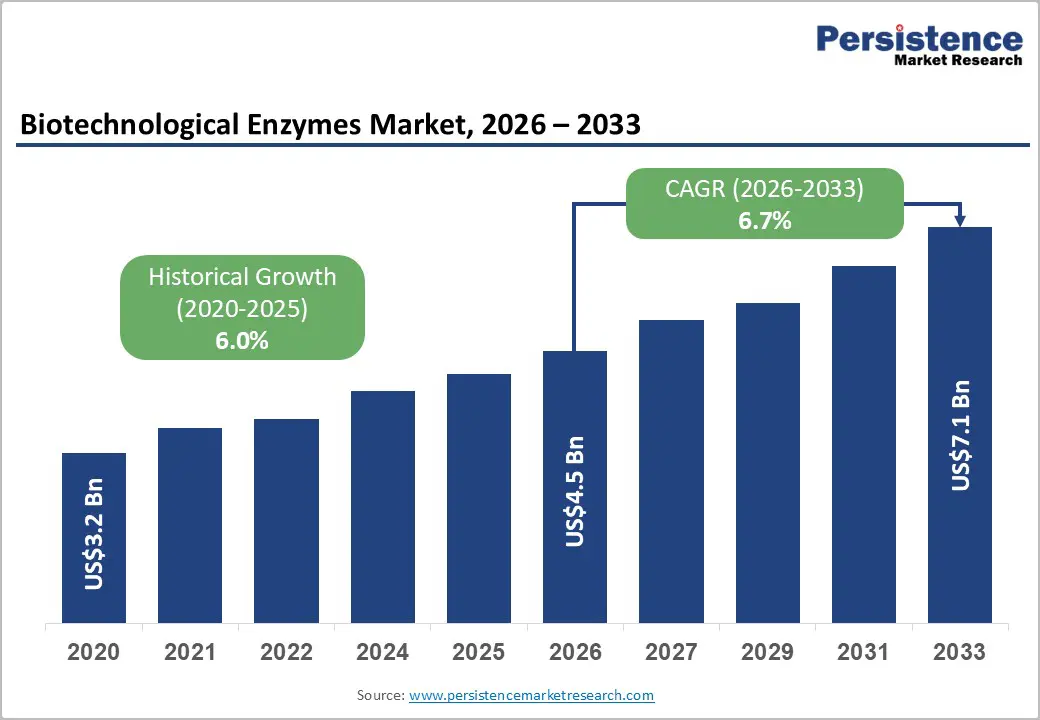
The global biotechnological enzymes market size is likely to be valued at US$4.5 billion in 2026 and is projected to reach US$7.1 billion by 2033, growing at a CAGR of 6.7% during the forecast period from 2026 to 2033, driven by rising adoption of biocatalysts in industrial biotechnology, growing demand for enzyme-based therapeutics, and increased use in diagnostic and analytical applications.
According to the Organisation for Economic Co-operation and Development (OECD) and U.S. Food and Drug Administration (FDA) biologics pipeline data, enzyme integration in healthcare and industry is accelerating. Growth is further supported by sustainability mandates in Europe and North America promoting bio-based alternatives, along with rising investments in synthetic biology and protein engineering.
Key Industry Highlights:
- Dominant Drug Class: Hydrolases are set to command a 38% share in 2026, while isomerases are likely to be the fastest-growing at 7.5% CAGR by 2033, driven by rising demand for chiral drug synthesis in pharmaceuticals.
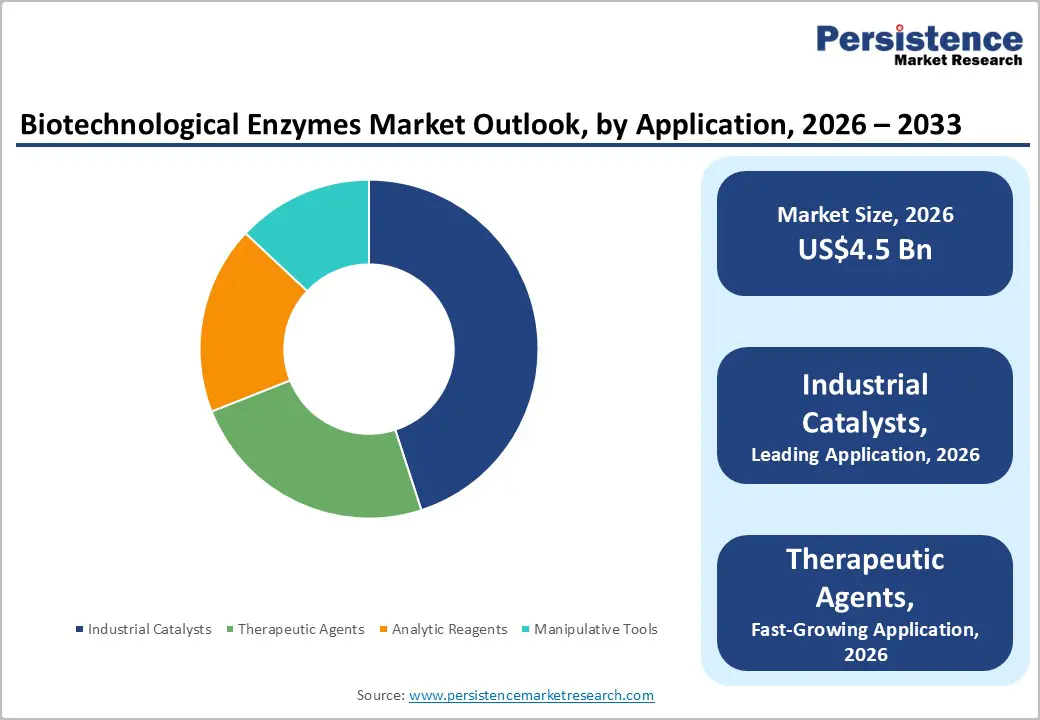
- Leading Application Segment: Industrial catalysts are expected to lead with a 45% share in 2026, while therapeutic enzymes are projected to grow the fastest at 8% CAGR, supported by expanding enzyme replacement therapies and biologics adoption.
- Dominant End-user Segment: Industries are anticipated to dominate with a 52% share in 2026, while diagnostic and forensic laboratories are expected to be the fastest growing at 7% CAGR, driven by enzyme-based molecular diagnostics expansion.
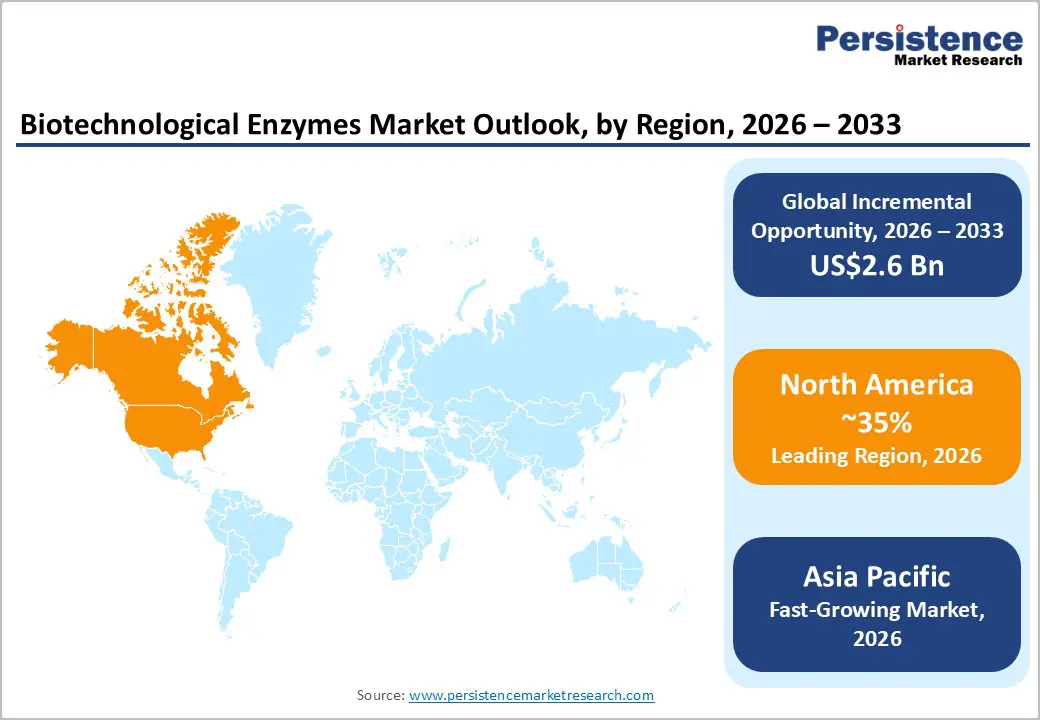
- Regional Leadership: North America is projected to hold a 35% share in 2026, while Asia Pacific is set to be the fastest-growing at 8% CAGR through 2033, supported by large-scale enzyme manufacturing and biotech expansion in China and India.
DRO Analysis
Driver - Rising adoption of industrial biocatalysis and green chemistry initiatives
The shift toward green chemistry and sustainable industrial processing is a key growth driver for the biotechnological enzymes market. According to the U.S. Environmental Protection Agency (EPA) and the European Chemicals Agency (ECHA), enzyme-based catalysis can reduce hazardous chemical waste by 30-60% in industrial processes. The Organisation for Economic Co-operation and Development (OECD) further notes that over 40% of industrial biotechnology applications already use enzyme-based systems, especially in food, textiles, and biofuels.
Stricter environmental regulations such as EU emissions standards and U.S. clean manufacturing policies are accelerating adoption. Enzyme integration in industrial processes has also reduced energy use by up to 25% in select applications, supporting ESG-driven investments. This is driving strong demand for industrial biotechnological enzymes, particularly hydrolases and oxidoreductases used in large-scale manufacturing.
Restraint - High production cost and enzyme stability limitations under industrial conditions
A key restraint is the high cost of enzyme production and limited operational stability. According to the U.S. Department of Energy (DOE) Bioenergy Technologies Office, enzyme production can account for 20-40% of total bioprocessing costs, especially in biofuel and pharma applications.
Many enzymes also lose activity under extreme industrial conditions, with only a limited number maintaining stability beyond 72-120 hours of continuous use. This increases replacement frequency and operating costs. These challenges are more pronounced in cost-sensitive regions such as parts of Latin America, Africa, and Southeast Asia, slowing broader adoption despite technological advancements.
Opportunity - Expansion of precision medicine and enzyme-based therapeutics
The growth of enzyme-based therapeutics in precision medicine presents a major opportunity. The U.S. National Institutes of Health (NIH) reports enzyme replacement therapies are used in over 50 rare genetic disorders, including Gaucher and Fabry diseases. World Health Organization estimates that globally, rare diseases affect over 300 million people, creating a large addressable patient pool.
Pharma pipelines are increasingly integrating engineered enzymes for targeted therapies, supported by incentives under the U.S. Food and Drug Administration (FDA) Orphan Drug Act and European Medicines Agency (EMA) frameworks. This segment could generate an incremental opportunity of US$ 2.0-2.5 Bn by 2033, driven by advances in recombinant DNA and CRISPR-based enzyme engineering.
Category-wise Analysis
Drug Class Insights
Hydrolases are estimated to dominate the biotechnological enzymes market with a 38% share in 2026, supported by strong usage in detergents, food processing, and pharmaceuticals. OECD biotechnology assessments indicate that enzyme-based hydrolases are likely embedded in 60% of commercial detergent formulations in developed markets, enabling significant energy savings through lower-temperature washing (up to ~20-30°C reduction). Strong industrial enzyme manufacturing capacity in North America and Europe is expected to further sustain this leadership position.
Isomerases are projected to be the fastest-growing drug class at a CAGR of 7.5% by 2033, driven by increasing demand for chiral and stereospecific drug synthesis. FDA approval trends suggest rising adoption of enantiomer-specific APIs, particularly in oncology and cardiovascular therapies requiring high molecular precision. Pharma R&D intensity in chiral chemistry is estimated to have increased by ~15% over recent years, supporting the steady expansion of isomerase applications in advanced drug development.
Application Insights
Industrial catalysts are estimated to lead with a 45% share in 2026, driven by adoption across biofuels, detergents, and food industries. The International Energy Agency (IEA) suggests enzyme-based catalytic systems are likely to improve bioethanol yield efficiency by ~10-15% in commercial setups, particularly in the U.S. and Brazil. EU Green Deal compliance is also estimated to have pushed over 35% of European chemical manufacturers toward enzyme-based process integration for emissions reduction.
Therapeutic agents are projected to be the fastest-growing application at a CAGR of 8%, supported by rising adoption of enzyme replacement therapies. NIH estimates indicate enzyme therapies are currently used in 50+ rare genetic disorders, including Gaucher and Fabry diseases. FDA orphan drug trends suggest a steady growth in enzyme-based approvals, reflecting increasing pipeline activity in precision medicine and biologics development.
End-user Insights
Industries are estimated to dominate with a 52% share in 2026, driven by widespread enzyme usage in food processing, chemicals, and industrial biotechnology. OECD estimates suggest enzymes are likely integrated into ~40% of global industrial fermentation and processing systems, particularly in developed markets such as the U.S., Germany, and Japan. Strong adoption in starch processing, dairy, and detergent manufacturing continues to reinforce this segment’s leadership.
Diagnostic and forensic laboratories are projected to be the fastest-growing end-user segment at a CAGR of 7%, supported by expanding use of enzyme-based molecular diagnostics and DNA analysis. WHO estimates indicate diagnostic testing volumes likely increased by ~25% post-pandemic, accelerating demand for enzyme reagents in PCR and immunoassay workflows. Additionally, rising government investments in forensic modernization programs across Europe and Asia are expected to strengthen adoption of enzyme-based analytical systems further.
Regional Insights
North America Biotechnological Enzymes Market Trends
North America is estimated to account for 35% of the global biotechnological enzymes market in 2026, supported by strong investments in enzyme innovation, biologics manufacturing, and synthetic biology. A key regional trend is the commercialization of engineered enzymes for therapeutics and industrial applications. For instance, Novonesis continues expanding enzyme production capabilities in North America, while companies such as Codexis are increasingly deploying protein-engineering platforms to develop customized biocatalysts for pharmaceutical manufacturing.
The region also benefits from significant funding from the National Institutes of Health (NIH) and the Biomedical Advanced Research and Development Authority (BARDA) for biologics and biotechnology innovation.
U.S. Biotechnological Enzymes Market Trends
The U.S. is projected to contribute 82% of the North America market share, driven by its leadership in enzyme therapeutics and industrial biotechnology. The country remains home to major players including Codexis, Thermo Fisher Scientific, DuPont, and Abbott Laboratories. A notable trend is the use of AI-assisted protein engineering to accelerate enzyme discovery, with companies increasingly integrating machine learning into enzyme design workflows. The U.S. also leads enzyme-based rare disease treatments, with therapies for Gaucher disease, Fabry disease, and Pompe disease continuing to expand clinical adoption.
Canada Biotechnological Enzymes Market Trends
Canada is estimated to hold 18% of the regional market share, supported by growing investments in sustainable biomanufacturing. The country's Protein Industries Canada initiative has accelerated development of enzyme-enabled food processing technologies, while biofuel projects supported by Natural Resources Canada are increasing demand for industrial enzymes. The growing adoption of enzyme-based biomass conversion technologies is positioning Canada as an emerging contributor to industrial biotechnology innovation.
Europe Biotechnological Enzymes Market Trends
Europe is expected to represent 28% of the global market share in 2026, supported by aggressive sustainability targets and strong biotechnology research networks. A major regional trend is the replacement of conventional chemical processing with enzyme-based manufacturing under the European Green Deal. Companies such as Novonesis, BASF, and AB Enzymes are actively expanding enzyme applications in food processing, detergents, and industrial chemicals. The region is also seeing increased funding through Horizon Europe, supporting enzyme engineering, circular bioeconomy projects, and sustainable manufacturing technologies.
Germany Biotechnological Enzymes Market Trends
Germany is projected to account for 26% of the Europe market share, making it the region's largest contributor. The country hosts major biotechnology and specialty chemical companies, including BASF, which continues investing in enzyme-enabled sustainable chemical production. Germany's industrial sector is increasingly adopting enzymes to reduce energy consumption and carbon emissions in manufacturing processes. Strong collaboration between institutions such as the Fraunhofer Society and industry players is accelerating enzyme innovation and commercialization.
U.K. Biotechnological Enzymes Market Trends
The U.K. is estimated to hold 18% of the regional market, driven by its advanced life sciences ecosystem. A notable trend is the increasing integration of synthetic biology into enzyme discovery through organizations such as SynbiCITE and research centers at Imperial College London and the University of Cambridge. The country is also witnessing growing investment in enzyme-based therapeutics and biologics development, supported by a strong biotechnology startup ecosystem and pharmaceutical R&D activity.
Asia Pacific Biotechnological Enzymes Market Trends
Asia Pacific is projected to be the fastest-growing regional market, advancing at a CAGR of 8% during the forecast period from 2026 to 2033. A major trend is the migration of global enzyme production toward Asia due to cost-efficient manufacturing and expanding fermentation capacity. The region is also benefiting from increasing demand for enzymes in pharmaceuticals, food processing, and industrial biotechnology. Government-led biotechnology initiatives are accelerating domestic production capabilities while attracting international investment in enzyme manufacturing facilities.
China Biotechnological Enzymes Market Trends
China is estimated to contribute 42% of the Asia Pacific market in 2026, supported by large-scale production capabilities and strong government backing for biotechnology. Companies such as Angel Yeast, Sunson Industry Group, and Vland Biotech have significantly expanded enzyme manufacturing for food, feed, and industrial applications. The country's 14th Five-Year Plan for Bioeconomy Development continues to prioritize biotechnology innovation, while growing investments in biopharmaceutical manufacturing are increasing demand for high-performance enzymes.
India Biotechnological Enzymes Market Trends
India is projected to account for 18% of the regional market in 2026, driven by its strong pharmaceutical manufacturing base and growing biotechnology sector. Companies such as Advanced Enzyme Technologies and Biocon are expanding enzyme production capabilities for pharmaceutical, food, and industrial applications. A key trend is the increasing use of fermentation-based enzyme production to support biologics manufacturing and active pharmaceutical ingredient (API) production.
Government initiatives under the National Biotechnology Development Strategy are also encouraging investment in enzyme research, bioprocessing infrastructure, and biotech startups, strengthening India's role in the global enzyme value chain.
Competitive Landscape
The global biotechnological enzymes market is moderately consolidated, with leading companies such as Novonesis, BASF SE, DuPont, and Thermo Fisher Scientific collectively accounting for a significant share of global revenue. These companies leverage extensive enzyme manufacturing capabilities, proprietary strain development platforms, and strong relationships with pharmaceutical, food, and industrial customers. They continue to invest heavily in protein engineering, synthetic biology, and bioprocess optimization to strengthen their competitive positions and expand high-value enzyme portfolios.
Meanwhile, specialized players such as Codexis, Advanced Enzyme Technologies, and Amano Enzyme are focusing on niche applications including pharmaceutical biocatalysis, food processing, and industrial biotechnology. High barriers related to regulatory approvals, fermentation scale-up, and intellectual property protection limit new entrants; however, advances in AI-driven protein design and synthetic biology are enabling emerging biotechnology firms to enter the market. Industry consolidation is expected to increase gradually as major enzyme producers pursue acquisitions, strategic partnerships, and technology licensing agreements to expand their geographic reach and strengthen enzyme engineering capabilities.
Key Industry Developments:
- In May 2026, Roche agreed to acquire PathAI for up to US$1.05 billion. The acquisition strengthened Roche’s digital pathology and diagnostic capabilities, supporting broader adoption of AI-enhanced enzyme-based testing and precision medicine workflows.
- In March 2026, Codexis completed a US$37.8 million technology transfer agreement with Merck. The agreement expanded commercialization of engineered enzyme technologies and reinforced the use of biocatalysis in advanced therapeutic manufacturing processes.
Companies Covered in Biotechnological Enzymes Market
- Novonesis
- Roche
- BASF SE
- DuPont
- Merck KGaA
- AbbVie
- Sanofi
- Thermo Fisher Scientific
- Codexis Inc.
- Amano Enzyme Inc.
- Chr. Hansen Holding A/S
- Advanced Enzyme Technologies
- Koninklijke DSM
- EnzymeWorks Inc.
- AB Enzymes
Frequently Asked Questions
The global biotechnological enzymes market is projected to reach US$4.5 billion in 2026.
Growing adoption of industrial biocatalysts, rising enzyme-based therapeutics, and increasing demand for sustainable manufacturing drive market growth.
The biotechnological enzymes market is expected to grow at a CAGR of 6.7% from 2026 to 2033.
Precision medicine, enzyme replacement therapies, and advances in protein engineering create significant growth opportunities.
Key players include Novonesis, BASF SE, DuPont, and Thermo Fisher Scientific.


