




- Biotechnology
- Ovarian Reserve Test Market
Ovarian Reserve Test Market Size, Share, and Growth Forecast, 2026 - 2033
Ovarian Reserve Test Market by Product Type (Follicle Stimulating Hormone Testing, Anti-Mullerian Hormone Testing, Others), Application (Hospitals, IVF Centers, Diagnostic Centres, Ambulatory Surgical Centres, Others), and Regional Analysis for 2026–2033

Ovarian Reserve Test Market Size and Trends Analysis
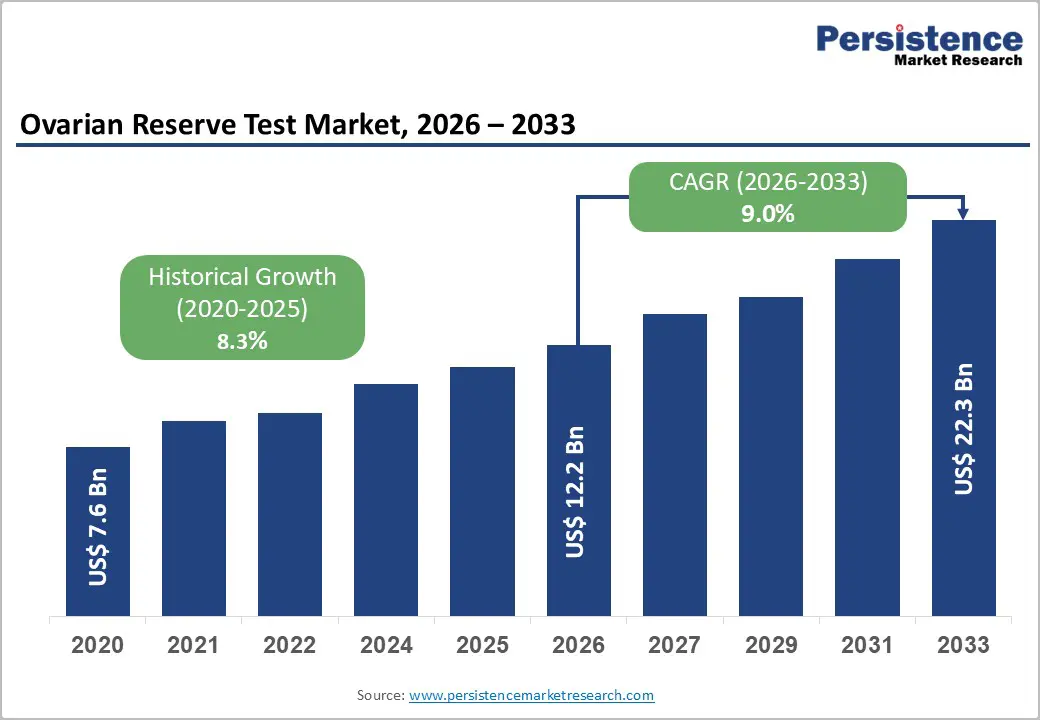
The global ovarian reserve test market size is projected to be valued at US$12.2 billion in 2026 and is expected to reach US$22.3 billion by 2033, growing at a CAGR of 9.0% during the forecast period from 2026 to 2033, driven by the rising prevalence of infertility, increasing use of IVF and other assisted reproductive technologies (ART), and delayed childbearing among women. Growing awareness of fertility preservation, expanding fertility clinic networks, and wider access to reproductive healthcare are further accelerating demand for ovarian reserve testing.
Key Industry Highlights:
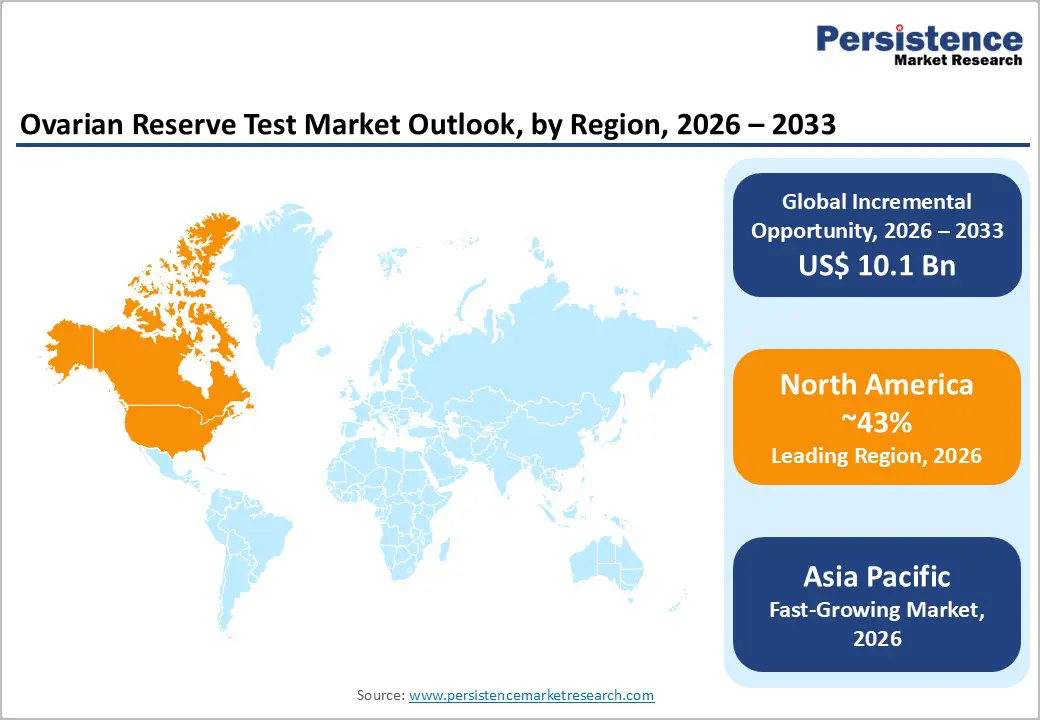
- Dominant Region: North America is expected to lead the ovarian reserve test market with about 43% revenue share in 2026, driven by high ART adoption, expanding fertility coverage, and strong demand for reproductive health testing.
- Fastest-growing Region: Asia Pacific is anticipated to register the highest growth rate during the forecast period, with a CAGR of 10.8% from 2026 to 2033, supported by expanding access to IVF treatments, increasing healthcare expenditures, and a rising trend toward delayed parenthood across the region.
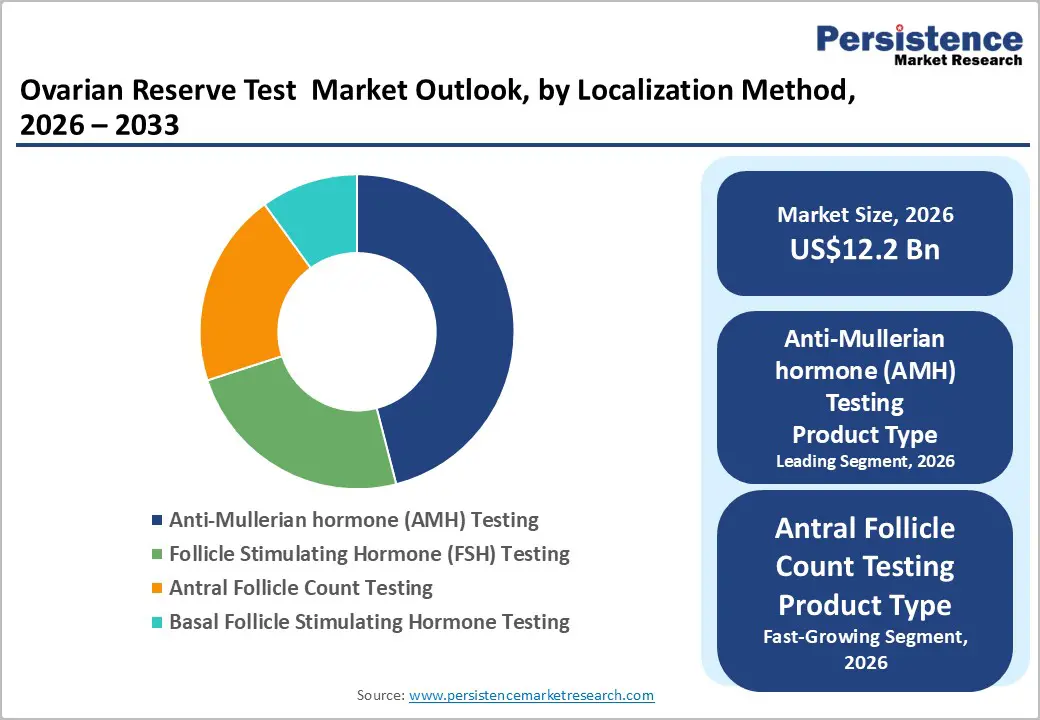
- Leading Product Type: AMH testing dominates the market, accounting for around 46% of 2026 revenues, due to its ability to provide a reliable quantitative assessment of a woman’s remaining ovarian reserve.
- Dominant Application: IVF centers are expected to lead the market with around 38% of the revenue share in 2026, driven by the routine use of ovarian reserve testing in pre-treatment fertility evaluations.
DRO Analysis
Driver- Rising Female Infertility Prevalence and Growing ART Utilization
Female infertility has emerged as a major and increasing global public health concern, with the World Health Organization estimating that approximately 17.5% of adults worldwide, around one in six individuals, experience infertility during their reproductive years. Female-related factors, such as diminished ovarian reserve, polycystic ovary syndrome (PCOS), endometriosis, and tubal disorders, contribute to nearly 35–40% of all infertility cases globally.
The global assisted reproductive technology (ART) market has witnessed sustained high single-digit growth, supported by the rising prevalence of infertility, continual improvements in IVF success rates, and the gradual expansion of insurance reimbursement and public healthcare coverage for fertility treatments across major markets. Due to the introduction of IVF, an estimated 8–10 million babies have been born worldwide through ART procedures, while approximately 2–3 million fresh and frozen IVF cycles are performed annually. This expanding treatment volume continues to drive the demand for ovarian reserve assessment, as anti-Müllerian hormone (AMH) testing and antral follicle count evaluation remain essential components of pre-IVF diagnostics used to optimize ovarian stimulation protocols for virtually every treatment cycle.
Restraint - Clinical Interpretation Complexity and Lack of Standardized Reference Ranges
A major clinical and commercial challenge that the ovarian reserve testing market faces is the lack of universally accepted AMH assay standardization and comprehensive population-based reference ranges, which limits the consistency and reliability of test interpretation across laboratories, assay platforms, and patient groups.
AMH measurement results can vary significantly between assay systems, with platforms such as the Beckman Coulter Access AMH assay and the Roche Elecsys AMH assay often generating different numerical values for the same patient sample. This lack of harmonization can create uncertainty for both clinicians and patients when comparing results obtained from different laboratories or testing methods. Similarly, antral follicle count (AFC) evaluations are influenced by factors such as ultrasound equipment quality, operator expertise, and the timing of assessment within the menstrual cycle, leading to variability in results and limiting the reproducibility of this important ovarian reserve testing approach.
Opportunity - Fertility Preservation Testing and Egg Freezing Market Growth
The increasing adoption of elective fertility preservation through egg freezing (oocyte cryopreservation) among women without medical indications has emerged as a key growth driver for the ovarian reserve testing market. Many women are choosing to preserve their fertility to maintain future reproductive options while focusing on career advancement, education, or personal goals. As part of the egg-freezing process, ovarian reserve evaluation, including AMH testing and antral follicle count (AFC) assessment, is routinely performed to estimate potential oocyte yield, guide patient counseling regarding the expected number of retrievable mature eggs, and support the selection of appropriate ovarian stimulation protocols.
The egg-freezing market is experiencing robust growth worldwide, supported by increasing adoption of fertility preservation benefits by employers, greater awareness of reproductive health planning, and expanding access to egg-freezing procedures through fertility clinics across North America, Europe, and Asia Pacific. As ovarian reserve testing plays a critical role in evaluating a woman's suitability for egg freezing and optimizing treatment strategies, the continued growth of this market is expected to drive steady demand for AMH testing and related ovarian reserve assessment methods.
Category-wise Analysis
Product Type Insights
Anti-Müllerian Hormone (AMH) Testing is expected to remain the leading segment, accounting for approximately 46% of total market revenue in 2026. AMH is a hormone secreted by granulosa cells within small growing ovarian follicles, and its serum levels serve as a reliable indicator of ovarian reserve by reflecting the quantity of a woman's remaining egg supply. Owing to its strong predictive value in fertility assessment and assisted reproductive treatments, AMH testing has become a widely adopted tool in reproductive medicine. Further supporting market growth, in March 2024, Siemens Healthineers introduced its Anti-Müllerian Hormone (AMH) Assay, designed to assist physicians in evaluating ovarian reserve and predicting patient response to IVF stimulation protocols.
Antral Follicle Count (AFC) Testing is expected to be the fastest-growing product segment during the forecast period, driven by increasing adoption of ultrasound-based ovarian reserve assessments in fertility and IVF clinics. AFC provides a direct visualization and count of small ovarian follicles, making it a valuable tool for evaluating ovarian reserve and predicting response to ovarian stimulation during IVF treatment. The growing use of personalized fertility treatment strategies is further supporting the demand for AFC testing. In 2024, CooperSurgical Fertility Solutions continued to expand its fertility ultrasound solutions and clinical support offerings, reinforcing the routine use of AFC assessments as part of baseline ovarian reserve evaluations in IVF practices.
Application Insights
IVF centers are projected to lead the application segment, accounting for approximately 38% of total market revenue in 2026. These facilities represent the primary source of demand for ovarian reserve testing, as AMH testing and other ovarian reserve assessments are standard components of fertility evaluations conducted before IVF treatment. For example, Birla Fertility & IVF incorporates AMH testing, ovarian reserve analysis, and comprehensive fertility assessments as integral parts of its IVF treatment protocols.
Diagnostic centers are expected to register the fastest growth during the forecast period, driven by the increasing availability of ovarian reserve testing beyond specialized fertility clinics. AMH testing is gradually becoming part of routine laboratory services, gynecological care, and preventive women's health assessments, supporting broader population-level screening. For instance, Quest Diagnostics offers Anti-Müllerian Hormone (AMH) testing through its extensive laboratory network, enabling access to ovarian reserve assessment for gynecology practices, primary care providers, and women seeking routine reproductive health evaluations.
Regional Insights
North America Ovarian Reserve Test Market Trends
North America is expected to remain the largest regional market for ovarian reserve testing, accounting for approximately 43% of global revenue in 2026. The region's strong market position is supported by high utilization of assisted reproductive technologies (ART), a well-established direct-to-consumer (DTC) fertility testing industry, expanding insurance coverage for fertility diagnostics and treatments, and a high level of consumer awareness regarding reproductive health. Increasing adoption of proactive fertility monitoring and family-planning strategies continues to drive demand for ovarian reserve testing across the region.
U.S. Ovarian Reserve Test Market Insights
The U.S. is expected to account for approximately 87% of North America ovarian reserve testing revenue share in 2026, driven by its position as the world's largest assisted reproductive technology (ART) market, with around 330,000 ART cycles performed annually. This high procedure volume creates substantial demand for pre-treatment ovarian reserve assessments. The country also benefits from a highly developed direct-to-consumer (DTC) fertility testing market, supported by leading providers such as Modern Fertility, Everlywell, and LetsGetChecked, as well as the growing adoption of employer-sponsored fertility benefit programs that cover fertility diagnostics and treatment services for employees.
Canada Ovarian Reserve Test Market Insights
Canada is estimated to account for approximately 13% of North American revenue share in 2026, supported by publicly funded IVF programs in Ontario and Quebec that have expanded ART access and pre-treatment ovarian reserve testing volumes, the country's growing private fertility clinic network, and rising public awareness of ovarian reserve testing among Canadian women of reproductive age.
Europe Ovarian Reserve Test Market Trends
Europe is expected to account for approximately 26% of global market revenue in 2026. The region’s strong market presence is supported by its extensive pharmaceutical manufacturing industry across countries such as Germany, France, Italy, Switzerland, and the U.K., along with strict regulatory standards for packaging and manufacturing compliance. In addition, Europe’s well-established food and beverage sector, which includes premium alcoholic beverages, condiments, specialty foods, and processed products, continues to drive demand for high-quality packaging and production solutions across the region.
Germany Ovarian Reserve Test Market Trends
Germany is expected to account for approximately 22% of Europe ovarian reserve testing revenue share in 2026, supported by its large network of private fertility clinics, increasing adoption of AMH testing within routine gynecological care, and a well-developed clinical laboratory infrastructure that enables widespread access to automated ovarian reserve testing services. In addition, favorable fertility reimbursement policies and the growing number of patients pursuing self-funded fertility treatments are contributing to sustained demand for ovarian reserve assessments across the country.
U.K. Ovarian Reserve Test Market Trends
The U.K. is anticipated to hold around 20% of Europe revenue share in 2026, driven by the HFEA (Human Fertilization and Embryology Authority)-regulated IVF sector with approximately 68,000 treatment cycles performed annually, the highest volume in Europe, and the NHS provision of limited IVF cycles in some Clinical Commissioning Group areas generating demand for pre-treatment ovarian reserve assessment.
Asia Pacific Ovarian Reserve Test Market Trends
Asia Pacific is likely to be the fastest growing regional market, projected to expand at a CAGR of approximately 10.8% from 2026 to 2033, The region's exceptional growth rate reflects the rapid expansion of IVF center networks, rising per-capita healthcare expenditure enabling greater fertility treatment access, delayed childbearing trends in urbanized East Asian societies, and the progressive introduction of public ART funding programs in China and other markets.
China Ovarian Reserve Test Market Trends
China is expected to command approximately 35% of Asia Pacific revenue share in 2026, driven by its large and rapidly growing IVF market with an estimated 1 million ART cycles performed annually, the post-two-child and three-child policy fertility support framework generating government encouragement for ART utilization, and the expansion of licensed reproductive medicine centers across tier-1 and tier-2 Chinese cities.
India Ovarian Reserve Test Market Trends
India is expected to account for approximately 22% of Asia Pacific ovarian reserve testing revenue share in 2026, driven by one of the world's largest and fastest-expanding fertility treatment markets. The country is home to more than 1,500 IVF centers, providing extensive access to assisted reproductive services across major urban and regional areas. Cost-effective fertility treatments compared with Western countries have also positioned India as an attractive destination for both domestic patients and international fertility tourists. Additionally, growing awareness of reproductive health, fertility planning, and ovarian reserve testing among urban women is contributing to increasing demand for ovarian reserve assessment services nationwide.
Competitive Landscape
The global ovarian reserve test market features a competitive landscape spanning clinical immunodiagnostic companies supplying institutional laboratory AMH assay systems, reference laboratory service providers, and direct-to-consumer fertility testing platforms.
Beckman Coulter's Access AMH immunoassay, run on the Access 2 and DxI series automated immunoassay analyzers, is the most widely installed laboratory AMH platform globally, benefiting from deep penetration in hospital and reference laboratory settings, extensive clinical validation data, and a large global service network. Roche Diagnostics' Elecsys AMH assay, run on cobas e immunoassay analyzers, competes for laboratory AMH testing market share with superior throughput in high-volume laboratory settings and integration with Roche's comprehensive clinical chemistry menu. Fujirebio's LUMIPULSE AMH assay serves the Asian laboratory market and provides a third automated AMH platform option for laboratories seeking assay diversity.
Key Industry Developments:
- In March 2024, Siemens Healthineers expanded its reproductive endocrinology testing portfolio by introducing the AMH Assay, enabling laboratories to rapidly assess ovarian reserve. The company designed the assay to support physicians in evaluating a patient’s remaining egg supply and determining the likelihood of a favorable ovarian response to in vitro fertilization (IVF). The addition strengthened laboratory testing capabilities and assisted clinicians in making informed fertility treatment decisions.
Companies Covered in Ovarian Reserve Test Market
- Beckman Coulter
- Fujirebio
- F. Hoffmann-La Roche Ltd
- Everlywell
- LabCorp
- VIDAS
- Modern Fertility
- Future Family
- LetsGetChecked
- EggQ
Frequently Asked Questions
The global ovarian reserve test market is projected to reach US$12.2 billion in 2026.
Rising female infertility rates and increasing adoption of assisted reproductive technologies (ART), particularly IVF, are driving demand for ovarian reserve testing, as AMH assessment is a standard part of fertility evaluation and treatment planning.
The ovarian reserve test market is poised to witness a CAGR of 9.0% from 2026 to 2033.
Growth in elective egg freezing and fertility preservation services is driving demand for ovarian reserve testing, particularly AMH assessments, as more women seek to extend reproductive options and fertility clinics expand egg-freezing programs globally.
Key players include Beckman Coulter, F. Hoffmann-La Roche Ltd, Fujirebio, LabCorp, VIDAS (bioMérieux), Modern Fertility (Ro), and Everlywell.


