




- Medical Devices
- Surgical Simulation Market
Surgical Simulation Market Size, Share, and Growth Forecast, 2026 - 2033
Surgical Simulation Market by Technology (Virtual Reality (VR), Others), Application (Cardiac Surgery, Neurosurgery, Others), End-user (Hospitals, Academic Institutes & Research Centers, Others), and Regional Analysis for 2026 - 2033

Surgical Simulation Market Share and Trends Analysis
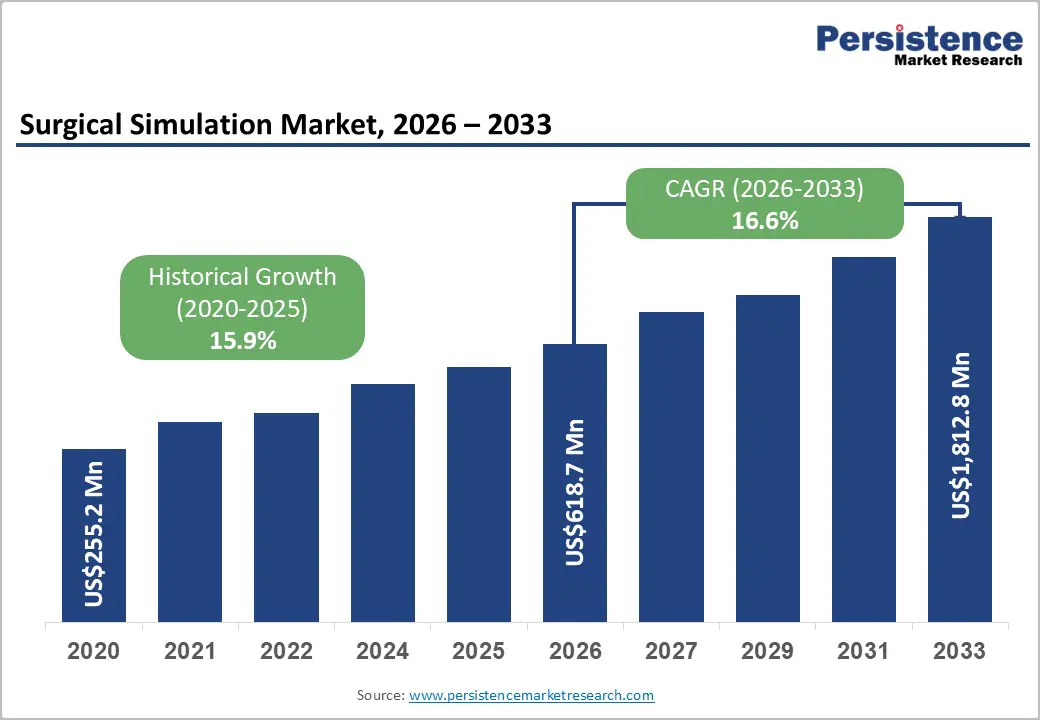
The global surgical simulation market size is likely to be valued at US$618.7 million in 2026 and is estimated to reach US$1812.8 million by 2033, growing at a CAGR of 16.6% during the forecast period from 2026 to 2033, driven by structural shifts in healthcare training paradigms and technological infrastructure.
Demographic changes, notably an aging global population requiring complex surgical interventions, create an urgent demand for rapid, proficient medical worker training without compromising patient safety. Regulatory bodies increasingly mandate objective proficiency-based benchmarks prior to live operating room exposure, forcing training institutions to institutionalize standardized virtual curriculum platforms.
Key Industry Highlights
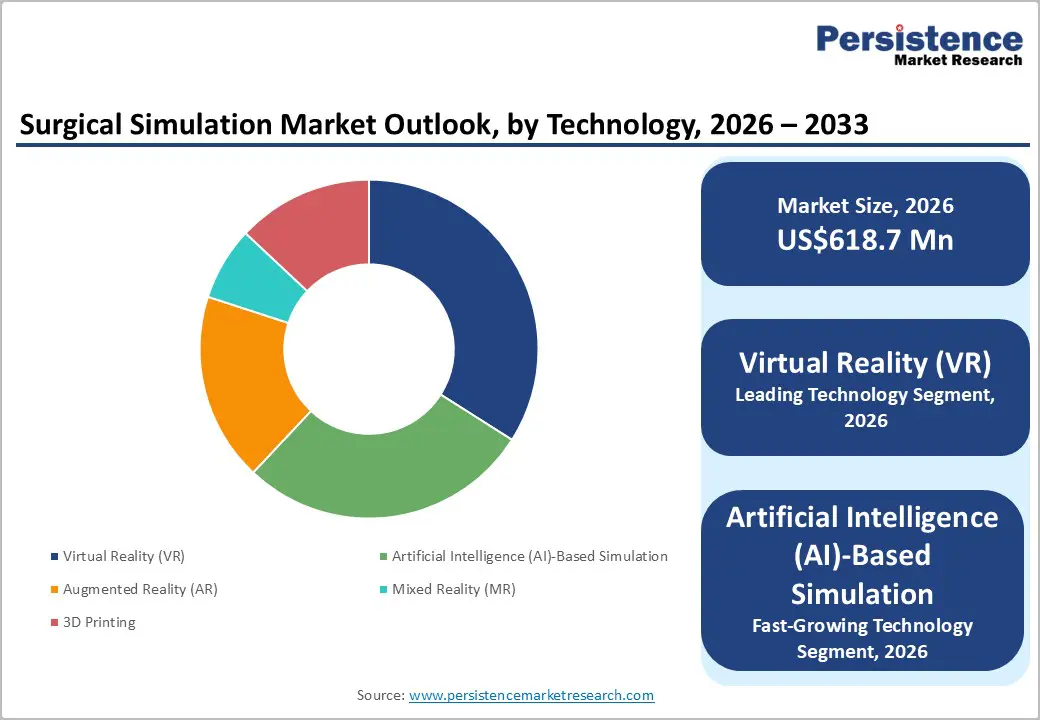
- Leading Technology: Virtual reality (VR) is set to hold around 34% revenue share in 2026, driven by increasing adoption in robotic-assisted and minimally invasive surgical training.
- Fastest-growing Technology: Artificial intelligence (AI)-based simulation is projected as the fastest-growing segment, driven by rising demand for predictive analytics and real-time procedural feedback systems.
- Leading Application: Cardiac surgery is estimated to hold roughly 26% revenue share in 2026, driven by expanding utilization of precision-focused robotic cardiovascular interventions.
- Fastest-growing Application: Neurosurgery is forecast to record the fastest growth, driven by increasing deployment of image-guided and robotic-assisted neurological procedures.
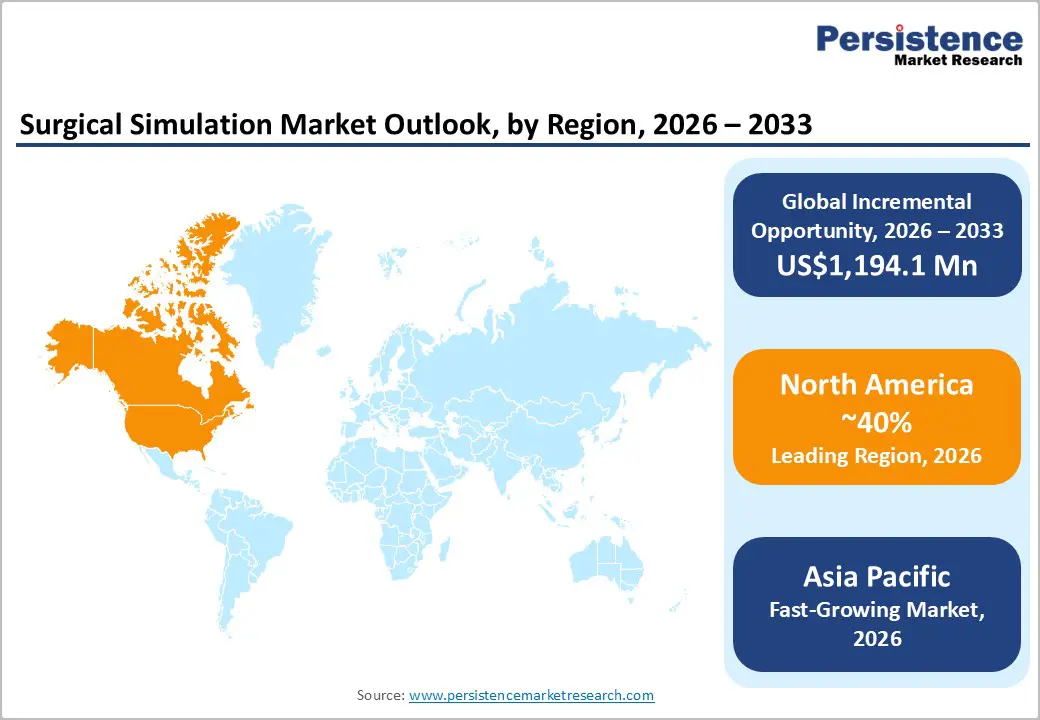
- Regional Leadership: North America is projected to capture roughly 40% of the market share by 2026, driven by strong robotic surgery penetration and advanced healthcare digitalization.

DRO Analysis
Driver - Rising Demand for Minimally Invasive and Robotic-assisted Procedures
Growing preference for minimally invasive interventions is increasing the requirement for simulation-based surgical training due to the higher precision associated with robotic systems and image-guided procedures. Healthcare institutions are prioritizing structured training environments to reduce procedural errors and improve surgeon preparedness before operating room exposure. The World Health Organization estimated that more than 234 million major surgical procedures are performed annually worldwide, creating sustained demand for standardized procedural competency frameworks.
Robotic surgery adoption is expanding across cardiac, orthopedic, and neurological specialties because simulation platforms reduce learning curves and improve hand-eye coordination in technology-intensive procedures. Companies, including Intuitive Surgical and Medtronic, are integrating digital training ecosystems with robotic systems to improve utilization efficiency. AI-powered surgical simulation for robotic surgery training is gaining visibility as healthcare systems pursue data-driven procedural education aligned with patient safety mandates.
Restraint - High Implementation Costs and Infrastructure Dependency
Advanced simulation systems require substantial investments in hardware, software integration, haptic feedback systems, and high-performance computing infrastructure. Smaller hospitals and training centers face budget limitations that restrict the adoption of immersive learning platforms. High installation and maintenance expenditures reduce operational margins for healthcare providers operating within constrained reimbursement environments.
Limited interoperability between simulation software and hospital information systems creates scalability challenges across multi-site healthcare networks. Dependence on periodic software upgrades and specialized technical support increases recurring operational costs. Procurement cycles within public healthcare institutions frequently delay implementation timelines, reducing commercial scalability for simulation technology providers.
Opportunity - Integration of Artificial Intelligence and Data Analytics into Procedural Training
Artificial intelligence integration is creating opportunities for personalized procedural assessment and predictive performance analytics within digital surgical education. Simulation platforms equipped with real-time feedback engines can identify technical deficiencies and recommend targeted learning pathways for surgeons. Companies developing AI-enabled visualization systems are positioned to improve procedural standardization and reduce variability across training environments.
Healthcare institutions are expanding investments in competency-based education because predictive analytics can improve training efficiency and optimize operating room preparedness. In January 2025, the U.S. Food and Drug Administration expanded guidance supporting lifecycle management for AI-enabled medical devices, strengthening commercial confidence in validated simulation platforms. AI-based surgical performance assessment software is emerging as a strategic investment area for technology developers and healthcare providers.
Category-wise Analysis
Technology Insights
Virtual reality (VR) is anticipated to secure around 34% of the surgical simulation market share in 2026, reflecting increasing demand for immersive procedural training across minimally invasive surgeries and robotic interventions. Intuitive Surgical expanded digital VR training modules within robotic education ecosystems during 2025, strengthening adoption among hospitals and academic institutions. High visualization accuracy and controlled learning environments continue to support broader integration into structured surgical competency programs.
Artificial intelligence (AI)-based simulation is expected to be the fastest-growing segment, propelled by rising adoption of predictive analytics and real-time procedural feedback systems within digital surgical training environments. In 2025, Siemens Healthineers expanded AI-enabled surgical planning tools supporting performance evaluation and workflow optimization across complex interventions. Adaptive learning algorithms and automated competency tracking are increasing institutional demand for intelligent simulation ecosystems across healthcare education networks.
Application Insights
Cardiac surgery is poised to dominate with a forecast market share of over 26% in 2026, powered by increasing procedural complexity and rising integration of robotic-assisted interventions within cardiovascular care environments. Mayo Clinic expanded simulation-based cardiac training initiatives during 2025 to strengthen procedural accuracy among multidisciplinary surgical teams. Demand for precision-focused training platforms continues to increase due to higher patient safety expectations and minimally invasive treatment adoption.
Neurosurgery is estimated to be the fastest-growing segment, fueled by increasing reliance on image-guided procedures and high-precision robotic systems within neurological interventions. In 2025, Brainlab enhanced immersive planning and navigation technologies supporting simulation-assisted neurosurgical training across specialized treatment centers. Growth in complex cranial and spinal procedures is increasing demand for advanced visualization systems capable of improving spatial orientation and procedural consistency.
End-user Insights
Hospitals are likely to be the leading segment with a projected 41% of the surgical simulation market share in 2026, due to increasing adoption of robotic surgery platforms and expanding investments in digital operating room infrastructure. Cleveland Clinic strengthened simulation-focused procedural training programs during 2025 to improve competency assessment for minimally invasive interventions. Integration of structured simulation education into hospital credentialing frameworks continues to support sustained technology adoption.
Academic institutes & research centers are anticipated to be the fastest-growing segment, fueled by increasing investments in digital medical education and competency-based surgical learning programs. In 2025, Stanford Medicine expanded immersive simulation laboratories supporting collaborative research in robotic surgery and procedural analytics. Rising emphasis on standardized surgical training and remote learning accessibility is accelerating the deployment of cloud-connected simulation platforms across academic healthcare ecosystems.
Regional Insights
North America Surgical Simulation Market Trends
North America is expected to lead with an estimated 40% of the surgical simulation market share in 2026, supported by concentrated healthcare investments, regulatory pressure, and mature training infrastructure. The regional market maintains structural dominance through strict training mandates enforced by the American College of Surgeons, which demand quantifiable proficiency benchmarks.
U.S. Surgical Simulation Market Insights
The U.S. market is likely to be characterized by consistent expansion, contributing approximately 82.5% of the total North American revenue share in 2026. Forward-looking procurement structures are forecast to favor automated, patient-specific pre-operative software twins to minimize medical liability expenses.
Canada Surgical Simulation Market Insights
The Canadian market is expected to indicate steady demand, projected to secure a 17.5% share of the regional market in 2026. The localized expansion of universal health networks drives the adoption of remote, cloud-linked virtual simulators to standardize distant academic training programs.
Europe Surgical Simulation Market Trends
Europe market is anticipated to maintain the second-largest global position, capturing roughly 29.5% of the global market share in 2026 due to extensive workforce development frameworks. The widespread implementation of competency-based certification policies across the European Union forces hospitals to invest heavily in objective training validation models. Regional market dynamics remain supported by centralized medical education spending and aging demographic requirements.
Germany Surgical Simulation Market Insights
The Germany market is projected to demonstrate regional leadership, holding an estimated 31% of the European market share in 2026. Strict legislative working-hour constraints for resident physicians accelerate the integration of efficient, high-fidelity replication suites outside the operating room. Collaborative development strategies between local precision optical engineering operators and simulator providers enhance regional technological deployment.
U.K. Surgical Simulation Market Insights
The U.K. Surgical Simulation Market is expected to capture a 22.4% share of the Europe market in 2026, driven by National Health Service efficiency optimization strategies. Institutional procurement policies increasingly favor bundled service and hardware configurations to manage long-term total cost of ownership factors. Public training centers expand software deployments to systematically reduce active trainee supervision hours during live interventions.
Asia Pacific Surgical Simulation Market Trends
Asia Pacific regional market is forecast to be the fastest-growing market for surgical simulation, stimulated by rapid hospital infrastructure construction and expanding medical access, reaching an estimated 22.3% global market share in 2026. Rising investments from public and private entities aim to expand localized specialty surgical capabilities across dense population clusters.
China Surgical Simulation Market Insights
The China market is projected to reflect rapid scale expansion, expected to secure approximately 38.5% of the Asia Pacific market share in 2026. Large municipal hospital systems establish extensive centralized simulation laboratories to address severe patient-to-surgeon ratio imbalances efficiently. Public modernization directives mandate the integration of digital simulation into newly constructed medical university campuses.
India Surgical Simulation Market Insights
India's surgical simulation market is forecast to show accelerated growth, likely to capture a 24.1% share of the regional market in 2026. Private hospital networks and emerging public colleges invest heavily in advanced laparoscopy and endovascular simulation platforms to establish standardized specialty fellowship programs. Rising medical tourism volumes incentivize regional hospital administrations to deploy high-fidelity simulators for advanced procedural marketing and validation.
Competitive Landscape
The global surgical simulation market is moderately fragmented, with a balanced combination of tier-one medical device corporations and highly specialized simulation technology developers. Industry participants leverage distinct technical capabilities, with established entities utilizing broad distribution networks while agile startups pioneer niche software algorithms. Key players driving global market development include Surgical Science Sweden AB, 3D Systems Inc., Laerdal Medical, VirtaMed AG, and Simulab Corporation.
These entities focus resources heavily on proprietary haptic interface engineering and software curriculum validation to erect competitive entry barriers around core product lines. Strategic consolidation occurs frequently as larger hardware conglomerates acquire software developers to provide comprehensive, end-to-end clinical simulation ecosystems.
Key Industry Developments:
- In May 2026, HelpMeSee partnered with Sri Sankaradeva Nethralaya in Guwahati to launch a simulation-based cataract surgery training initiative using virtual reality surgical simulators, strengthening immediate surgical capacity development across Northeast India.
- In October 2025, Surgical Science launched the portable RobotiX Express robotic surgery training platform, reinforcing accessibility and scalability in simulation-based surgical education across hospitals and medical training institutions.
Companies Covered in Surgical Simulation Market
- Surgical Science Sweden AB
- 3D Systems Inc.
- Laerdal Medical
- VirtaMed AG
- Simulab Corporation
- Mentice AB
- Inovus Medical
- Osso VR Inc.
- SimX
- Gaumard Scientific Company
- Limbs & Things Ltd.
- ImmersiveTouch Inc.
Frequently Asked Questions
The global surgical simulation market is projected to reach US$618.7 million in 2026.
Increasing adoption of minimally invasive and robotic-assisted surgeries, rising focus on patient safety, and expanding demand for competency-based surgical training are driving the surgical simulation market.
The surgical simulation market is poised to witness a CAGR of 16.6% from 2026 to 2033.
Integration of artificial intelligence-driven training analytics, expansion of virtual reality surgical education platforms, and growing investments in digital medical training infrastructure are creating key opportunities in the surgical simulation market.
Some of the key market players include Surgical Science Sweden AB, 3D Systems Inc., Laerdal Medical, VirtaMed AG, and Simulab Corporation.


