




- Food Ingredients & Additives
- Organic Molasses Market
Organic Molasses Market Size, Share, and Growth Forecast, 2026 - 2033
Organic Molasses Market by Source (Sugarcane-Based Organic Molasses, Sugar Beet-Based Organic Molasses), Form (Liquid, Powder, Granulated), Application (Food and Beverages, Animal Feed, Pharmaceuticals, Others), and Regional Analysis for 2026 - 2033

Organic Molasses Market Size and Trends Analysis
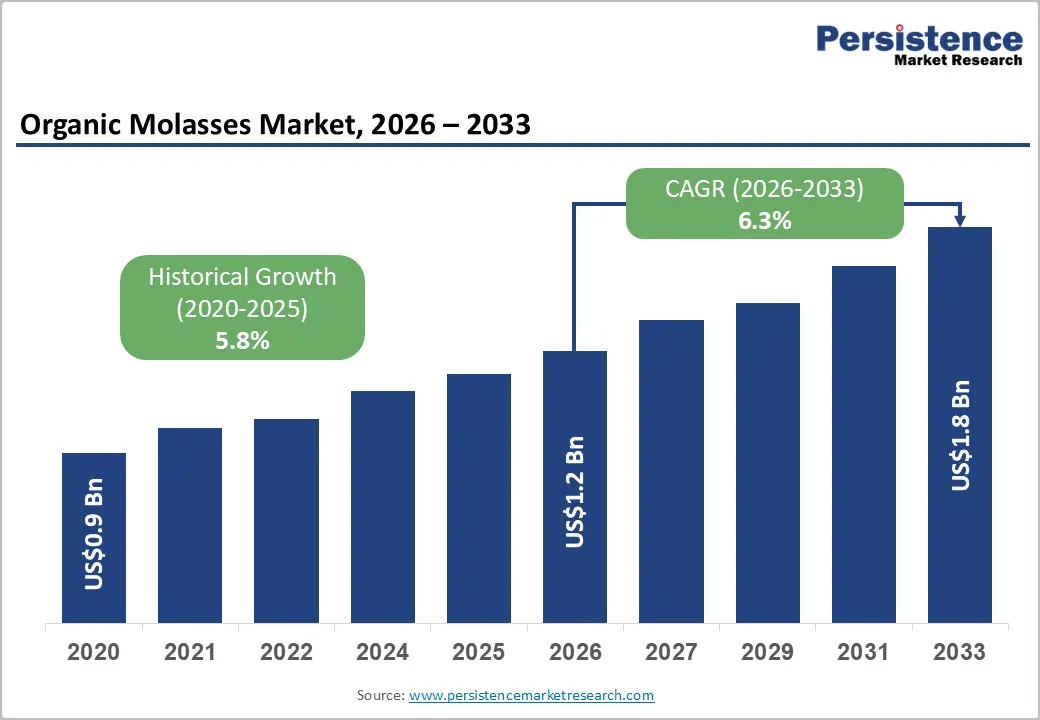
The global organic molasses market size is likely to be valued at US$1.2 billion in 2026 and is estimated to reach US$1.8 billion by 2033, growing at a CAGR of 6.3% during the forecast period from 2026 to 2033, driven by rising demand for organic sweeteners, expansion of sustainable livestock feed systems, and the increasing substitution of refined sugar with natural byproducts.
Demographic transition toward health-conscious consumption patterns supports higher adoption across food and beverage processing. Regulatory frameworks such as the United States Department of Agriculture (USDA) Organic Program enforcement and the European Union (EU) organic labeling standards are strengthening product credibility and traceability systems. Technology adoption in sugarcane processing and fermentation efficiency improves yield consistency and nutrient retention.
Key Industry Highlights:
- Leading Source: The sugarcane-based organic molasses segment is set to hold around 71% revenue share in 2026, driven by established tropical cultivation infrastructure and mature organic certification frameworks across Brazil, Paraguay, and Peru.
- Fastest-Growing Source: The sugar beet-based organic molasses segment is projected as the fastest-growing segment, supported by EU Farm to Fork Strategy commitments expanding certified organic sugar beet cultivation across Germany, France, and Poland.
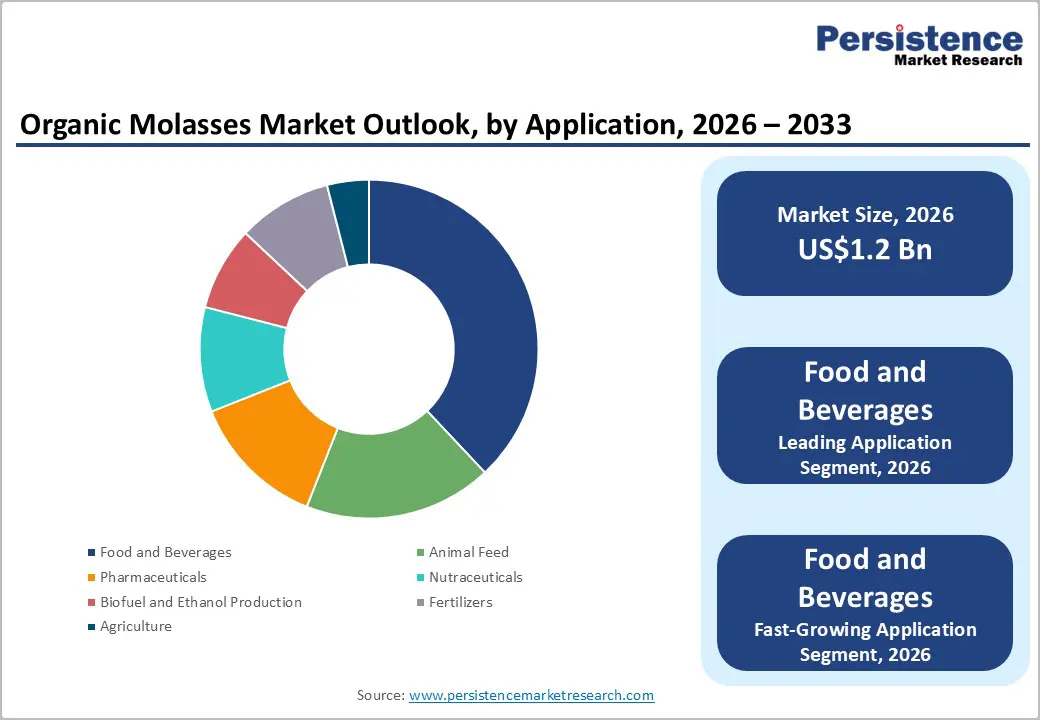
- Leading Application: Food and beverages are estimated to hold roughly a 38% revenue share in 2026, driven by clean-label reformulation trends and consistent procurement by organic bakery, sauce, and beverage manufacturers seeking natural sweetening and coloring agents.
- Fastest-Growing Application: Animal Feed is forecast to record the fastest growth, driven by strict regulatory restrictions regarding synthetic chemical components in commercial livestock rations.
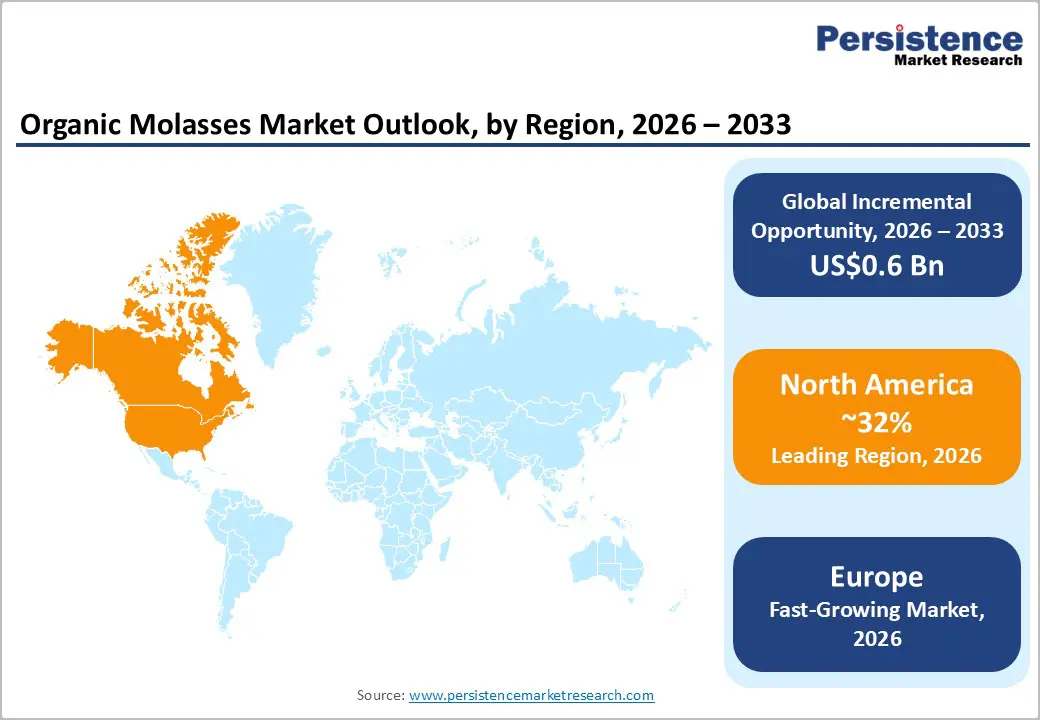
- Regional Leadership: North America is projected to capture roughly 32% of the global market share in 2026, while Europe is forecast to record the fastest growth due to bio-based industrial expansion.
- Competitive Environment: The market reflects a moderately consolidated structure, with key players such as Wholesome Sweeteners and Florida Crystals Corporation leveraging vertically integrated organic supply chains, third-party certification infrastructure, and established retail distribution to maintain competitive positioning.
DRO Analysis
Driver - Growth in Organic Livestock Nutrition Systems
Expansion of organic livestock production systems increases demand for natural feed additives such as molasses used in energy enrichment and silage binding applications. Rising regulatory focus on certified feed inputs strengthens procurement across verified organic supply chains. European Union organic farmland reached nearly 17.7 million hectares in 2025, according to European Commission data, signaling sustained scaling of certified livestock feed ecosystems across member states and reinforcing structured ingredient demand within feed manufacturing.
Feed manufacturers integrate molasses into organic ration formulations to enhance energy density, palatability, and fermentation efficiency in silage systems. Rising shift toward antibiotic-free livestock production increases dependence on natural binding agents and carbohydrate-rich feed inputs. Supply chain alignment between organic feed producers and dairy and poultry operations supports consistent consumption patterns. Expansion of certified feed mills improves processing efficiency and reduces formulation variability across large-scale livestock nutrition systems.
Restraint - Supply Chain Fragmentation and Raw Material Price Volatility
Organic molasses production is structurally dependent on certified organic sugarcane and sugar beet cultivation, both of which are subject to agronomic variability driven by weather events, soil depletion, and pest pressure. The inability to deploy synthetic agrochemicals under organic certification protocols limits yield stabilization options, creating recurring supply gaps that compress processor margins during periods of raw material scarcity.
This supply fragmentation directly constrains the scalability of mid-tier manufacturers operating without vertically integrated sourcing infrastructure. When raw material costs spike due to harvest shortfalls, as occurred across Brazilian sugarcane belts in 2024, organic molasses prices become uncompetitive relative to conventional alternatives, causing procurement substitution among cost-sensitive buyers and limiting market penetration in price-elastic segments such as industrial animal feed.
Opportunity - Biofuel Feedstock Demand under Renewable Energy Policy Mandates
Government mandates for blended biofuel adoption are creating a new industrial demand corridor for fermentable organic sugar sources. Organic molasses, as a high-sucrose fermentation substrate, is well-positioned to serve ethanol producers operating under certified organic or sustainable feedstock sourcing criteria. In the United States, the Renewable Fuel Standard administered by the Environmental Protection Agency requires specific volumes of cellulosic and advanced biofuel production annually, creating incentive structures for organic feedstock procurement.
This policy-driven demand source is structurally independent of food market cycles, providing organic molasses producers with a counter-cyclical revenue channel. Investments in co-located fermentation facilities adjacent to organic sugarcane mills in Brazil and India can significantly reduce feedstock transportation costs, improving overall economics. The convergence of renewable energy mandates and organic agriculture expansion policies across the EU and Latin America is expected to accelerate this growth pathway through the end of the forecast period.
Category-wise Analysis
Source Insights
Sugarcane-based organic molasses is anticipated to secure around 71% of the organic molasses market share in 2026, reflecting its established agronomic base, lower production cost structure, and widespread geographic cultivation. Companies such as Wholesome Sweeteners have built commercial supply chains entirely around certified organic sugarcane sourcing from Brazil and Paraguay. The segment benefits from mature extraction infrastructure and well-established regulatory certification pathways, reinforcing its dominant position throughout the forecast period.
Sugar beet-based organic molasses is expected to be the fastest-growing segment, propelled by expanding organic sugar beet cultivation programs across European Union member states under the EU Farm to Fork Strategy. Nordzucker AG has invested in certified organic beet processing capacity in Germany and Denmark. Growing demand for non-tropical organic sweetener sources among European manufacturers seeking reduced import dependency is driving cultivation area expansion and processing investment.
Form Insights
Liquid form is poised to dominate with a forecast market share of over 81% of the organic molasses market in 2026, powered by immediate dissolvability characteristics and established bulk pumping infrastructure across major food processing plants. Industrial bakeries prioritize this format to maintain continuous mixing speeds inside large automated dough preparation systems. Commercial sauce manufacturers employ bulk liquid pumping systems to introduce raw molasses into barbecue bases, preventing the clumping issues often caused by dry alternatives.
Powdered is estimated to be the fastest-growing segment, fueled by rising demand for shelf-stable components within dry-mix industrial applications and ready-to-eat breakfast cereal manufacturing lines. Eliminating moisture content drastically reduces long-term spoilage risks and optimizes storage space utilization within commercial warehouses. Global sports nutrition brands incorporate dry organic syrup solids into premium protein powders to achieve natural sweetening goals without using synthetic chemical compounds.
Application Insights
Food and beverages are likely to be the leading segment with a projected 38% of the organic molasses market share in 2026 due to its broad use as a natural sweetener, colorant, and flavor enhancer across baked goods, sauces, beverages, and confectionery. Plantation Brand has established organic molasses as a flagship baking ingredient across North American retail channels. Clean-label reformulation trends across branded food manufacturers are sustaining high procurement volumes throughout the forecast period.
Animal feed is anticipated to be the fastest-growing segment, fueled by tightening global regulations against synthetic growth promoters and an increasing focus on livestock health. Cattle and swine operations require highly palatable energy supplements to maintain consumption targets during extreme seasonal temperature transitions. Commercial aquaculture operations utilize certified organic syrups to bind specialized feed pellets, ensuring uniform nutrient delivery while minimizing waste dissolution in intensive farming environments.
Regional Insights
North America Organic Molasses Market Trends
North America is expected to lead with an estimated 32% market share in 2026, supported by advanced biofuel infrastructure, strong livestock nutrition systems, and integrated sugar processing ecosystems. Expansion of ethanol blending mandates increases industrial utilization of molasses in fermentation systems, while organic feed adoption strengthens across commercial livestock operations. Supply chain maturity enhances production scalability and export efficiency.
U.S. Organic Molasses Market Insights
The U.S. is expected to account for 83% market share in 2026, driven by renewable fuel standards, large-scale ethanol production, and established biorefinery networks. Midwest industrial clusters integrate molasses as a primary fermentation feedstock, supporting biofuel output expansion. Organic livestock feed adoption increases across dairy and poultry operations due to regulated nutrition frameworks.
Canada Organic Molasses Market Insights
Canada is expected to hold a 17% market share in 2026, supported by organic dairy farming expansion and structured livestock nutrition policies. Import dependency on sugar derivatives strengthens global sourcing networks. Adoption of sustainable feed additives increases across certified agricultural systems, improving productivity, efficiency and feed conversion performance.
Europe Organic Molasses Market Trends
Europe is forecast to be the fastest-growing market for organic molasses, stimulated by strict organic certification systems, circular economy initiatives, and rapid expansion of bio-based chemical industries. Regulatory pressure on synthetic inputs increases demand across fermentation and livestock feed applications. Strong integration of sugar beet processing enhances regional supply capability.
Germany Organic Molasses Market Insights
Germany is expected to capture 31% market share in 2026, supported by advanced sugar beet processing infrastructure and strong industrial fermentation capacity. Biochemical production systems utilize molasses for amino acid and enzyme manufacturing. Renewable chemical substitution policies strengthen industrial demand for bio-based inputs.
France Organic Molasses Market Insights
France is expected to account for 15% market share in 2026, driven by sugar beet cultivation strength and expanding organic livestock farming systems. Feed modernization programs increase the integration of nutrient-rich molasses in animal nutrition. Sustainability regulations encourage reduced reliance on synthetic agricultural inputs.
Asia Pacific Organic Molasses Market Trends
Asia Pacific is expected to capture around 28% of the market share in 2026, supported by large-scale sugarcane production, expanding ethanol programs, and rising livestock demand. Infrastructure development in agro-processing clusters enhances production efficiency and export capability. Industrial fermentation demand continues to expand across biochemical applications.
India Organic Molasses Market Insights
India is expected to account for 26% market share in 2026, driven by high sugarcane output, ethanol blending mandates, and growth in organic livestock nutrition systems. Dairy sector modernization supports adoption of molasses-based feed supplements. Government biofuel policies strengthen industrial demand for fermentation-grade molasses.
China Organic Molasses Market Insights
China is expected to hold a 12% market share in 2026, supported by biofuel diversification strategies and large-scale feed manufacturing systems. Expansion of industrial fermentation capacity enhances biochemical production using molasses. Agricultural modernization policies promote integration of organic feed inputs across livestock sectors.
Competitive Landscape
The global organic molasses market is moderately consolidated, with a limited number of vertically integrated producers controlling significant shares of certified organic supply chains. Key players, including Wholesome Sweeteners, Crosby Molasses, Bob's Red Mill Natural Foods, Florida Crystals Corporation, and Zook Molasses Company, maintain competitive advantage through direct relationships with certified organic sugarcane and sugar beet cultivation operations, ensuring supply continuity and certification traceability.
Mid-tier and regional players compete primarily on price and geographic distribution reach rather than product differentiation, creating a two-tiered competitive dynamic. The leading players are leveraging third-party certification infrastructure, proprietary processing know-how, and established retail distribution networks to maintain pricing power in premium channels, while smaller operators serve commodity and industrial segments where cost efficiency is the primary competitive criterion.
Companies Covered in Organic Molasses Market
- Wholesome Sweeteners
- Crosby Molasses
- Bob's Red Mill Natural Foods
- Florida Crystals Corporation
- Zook Molasses Company
- Brer Rabbit (B&G Foods)
- NOW Foods
- Plantation Brand
- Organic Valley
- Nordzucker AG
- Südzucker AG
- Shakti Sugars Limited
- Imperial Sugar Company
- Domino Foods Inc.
- Golden Barrel (Country Life Foods)
Frequently Asked Questions
The organic molasses market is projected to reach US$1.2 billion in 2026.
Rising demand for organic sweeteners, expansion of sustainable livestock nutrition systems, and growth in bio-based fermentation applications drive the organic molasses market.
The organic molasses market is poised to witness a CAGR of 6.3% from 2026 to 2033.
Expansion of bio-based fermentation industries, increasing adoption of clean-label food formulations, and rising integration in organic livestock feed systems create key market opportunities.
Some of the key market players include Wholesome Sweeteners, Crosby Molasses, Bob's Red Mill Natural Foods, Florida Crystals Corporation, and Zook Molasses Company.


