




- Display Technologies
- Night Vision Goggles Market
Night Vision Goggles Market Size, Share, and Growth Forecast, 2026 - 2033
Night Vision Goggles Market by Technology (Image Intensification, Thermal Imaging, Others), Application (Military, Aviation, Naval, Others), Product Type (Monocular, Binocular, Panoramic, Helmet-integrated, Clip-on), and Regional Analysis for 2026 - 2033

Night Vision Goggles Market Share and Trends Analysis
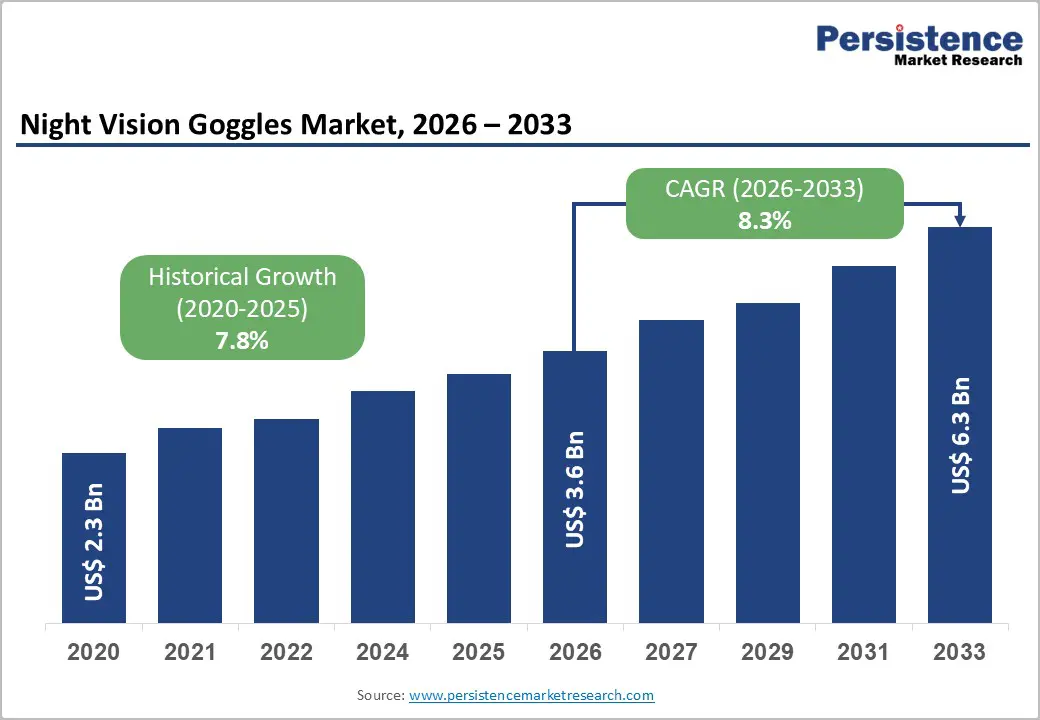
The global night vision goggles market size is likely to be valued at US$3.6 billion in 2026 and is projected to reach US$6.3 billion by 2033, growing at a CAGR of 8.3% during the forecast period 2026 - 2033, driven by rising defense modernization programs, increasing demand for advanced situational awareness systems, and rapid adoption of thermal imaging and digital night vision technologies.
The technological convergence between image intensification and fusion systems is improving operational efficiency in low-light environments across military and law enforcement applications. Rising integration of AI-enabled optics and lightweight wearable systems is also reshaping product innovation cycles. Thus, the market demonstrates strong structural demand supported by geopolitical instability and continuous technological advancements in optical imaging systems.
Key Industry Highlights:
- Dominant Application Segment: Military is expected to lead with 53% share in 2026, while search & rescue is projected to be the fastest-growing segment through 2033, driven by rising emergency response deployments and disaster management needs in low-visibility environments.
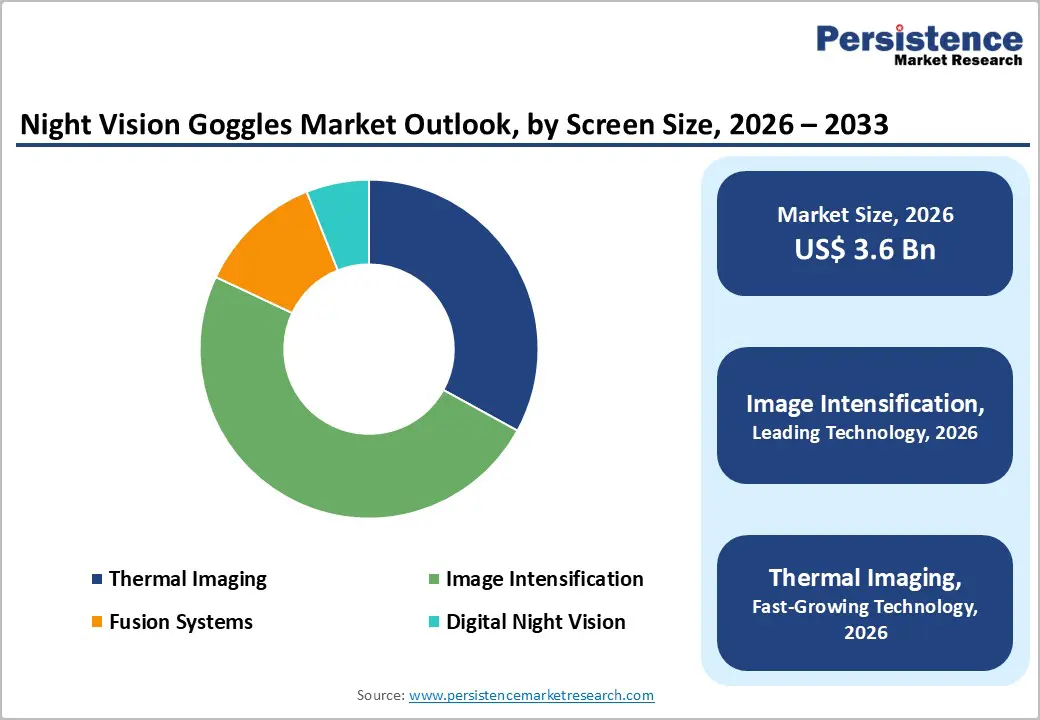
- Leading Technology Segment: Image intensification is expected to hold 49% share in 2026, while thermal imaging is anticipated to grow the fastest through 2033 due to superior performance in complete darkness and expanding surveillance and border security applications.
- Dominant Product Type: Binocular goggles are projected to lead with 41% share in 2026, while helmet-integrated systems are expected to grow the fastest through 2033, driven by demand for hands-free tactical operations and soldier modernization programs.
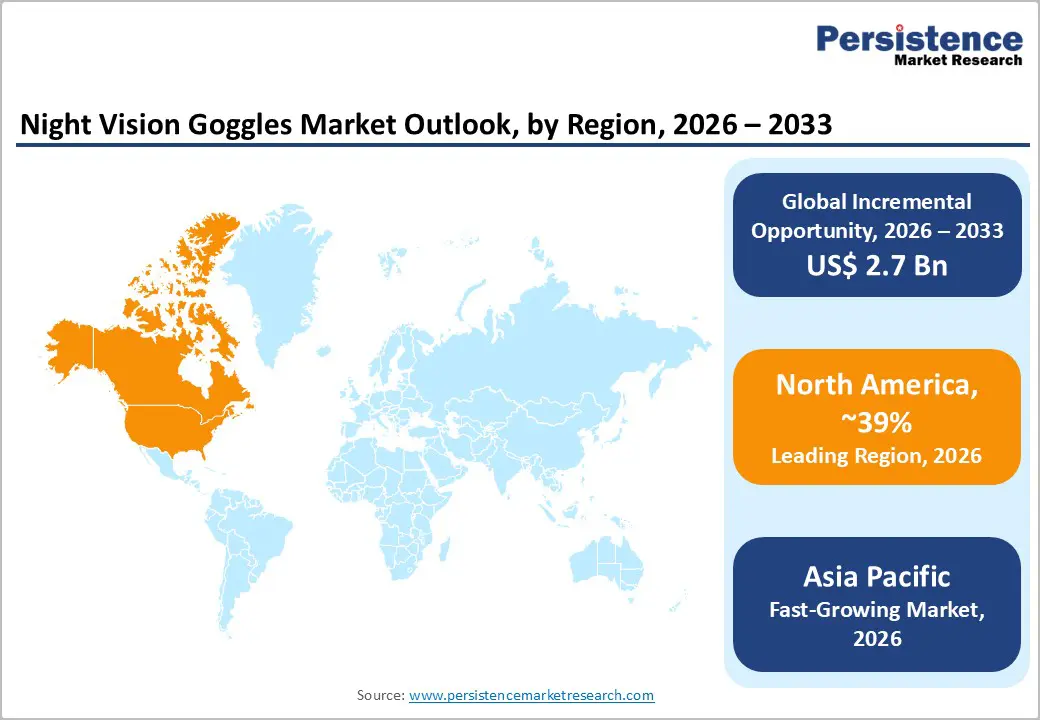
- Regional Leadership: North America is expected to dominate with 39% share in 2026, while Asia Pacific is projected to grow the fastest through 2033, driven by defense modernization in China and India and rising security investments.
- Competitive Environment: Market competition is increasingly shaped by AI-enabled optics, fusion systems, and digital imaging integration, with players focusing on innovation, defense contracts, and strategic partnerships to strengthen positioning in the night vision goggles market.
DRO Analysis
Driver - Rising Global Defense Modernization and Night Combat Operations Demand
The primary driver of the night vision goggles market is increasing global defense expenditure aimed at modernizing infantry equipment and enhancing night-time operational capabilities. According to SIPRI (Stockholm International Peace Research Institute), global military spending exceeded US$2.4 trillion in recent years, with a significant portion allocated to advanced surveillance and soldier modernization systems.
Countries such as the U.S., China, and India are actively investing in image intensification and thermal imaging goggles for border protection and counter-terrorism operations. The U.S. Department of Defense continues to prioritize soldier enhancement programs, such as IVAS (Integrated Visual Augmentation System), boosting demand for high-performance night-vision systems. This surge in procurement directly accelerates market expansion across military applications globally.
Restraint - High Procurement and Maintenance Costs Limiting Wider Adoption
High procurement and maintenance costs continue to act as a structural barrier in the night vision goggles market, particularly for advanced fusion-based and thermal imaging systems that rely on high-precision infrared sensors and micro-display components. This cost intensity is further amplified by ongoing calibration needs, lifecycle replacements, and integration challenges with legacy defense infrastructure. As a result, total ownership costs remain significantly high for end-users.
This creates a clear adoption gap, especially in developing economies where budget constraints limit procurement beyond essential defense use cases. Additionally, export control frameworks such as ITAR slow cross-border availability, leading to procurement delays of 15-25%. These factors limit scalability, delay modernization programs, and reinforce reliance on conventional, lower-cost night-vision solutions in cost-sensitive markets.
Opportunity - Expansion of Digital and AI-Integrated Night Vision Systems
The night vision goggles market is transitioning from hardware-led imaging systems to intelligent, software-enhanced vision platforms used across defense, law enforcement, aviation, and civilian security. The integration of AI with thermal imaging and digital night vision is improving real-time object detection, environmental mapping, and low-light situational awareness, enabling faster and more accurate decision-making across operational environments.
This shift is being accelerated by developments such as the U.S. Department of Homeland Security deploying AI-assisted surveillance upgrades for urban security and transport corridors, alongside India’s expansion of AI-enabled smart city surveillance for traffic management and public safety. Additionally, ICAO-led aviation security modernization initiatives are promoting advanced low-light monitoring systems for runway operations and perimeter safety.
As a result, adoption is expanding beyond defense into aviation, infrastructure security, and public safety, creating strong commercial demand for AI-integrated night vision goggles. This is opening scalable growth opportunities for vendors delivering cross-sector, software-driven imaging solutions globally.
Category-wise Analysis
Technology Insights
The image intensification technology segment is estimated to dominate the night vision goggles market, accounting for approximately 49% share in 2026, supported by its reliability, low power consumption, and consistent performance in near-total darkness. It remains the foundational technology for most standard surveillance and tactical vision systems due to its operational stability and cost efficiency across large-scale deployments.
Recent innovation trends indicate continued upgrades in photocathode efficiency and compact microdisplay architectures, particularly in advanced optical programs in the U.S., aimed at improving resolution while reducing device weight and energy consumption.
In parallel, the thermal imaging segment is expected to be the fastest-growing technology, through 2033, driven by its capability to detect heat signatures in complete darkness. In 2025, European environmental monitoring initiatives under space and climate observation programs are increasingly estimated to integrate advanced thermal sensing modules, supporting wider civilian and industrial adoption beyond traditional security applications.
Application Insights
The military segment is estimated to lead the night vision goggles market, with approximately 53% share in 2026, driven by ongoing modernization of surveillance systems, navigation support tools, and low-light operational equipment. Its dominance is supported by sustained investments in advanced optical technologies designed to enhance situational awareness and mission efficiency across defense infrastructure.
In 2025, large-scale modernization initiatives under the U.S. Department of Homeland Security are expected to expand the use of AI-assisted surveillance and imaging systems across critical infrastructure monitoring networks, strengthening the role of advanced night-vision technologies in civilian security ecosystems.
The search & rescue segment is expected to be the fastest-growing application through 2033, driven by rising investment in disaster response capabilities. Japan and select European agencies are increasingly estimated to deploy thermal-enabled vision systems in drone-assisted and remote rescue operations, improving night-time detection accuracy in challenging terrains.
Product Type Insights
The binocular night vision goggles segment is estimated to lead the market with approximately 41% share in 2026, supported by superior depth perception, wider field of view, and strong adoption across aviation and tactical mobility applications. Its ergonomic design and compatibility with helmet-mounted systems continue to position it as the preferred solution for extended operational use in low-light environments.
Recent product development trends suggest increasing adoption of lightweight composite materials and enhanced digital fusion optics, which are estimated to improve durability and reduce operator fatigue during long-duration use.
The helmet-integrated goggles are expected to be the fastest-growing product category through 2033, driven by demand for hands-free operational capability. Public safety and emergency response agencies in multiple regions are increasingly piloting helmet-mounted vision systems for urban night operations, improving coordination and real-time situational awareness during complex field activities.
Regional Analysis
North America Night Vision Goggles Market Trends
North America is estimated to lead the night vision goggles market, accounting for approximately 39% of global share in 2026, driven by advanced defense modernization, rapid AI-enabled imaging adoption, and deep integration of digital optics across security and critical infrastructure systems. Growth is also supported by continuous upgrades in sensor-based surveillance networks and increasing deployment of wearable vision systems across public safety and industrial monitoring environments.
U.S. Night Vision Goggles Market Trends
The U.S., estimated at around 55% of the regional market in 2026, continues to anchor demand through sustained investment in AI-driven imaging, edge processing optics, and sensor fusion technologies. In 2025, NASA’s Earth Science Division initiatives are estimated to have expanded the use of low-light and infrared imaging sensors in environmental monitoring programs, indirectly accelerating advancements in high-sensitivity optical components used in night vision goggles systems.
Canada Night Vision Goggles Market Trends
Canada, estimated at approximately 15% of the regional share in 2026, is witnessing steady growth driven by the modernization of remote monitoring and infrastructure inspection systems. In 2025, Transport Canada-led aviation safety enhancement initiatives are estimated to have promoted the use of low-light runway monitoring technologies, supporting broader integration of advanced optical imaging solutions for operational safety in extreme weather conditions.
Europe Night Vision Goggles Market Trends
Europe is estimated to hold approximately 29% share of the global night vision goggles market in 2026, supported by strong precision optics manufacturing, structured security modernization, and increasing integration of digital and thermal imaging technologies across transport, industrial, and public safety ecosystems. Demand is further reinforced by rising investments in intelligent infrastructure monitoring systems.
Germany Night Vision Goggles Market Trends
Germany, estimated at around 30% of the regional market in 2026, leads due to its strong industrial base in advanced optics and sensor engineering. In 2025, Germany’s Federal Ministry for Digital and Transport initiatives supporting AI-enabled infrastructure monitoring are estimated to have increased deployment of intelligent imaging systems for railway and highway safety management, strengthening demand for advanced night vision goggles technologies.
U.K. Night Vision Goggles Market Trends
The U.K., estimated at approximately 18% of regional share, is expanding adoption across aviation, maritime, and urban infrastructure monitoring applications. In 2025, UK Maritime and Coastguard Agency modernization programs are estimated to have upgraded night-time coastal surveillance systems using enhanced thermal imaging technologies, improving detection capabilities and reinforcing demand for high-performance night vision solutions.
Asia Pacific Night Vision Goggles Market Trends
Asia Pacific is estimated to be the fastest-growing region in the night vision goggles market, accounting for approximately 22% of global share in 2026, driven by rapid infrastructure digitization, expanding surveillance ecosystems, and increasing adoption of AI-enabled optical technologies. Growth is further supported by the rising deployment of smart monitoring frameworks across transportation, urban safety, and industrial applications.
China Night Vision Goggles Market Trends
China, estimated at around 38% of the regional market in 2026, continues to lead through the large-scale expansion of intelligent infrastructure and surveillance systems. In 2025, national-level initiatives under China’s Ministry of Public Security are estimated to have increased deployment of integrated AI-video analytics platforms with low-light imaging systems, supporting wider adoption of advanced night vision goggles technologies in urban safety and infrastructure monitoring applications.
India Night Vision Goggles Market Trends
India, estimated at approximately 16% of the regional share in 2026, is witnessing steady growth driven by the modernization of transport safety systems and the expansion of indigenous technology development. In 2025, Indian Railways’ safety modernization programs are estimated to have introduced enhanced night-time monitoring systems across key transit corridors, indirectly supporting increased adoption of thermal and digital night vision solutions for infrastructure protection and operational safety.
Competitive Landscape
The global night vision goggles market is moderately consolidated, with leading players such as L3Harris Technologies, Elbit Systems, Thales Group, and BAE Systems estimated to collectively account for 55-60% of market share in 2026. Their dominance is supported by long-term defense contracts, strong R&D capabilities, and vertically integrated manufacturing of image intensification, thermal imaging, and fusion systems. High entry barriers, including strict export regulations and complex certification requirements, continue to reinforce their stronghold.
Competition is increasingly shifting toward AI-enabled optics and digital fusion platforms, with firms such as FLIR Systems, Teledyne Technologies, and Hensoldt strengthening positions in thermal and sensor-based imaging. In 2025-2026, multiple industry collaborations between optics manufacturers and AI software developers are estimated to have accelerated the deployment of intelligent night vision solutions across security and infrastructure applications. This is driving gradual consolidation through partnerships and targeted acquisitions, as companies expand capabilities and global reach in the evolving night vision goggles market.
Key Industry Developments:
- In May 2025, Elbit Systems of America secured a US$112 million delivery order for Squad Binocular Night Vision Goggles (SBNVG) for the U.S. Marine Corps.
Production is scheduled through 2026 at its Roanoke, Virginia, facility, strengthening the supply of white phosphor image intensification systems. - In January 2025, L3Harris received a US$263 million production order for Enhanced Night Vision Goggle-Binocular (ENVG-B) systems under the U.S. Army modernization program. The contract reinforces large-scale deployment of advanced thermal and white phosphor night vision systems, supporting continued soldier modernization initiatives.
Companies Covered in Night Vision Goggles Market
- L3Harris Technologies
- Elbit Systems
- Thales Group
- BAE Systems
- Leonardo S.p.A.
- Rheinmetall AG
- Teledyne Technologies
- FLIR Systems
- Safran Group
- Hensoldt AG
- ATN Corporation
- Yukon Advanced Optics
- Newcon Optik
- Bharat Electronics Limited
Frequently Asked Questions
The global night vision goggles market is projected to reach US$ 3.6 billion in 2026.
Rising defense modernization, expanding surveillance needs, and rapid adoption of thermal and AI-enabled imaging systems drive the market.
The night vision goggles market is expected to grow at a CAGR of 8.3% from 2026 to 2033.
Integration of AI-based imaging, expansion of smart surveillance systems, and adoption in civilian safety applications create strong growth opportunities.
Key players include L3Harris Technologies, Elbit Systems, Thales Group, BAE Systems, FLIR Systems, and Teledyne Technologies.


