




- Technology
- Lighting Control System Market
Lighting Control System Market Size, Share, and Growth Forecast, 2026 - 2033
Lighting Control System Market by Offering (Hardware, Software, Services), Technology (Wired, Wireless), Installation Type (New Installations, Retrofit Installations), Application (Residential, Commercial, Industrial, Outdoor / Infrastructure, Others), and Regional Analysis for 2026 - 2033

Lighting Control System Market Size and Trends
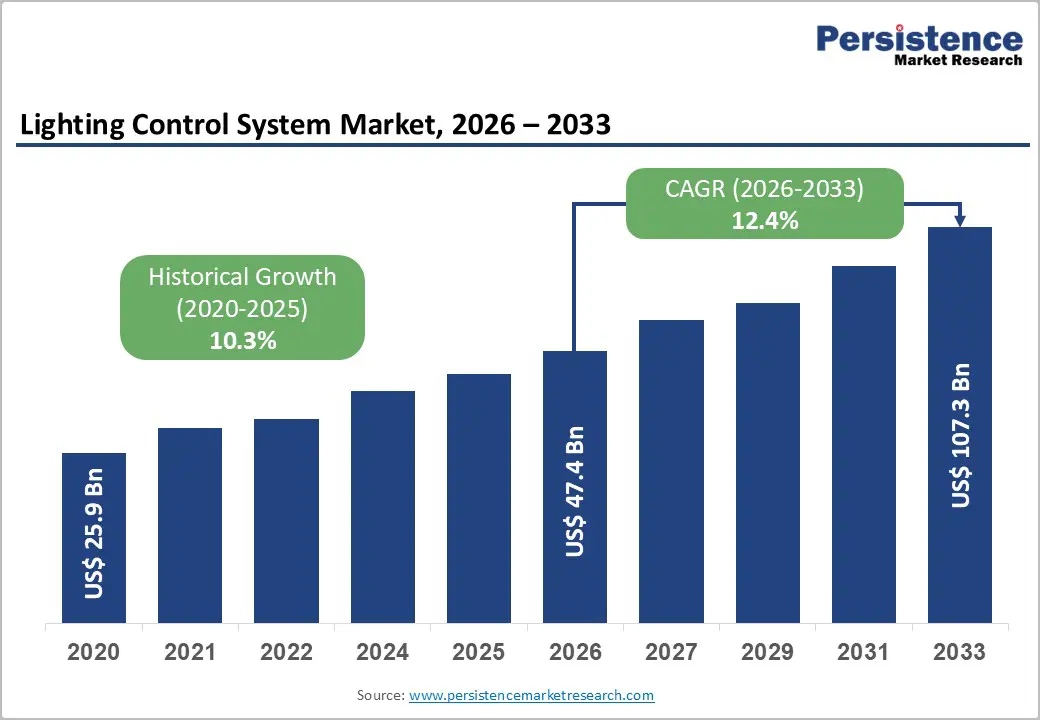
The global Lighting Control System Market size is projected to rise from US$47.4 billion in 2026 to US$107.3 billion by 2033. It is anticipated to witness a CAGR of 12.4% during the forecast period from 2026 to 2033, driven by accelerating energy efficiency mandates, proliferating smart city programs, and deep integration of Internet of Things (IoT) and Artificial Intelligence (AI) into building management infrastructure.
Governments globally are tightening building energy codes, notably ASHRAE/IES Standard 90.1-2022, which mandates occupancy sensors, daylight-responsive controls, and scheduling systems for most commercial spaces, creating a robust regulatory tailwind for market adoption.
Key Industry Highlights:
- Leading Offering: Hardware dominates with over 52% market share in 2026, valued at over US$24.7 Bn, driven by demand for reliable sensors, drivers, gateways, and control units enabling automated and energy-efficient lighting.
- Leading Technology: Wired systems hold over 60% share in 2026, valued at above US$ 28.4 Bn, due to high reliability, secure connectivity, and suitability for large-scale infrastructure projects. Wireless systems are the fastest growing, supported by demand for flexible installation, retrofit applications, IoT connectivity, and seamless integration with smart home and building ecosystems.
- Leading Installation Type: Retrofit installations account for over 58% share in 2026, valued at over US$27.5 Bn, as building owners upgrade existing infrastructure to meet energy efficiency mandates and sustainability goals.
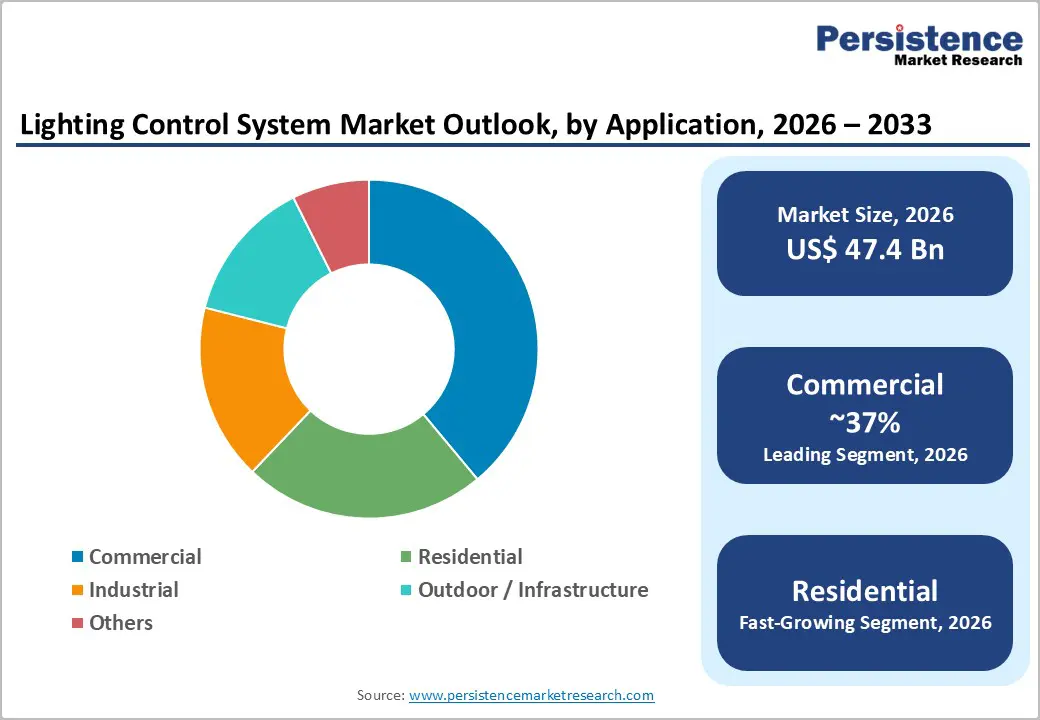
- Leading Application: Commercial leads with more than 37% share in 2026, valued above US$ 17.5 Bn, supported by strong adoption in offices, retail, hospitality, and educational buildings focused on energy savings and productivity improvement.
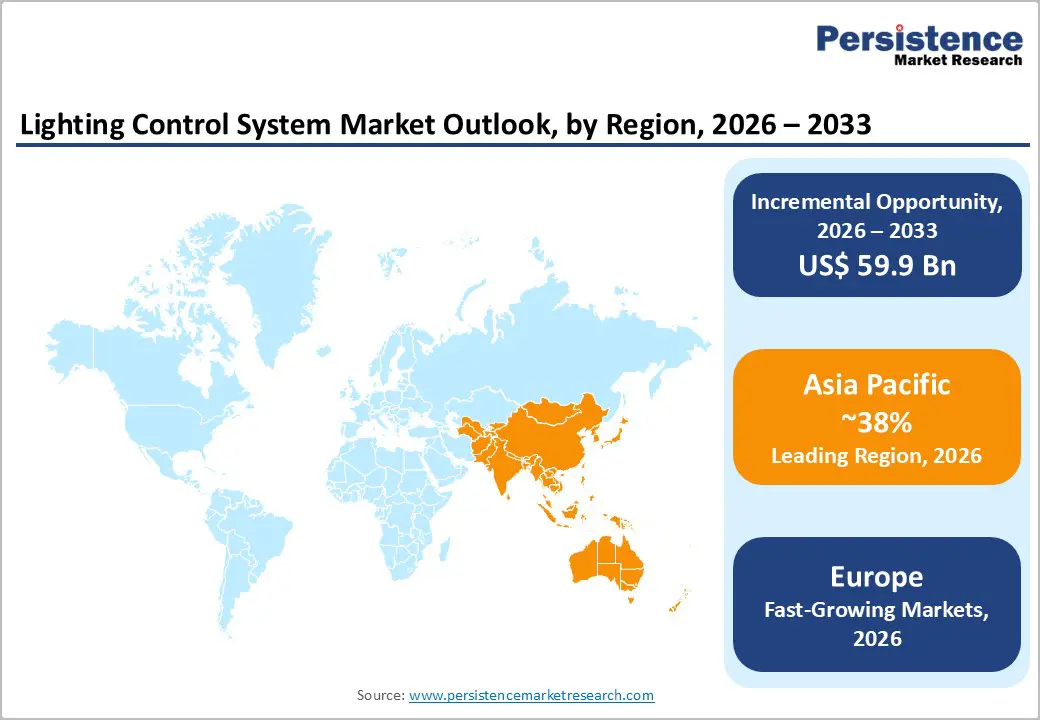
- Leading Region: Asia Pacific leads with over 38% share in 2026, valued at US$ 18.0 Bn, driven by rapid urbanization, smart city deployments, and large-scale infrastructure programs in China and India. North America leads with over 30% share, supported by strict efficiency regulations such as ASHRAE 90.1 and Title 24, while Europe remains strong with over 23% share due to stringent EU decarbonization and building efficiency mandates.
| Key Insights | Details |
|---|---|
|
Lighting Control System Market Size (2026E) |
US$47.4 Bn |
|
Market Value Forecast (2033F) |
US$107.3 Bn |
|
Projected Growth (CAGR 2026 to 2033) |
12.4% |
|
Historical Market Growth (CAGR 2020 to 2025) |
10.3% |

Market Dynamics
Driver - Rising Energy Efficiency Mandates and Green Building Codes
Governments across the globe are enacting increasingly stringent energy efficiency policies that directly stimulate demand for lighting control systems. The IEA reported that in 2025 governments representing more than 85% of global energy demand introduced new or updated efficiency policies. Regulatory frameworks such as the U.S. ASHRAE 90.1, California's Title 24, and the EU Ecodesign
Regulation mandate automatic shut-off and daylight-responsive dimming in commercial facilities, making lighting controls a compliance necessity rather than a discretionary upgrade. U.S. Department of Energy (DOE) projects that LED technology, when paired with intelligent controls, could save approximately 569 TWh annually by 2035, representing a 40% reduction in projected site electricity consumption. Such regulatory certainty gives building owners a compelling business case to invest in advanced lighting control platforms.
Rapid Expansion of Smart City Initiatives and IoT Integration
The global smart city movement is generating significant and durable demand for networked, adaptive lighting control systems, particularly in outdoor and infrastructure segments. Municipal governments are deploying connected street lighting systems equipped with occupancy sensors, remote dimming, and real-time monitoring dashboards to reduce public-sector energy costs and improve urban safety.
China alone has over 500 smart city initiatives currently underway, with smart lighting forming a core pillar of each program. The integration of IoT-enabled lighting platforms with broader Building Management Systems (BMS) and Digital Twin technologies is further expanding the addressable value of each installation, allowing predictive maintenance, occupancy analytics, and energy optimization to be delivered as subscription-based managed services, effectively broadening market revenues beyond hardware sales.
Restraint - High Initial Capital Investment and Complex Installation
A smart lighting control setup, including transmitters, occupancy sensors, LED drivers, gateways, and commissioning services, costs 2–4 times as much as conventional lighting switches and fixtures per installation. For small and medium-sized enterprises (SMEs), this initial outlay creates a significant payback-period concern even when long-term energy savings are factored in. In emerging economies where financing mechanisms remain underdeveloped, the cost barrier is compounded by low awareness of total-cost-of-ownership benefits, limiting the pace of market penetration despite supportive government policies.
Interoperability Challenges and Fragmented Protocol Ecosystem
The lighting control system market is characterized by a fragmented ecosystem of communication protocols, including DALI, Zigbee, Z-Wave, Bluetooth Mesh, KNX, and Wi-Fi, that often lack seamless interoperability. According to a study, fragmented smart-lighting protocols risk limiting the sector's benefits, as most smart systems remain tied to proprietary hubs. Although the Matter standard promises cross-brand control, full Thread 1.4 support is not expected to be ubiquitous until 2026, prolonging buyer hesitation for large, multi-vendor commercial rollouts and increasing total integration costs for facility managers.
Opportunity - Integration of Human-Centric Lighting and AI-Driven Personalization
Increasing adoption of circadian rhythm-aligned lighting in offices, healthcare, and educational facilities is enhancing occupant well-being, productivity, and comfort. AI-powered automation enables dynamic adjustment of color temperature and brightness based on time of day, occupancy patterns, and user preferences.
In March 2025, Enlighted launched Enlighted Eazy, an advanced solution that offers app-based deployment and laser-based commissioning, up to 30% faster than traditional Bluetooth methods. The rising use of voice control and adaptive scheduling is driving the adoption of premium smart lighting, creating strong opportunities for integrated hardware, software, and managed service providers.
Indoor Positioning and Occupancy Analytics as Value-Added Services
Advanced lighting control infrastructure, particularly dense networks of Bluetooth Low Energy (BLE) and Ultra-Wideband (UWB) sensors embedded in commercial ceilings, serves a dual purpose, delivering illumination control while simultaneously enabling precise indoor positioning systems (IPS) and real-time occupancy analytics. This convergence opens a high-value, differentiated service layer for vendors, where lighting networks become the data backbone for space utilization intelligence, workforce productivity monitoring, retail customer journey analysis, and healthcare patient flow optimization. For commercial real estate owners, this dual-use value proposition enhances the investment case for deploying advanced lighting control systems beyond pure energy economics.
Category-wise Analysis
Offering Insights
Hardware dominates the market, capturing more than 52% share in 2026 with a value exceeding US$ 24.7 Bn, due to ensure reliable and stable lighting performance. Hardware components form the backbone of any lighting control setup and are essential for achieving automation and energy efficiency. Demand is strongly driven by the need for precise control over lighting intensity, occupancy-based adjustments, and integration with smart building systems. Hardware solutions are also preferred due to their durability, ease of deployment in large-scale installations, and compatibility with existing electrical frameworks.
Services are expected to grow significantly as users increasingly seek consultation, system integration, maintenance, and optimization support. Modern lighting systems are becoming more complex, requiring expert design and commissioning to ensure seamless performance. End users need services for customization of lighting scenes, remote monitoring, and lifecycle management of installed systems. The shift toward smart buildings and IoT-enabled environments is increasing demand for continuous technical support and software updates.
Technology Insights
Wired holds over 60% share in 2026, with a value exceeding US$ 28.4 Bn, due to its high reliability, stable connectivity, and minimal signal interference. They are preferred in large infrastructure projects such as commercial buildings, industrial facilities, and institutional spaces where consistent performance is critical. Users value wired systems for their security, lower risk of network disruptions, and ability to support complex control architectures. These systems are also easier to manage in environments where long-term durability and predictable operation are required.
Wireless is expected to grow at the highest rate as users seek flexibility, scalability, and easier installation. They eliminate the need for extensive cabling, reducing installation time and structural modifications, which is particularly important in retrofitting older buildings. Growing adoption of smart homes, IoT ecosystems, and mobile-based control solutions is driving this shift. Users also prefer wireless systems for their ability to enable remote access, personalized lighting control, and seamless integration with other smart devices. Continuous improvements in connectivity protocols are further enhancing their reliability and appeal.
Installation Type Insights
Retrofit Installations command the largest market share at over 58% in 2026, with a value exceeding US$ 27.5 Bn, as many existing buildings are upgrading from conventional lighting to smart, energy-efficient systems. Users are motivated by the need to reduce energy consumption, improve operational efficiency, and comply with sustainability standards without rebuilding infrastructure. It allows integration of advanced lighting controls into existing electrical layouts, minimizing disruption and cost. The demand is also driven by modernization initiatives and smart city developments.
New Installations are expected to grow at a CAGR of 17.6% due to rising construction activities and the increasing adoption of smart building concepts from the design stage itself. Developers are integrating lighting control systems into new projects to ensure energy optimization, automation, and enhanced user experience from the outset. This allows seamless integration with building management systems and IoT platforms. Growing awareness about long-term cost savings and sustainability is encouraging builders to adopt advanced lighting infrastructure during initial construction rather than retrofitting later.
Application Insights
Commercial dominates the market, capturing more than 37% share in 2026 with a value exceeding US$ 17.5 Bn, as businesses focus on energy efficiency, productivity, and operational cost reduction. Offices, retail stores, hotels, and educational institutions require intelligent lighting systems that can adjust based on occupancy, daylight availability, and usage patterns. These environments benefit from centralized control, scheduling, and automation features that enhance comfort while reducing energy waste. The need for smart building compliance and green certification further strengthens adoption in commercial infrastructure.
Residential is expected to grow rapidly as homeowners increasingly adopt smart home technologies for convenience, security, and energy savings. Users are shifting toward app-based and voice-controlled lighting systems that allow personalized ambiance and remote access. Rising awareness about energy conservation and integration with home automation ecosystems is further driving demand. Modern households also prefer adaptive lighting that enhances comfort, supports wellness, and improves lifestyle efficiency, making residential adoption increasingly attractive.
Regional Insights
North America Lighting Control System Market Trends
North America holds over 30% share in 2026, reaching US$ 14.2 Bn value, primarily driven by the United States. Strong regulatory enforcement through ASHRAE 90.1, California Title 24, and IECC mandates occupancy-based controls and daylight dimming in commercial buildings, accelerating adoption. The region benefits from a mature ecosystem with key players supporting large-scale deployment. With over 6 million commercial buildings, retrofit demand remains a major growth driver. Smart city initiatives in states such as California, Texas, and New York are expanding connected streetlight deployments, while DOE-backed efficiency programs continue to support LED-to-smart-control upgrades.
Asia Pacific Lighting Control System Market Trends
Asia Pacific holds over 38% share in 2026, reaching US$ 18.0 billion value, supported by rapid urbanization and smart infrastructure expansion. China is a key contributor, implementing multiple new lighting efficiency standards that push the adoption of IoT-enabled and automated control systems in urban clusters such as Shenzhen, Shanghai, and Guangdong. These initiatives are increasingly integrating lighting controls within broader smart city master plans. India is also witnessing strong growth, with over 8,000 smart city projects under development and large-scale investment programs such as the Bright Road initiative, which supports LED modernization integrated with smart controls across 186 cities. Japan and ASEAN nations are expanding building automation systems as part of energy transition strategies.
Europe Lighting Control System Market Trends
Europe is expected to hold more than 23% share by 2026, driven by stringent energy efficiency regulations. The EU Ecodesign Regulation and Energy Performance of Buildings Directive (EPBD) are pushing building owners toward intelligent lighting controls as part of deep energy retrofit strategies aligned with long-term decarbonization goals.
Germany leads adoption, supported by subsidy programs such as KfW energy-efficiency financing, which encourage upgrades like Zigbee-based lighting control systems. The United Kingdom is also tightening efficiency norms, targeting ultra-high-efficiency thresholds for lighting systems, further promoting the integration of smart controls. Companies are deploying advanced lighting control solutions in stadiums and large infrastructure projects, showcasing expanding application scope beyond traditional commercial buildings.
Competitive Landscape
The global lighting control system market is moderately consolidated, with the top players collectively holding over 40% of the global market share. Signify, Acuity Brands, and Lutron Electronics maintain leadership by offering integrated capabilities across driver technology, fixture brands, and cloud platforms. Key differentiators include proprietary sensor integration, AI-based energy analytics, and the ability to deliver end-to-end solutions spanning hardware, software, and managed services.
Emerging business models center on subscription-based Lighting-as-a-Service (LaaS) contracts and performance-based utility incentive programs. Significant R&D investments are ongoing to focus on AI-driven adaptive lighting, human-centric illumination, and multi-protocol interoperability platforms.
Key Developments:
- In February 2026, Lutron Electronics, at ISE 2026, showcased its expanded intelligent lighting portfolio, highlighting a shift toward fully integrated, human-centric smart lighting systems. The announcement combined its Ketra and Orluna product lines under a unified ecosystem designed for seamless control and design flexibility.
- In February 2026, ABB launched its new System Access Point 3.0 Wireless under the ABB-free@home ecosystem, expanding its smart home control capabilities with improved scalability, secure remote access, and support for larger installations. The solution is designed for both retrofit and new homes, enabling seamless wireless control of lighting, HVAC, shading, and other devices through a unified smart home platform.
Companies Covered in Lighting Control System Market
- Signify Holding
- Acuity Brands, Inc.
- Legrand S.A.
- Schneider Electric SE
- Lutron Electronics Co., Inc.
- Eaton Corporation plc
- Honeywell International Inc.
- Siemens AG
- ABB Ltd.
- ams-OSRAM AG
- Zumtobel Group AG
- Hubbell Incorporated
- Leviton Manufacturing Co., Inc.
- Cree Lighting USA LLC
- Others
Frequently Asked Questions
The global market is projected to be valued at US$47.4 Bn in 2026.
Rising demand for energy-efficient buildings and smart infrastructure is driving the adoption of lighting control systems to reduce power consumption and operating costs.
The market is expected to witness a CAGR of 12.4% from 2026 to 2033.
Expansion of human-centric and AI-driven lighting solutions in commercial and healthcare spaces is creating strong growth opportunities.
Signify Holding, Acuity Brands, Inc., Legrand S.A., Schneider Electric SE, Lutron Electronics Co., Inc., Eaton Corporation plc, Honeywell International Inc., Siemens AG, and ABB Ltd. are among the leading key players.


