




- Processed Food
- Functional Mushroom Market
Functional Mushroom Market Size, Share, and Growth Forecast 2026 - 2033
Functional Mushroom Market by Product (Reishi, Cordyceps, Lion's Mane, Turkey Tail, Shiitake, Chaga, Others), Application (Food and Beverage, Dietary Supplements, Pharmaceutical, Others), and Regional Analysis, 2026 - 2033

Functional Mushroom Market Size and Trend Analysis
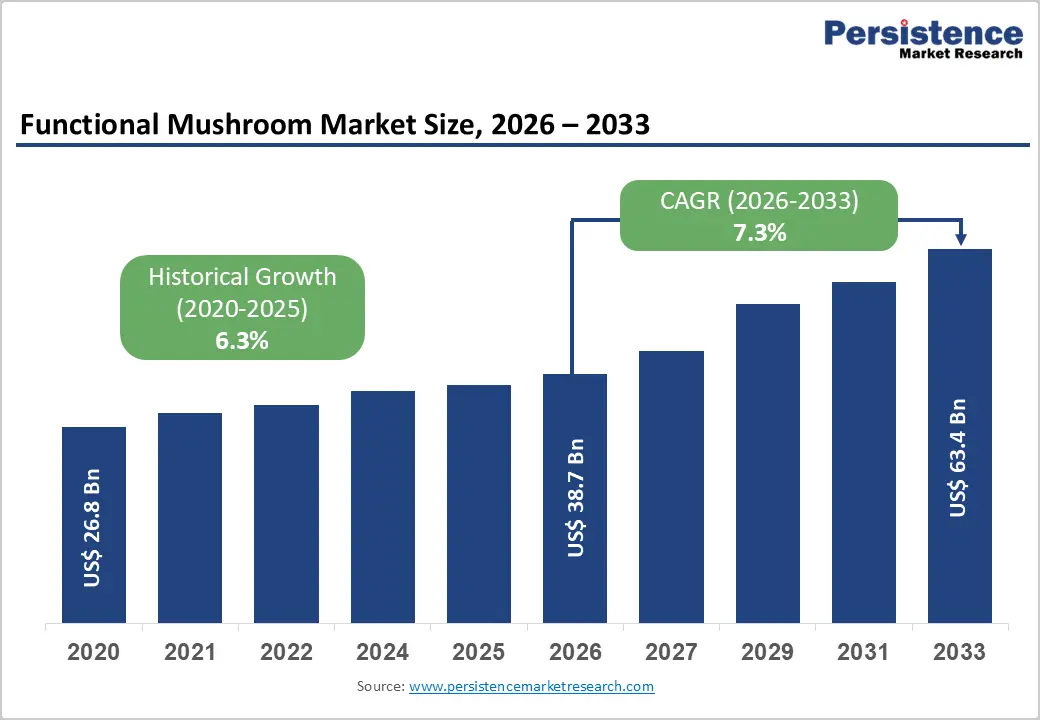
The global functional mushroom market size is expected to be valued at US$ 38.7 billion in 2026 and projected to reach US$ 63.4 billion by 2033, growing at a CAGR of 7.3% between 2026 and 2033. It is experiencing sustained expansion driven by rising consumer demand for natural, adaptogenic health solutions and a growing body of peer-reviewed clinical evidence supporting the immunomodulatory, neuroprotective, and anti-inflammatory properties of medicinal mushroom species.
The rise in health consciousness globally, particularly among millennials and Gen Z consumers is accelerating the integration of functional mushrooms into dietary supplements, fortified foods, and nutraceutical formulations. According to the National Institutes of Health (NIH), consumer interest in complementary and integrative health approaches has grown substantially, with preference on using dietary supplements.
Key Industry Highlights:
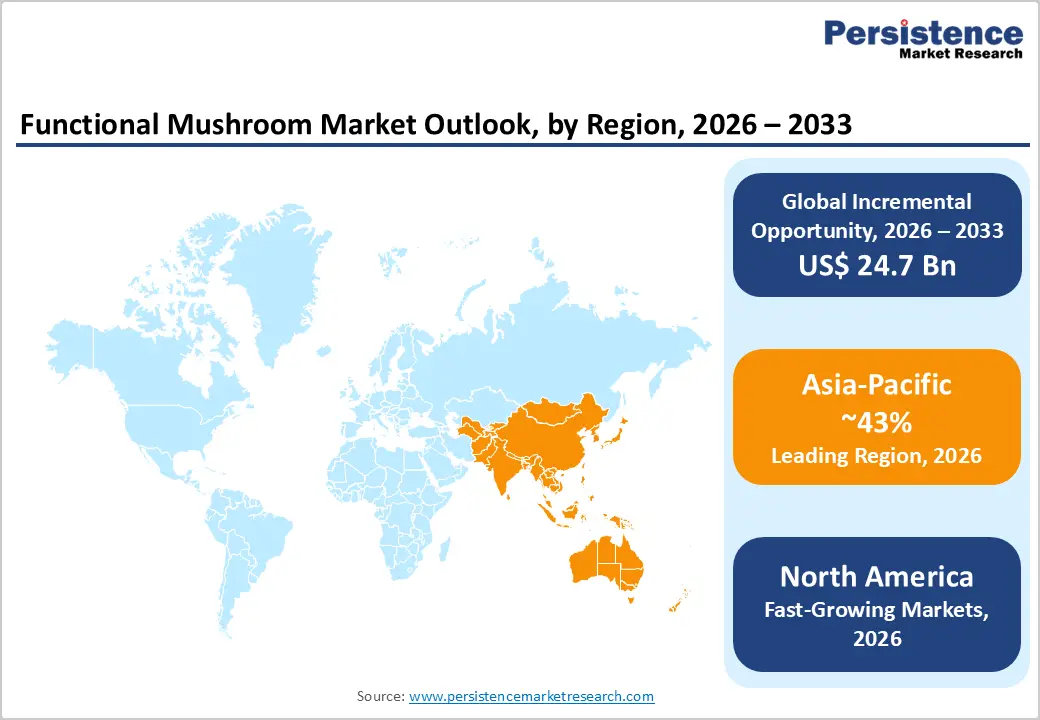
- Leading Region: Asia Pacific leads the global functional mushroom market with approximately 43% share in 2025, anchored by China's dominance as the world's largest mushroom producer accounting for over 85% of global cultivation output per FAO data.
- Fastest Growing Region: North America is the fastest-growing functional mushroom market, driven by surging mainstream consumer adoption of mushroom coffee, Lion's Mane cognitive supplements, and Cordyceps sports nutrition products across major retail and e-commerce channels.
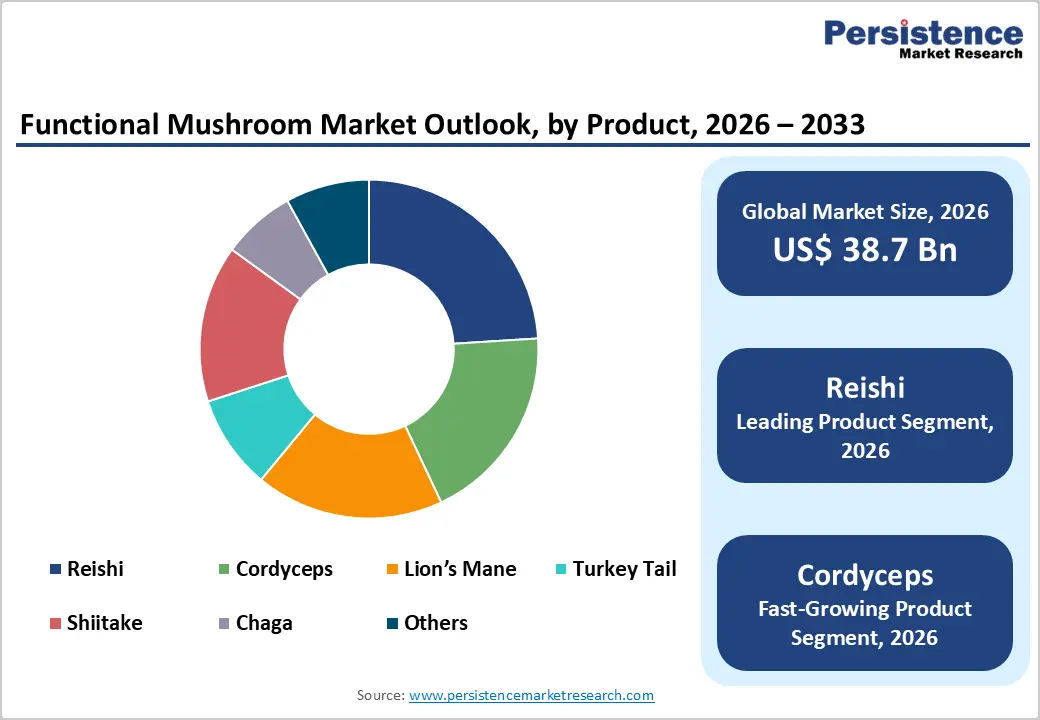
- Dominant Segment: Reishi holds the leading product segment position with approximately 24% market share in 2025, supported by extensive TCM heritage, broad FDA-recognized safety documentation, and versatile applications across supplements, beverages, and cosmeceuticals.
- Fastest Growing Segment: Cordyceps is the fastest-growing product segment, fueled by scientific evidence supporting VO2 max improvement and ATP production, and accelerating integration into the booming global sports nutrition and active lifestyle supplement market.
- Key Opportunity: Pharmaceutical-grade mushroom bioactive development particularly Turkey Tail PSK and Lion's Mane hericenones for oncology and neurodegenerative disease applications presents the highest long-term value opportunity with significant pricing power and regulatory protection.
Market Dynamics
Drivers - Surging Consumer Demand for Adaptogenic and Immune-Supportive Natural Products
Growing awareness of the health benefits of functional mushrooms particularly their adaptogenic, immunomodulatory, and cognitive-enhancing properties is a primary driver of market growth. Scientific studies published in peer-reviewed journals including Frontiers in Pharmacology and the Journal of Ethnopharmacology have documented the beta-glucan and polysaccharide content of species such as Reishi (Ganoderma lucidum) and Turkey Tail (Trametes versicolor), linking them to enhanced NK cell activity and immune regulation.
The Council for Responsible Nutrition (CRN) reported that 74% of U.S. adults consumed dietary supplements in 2023, with immune health and brain health among the top-cited motivations directly fueling demand for Reishi, Lion's Mane, and Cordyceps-based supplement formulations across retail and direct-to-consumer channels.
Restraints - Limited Standardization of Extraction Methods and Product Quality Inconsistencies
A significant challenge restraining the functional mushroom market is the lack of industry-wide standardization for extraction processes and bioactive compound verification. The concentration of active compounds such as beta-glucans and triterpenes varies substantially across cultivation methods, extraction techniques, and raw material sources.
The U.S. Food and Drug Administration (FDA) classifies most mushroom supplements under dietary supplements, which do not require pre-market approval, enabling inconsistent product quality in the marketplace. Third-party testing coverage remains incomplete across many brands, creating consumer trust challenges and contributing to product mislabeling incidents particularly regarding mycelium-on-grain versus fruiting body content that undermine credibility and consumer confidence.
Opportunities - Rising Demand for Cordyceps-Powered Sports Nutrition and Performance Supplements
Cordyceps, the fastest-growing functional mushroom segment, presents a compelling market opportunity driven by the booming global sports nutrition industry and growing scientific interest in its performance-enhancing properties. Research published in the Journal of Dietary Supplements demonstrated that Cordyceps militaris supplementation improved oxygen utilization (VO2 max) in healthy older adults, supporting its positioning as a natural ergogenic aid. Companies developing clinically validated, standardized Cordyceps extracts with documented beta-glucan and cordycepin content can command premium pricing and gain competitive differentiation in the high-growth sports performance and active lifestyle nutrition segments.
Category-wise Analysis
Product Insights
Reishi (Ganoderma lucidum) leads the functional mushroom market by product, commanding approximately 24% of total market share in 2025. Its dominant position stems from a centuries-long history of use in Traditional Chinese Medicine (TCM) and an extensive body of modern scientific literature documenting its immunomodulatory, anti-inflammatory, and hepatoprotective properties. Reishi's versatility across supplement capsules, powders, tinctures, and functional beverages supports broad commercial applicability.
The American Herbal Products Association (AHPA) recognizes Reishi as a well-established botanical ingredient with strong safety and efficacy documentation. Consumer trust in Reishi is reinforced by its classification as a Generally Recognized As Safe (GRAS) ingredient by the FDA for specified applications, further supporting product development across food, supplement, and cosmeceutical categories.
Application Analysis
The dietary supplements segment leads the functional mushroom market by application, accounting for approximately 45% share in 2025. This dominance reflects the established consumer habit of purchasing mushroom extracts in capsule, powder, and tincture formats through health food retailers, pharmacies, and e-commerce platforms. The Council for Responsible Nutrition (CRN) 2023 Consumer Survey confirmed dietary supplements remain a mainstream health investment for U.S. adults, with mushroom supplements gaining particular traction among immunity and cognitive health seekers.
Growing online retail penetration accelerated by direct-to-consumer brands such as Real Mushrooms and Host Defense (Fungi Perfecti)continues to expand the dietary supplement segment's reach and accessibility globally.
Regional Insights
Asia Pacific Functional Mushroom Market Trends and Insights
Asia Pacific dominates the functional mushroom market due to large-scale production, strong traditional medicine systems, and high domestic consumption. The region contributes nearly half of global demand in nutraceutical mushrooms, supported by FAO data showing China produces 70-75% of global cultivated mushrooms.
China is the leading country and is expected to reach US$ 21 billion contribution within the US$ 38.7 billion due to industrial cultivation, exports, and TCM integration. India is the fastest-growing country, expected to grow at 11% CAGR, driven by Ayurveda-based wellness adoption and government-supported mushroom farming programs. Japan and South Korea also contribute through high-value functional food innovation, particularly Lion’s Mane and Shiitake-based products in aging population nutrition systems.
China Functional Mushroom Market Trends and Insights
China is the dominant global hub for functional mushrooms, supported by FAO agricultural data showing it produces 75% of global mushrooms. It has advanced cultivation infrastructure across provinces like Fujian and Yunnan. Mushrooms such as Reishi, Cordyceps, and Shiitake are widely integrated into Traditional Chinese Medicine and food systems. Strong export demand for extracts and powders supports large-scale industrial output, making China the backbone of global functional mushroom supply chains.
India Functional Mushroom Market Trends and Insights
India is the fastest-growing market due to rising health awareness and Ayurveda-driven nutraceutical adoption. Government schemes under the National Horticulture Mission and agricultural diversification programs are promoting mushroom cultivation among farmers. Urban demand for immunity-boosting supplements and functional beverages is rising rapidly. India’s functional mushroom segment is expected to grow at 10-11% CAGR, driven by preventive healthcare trends, e-commerce supplement penetration, and increasing acceptance of Lion’s Mane and Reishi-based products.
Europe Functional Mushroom Market Trends and Insights
Europe is an important region due to the strong demand for organic, plant-based, and clean-label nutraceuticals. It accounts for 24% of global demand within the US$ 38.7 Bn (2026) market, driven by strict EFSA regulations and high supplement consumption. Germany is the leading country and is expected to reach US$ 7-8 Bn market contribution, supported by high per-capita dietary supplement usage and aging population health needs.
Poland is the fastest-growing country, expected to grow at 11% CAGR, driven by mushroom cultivation expansion and export supply to Western Europe. France and the UK also contribute significantly due to rising vegan and immunity-focused dietary trends, increasing adoption of Reishi and Lion’s Mane supplements.
Germany Functional Mushroom Market Trends and Insights
Germany leads Europe due to strong consumer preference for natural health products and high supplement penetration. The Federal Institute of Risk Assessment (BfR) ensures strict product safety, boosting consumer trust. Germany has one of the highest per-capita dietary supplement consumptions in Europe. Functional mushrooms like Reishi and Lion’s Mane are widely used for immunity and cognitive health, supported by a strong retail pharmacy and nutraceutical distribution ecosystem.
Poland Functional Mushroom Market Trends and Insights
Poland is the fastest-growing European market due to expanding mushroom farming infrastructure and strong export orientation. It supplies dried mushrooms and extracts across EU countries. Lower production costs and favorable climate conditions support large-scale cultivation. Rising domestic demand for immunity supplements and herbal nutraceuticals is increasing adoption. Poland is becoming a key sourcing hub for Reishi and Shiitake extracts in Europe’s functional food supply chain.
North America Functional Mushroom Market Trends and Insights
North America is the fastest-growing region in the functional mushroom market due to strong demand for nootropics, sports nutrition, and functional beverages. It holds around 30-35% share of the US$ 38.7 Bn (2026) market, with rapid expansion in dietary supplements. The United States is the leading country and is expected to contribute US$ 11-12 Bn market size, driven by high supplement consumption and innovation in mushroom coffee and energy drinks.
Canada is the fastest-growing country, expected to grow at 10% CAGR, supported by Natural Health Product (NHP) regulations and rising plant-based wellness adoption. USDA reports show U.S. supplement spending exceeding US$ 45-50 Bn annually, supporting strong functional mushroom penetration.
U.S. Functional Mushroom Market Trends and Insights
The United States dominates due to high consumer spending on dietary supplements and strong wellness culture. Functional mushrooms are widely used in coffee blends, energy drinks, gummies, and capsules. Lion’s Mane is widely adopted for cognitive enhancement, while Cordyceps supports sports performance. The FDA’s DSHEA framework allows structure-function claims, enabling rapid commercialization. Strong e-commerce penetration through Amazon and D2C brands accelerates adoption of functional mushroom products.
Canada Functional Mushroom Market Trends and Insights
Canada is the fastest-growing market due to strong demand for Natural Health Products regulated under Health Canada’s NHP framework. Consumers are increasingly shifting toward plant-based immunity and stress-relief supplements. Functional beverages and mushroom-infused wellness drinks are expanding in urban markets. Rising awareness of cognitive health and preventive nutrition is driving adoption of Lion’s Mane and Reishi products. Strong regulatory clarity supports innovation and market expansion.
Competitive Landscape
The global functional mushroom market is highly fragmented, with a mix of large traditional Asian mushroom cultivation companies, specialty extract manufacturers, and Western health and wellness brands competing across multiple application segments. Key differentiators include certified organic cultivation, dual-extraction techniques ensuring both water-soluble and alcohol-soluble bioactives, and third-party beta-glucan verification.
Leading extract suppliers such as Nammex and Real Mushrooms have built competitive positions on transparency and fruiting-body-only sourcing claims. Emerging business model trends include subscription-based DTC supplement services, functional beverage co-branding, and white-label extract supply to nutraceutical companies globally.
Key Developments:
- April 2026: M2 Ingredients had partnered with Anchor Ingredients Co. LLC to expand the use of functional mushroom ingredients in the pet nutrition sector, marking a strategic move into the rapidly growing animal wellness category.
- May 2025: M2 Ingredients had launched its first American-made functional mushroom extracts to meet the rapidly growing demand for clean, traceable, and domestically sourced ingredients in the nutraceutical market. The company introduced a new line of mushroom extracts produced entirely in the United States, addressing supply chain disruptions, import tariffs, and quality concerns linked to overseas sourcing, particularly from Asia.
Functional Mushroom Market - Key Insights
| Key Insights | Details |
|---|---|
| Historical Market Value (2020) | US$ 26.8 Billion |
| Projected Market Value (2026) | US$ 38.7 Billion |
| Projected Market Value (2033) | US$ 63.4 Billion |
| CAGR (2026 - 2033) | 7.3% |
| Leading Region | Asia-Pacific, 43% share |
| Dominant Product | Reishi, 24% share |
| Top-ranking Application | Dietary Supplements, 49% share |
| Incremental Opportunity | US$ 24.7 billion |
Companies Covered in Functional Mushroom Market
- Mitoku Company
- Lianfeng (Suizhou) Food Co. Ltd.
- M2 Ingredients
- Nammex
- Hokkaido Reishi Co. Ltd
- Sotru
- Rebbl
- Real Mushrooms
- SWADESHI Mushroom Spawn Laboratory
- Concord Farms
- Others
Frequently Asked Questions
The global functional mushroom market is estimated to be valued at US$ 38.7 billion in 2026.
Rising immunity awareness, wellness trends, nootropics demand, plant-based diets, sports nutrition, and preventive healthcare adoption.
Asia Pacific is the leading region with approximately 43% of total market share in 2025. China dominates as the world's largest mushroom producer, contributing over 85% of global cultivation output according to the Food and Agriculture Organization (FAO).
Expansion in functional beverages, personalized nutrition, nutraceuticals, and science-backed pharmaceutical-grade mushroom extracts globally.
Mitoku Company, Lianfeng (Suizhou) Food Co. Ltd., M2 Ingredients, Nammex, Hokkaido Reishi Co. Ltd, Sotru.


