




- Food Ingredients & Additives
- Food Bleaching Agents Market
Food Bleaching Agents Market Size, Share, and Growth Forecast 2026 - 2033
Food Bleaching Agents Market by Product Type (Azodicarbonamide, Hydrogen Peroxide, Ascorbic Acid, Chlorine Dioxide, Others), Form (Liquid, Powder), Application (Bakery Products, Flour, Cheese, Others), by Regional Analysis, 2026 - 2033

Food Bleaching Agents Market Size and Trend Analysis
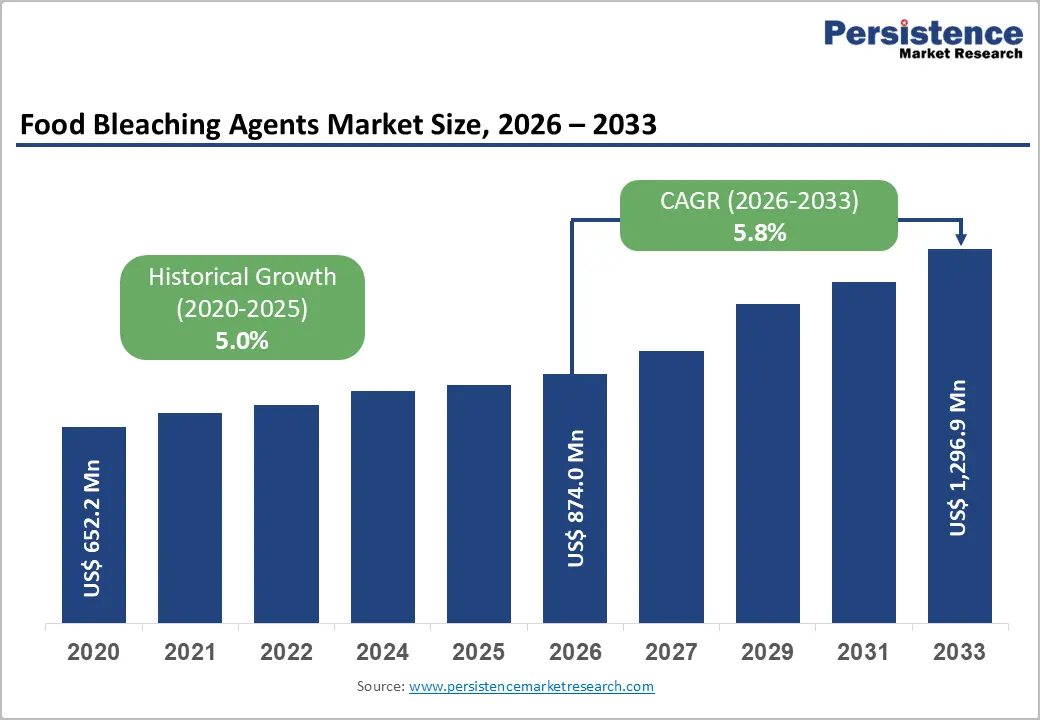
The global food bleaching agents market size is expected to be valued at US$ 874.0 million in 2026 and projected to reach US$ 1,296.9 million by 2033, growing at a CAGR of 5.8% between 2026 and 2033. It is advancing due to the rise in global demand for visually appealing, standardized, and high-quality processed food products, particularly in the bakery, flour milling, and dairy sectors, where bleaching is an essential quality optimization step.
The U.S. Food and Drug Administration (FDA) and European Food Safety Authority (EFSA) maintain approved ingredient frameworks for food-grade bleaching agents, providing regulatory clarity that underpins commercial-scale industrial adoption. Simultaneously, accelerating urbanization and rising packaged food consumption across the Asia Pacific and Latin America, where flour-based processed food categories are growing rapidly, are creating structurally expanding demand bases for bleaching agent manufacturers beyond mature North American and European markets.
Key Market Highlights
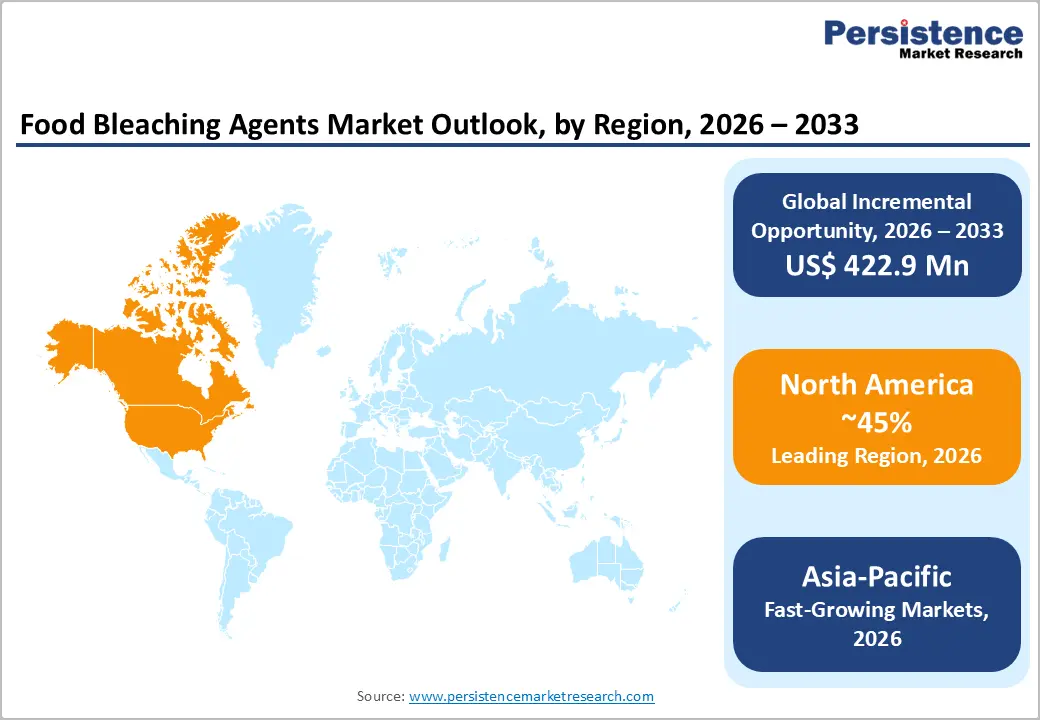
- Leading Region: North America holds approximately 45% of the global food bleaching agents market share in 2025, driven by the U.S.'s large-scale commercial flour milling processing over 20 million metric tons annually, FDA approval frameworks, and dominant bakery industry demand.
- Fast-Growing Region: Asia Pacific is the fastest-growing region through 2033, driven by China's commercial baking industry expanding at over 7% annually, India's massive flour milling base, and rapid food processing modernization across Southeast Asian markets.
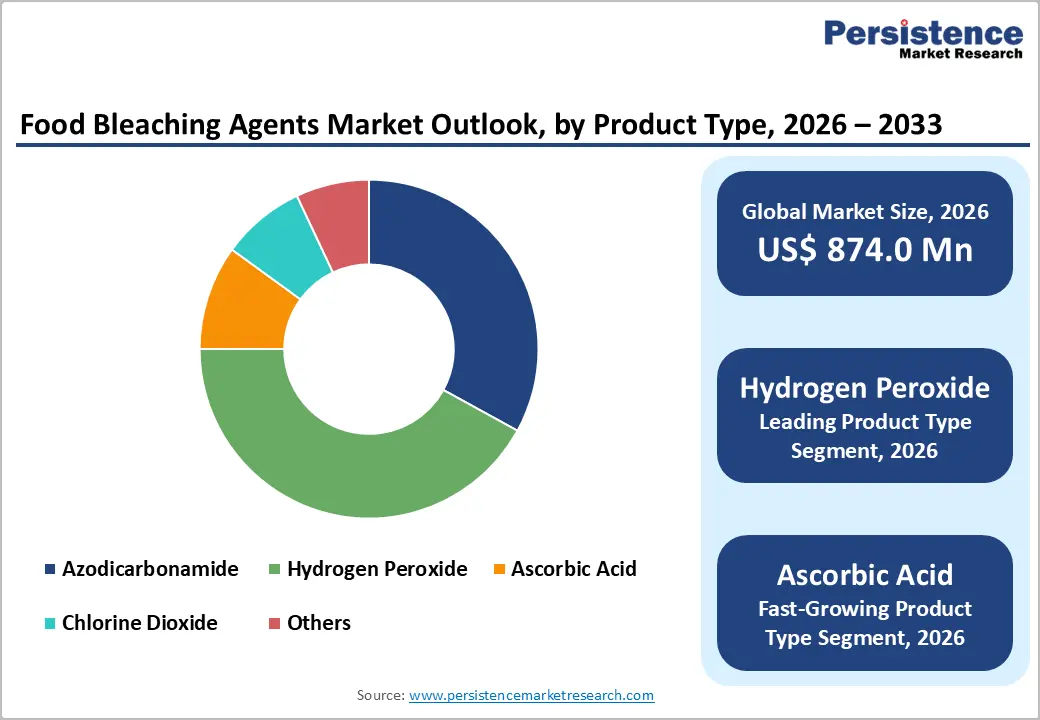
- Dominant Product Segment: Hydrogen Peroxide commands approximately 42% of global product type share in 2025, benefiting from broad-spectrum utility in flour bleaching, dairy sterilization, and food packaging applications with zero harmful residue, producing only water and oxygen on decomposition.
- Fastest-Growing Product Segment: Ascorbic Acid is the fastest-growing product type, driven by EU/FDA regulatory acceptance as E300/GRAS, clean-label consumer positioning as a natural vitamin ingredient, and growing adoption as a direct replacement for azodicarbonamide in European and premium North American bakery markets.
- Opportunity: BASF SE, Evonik Industries AG, and regional suppliers investing in ascorbic acid-based clean-label flour treatment solutions stand to capture accelerating reformulation demand globally as bakery manufacturers phase out conventional synthetic bleaching agents in response to retailer clean-label requirements.
Market Dynamics
Drivers - Expanding Global Bakery and Flour Milling Industry Driving Bleaching Agent Consumption
The global bakery industry's sustained growth is the primary structural demand driver for food bleaching agents, particularly hydrogen peroxide and azodicarbonamide used in flour treatment and bread improver formulations. According to the American Bakers Association (ABA), the U.S. commercial baking industry generates over US$50 million in annual sales, with flour bleaching and maturing agents constituting critical processing inputs for standardized bread crumb color and dough rheology.
The International Association of Plant Bakers (AIBI) reports consistent global growth in bakery production volumes of approximately 3–4% annually in emerging markets, driven by urbanization and rising disposable incomes. Industrial flour mills, which process hundreds of thousands of metric tons of wheat annually, rely on bleaching agents to standardize flour whiteness, improve protein functionality, and meet commercial bakers' quality consistency specifications at scale.
Restraints - Regulatory Restrictions on Azodicarbonamide and Certain Bleaching Agents in Key Markets
Azodicarbonamide (ADA), one of the most widely used dough conditioners and flour bleaching agents in North America, faces outright prohibition in the European Union and Australia under their respective food safety regulatory frameworks, creating geographic market access constraints for manufacturers whose product portfolios depend on this ingredient. The European Food Safety Authority (EFSA)'s precautionary stance on certain food processing aids has also increased compliance scrutiny for market participants, raising reformulation costs and limiting market expansion opportunities in regulatory-stringent markets.
Opportunities - Ascorbic Acid: Fastest-Growing Bleaching Agent Aligning with Clean-Label and Regulatory Trends
Ascorbic acid (vitamin C) is the fastest-growing product type within the food bleaching agents market, positioned at the ideal convergence of regulatory compliance, clean-label consumer acceptance, and functional efficacy in dough conditioning and flour maturing applications. Unlike azodicarbonamide, which is prohibited in the EU and Australia, ascorbic acid is approved as a food additive (E300) under EU Regulation (EC) No 1333/2008 and carries GRAS (Generally Recognized as Safe) status with the U.S. FDA.
It is marketed simultaneously as a natural vitamin ingredient to clean-label-focused consumers, enabling manufacturers to maintain bleaching and dough-conditioning functionality while meeting the clean-label requirements of premium retail channels. Suppliers, including BASF SE and Evonik Industries AG, are well positioned to capture growing demand for ascorbic acid from global flour millers and bakery manufacturers.
Category-wise Analysis
Product Type Insights
Hydrogen Peroxide leads the food bleaching agents market by product type with approximately 42% of global market share in 2025, driven by its broad-spectrum utility across flour bleaching, cheese manufacturing, dairy equipment sanitization, and food packaging sterilization applications. Food-grade hydrogen peroxide meeting FDA 21 CFR Part 184.1366 and EU food additive authorization (E 928) standards is unique in producing only water and oxygen as reaction by-products, making it the functionally preferred bleaching agent in dairy and aseptic food processing where residue-free processing is mandatory. Major producers, including Solvay, Evonik Industries AG, Nouryon, and Kemira Oyj, maintain significant hydrogen peroxide food-grade production capacity. Ascorbic Acid is the fastest-growing segment, benefiting from clean-label positioning and global regulatory acceptance.
Form Insights
Liquid form bleaching agents lead the food bleaching agents market by form with approximately 61% of global market share in 2025, reflecting the operational preferences of large-scale industrial flour mills and commercial food processors for hydrogen peroxide and chlorine dioxide in liquid concentration forms that enable precise dosing, continuous-flow processing integration, and consistent bleaching uniformity at high throughput. Liquid bleaching agents, particularly 35–50% food-grade hydrogen peroxide solutions, are stored in dedicated bulk-handling systems at major flour milling operations, enabling cost-efficient large-volume procurement. Powder form is the fastest-growing segment, driven by the growing adoption of powdered ascorbic acid and azodicarbonamide in premixed bakery improver and flour treatment blends that simplify handling, measurement, and shelf-life management for smaller commercial bakeries and specialty food manufacturers globally.
Regional Insights
North America Food Bleaching Agents Market Trends and Insights
North America dominates due to its highly industrialized food processing sector, strong regulatory enforcement, and large-scale bakery production systems. The region benefits from advanced milling infrastructure and widespread adoption of food-grade oxidizing agents. High consumption of packaged and ready-to-eat foods further supports demand. Strict compliance standards from regulatory bodies ensure consistent use of approved bleaching agents, particularly in flour and edible oil processing. Additionally, strong agricultural output and supply chain efficiency make North America a mature and stable market.
U.S. Food Bleaching Agents Market
The U.S. leads due to its large-scale food processing and flour milling industry, supported by wheat production exceeding 44 million metric tons annually (USDA). The country’s market is expected to reach ~US$ 260 Mn by 2033, driven by high consumption of packaged bakery goods and processed foods. Regulatory oversight by the FDA ensures consistent use of approved bleaching agents. Industrial baking, ready-to-eat meals, and strong retail penetration continue to sustain steady demand across applications.
Canada Food Bleaching Agents Market
Canada is expected to grow at ~6.8% CAGR, supported by expansion in food processing and rising demand for premium bakery products. The food manufacturing sector contributes over CAD 150 Bn annually to the economy (Government of Canada). The growing preference for clean-label ingredients is driving the adoption of safer bleaching agents, such as ascorbic acid. Growth in packaged foods and alignment with U.S. food standards further accelerate market expansion.
Europe Food Bleaching Agents Market Trends and Insights
Europe is a key region due to its strong bakery culture, regulatory-driven innovation, and high per capita consumption of bread and processed foods. The region emphasizes safety and compliance, leading to increased use of approved and alternative bleaching agents. Advanced food processing technologies and export-oriented production further support steady demand. While regulations limit certain chemicals, they also encourage innovation in safer and functional bleaching solutions.
Germany Food Bleaching Agents Market Insights
Germany leads with a well-established bakery sector, having over 10,000 bakeries and high per capita bread consumption (~80 kg annually). The market is expected to reach ~US$ 80 Mn by 2033, supported by strong domestic demand and exports. Although regulations restrict some bleaching agents, demand remains stable due to industrial baking and adoption of compliant alternatives like ascorbic acid. Advanced processing infrastructure supports consistent usage.
United Kingdom Food Bleaching Agents Market Insights
The UK is projected to achieve a ~6% CAGR, driven by rising demand for convenience foods and packaged bakery products. The food and drink sector contributes over £120 Bn annually (UK Government). Growth in ready meals, private-label brands, and evolving consumer preferences is boosting demand for food-grade bleaching agents. Clean-label trends are also encouraging the shift toward safer alternatives.
Asia Pacific Food Bleaching Agents Market Trends and Insights
Asia Pacific is the fastest-growing region due to rapid urbanization, population growth, and increasing processed food consumption. Expanding middle-class populations and changing dietary habits are driving demand for bakery and packaged foods. Industrialization of food processing and investments in manufacturing infrastructure further support growth. The region offers strong volume expansion potential, given still-developing consumption levels compared to Western markets.
China Food Bleaching Agents Market
China leads due to its massive food processing sector and wheat production exceeding 135 million metric tons annually (National Bureau of Statistics). The market is expected to reach ~US$ 200 Mn by 2033, driven by rising demand for refined flour and packaged foods. Industrial-scale production and government-supported manufacturing expansion continue to boost demand for bleaching agents.
India Food Bleaching Agents Market
India is expected to grow at ~8% CAGR, supported by rapid urbanization and rising demand for processed foods. The food processing sector is valued at over US$ 400 Bn (Ministry of Food Processing Industries). Low per capita consumption of packaged foods provides strong growth headroom. Expansion of organized retail and bakery chains is significantly increasing demand for bleaching agents.
Competitive Landscape
The global food bleaching agents market is moderately consolidated, with specialty chemical majors BASF SE, Solvay, Evonik Industries AG, Nouryon, and Kemira Oyj dominating hydrogen peroxide production for food-grade applications, while food ingredient specialists like Engrain and Arkema S.A. compete on formulated bleaching and flour treatment solutions. Key competitive differentiators include food-grade certification depth (FDA GRAS, EU E-number authorizations), technical application support for flour millers and bakeries, and supply chain reliability. Clean-label ingredient innovation, particularly in ascorbic acid-based dough improvers, is emerging as the dominant R&D investment theme.
Key Developments:
- March, 2026: Silox completed the acquisition of selected hydrosulfite-related assets from BASF SE, strengthening its position in the sulfur-based chemicals segment. The deal included specific production capabilities, technology, and customer contracts associated with hydrosulfite products, which are widely used as reducing and bleaching agents in industries such as textiles and pulp processing.
- January, 2025: Evonik Industries AG and Fuhua Tongda Chemicals Company established a joint venture to produce hydrogen peroxide for specialty applications in China. The partnership aimed to strengthen Evonik’s presence in the rapidly growing Asia-Pacific market while leveraging Fuhua’s local manufacturing capabilities and infrastructure.
Global Food Bleaching Agents Market - Key Insights & Details
| Key Insights | Details |
|---|---|
|
Historical Market Value (2020) |
US$ 652.2 Million |
|
Projected Market Value (2026) |
US$ 874.0 Million |
|
Projected Market Value (2033) |
US$ 1,296.9 Million |
|
CAGR (2026-2033) |
5.8% |
|
Leading Region |
North America, 45% share |
|
Dominant Product |
Hydrogen Peroxide, 42% share |
|
Top-ranking Form |
Liquid, 56% share |
|
Incremental Opportunity |
US$ 874.0 Million |
Companies Covered in Food Bleaching Agents Market
- BASF SE
- Evonik Industries AG
- Aditya Birla Chemicals
- Solvay
- Spectrum Chemical Manufacturing Corp.
- AkzoNobel
- Engrain
- Nouryon
- Arkema S.A.
- Brenntag SE
- Mitsubishi Gas Chemical Company, Inc.
- Kemira Oyj
- Hawkins, Inc.
- Nelson-Jameson, Inc.
- Others
Frequently Asked Questions
The global Food Bleaching Agents market is valued at US$ 874.0 million in 2026.
Shelf life extension, flour whitening, food safety standards, processed food demand, bakery industry growth, and cost efficiency.
North America leads the global Food Bleaching Agents market with approximately 45% of global market share in 2025.
Clean-label innovations, emerging markets expansion, bakery sector growth, natural bleaching agents development, regulatory compliance advancements.
BASF SE, Evonik Industries AG, Aditya Birla Chemicals, Solvay, Spectrum Chemical Manufacturing Corp., AkzoNobel.


